International trade in natural stone is far more complex than simply shipping slabs from one country to another. For importers, distributors, contractors, architects, and procurement managers, one of the most critical yet overlooked areas is proper customs classification. Incorrect tariff coding can trigger customs delays, unexpected duties, shipment holds, penalties, or even retroactive compliance audits.
In the global stone industry, marble slabs may fall under different Harmonized System (HS) or HSN classifications depending on how the material has been processed. A rough-cut block, a gang-sawn slab, and a fully polished marble panel may all be treated differently by customs authorities.
For companies importing luxury stone materials into Canada, the United States, Europe, Australia, or the Middle East, understanding HS classification logic is essential for reducing trade risk and maintaining supply chain efficiency.
This guide explains how marble slabs are generally classified, why processing levels affect tariff treatment, what import documents are required, and how buyers can reduce customs compliance risk when sourcing marble internationally.

Why HSN/HS Codes Matter?
The Harmonized System (HS) is an internationally standardized product classification system administered by the World Customs Organization (WCO). Most countries use HS codes as the foundation for tariff schedules, customs duties, import statistics, and trade regulations.
In some countries, the term “HSN code” (Harmonized System of Nomenclature) is commonly used, especially in India and parts of Asia. Although terminology differs slightly, the classification logic is based on the same international framework.
For marble slab importers, HS classification affects:
- Import duty rates
- GST/VAT calculations
- Anti-dumping or safeguard measures
- Customs inspection frequency
- Trade agreement eligibility
- Country-of-origin declarations
- Customs valuation
- Shipping documentation requirements
- Statistical reporting
Incorrect classification can create major operational problems:
- Containers held at the port
- Reclassification penalties
- Additional duties
- Retroactive customs reassessment
- Delayed construction schedules
- Increased compliance audits
In large commercial projects such as hotels, luxury residences, airports, retail malls, and office towers, a delayed marble shipment can impact entire project timelines.
For this reason, experienced stone importers usually work closely with customs brokers, freight forwarders, and suppliers to ensure proper HS classification before shipment departure.
Rough or Merely Cut Marble vs Worked Marble
One of the most important concepts in marble customs classification is the distinction between:
- Rough or merely cut stone
- Worked or processed stone
This distinction determines whether marble falls into Chapter 25 or Chapter 68 under the HS system.
Chapter 25 — Crude or Merely Cut Stone
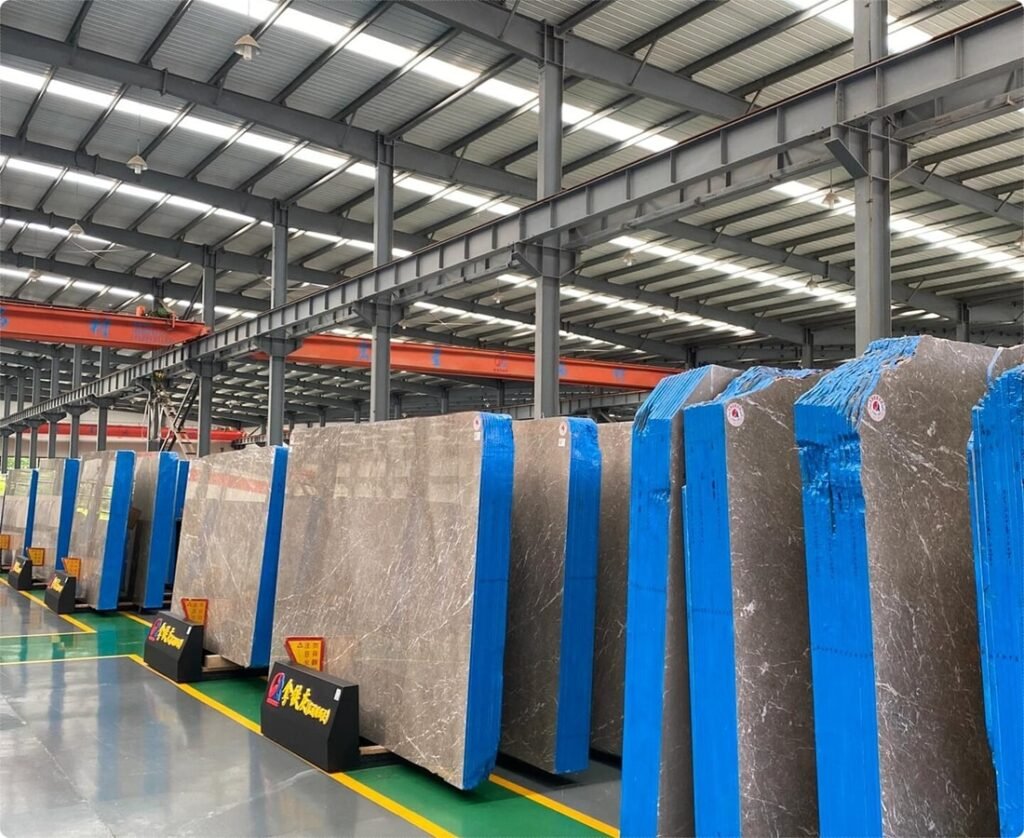
Natural marble and travertine that are rough, sawn, or merely cut into rectangular forms generally fall under Chapter 25.
Typical characteristics include:
- Rough blocks
- Gang-sawn slabs
- Unpolished surfaces
- No resin reinforcement
- No edge finishing
- Minimal processing
- No decorative fabrication
Examples may include:
- Quarry blocks
- Raw slabs for downstream fabrication
- Industrial stone materials await finishing
In many customs systems, marble and travertine slabs that are simply cut into flat shapes without substantial processing are commonly associated with tariff heading 2515.
This category often covers:
- Marble blocks
- Travertine blocks
- Merely sawn marble slabs
- Rough dimensional stone
Chapter 68 — Worked Monumental or Building Stone
Once marble undergoes substantial processing, it may shift into Chapter 68 classifications.
Typical “worked” features may include:
- Polishing
- Honing
- Leather finishing
- Brushed finishing
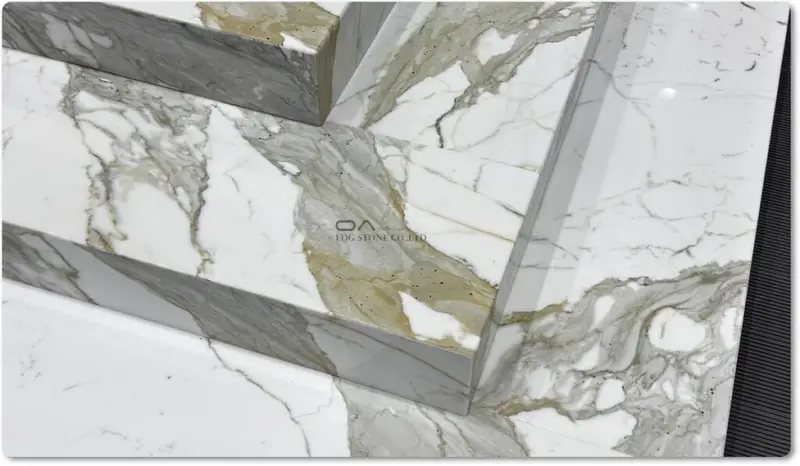
- Edge profiling
- Resin treatment
- Reinforcement mesh backing
- Precision cutting
- CNC fabrication
- Waterjet processing
- Decorative shaping
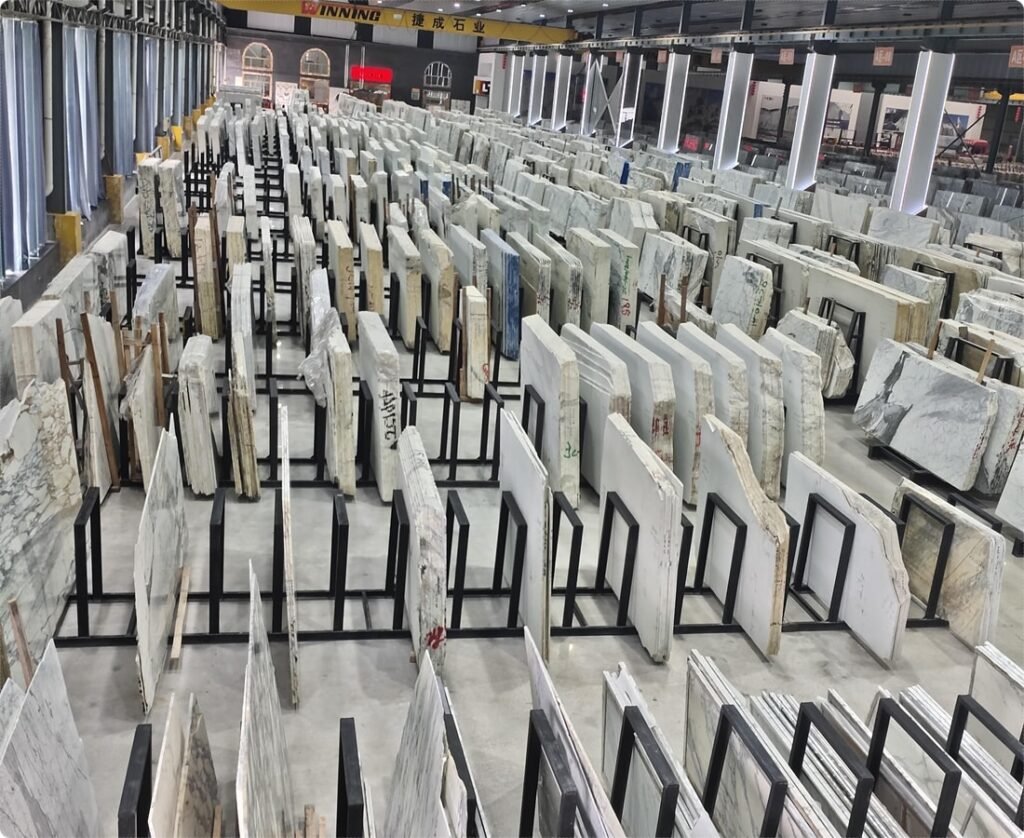
Worked marble products often include:
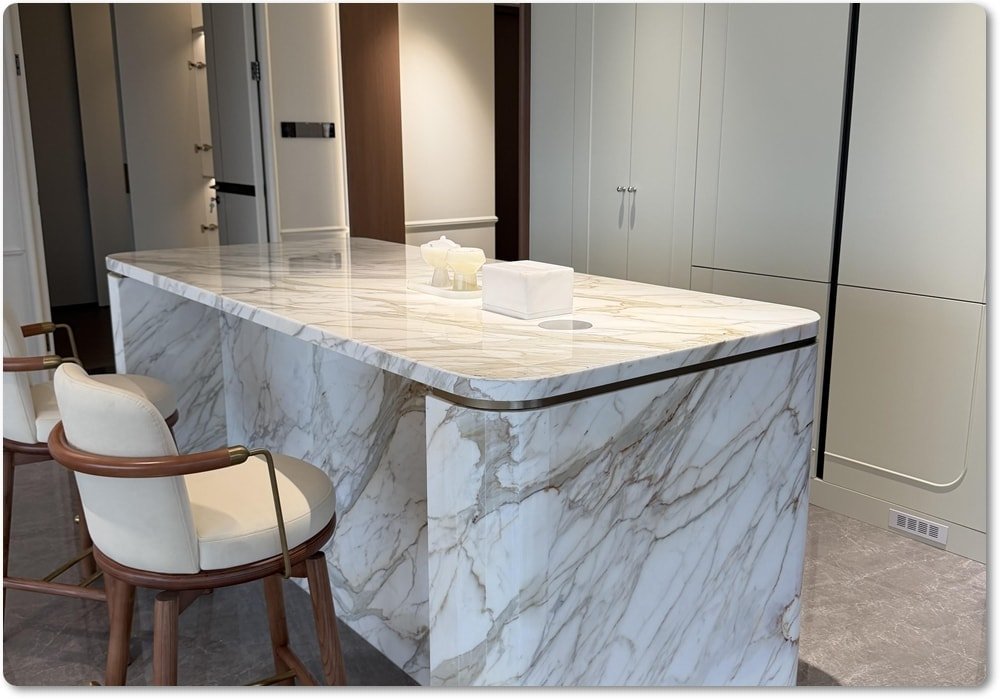
- Countertops
- Vanity tops
- Wall cladding panels
- Flooring tiles
- Stair treads
- Decorative architectural stone
- Finished slab products
These products are frequently associated with heading 6802 in many customs systems.
The classification shift from Chapter 25 to Chapter 68 can significantly affect:
- Duty rates
- Trade agreement eligibility
- Inspection standards
- Customs declarations
- Import taxes
For global buyers, understanding where the processing threshold changes is extremely important.
How Canada Classifies Marble and Travertine Slabs?
In Canada, customs classification follows the Customs Tariff schedule administered by the Canada Border Services Agency (CBSA).
Canada generally distinguishes between:
- Marble/travertine that is rough or merely cut
- Marble/travertine that has been worked beyond basic sawing
Canadian tariff logic aligns with international HS structure principles.
HS 2515 Logic
Heading 2515 generally applies to:
- Marble
- Travertine
- Ecaussine
- Calcareous monumental stone
provided the stone is:
- Crude
- Roughly trimmed
- Merely cut by sawing
- Cut into rectangular or square forms
Typical examples:
- Quarry blocks
- Raw slabs
- Semi-processed slabs without surface finishing
HS 6802 Logic
Heading 6802 generally applies to worked monumental or building stone.
Examples may include:
- Polished marble slabs
- Finished wall panels
- Countertops
- Decorative marble products
- Fabricated architectural stone
Canadian customs authorities may review whether the stone has undergone sufficient processing to qualify as “worked.”
This distinction becomes especially important when importing:
- Luxury polished marble
- Resin-treated slabs
- Mesh-backed slabs
- CNC-fabricated stone
- Prefabricated countertops
Why Importers Must Verify Classification Before Shipment?
Many import disputes occur because suppliers and buyers classify products differently.
For example:
| Product Type | Potential Classification Risk |
|---|---|
| Rough gang-sawn slab | Usually, a lower processing category |
| Polished slab | May shift into the worked stone category |
| Resin-filled slab | May trigger a different interpretation |
| Countertop with cutouts | Clearly fabricated product |
| Bookmatched polished slab | Often treated as processed stone |
Because customs officers may inspect actual shipment conditions, importers should ensure:
- Commercial invoices match product condition
- Product descriptions are accurate
- Surface finish is declared correctly
- Photos correspond to declared goods
- Packing lists identify processing status
Why Finish and Process Change Classification Risk?
In the stone industry, processing levels directly affect customs interpretation.
Many buyers assume marble is “just stone,” but from a customs perspective, each processing step can alter tariff treatment.
Surface Finish Impacts Classification
Surface finishing is one of the biggest factors affecting classification risk.
Examples include:
Low Processing Risk
- Rough sawn
- Unpolished
- Quarry cut
- Basic dimensional slabs
Higher Processing Risk
- Polished
- Honed
- Leathered
- Brushed
- Flamed
- Sandblasted
- Resin-coated
The more value-added processing applied to the slab, the more likely customs authorities are to classify the product as worked stone.
Fabrication Adds Additional Complexity
Fabricated marble products often receive different tariff treatment than plain slabs.
Examples include:
- Sink cutouts
- Faucet holes
- Edge polishing
- Laminated edges
- Miter fabrication
- Prefinished countertop systems
These products may no longer qualify as merely cut stone.
Reinforcement Materials May Matter
Some marble slabs include:
- Fiberglass mesh backing
- Epoxy resin reinforcement
- Composite support structures
Depending on the country and customs interpretation, reinforcement systems may influence classification analysis.
This is especially relevant for fragile luxury marbles used in:
- High-rise developments
- Hotel interiors
- Large-format wall systems
- Bookmatched installations
Documents Needed for Customs Clearance
Successful marble slab imports depend heavily on accurate documentation.
Even when the HS code is correct, incomplete paperwork can delay customs release.
Commercial Invoice
The commercial invoice should clearly describe:
- Stone type
- Processing level
- Finish
- Quantity
- Value
- Country of origin
- HS classification
Avoid vague descriptions such as:
- “Stone slabs”
- “Building materials”
- “Natural products”
Instead, use specific descriptions such as:
- “Polished natural marble slabs”
- “Merely cut travertine slabs”
- “Honed Calacatta marble panels”
Packing List
The packing list should include:
- Bundle counts
- Crate dimensions
- Net weight
- Gross weight
- Slab thickness
- Quantity per crate
For customs inspection, clear crate labeling is important.
Bill of Lading
The bill of lading confirms:
- Shipper
- Consignee
- Port of loading
- Port of discharge
- Cargo details
- Container numbers
Incorrect cargo descriptions can create customs inconsistencies.
Certificate of Origin
Many countries require origin verification for:
- Preferential trade agreements
- Duty reductions
- Anti-dumping compliance
- Sanction screening
The origin of marble can be particularly important because quarry source impacts trade classification and valuation.
Fumigation and Packaging Compliance
Wooden export crates may require:
- ISPM-15 compliance
- Heat treatment certification
- Fumigation marks
Failure to comply can result in port rejection or quarantine issues.
Common Compliance Errors
Global stone importers frequently encounter customs problems because of avoidable compliance mistakes.
Misdeclaring Worked Stone as Raw Stone
Some importers incorrectly classify polished slabs as merely cut slabs to reduce duties.
This can trigger:
- Customs reassessment
- Financial penalties
- Increased audit risk
- Shipment detention
Inconsistent Product Descriptions
If the invoice says:
- “rough marble slab”
But inspection reveals:
- polished resin-filled slabs
Customs authorities may challenge the declaration.
Consistency across all documents is critical.
Incorrect Country of Origin
Marble may be:
- quarried in one country
- processed in another
- exported from a third country
Origin rules vary by jurisdiction, making documentation accuracy essential.
Missing Technical Details
Insufficient documentation may delay clearance.
Helpful supporting details include:
- Slab finish
- Thickness
- Photos
- Fabrication details
- Surface treatment descriptions
Underestimating Customs Review Risk
Luxury stone imports are high-value cargoes.
Large commercial shipments often receive closer inspection due to:
- High invoice values
- Weight discrepancies
- Anti-dumping concerns
- Natural resource trade controls
Professional customs compliance procedures help reduce delays.
Best Practices for Marble Importers
Experienced importers typically implement structured compliance procedures.
Verify Classification Before Production
Do not wait until the shipment departure.
Review:
- Product finish
- Fabrication scope
- Resin treatment
- Intended HS code
- Destination-country tariff rules
before manufacturing begins.
Work With Specialized Customs Brokers
Stone imports involve unique classification issues not always familiar to general freight agents.
Experienced brokers can help:
- Validate HS codes
- Review invoices
- Confirm tariff treatment
- Minimize customs disputes
Request Accurate Supplier Documentation
Suppliers should provide:
- Detailed invoices
- Product photos
- Finish descriptions
- Slab specifications
- Origin declarations
The more precise the documentation, the lower the compliance risk.
Maintain Import Audit Records
Many jurisdictions allow post-entry customs audits years after importation.
Maintain organized records for:
- Invoices
- Packing lists
- Shipping documents
- HS rulings
- Customs communications
Conclusion
Marble slab customs classification is far more technical than many buyers initially expect. The difference between rough-cut stone and processed architectural marble can significantly affect tariff treatment, import duties, customs inspections, and compliance obligations.
As global stone supply chains become increasingly regulated, importers must understand how processing stages influence HS classification logic. Polishing, resin treatment, edge fabrication, and decorative finishing can all shift marble products into different tariff categories.
For companies importing marble into Canada and other international markets, proper documentation, accurate product descriptions, and pre-shipment compliance verification are essential for avoiding delays and reducing customs risk.
Professional stone suppliers, customs brokers, and procurement teams should work together to ensure marble shipments are classified correctly before cargo leaves the factory.
In the international natural stone industry, customs accuracy is no longer optional — it is a core part of global trade risk management.
FAQ
What is the HS logic for marble slabs?
Marble slabs are generally classified based on processing level. Rough or merely cut marble often falls under Chapter 25 tariff logic, while polished or fabricated marble products may fall under Chapter 68 classifications for worked stone.
Why do processed slabs classify differently from raw cut slabs?
Customs systems distinguish between minimally processed raw materials and value-added manufactured products. Polishing, resin treatment, edge profiling, and fabrication increase processing levels, which can shift tariff classification.
What should buyers verify before shipment?
Buyers should verify:
- HS classification
- Product finish
- Invoice descriptions
- Country of origin
- Packing documentation
- Surface processing details
- Customs broker review
before shipment departure.
References
- Canada Border Services Agency (CBSA) — Customs Tariff Chapter 25
- Canada Border Services Agency (CBSA) — Customs Tariff Chapter 68
- World Customs Organization (WCO) — Harmonized System Overview
- Global Affairs Canada — Import and Export Guidance
- International Trade Centre — Trade Map and Tariff Resources
- Natural Stone Institute — International Stone Trade Guidance
- U.S. International Trade Commission — Harmonized Tariff Schedule
- European Commission TARIC Database
- WTO Trade Facilitation Resources
- International Chamber of Commerce — Global Trade Documentation Standards