
Global demand for premium marble slabs continues to grow across luxury residential, hospitality, retail, and commercial construction sectors. Architects, distributors, developers, and stone fabricators increasingly require suppliers capable of delivering stable inventory, consistent quality, and dependable export execution.
For international buyers, sourcing marble is no longer only about selecting beautiful slabs. Procurement teams must evaluate production stability, quarry access, packaging standards, logistics management, lead times, and long-term supply reliability. A single delay or quality inconsistency can affect construction schedules, fabrication efficiency, installation timelines, and project profitability.
As an experienced stone factory and marble export supplier, EDG Stone supports clients worldwide with integrated supply-chain management covering quarry sourcing, slab production, inspection, packaging, and international shipment coordination. By focusing on stable supply systems rather than short-term transactions, the company helps importers reduce operational risk and maintain project continuity.
This guide explains how professional marble slab suppliers deliver reliable global supply and what commercial buyers should evaluate before choosing a long-term stone manufacturing partner.
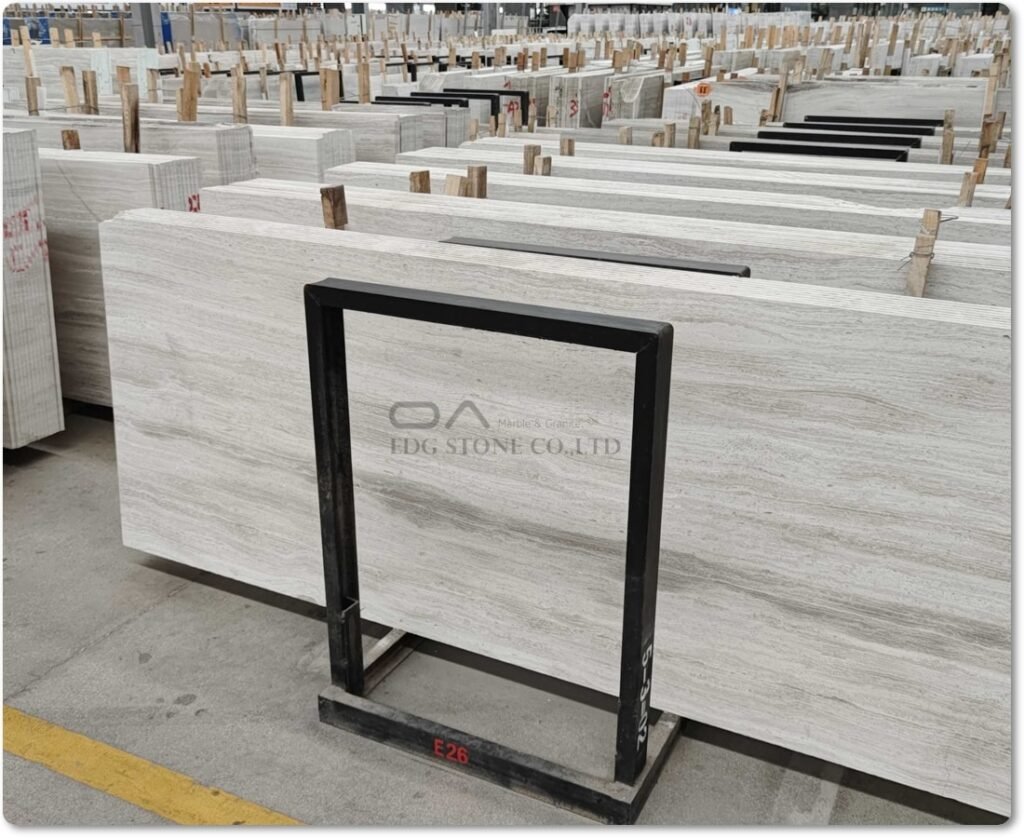
What Buyers Should Expect from a Reliable Supplier?
Professional buyers today expect far more than low pricing from a marble slab supplier. A reliable supplier must function as a strategic manufacturing and logistics partner capable of supporting long-term commercial procurement.
Key expectations include:
- Stable raw material access
- Consistent slab quality
- Export-grade packaging
- Accurate color and vein matching
- Predictable lead times
- Responsive communication
- Scalable production capacity
- Batch consistency for large projects
- Documentation support for customs and compliance
- Fast problem resolution
Many sourcing problems occur because buyers choose traders without direct factory integration. While trading companies may offer attractive pricing initially, they often lack production control, inventory transparency, and quarry relationships. This creates risks such as inconsistent colors, delayed shipments, missing slabs, or replacement difficulties.
A professional stone factory maintains visibility across the entire supply chain, including:
- Quarry selection
- Block purchasing
- Slab cutting
- Resin treatment
- Surface finishing
- Inspection
- Packing
- Container loading
- Export coordination
Commercial buyers should also assess whether the supplier understands international market expectations. North American, European, Australian, and Middle Eastern projects may require different standards regarding finish tolerance, crate structure, labeling, fumigation, and certification.
Reliable marble suppliers typically offer:
- High-resolution slab photography
- Video inspections
- Digital inventory systems
- Batch tracking
- Project reservation capability
- Custom fabrication support
- Container optimization planning
In today’s competitive construction market, procurement reliability directly affects project profitability. A dependable supplier helps reduce hidden costs associated with delays, replacements, claims, and installation issues.
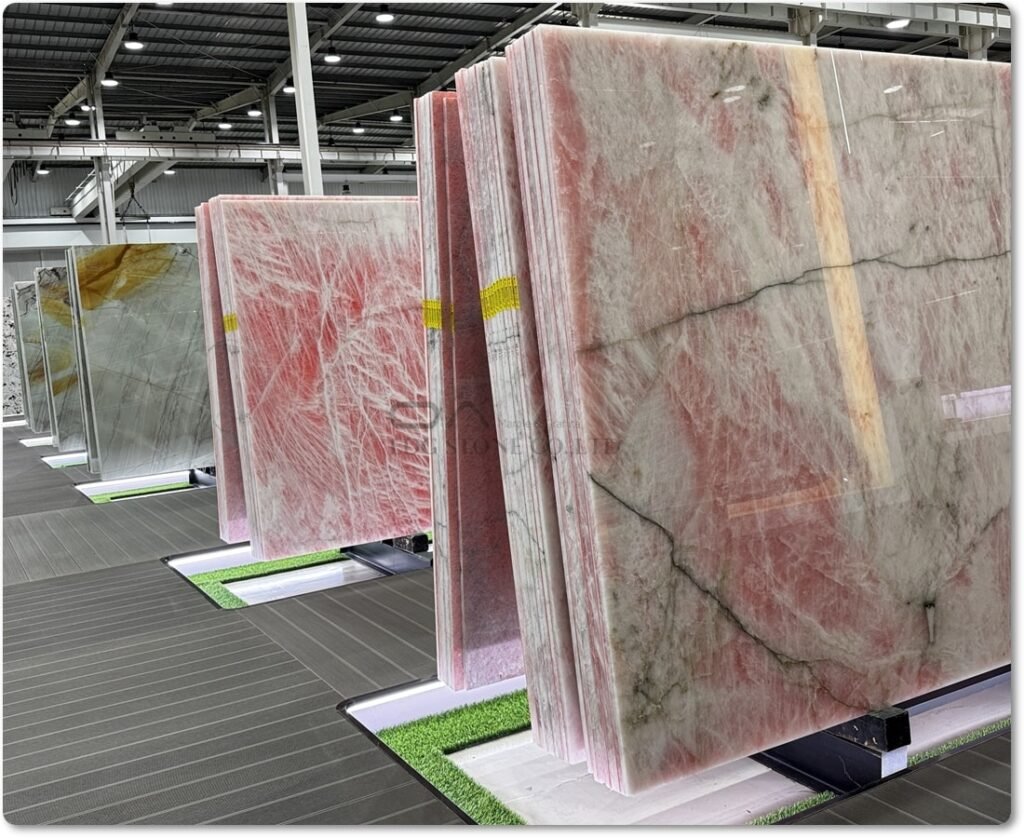
Inventory Depth and Quarry Relationships
One of the most important indicators of supplier strength is inventory depth. Large inventory systems allow suppliers to provide stable availability, faster lead times, and better batch consistency.
Marble is a natural material, meaning no two blocks are identical. Veining, tone variation, movement, and mineral composition change from quarry to quarry and even between extraction periods within the same quarry. Suppliers with shallow inventory often struggle to maintain visual continuity across large orders.
Why Quarry Relationships Matter?
Strong quarry partnerships provide several operational advantages:
- Priority access to premium blocks
- Better color consistency
- Stable production scheduling
- Reduced raw material shortages
- Improved pricing stability
- Access to exclusive materials
Factories that purchase directly from quarries generally maintain better quality control because they can select blocks before production begins.
For example, luxury white marble categories often experience substantial variation between extraction batches. Without strong quarry coordination, distributors may receive inconsistent slabs that cannot be installed together within the same project.
Professional suppliers typically maintain:
- Long-term quarry contracts
- Reserved block inventory
- Strategic material stock
- Multi-country sourcing networks
- Alternative quarry backup options
This becomes especially important for commercial developments requiring repeat orders months later. Hotels, condominiums, shopping centers, and large residential projects often require phased deliveries over extended construction schedules.
Inventory Management Systems
Advanced stone factories increasingly use digital inventory management systems to track:
- Slab dimensions
- Thickness
- Finish type
- Lot number
- Bundle identification
- Project allocation
- Container loading plans
This improves order accuracy and reduces shipping errors.
A supplier with deep inventory can also help buyers optimize material yield. Larger slab selections allow fabricators to improve countertop layouts, reduce waste, and better match bookmatched applications.
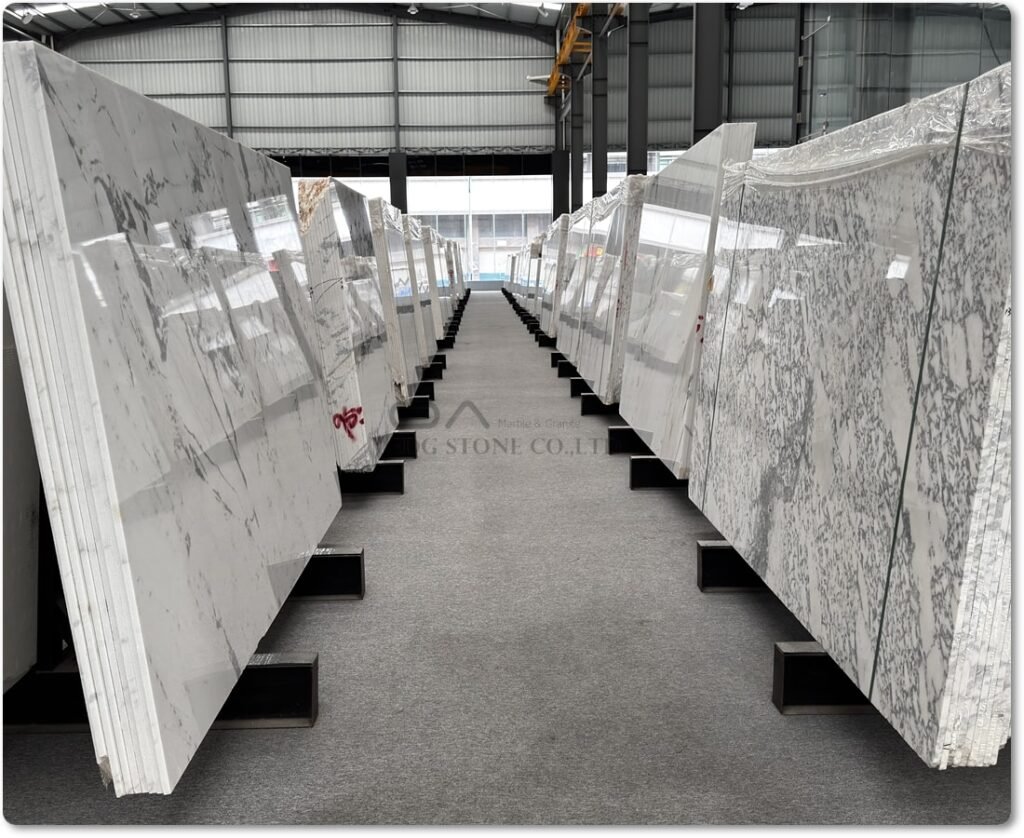
QC Process and Visual Inspection
Quality control is one of the most critical parts of marble slab export operations. Natural stone is inherently variable, which means inspection systems must combine technical standards with visual evaluation.
Professional marble factories typically implement multi-stage QC procedures throughout production.
Block Selection Inspection
The QC process begins before slabs are cut. Experienced inspectors evaluate raw blocks for:
- Structural integrity
- Crack density
- Color consistency
- Vein distribution
- Waterline presence
- Mineral defects
Poor block selection often creates downstream fabrication and installation problems.
Slab Production Inspection
After cutting, slabs are inspected for:
- Thickness tolerance
- Flatness
- Surface polish quality
- Resin treatment effectiveness
- Edge damage
- Pinholes or fissures
Factories exporting to commercial markets usually maintain tighter tolerances because fabrication automation depends on dimensional consistency.
Visual Matching and Batch Control
Visual inspection is especially important for premium marble.
Buyers frequently request:
- Bookmatching
- Sequential vein continuity
- Uniform background tone
- Consistent polish reflection
- Controlled movement patterns
Professional suppliers often provide:
- Slab-by-slab photography
- Wet-view videos
- Natural lighting inspection
- Bundle sequencing
- Approval before shipment
This reduces disputes after arrival.
Final Pre-Shipment QC
Before container loading, final inspections confirm:
- Correct quantities
- Label accuracy
- Surface protection
- Crate integrity
- Moisture protection
- Container cleanliness
A disciplined QC system minimizes claims, breakage risk, and installation delays.
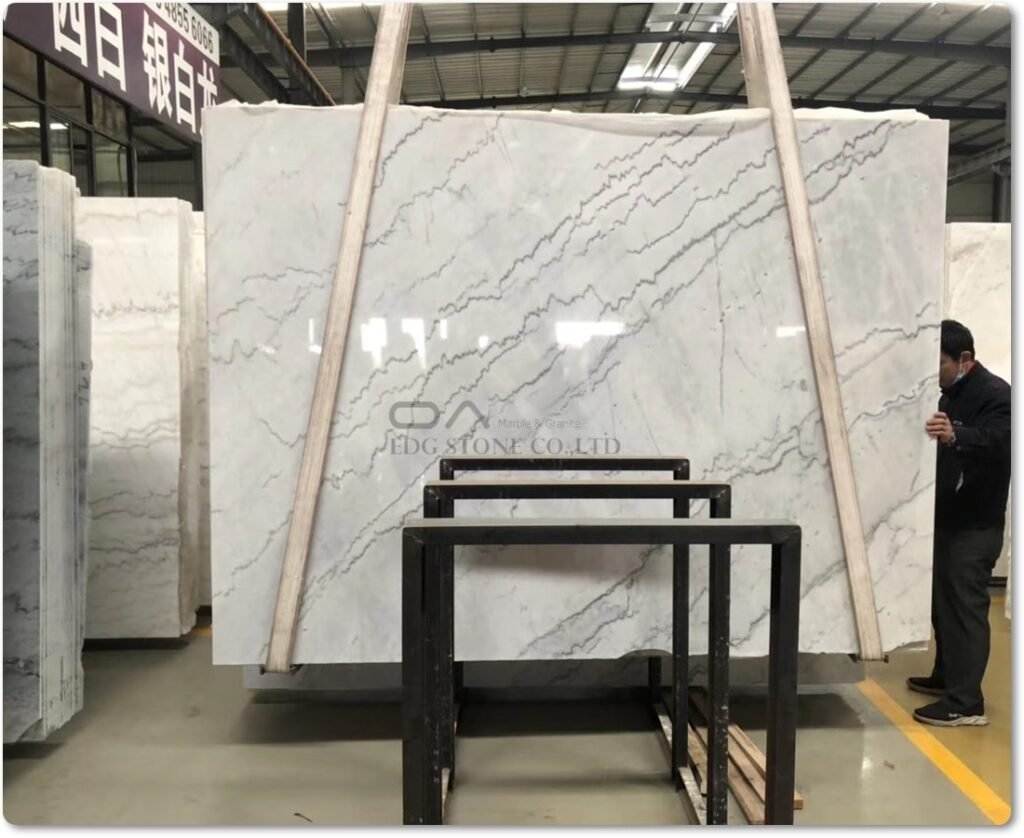
Packing for Long-Distance Shipping
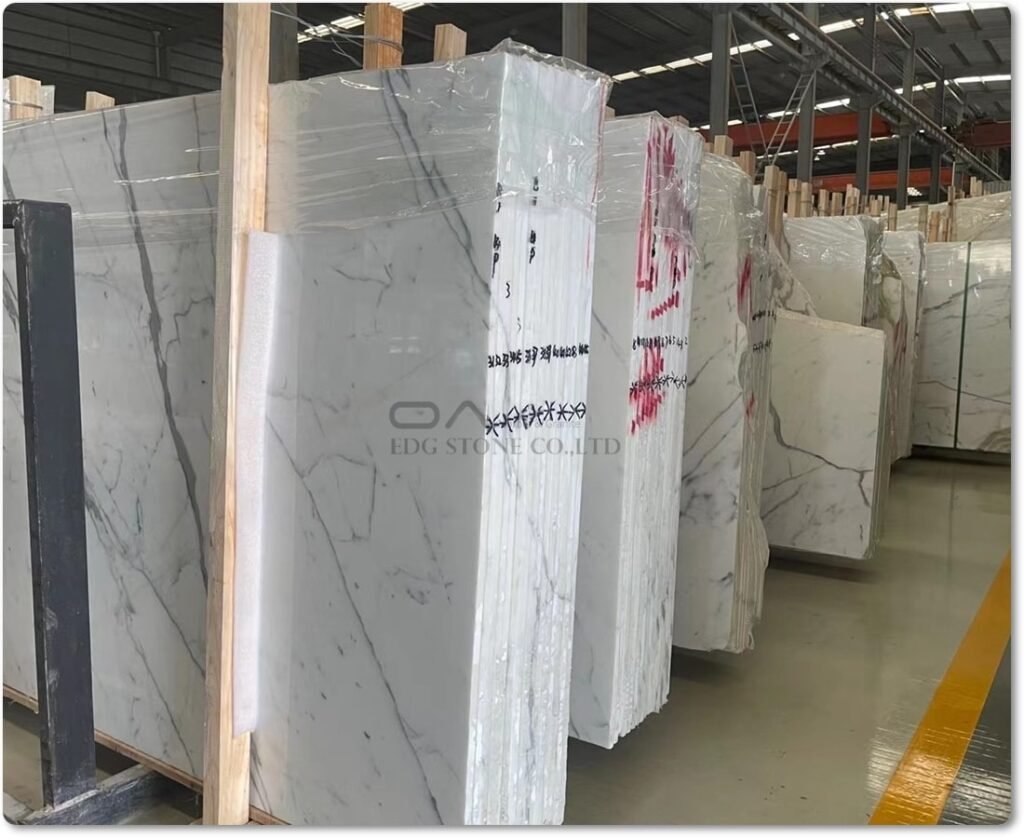
International marble shipping presents major logistical challenges. Stone slabs are heavy, fragile, and vulnerable to vibration, impact, moisture, and improper handling during transit.
Export-grade packaging is essential for reducing shipping damage.
Standard Export Packing Systems
Professional stone factories commonly use:
- Heat-treated wooden crates
- Steel reinforcement
- Foam separators
- Waterproof plastic wrapping
- Protective corner guards
- Anti-slip internal supports
Packaging design may vary depending on:
- Slab size
- Thickness
- Surface finish
- Shipping destination
- Container type
- Local import regulations
Container Loading Strategy
Improper container loading can create severe damage during ocean transport.
Experienced suppliers carefully calculate:
- Weight distribution
- Crate positioning
- Center of gravity
- Forklift clearance
- Shock absorption spacing
Container overloading can also create customs and transportation risks.
Moisture and Climate Protection
Long ocean transit exposes marble to changing humidity and temperature conditions. Professional exporters implement moisture protection systems to prevent:
- Water staining
- Resin instability
- Wooden crate deterioration
- Mold growth
- Surface contamination
Certain marble categories are especially sensitive to moisture and require additional protection measures.
Why Packaging Expertise Matters?
Shipping claims can be expensive and time-consuming. Broken slabs often delay fabrication schedules and create replacement difficulties, especially when natural stone variations make exact matching impossible.
Professional export packaging significantly reduces these risks and helps protect project timelines.
MOQ, Lead Time, and Batch Planning
Commercial marble procurement depends heavily on planning accuracy.
Importers should clearly understand:
- Minimum order quantities (MOQ)
- Production lead times
- Container consolidation options
- Batch reservation procedures
- Reorder capability
MOQ Flexibility
Some suppliers only support full-container orders, while others offer mixed-container programs that help distributors test new materials with lower risk.
Flexible MOQ policies benefit:
- New importers
- Boutique distributors
- Design studios
- Small fabrication shops
- Regional wholesalers
However, extremely low MOQ requests may affect pricing efficiency because freight and handling costs become proportionally higher.
Lead Time Management
Typical marble slab lead times vary depending on:
- Quarry availability
- Processing schedule
- Surface finishing
- Inventory status
- Shipping route
- Seasonal demand
Reliable suppliers communicate realistic timelines rather than promising unrealistic delivery dates.
Commercial buyers should also account for:
- Port congestion
- Customs clearance
- Holiday shutdown periods
- Weather disruptions
- Ocean freight fluctuations
Batch Planning for Large Projects
Large developments often require phased procurement.
Professional suppliers help buyers manage:
- Future inventory reservation
- Sequential production
- Color continuity
- Repeat order consistency
- Project allocation tracking
Batch planning becomes particularly important for luxury hospitality and residential projects where visual continuity is essential.
OEM and Private-Label Supply
Many global distributors and building-material brands now seek OEM stone manufacturing partnerships.
OEM programs allow buyers to build their own brand identity while leveraging established factory production systems.
Common OEM Services
Professional marble factories may provide:
- Custom labeling
- Private packaging
- Brand engraving
- Marketing support
- Product catalogs
- Customized finishes
- Exclusive material sourcing
Some suppliers also support customized slab dimensions and cut-to-size production for regional market requirements.
Advantages of OEM Partnerships
OEM supply models help distributors:
- Build stronger brand recognition
- Improve customer loyalty
- Differentiate product offerings
- Expand premium product categories
- Control retail positioning
For suppliers, long-term OEM partnerships create more stable production forecasting and operational efficiency.
Why Factory Integration Matters?
True OEM capability requires direct manufacturing control. Suppliers without factory ownership may struggle to maintain consistency across branded programs.
Integrated factories provide better:
- Production scheduling
- Quality consistency
- Packaging customization
- Communication efficiency
- Technical support
This is especially valuable for buyers managing large dealer networks or commercial supply programs.
Why Total Landed Cost Matters More Than Unit Price?
One of the biggest procurement mistakes buyers make is focusing only on the slab unit price.
Low-priced material may ultimately generate higher total project costs due to:
- Breakage
- Delays
- Color inconsistency
- Replacement shipments
- Fabrication waste
- Installation complications
- Claim management
- Inventory shortages
Professional importers evaluate total landed cost instead.
Components of Total Landed Cost
Total landed cost includes:
- Material cost
- Ocean freight
- Packaging
- Customs duties
- Insurance
- Inland transportation
- Storage
- Damage risk
- Labor impact
- Waste percentage
A slightly higher factory price may actually reduce overall project cost if the supplier delivers:
- Better yield optimization
- Lower breakage rates
- Faster lead times
- More accurate slab matching
- Reliable scheduling
Hidden Costs of Poor Supply Management
Unstable supply creates indirect financial damage, such as:
- Construction delays
- Idle labor
- Missed opening deadlines
- Client disputes
- Reputation damage
For commercial developers, these hidden costs often exceed the initial material savings from cheaper suppliers.
Long-Term Supplier Relationships
Experienced importers increasingly prioritize long-term supplier relationships rather than transactional purchasing.
Stable supplier partnerships provide:
- Better pricing consistency
- Priority production scheduling
- Improved communication
- Faster issue resolution
- More predictable project execution
This operational stability becomes a competitive advantage in global construction markets.
Conclusion
Global marble procurement requires far more than selecting attractive stone materials. Successful commercial sourcing depends on supply-chain stability, quality control systems, inventory depth, packaging expertise, and export execution capability.
A professional marble slab supplier should function as a long-term operational partner capable of supporting project continuity from quarry to final delivery.
EDG Stone focuses on integrated stone manufacturing and export management designed to support distributors, contractors, fabricators, developers, and designers worldwide. Through strong quarry relationships, disciplined QC systems, export-grade packaging, and coordinated logistics planning, the company helps reduce procurement risk while improving supply reliability.
As global construction projects become increasingly schedule-sensitive and quality-driven, choosing the right marble supplier becomes a strategic business decision rather than simply a pricing comparison.
Buyers who prioritize stable supply systems, consistent batch control, and reliable export execution are better positioned to reduce hidden costs, protect project timelines, and improve long-term profitability.
FAQ
What makes a marble supplier reliable?
A reliable marble supplier maintains stable quarry relationships, consistent inventory, strong quality-control systems, export-grade packaging, transparent communication, and dependable shipping coordination. Professional suppliers also provide batch consistency, realistic lead times, and effective after-sales support.
How do importers reduce shipping risk?
Importers reduce shipping risk by working with experienced stone exporters that use reinforced wooden crates, moisture protection systems, accurate container loading strategies, and pre-shipment inspections. Insurance coverage, proper documentation, and supplier QC procedures also help minimize damage and delays.
Why should buyers look beyond unit price?
Focusing only on unit price can increase overall project costs through breakage, delays, inconsistent slabs, fabrication waste, and replacement shipments. Evaluating total landed cost provides a more accurate understanding of procurement efficiency and long-term profitability.