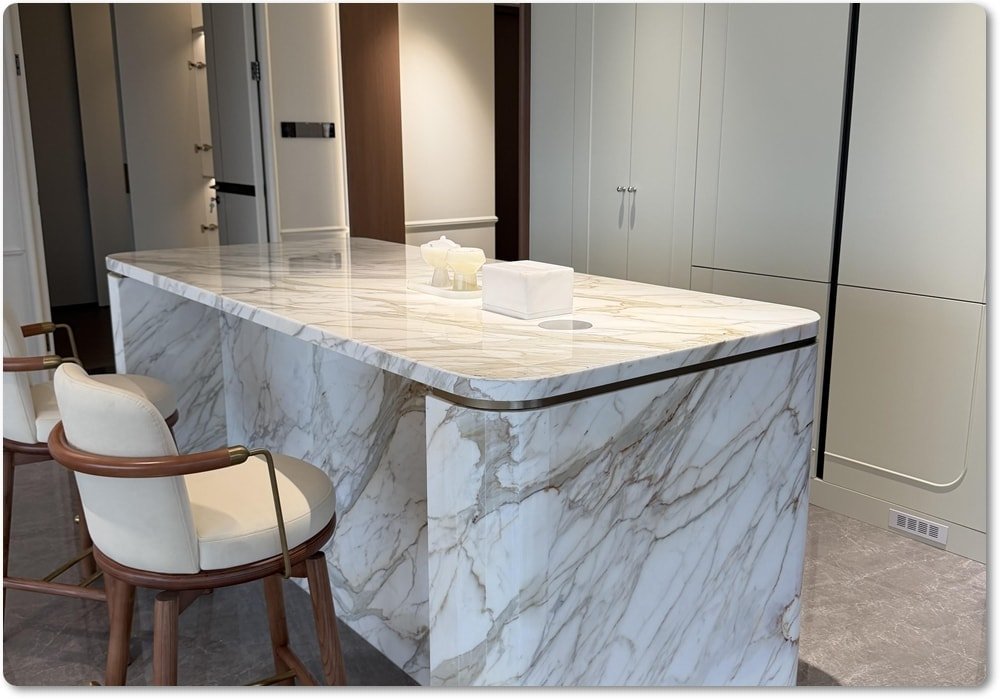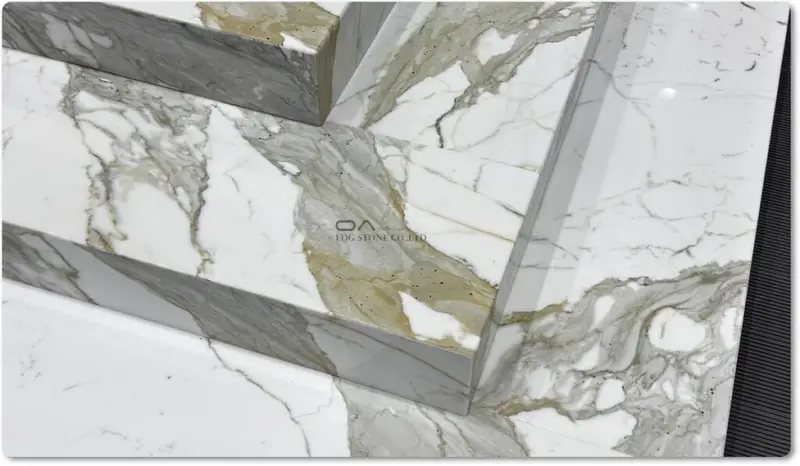
Quick Summary: What Are Ultra-Compact Kitchen Countertops?
Ultra Compact Kitchen Countertops
What: Ultra compact countertops are advanced large-format surfaces manufactured using high-temperature and high-pressure processes that create dense, low-porosity materials.
Why: They are increasingly used where homeowners, architects, and commercial buyers need heat resistance, scratch resistance, low maintenance, and large-format visual continuity.
How: The material is manufactured from carefully selected mineral-based raw materials that are processed, compacted, and sintered into dense architectural slabs.
Options: Ultra-compact surfaces may include sintered stone, ultracompact porcelain, and proprietary high-performance surface technologies, depending on the manufacturer and formulation.
Considerations: Buyers should evaluate fabrication requirements, edge design, thickness, transportation, installation capability, price, local occupational safety regulations, and the supplier’s technical documentation before purchasing.
The kitchen countertop market is changing rapidly.
For decades, homeowners and commercial developers mainly compared granite, marble, and quartz countertops. Today, a new generation of high-performance surfaces is becoming increasingly important: ultra-compact kitchen countertops.
Architects want larger slabs. Designers want seamless kitchens. Homeowners want surfaces that are easier to maintain. Fabricators need materials that fit changing workplace safety requirements. Developers increasingly evaluate lifecycle performance, sustainability documentation, and regulatory risk before specifying countertop materials.
As a result, ultra-compact countertops have become one of the most important material categories in the modern kitchen industry.
For global buyers, contractors, wholesalers, and kitchen manufacturers, the question is no longer simply:
“Which countertop looks the best?”
The more important question is:
Which countertop material delivers the right balance of design, performance, fabrication practicality, regulatory compatibility and long-term value?
This guide explains everything you need to know about ultra-compact kitchen countertops, including what they are, how they compare with quartz, how much they cost, which brands dominate the market, what trends are shaping the industry, and how to source ultra-compact slabs from manufacturers and wholesale suppliers.
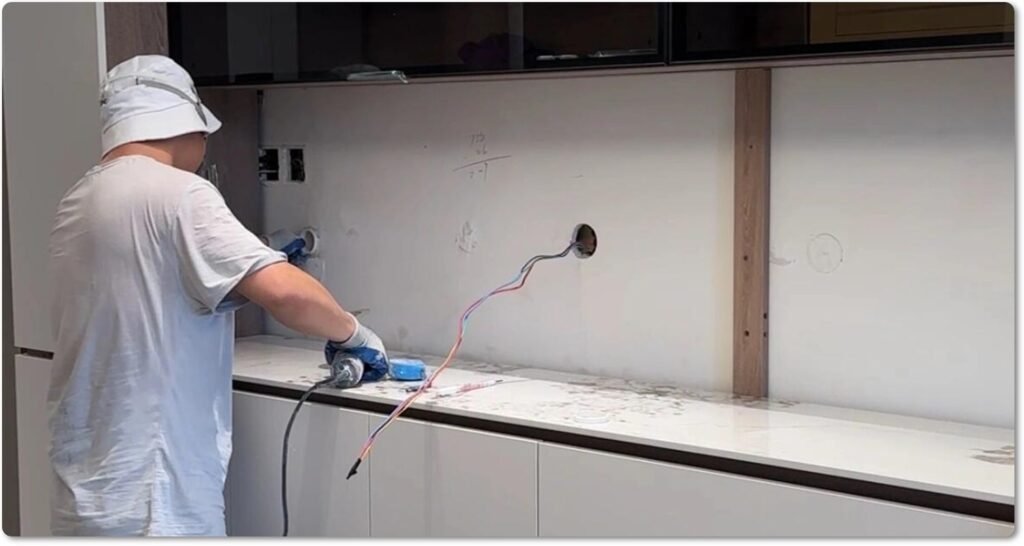
What Is an Ultra Compact Countertop?
An ultra-compact countertop is a high-density architectural surface designed through advanced industrial manufacturing processes involving mineral-based materials, extreme compaction, and high-temperature sintering or similar proprietary technologies.
The goal of ultra-compaction is simple:
Create a surface with:
- Extremely low porosity
- High density
- Strong scratch resistance
- Strong abrasion resistance
- High heat resistance
- Stain resistance
- UV resistance
- Low maintenance requirements
- Large-format design possibilities
The term ultra-compact surface is sometimes used as a broad industry category rather than a single standardized material definition.
Different manufacturers may use proprietary technologies and terminology.
For example, major brands market ultracompact materials using proprietary production technologies, while other suppliers may classify similar products as:
- Sintered stone
- Ultracompact porcelain
- Large-format porcelain slabs
- High-performance mineral surfaces
- Compact surfaces
- Advanced architectural slabs
Therefore, buyers should always evaluate the technical specifications of the actual product, rather than purchasing based only on the marketing category.
What Is an Ultra Compact Surface Countertop?
The simple definition
An ultra-compact surface countertop is a dense, engineered architectural slab designed for demanding applications such as kitchens, bathrooms, commercial interiors, and outdoor environments.
The manufacturing process generally combines selected mineral raw materials with advanced industrial processing.
Depending on the specific manufacturer, production may involve:
- Raw material selection
- Mineral blending
- Particle preparation
- Extreme compaction
- High-temperature treatment or sintering
- Surface finishing
- Large-format slab production
- Quality inspection
The resulting surface is designed to minimize internal porosity and improve performance.
Major ultracompact products such as Dekton are marketed as advanced surfaces created through proprietary ultra-compaction and particle-sintering technologies. Manufacturers emphasize properties including heat resistance, abrasion resistance, low porosity, and large-format application possibilities.
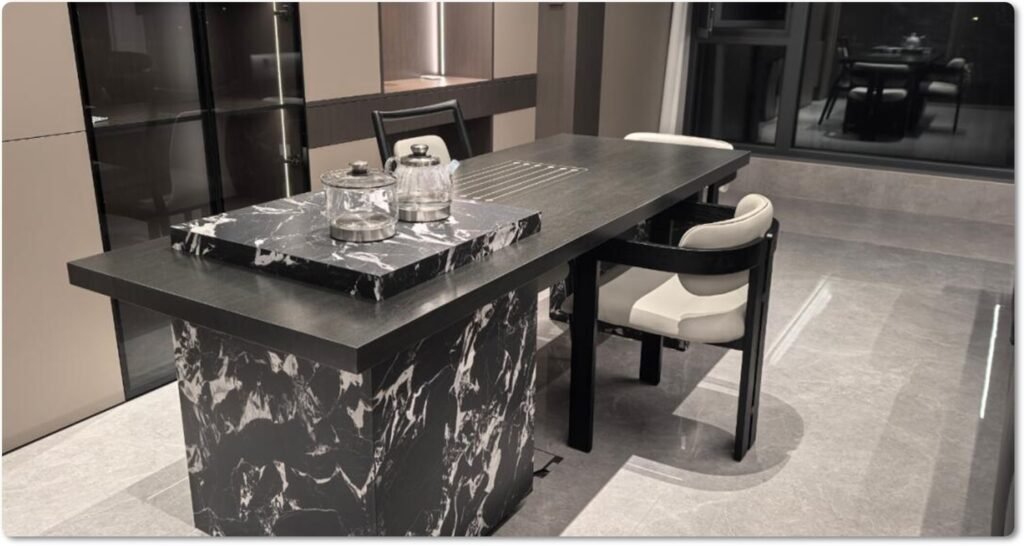
Why Are Ultra Compact Kitchen Countertops Becoming Popular?
The Kitchen Is Becoming a High-Performance Living Space
Modern kitchens are no longer only food preparation areas.
Today, kitchens are also:
- Entertainment spaces
- Family gathering areas
- Home offices
- Social spaces
- Luxury design features
- Architectural focal points
This means countertops must perform under more demanding conditions.
A modern kitchen surface may be exposed to:
- Hot cookware
- Food acids
- Coffee
- Wine
- Oils
- Cleaning products
- Knives and utensils
- Heavy appliances
- Daily impact
- Direct sunlight
Traditional materials may perform extremely well in some of these categories but require compromises in others.
Ultra compact kitchen countertops are designed to reduce some of these compromises.
Large-Format Kitchen Design Is Driving Demand
One of the biggest design trends is the move toward visual continuity.
Instead of combining multiple unrelated materials, designers increasingly want one material to flow across:
- Kitchen countertops
- Waterfall islands
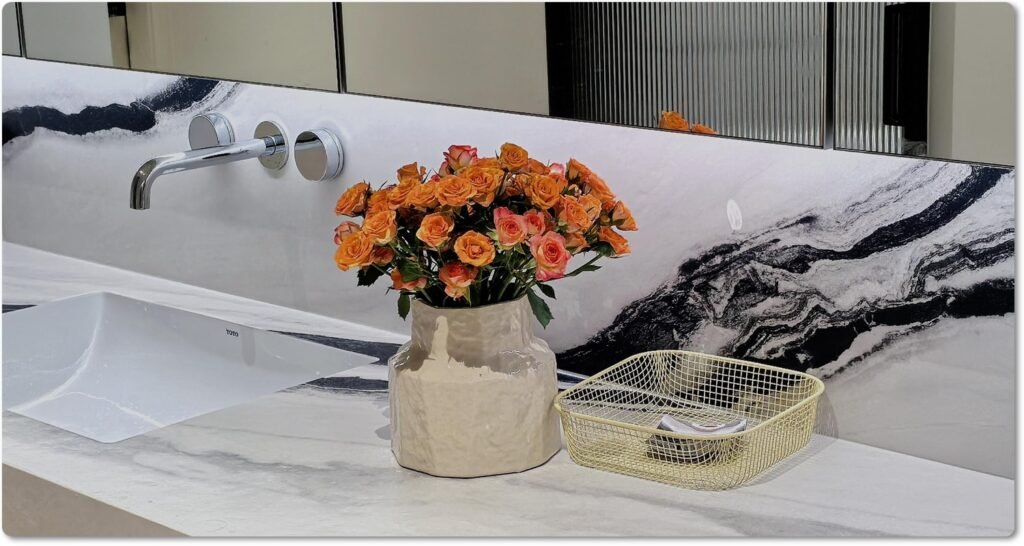
- Full-height backsplashes
- Wall cladding
- Dining tables
- Cabinet surfaces
- Kitchen flooring
Large-format ultra compact slabs can support this architectural approach.
The result is a kitchen that feels more integrated and visually spacious.
This is especially important in luxury residential projects, hotels, apartments and modern commercial interiors.
Ultra Compact Countertops vs Quartz: What Are the Key Differences?
Ultra Compact Countertops vs Quartz
The keyword “ultra compact countertops vs quartz” has become increasingly important because these two categories often compete for the same kitchen projects.
However, they are fundamentally different material categories.
| Feature | Ultra Compact Surface | Quartz Countertop |
|---|---|---|
| Material Technology | Mineral-based advanced compact/sintered technology | Engineered stone using mineral aggregates and binders |
| Heat Resistance | Generally very high | Can be more sensitive to extreme direct heat |
| UV Resistance | Often suitable for outdoor applications | Many quartz products are primarily designed for indoor use |
| Porosity | Extremely low in many products | Generally low |
| Scratch Resistance | Generally very high | High |
| Outdoor Applications | Often possible depending on product | Usually more limited |
| Fabrication | Requires specialized tools and expertise | Requires professional fabrication |
| Edge Options | Depends on thickness and fabrication system | Broad design flexibility |
| Appearance | Marble, stone, concrete, industrial and modern designs | Marble-look and engineered patterns are common |
| Price | Mid-to-premium and premium | Wide range |
| Safety/Regulatory Considerations | Depends on formulation and local rules | Increasingly important in some markets |
Important note:
There is no single universal answer to the question:
“Which is better: ultra compact or quartz?”
The answer depends on the project.
Choose Ultra Compact Countertops When:
Ultra compact surfaces may be the better choice when the project requires:
- High heat resistance
- Outdoor kitchen applications
- UV resistance
- Large-format slabs
- Continuous backsplashes
- Waterfall islands
- Extremely low maintenance
- Contemporary architectural design
- High abrasion resistance
Choose Quartz Countertops When:
Quartz may be the better option when buyers prioritize:
- Familiar fabrication processes
- Traditional countertop installation
- A broad range of engineered patterns
- Specific price points
- Established local fabrication infrastructure
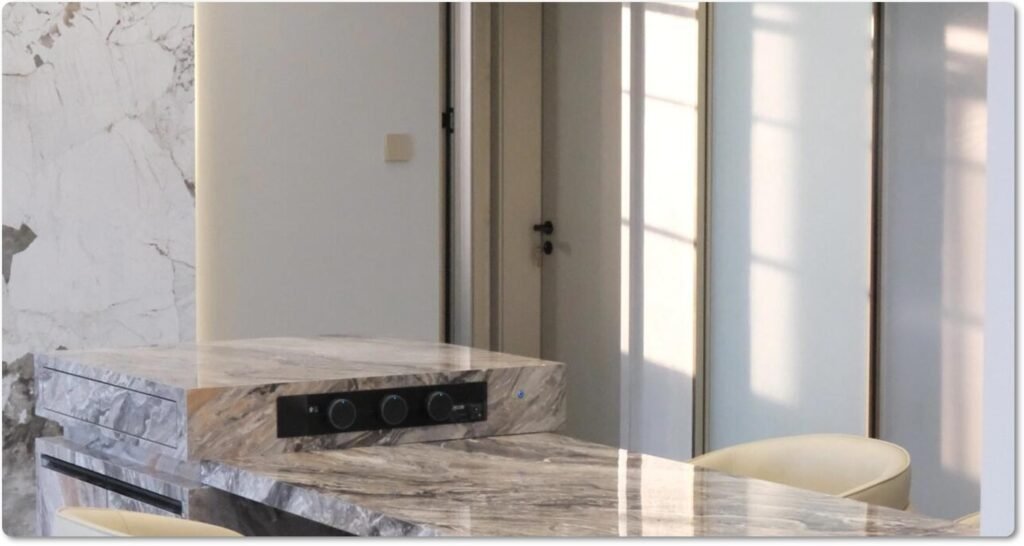
However, sourcing decisions should increasingly include occupational safety and regulatory requirements, particularly in markets where respirable crystalline silica exposure and engineered stone regulations are evolving.
How Are Regulations Changing the Countertop Industry?
The Global Countertop Market Is Entering a Regulatory Transition
One of the most important developments in the surface industry is the growing focus on respirable crystalline silica exposure during fabrication.
This issue affects procurement decisions, fabrication processes and material selection.
Australia introduced a major prohibition affecting engineered stone benchtops, panels and slabs. The national framework distinguishes certain resin-free sintered stone and porcelain products from the definition of prohibited engineered stone, while the exact legal application depends on product composition and jurisdictional requirements.
In California, regulatory discussions in 2026 have also focused on proposed restrictions concerning the fabrication of engineered stone countertops containing more than 1% crystalline silica, reflecting continued concern about occupational exposure.
Why does this matter for buyers?
Because countertop procurement is no longer only about:
- Color
- Price
- Thickness
It is increasingly about:
- Material composition
- Safety documentation
- SDS availability
- Fabrication requirements
- Local regulations
- Supply chain risk
- Product classification
Important procurement principle:
Do not assume that every “low-silica,” “sintered,” “porcelain,” or “ultra compact” product is treated identically under every country’s regulations.
Always request:
- Technical Data Sheet
- Safety Data Sheet
- Material composition information
- Certification documents
- Applicable test reports
Ultra Compact Countertop Price: How Much Does It Cost?
What Is the Average Ultra Compact Countertop Price?
The ultra compact countertop price varies significantly depending on:
- Brand
- Country of origin
- Slab size
- Thickness
- Surface finish
- Design complexity
- Fabrication
- Edge profile
- Cutouts
- Transportation
- Installation
- Project quantity
Therefore, there is no single global price.
A luxury imported ultracompact surface installed by a premium fabricator can cost substantially more than a wholesale slab sourced directly from a manufacturer.
The total project cost should be divided into:
1. Material Cost
The price of the slab itself.
2. Fabrication Cost
This may include:
- Cutting
- Polishing
- Sink cutouts
- Cooktop cutouts
- Edge processing
- Mitered edges
3. Installation Cost
Large-format slabs require experienced handling and installation.
4. Logistics Cost
Transportation can be significant because slabs are:
- Large
- Heavy
- Fragile during handling
Ultra Compact Countertop Wholesale Pricing
For B2B buyers, wholesale pricing is usually influenced by:
- Container quantity
- MOQ
- Slab thickness
- Color selection
- OEM requirements
- Packaging specifications
- Destination country
- Freight conditions
This creates an important distinction between:
Retail Countertop Price
The price paid by homeowners.
Wholesale Slab Price
The price paid by:
- Distributors
- Importers
- Fabricators
- Contractors
- Kitchen manufacturers
For large projects, sourcing directly from an ultra-compact countertop manufacturer or factory may provide better control over:
- Product specifications
- Batch consistency
- Lead time
- Packaging
- Custom sizes
- Wholesale pricing
Ultra Compact Countertop Brands: Who Are the Major Players?
Leading Ultra Compact Surface Brands
The global market includes several well-known surface manufacturers and brands.
One of the most recognizable names is Dekton, marketed by Cosentino as an ultracompact surface technology for countertops, flooring, cladding and other architectural applications. The company promotes large-format slabs, multiple thicknesses and strong resistance characteristics for demanding environments.
However, buyers should understand that brand recognition is not the only purchasing factor.
A commercial buyer should compare:
Product Performance
- Water absorption
- Flexural strength
- Scratch resistance
- Chemical resistance
- Thermal performance
Manufacturing Capability
- Slab size
- Thickness availability
- Production consistency
Design Range
- Marble look
- Natural stone look
- Concrete look
- Solid colors
- Bookmatched patterns
Supply Chain Capability
- Export packaging
- Container loading
- Lead time
- Inventory availability
Technical Support
- Fabrication guidelines
- Installation instructions
- Technical documents
What Is the Best Countertop for a Small Kitchen?
Best Countertop Options for Small Kitchens
The best countertop for a small kitchen is not necessarily the most expensive one.
In small spaces, visual continuity matters more.
A countertop can make a small kitchen feel significantly larger when it uses:
- Light colors
- Minimal seams
- Large-format slabs
- Continuous backsplash designs
- Consistent patterns
Recommended Options:
Option 1: Light Ultra Compact Marble-Look Surface
Good for:
- Modern apartments
- Luxury kitchens
- Minimalist interiors
Option 2: White Quartz
Good for:
- Traditional kitchens
- Consistent color
- Easy design coordination
Option 3: Light Natural Quartzite
Good for:
- Luxury projects
- Unique natural patterns
Option 4: Large-Format Porcelain or Sintered Surface
Good for:
- Seamless backsplashes
- Thin modern profiles
- Contemporary kitchens
Best visual strategy for a small kitchen:
Use one light-colored surface across the countertop and backsplash.
This reduces visual fragmentation.
What Is the Newest Trend in Kitchen Countertops?
2026 Kitchen Countertop Trends
The newest countertop trends are moving away from purely decorative materials.
The market is shifting toward performance-driven design.
Trend 1: Large-Format Slabs
Fewer joints.
More visual continuity.
More architectural impact.
Trend 2: Full-Height Backsplashes
Instead of small tile backsplashes, designers increasingly extend the countertop material vertically.
This creates a unified appearance.
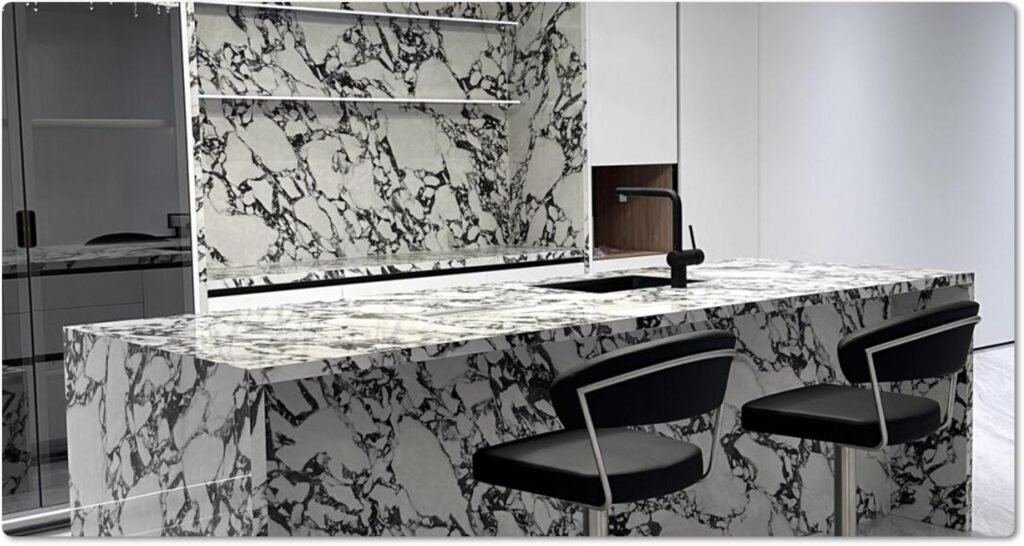
Trend 3: Waterfall Kitchen Islands
The countertop material continues down the side of the island.
Ultra compact slabs are frequently selected for this type of architectural application.
Trend 4: Natural Stone-Look Surfaces
Popular patterns include:
- Calacatta marble
- Arabescato marble
- Taj Mahal quartzite
- Travertine
- Limestone
- Concrete
The difference is that buyers increasingly want these appearances combined with lower maintenance.
Trend 5: Matte and Textured Finishes
Highly polished surfaces are no longer the only luxury option.
Growing interest includes:
- Matte
- Velvet
- Honed
- Textured finishes
Trend 6: Low-Maintenance Kitchens
Consumers increasingly prioritize materials that require:
- No regular sealing
- Minimal cleaning
- Strong stain resistance
Trend 7: Regulatory-Aware Material Selection
This is one of the most important B2B trends.
Developers and fabricators increasingly ask:
What is the composition of this material?
How should it be fabricated?
Does it comply with local requirements?
What safety documentation is available?
This makes technical transparency increasingly important.
How Durable Are Ultra Compact Kitchen Countertops?
Performance in Daily Kitchen Use
Ultra compact countertops are designed for demanding environments.
Typical performance advantages include:
Heat Resistance
Many ultracompact surfaces are designed to tolerate high temperatures better than many resin-based countertop materials.
However:
Direct thermal shock resistance should always be evaluated according to the manufacturer’s technical specifications.
Scratch Resistance
Dense mineral surfaces can provide strong resistance to everyday scratching.
However, countertops should not automatically be treated as cutting boards.
Knife blades may be damaged even when the countertop surface is not.
Stain Resistance
Low porosity can reduce liquid absorption.
This makes ultra compact surfaces suitable for kitchens exposed to:
- Coffee
- Wine
- Cooking oils
- Tomato sauce
- Citrus
UV Resistance
Many ultra compact and porcelain-based surfaces are suitable for environments exposed to sunlight.
This makes them attractive for:
- Outdoor kitchens
- Pool bars
- Exterior dining areas
Can Ultra Compact Countertops Be Used for Outdoor Kitchens?
Yes—But Product Selection Matters
Outdoor kitchens are one of the strongest application areas for high-performance ultracompact surfaces.
The material may need to withstand:
- UV exposure
- Rain
- Temperature changes
- Humidity
- Food stains
- Outdoor cleaning
However, buyers should verify:
UV Resistance
Not every countertop material performs equally under direct sunlight.
Freeze-Thaw Conditions
Important in cold climates.
Installation System
Outdoor structures expand and contract.
Adhesive Compatibility
The installation system must be designed for exterior conditions.
Ultra Compact Kitchen Countertops: Thickness Options
Common Thicknesses
Ultra compact slabs may be available in different thicknesses depending on the manufacturer.
Common architectural options include:
- 6 mm
- 8 mm
- 12 mm
- 20 mm
Some product systems also offer thicker formats for specific applications.
Major ultracompact brands, for example, offer multiple thickness options for countertop applications, while large-format dimensions can exceed 3 meters in length.
Which Thickness Is Best for Kitchen Countertops?
Thin Slabs
Best for:
- Wall cladding
- Backsplashes
- Cabinet surfaces
Medium Thickness
Best for:
- Standard kitchen countertops
- Islands
Thick or Built-Up Profiles
Best for:
- Luxury kitchen islands
- Bold edge designs
- Architectural statement pieces
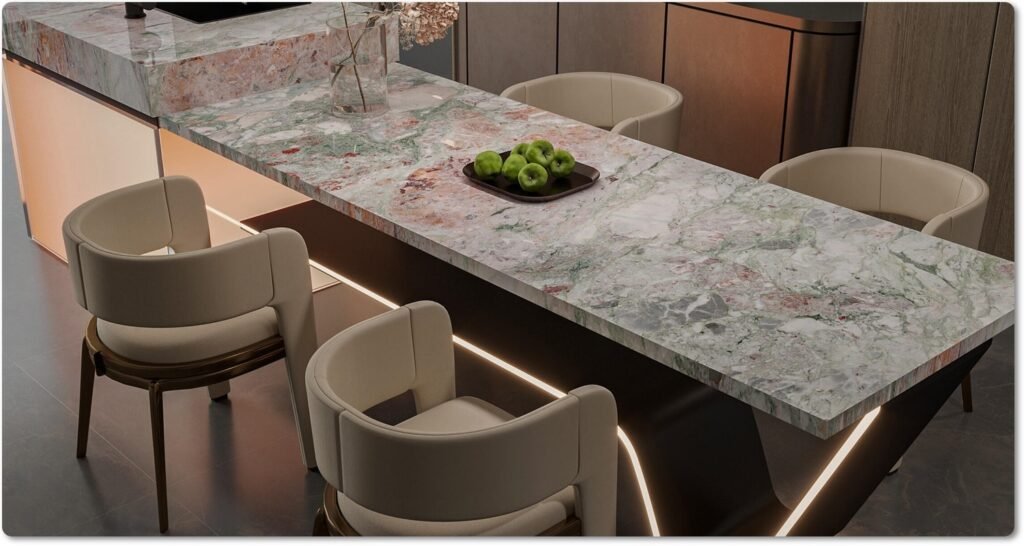
A mitered edge can create the appearance of a thicker countertop while using a thinner slab.
How to Choose an Ultra-Compact Countertop Manufacturer
10 Questions B2B Buyers Should Ask
1. What Is the Exact Material Composition?
Never rely only on a marketing name.
2. What Technical Standards Does the Product Meet?
Ask for:
- Technical Data Sheet
- Test reports
- Certifications
3. What Slab Sizes Are Available?
Large slabs can reduce seams.
4. What Thicknesses Are Available?
Thickness determines:
- Weight
- Fabrication method
- Edge possibilities
5. What Is the MOQ?
Important for wholesalers and distributors.
6. Can the Factory Provide OEM Services?
Useful for:
- Private labels
- Custom colors
- Custom packaging
7. What Is the Production Lead Time?
Critical for construction schedules.
8. What Packaging System Is Used?
Stone slabs require professional export packaging.
9. Does the Supplier Have Project Experience?
Ask for:
- Hotel projects
- Apartment projects
- Commercial projects
- Kitchen projects
10. What Technical Support Is Available?
A good supplier should provide:
- Fabrication guidance
- Installation recommendations
- Technical documentation
Why Work With an Ultra Compact Countertop Factory?
Manufacturer vs Trader: What Is the Difference?
For large-volume procurement, working directly with an ultra compact countertop manufacturer may offer advantages.
Factory Advantages:
- Better production communication
- Customization possibilities
- Batch control
- OEM capability
- Wholesale pricing
- Packaging control
- Project support
However, buyers should still conduct supplier verification.
A professional sourcing process should include:
Factory Evaluation
- Production capability
- QC procedures
- Export experience
Product Evaluation
- Sample inspection
- Color consistency
- Surface quality
Documentation Review
- Technical data
- Safety documents
- Certifications
EDG Stone and Ultra Compact Kitchen Countertops
Sourcing High-Performance Kitchen Surfaces for Global Projects
EDG Stone serves global buyers looking for natural stone and advanced surface materials for residential and commercial projects.
For kitchen countertop sourcing, buyers increasingly need more than a simple slab supplier.
They need a supply partner capable of understanding:
- Countertop applications
- Slab selection
- Thickness requirements
- Fabrication requirements
- Export packaging
- Project quantities
- Wholesale procurement
EDG Stone can position its ultra compact surface solutions around a broader material strategy.
Recommended EDG Stone Application Categories:
- Ultra Compact Kitchen Countertops
- Ultra Compact Kitchen Islands
- Ultra Compact Backsplashes
- Outdoor Kitchen Countertops
- Commercial Kitchen Surfaces
- Large-Format Architectural Slabs
For B2B buyers, the strongest value proposition is not simply:
“We sell slabs.”
It is:
“We help global buyers source the right surface material for the right application.”
Ultra Compact Countertops vs Other Kitchen Materials
Ultra Compact vs Marble
Marble Advantages:
- Natural beauty
- Unique veining
- Luxury appearance
Ultra Compact Advantages:
- Lower maintenance
- Higher stain resistance
- Greater consistency
Ultra Compact vs Granite
Granite Advantages:
- Natural material
- Strong durability
- Unique appearance
Ultra Compact Advantages:
- Large-format design
- Modern aesthetics
- Low porosity
Ultra Compact vs Quartzite
Quartzite Advantages:
- Natural stone
- Exceptional visual depth
- Luxury positioning
Ultra Compact Advantages:
- Consistent appearance
- Easier sourcing for large projects
- Predictable patterns
Buying Checklist for Ultra Compact Kitchen Countertops
Before You Buy, Confirm These Details
Design
- What color works with the cabinets?
- Do you need bookmatching?
- Do you need a waterfall island?
Performance
- Is heat resistance important?
- Will the kitchen receive direct sunlight?
Fabrication
- Does your fabricator have experience with the material?
- Are specialized tools required?
Installation
- Is the cabinet structure strong enough?
Logistics
- How will large slabs be transported?
Regulations
- Does the material comply with relevant local requirements?
Documentation
Request:
- Technical Data Sheet
- SDS
- Installation guide
- Fabrication guide
The Future of Ultra Compact Kitchen Countertops
From Decorative Surfaces to Performance Architecture
The future countertop is becoming more architectural.
The winning materials will not be selected only because they look like marble.
They will be selected because they can perform across multiple applications.
Future kitchens will increasingly use one surface for:
- Countertops
- Backsplashes
- Islands
- Cabinet panels
- Dining tables
- Wall cladding
This creates what can be described as:
The integrated surface kitchen.
Ultra-compact materials are well positioned for this trend because large-format slabs can support visual continuity across multiple architectural elements.
Semantic Insight: How to Select the Right Ultra-Compact Kitchen Countertop
Ultra Compact Kitchen Countertops: The Complete Selection Framework
What Is the Real Value of an Ultra Compact Countertop?
The real value is not simply extreme durability. The value comes from combining design flexibility, low porosity, heat performance, large-format possibilities, and architectural versatility in one surface category.
Why Is the Market Moving Toward Ultra Compact Surfaces?
The countertop market is responding to three simultaneous changes: consumers want lower-maintenance kitchens, designers want seamless large-format surfaces, and professional buyers increasingly evaluate material composition, fabrication risk,k and regulatory requirements.
How Should Buyers Compare Ultra Compact Countertops with Quartz?
Buyers should compare actual product data rather than marketing claims. The comparison should include heat resistance, UV performance, slab size, thickness, fabrication requirements, price, local regulations, ns and the experience of the installation team.
Option: Which Type of Ultra Compact Surface Is Best?
There is no single best option for every project. A luxury indoor kitchen may prioritize marble aesthetics and seamless veining. An outdoor kitchen may prioritize UV and weather resistance. A commercial project may prioritize durability, supply consistency,ncy and technical documentation.
Consideration: What Should Professional Buyers Evaluate Before Purchasing?
Professional buyers should evaluate the entire supply chain: manufacturer capability, slab consistency, packaging, shipping, fabrication support, installation requirements, safety documentation, and applicable regulations. The cheapest slab price does not always represent the lowest total project cost.
Industry Direction: What Will Define the Next Generation of Kitchen Countertops?
The next generation of countertops will increasingly combine high performance, architectural integration, large-format design, regulatory awareness, and transparent technical information. The market is moving from decorative material selection toward intelligent surface specification.
Search Conclusion: Ultra-compact kitchen countertops are becoming a major alternative to traditional quartz and natural stone because they support the growing demand for seamless design, high-performance surfaces, and more informed material procurement. The best choice depends on application requirements, fabrication capability, budget,t and local regulations.
Frequently Asked Questions About Ultra-Compact Kitchen Countertops
1. What is an ultra-compact surface countertop?
An ultra-compact surface countertop is a high-density architectural surface manufactured using advanced compaction and high-temperature processing technologies. It is designed to provide low porosity and strong resistance to everyday kitchen conditions.
2. What are the key differences between an ultracompact countertop and quartz countertops?
Ultra-compact surfaces are generally based on advanced mineral compaction or sintering technologies, while quartz countertops are engineered surfaces commonly made using mineral aggregates and binders. Differences may include heat performance, UV resistance, fabrication requirements, and regulatory considerations.
3. Are ultra-compact countertops more expensive than quartz?
It depends on the brand, design, slab thickness, fabrication,n and installation. Premium ultra-compact surfaces can cost more than standard quartz, but wholesale sourcing and project quantities can significantly affect the final price.
4. What is the best countertop for a small kitchen?
Light-colored large-format surfaces are often effective because they reduce visual seams and create a more continuous appearance. White marble-look ultra-compact surfaces, porcelain slabs, and light quartz are popular options.
5. What is the newest trend in kitchen countertops?
Major trends include large-format slabs, waterfall islands, full-height backsplashes, natural stone-look surfaces, matte finishes,s and high-performance materials that combine design with low maintenance and technical transparency.
Final Thoughts: Are Ultra Compact Kitchen Countertops Worth It?
Ultra-compact kitchen countertops are not simply another countertop trend.
They represent a broader transformation in the architectural surface industry.
The market is moving toward materials that deliver:
- Better performance
- Larger formats
- More design continuity
- Lower maintenance
- Greater application versatility
- Improved technical transparency
For homeowners, the right countertop depends on lifestyle and design preferences.
For architects, the decision depends on performance and application.
For distributors and wholesalers, the decision depends on supply consistency and pricing.
For commercial buyers, the decision increasingly includes technical documentation and regulatory considerations.
For companies sourcing from global suppliers, working with an experienced stone and surface partner such as EDG Stone can help simplify the process of comparing natural stone, quartz, porcelain, sintered stone, and ultra-compact surface options.
The future of kitchen design is not about choosing the most fashionable slab.
It is about choosing the right surface for the complete project ecosystem.