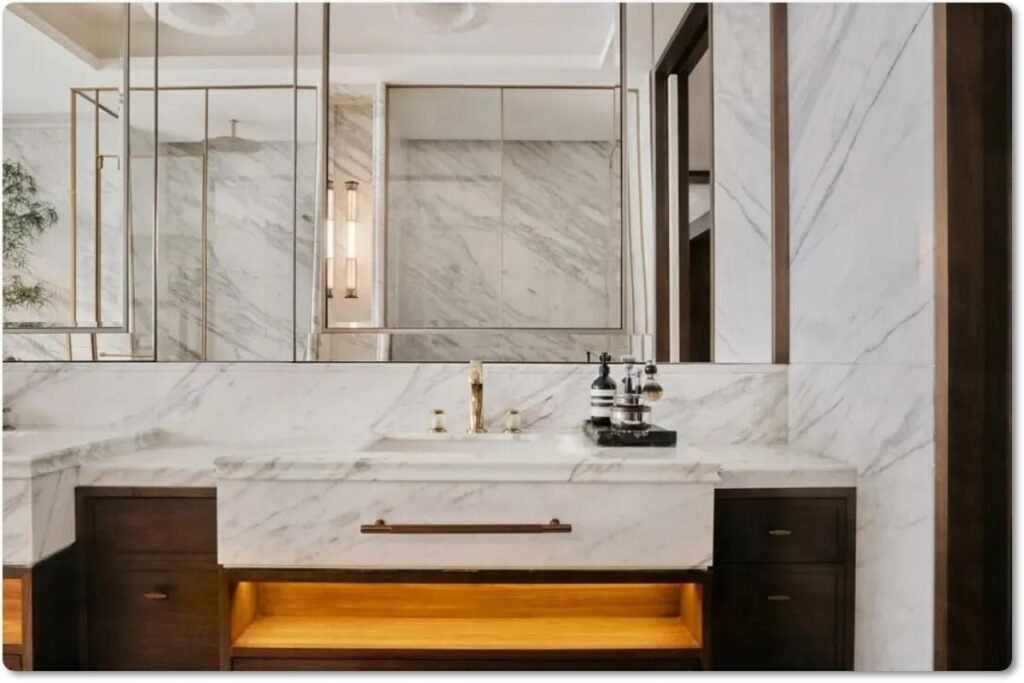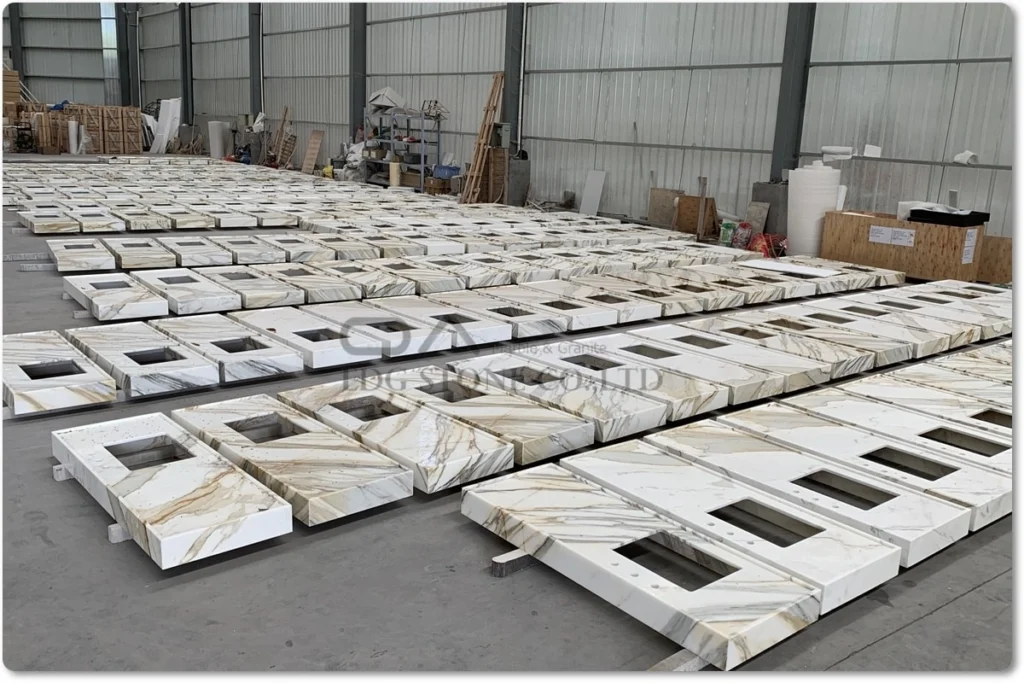
What Are Ultra-Compact Slabs? A Quick Answer
Ultra Compact Surfaces: What They Are, Why They Matter, and Where the Market Is Going
Ultra compact slabs represent the evolution of large-format architectural surfaces. Their value is not limited to appearance: they combine design flexibility, large dimensions, low porosity, durability, and multi-application performance. As global construction markets place greater emphasis on product traceability, technical documentation, worker safety, lifecycle performance, and lower-maintenance building materials, ultra-compact surfaces are increasingly positioned as an important alternative to conventional engineered stone and natural stone in selected applications.
What: A dense, high-performance architectural surface produced through advanced compaction and sintering technologies.
Why: Designers and buyers increasingly require surfaces that can perform across kitchens, bathrooms, façades, furniture, and commercial projects.
How: Mineral-based raw materials are processed, compacted, and sintered to create an extremely dense finished surface.
Options: Buyers can choose different slab sizes, thicknesses, finishes, colors, marble-look designs, concrete-look designs, stone-look surfaces, and application-specific specifications.
Considerations: The best material depends on application, fabrication capability, transportation, slab thickness, edge design, installation conditions, budget, local regulations, and long-term maintenance requirements.
Ultra-compact slabs are becoming one of the most important categories in the global architectural surface industry. From luxury kitchens and bathroom vanity tops to hotel walls, commercial flooring, outdoor kitchens, furniture, and building façades, designers are increasingly looking for materials that combine the visual appeal of natural stone with modern technical performance.
But what exactly are ultra compact surfaces?
Are ultra-compact countertops the same as porcelain slabs?
Is Dekton the same as an ultra-compact slab?
And how do ultra compact countertops compare with quartz?
This complete guide from EDG Stone explains everything buyers, architects, fabricators, distributors, contractors, and project developers need to know about ultra-compact porcelain, ultra-compact slabs, compact slabs, and high-performance countertop surfaces.
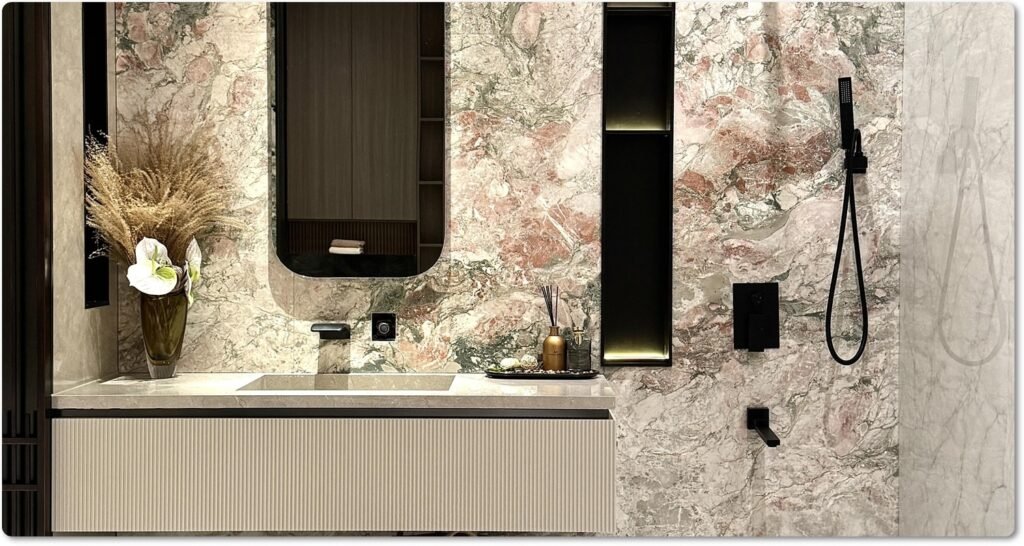
What Are Ultra Compact Slabs?
Ultra compact slabs are engineered architectural surfaces manufactured through advanced material-processing technologies that create extremely dense and durable slabs.
The category may include products marketed as:
- Ultra compact surfaces
- Ultra compact slabs
- Ultra compact porcelain
- Sintered stone slabs
- Large-format porcelain slabs
- Compact slabs
- Ultra compact countertops
- High-performance ceramic surfaces
Although terminology varies between manufacturers and markets, the central idea is similar: the material is designed to create a dense, low-porosity surface suitable for demanding architectural applications.
Many ultra-compact surfaces are manufactured from combinations of natural minerals, clays, feldspars, silica-based materials, and other inorganic components. These raw materials are processed using controlled industrial technologies involving compaction and high-temperature sintering.
The result is a large-format surface with characteristics that may include:
- Very low porosity
- High resistance to staining
- Strong scratch resistance
- High-temperature resistance
- UV stability
- Color stability
- Resistance to many common household chemicals
- Large-format design possibilities
- Low-maintenance performance
However, performance can vary significantly between manufacturers, thicknesses, product collections, finishes, and intended applications. Buyers should always review the manufacturer’s technical documentation before specifying a product for commercial or structural use.
What Is an Ultra Compact Surface Made Of?
The composition of an ultra compact surface depends on the manufacturer and manufacturing technology.
In general, these surfaces are based primarily on carefully selected inorganic mineral materials.
Typical Raw Material Categories Include:
1. Natural Minerals
Mineral components provide the foundation for the physical structure of the material.
2. Clays and Ceramic Materials
These materials contribute to the ceramic body and sintering process.
3. Silica-Based Raw Materials
Certain products may contain silica-containing raw materials, although composition differs substantially from product to product.
4. Feldspar and Mineral Fluxes
These materials can support vitrification and densification during firing.
5. Inorganic Pigments
Pigments and decorative technologies create marble-look, concrete-look, metal-look, wood-look, and contemporary architectural designs.
The exact formulation is generally proprietary.
Therefore, professional buyers should not assume that all ultra-compact slabs have identical chemical compositions simply because they are marketed under similar terminology.
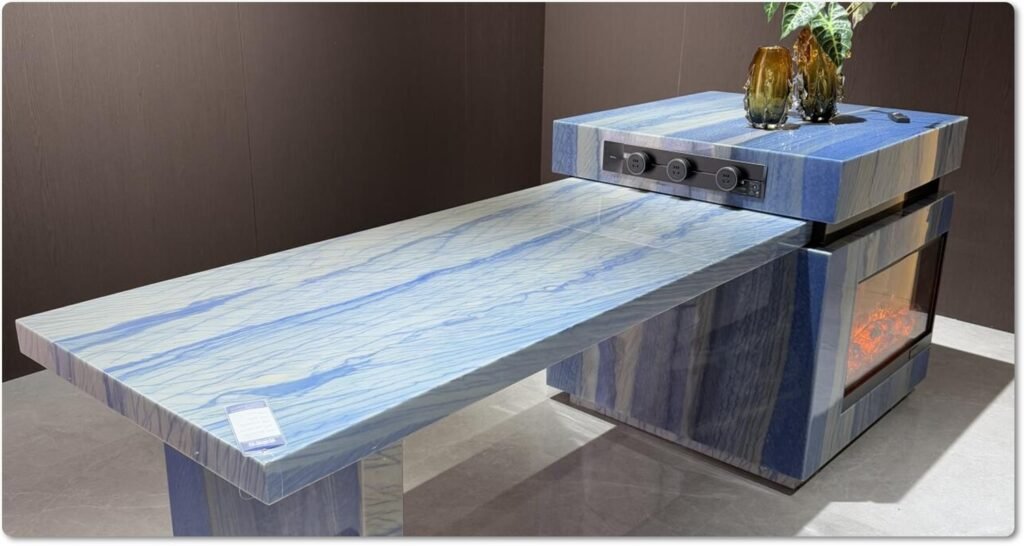
How Are Ultra Compact Slabs Manufactured?
The manufacturing process is one of the main reasons ultra-compact slabs are positioned as advanced architectural surfaces.
Although technologies vary by producer, the process generally includes several stages.
Step 1: Raw Material Selection
Minerals and ceramic raw materials are selected according to the desired technical and aesthetic properties.
Step 2: Material Processing
Raw materials are processed into controlled particle sizes and prepared for manufacturing.
Step 3: Mixing and Formulation
The materials are combined according to a specific industrial formulation.
Step 4: Ultra Compaction
The material is subjected to extremely high pressure.
This process helps reduce internal voids and creates a dense material structure.
Step 5: High-Temperature Sintering
The compacted material is exposed to very high temperatures.
Sintering allows particles to bond and densify without simply functioning like a conventional adhesive-based composite.
Step 6: Surface Decoration and Finishing
Modern technologies can create highly realistic designs, including:
- Calacatta marble looks
- Statuario marble looks
- Travertine designs
- Concrete surfaces
- Industrial textures
- Natural stone patterns
- Solid colors
- Metal-inspired surfaces
Step 7: Quality Control
Finished slabs are inspected for dimensional consistency, visual quality, surface characteristics, and applicable technical specifications.
What Is Dekton?
Dekton® is one of the best-known branded ultra-compact surface products in the international market.
It is manufactured and marketed by Cosentino.
The term Dekton is often used by consumers as if it were a general material category, but this is not technically correct.
Dekton Is a Brand, Not the Generic Name of the Entire Category
The broader category includes products that may be described as:
- Ultra-compact surfaces
- Sintered stone
- Large-format ceramic slabs
- Ultra-compact porcelain
Dekton has helped popularize the concept of ultra-compact architectural surfaces worldwide.
According to current Cosentino product information, Dekton is available in large slab formats and multiple thicknesses depending on the application. Standard formats are commonly around 3,200 × 1,440 mm, while Jumbo formats can reach approximately 3,300 × 1,630 mm.
This large-format capability is one of the reasons ultra compact surfaces have become attractive for kitchen countertops, wall panels, and architectural projects.
What Are Ultra Compact Countertops?
Ultra compact countertops are kitchen or bathroom work surfaces fabricated from ultra compact slabs.
They are increasingly used for:
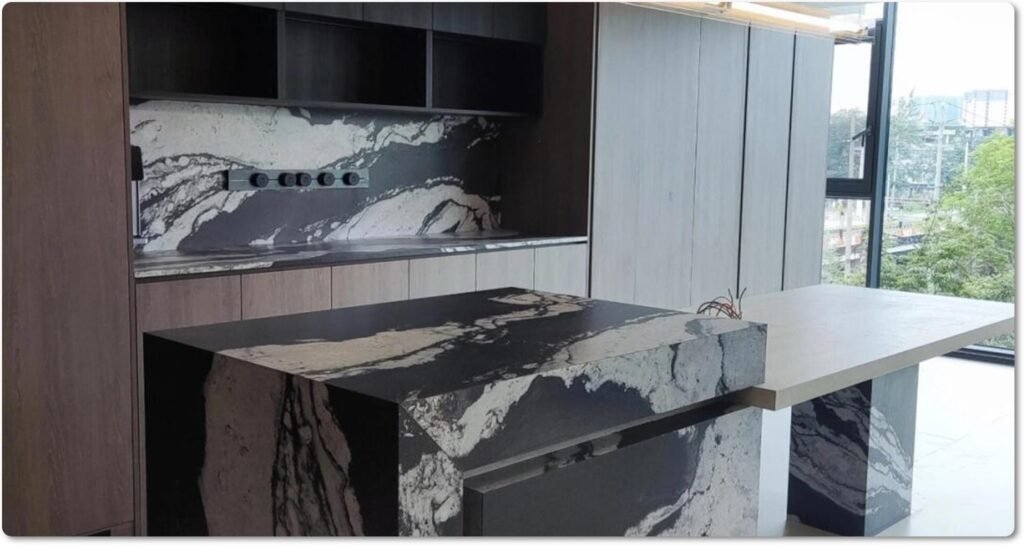
- Kitchen countertops
- Kitchen islands
- Bathroom vanity tops
- Backsplashes
- Waterfall islands
- Outdoor kitchens
- BBQ countertops
- Commercial work surfaces
- Restaurant counters
- Hotel vanity tops
The key advantage is that one material category can potentially serve multiple architectural functions.
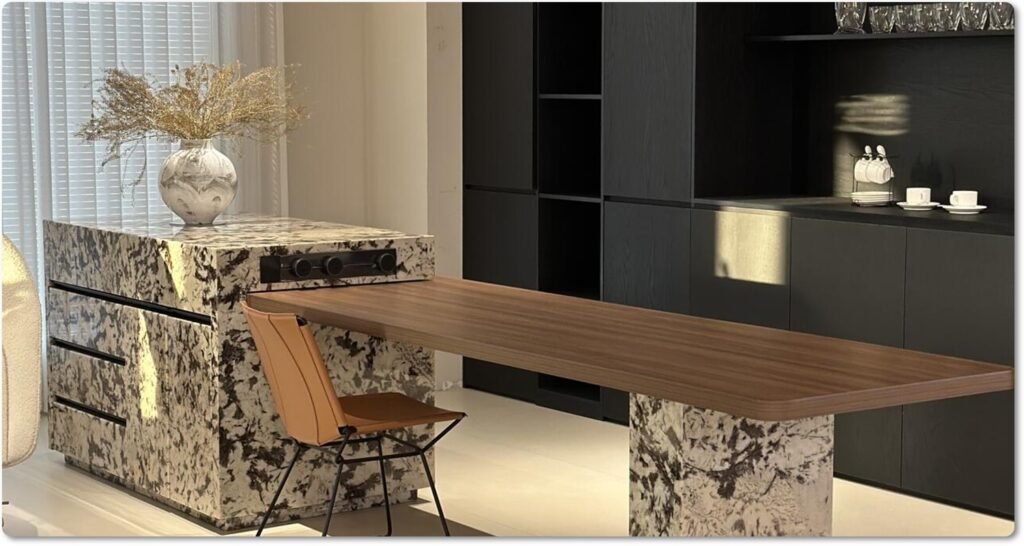
For example, the same design may be extended from:
Countertop → Backsplash → Wall Panel → Cabinet Surface → Furniture
This creates stronger visual continuity and supports modern minimalist interior design.
Ultra Compact Countertops vs Quartz: What Is the Difference?
One of the most frequently searched questions is:
Ultra compact countertops vs quartz: which is better?
The answer depends on the application.
Ultra Compact Surfaces
Ultra compact slabs are generally mineral- and ceramic-based surfaces manufactured through advanced compaction and sintering technologies.
They are commonly selected for:
- High-temperature environments
- Outdoor applications
- Large-format walls
- UV-exposed surfaces
- Commercial projects
- Low-maintenance architectural applications
Quartz Countertops
Engineered quartz surfaces typically contain quartz minerals combined with resins, pigments, and other components.
Quartz remains extremely popular because of:
- Wide color availability
- Consistent appearance
- Strong stain resistance
- Established fabrication infrastructure
- Broad residential availability
However, buyers should understand that the two materials perform differently under extreme heat and UV exposure.
Ultra Compact Countertops vs Quartz Comparison
| Factor | Ultra Compact Surface | Engineered Quartz |
|---|---|---|
| Heat Resistance | Generally strong | Depends on resin system and manufacturer |
| UV Resistance | Generally suitable for UV-exposed applications when specified | Some products may have limitations outdoors |
| Large Format | Often available in very large slabs | Large slabs also available |
| Outdoor Applications | Commonly considered for outdoor projects | Requires manufacturer-specific verification |
| Fabrication Difficulty | Can require specialized equipment and experience | Established fabrication methods |
| Design Options | Very broad and increasingly realistic | Very broad |
| Low Porosity | Typically very low | Typically low |
The best choice depends on the project.
For example:
Luxury indoor kitchen: Both quartz and ultra-compact surfaces can be excellent options.
Outdoor kitchen: Ultra-compact porcelain may provide advantages where UV and heat exposure are major concerns.
Large commercial wall: Lightweight or thin ultra-compact panels may be more appropriate.
High-volume residential development: Cost, fabrication capacity, logistics, and local supply availability may determine the best option.
Why Are Ultra-Compact Slabs Becoming More Popular?
Several global trends are driving the growth of ultra-compact surfaces.
1. Demand for Large-Format Architectural Surfaces
Modern architecture increasingly favors fewer visible joints.
Large-format slabs allow designers to create:
- Continuous kitchen islands
- Large shower walls
- Bookmatched feature walls
- Minimalist interiors
- Large commercial surfaces
For example, current Dekton product formats include large slabs around 3,200 × 1,440 mm, with larger Jumbo formats available for selected applications.
2. Growth of Outdoor Living
Outdoor kitchens and entertainment spaces are becoming increasingly important in residential design.
Materials exposed to:
- Sunlight
- Temperature changes
- Rain
- Humidity
- Outdoor pollution
require careful material selection.
Ultra-compact surfaces are increasingly considered for these applications because many products are designed to offer strong UV and weather resistance.
3. The Search for Low-Maintenance Materials
Modern consumers increasingly prefer surfaces that do not require frequent sealing or complicated maintenance.
Low-porosity materials can simplify daily cleaning.
4. Design Technology Is Improving
Digital decoration and advanced manufacturing technologies now allow ultra-compact slabs to reproduce natural materials with remarkable realism.
Popular designs include:
- Calacatta marble look
- Statuario marble look
- Taj Mahal quartzite look
- Travertine look
- Concrete look
- Dark stone look
Ultra Compact Slab Sizes and Thicknesses
One of the major advantages of this category is format flexibility.
Typical ultra compact slab thicknesses may include:
- 4 mm
- 6 mm
- 8 mm
- 12 mm
- 20 mm
- 30 mm
Availability varies by manufacturer.
Thin Slabs
Thin slabs are commonly used for:
- Wall cladding
- Furniture surfaces
- Cabinet doors
- Backsplashes
- Renovation projects
Dekton Slim, for example, is promoted as a 4 mm lightweight format for walls and furniture applications.
12 mm Slabs
12 mm is a common thickness for:
- Kitchen countertops
- Bathroom vanity tops
- Commercial counters
20 mm and 30 mm Slabs
Thicker materials may be selected for:
- Heavy-duty countertops
- Outdoor kitchens
- Tables
- Architectural features
- Flooring applications
The correct thickness should always be selected based on span, support structure, fabrication design, application, and manufacturer recommendations.
Ultra Compact Countertop Price: How Much Do Ultra Compact Slabs Cost?
The ultra compact countertop price depends on several factors.
There is no single global price because projects differ significantly.
Key Pricing Factors Include:
1. Brand
Premium international brands generally have different pricing structures from wholesale manufacturers.
2. Slab Size
Larger slabs can reduce joints but may increase transportation and handling complexity.
3. Thickness
Thicker slabs generally require more material.
4. Surface Design
Complex marble-look designs or premium collections may have higher prices.
5. Fabrication
Countertop fabrication can include:
- Cutouts
- Sink openings
- Cooktop openings
- Mitered edges
- Waterfall panels
- Drain grooves
- Polishing
6. Installation
Installation costs vary by country and project complexity.
Dekton Cost
The Dekton cost also varies depending on color, slab size, thickness, fabrication, and installation.
Cosentino itself notes that project pricing depends on fabrication and installation requirements, as well as the selected color, size, and thickness.
Therefore, buyers should compare:
Material Cost + Fabrication Cost + Transportation + Installation + Waste Factor
rather than comparing slab prices alone.
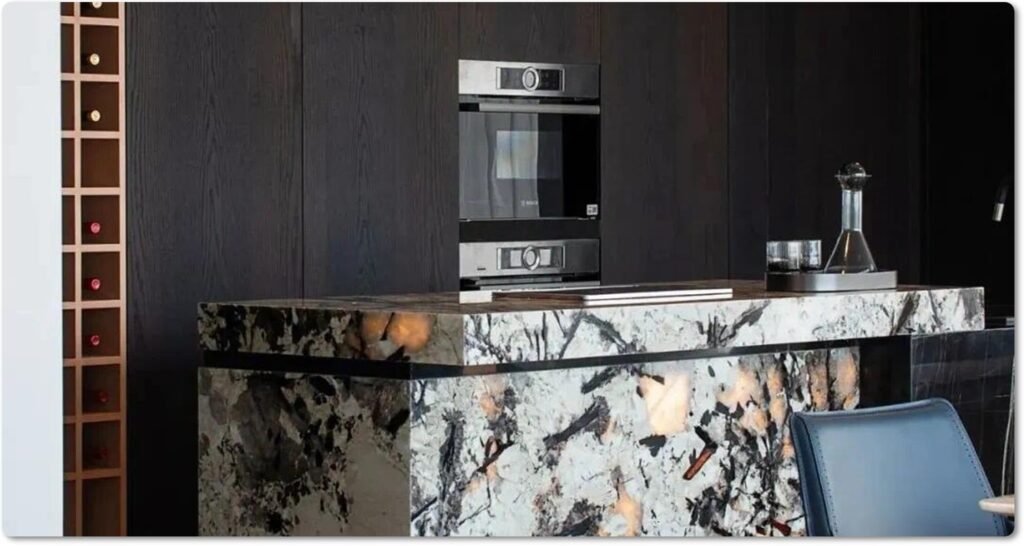
Ultra Compact Slabs for Kitchens
Kitchen countertops remain one of the largest application areas.
Popular kitchen applications include:
- Ultra compact porcelain countertop
- Kitchen island
- Waterfall countertop
- Full-height backsplash
- Dining table
- Cabinet cladding
Why Designers Choose Ultra Compact Kitchen Countertops
The main advantages include:
- Large-format appearance
- Minimal visible joints
- Low porosity
- Modern marble-look designs
- Heat resistance
- Easy daily maintenance
However, fabrication quality is critical.
Ultra-compact slabs can require experienced fabricators, appropriate cutting equipment, correct tooling, and careful handling.
Ultra Compact Slabs for Bathrooms
Bathrooms are another major application.
Ultra-compact slabs can be used for:
- Vanity tops
- Shower walls
- Bathtub surrounds
- Bathroom feature walls
- Floor surfaces
Large-format slabs can significantly reduce grout lines compared with traditional small-format tiles.
This can create:
A cleaner appearance + fewer visible joints + easier maintenance
Ultra Compact Slabs for Wall Cladding
Large-format wall panels are one of the fastest-growing applications for compact slabs.
Common applications include:
- Hotel lobbies
- Luxury residences
- Apartment projects
- Retail stores
- Office interiors
- Restaurant walls
- Fireplace surrounds
Some systems also use ultra-compact panels in exterior façade applications.
However, façade applications require professional engineering, approved fixing systems, and compliance with local building regulations.
Industry Regulations and Why Compliance Is Becoming More Important
The architectural surface industry is increasingly influenced by regulations relating to product information, construction performance, environmental documentation, worker safety, and material traceability.
European Construction Products Regulation
The European Union’s Construction Products Regulation provides harmonized rules for the marketing and performance assessment of construction products.
The new Regulation (EU) 2024/3110 also establishes a framework for a future construction digital product passport system and emphasizes interoperability with modern construction information systems such as BIM.
For manufacturers and exporters, this direction is important.
The future market is increasingly moving toward:
- Better product documentation
- Performance transparency
- Digital product information
- BIM compatibility
- Traceability
- Environmental information
Worker Safety and Silica Exposure
Another important industry trend is occupational safety during stone fabrication.
The U.S. Occupational Safety and Health Administration has increased attention to respirable crystalline silica exposure in stone countertop fabrication and installation environments.
OSHA notes that engineered stone can contain very high levels of crystalline silica and has identified cutting, grinding, drilling, and polishing as processes requiring effective exposure controls.
This does not mean that every ultra-compact slab is automatically risk-free during fabrication.
Different materials have different compositions, and cutting any mineral-based surface can generate dust.
Therefore, responsible fabrication should include appropriate controls such as:
- Wet cutting
- Local exhaust ventilation
- HEPA filtration
- Appropriate housekeeping
- Worker training
- Personal protective equipment where required
This regulatory and safety direction is pushing the entire surface industry toward more professional fabrication systems.
Ultra Compact Surfaces and Sustainability Trends
Sustainability is becoming increasingly important in construction materials.
Future purchasing decisions are likely to consider not only appearance and price but also:
- Material durability
- Product lifespan
- Maintenance requirements
- Environmental documentation
- Manufacturing efficiency
- Transportation impact
- Waste reduction
- Product traceability
Large-format slabs can potentially reduce the number of joints and simplify certain installations, while optimized slab sizes may also help reduce cutting waste for specific applications.
For example, manufacturers are increasingly developing application-specific formats designed to improve handling and material efficiency.
The most important sustainability question is not simply:
“Is this material sustainable?”
The better question is:
“How does this material perform throughout its complete lifecycle?”
That includes production, transportation, fabrication, installation, maintenance, durability, replacement, and end-of-life management.
How to Choose an Ultra-Compact Slab Manufacturer?
For distributors, contractors, wholesalers, and project buyers, selecting the right supplier is critical.
1. Check Manufacturing Capability
Ask whether the supplier is:
- A manufacturer
- A factory-direct supplier
- A trading company
- A distributor
2. Request Technical Documentation
Professional suppliers should be able to provide relevant documentation for the intended market and application.
3. Review Available Slab Sizes
Large slab sizes can influence:
- Container loading
- Fabrication yield
- Transportation
- Installation
- Project waste
4. Check Thickness Availability
A strong ultra-compact slab supplier should offer application-specific thickness options.
5. Evaluate Surface Quality
Check:
- Color consistency
- Pattern continuity
- Surface flatness
- Edge quality
- Batch consistency
6. Ask About Wholesale and Project Supply
B2B buyers should ask about:
- MOQ
- Container quantities
- Mixed colors
- Custom cutting
- OEM options
- Project support
- Export packaging
EDG Stone and Ultra Compact Surface Solutions
EDG Stone works with global buyers seeking architectural surface materials for residential, commercial, hospitality, and project applications.
For professional buyers, the purchasing process should go beyond selecting a beautiful slab.
A complete sourcing decision should consider:
Material Selection → Technical Requirements → Slab Size → Thickness → Fabrication → Packaging → Shipping → Installation → Long-Term Maintenance
This is particularly important for international projects.
A material that looks excellent in a showroom may still create problems if:
- The slab size does not fit the project layout
- The fabricator lacks suitable equipment
- The thickness is incorrectly specified
- The packaging is insufficient for export
- The installation system is not compatible
EDG Stone can support buyers in evaluating different stone and surface material options based on project requirements rather than simply selecting the lowest initial price.
Are Ultra Compact Slabs Better Than Natural Stone?
Not necessarily.
They are different materials with different strengths.
Natural Stone Advantages
Natural stone offers:
- Unique geological patterns
- Natural variation
- Authenticity
- Timeless luxury
Ultra Compact Surface Advantages
Ultra-compact surfaces can offer:
- High consistency
- Large-format designs
- Low porosity
- Strong UV performance
- High-temperature resistance
- Modern technical characteristics
The best material depends on the project.
Luxury residential projects may even combine both.
For example:
Natural Marble Feature Wall + Ultra Compact Kitchen Countertop
or:
Natural Travertine Flooring + Ultra Compact Bathroom Walls
The future of architecture is not necessarily about replacing one material with another.
It is increasingly about selecting the right material for the right application.
The Future of Ultra Compact Slabs
The ultra compact surface market is likely to continue developing in several important directions.
Trend 1: Larger Formats
Architects want fewer joints and more continuous surfaces.
Trend 2: Thinner Materials
Thin slabs support:
- Renovation
- Furniture
- Wall cladding
- Lightweight applications
Trend 3: Better Natural Stone Designs
Digital decoration technologies are making marble-look and natural stone-look surfaces increasingly realistic.
Trend 4: BIM and Digital Product Information
Construction product documentation is moving toward greater digital integration and traceability.
Trend 5: Safer Fabrication
Dust control and professional fabrication systems are becoming increasingly important.
Trend 6: Lifecycle-Based Purchasing
Buyers are beginning to evaluate:
Initial Cost + Installation + Maintenance + Durability + Replacement Risk
instead of simply comparing slab prices.
Ultra Compact Slabs: The Buyer’s Decision Framework
Before purchasing ultra-compact slabs, ask five essential questions.
What Do I Need?
Countertop?
Wall?
Floor?
Furniture?
Outdoor kitchen?
Commercial project?
Why Am I Choosing This Material?
Heat resistance?
UV stability?
Low maintenance?
Large format?
Design?
Durability?
What Options Are Available?
Thickness?
Finish?
Slab size?
Color?
Pattern?
Application system?
What Should I Consider Before Buying?
Fabrication?
Transportation?
Installation?
Local regulations?
Technical specifications?
Budget?
How Will the Material Perform Long-Term?
Maintenance?
Wear?
Cleaning?
Replacement?
Future availability?
This framework helps buyers make better decisions than simply searching for the lowest ultra-compact countertop price.
FAQ: Ultra Compact Slabs and Ultra Compact Countertops
1. What are ultra compact slabs?
Ultra compact slabs are high-density architectural surfaces produced through advanced compaction and sintering technologies. They are commonly used for countertops, wall cladding, flooring, bathrooms, furniture, and commercial architectural applications.
2. Is Dekton the same as ultra-compact porcelain?
Dekton is a branded ultra-compact surface product. Ultra compact porcelain and sintered surfaces are broader material categories that may include products from different manufacturers using different technologies and formulations.
3. Are ultra compact countertops better than quartz?
Neither material is universally better. Ultra-compact surfaces can offer advantages in heat, UV exposure, and outdoor applications, while quartz remains highly popular for indoor residential countertops. The best choice depends on the application.
4. How much do ultra compact countertops cost?
Ultra compact countertop price depends on slab brand, size, thickness, design, fabrication, transportation, installation, and regional labor costs. Buyers should compare the complete installed cost rather than slab price alone.
5. Can ultra compact slabs be used outdoors?
Many ultra-compact surfaces are designed for outdoor applications because of their UV and weather resistance. However, buyers should always verify the manufacturer’s technical specifications for the specific product and installation system.
Final Insight: Why Ultra Compact Slabs Are Reshaping the Surface Industry?
Ultra Compact Slabs in One Complete Perspective
What they are: Ultra compact slabs are advanced large-format architectural surfaces designed to combine mineral-based material technology, extreme densification, decorative design, and multi-application performance.
Why the category is growing: Modern architecture increasingly demands larger surfaces, fewer joints, low-maintenance materials, outdoor durability, realistic stone aesthetics, and better technical performance.
How they create value: Their value comes from application flexibility. A single surface family can potentially support countertops, backsplashes, walls, bathrooms, furniture, floors, and architectural projects.
The most important options: Buyers can choose between different slab sizes, thicknesses, finishes, marble-look designs, concrete-look surfaces, compact formats, lightweight panels, and project-specific fabrication solutions.
What buyers should consider: Material performance alone is not enough. The final success of an ultra-compact surface project depends on slab selection, fabrication technology, worker safety, transportation, installation, local regulations, technical documentation, and lifecycle cost.
The market direction: The next generation of architectural surface purchasing will increasingly focus on traceability, BIM compatibility, digital product information, environmental documentation, safer fabrication, lifecycle performance, and application-specific material selection.
The strategic conclusion: Ultra-compact slabs are not simply another countertop material. They represent a broader shift toward high-performance, large-format architectural surfaces designed for the changing needs of global construction, interior design, hospitality, residential development, and commercial projects.
For architects, distributors, wholesalers, fabricators, contractors, and international buyers, the key question is no longer simply:
“What is the cheapest slab?”
The more important question is:
“Which surface material delivers the best combination of design, performance, fabrication efficiency, compliance, lifecycle value, and long-term reliability for this specific project?”
That is where ultra-compact surfaces are expected to play an increasingly important role.