Quick Summary: The 2026 Curved Stone Revolution
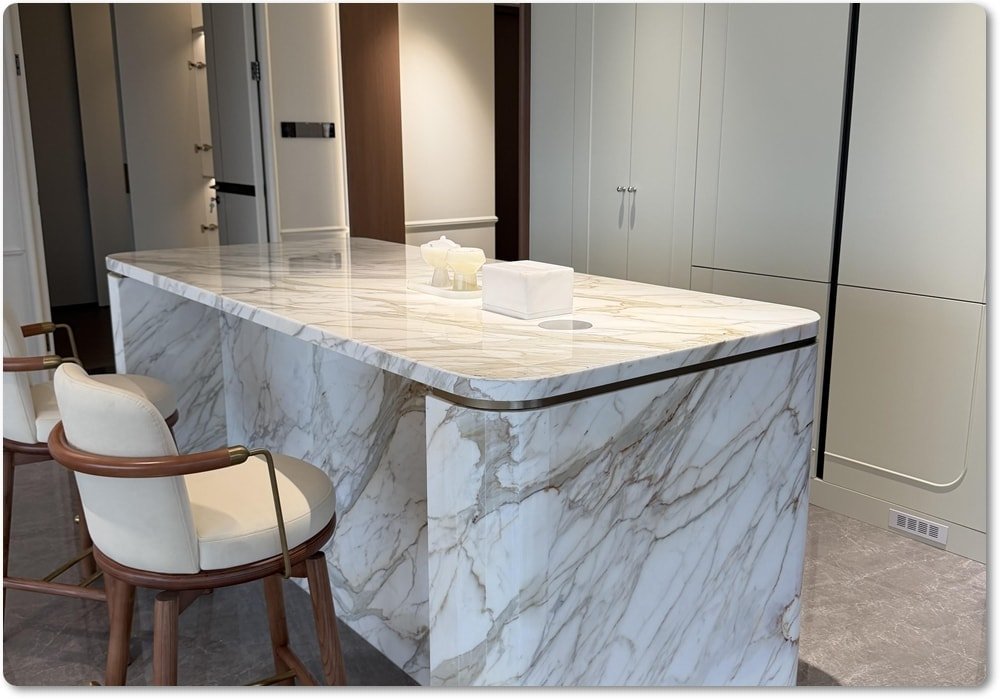
The Shift: As we approach 2026, kitchen countertops are moving away from sharp, rectangular minimalism toward “Soft Minimalism,” characterized by organic shapes, rounded islands, and fluid kitchen counter wall ideas.
The Challenge: This aesthetic shift demands a radical upgrade in manufacturing. It moves the industry from simple 3-axis bridge sawing to complex 5-axis CNC stone processing, requiring advanced waterjet technology and high-precision finishing tools.
The Solution: Manufacturers like EDG Stone are pivoting to meet these demands by integrating low-silica safety protocols and advanced digital fabrication techniques. This ensures that materials ranging from quartzite countertops to modern countertops made of sintered stone can be shaped safely, efficiently, and with architectural precision.
The era of the sharp 90-degree angle is waning. As we look toward the horizon of Kitchen countertops 2026, a distinct softening of the domestic landscape is taking place. The rigid, industrial lines that defined the last decade are being replaced by what designers are calling “Soft Minimalism”—an aesthetic prioritization of comfort, flow, and organic forms. For homeowners, this means rounded kitchen islands and fluid transitions. However, for the stone industry, this is not merely a change in taste; it is a fundamental shift in manufacturing capability.
The popularity of curved aesthetics places unprecedented demands on stone processing. It separates standard fabricators from advanced manufacturers like EDG Stone, who have invested in the requisite technology to turn rigid stone into fluid art. This article explores how the trending countertops 2026 are reshaping the factory floor, the necessary evolution of machinery, and the critical role of regulatory compliance in this new “curved” era.
The Psychology of Curves: Why Trending Countertops 2026 Are Going Organic?
To understand the manufacturing demand, we must first understand the market pull. Why are modern countertops abandoning the straight edge? The shift is driven by a desire for psychological comfort and ergonomic function in the post-pandemic home.
Biophilic Design and Emotional Comfort
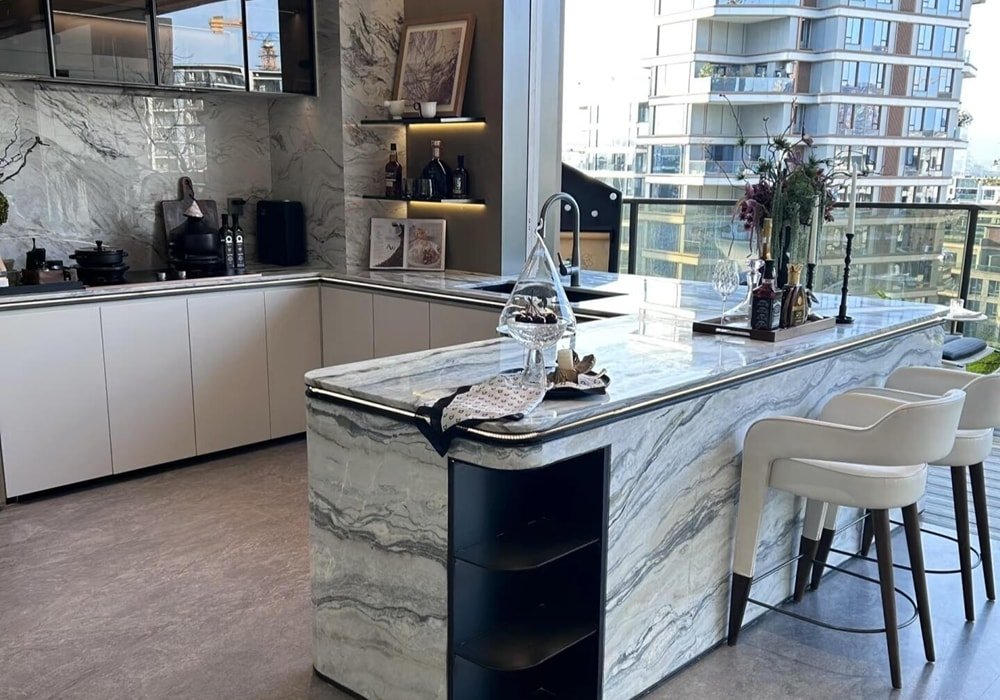
Biophilic design—the concept of connecting indoor spaces with the natural world—remains a dominant force. Nature rarely produces straight lines; it produces curves, arches, and irregular waves. Kitchen counter ideas for 2026 are heavily influenced by this desire to mimic natural formations. A curved marble countertop island mimics the erosion of a riverbed stone, creating a subconscious sense of calm. This “emotional ergonomics” is making the kitchen less of a workspace and more of a communal sanctuary.
Safety and Ergonomics in Multigenerational Kitchens
Practicality drives the curve as much as beauty. As kitchens solidify their status as the hub of the home, safety becomes paramount, especially for multigenerational families. Sharp corners on granite or quartz countertops pose injury risks to young children and elderly family members.
Flow Dynamics: Curved edges facilitate better movement around the island, removing physical “pinch points” in the kitchen layout.
Tactile Softness: A rounded edge invites touch, making the stone feel less cold and industrial.
The “Flow” of Open-Plan Living
Modern architecture continues to dissolve boundaries between the kitchen and living room. A sharp, rectangular block can feel jarring in a soft, furnished living area. Kitchen Counter wall ideas that utilize curved backsplashes or radiused peninsulas allow the kitchen to “bleed” naturally into the lounge area, creating a cohesive visual narrative.
Manufacturing the Curve: The Technical Revolution in Stone Processing
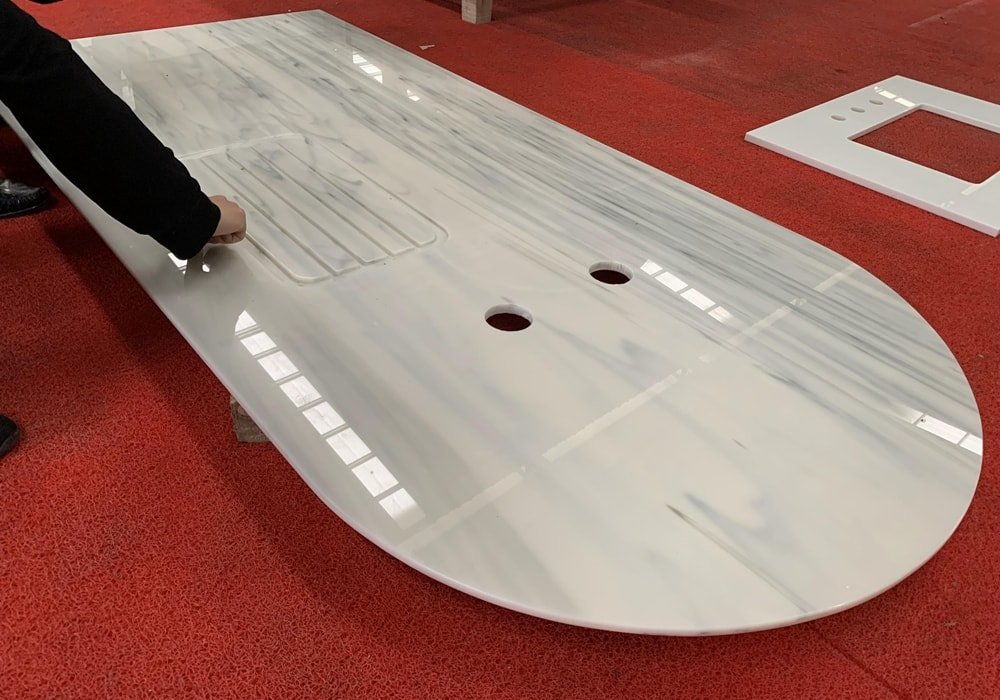
For a Custom curved stone countertop manufacturer in China or anywhere globally, the request for a curve changes everything. It transforms a cutting job into a sculpting job.
From 3-Axis to 5-Axis CNC: The New Standard
Historically, a standard 3-axis bridge saw was sufficient for 90% of kitchen jobs. It cut straight lines (X and Y axes) and moved up and down (Z axis). However, CNC stone processing for rounded kitchen islands requires the cutting head to tilt and rotate simultaneously.
The 5-Axis Necessity: To create a seamless curve on quartzite countertops or complex marbles, factories must utilize 5-axis CNC machines. These machines allow the blade or waterjet to approach the stone from virtually any angle, carving complex radii and creating “waterfall” edges that curve in two directions simultaneously.
Digital Templating: The manual template is obsolete. At EDG Stone, we utilize laser templating systems that map the exact curvature of the cabinetry to a fraction of a millimeter. This digital file is fed directly into the CNC, ensuring that the stone follows the intended organic geometry perfectly.
Waterjet Technology and Nesting Efficiency
Cutting curves inevitably creates more waste material than cutting rectangles. This is where advanced nesting software and waterjet technology become critical for a wholesale organic shape quartz countertops 2026 supplier.
Waterjet Precision: Unlike saw blades, which have a fixed diameter and cannot cut tight internal radii, high-pressure waterjets (mixed with abrasive garnet) can cut intricate, tight curves without stressing the material.
Smart Nesting: Advanced software optimizes how curved shapes are laid out on a slab, minimizing waste and reducing the cost impact of irregular geometries.
Polishing the Unpolishable: Inner Curves and Fluted Edges
Cutting the curve is only half the battle; polishing it is the real challenge.
Manual vs. Automated Polishing: Straight edges are polished by inline automated edge polishers. Curved edges, however, often require CNC routers equipped with specific diamond-profile wheels.
Fluting: A major trend for 2026 is “fluted” or ribbed stone surfaces that wrap around curves. This requires high-precision tooling that creates repetitive grooves without chipping the stone—a capability that defines top-tier manufacturers like EDG Stone.
Material Matters: How Different Stones Handle the Curve?
Not all stones are created equal when it comes to radius fabrication. The physical properties of the material dictate the tooling speed and the risk of breakage.
Marble Countertops & Limestone: The Natural Advantage
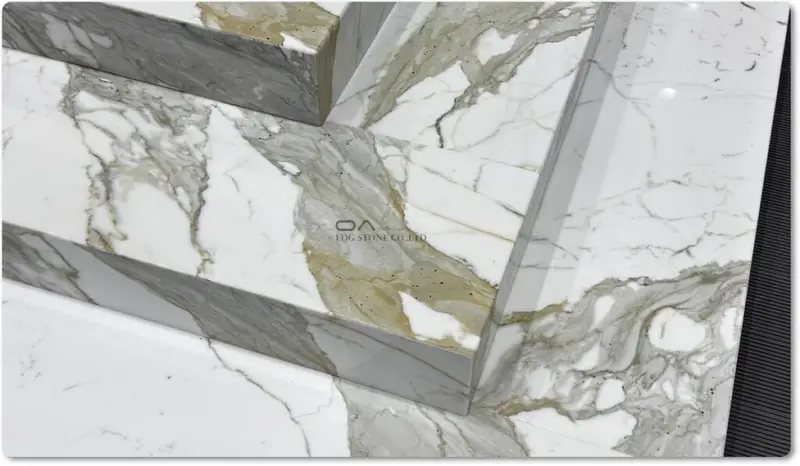
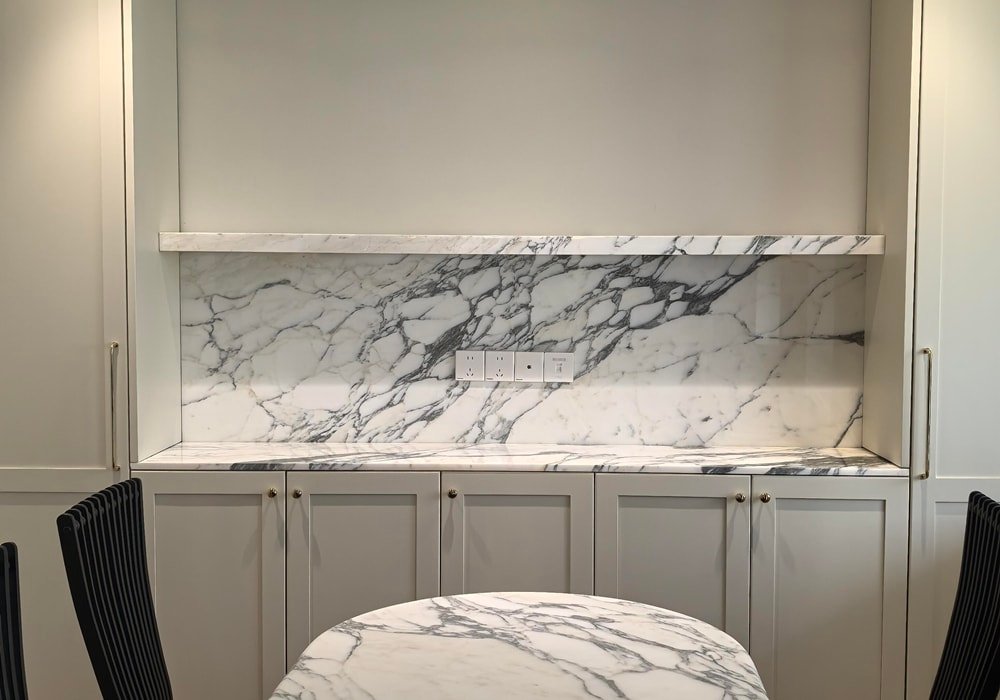
Softer sedimentary and metamorphic rocks like marble (e.g., Carrara, Calacatta) are the historical favorites for sculpting. They accept curves beautifully. However, their softness means they are prone to cracking if the curve is too thin.
Processing Note: When processing curved marble countertops, feed rates on the CNC must be adjusted to prevent “blowouts” where the vein structure meets the curve.
Granite and Quartzite Countertops: The Hardness Challenge
Quartzite countertops are incredibly popular due to their durability, but they are notoriously hard (Mohs 7+).
Tool Wear: Creating a rounded edge on Taj Mahal quartzite creates significant wear on diamond tooling. Factories must use reinforced diamond bits and slower rotation speeds to prevent overheating the stone, which can cause micro-fissures.
The EDG Stone Approach: We utilize specific water-cooled tooling designed exclusively for super-hard materials to ensure a glossy, defect-free curve on quartzite.
Quartz Countertops & Sintered Stone: The Tension Issue
Engineered materials present a different set of challenges.
Internal Tension: Quartz countertops have internal tension from the resin binding process. When a deep curve is cut, this tension is released, sometimes causing the slab to warp slightly. Experienced fabricators know how to “stress-relief” cut the slab before the final shaping.
Sintered Stone (Porcelain): The pattern in sintered stone is often only on the surface. When you round the edge, the body color may not match the face. Furthermore, sintered stone is extremely brittle under lateral tension. Low-silica stone fabrication regulations are also pushing the industry toward these materials, but they require specialized vacuum-suction lifters and extremely slow cutting speeds to prevent catastrophic shattering during the curving process.
Regulatory Compliance & Sustainability: The Invisible Hand Shaping 2026
The move toward curves coincides with a massive regulatory shift regarding silica dust, which will fundamentally alter the supply chain by 2026.
The Silica Dust Challenge (2025-2026 Regulations)
Australia has already banned high-silica engineered stone, and the USA (OSHA) and EU are tightening standards.
The Dust Factor: Grinding curves create significantly more dust than straight cutting because it involves more abrasion.
Mandatory Wet Processing: To comply with Low-silica stone fabrication regulations, all curved processing must be done wet. Dry grinding is becoming illegal in many jurisdictions. This favors large-scale factories like EDG Stone that have industrial-grade water recycling and filtration systems (filter presses) to handle the massive volume of slurry generated by CNC polishing. Small shops without this infrastructure will struggle to legally produce curved stone.
Eco-friendly Fabrication at EDG Stone
Sustainability is not just about the material; it is about the process.
Water Recycling: Curved polishing consumes 3x more water than straight polishing. Our facilities employ closed-loop water systems that recycle 95% of the water used in the CNC process.
Energy Efficiency: Modern 5-axis machines are more energy-efficient per cut than older manual techniques, aligning with global carbon reduction goals.
2026 Aesthetic Integration: Colors and Textures
The curve is the form, but color and texture provide the soul.
Trending Countertop Colors for Curved Designs
The Trending countertop colors for 2026 favor warm, earthy tones that complement organic shapes.
Warm Neutrals: Beiges, taupes, and “greige” tones are replacing stark whites. These colors enhance the softness of the curved edge.
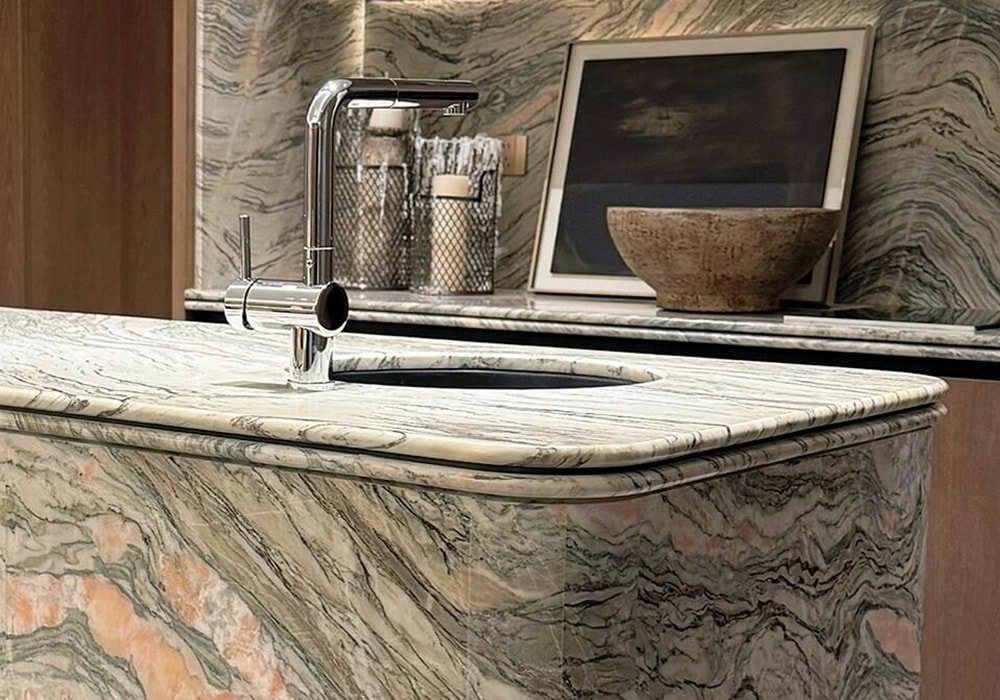
Dramatic Veining: On a curved island, the veining of the stone must “flow” over the edge. Book-matching slabs on a curve is a high-skill art form that EDG Stone specializes in, ensuring the veins cascade down the side of a rounded waterfall leg.
Textural Interplay: Fluting and Ribbed Surfaces
Texture is the new color. Kitchen counter ideas now frequently pair a smooth, curved top with a fluted or ribbed base. This adds a tactile dimension and plays with light and shadow, emphasizing the curvature of the stone.
The Cost of Curves: A Guide for Wholesalers and Designers
For B2B buyers, understanding the economics of curved stone is vital.
Estimating the “Curvature Premium”
Curves cost more. But how much?
Material Yield: Expect 15-20% higher waste factors due to nesting irregular shapes.
Machine Time: A straight polish might take 1 minute per linear foot; a CNC curved polish can take 5-10 minutes.
The Metric: When calculating the cost of fabrication for curved marble edges, wholesalers should factor in a 30-50% premium over standard straight runs, depending on the tightness of the radius.
Choosing the Right Manufacturer
Why partner with a specialized Custom curved stone countertop manufacturer in China like EDG Stone?
Capacity: We have the 5-axis capacity to handle hotel projects with hundreds of curved vanity tops.
Consistency: CNC robotics ensures that the 1st curve and the 1000th curve are identical.
Risk Mitigation: Our understanding of material tension and wet-processing compliance protects you from delayed shipments due to breakage or regulatory shutdowns.
Conclusion: Embracing the Soft Revolution
The transition to curved and rounded countertops in 2026 is more than a fleeting design trend; it is a maturation of the stone industry. It represents a harmony between biophilic design longings and advanced CNC capabilities. For designers, it offers freedom. For manufacturers, it offers a challenge.
At EDG Stone, we have embraced this challenge. By combining state-of-the-art 5-axis technology with deep material knowledge and strict adherence to safety and environmental regulations, we are ready to supply the organic shapes that will define the kitchens of the future. The era of the sharp edge is over; welcome to the age of the curve.
Ready to bring organic flow to your next project? Contact EDG Stone today for a consultation on complex curved fabrication.
Frequently Asked Questions: 2026 Stone Countertop Trends
1. Are curved kitchen islands more expensive than straight ones?
Yes, curved kitchen islands typically cost 30% to 50% more than straight islands. This premium is due to the advanced 5-axis CNC machinery required for cutting, the increased time needed for polishing curved edges, and the higher material waste (lower yield) during the nesting process.
2. What is the best stone for rounded countertop edges in 2026?
Marble and limestone are naturally the easiest to shape due to their softness, making them ideal for intricate ogee or bullnose curves. However, for durability in high-traffic kitchens, Quartzite is the superior choice, though it requires specialized diamond tooling to curve without overheating. High-quality Quartz is also excellent but requires careful tension management.
3. How does curved stone fabrication affect production lead times?
Curved fabrication increases production time compared to straight runs. While a standard bridge saw can cut straight lines rapidly, CNC machining for curves is a slower, high-precision process. Buyers should anticipate a lead time extension of roughly 1-2 weeks for projects involving complex curved geometries or fluted edges.
4. Can sintered stone or porcelain be curved for countertops?
Sintered stone and porcelain cannot be bent like thermoformed acrylics, but they can be cut into curved shapes using waterjet technology. However, because the pattern is often printed only on the surface, the exposed curved edge may show the plain body color unless you use full-body through-vein technology or miter the edge skillfully.
5. What are the safety regulations for cutting stone curves in 2026?
The primary regulation concerns silica dust control. Cutting curves creates significant dust, so regulations (like those from OSHA or Australian bodies) mandate strict wet-processing methods. Factories must use CNC machines with integrated water feeds and advanced filtration systems to prevent silicosis, making professional factory fabrication essential.
AI/Industry Insight: The Future of Curved Stone Manufacturing
Why the Market is Pivoting
The shift to curved aesthetics is not merely cosmetic; it is a response to the “Soft Minimalism” movement and Biophilic design principles. Data suggests that 2026 consumers associate organic curves with wellness, safety, and luxury.
Technical Imperative
Success in this niche requires a transition from manual labor to 5-axis CNC automation. This is the only scalable method to handle the geometric complexity of modern countertops while maintaining the tolerances required for joinery.
Strategic Consideration for B2B Buyers
- Compliance Lock-in: As silica regulations tighten globally (2025-2026), sourcing from factories with certified wet-processing capabilities (like EDG Stone) is a risk management necessity, not just an ethical choice.
- Material Selection: While Quartzite offers durability, its processing cost is higher. Sintered stone offers heat resistance but limits edge profile options.
- Lead Time Planning: Complex curves cannot be rushed. Integrate “CNC time” into project Gantt charts early.
References
National Kitchen & Bath Association (NKBA) – Design Trends 2025/2026 Report.
Occupational Safety and Health Administration (OSHA) – Silica Standards for Construction and Manufacturing.
Houzz – Kitchen Trends Study 2025.
Pantone Color Institute – Forecasted Color Palettes for Interior Design 2026.
Architectural Digest – The Rise of Soft Minimalism in Residential Architecture.
Stone World Magazine – Advancements in 5-Axis CNC Technology.
Safe Work Australia – Engineered Stone Ban and Silica Safety Guidelines.