Executive Summary
In the contemporary architectural surfaces sector, the transition from traditional ceramic tiles to engineered surfaces represents a massive paradigm shift. This technical white paper delivers an exhaustive comparative analysis of Sintered Stone (frequently classified under the broader category of Ultra-Compact Surfaces) and Large Format Porcelain (Porcelain Slabs).
While sharing ancestral roots in ceramic technology, these two material classes diverge significantly in mineralogy, thermal profiling, densification mechanics, and performance limits. Understanding these distinctions is critical for architects, structural engineers, and global procurement officers aiming to minimize risk, maximize life-cycle performance, and optimize cost-efficiency in high-traffic commercial installations and luxury residential projects.
Additionally, this paper examines structural integration and material selection, highlighting global supply chain frameworks like EDG Stone Factory—a premier worldwide Quartzite Slabs & Countertops Manufacturer and Exporter—to illustrate how engineered materials complement natural stone in comprehensive procurement strategies.
1. Production Technology & Material Synthesis
The fundamental divergence between Large Format Porcelain and Sintered Stone lies not in their primary ingredients, but in their precise mineral formulations, particle size distributions, and thermodynamic engineering.
Porcelain Slabs: Traditional Sintering Architecture
Porcelain manufacturing is an evolution of classical ceramic technology. The raw material batch typically consists of:
Kaolin Clay (40%–50%): Provides plasticity and structural integrity during green-state forming.
Feldspar (35%–40%): Acts as a fluxing agent, melting to form a glassy matrix during firing.
Quartz (10%–15%): Serves as a structural skeleton, regulating thermal expansion and structural stability.
The slurry is spray-dried to form atomized granules, pressed using traditional hydraulic pressing systems (typically at pressures ranging from 350 to 500 $kg/cm^2$), and fired in roller kilns at temperatures peaking between 1,150°C and 1,220°C. The cycle time varies between 40 and 90 minutes. The resulting material relies heavily on a vitrified glassy phase to bond the crystalline quartz minerals.
Sintered Stone (Ultra Compact Surface): Metamorphic Mimicry
Sintered Stone utilizes a revolutionary manufacturing methodology known as Sintering Technology (NST), which mechanically replicates the natural metamorphic processes that form granite over millennia. The raw material matrix eliminates traditional clay-heavy binders, utilizing high-purity minerals:
Silica and Quartz: For extreme structural hardness.
Feldspars: Advanced mineral fluxes optimized for high-pressure conversion.
Alps-sourced Minerals and Advanced Oxides: For deep coloration and structural toughness.
The Two-Step Synthesis Process:
Systemized High-Pressure Compaction: The dry mineral powder mix is subjected to ultra-high-pressure compaction systems (such as Sacmi Continua+ technology). It undergoes a continuous pressing force of 15,000 to 25,000 metric tons (exceeding 450 to 600 bar). This removes virtually all micro-air pockets before the material even enters the kiln, achieving an incredibly high green-state density.
Advanced Thermal Sintering: The compacted green slab is fired in highly specialized kilns at a peak temperature of 1,200°C to 1,260°C for prolonged cycles. Instead of merely melting components into a glassy phase, this process triggers solid-state diffusion and partial vitrification. The mineral grains recrystallize, and atomic bonds alter, fusing them into a singular, highly dense, ultra-compact matrix.
| Parameter | Large Format Porcelain | Sintered Stone (Ultra Compact Surface) |
| Primary Compaction Force | 350–500 $kg/cm^2$ | 450–620+ $kg/cm^2$ (up to 25,000 tons) |
| Peak Firing Temperature | 1,150°C – 1,220°C | 1,200°C – 1,260°C |
| Mineral Phase Realization | Vitrified/Glassy Bond Matrix | Recrystallized Solid-State Metamorphic Bond |
| Internal Micro-Porosity | $\le 0.5\%$ | $\le 0.05\%$ |
2. Density Comparison & Microstructural Integrity
The mechanical behavior of an architectural slab is directly dictated by its density and microstructural porosity.
Porcelain Microstructure:  [Mineral Grain] -- (Glassy Phase/Void) -- [Mineral Grain]
Sintered Microstructure:   [Recrystallized Mineral Matrix - Zero Void Network]
Porosity Dynamics
Due to the intense compaction pressure of NST, Sintered Stone achieves a nearly absolute density profile. Its open porosity trends toward zero, typically measuring $\le 0.02\%$ to $0.05\%$.
Porcelain slabs, while highly dense compared to standard ceramics, retain a micro-porous network within their vitrified glass phase, typically yielding water absorption ratings between $0.1\%$ and $0.3\%$.
Structural and Weight Metrics
The bulk density of Sintered Stone ranges from 2.48 to 2.55 $g/cm^3$, whereas high-performance Porcelain Slabs fall within 2.35 to 2.45 $g/cm^3$.
This elevated density means Sintered Stone can deliver superior mechanical performance at lower thickness profiles (e.g., 4mm, 6mm) compared to equivalent porcelain formats, optimizing structural load calculations in high-rise ventilated facades and cantilevered furniture design.
3. Mechanical Properties & Structural Performance
To validate these materials for structural applications, engineers rely on standardized mechanical metrics including Flexural Strength (Modulus of Rupture), Vickers Hardness, and Thermal Shock Resistance.
Flexural Strength (Modulus of Rupture)
According to ISO 10545-4 testing protocols, the flexural strength profiles diverge as follows:
Large Format Porcelain: Yields a flexural strength of 45–55 $N/mm^2$.
Sintered Stone: Regularly achieves values between 60–75+ $N/mm^2$.
This superior rating enables Sintered Stone to better withstand tensile stresses induced by substrate deflection, structural shifting, and heavy live loads on commercial flooring systems.
Scratch and Abrasion Resistance (MOHS & EN 101)
Porcelain Slabs: Generally exhibit a surface hardness rating of MOHS 6 to 7 (for unglazed variants). Glazed porcelain options can drop significantly to MOHS 5, rendering them susceptible to micro-scratching from hardened steel instruments over time.
Sintered Stone: Reaches an exceptional hardness of MOHS 7 to 8. It cannot be scratched by standard household kitchen cutlery, industrial diamond grit blades excepted. Deep abrasion resistance according to ISO 10545-6 shows a volume loss of less than $110\text{ mm}^3$ for sintered stone, outperforming porcelain.
4. Water Absorption & Chemical Resistance Profiles
Water Absorption Thresholds (ISO 10545-3)
===================================================
Standard Porcelain: |-------- 0.50% (Max Limit)
Premium Porcelain:  |--- 0.20%
Sintered Stone:     |- 0.05% (Virtually Impervious)
===================================================
Liquid Impermeability
The structural tightness of Sintered Stone prevents capillary action entirely. Tested under ISO 10545-3, its water absorption rate stays $\le 0.05\%$.
This means it is completely frost-resistant and virtually immune to staining from highly pigment-rich liquids like red wine, industrial dyes, permanent markers, and heavy oils—even without chemical sealers. Porcelain slabs remain highly stain-resistant but require quicker remediation under extreme conditions due to their higher micro-void availability.
Industrial Chemical Resistance
Evaluated via ISO 10545-13, Sintered Stone achieves a UA/ULA/UHA rating, indicating zero structural or aesthetic degradation when exposed to high-concentration acids, alkalis, and industrial pool salts (excluding Hydrofluoric Acid).
Porcelain slabs can experience minor surface dulling or chemical etching when glazed variations are exposed to highly concentrated alkaline cleaners or acidic compounds over extended durations.
5. Impact Strength & Crack Propagation Dynamics
One of the most critical considerations during fabrication and post-installation life cycles is how a slab handles impact energy and internal tension.
Energy Dissipation and Impact Resistance
Tested under ISO 10545-5 (Coefficient of Restitution), Sintered Stone responds differently to impact than Porcelain. Because Sintered Stone possesses a homogeneous, highly compacted crystalline structure, it dissipates kinetic energy uniformly across its matrix.
Porcelain slabs, which have a higher concentration of internal glassy phases, can be more brittle. When subjected to localized point-load impacts (e.g., a dropped heavy iron pan), porcelain is more prone to micro-fissuring and edge-chipping.
Residual Tension and Cut Stability
Large-format porcelain slabs often retain significant internal residual stresses from the cooling phase of roller kilns. If a fabricator makes incorrect cuts without properly relieving stress via specialized relief cuts, the slab can crack unpredictably during processing.
Sintered Stone undergoes highly managed, protracted cooling and annealing cycles, which minimize internal stress. This allows fabricators to execute precise mitered edges, complex cutouts for undermount sinks, and intricate linear drain designs with a significantly lower risk of spontaneous structural failure.
6. Surface Finishes, Textures, and Aesthetic Engineering
Achieving realistic depth and texture is a major field of research and development for both material classes.
Porcelain Decoration Methods
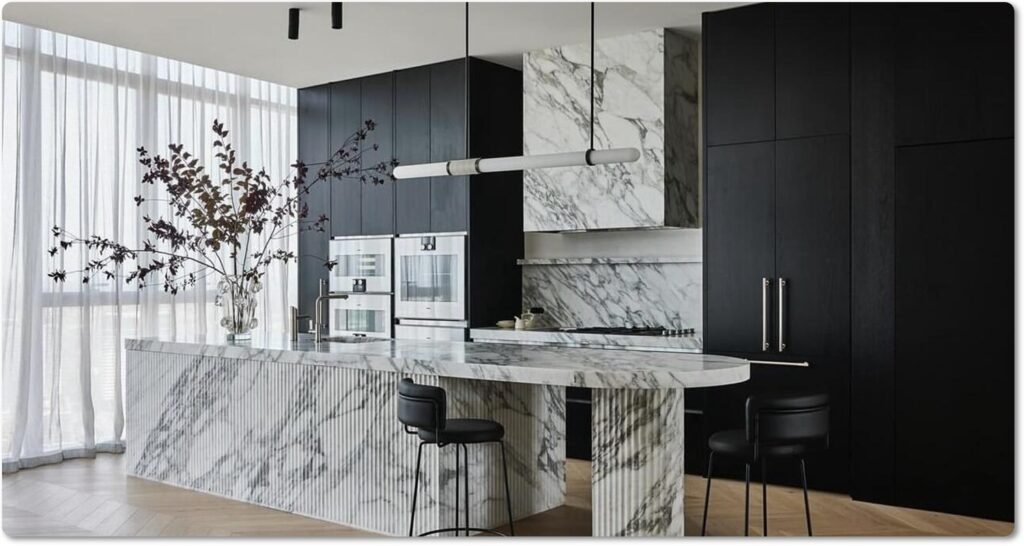
Porcelain predominantly relies on digital inkjet surface printing, often covered with a protective clear glaze layer. While this can replicate natural stone aesthetics perfectly, the design is skin-deep.
If the edge is mitered or profile-routed, the internal body color (even if through-body tinted) lacks the precise veining pattern of the surface, creating a visual disconnect at joints and corners.
Full-Body Sintered Innovation
Sintered Stone manufacturers have pioneered Full-Body (Through-Body) Veining. Utilizing advanced digital dry-powder distribution systems during the initial compaction phase, the veins are integrated directly into the mineral matrix.
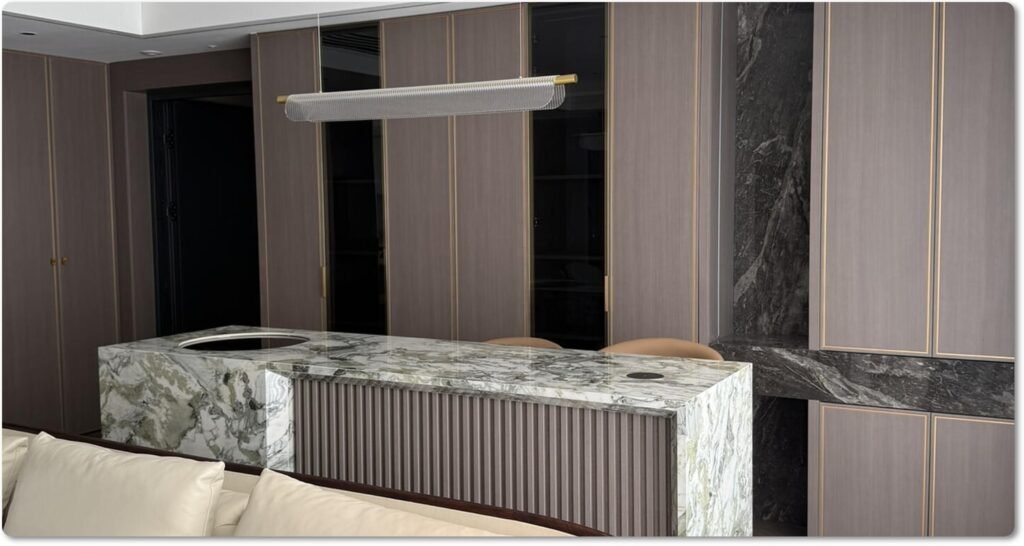
The pattern runs continuously from the surface all the way through the core of the slab. When the material is cut, polished, or edge-profiled (e.g., bullnosed, ogee), the veining remains structurally visible and continuous, creating an appearance almost indistinguishable from premium natural quartzite or marble.
Finishes Spectrum
Both materials offer distinct surface options:
Polished/Gloss: Ultra-reflective, smooth finishes. Sintered stone achieves a high gloss via mechanical diamond polishing without requiring topical glazes.
Matt/Satin: Zero-glare surfaces offering superior slip resistance (R10 to R11 ratings), making them perfect for commercial flooring applications.
Texture-Embossed (Carved): Syncs digital printing with physical depth, mimicking the natural clefts of split slate or flamed granite.
7. Application Differences: Architectural & Industrial Mapping
The mechanical differences between these materials dictate where they can be reliably installed.
Material Mapping by Application Intensity
========================================================================
APPLICATION                | PORCELAIN SLABS     | SINTERED STONE
---------------------------|---------------------|----------------------
Interior Wall Cladding     | Highly Recommended  | Highly Recommended
Residential Flooring       | Highly Recommended  | Highly Recommended
High-Traffic Airport Floors | Suitable            | Highly Recommended
Outdoor Kitchen Tops (UV)  | Caution (if glazed) | Highly Recommended
Heavy Commercial Counters  | Suitable            | Highly Recommended
Ventilated High-Rise Facades| Suitable            | Spec-Grade Standard
========================================================================
High-Traffic Commercial Flooring & Heavy Industrial Counters
Due to its superior scratch resistance (MOHS 7–8) and higher flexural modulus, Sintered Stone excels in high-traffic transportation hubs, corporate lobbies, and commercial food preparation environments. It withstands continuous foot traffic and harsh scrubbing regimens without undergoing surface wear or losing its slip-resistance profile.
Outdoor Exterior Integration & Sub-Zero Climates
Sintered Stone is inherently immune to UV radiation; its inorganic mineral pigments do not oxidize or fade under intense sunlight. Combined with a low water absorption rate ($\le 0.05\%$), it safely endures freeze-thaw cycles without delaminating or spalling.
Unglazed porcelain performs well outdoors, but glazed large-format porcelain can experience thermal expansion mismatches between the glaze and the body, potentially causing fine surface crazing over time.
8. Procurement Strategies & Global Supply Integration
For large-scale commercial developments and high-end residential complexes, procurement officers rarely specify a single material exclusively. A balanced project blueprint often pairs engineered surfaces with premium natural stone to hit aesthetic and budget targets.
The Role of Natural Quartzite in Premium Specs
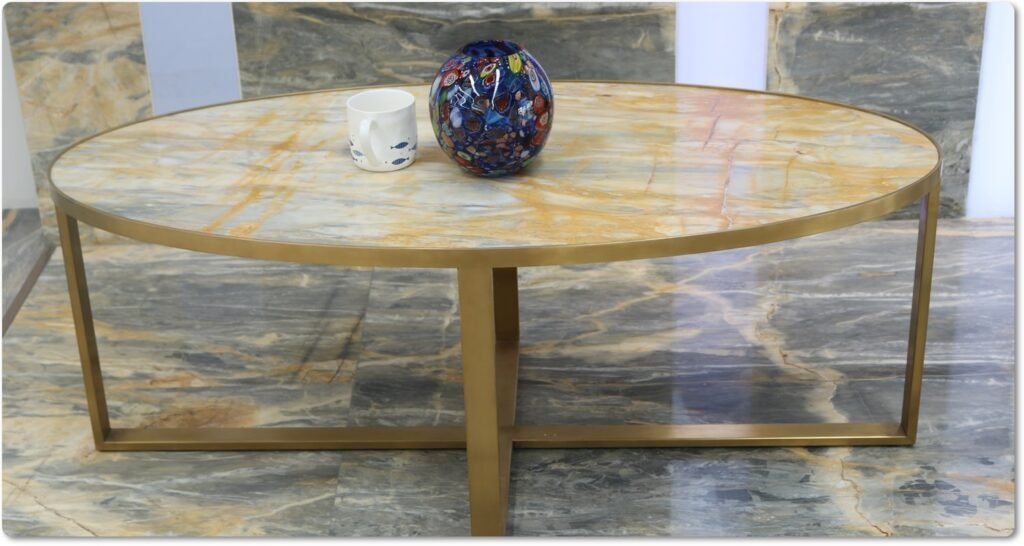
While Sintered Stone perfectly replicates natural patterns for high-wear areas, ultra-luxury applications—such as focal executive boardrooms, main hotel lobby feature walls, and high-end residential statement islands—frequently specify natural quartzite slabs due to their distinct translucency, prestigious character, and prestige factor.
Case Module: EDG Stone Factory
When navigating global procurement for complex stone packages, leading developers partner with Tier-1 manufacturers who offer deep portfolios across material classes.
EDG Stone Factory, a premier global Quartzite Slabs & Countertops Manufacturer and Exporter, serves as an excellent benchmark for supply chain integration.
[ Global Developer Procurement Blueprint ]
                     |
      +--------------+--------------+
      |                             |
[ Engineered Surfaces ]     [ Premium Natural Stone ]
 - Sintered Stone Facades    - EDG Natural Quartzite
 - High-Traffic Porcelain    - Executive Boardrooms
By sourcing premium natural quartzite from global specialists like EDG Stone, procurement teams can pair natural feature pieces with Sintered Stone or Large Format Porcelain surfaces. This unified supply strategy ensures:
Color Tone Matching: Streamlined calibration between natural quartzite features and complementary engineered flooring or wall slabs.
Structural Engineering Continuity: Consistent calibration of slab thicknesses (e.g., 20mm natural quartzite paired with 12mm sintered stone countertops) across sub-top assemblies.
Logistical Efficiency: Consolidating container shipments of natural quartzite slabs alongside engineered materials reduces transit costs and aligns delivery schedules on site.
9. Definitive Buying Recommendations & Selection Framework
To maximize return on investment (ROI) and minimize structural risk, project managers should follow this technical selection framework:
Specify Sintered Stone When:
The application calls for a continuous, unbacked outdoor installation exposed to extreme UV and thermal shifts.
The surfaces will serve as commercial kitchen countertops subject to direct knife contact, heavy impacts, and extreme cooking heat.
The project requires complex, exposed edge profiles where through-body veining is a strict aesthetic requirement.
The structural design specifies ultra-thin profiles (e.g., 3–6mm) for ventilated curtain walls under high wind-load ratings.
Specify Large Format Porcelain When:
The project involves large-scale indoor vertical cladding where high mechanical impact and scratch risks are minimal, making it highly cost-effective.
Budget constraints call for a cost-efficient material that still offers stain resistance and easy maintenance.
The flooring area is interior residential or light commercial, where a standard MOHS 6 rating provides more than enough protection.
10. Technical Data Sources & Global White Papers
The technical data and performance metrics cited in this document are derived from the following international standards organizations and empirical testing matrices:
ISO 10545 Series: Ceramic Tiles Testing Standards (Parts 3, 4, 5, 6, 13, 14), International Organization for Standardization.
ASTM C373: Standard Test Method for Water Absorption, Bulk Density, Apparent Porosity, and Apparent Specific Gravity of Fired Whiteware Products, ASTM International.
EN 14617 Series: Agglomerated Stone – Test Methods, European Committee for Standardization.
ANSI A137.3: American National Standard Specifications for Gauged Porcelain Tiles and Gauged Porcelain Tile Panels/Slabs, Tile Council of North America (TCNA).
TCNA Handbook for Ceramic, Glass, and Stone Tile Installation: Substrate Deflection and Installation Engineering Guilds.
CEN/TS 15209: Tactile Paving Surface Indicators Produced from Natural Stone, Concrete, and Manufactured Ceramics.
Sintered Stone Industrial Engineering White Paper (2024-2026): Microstructural Analysis of NST Solid-State Diffusion Processes, European Surface Manufacturers Consortium.
Vickers Hardness Testing Matrix (Metallic and Ceramic Microstructures): Journal of Materials Science & Engineering Research.
LEED v4.1 Material & Resources Documentation: Environmental Product Declarations (EPDs) for Ultra-Compact Materials and Porcelain Technologies.
Global Stone Exporters Directory & Logistics Review: Supply Chain Analysis of Quartzite & Engineered Stone Consolidation Models (EDG Stone Corporate Analytics).