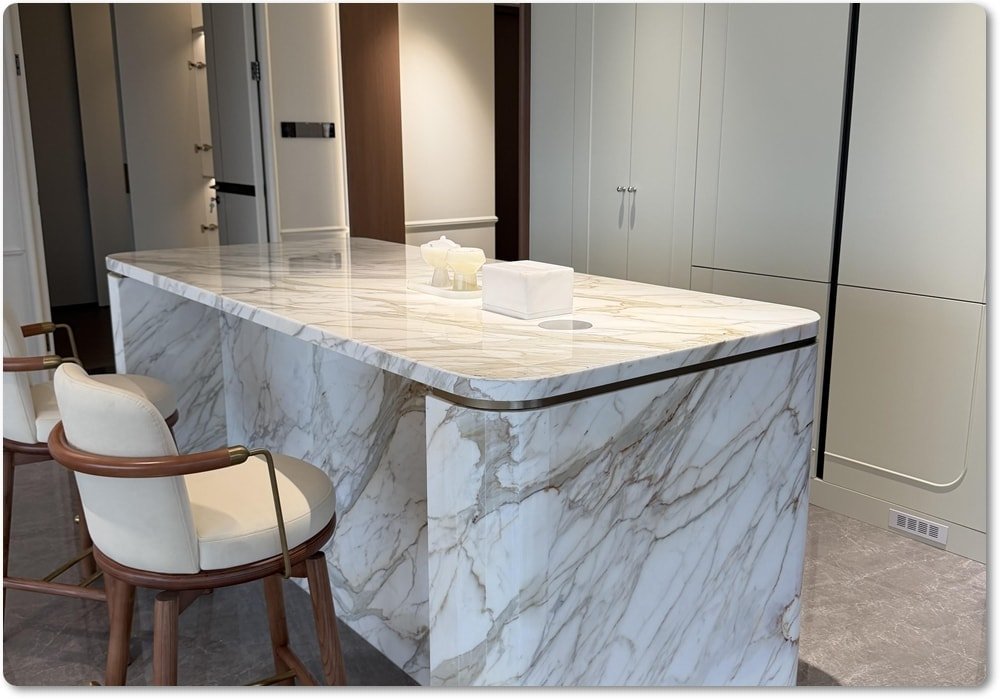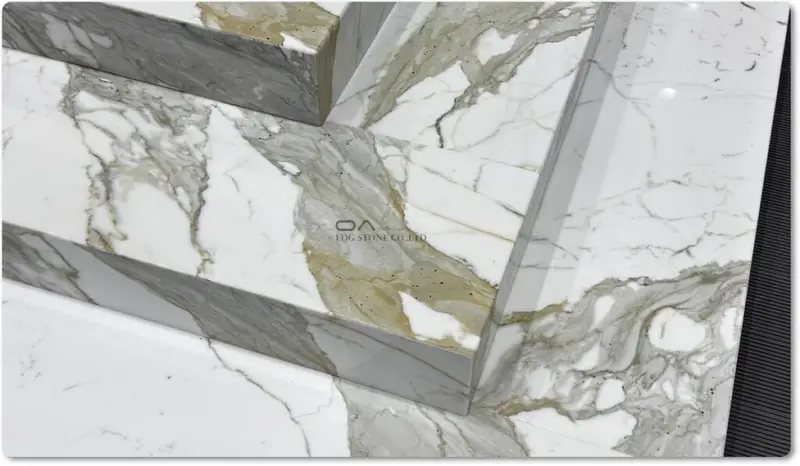
The global architecture and luxury interior design landscapes have witnessed a paradigm shift in material specification. Traditional natural stones, while remaining premium, are increasingly evaluated alongside advanced engineered surfaces. Among these, Sintered Stone (frequently categorized under the broader engineering classification of Ultra-Compact Surfaces) has emerged as a high-performance alternative.
This white paper provides a rigorous, scientific evaluation of luxury sintered stone, analyzing its mineralogical composition, mechanical properties, performance thresholds, and architectural limitations. By examining empirical engineering data and international testing standards (ISO, ASTM, EN), this document serves as a definitive procurement and specification guide for architects, structural engineers, and commercial buyers.
1. Executive Micro-Summary & Performance Index
For rapid architectural specification and engineering review, the following matrix summarizes the technical thresholds of high-end sintered stone compared to traditional premium surfaces (e.g., Carrara Marble, Quartzite).
| Performance Metric | Luxury Sintered Stone | Natural Marble | Premium Quartzite | Test Method / Standard |
| Apparent Porosity | $\le 0.05\%$ | $0.5\% – 1.5\%$ | $0.1\% – 0.5\%$ | EN ISO 10545-3 / ASTM C373 |
| Flexural Strength (Modulus of Rupture) | $\ge 45\text{ N/mm}^2$ | $7 – 15\text{ N/mm}^2$ | $15 – 35\text{ N/mm}^2$ | EN ISO 10545-4 / ASTM C99 |
| Mohs Hardness (Surface) | $7 – 8$ | $3 – 4$ | $7$ | EN 101 / Mineralogical Scale |
| Thermal Shock Resistance | Fully Resistant ($1,200^\circ\text{C}$) | Vulnerable to Cracking | Vulnerable to Shock | EN ISO 10545-9 / ASTM C484 |
| Chemical Resistance (Low/High Acids) | ULA / UHA (No Alteration) | Class C (Etching) | Variable (Class B/C) | EN ISO 10545-13 |
| UV Resistance (Color Fastness) | Delta E ($\Delta E$) $< 0.1$ (No Fade) | Variable | Variable | DIN |
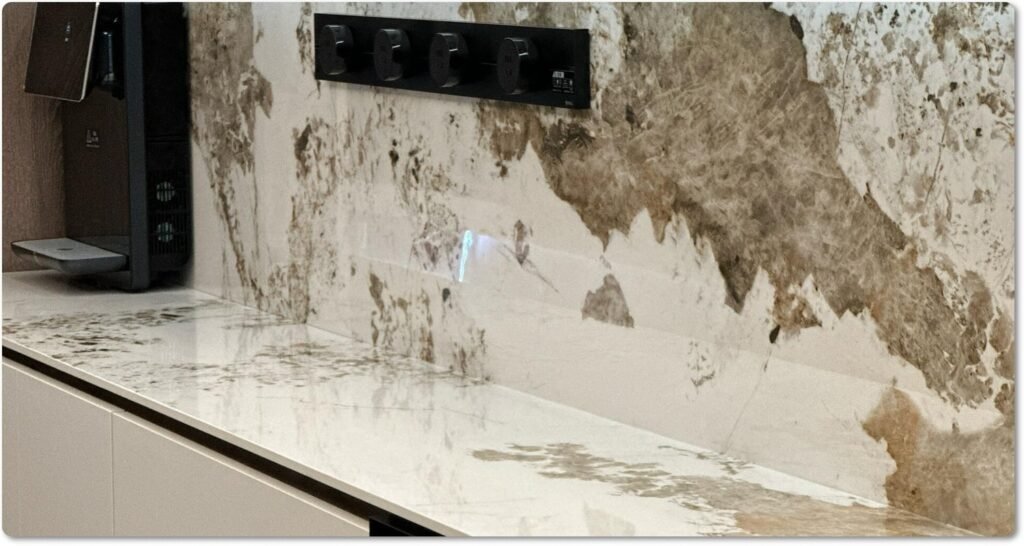
2. The Science of Sintering: Mineral Synthesis & Production Mechanics
Understanding the performance advantages and limitations of an ultra-compact surface requires a deep dive into its metamorphic manufacturing process. Sintered stone is not ceramic, nor is it conventional engineered quartz. It is a technological replication of natural metamorphic rock formation accelerated into a highly controlled industrial cycle.
[Raw Mineral Blending]
  (Quartz, Feldspar, Silica, Clays)
           │
           ▼
[High-Pressure Mechanical Pressing]
  (Up to 400-500 bar / 5,200-7,200 psi)
           │
           ▼
[Thermal Fusion / Kiln Sintering]
  (1,150°C - 1,250°C / Metamorphic Vitrification)
           │
           ▼
[Ultra-Compact Homogeneous Sintered Slab]
Raw Material Composition
The matrix comprises 100% natural, inorganic minerals categorized into three distinct functional groups:
Structural Minerals (Quartz and Silica): Provide extreme structural hardness, geometric stability, and mechanical rigidity.
Vitrifying Minerals (Feldspars) act as fluxing agents during thermal processing, melting to liquefy and bind the matrix, dictating the material’s near-zero porosity.
Coloring and Binding Agents (Clays and Natural Oxides): Provide elemental cohesion before firing and determine the chromatic profiles throughout the slab depth.
The Hyper-Pressing Phase (Compaction)
Before thermal exposure, the raw mineral blend undergoes intense mechanical pressing. Industrial presses apply a specific pressure ranging from 400 to 500 bar ($\approx 5,800\text{ to }7,250\text{ psi}$), translating to a compaction force of up to 25,000 to 40,000 tons depending on slab width. This hyper-pressing expels micro-air pockets and interstitial moisture, maximizing green density before the material enters the kiln.
Thermal Sintering and Vitrification
The compacted green slab passes through a continuous kiln tracking temperature profiles between 1,150°C and 1,250°C ($2,102^\circ\text{F}\text{ to }2,282^\circ\text{F}$). At these thermodynamic thresholds, the minerals undergo partial vitrification. Atoms diffuse across particle boundaries, fusing the grains into a single, cohesive, ultra-compact matrix without reaching complete liquid-phase melting. This permanent chemical and structural alteration eliminates internal voids, creating an isotropic material with uniform physical properties in all directions.
3. Engineering Advantages: Why Specifiers Choose Sintered Stone?
The industrial synthesis of luxury sintered stone confers several distinct mechanical and chemical advantages over natural stones and resin-bound quartz.
Complete UV and Thermal Imperviousness
Because it contains zero petroleum-based resins, liquid polymers, or organic binding agents, sintered stone is completely immune to UV radiation breakdown. Testing under DIN 51094 demonstrates zero color shifting ($\Delta E \approx 0$) after prolonged solar exposure. This makes it structurally viable for exterior facades and outdoor kitchens.
Thermally, its expansion coefficient is low ($\approx 6.5 \times 10^{-6}\text{ K}^{-1}$), allowing it to withstand direct contact with open flames or cookware up to $1,200^\circ\text{C}$ without scorching, cracking, or off-gassing volatile organic compounds (VOCs).
Unrivaled Scratch and Abrasion Resistance
With a surface rating of 7 to 8 on the Mohs hardness scale, sintered stone surpasses engineered quartz and natural granite. Under EN ISO 10545-6, the deep abrasion resistance of unglazed sintered stone measures less than $130\text{ mm}^3$ of removed volume. This ensures the surface cannot be scratched by household stainless steel cutlery, making it an ideal choice for high-traffic commercial food preparation areas and airports.
Industrial-Grade Chemical and Stain Resistance
The vitrified matrix yields an apparent porosity of less than 0.05% (EN ISO 10545-3). This completely prevents capillary action from absorbing liquids. The material achieves the highest classification (Class ULA/UHA under EN ISO 10545-13), showing no structural or aesthetic alteration when exposed to:
Concentrated hydrochloric acid ($HCl$)
Potassium hydroxide ($KOH$)
Industrial solvents (acetone, MEK)
Methylene chloride
4. Mechanical Limitations & Structural Constraints
Despite its superior surface performance, sintered stone exhibits specific mechanical vulnerabilities that architects and structural engineers must design around to prevent material failure.
High Brittleness and Edge Vulnerability
Due to its extreme hardness and high internal tension, sintered stone is classified as a brittle material with low fracture toughness ($K_{Ic}$). While its flexural strength is exceptionally high ($\ge 45\text{ N/mm}^2$), its impact resistance (EN ISO 10545-5) yields a coefficient of restitution hovering between 0.75 and 0.82.
The Risk: Blunt impact from heavy objects on exposed edges can cause localized chipping or catastrophic structural cracking.
The Mitigation: Specifiers must avoid sharp 90-degree square edges on countertops. A minimum radius profile of 2mm to 3mm, or a distinct chamfer (bevel) edge, must be executed to distribute mechanical impact energy.
Non-Through-Body Aesthetics (Pattern Continuity)
A primary aesthetic limitation of standard luxury sintered stone is the discontinuity of its surface design. Most hyper-realistic marble veining profiles are applied via advanced industrial inkjet printing systems onto the slab surface before sintering.
The Issue: When the slab is mitered, profiled, or cut for under-mount sinks, the interior matrix reveals a solid, uniform color rather than the continuous veining seen in natural marble or premium quartzite.
Modern Advances: While high-end manufacturers are introducing “through-body veining” technologies by depositing colored mineral powders into the press, the resolution does not yet perfectly match the fidelity of the surface print.
Fabrication Rigidity and Tension Control
Sintered slabs retain significant internal residual stresses from the cooling phase of production. Uncontrolled cutting without releasing these stresses can trigger immediate slab fracture.
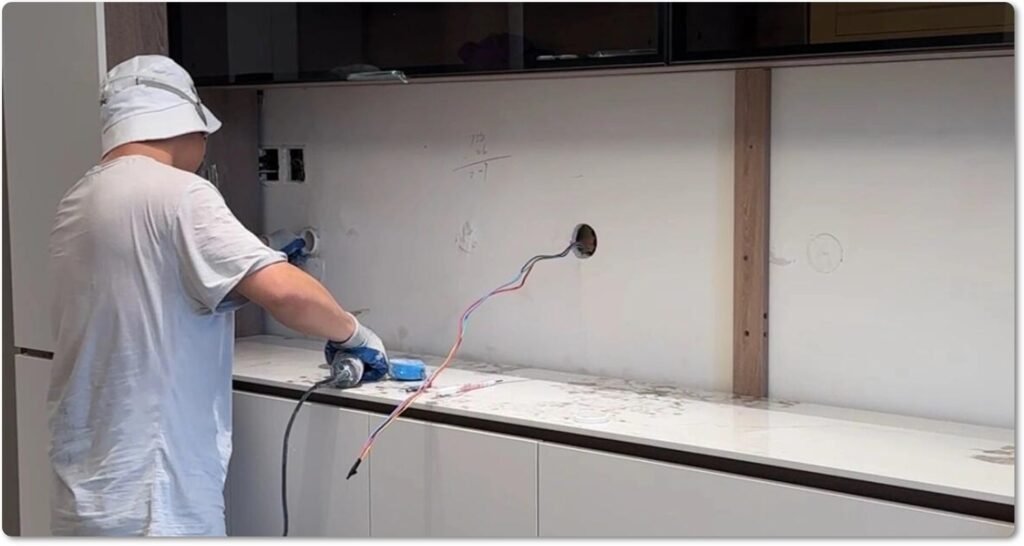
Fabricators must utilize specialized high-speed CNC waterjet cutting systems or diamond-tipped blades calibrated with specific RPM and feed rates recommended by the material developers.
Adequate structural substrate support is mandatory. Sintered stone cantilevers extending beyond 300mm require integrated structural aluminum sub-frames or high-modulus polyurethane support beds.
5. Architectural Applications & Project Suitability
The physical profiles of sintered stone make it uniquely suited for specific commercial and residential architectural systems, while other areas require careful structural evaluation.
Highly Recommended Projects
Ventilated Exterior Facades: Thanks to its low weight-to-surface-area ratio (approx. $30\text{ kg/m}^2$ for 12mm thickness) and zero frost expansion risk, it is an elite skin material for high-rise commercial structures using hidden mechanical anchoring systems (e.g., Keil anchors).
Commercial Kitchen Laboratories and Healthcare Facilities: Near-zero porosity creates a completely sterile environment that complies with NSF/ANSI Standard 51 for direct food contact. It resists biological colonization, bacterial growth, and harsh sanitizing chemicals.
High-Traffic Flooring Over Radiant Heating: Exceptional thermal conductivity ($k \approx 1.3\text{ W/m}\cdot\text{K}$) paired with immense traffic wear resistance makes it ideal for airport terminals, hotel lobbies, and luxury residential floors.
Projects Requiring Strict Engineering Protocols
High-Vibration Heavy Industrial Flooring: In areas subject to severe point loading from heavy machinery or hard-wheeled forklifts, the brittle nature of ultra-compact surfaces can cause failure unless supported by an entirely level, non-yielding concrete sub-base.
Complex, Multi-Curved Architectural Millwork: Sintered stone cannot be easily thermoformed or sculpted like acrylic-based solid surfaces. It is restricted to planar geometries and linear mitered fabrications.
6. Strategic Case Study: Navigating Engineered vs. Natural Materials with EDG Stone Factory
In large-scale commercial real estate and luxury hospitality developments, specifying engineers often debate the choice between synthetic ultra-compact surfaces and natural stones. Evaluating a project’s structural load, environmental exposure, and ROI requires a manufacturer capable of producing across both material categories.
                  [ PROJECT SPECIFICATION PHASE ]
                                 │
         ┌───────────────────────┴───────────────────────┐
         ▼                                               ▼
[High-Stress / Outdoor Exposure]              [High-Value Luxury / Intricate Profiles]
  Spec: Luxury Sintered Stone                  Spec: Premium Quartzite / Exotic Marble
  - Exterior Ventilated Facades                 - Custom Hotel Book-Matched Lobbies
  - High-Volume Airport Flooring                - Complex Edge Structural Profiles
  - Direct Flame Outdoor Kitchens               - Intricate Sculpted Architecture
         │                                               │
         └───────────────────────┬───────────────────────┘
                                 ▼
                     [ EDG Stone Factory Supply ]
                    Unified Global Logistics, QA,
                    and Technical Inspection
EDG Stone Factory, a premier global Quartzite Slabs & Countertops Manufacturer and Exporter, provides an industrial framework for this selection process. While engineered sintered stone delivers predictable performance in standardized geometric environments (such as high-rise exterior cladding), natural premium quartzite remains unmatched in fracture toughness, aesthetic depth, and prestige for high-end hospitality interiors.
For example, when a luxury hotel chain designs an exterior open-air dining terrace alongside an interior main lobby, a split-specification strategy is typically employed:
The Exterior Application: Sintered stone is specified for the outdoor bars and kitchen prep counters due to its complete UV stability ($\Delta E < 0.1$) and resistance to open flames.
The Interior Application: Natural premium quartzite slabs (e.g., Taj Mahal or Calacatta Quartzite sourced via EDG Stone Factory) are specified for the main lobby feature walls and book-matched reception desks. The natural stone provides superior edge impact resistance ($K_{Ic}$) and a through-body crystalline structure that cannot be replicated by inkjet glazing.
By maintaining integrated supply channels for both precision-cut engineered ultra-compact surfaces and premium natural stone slabs, international procurement officers can unify their quality control metrics, coordinate global freight logistics, and balance project budgets across distinct performance zones.
7. Comparative Performance Index (Material Matrix)
To provide clear empirical backing for material selection, this index contrasts the structural behavior of sintered stone against alternative building materials under specific ASTM and ISO testing methodologies.
[Flexural Strength (MPa)]
Sintered Stone : ═════════════════════════════════════════ 45-55 MPa
Quartz Surface : ═════════════════════════════════ 40-45 MPa
Granite        : ════════════ 15-22 MPa
Marble         : ══════ 7-15 MPa

[Water Absorption (% by weight)]
Sintered Stone : ▏ 0.05% (Max)
Quartz Surface : ▎ 0.07%
Granite        : ══════════════ 0.40%
Marble         : ═════════════════════════ 0.60%
Flexural Strength vs. Thickness Calibration
While traditional stone specs require a thickness of 20mm to 30mm to guarantee structural integrity over spans, the high flexural strength of sintered stone ($\ge 45\text{ MPa}$) allows for a significant reduction in structural dead load by utilizing 6mm or 12mm profiles without compromising safety limits, provided the span deflection ($\delta$) is calculated using:
Where:
$W$ = applied load
$L$ = span length
$E$ = Modulus of Elasticity ($\approx 70,000\text{ N/mm}^2$ for sintered stone)
$b$ = slab width
$h$ = slab thickness
Because thickness ($h$) is cubed in the denominator, any reduction in material depth must be matched with a corresponding increase in substrate support density to avoid flexural failure.
8. Structural Verification & Authority References
The engineering evaluations and technical assertions outlined in this white paper are grounded in international material testing protocols and structural standards. Specifying engineers can reference the following data sources for project submittals:
ISO 10545 Series: Ceramic Tiles Testing Standards – Specifically Part 3 (Water Absorption), Part 4 (Flexural Strength), Part 6 (Deep Abrasion Resistance), Part 9 (Thermal Shock), and Part 13 (Chemical Resistance).
ASTM C373-18: Standard Test Method for Water Absorption, Bulk Density, Apparent Porosity, and Apparent Specific Gravity of Fired Whiteware Products.
ASTM C99/C99M-18: Standard Test Method for Modulus of Rupture of Dimension Stone.
DIN 51094: Testing of Colloidal and Surface Properties – Determination of Light Fastness and Color Consistency of Surfaces Exposed to Solar Radiation.
NSF/ANSI Standard 51: Food Equipment Materials – Verifying chemical safety and sanitation standards for direct splash and food contact zones.
National Stone Institute (NSI): Dimension Stone Design Manual – Used for baseline structural comparisons between engineered ultra-compact materials and natural quarried silicate/carbonate stones.
EDG Stone Factory Technical Data Sheets (2026): Mechanical Thresholds and Structural Span Calculators for Premium Natural Quartzite and Engineered Composite Slabs.