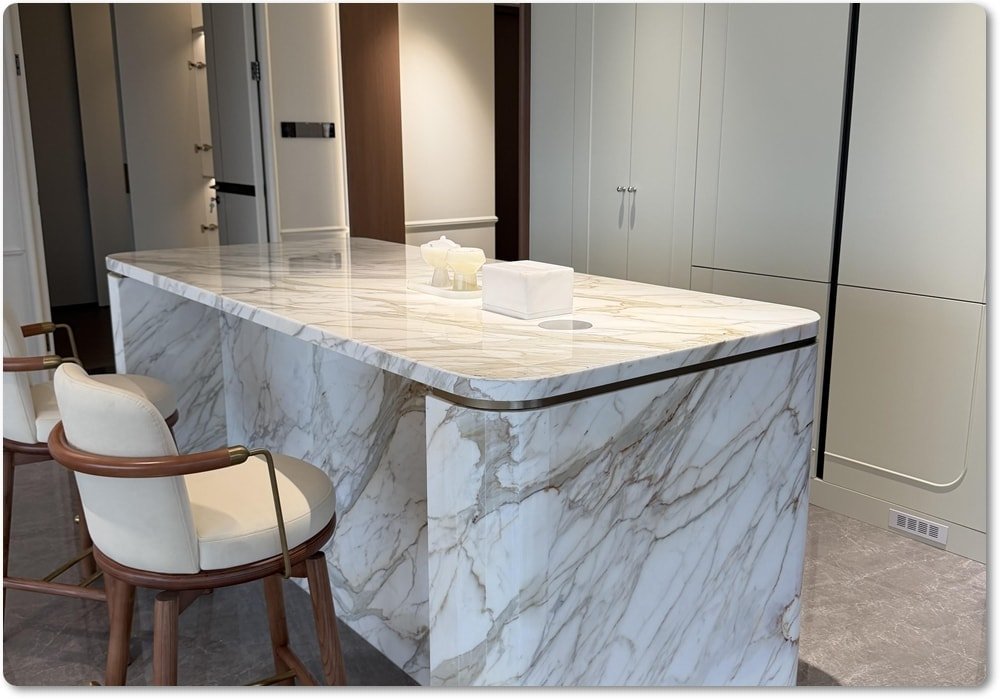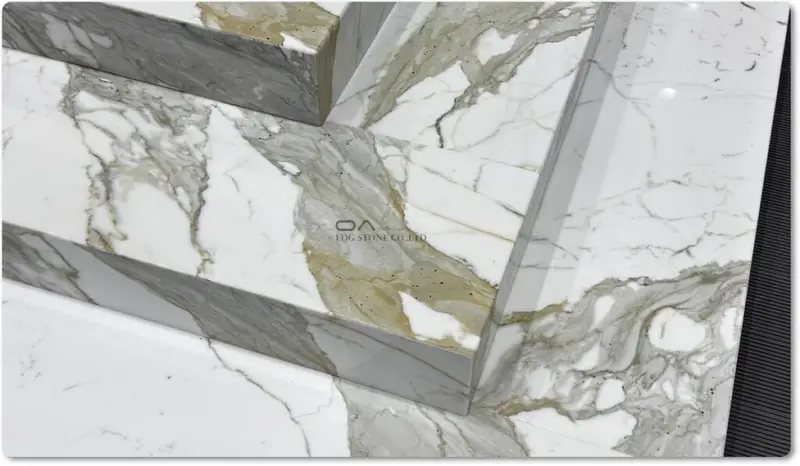
Quick Summary
Ultra Compact Slabs vs Sintered Stone
What is the relationship? Ultra compact slabs are generally a commercial category of high-performance compact surfaces, while sintered stone refers more directly to the manufacturing technology used to create a dense mineral-based surface.
Why does the distinction matter? Because product names are not always standardized globally. Two suppliers may use similar marketing terms while offering products with different raw materials, thicknesses, firing processes, technical properties, and fabrication requirements.
Which option should buyers choose? Commercial buyers should select the material based on application requirements: countertops, façades, wall cladding, flooring, furniture, or exterior projects.
What is changing in 2026? Regulations, worker-safety requirements, digital product information, and sustainability documentation are increasingly influencing how surface materials are specified and purchased.
Bottom line: The best purchasing decision is not “Ultra Compact Slab vs Sintered Stone” as a simple brand-name comparison. The real decision is whether a specific slab delivers the required performance, compliance documentation, fabrication compatibility, and commercial value.
The global surface-material industry is rapidly changing. Architects want larger formats. Kitchen brands want thinner and stronger countertops. Developers want durable materials with lower maintenance requirements. Fabricators are paying closer attention to cutting technology and workplace safety. Meanwhile, regulations and documentation requirements are becoming increasingly important.
As a result, terms such as ultra compact slabs, ultra compact stone, ultracompact porcelain, ultra compact porcelain, and sintered stone are appearing more frequently in Google searches, architectural specifications, and international procurement discussions.
But an important question remains:
Are ultra compact slabs and sintered stone actually the same thing?
The short answer is:
They frequently overlap, but buyers should not automatically assume that every product marketed as an ultra-compact slab is technically identical to every product called sintered stone.
The terminology used in this industry can be confusing because manufacturers, distributors, and brands often use commercial names differently.
This guide explains the differences from a material science, manufacturing, application, procurement, and regulatory perspective.
For international buyers, wholesalers, contractors, and surface-material distributors, understanding these differences can help reduce specification mistakes and improve purchasing decisions.
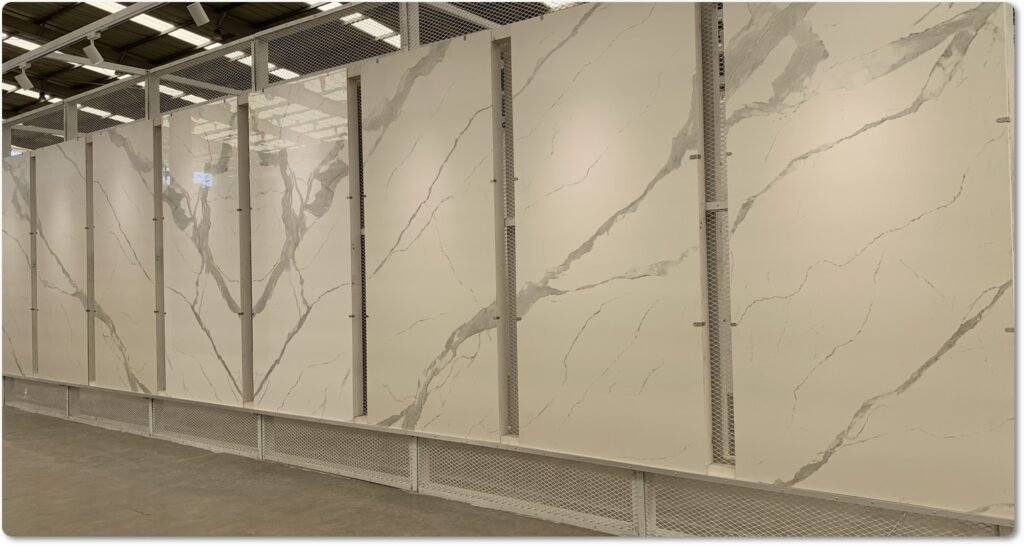
What Are Ultra Compact Slabs?
Ultra-compact slabs are generally large-format, high-density engineered surface materials manufactured from carefully selected mineral raw materials using advanced industrial compaction and thermal processing.
The category is commonly associated with products designed to deliver:
- High density
- Low water absorption
- Large-format dimensions
- Thin or ultra-thin profiles
- Scratch resistance
- Heat resistance
- UV stability
- Chemical resistance
- Low maintenance
- Design flexibility
The term ultra-compact primarily communicates the idea of an extremely dense and highly compressed surface.
In commercial markets, ultra-compact surfaces may be used for:
- Kitchen countertops
- Bathroom vanity tops
- Wall cladding
- Flooring
- Furniture surfaces
- Fireplace surrounds
- Exterior façades
- Hospitality projects
- Commercial interiors
Some ultra compact slabs are manufactured using technologies closely associated with sintering.
Therefore, the categories frequently overlap.
A useful way to understand the terminology is:
Ultra Compact Surface = Commercial/Product Category
Sintered Stone = Manufacturing Technology and Material Concept
However, terminology should never replace technical verification.
What Is Sintered Stone?
Sintered stone is an engineered mineral surface produced through a process involving the compaction and high-temperature treatment of mineral-based raw materials.
The word sintering describes a process in which particles are bonded together through heat without necessarily becoming a conventional liquid melt.
Modern sintered surfaces are generally produced using combinations of:
- Natural minerals
- Silica-containing minerals
- Clay minerals
- Feldspar
- Inorganic pigments
- Other inorganic components
The materials are processed, compacted, and fired at extremely high temperatures.
A 2025 material overview from the Healthy Building Network describes sintered stone countertops—also called ultra-compact or compact surfaces—as large-format mineral-based surfaces typically manufactured primarily without resin binders, using high pressure and firing temperatures commonly in the approximate 1,000–1,200°C range.
This manufacturing approach creates a dense surface with characteristics suitable for demanding architectural applications.
Ultra Compact Slabs vs Sintered Stone: The Main Difference
The easiest way to understand the difference is through terminology.
| Category | Ultra Compact Slabs | Sintered Stone |
|---|---|---|
| Primary meaning | Product/material category | Manufacturing and material concept |
| Main focus | Extremely dense, compact surface | Mineral particles fused through sintering |
| Industry usage | Commercial and architectural | Technical and commercial |
| Typical format | Large-format slabs | Large-format slabs |
| Possible applications | Countertops, walls, floors, furniture | Countertops, walls, floors, façades |
| Composition | Depends on manufacturer | Primarily mineral/inorganic systems |
| Manufacturing | Advanced compaction and thermal processing | Sintering under high-temperature conditions |
| Terminology standardization | Can vary by market | More technically descriptive |
The Key Procurement Lesson
Do not purchase based only on the words printed in a catalog.
Instead, ask the manufacturer:
- What are the primary raw materials?
- Is the material resin-based?
- What manufacturing technology is used?
- What is the slab density?
- What is the water absorption rate?
- What thicknesses are available?
- What testing standards apply?
- What fabrication methods are recommended?
- What safety documentation is available?
- What certifications apply to the destination market?
This approach is especially important when sourcing from an ultra-compact slab manufacturer, sintered stone factory, or ultra-compact porcelain wholesale supplier.
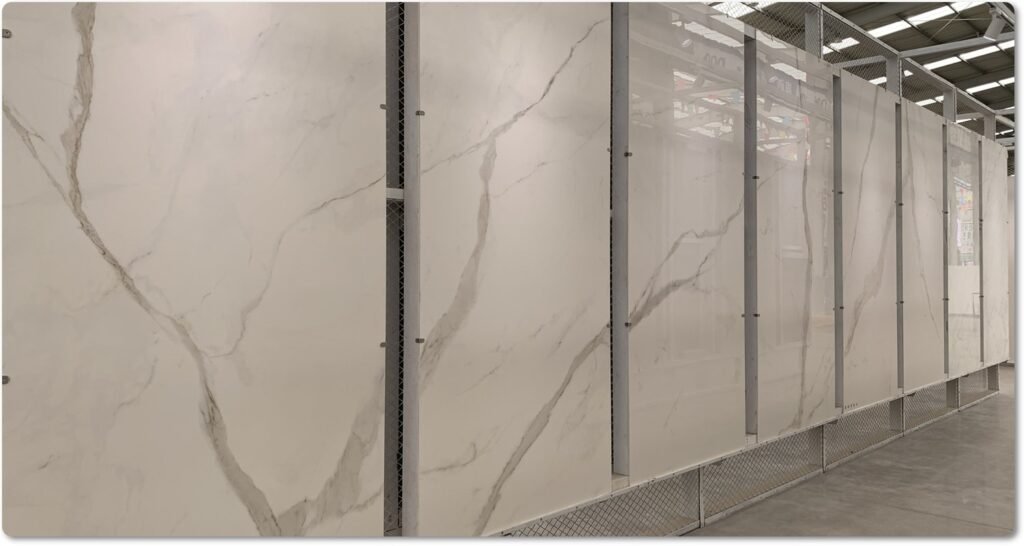
Why the Industry Uses Different Names for Similar Materials
The surface-material industry has historically developed through different product categories.
Traditional categories include:
- Natural stone
- Ceramic tiles
- Porcelain
- Quartz surfaces
- Engineered stone
- Solid surfaces
- Sintered surfaces
- Ultra compact surfaces
As manufacturers developed new technologies, marketing terminology also expanded.
This created several overlapping expressions:
- Ultra compact slabs
- Ultra compact stone
- Compact surface
- Sintered stone
- Sintered surface
- Ultracompact porcelain
- Ultra compact porcelain
- Large-format porcelain slab
- Technical porcelain
- Pyrolytic surface
The problem is that commercial terminology develops faster than international standardization.
For example, ISO published ISO 19947:2026, Engineered Stone — Vocabulary, providing terminology and definitions for engineered stone used in products including countertops, vanities, floor and wall coverings, and accessories. The publication reflects the growing importance of clearer material terminology across the global surface industry.
Why Terminology Matters for Architects
Architects often specify materials based on:
- Performance
- Appearance
- Thickness
- Sustainability
- Maintenance
- Fire behavior
- Weather resistance
- Installation systems
If terminology is unclear, specifications can become inaccurate.
For example:
A product called “ultra compact stone” may perform differently from another product using the same marketing language.
Therefore, specification documents should identify:
Technical Specification Data
Instead of simply writing:
Material: Ultra Compact Stone
A stronger specification may include:
- Product classification
- Manufacturer
- Composition
- Thickness
- Surface finish
- Water absorption
- Flexural strength
- Abrasion resistance
- Intended application
- Installation system
- Required certification
This creates a more reliable procurement framework.
How Ultra Compact Slabs and Sintered Stone Are Manufactured
Although manufacturing technologies vary by producer, the general process usually involves several stages.
Step 1: Raw Material Selection
The production process begins with selected mineral materials.
These may include:
- Clay
- Feldspar
- Silica-containing minerals
- Natural minerals
- Ceramic components
- Inorganic pigments
The exact formulation differs between manufacturers.
This is one reason why buyers should not assume that all ultra-compact slabs have identical performance.
Step 2: Fine Grinding and Material Preparation
Raw materials are processed into extremely fine particles.
Particle size and distribution can influence:
- Surface density
- Compaction
- Appearance
- Mechanical properties
- Final texture
Advanced manufacturing systems use controlled material preparation to create more consistent slabs.
Step 3: High-Pressure Compaction
The prepared material is compacted under extremely high pressure.
The purpose is to reduce internal porosity and create a dense material structure.
This stage contributes to the concept of the:
Ultra Compact Surface
Higher density can improve performance characteristics such as:
- Water resistance
- Mechanical strength
- Surface durability
However, the actual performance must always be verified through testing.
Step 4: High-Temperature Sintering
The compacted material is fired at very high temperatures.
During this stage, mineral particles bond and form a dense solid structure.
This is the fundamental principle behind the term:
Sintered Stone
The material is transformed from compacted mineral particles into a dense engineered surface.
Step 5: Surface Finishing
After firing, slabs may receive different finishes.
Popular options include:
- Polished
- Honed
- Matte
- Textured
- Natural finish
- Leather-like finish
- Structured anti-slip finish
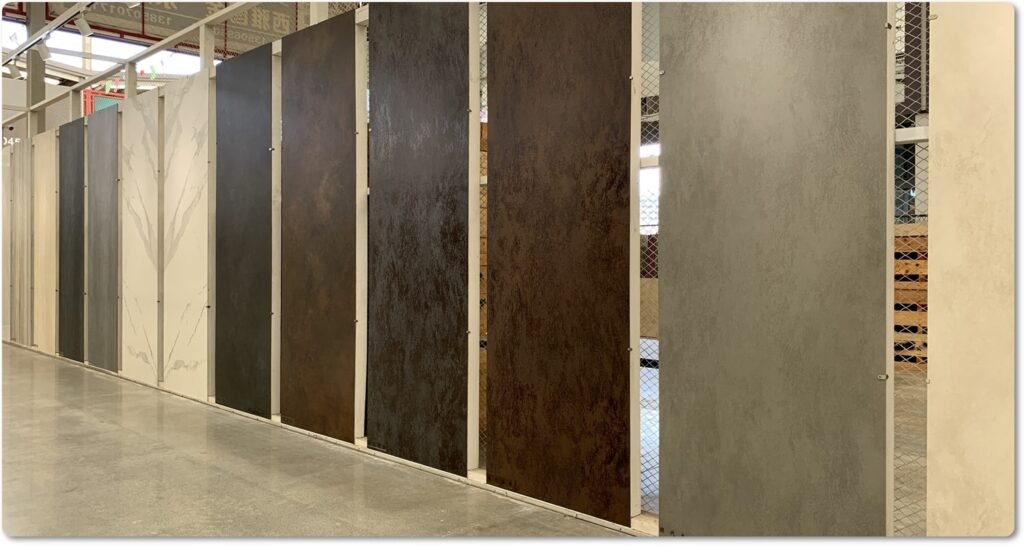
Digital decoration technologies can also reproduce:
- Marble
- Granite
- Limestone
- Travertine
- Concrete
- Metal
- Wood
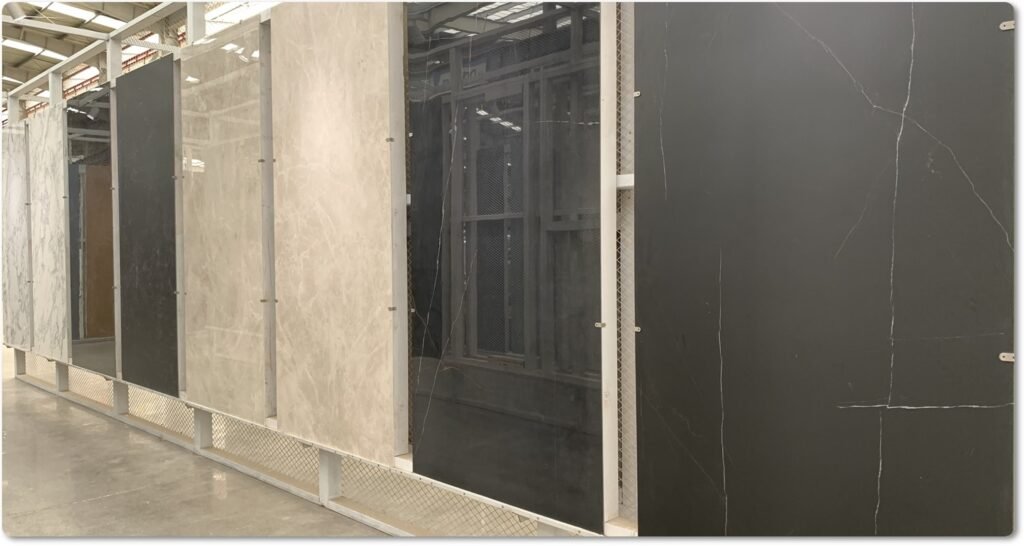
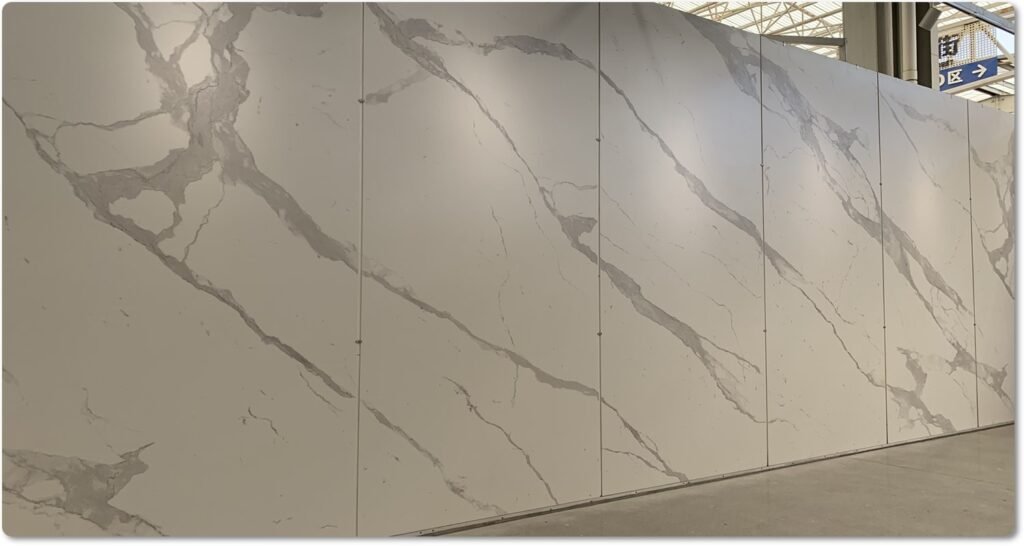
This design flexibility is one of the reasons large-format sintered and ultra-compact surfaces continue to grow in architectural applications.
Ultra Compact Slabs vs Ultra Thin Slabs
Another important category is:
Ultra Thin Stone Slabs
Ultra-thin slabs are defined primarily by thickness.
They may be used for:
- Renovation projects
- Wall applications
- Furniture
- Cabinet cladding
- Interior remodeling
Common commercial thickness categories may include thin and ultra-thin formats, depending on the manufacturer and application.
However:
Ultra-thin does not automatically mean ultra-compact.
Thickness and density are two different properties.
A thin slab may be:
- Ceramic
- Porcelain
- Sintered
- Composite
- Natural stone
Similarly, an ultra-compact slab may be manufactured in several thicknesses.
The Best Way to Compare
Ask two separate questions:
Question 1: How thick is the slab?
Question 2: How dense and technically durable is the material?
This avoids a common purchasing mistake.
Ultra Compact Stone vs Porcelain Slab
One of the most searched questions is whether:
Ultra Compact Stone = Porcelain Slab
The answer is:
Sometimes the categories overlap, but the terminology should not automatically be treated as identical.
Large-format porcelain slabs and ultra-compact surfaces may share:
- Mineral-based compositions
- High-temperature firing
- Large-format production
- Low water absorption
- Architectural applications
However, manufacturers may use different:
- Raw material formulas
- Pressing technologies
- Decoration technologies
- Firing systems
- Technical standards
- Product positioning
Therefore, the most important question is not:
“What marketing name does the supplier use?”
Instead ask:
“What are the verified technical characteristics of this slab?”
For a detailed related comparison, buyers can also explore Sintered Stone vs Porcelain Slab.
Ultra Compact Porcelain vs Sintered Stone
The phrase ultra-compact porcelain is increasingly used by manufacturers and distributors.
In many commercial markets, it refers to:
Large-format, dense, high-performance porcelain-based surface materials designed for architectural applications.
Sintered stone is often positioned similarly.
Where They Overlap
Both can offer:
- Large dimensions
- Low porosity
- Heat resistance
- UV resistance
- Chemical resistance
- Durable decorative surfaces
Where Buyers Should Be Careful
The exact product technology may differ.
Therefore, project specifications should verify:
- Material composition
- Manufacturing method
- Technical test reports
- Installation recommendations
The safest procurement strategy is:
Compare specifications, not marketing vocabulary.
Performance Comparison: Ultra Compact Slabs vs Sintered Stone
| Performance Factor | Ultra Compact Slabs | Sintered Stone |
|---|---|---|
| Density | Generally high | Generally high |
| Water absorption | Usually very low | Usually very low |
| Heat resistance | High, depending on product | High, depending on product |
| UV resistance | Often excellent | Often excellent |
| Scratch resistance | High | High |
| Chemical resistance | High | High |
| Large-format production | Common | Common |
| Thin slabs | Available | Available |
| Outdoor applications | Product dependent | Product dependent |
| Countertops | Common | Common |
The most important words in this table are:
Product dependent
Performance values can vary significantly.
A professional buyer should request:
- Technical Data Sheet
- SDS where applicable
- Test reports
- Installation manual
- Warranty documentation
- Certification documents
Which Material Is Better for Kitchen Countertops?
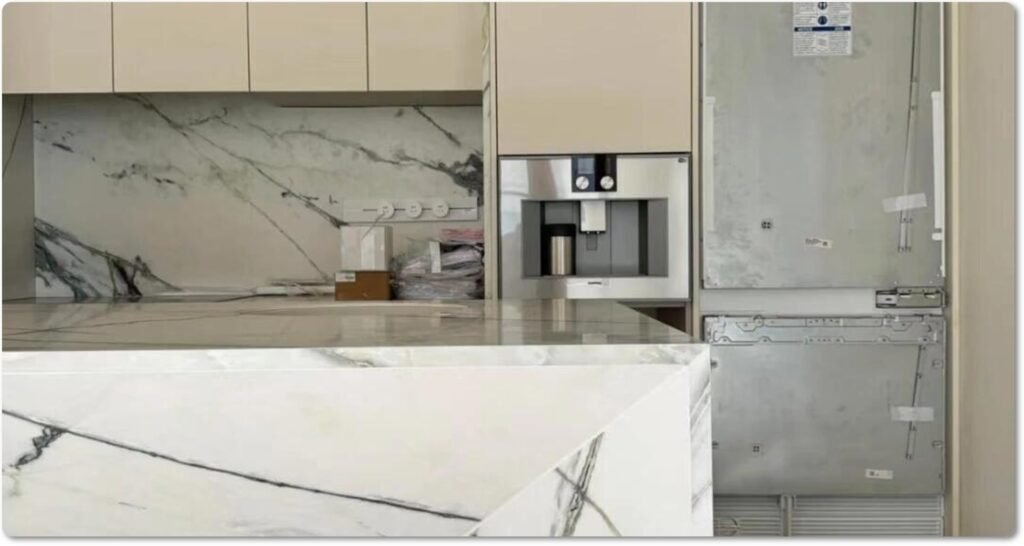
For kitchen countertops, both high-quality ultra-compact slabs and sintered stone can offer excellent performance.
Important Countertop Requirements
A kitchen surface should be evaluated for:
Heat Resistance
Kitchen countertops are exposed to:
- Hot cookware
- Steam
- Temperature changes
Always follow the manufacturer’s specific use recommendations.
Stain Resistance
Kitchen surfaces encounter:
- Coffee
- Wine
- Oil
- Sauces
- Acidic foods
Low-porosity surfaces generally provide advantages in maintenance.
Scratch Resistance
Kitchen knives and metal objects can damage many surfaces.
However, scratch resistance does not mean the material is indestructible.
Edge Strength
Large-format slabs may have strong flat surfaces but require professional fabrication around:
- Sink cutouts
- Cooktop openings
- Drain grooves
- Thin edges
Fabrication quality is often as important as the slab itself.
The Fabrication Question Is More Important Than Many Buyers Realize
One of the biggest differences between a successful and unsuccessful project is fabrication planning.
Ultra-compact slabs and sintered stone may require:
- Specialized diamond tools
- CNC machinery
- Water-cooled cutting
- Appropriate blade specifications
- Controlled cutting speeds
- Professional handling equipment
Large-format slabs can also present logistical challenges.
Common Fabrication Risks
These include:
- Edge chipping
- Corner cracking
- Cutout breakage
- Transportation damage
- Incorrect adhesive selection
- Incorrect support design
For wholesalers and project buyers, the best purchasing strategy is to confirm fabrication requirements before ordering the material.
Safety Regulations Are Changing the Surface-Material Industry
One of the most important industry trends is increasing attention to respirable crystalline silica.
This issue is particularly significant in fabrication environments where workers:
- Cut
- Grind
- Drill
- Polish
silica-containing materials.
OSHA explains that respirable crystalline silica can be generated during operations involving stone, artificial stone, ceramic products and other silica-containing materials. OSHA notes that approximately 2.3 million workers in the United States are exposed to silica in occupational settings.
In February 2026, NIOSH and OSHA issued an updated hazard alert concerning worker exposure to silica during countertop manufacturing, finishing and installation. The updated publication emphasizes controlling exposure and maintaining worker protection during these activities.
Why This Matters for Ultra Compact and Sintered Surfaces
Buyers should understand an important point:
The dust risk depends on the material composition and fabrication process—not simply on the marketing name of the slab.
A responsible procurement process should include:
- Composition review
- SDS review
- Fabrication planning
- Wet cutting where appropriate
- Local exhaust ventilation
- HEPA-filtered cleaning
- Worker training
OSHA’s silica standards and guidance emphasize exposure control, while the agency’s countertop enforcement initiatives demonstrate increasing regulatory attention to the stone-fabrication sector.
New EU Regulations Are Pushing the Industry Toward Better Product Information
The construction-products industry is also moving toward greater transparency.
The European Union’s updated Construction Products Regulation, Regulation (EU) 2024/3110, establishes the framework for harmonized construction-product information and includes provisions for a future construction digital product passport system.
What This Means for Surface-Material Manufacturers
Over time, manufacturers supplying international construction markets will increasingly benefit from better digital documentation.
This may include:
- Product identification
- Technical information
- Performance declarations
- Safety information
- Technical documentation
- Product traceability
The EU has also described the new framework as supporting cleaner and smarter construction products, including the development of digital product information systems.
The 2026 Procurement Trend
The future competitive advantage will not come only from:
- Better colors
- Bigger slabs
- Lower prices
It will increasingly come from:
Better Product Data + Better Compliance + Better Traceability
This is particularly important for:
- European distributors
- Architects
- Hospitality projects
- Commercial developments
- Government projects
- Large construction companies
Ultra Compact Slabs Applications
Ultra-compact slabs can be used across multiple architectural categories.
Kitchen Countertops
Benefits may include:
- Large formats
- Low maintenance
- Modern aesthetics
- Heat resistance
- Low porosity
Bathroom Vanity Tops
Popular because of:
- Moisture resistance
- Easy cleaning
- Design flexibility
Wall Cladding
Large-format slabs can reduce visible grout lines.
Applications include:
- Hotel lobbies
- Luxury residences
- Retail stores
- Commercial interiors
Flooring
Appropriate products may provide:
- Durability
- Large-format design
- Easy maintenance
Surface finish and slip requirements should always be evaluated for the intended location.
Furniture
A rapidly growing application includes:
- Dining tables
- Coffee tables
- Console tables
- Side tables
- Cabinet surfaces
This creates new opportunities for the stone furniture and luxury interior markets.
Exterior Applications
Certain technically suitable slabs can be considered for:
- Façades
- Outdoor walls
- Landscaping
- Exterior furniture
However, outdoor specifications must evaluate:
- Climate
- Installation systems
- Thermal movement
- Structural requirements
How to Choose an Ultra-Compact Slabs Manufacturer
For international procurement, price should not be the only selection factor.
A professional ultra-compact slabs manufacturer should provide:
Technical Documentation
Including:
- Technical Data Sheet
- Product specifications
- Installation recommendations
Quality Control
Ask about:
- Thickness consistency
- Flatness
- Surface inspection
- Color consistency
- Batch control
Manufacturing Capacity
Important questions include:
- Monthly production capacity
- Available slab sizes
- Available thicknesses
- Lead times
Export Packaging
Large-format slabs require professional:
- A-frame packaging
- Reinforced protection
- Container loading procedures
Project Experience
Ask for experience with:
- Hotels
- Apartments
- Commercial projects
- Countertop fabrication
Why Wholesale Buyers Should Compare More Than Price
A low purchase price can become expensive when problems occur.
Potential hidden costs include:
- High breakage rates
- Fabrication problems
- Color inconsistency
- Replacement shipments
- Installation delays
Therefore, wholesale buyers should evaluate:
Total Procurement Value
This includes:
Product Price + Quality + Yield + Fabrication Efficiency + Packaging + Documentation + After-Sales Support
This is particularly important when sourcing:
- Ultra compact slabs wholesale
- Sintered stone wholesale
- Ultra compact porcelain China
- Large-format porcelain slabs factory
EDG Stone and the Global Surface-Material Supply Chain
EDG Stone works within the broader international stone and architectural surface-material supply chain, serving buyers seeking natural stone and engineered surface solutions for projects, wholesale distribution and customized applications.
For buyers comparing:
- Ultra-compact slabs
- Sintered stone
- Porcelain slabs
- Quartz surfaces
- Natural stone
The most important strategy is to begin with the application.
For example:
Luxury Natural Appearance
Consider:
- Marble
- Quartzite
- Granite
Highly Consistent Engineered Appearance
Consider:
- Quartz
- Engineered surfaces
Large-Format Technical Performance
Consider:
- Ultra compact slabs
- Sintered stone
- Large-format porcelain
The best material depends on the project—not the popularity of a product name.
2026 Market Trends for Ultra Compact Surfaces
The next stage of industry development will likely focus on five major directions.
1. Larger Formats
Architects increasingly prefer:
- Fewer joints
- Continuous surfaces
- Minimalist interiors
Large slabs support this trend.
2. Thinner Materials
Ultra thin slabs are becoming increasingly attractive for:
- Renovation
- Wall applications
- Furniture
3. Better Digital Design
Manufacturers continue improving:
- Marble patterns
- Veining
- Texture
- Surface realism
4. Safer Fabrication
Silica exposure regulations and enforcement are increasing pressure on the industry to improve:
- Wet processing
- Dust collection
- Ventilation
- Worker training
The updated 2026 OSHA/NIOSH guidance reinforces the importance of exposure controls throughout countertop fabrication and installation.
5. Digital Product Transparency
The direction of construction-product regulation increasingly favors:
- Traceability
- Structured data
- Digital product information
- Machine-readable documentation
This trend is highly relevant to manufacturers serving international construction markets.
Ultra Compact Slabs vs Sintered Stone: Final Verdict
The most accurate answer is:
Ultra compact slabs and sintered stone frequently describe overlapping categories of high-performance mineral-based surfaces, but they should not be treated as universally identical terms without reviewing the manufacturer’s technical specifications.
Choose Based on Five Factors:
1. Application
Where will the material be used?
2. Performance
What technical properties are required?
3. Fabrication
Can your fabricator process the material correctly?
4. Compliance
Does the product meet destination-market requirements?
5. Supplier Capability
Can the manufacturer provide consistent quality and documentation?
For architects and international buyers, this is a far better decision-making framework than simply asking:
“Which one is better?”
FAQ: Ultra Compact Slabs vs Sintered Stone
1. Are ultra compact slabs the same as sintered stone?
They are often used interchangeably, but terminology varies between manufacturers and markets. Sintered stone generally refers more specifically to the manufacturing principle involving the thermal bonding of mineral particles, while ultra compact slabs often describe the broader commercial category of dense high-performance surfaces.
2. Is sintered stone better than porcelain?
Not necessarily. The best choice depends on composition, manufacturing technology, technical performance, and intended application. Buyers should compare certified product data instead of relying only on marketing terminology.
3. Are ultra compact slabs good for kitchen countertops?
Yes, high-quality ultra-compact slabs can be suitable for kitchen countertops because many products offer low porosity, heat resistance, and strong surface durability. However, correct fabrication and installation are essential.
4. Canultra-thinn slabs be used for countertops?
Some ultra-thin materials can be used for specific countertop applications, but structural support, substrate requirements, and manufacturer installation guidelines must be carefully evaluated.
5. What should I ask an ultra-compact slabs manufacturer before buying?
Ask for technical specifications, composition information, available sizes and thicknesses, test reports, fabrication recommendations, packaging details, production lead time, and certifications relevant to your destination market.
Ultra Compact Slabs vs Sintered Stone: Market Insight, Selection Logic and 2026 Direction
What is the real difference?
The practical difference is primarily about terminology and product definition. Ultra-compact slabs usually describe a commercial category of dense, high-performance architectural surfaces. Sintered stone describes a material technology based on the thermal bonding of mineral particles. In many products, the two concepts overlap.
Why should buyers avoid relying only on product names?
Because global manufacturers use different commercial terminology. A product name does not automatically reveal composition, technical performance, fabrication requirements, or regulatory suitability. The most reliable comparison uses technical data, test reports and application requirements.
How should architects and wholesalers make a decision?
Start with the intended application, then evaluate thickness, slab size, surface performance, fabrication requirements, installation conditions,s and available documentation. The correct material is the one that delivers the required performance for the specific project.
What options are available in the modern surface market?
Modern buyers can choose from natural stone, quartz surfaces, large-formatporcelain, ultra-compact slabs, and sintered stone. Natural stone offers geological uniqueness; engineered surfaces provide consistency; ultra-compact and sintered materials can provide large formats and high-performance mineral-based characteristics.
What should procurement teams consider before placing a wholesale order?
Evaluate total procurement value rather than slab price alone. Consider quality consistency, usable yield, fabrication efficiency, packaging, shipping risk, documentation, certifications, and after-sales support.
Why is 2026 an important turning point?
The industry is moving toward a more transparent and technically documented supply chain. Updated silica-safety guidance and regulatory enforcement are increasing attention to fabrication practices, while the EU Construction Products Regulation is moving the construction-products ecosystem toward stronger digital product information and traceability.
Where is the market heading?
The future of ultra-compact surfaces will be shaped by larger formats, thinner profiles, advanced digital decoration, safer fabrication systems, better technical documentation and machine-readable product information. Manufacturers that combine material performance with compliance and traceability will have a stronger position in international markets.
The strategic conclusion
Ultra-compact slabs vs sintered stone should not be treated as a simple “winner versus loser” comparison. The intelligent choice is application-driven procurement supported by verified technical data. For architects, distributors, wholesalers, and project buyers, the next generation of successful sourcing will combine material performance, fabrication planning, regulatory awareness,s and supplier transparency.