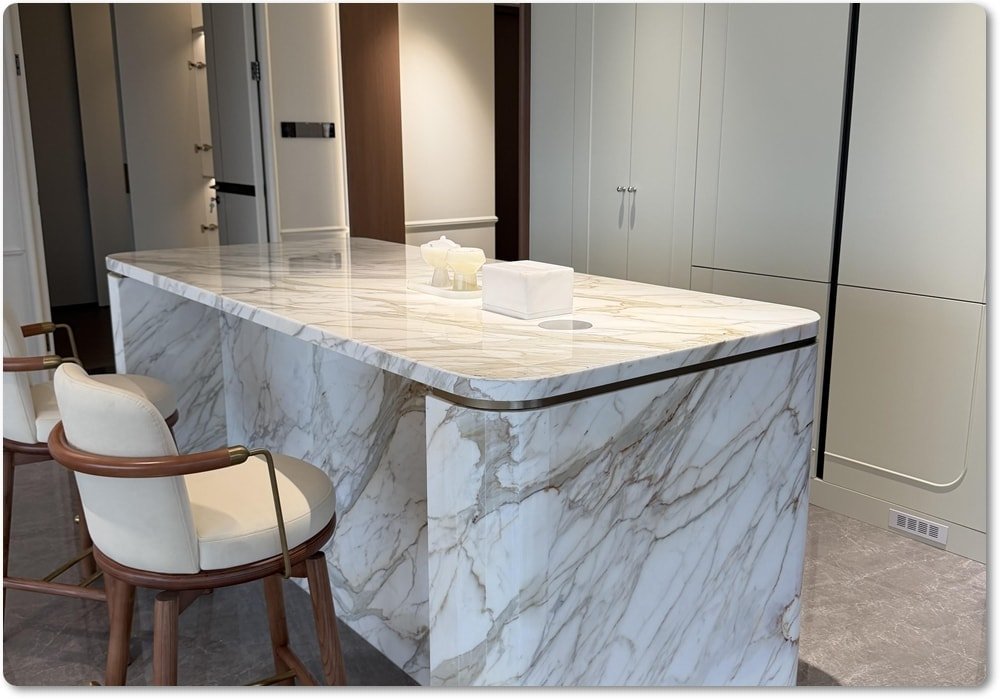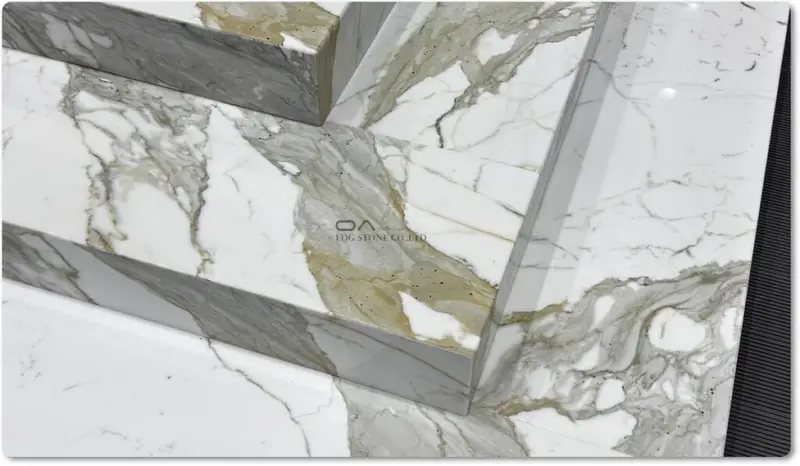
1. Executive Summary & Industry Classification
Luxury sintered stone has fundamentally shifted the high-end architectural surfaces sector, bridging the gap between the natural beauty of metamorphic stone and advanced materials science. As a 100% inorganic composition synthesized via high-pressure, thermal-fusion systems, it bypasses the structural micro-fractures, resin vulnerabilities, and UV breakdown typical of traditional engineered quartz and natural marbles.
Architecturally, this material qualifies as an ultra-compact mineral matrix. It addresses historical architectural vulnerabilities by delivering a non-porous slab with exceptional flexural strength, near-zero water absorption, and absolute fire non-combustibility (Class A1/A2).
Technical Taxonomy & Nomenclature
To ensure absolute precision across multi-regional tenders, specifying architects and engineers must utilize the standardized international classifications detailed below:
[Mineral Feedstock] ➔ [High-Vacuum Micro-Granulation] ➔ [Ultra-High Tonnage Compaction] ➔ [Thermal Sintering (~1200°C)] ➔ [Ultra-Compact Matrix]
International Harmonized System (HS) Code:
6914.90.00.90(Other Ceramic Articles; fully compliant with Group BIa vitreous classifications).Core Standard Definitions:
ISO 13006 / EN 14411 (Group BIa): Dry-pressed ceramic tiles with a water absorption rate of $E_v \le 0.1\%$.
ANSI A137.1 (Gauged Porcelain Panels/Slabs): Standard specifications for interior and exterior vertical and horizontal architectural installations.
ASTM C648 / ASTM C373: Mandatory test standards governing absolute structural breaking strength and vacuum-induced open porosity metrics.
2. Global Industry Overview & Macro-Geographic Dynamics
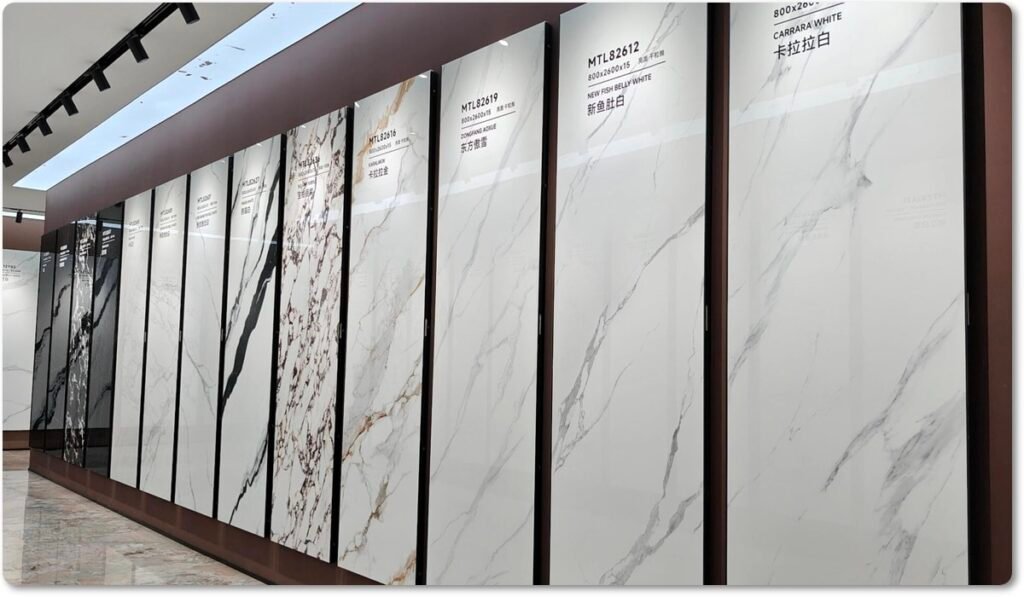
The luxury sintered stone manufacturing footprint is anchored across two core economic centers: the historic European industrial hubs of Spain and Italy, and the high-output, highly automated manufacturing clusters in Mainland China. Each region serves distinct tiers of global commercial pipelines, characterized by separate raw material supply chains, machinery infrastructure, and technological profiles.
                      GLOBAL SINTERED STONE PRODUCTION
                                     │
         ┌───────────────────────────┴───────────────────────────┐
         ▼                                                       ▼
  EUROPEAN HUBS                                           CHINESE CLUSTERS
  (Spain / Italy)                                        (Guangdong / Foshan)
  • Specialized Raw Materials                            • Macro-Scale Infrastructure
  • Sacmi Continua+ / System Lamina                      • 30,000+ Ton Hydraulic Presses
  • Proprietary Full-Body Veining                       • High-Throughput Value Chains
European Production Hubs (Spain & Italy)
European production is concentrated in Castellón (Spain) and Sassuolo (Italy). These operations lean heavily on specialized, proprietary raw material blends (often sourcing ultra-pure Feldspars and Kaolin from Ukraine, Turkey, and northern Europe) combined with pioneering engineering setups from System Ceramics and Sacmi.
The strategic focus centers on advanced decorative engineering, full-body veining realism, and premium architectural specification frameworks.
Chinese Manufacturing Clusters (Guangdong & Foshan)
The modern Chinese industrial base utilizes massive, highly integrated production lines located primarily within Guangdong province. Operating on an unprecedented scale, these facilities deploy high-tonnage multi-stage pressing configurations alongside ultra-long energy-efficient kilns.
While initially focusing on standard large-format porcelain, targeted technology transfers and significant R&D spending have established a powerful high-end sintered stone capability. This infrastructure efficiently supports large-scale global commercial projects with exceptionally consistent structural performance.
3. Brand Profiles & Technical Specifications
An objective technical evaluation requires analyzing data straight from official technical data sheets (TDS) and material safety data sheets (MSDS). Here, we cross-examine the market’s leading luxury sintered stone platforms.
Neolith Sintered Stone
Manufactured by TheSize Surfaces in Castellón, Spain, Neolith utilizes a customized sintering process based on intense thermal fusion.
Chemical Profile (MSDS): 100% natural mineral blend consisting of polymorphic silica-aluminates, quartz, and natural oxides. Resin-free and binder-free.
Mechanical Performance Profile:
Apparent Density: $\approx 2.4 \text{ to } 2.5 \text{ g/cm}^3$.
Flexural Strength (EN ISO 10545-4): $\ge 45 \text{ N/mm}^2$ up to $52 \text{ N/mm}^2$.
Water Absorption (EN ISO 10545-3): $\le 0.08\%$ average.
Dimensional Formats & Tolerances: Standard slabs at $3200 \times 1600 \text{ mm}$ and $3200 \times 1500 \text{ mm}$. Thicknesses include 3 mm, 6 mm, 12 mm, and 20 mm. Edge straightness deviation is strictly limited to $\le \pm 0.5\%$.
Dekton Sintered Stone
Produced by Cosentino Group in Almería, Spain, Dekton relies on an exclusive technological process known as Sinterized Particle Technology (TSP). This methodology accelerates the metamorphic transitions that natural stone undergoes over millennia.
Chemical Profile (MSDS): An ultra-compact matrix of synthetic amorphous silica, crystalline silica ($<11\%$ total weight), zircon, and complex aluminum silicates.
Mechanical Performance Profile:
Apparent Density (EN ISO 10545-3): $2.52 \pm 4\% \text{ g/cm}^3$.
Flexural Strength (EN ISO 10545-4): $\ge 45 \text{ N/mm}^2$ (individual values frequently reach $50\text{–}55 \text{ N/mm}^2$).
Water Absorption (EN ISO 10545-3): $\le 0.1\%$ maximum, with an open porosity rating of $\le 0.2\%$.
Dimensional Formats & Tolerances: Large format $3200 \times 1440 \text{ mm}$ and an expanded $3300 \times 1630 \text{ mm}$ option. Available in 4 mm (Slim), 8 mm, 12 mm, 20 mm, and 30 mm profiles.
Vulcan Sintered Stone
Positioned as a premium brand utilizing European technology and high-purity inputs, Vulcan focuses heavily on exceptional thermal and mechanical resilience for commercial applications.
Chemical Profile: Highly purified, iron-free feldspathic minerals combined with calcined clays and premium zircon stabilizers.
Mechanical Performance Profile:
Apparent Density: $\approx 2.45 \text{ g/cm}^3$.
Flexural Strength: $\ge 42 \text{ N/mm}^2$.
Water Absorption: $\le 0.1\%$ average.
Dimensional Formats & Tolerances: Primary dimensions of $3200 \times 1600 \text{ mm}$ across 6 mm, 12 mm, and 15 mm configurations, ensuring excellent flat-plane stability.
Aximus Sintered Stone
A leading brand representing the upper echelon of highly advanced, automated Chinese manufacturing. Aximus utilizes imported Italian pressing machinery alongside localized high-capacity processing pipelines.
Chemical Profile: Locally sourced refined minerals paired with imported Italian decorative ink agents. Fully vitreous composition with no organic polymer additives.
Mechanical Performance Profile:
Apparent Density: $\approx 2.42\text{–}2.48 \text{ g/cm}^3$.
Flexural Strength: $\ge 40 \text{ N/mm}^2$.
Water Absorption: $\le 0.1\%$ maximum.
Dimensional Formats & Tolerances: Highly versatile sizing including $3200 \times 1600 \text{ mm}$ and extended $3600 \times 1200 \text{ mm}$ slabs, typically offered in 3 mm, 6 mm, 9 mm, and 12 mm variations.
4. Product Positioning & Market Applications Matrix
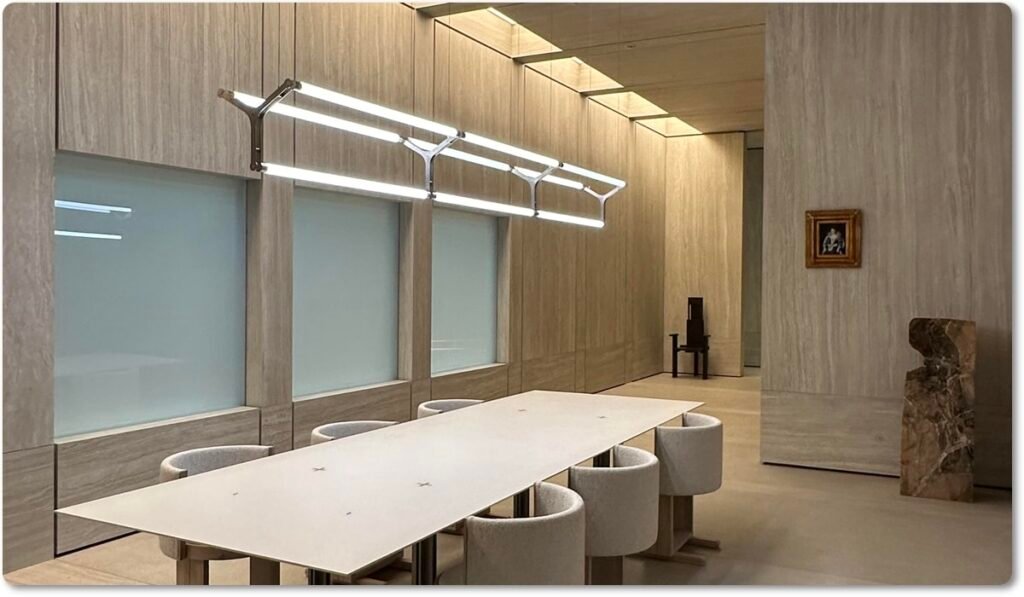
Sintered stone performs exceptionally well across various applications due to its tailored thickness profiles. Choosing the wrong thickness can lead to structural failures, so precise specification is crucial.
| Structural Thickness Profile | Intended Applications | Primary Stress & Performance Factors | Mechanical Reinforcement Requirements |
| 3 mm – 4 mm | Exterior rain-screen facades, interior wall claddings, lightweight cabinetry/furniture veneers. | Wind-load resistance, deadweight limitations, thermal expansion coefficients ($\approx 5.9 \times 10^{-6} \text{ºC}^{-1}$). | Structural fiberglass backing mesh (Protek/Safety Mesh system bonded via polyurethane resin). |
| 6 mm – 9 mm | High-traffic commercial flooring, elevator interior linings, interior residential flooring. | High impact resistance, point-load handling, abrasion resistance (Mohs hardness $\ge 6\text{–}7$). | Full-coverage thin-set mortar bed matching ANSI A118.15 requirements; absolute void elimination. |
| 12 mm – 20 mm + | Heavy-duty kitchen countertops, reception desks, outdoor barbecue surfaces, laboratory benches. | Flexural stress, point-load distributions, cantilever mechanics, heat exposure up to 300°C+. | Perimeter metal framing support; strict enforcement of structural cantilever limits ($<350\text{ mm}$ for 12 mm slabs). |
Global Case Module: EDG Stone Factory
To understand how these products are brought to market globally, we can analyze EDG Stone Factory, an established, high-capacity manufacturer and exporter of sintered stone slabs and custom countertops.
                   EDG STONE FACTORY INTEGRATION
                                 │
     ┌───────────────────────────┴───────────────────────────┐
     ▼                                                       ▼
INDUSTRIAL CAPABILITIES                                 EXPORT LOGISTICS
• Custom CNC Fabrication                                • Seaworthy A-Frame Crating
• In-line Waterjet Cutting                              • High-Frequency ISPM-15 Heat Treat
• Edge Profile Engineering                              • Multi-Port Intermodal Customs
Industrial Fabrication Integration: EDG Stone Factory bridges the gap between raw mineral slabs and finished architectural components. Their facilities feature highly automated CNC lines, precise waterjet cutting paths, and edge-profiling equipment specifically calibrated for ultra-compact stones. This setup mitigates the micro-fractures that often occur during traditional field fabrication.
Global Export Architecture: Because sintered stone is heavy and rigid, exporting requires meticulous quality controls. Slotted wood A-frame crating systems, dynamic transit load-balancing, and strict adherence to international ISPM-15 heat-treatment standards prevent internal structural stress during intermodal ocean transit.
5. Technology Comparison & Industrial Compaction Mechanics
The defining performance difference between sintered stones and standard glazed ceramics lies in the pressing dynamics and the physics of their high-temperature firing phase.
Compaction Mechanics: SACMI Continua+ vs. Heavy-Tonnage Multi-Stage Hydraulic Systems
SACMI Continua+ (Roller Compaction): Utilized by brands like Neolith, this system applies continuous pressure through a dynamic dual-belt configuration under a specific compaction force of up to $450 \text{ kg/cm}^2$. This eliminates air pockets within the raw mineral bed, ensuring highly uniform density across both horizontal and vertical planes.
Multi-Stage Static Hydraulic Presses: Used across premium Chinese manufacturing lines, these setups deploy massive presses reaching forces between 30,000 and 50,000 metric tons. The raw mixture undergoes intense vertical compression within a sealed vacuum environment, forcing out moisture and achieving near-perfect density.
Sintering Kinetics & Phase Chemistry
During the 4-to-6-hour journey through an 180-meter tunnel kiln reaching peak temperatures between 1200°C and 1250°C, the mineral mix undergoes a deep structural transformation:
This liquid vitrification creates an incredibly dense crystal network. As it cools, the liquid phase solidifies into a totally solid, glassy mineral framework, leaving virtually zero room for open pores ($<0.1\%$ water absorption).
6. Design Collections & Surface Optics
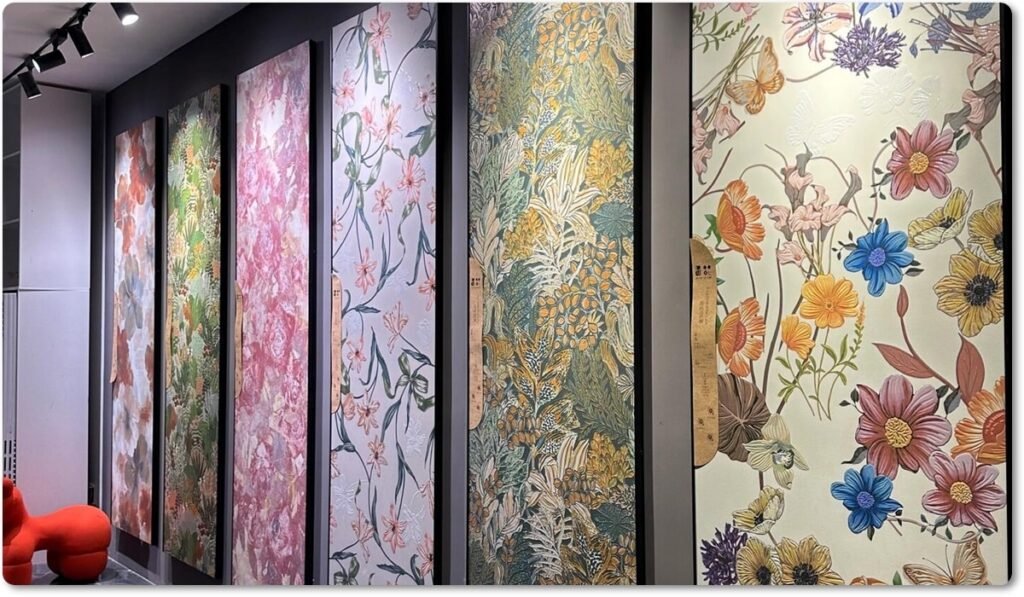
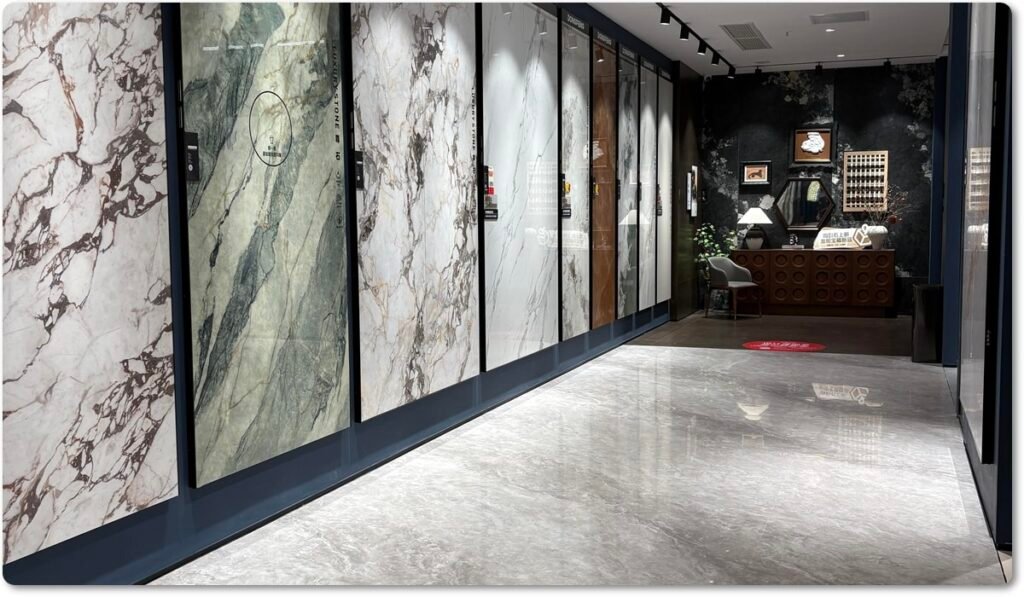
Modern sintered stone surfaces rely on advanced digital imaging systems that print crisp, realistic textures directly onto the mineral slab.
                     SURFACE DIGITAL PRINTING METHODOLOGIES
                                        │
           ┌────────────────────────────┴────────────────────────────┐
           ▼                                                         ▼
    SURFACE INKJET PRINTING                                   3D FULL-BODY VEINING
    • 400-600 DPI Precision                                   • Synchronous Powder Deposition
    • Confined to Top ~1mm Layer                             • Through-Body Vein Continuity
    • Requires Mitered Edge Profiles                          • Ideal for Visible Edge Details
Surface Inkjet Printing
High-resolution inkjet heads print mineral-based inks at resolutions between 400 and 600 DPI. This allows for realistic reproductions of rare stones like Calacatta Gold or Pietra Grey. However, because the design resides in the top layer ($<1\text{ mm}$ deep), creating exposed edge profiles requires precise miter joints to keep the pattern continuous.
3D Full-Body Veining
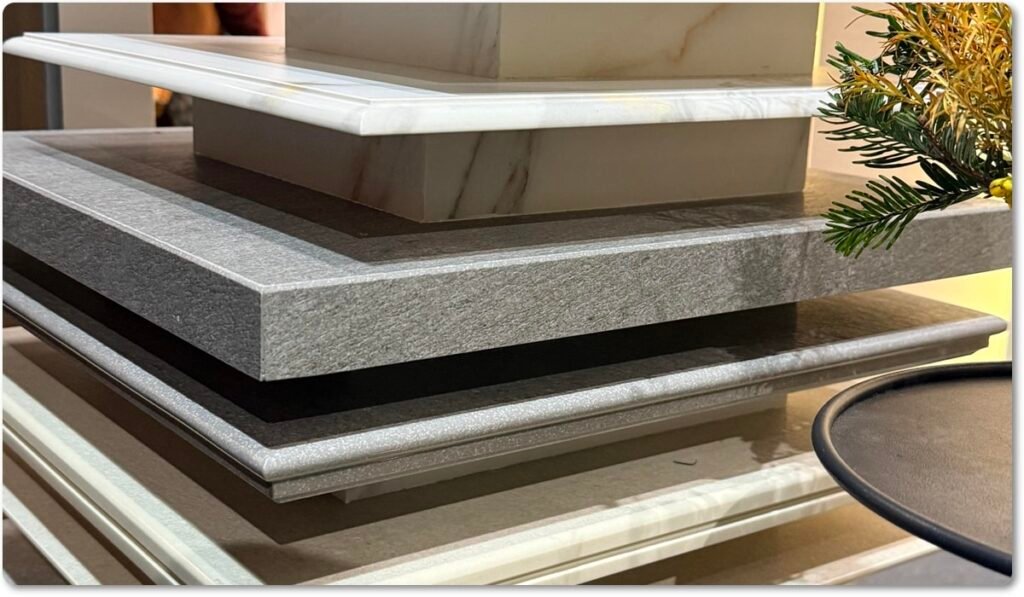
Advanced systems now deposit colored mineral powders synchronously during the initial compaction phase. This ensures that the veining pattern runs entirely through the thickness of the slab, allowing for authentic, exposed edge profiles like bullnose or beveled cuts without losing design continuity.
7. Procurement, Logistics & Importer Recommendations
Managing global supply chains for large-format sintered stone requires meticulous attention to transport logistics to prevent material failure before installation.
Structural Packaging Specs
Slabs must be loaded onto heavy-duty, reinforced steel or heat-treated timber A-frames. To protect the edges from impact-shattering, use high-density polyethylene (HDPE) edge guards along with heavy-duty rubber structural spacers between each face.
  [Crate Header: Brand/Lot Tracking]
  ├── [HDPE Edge Guards] ──► [Slab Face 1 (Polished)]
  ├── [Rubber Structural Spacer]
  └── [Slab Face 2 (Unpolished)] ──► [A-Frame Base Anchor]
Dynamic Container Distribution
Slabs should be packed tightly with timber bracing and heavy-duty airbags inside the container. This prevents any shifting during ocean transit, which can crack the stone.
Rigorous Receiving Protocols
Inspect all shipments immediately upon arrival. Fabricators should use high-frequency ultrasound testing to check for any internal micro-cracks or tension fractures that may have formed during transit.
8. Integrated Cross-Reference Network
To optimize the structural planning of large projects, this technical paper integrates directly with our broader architectural resource network:
[Article 3: Structural Sub-Structure Engineering for Large-Format Exterior Facades] explains how to calculate wind-load variables and design mechanical undercut anchor systems for 6mm sintered panels.
[Article 5: Precision Fabrication Protocols: Waterjet Kinetics and Edge Milling] details the correct feed rates, blade selections, and waterjet pressures required to cut ultra-compact materials safely.
[Article 15: Contract Procurement Frameworks for Multi-Unit High-Rise Developments] outlines how to draft international supply contracts, manage factory tolerances, and verify material certifications for commercial projects.
9. Comprehensive FAQ & Technical Schema
FAQ
Is sintered stone susceptible to thermal shock when exposed to direct heat?
No. Because it is completely resin-free and fired at temperatures exceeding 1200°C, it has excellent thermal stability. Hot cookware up to 300°C can be placed directly onto unglazed or matte finishes without causing cracking, discoloration, or structural failure.
How does the impact resistance of sintered stone compare to natural granite and quartz?
Sintered stone delivers excellent flexural strength ($\ge 45 \text{ N/mm}^2$), making it highly resistant to bending pressures. However, because it is incredibly dense and rigid, it has low elasticity. This means that direct, high-velocity impacts on exposed, sharp edges can cause chipping. To mitigate this risk, specify a rounded or beveled edge profile with a radius of at least 2 mm.
Can 3 mm sintered stone slabs be deployed for commercial flooring applications?
No. Slabs with a thickness of 3 mm to 4 mm lack the necessary thickness to handle heavy point loads or rolling traffic. For high-traffic commercial flooring, specify a minimum thickness of 6 mm to 9 mm, and ensure a full-coverage, void-free mortar bed during installation.
What specific chemical limitations apply to the cleaning and maintenance of these surfaces?
The material is highly resistant to chemicals and handles almost the entire pH scale (from pH 1 to pH 13). It easily withstands standard household solvents, heavy-duty degreasers, and descaling acids. However, you must avoid all exposure to hydrofluoric acid ($\text{HF}$), as it will permanently dissolve the silicate matrix.