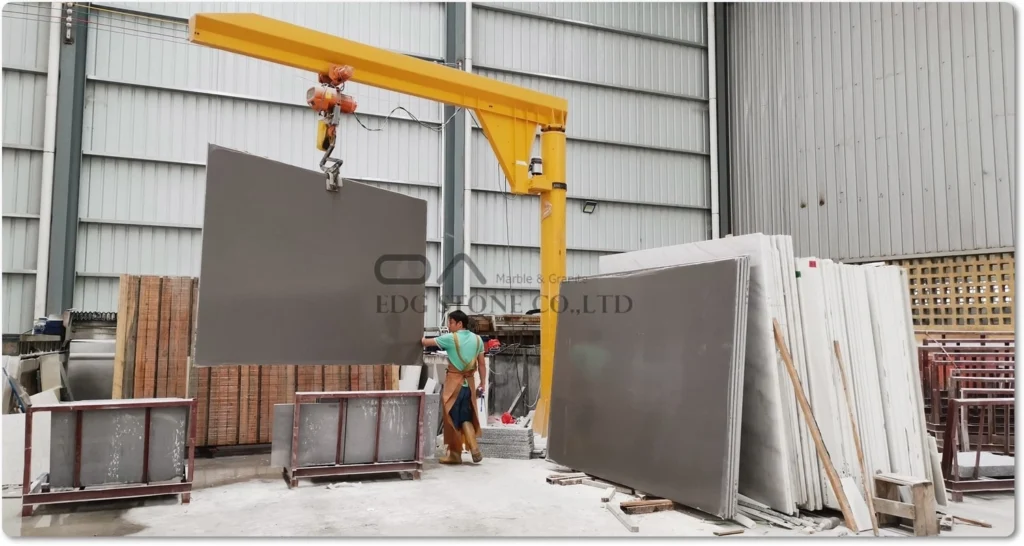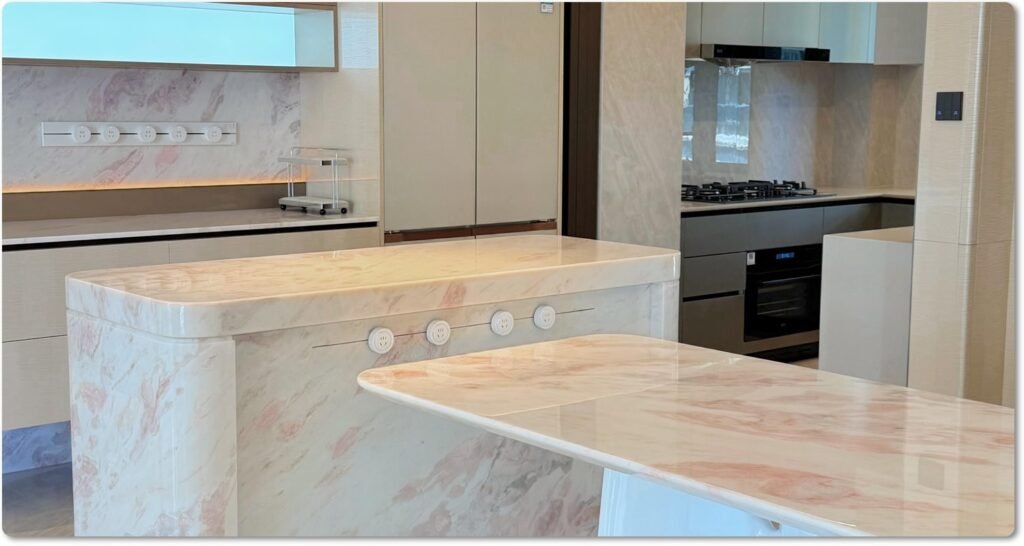
1. Executive Summary: Are Quartzite Countertops Worth It?
Natural quartzite countertops are premium natural stone surfaces formed when quartz-rich sandstone undergoes heat and pressure during geological metamorphism. Their main advantages include high hardness, excellent scratch resistance, natural mineral patterns, heat tolerance, and resistance to many household acids. Their disadvantages include potentially high material and fabrication costs, natural color variation, possible porosity, occasional resin repairs, difficult cutting and polishing, and the need for appropriate sealing depending on the individual stone. Buyers should verify that the selected slab is genuine quartzite, review its absorption and physical test results, inspect the actual slab, and approve fabrication drawings before production.
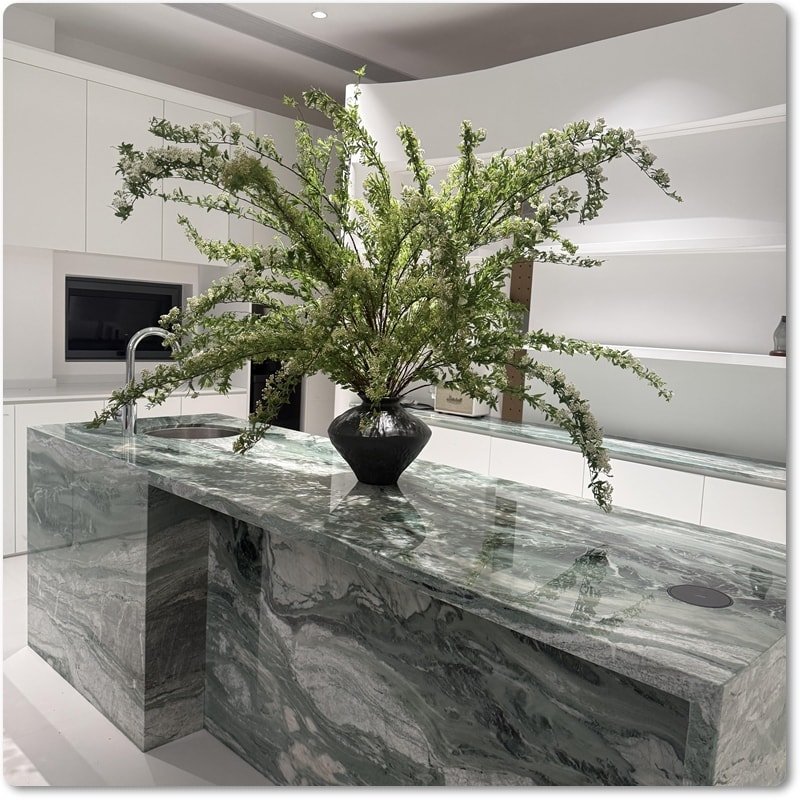
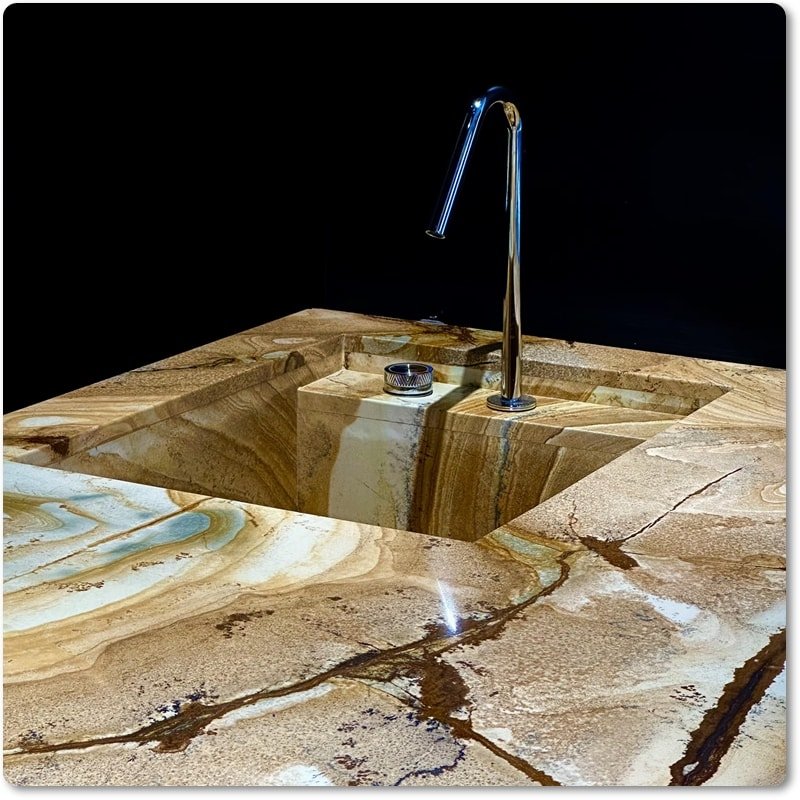
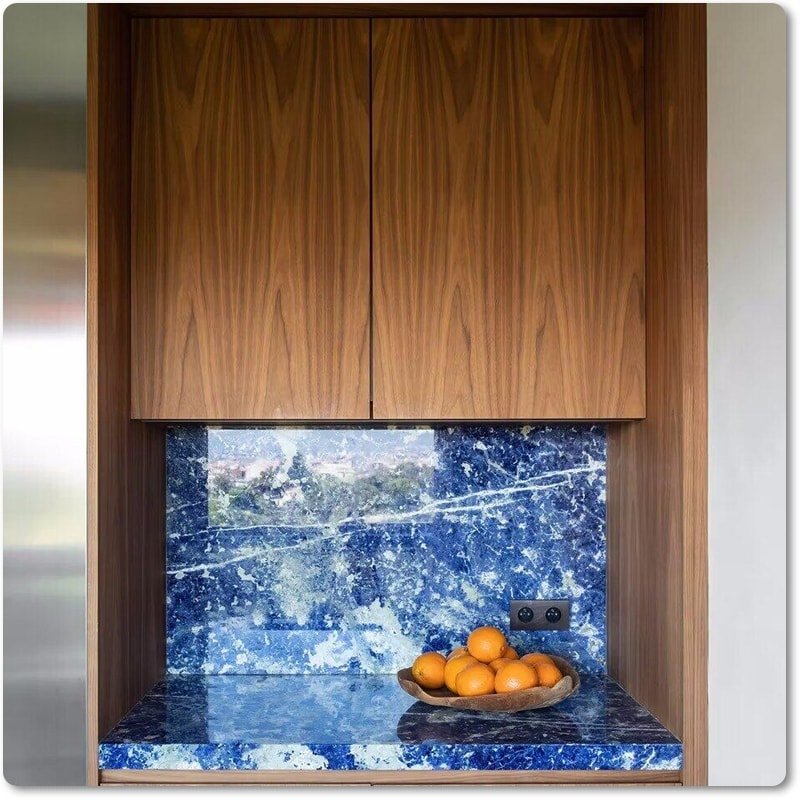
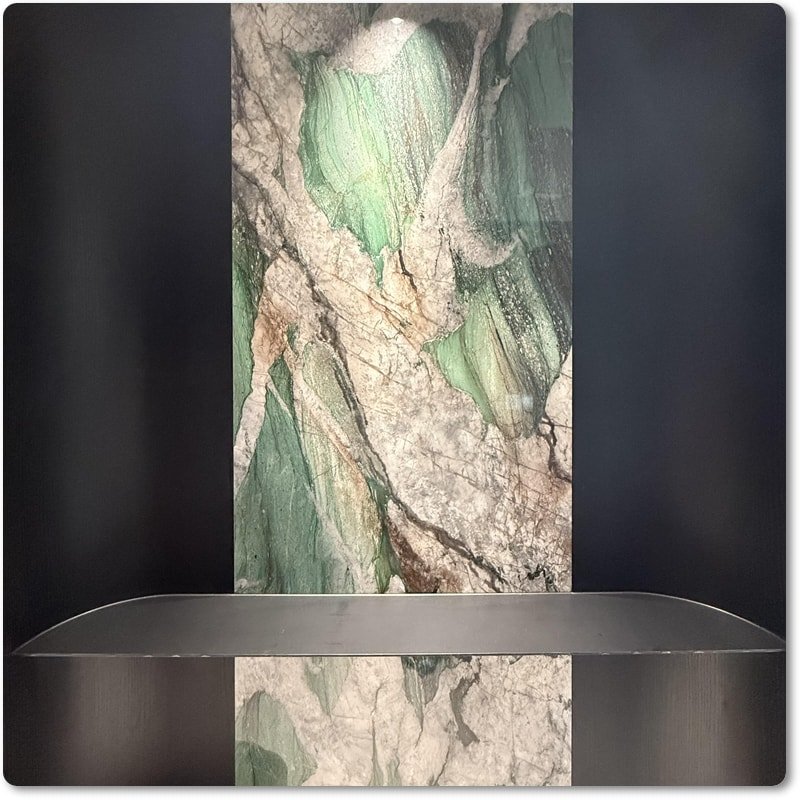
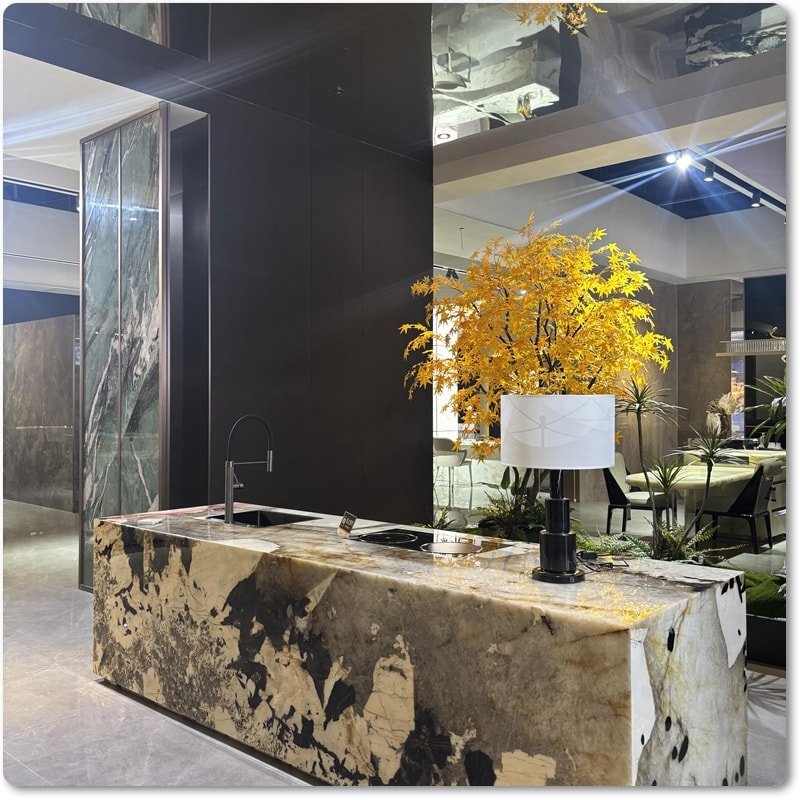
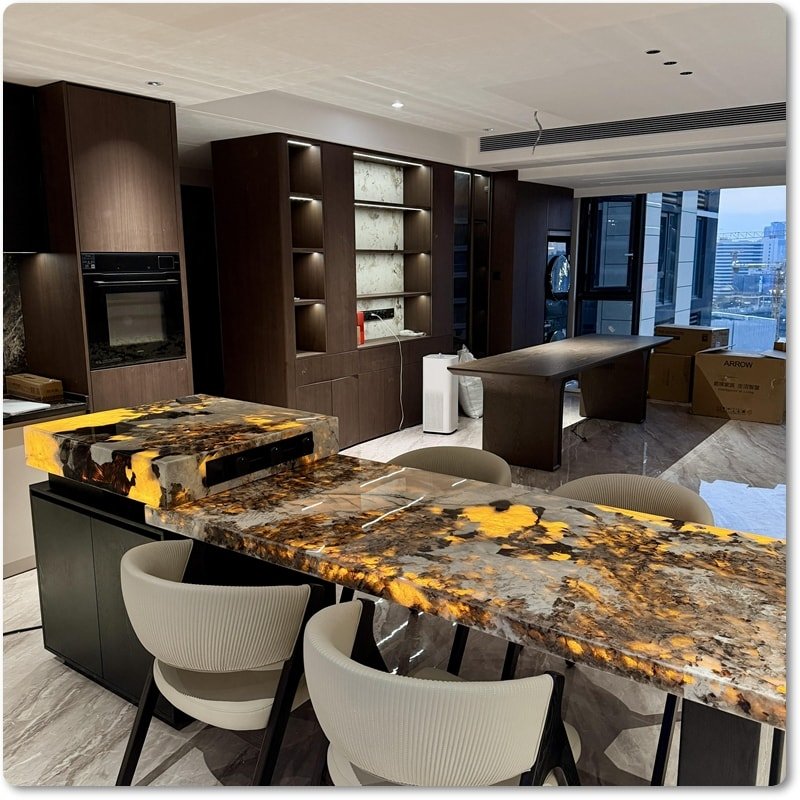
Quartzite countertops have become an important choice for premium residential kitchens, luxury hospitality projects, and commercial interior applications. They offer the appearance of sophisticated natural stone, frequently featuring white, beige, grey, green, and gold mineral patterns, combined with the hardness associated with quartz-rich geological formations.
However, quartzite is not automatically maintenance-free, stain-proof, or completely indestructible.
The actual performance of a quartzite countertop depends on its mineral composition, geological structure, porosity, fissures, surface treatment, fabrication quality, and installation conditions.
1.1 Main Advantages of Quartzite Countertops
High hardness: Genuine quartzite is generally harder than marble and is highly resistant to everyday scratching.
Natural durability: Its interlocking quartz-rich mineral structure provides excellent durability for properly selected and fabricated countertops.
Acid resistance: Genuine quartzite is generally more resistant to common household acids than calcite-based marble.
Heat tolerance: Natural stone tolerates normal kitchen temperature conditions well, although thermal shock and sudden temperature changes can still cause damage.
Natural aesthetics: Each slab has unique mineral patterns, colors, and veining.
Premium positioning: Quartzite is suitable for luxury kitchens, islands, bathroom vanities, and hospitality interiors.
Long service potential: Proper selection, fabrication, installation, and maintenance can support long-term use.
1.2 Main Disadvantages of Quartzite Countertops
Higher purchasing cost: Premium varieties and selected bookmatched slabs can be expensive.
Fabrication difficulty: High hardness increases tooling requirements and processing time.
Natural variation: Different slabs from the same quarry block or material lot may have different patterns.
Potential staining: Some quartzites contain porous areas, veins, fissures, or mineral inclusions that require additional protection.
Sealing considerations: Some varieties benefit from impregnating sealers.
Edge and transportation risks: Poor fabrication, insufficient support, and improper packaging can cause cracking or chipping.
Material identification problems: Some commercially marketed soft quartzites are actually marble or dolomitic marble.
1.3 Who Should Choose Quartzite?
| Buyer or application | Suitability | Main consideration |
|---|---|---|
| Luxury residential kitchens | Excellent | Slab selection and sealing |
| Kitchen islands | Excellent | Thickness, support and vein matching |
| Hotel vanity countertops | Excellent | Consistent production and maintenance |
| Multifamily developments | Good | Material consistency and budget |
| Commercial interiors | Good | Technical testing and application requirements |
| Outdoor kitchens | Conditional | UV exposure, weathering, and local climate |
| Budget-focused projects | Conditional | Fabrication and material costs |
Procurement conclusion: Quartzite is an excellent premium countertop material when buyers prioritize natural appearance, hardness, and long-term durability. It is less suitable when the project requires completely uniform patterns, minimal fabrication costs, or guaranteed zero-maintenance performance.
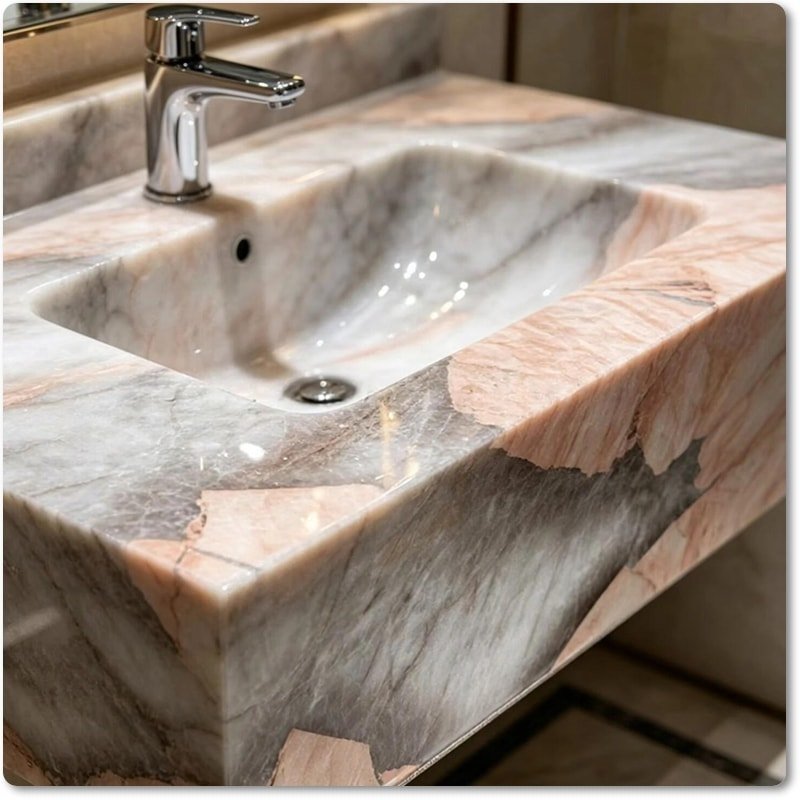
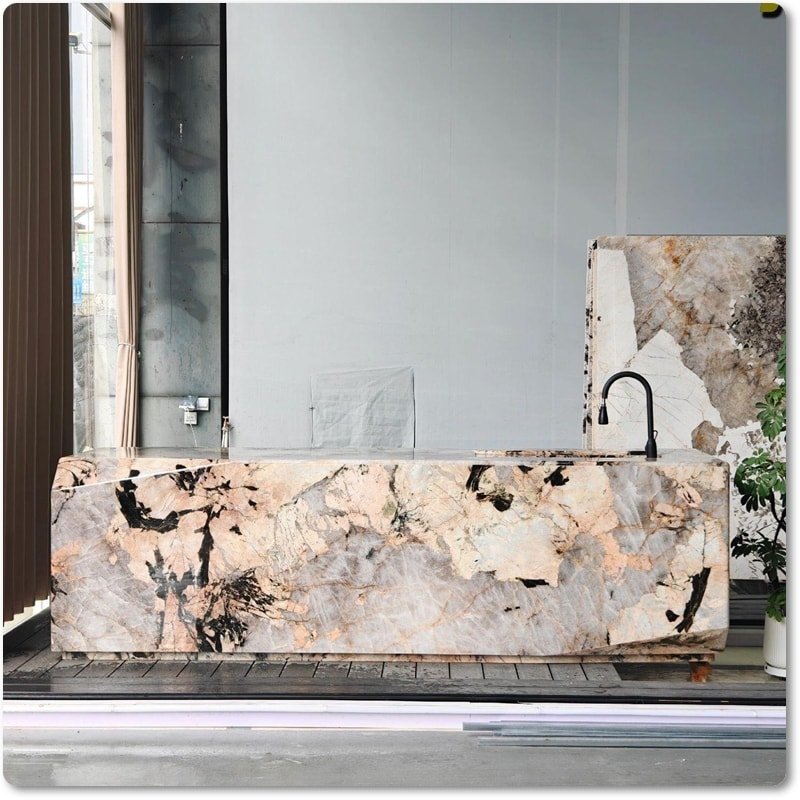
2. Scope and Definitions: What Is Quartzite?
2.1 What Is Natural Quartzite?
Quartzite is a metamorphic rock formed when quartz-rich sandstone is subjected to geological heat and pressure.
During metamorphism, quartz grains recrystallize and interlock tightly, creating a dense rock structure.
The principal mineral is quartz, although natural quartzite may also contain feldspar, mica, iron oxides, and other accessory minerals.
These additional minerals influence the stone’s:
Background color
Veining and mineral patterns
Surface appearance
Localized strength variations
Porosity and absorption characteristics
Quartzite is commonly extracted in large blocks, processed into slabs, and fabricated into countertops, wall panels, vanity tops, and architectural components.
2.2 Natural Quartzite vs. Engineered Quartz
One of the most important distinctions in countertop procurement is the difference between natural quartzite and engineered quartz.
They are not the same material.
| Characteristic | Natural Quartzite | Engineered Quartz |
|---|---|---|
| Material type | Natural metamorphic rock | Manufactured composite |
| Main composition | Recrystallized quartz-rich minerals | Quartz aggregates and binding materials |
| Manufacturing | Quarrying and stone processing | Mixing, molding and curing |
| Pattern | Naturally variable | Often more controlled |
| Slab consistency | Depends on geological source | Depends on production system |
| Resin content | May contain localized repairs | Commonly contains resin binders |
| Surface performance | Depends on individual stone | Depends on product formulation |
| Fabrication | Hard natural stone | Composite material with different processing requirements |
Important: The word “quartz” in a product name does not establish that the product is natural quartzite. Buyers should request geological identification and product documentation.
2.3 Quartzite vs. Marble: Why the Difference Matters
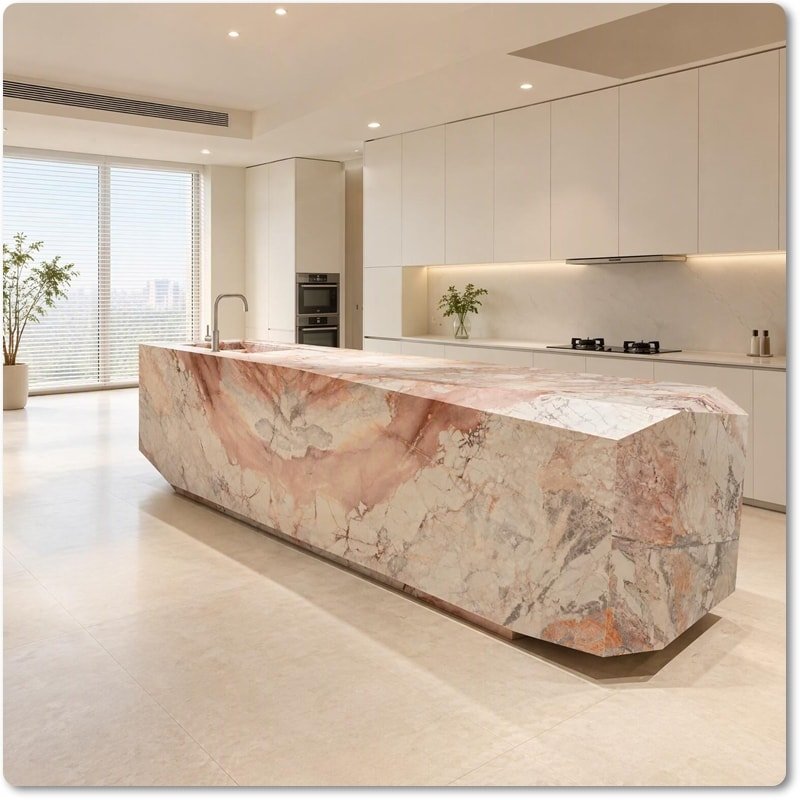
Quartzite and marble can look remarkably similar, especially white and beige varieties.
However, their mineral compositions differ fundamentally.
Marble is primarily composed of calcite or dolomite, while genuine quartzite is predominantly quartz-rich.
This distinction affects:
Resistance to acidic substances
Scratch resistance
Fabrication requirements
Cleaning methods
Long-term maintenance
A marble-like appearance does not necessarily indicate marble composition.
For procurement purposes, visual appearance alone is insufficient to identify a stone.
2.4 What Is Soft Quartzite?
The commercial stone industry sometimes uses the term “soft quartzite” to describe materials that are easier to fabricate than typical hard quartzite.
However, the term is not a reliable geological classification.
Some materials marketed as soft quartzite are actually dolomitic marble or other carbonate-rich rocks.
Before purchasing a large quantity, buyers should request petrographic identification and appropriate physical testing.
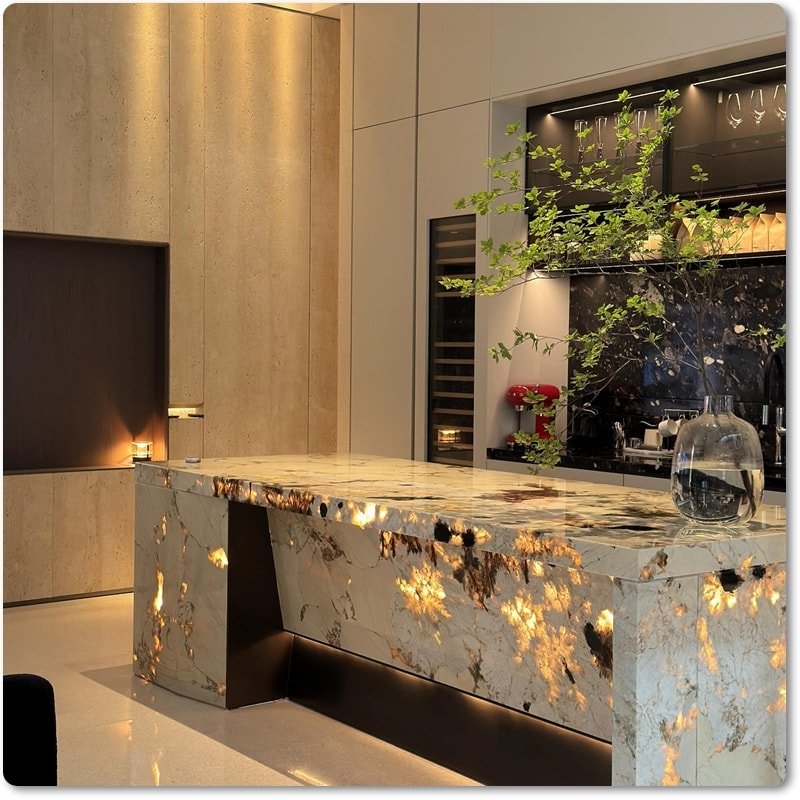
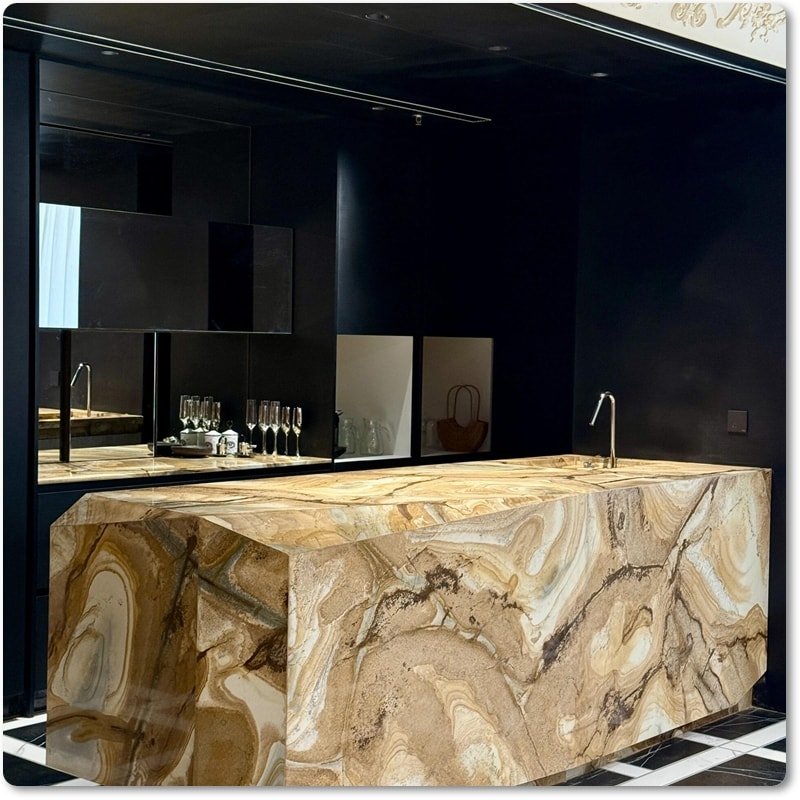
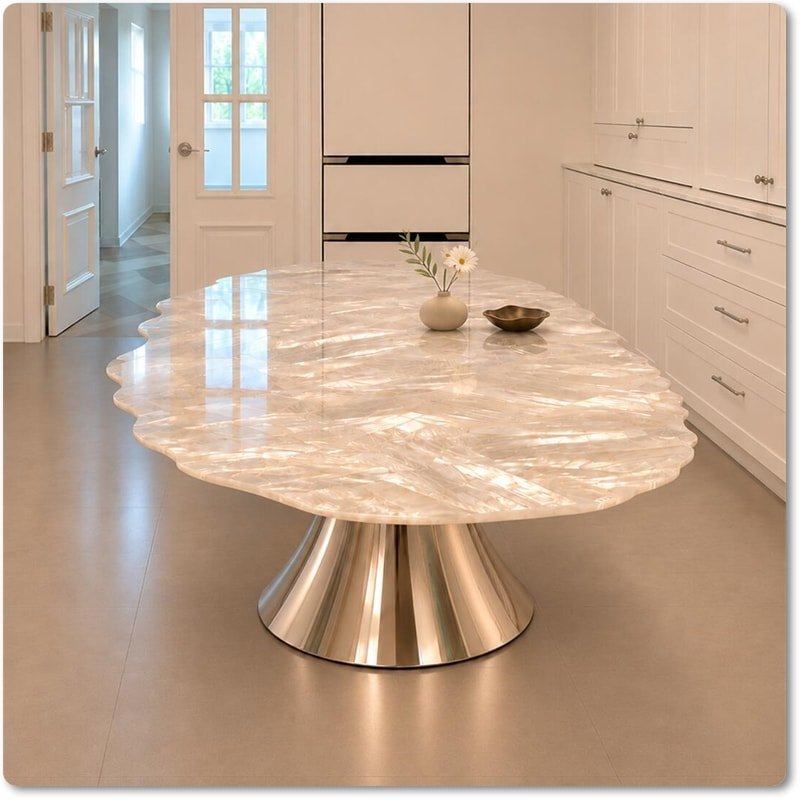
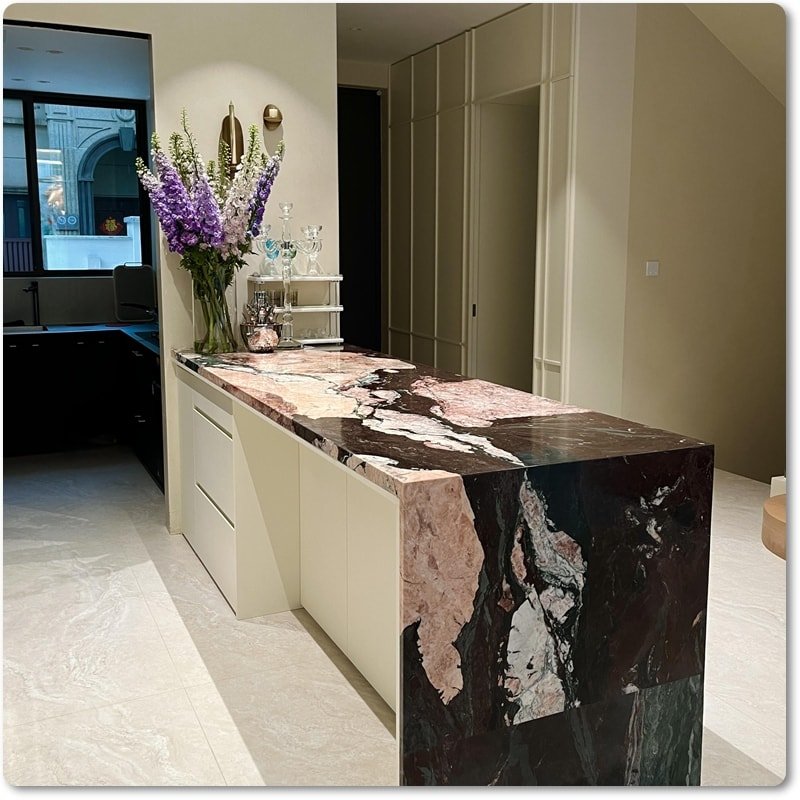
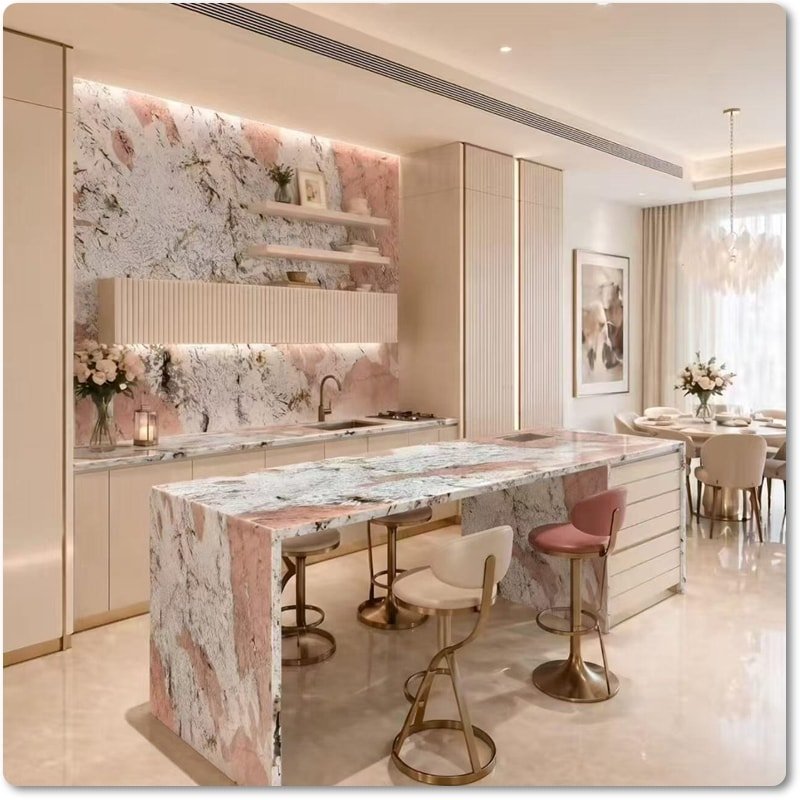
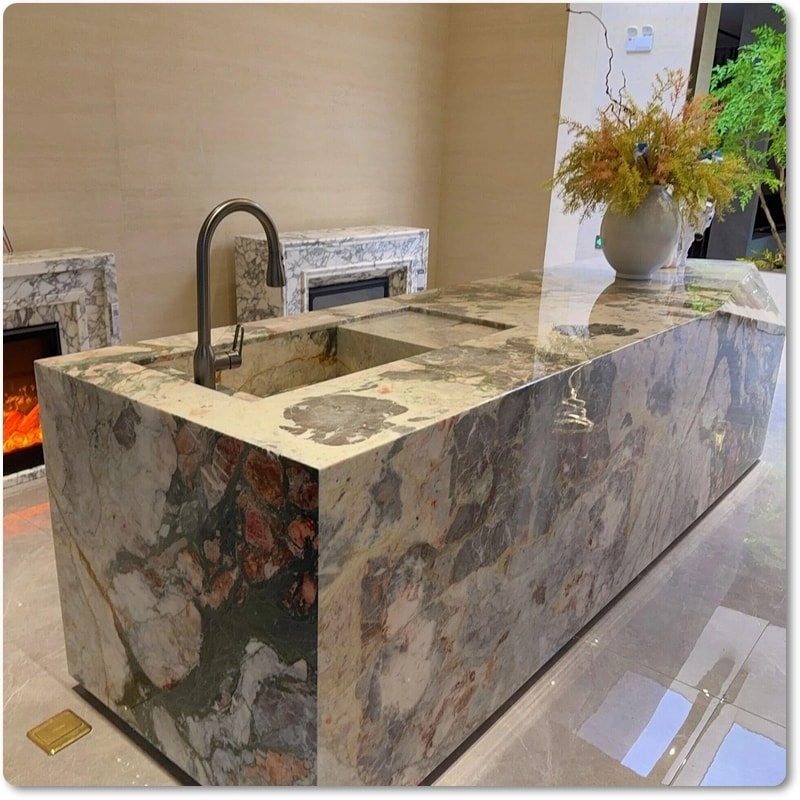
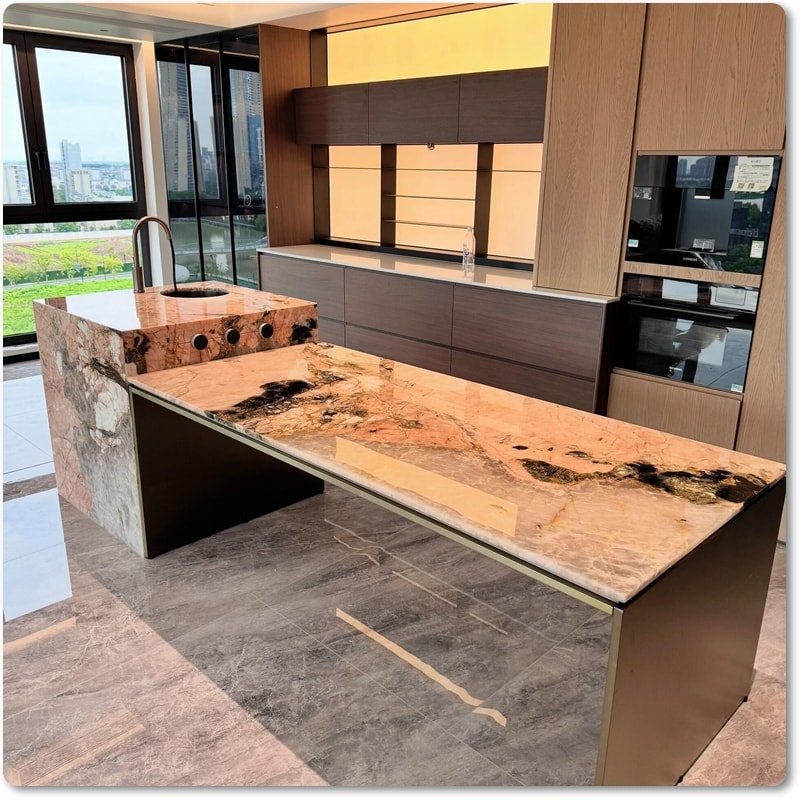
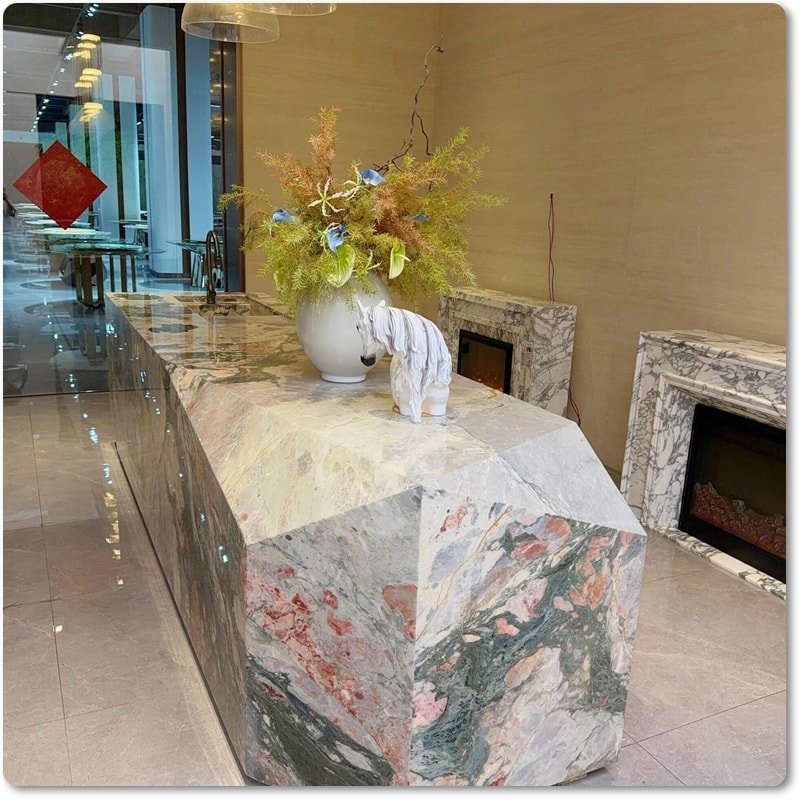
3. Technical Evaluation: Quartzite Countertops Advantages and Disadvantages
3.1 Hardness and Scratch Resistance
Hardness is one of quartzite’s most important advantages.
Quartz has a Mohs hardness of approximately 7, making genuine quartzite generally more resistant to everyday scratching than calcite-based marble.
This characteristic is particularly valuable in:
Residential kitchen countertops
Kitchen islands
Commercial food preparation areas
Hotel reception counters
Bathroom vanity tops
However, hardness should not be confused with overall mechanical strength.
A hard stone can still fracture under concentrated loads, impact, unsupported overhangs, or improper installation.
Procurement consideration: Request the actual material’s technical test results rather than relying on a generic hardness claim.
3.2 Heat Resistance
Natural quartzite generally performs well under normal kitchen temperature conditions.
It can tolerate ordinary contact with warm cookware better than many resin-based countertop materials.
Nevertheless, this does not mean quartzite is immune to thermal damage.
Sudden temperature changes can produce thermal stress, especially in areas containing fissures, repaired sections, or existing structural weaknesses.
Recommended practices include:
Using trivets for hot cookware.
Avoiding direct placement of extremely hot cookware on the surface.
Avoiding sudden temperature changes.
Protecting vulnerable seams and unsupported areas.
For commercial projects, the intended use and temperature exposure should be reviewed before material approval.
3.3 Acid Resistance and Etching
One advantage of genuine quartzite is its general resistance to household acids.
Lemon juice, vinegar, and many common acidic food substances can etch calcite-based marble.
Quartzite, being predominantly quartz-rich, is generally much less susceptible to this type of chemical reaction.
However, the performance of a particular slab depends on its actual mineral composition.
Some decorative quartzite varieties contain carbonate minerals, mineral veins, or repaired areas that may behave differently.
Buyers should therefore avoid treating every stone sold under the quartzite label as chemically identical.
3.4 Water Absorption and Stain Resistance
Does quartzite stain?
Yes, certain quartzite varieties can stain.
Quartzite is not automatically nonporous.
Its water absorption depends on mineral composition, grain boundaries, microfractures, porosity, and geological formation.
A dense quartzite may exhibit very low absorption, while another variety may absorb liquids more readily.
Common staining risks include:
Cooking oil
Coffee
Red wine
Food coloring
Grease
Certain cleaning chemicals
ASTM C97/C97M provides standardized test methods for determining water absorption and bulk specific gravity of dimension stone.
For commercial procurement, buyers should request absorption data for the selected material rather than accepting general statements about quartzite.
3.5 Does Quartzite Need to Be Sealed?
The answer depends on the stone.
Sealing is not automatically required for every quartzite countertop.
An appropriate impregnating sealer can reduce liquid penetration and improve stain resistance in materials with suitable absorption characteristics.
However, sealers do not make a stone completely stain-proof or eliminate the need for cleaning.
Before applying a sealer:
Confirm the stone’s absorption characteristics.
Check the sealer manufacturer’s compatibility instructions.
Test the product on an inconspicuous area.
Evaluate whether the finish changes.
Follow the manufacturer’s curing and maintenance instructions.
The frequency of resealing should be determined by the actual stone, sealer product, use conditions, and manufacturer recommendations.
3.6 Natural Fissures, Veins and Resin Repairs
Natural quartzite is not a factory-manufactured uniform product.
Its geological structure may contain:
Natural mineral veins
Hairline fissures
Grain boundaries
Color bands
Localized inclusions
Resin-treated areas
Not every visible line is a structural defect.
A distinction must be made between natural geological features and unacceptable fabrication or transportation damage.
For procurement inspection, classify visible characteristics into three groups:
A. Natural characteristics
Mineral veining
Color variation
Geological patterns
Natural grain differences
B. Treatment-related characteristics
Resin reinforcement
Filled fissures
Surface treatments
Polished or honed finish differences
C. Potential defects
Unstable cracks
Edge fractures
Unacceptable delamination
Damaged corners
Structural weaknesses affecting installation
Buyers should establish acceptance criteria using approved slab photographs and physical samples.
3.7 Fabrication Difficulty and Processing Requirements
Quartzite is generally more difficult to fabricate than marble because of its high hardness.
Professional fabrication may require:
Diamond cutting tools
CNC bridge saws
Waterjet cutting
Specialized edge profiling
Controlled polishing
Appropriate support during handling
Detailed inspection after processing
Harder material can increase diamond tooling wear and processing time.
This affects production costs, lead times, and factory capacity.
For complex designs, buyers should confirm that the quartzite manufacturer has suitable equipment and experience with the specific material.
3.8 Surface Finishes
Common quartzite countertop finishes include:
| Finish | Appearance | Typical application |
|---|---|---|
| Polished | Glossy and reflective | Luxury kitchens |
| Honed | Smooth and matte | Contemporary interiors |
| Leathered | Textured, low-gloss surface | Premium residential projects |
| Brushed | Subtle surface texture | Decorative applications |
| Sandblasted | More textured appearance | Selected architectural applications |
The finish can influence maintenance, perceived color, surface texture, and stain visibility.
A polished sample should not automatically be used to approve a honed or leathered production order.
3.9 Quartzite vs. Other Countertop Materials
| Performance factor | Quartzite | Marble | Granite | Engineered Quartz |
|---|---|---|---|---|
| Natural material | Yes | Yes | Yes | No |
| Scratch resistance | Generally high | Lower | Generally high | Product-dependent |
| Acid resistance | Generally high | Low | Generally good | Product-dependent |
| Heat tolerance | Generally high | High | High | Product-dependent |
| Natural variation | High | High | High | Usually lower |
| Sealing requirement | Depends on porosity | Often beneficial | Depends on porosity | Usually not required |
| Fabrication difficulty | High | Moderate | Moderate to high | Product-dependent |
| Luxury natural appearance | Excellent | Excellent | Excellent | Wide design range |
No countertop material is universally superior.
The correct selection depends on design requirements, performance expectations, maintenance preferences, budget, and project conditions.
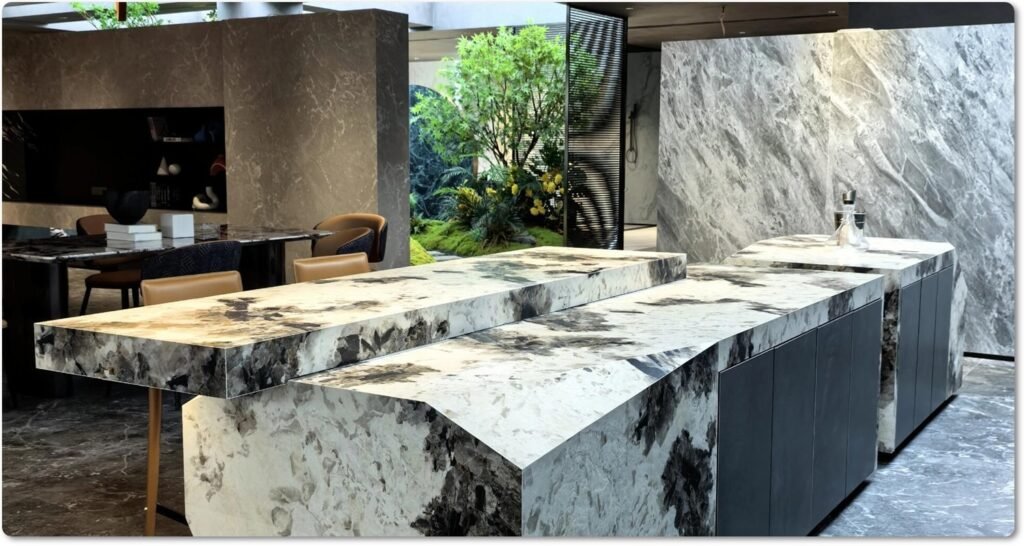
4. Procurement Checklist: How to Buy Quartzite Countertops?
Professional procurement should begin with material verification rather than price comparison.
4.1 Verify the Geological Identity
Ask the supplier to provide:
Commercial stone name
Quarry or country of origin, where documented
Geological material classification
Petrographic report, where necessary
Confirmation of whether resin treatments are present
For high-value projects, independent laboratory identification may be appropriate.
4.2 Inspect Actual Slabs
Never approve a large quartzite purchase based exclusively on a small photograph or sample.
Request:
Full slab photographs
Slab dimensions
Thickness measurements
Surface finish photographs
Close-up photographs of veins and fissures
Photographs of repaired areas
Slab identification numbers
For bookmatched projects, request sequential slab photographs and confirm the intended arrangement.
4.3 Review Technical Properties
Request available test results for:
| Property | Recommended verification |
|---|---|
| Water absorption | ASTM C97/C97M |
| Bulk specific gravity | ASTM C97/C97M |
| Compressive strength | ASTM C170/C170M |
| Modulus of rupture | ASTM C99/C99M |
| Flexural strength | ASTM C880/C880M |
| Abrasion resistance | Applicable project-specific method |
The appropriate test method and acceptance threshold must be determined according to the stone classification and intended application.
ASTM C616/C616M is particularly relevant to quartz-based dimension stone.
Do not assume that passing a general building-stone specification automatically establishes suitability for every countertop application.
4.4 Confirm Slab Dimensions and Yield
For kitchen and commercial projects, slab yield directly affects purchasing costs.
Calculate:
Total countertop area
Required slab quantity
Cutting allowance
Vein-matching allowance
Edge profile allowance
Sink and cooktop cutouts
Potential waste percentage
For complex patterns, nesting and cutting optimization should be completed before material reservation.
4.5 Approve Fabrication Drawings
The buyer should provide or approve:
CAD drawings
Overall dimensions
Thickness
Edge profiles
Sink cutout dimensions
Faucet holes
Cooktop cutouts
Backsplash dimensions
Waterfall panel details
Seam positions
Finished surface requirements
Do not begin mass production until the relevant drawings have been approved.
4.6 Confirm Quality Control and Packaging
For international shipments, inspect the following:
Surface quality
Edge condition
Thickness consistency
Dimensional tolerance
Resin repair condition
Corner protection
A-frame or suitable support
Moisture protection
Container loading
Packing list and identification
Quartzite is hard, but hard stone is not immune to impact damage.
Packaging and handling are essential parts of the quality-control process.
5. Cost and Risk Factors: How Much Do Quartzite Countertops Cost?
5.1 What Determines Quartzite Countertop Prices?
Quartzite countertop prices vary considerably.
There is no reliable universal price applicable to all varieties, countries, slab grades, and fabrication specifications.
The major cost components include:
Quarry block and raw material costs.
Slab production and processing.
Material color and pattern selection.
Slab thickness.
Surface finish.
Fabrication complexity.
CNC and waterjet processing.
Edge profiles and cutouts.
Resin treatment and reinforcement.
Packaging and transportation.
Import duties, taxes, and customs clearance.
Local installation and project management.
Rare colors, distinctive veining, large-format slabs, and bookmatched arrangements may increase procurement costs.
5.2 Why Is Quartzite More Expensive to Fabricate?
Quartzite’s hardness can increase diamond blade wear, polishing time, and processing difficulty.
Compared with softer stones, fabricators may require more specialized tooling and additional production controls.
Complex edges, waterfall panels, large cutouts, and intricate patterns can increase labor requirements.
This means buyers should compare the total fabricated cost rather than slab prices alone.
5.3 Common Procurement Risks
Risk 1: Misidentified Material
A product marketed as quartzite may actually be marble or dolomitic marble.
Solution: Request geological identification and testing.
Risk 2: Color and Pattern Differences
Natural stone slabs vary.
Solution: Approve actual slabs and production layouts.
Risk 3: Hidden Fissures and Repairs
Some fissures may be filled or reinforced.
Solution: Request close-up photographs and establish repair acceptance criteria.
Risk 4: Incorrect Thickness
Inconsistent thickness can affect installation and edge processing.
Solution: Specify thickness and dimensional tolerances in the purchase order.
Risk 5: Fabrication Damage
Improper cutting and handling can produce cracks and edge chips.
Solution: Use qualified fabricators and documented inspection procedures.
Risk 6: Transportation Damage
Inadequate packing and container handling can damage finished countertops.
Solution: Require appropriate protective packaging, loading photographs, and shipment identification.
5.4 Is Quartzite Worth the Investment?
Quartzite can offer excellent value when buyers prioritize natural stone aesthetics, durability, and premium positioning.
However, its value should be evaluated using the total lifecycle and project cost.
For a luxury kitchen, a carefully selected quartzite may justify a higher initial investment.
For a large multifamily project with strict budget controls, granite or another suitable material may provide a better cost-performance balance.
The right decision is not necessarily the most expensive stone. It is the material that meets the project’s technical, visual, and financial requirements.
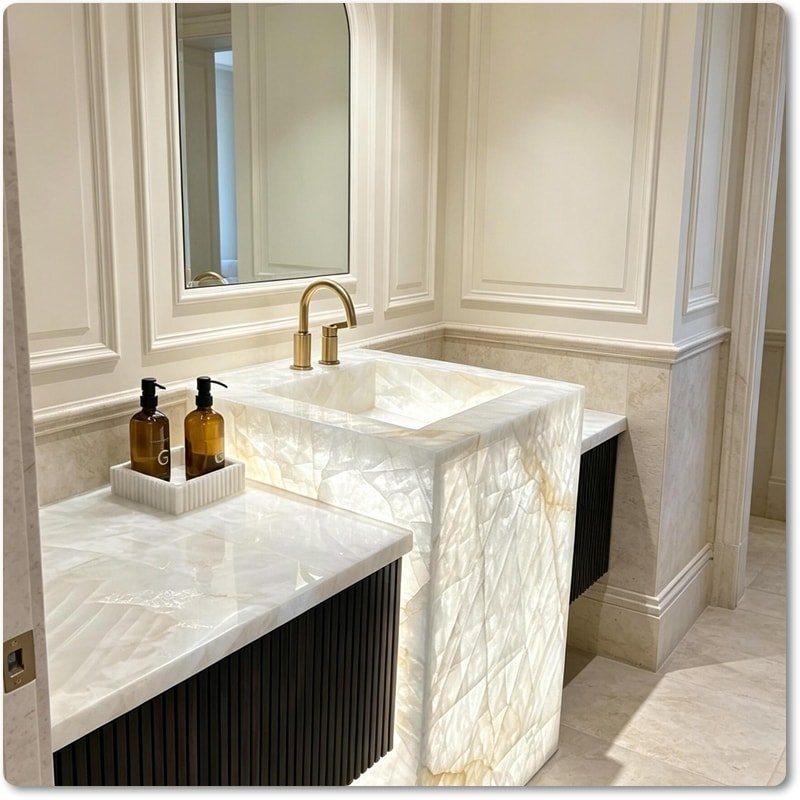
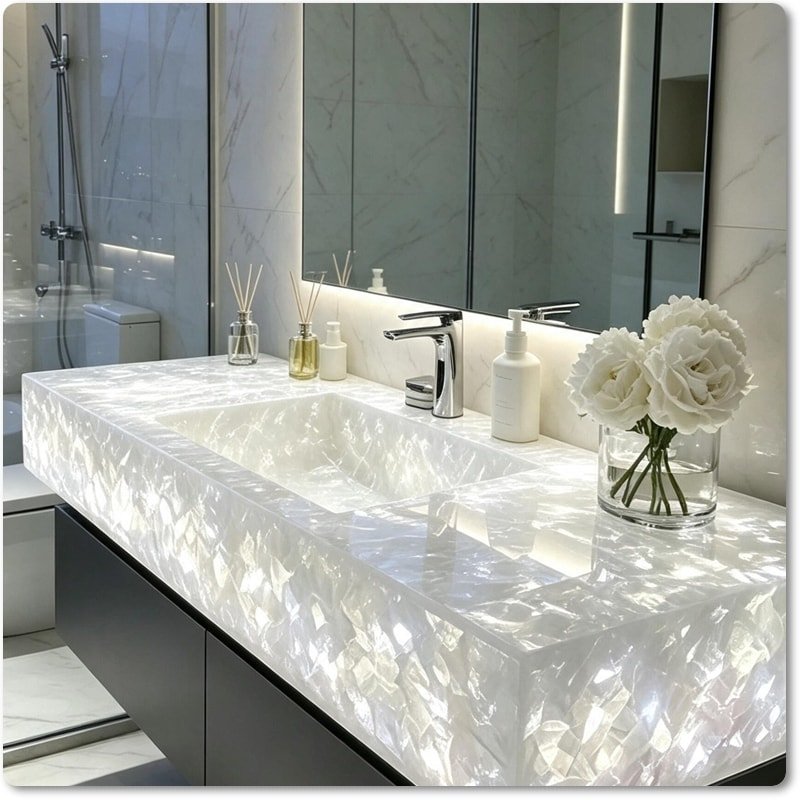
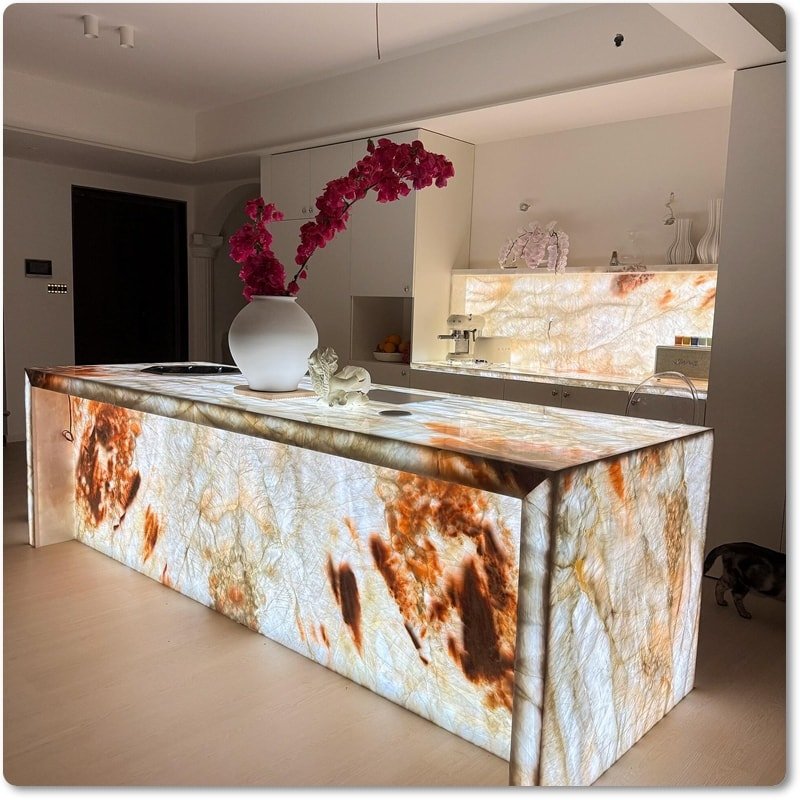
6. Supplier Evaluation: How to Choose a Quartzite Countertop Manufacturer?
For importers, wholesalers, distributors, and project procurement teams, supplier evaluation should cover more than the product price.
6.1 Factory Capability
A qualified quartzite countertop manufacturer should be able to demonstrate:
Natural stone sourcing capability
Slab selection and inspection
Professional cutting equipment
CNC processing
Waterjet processing
Edge profiling
Polishing capacity
Custom fabrication
Quality-control procedures
Export packaging experience
6.2 Documentation and Technical Evidence
Request the following documents where applicable:
| Document | Procurement purpose |
|---|---|
| Material specification | Confirm product identity |
| Petrographic report | Verify geological classification |
| Physical test report | Evaluate material performance |
| Slab photographs | Approve appearance |
| CAD drawings | Confirm dimensions |
| Inspection report | Verify finished-product quality |
| Packing photographs | Review protection |
| Commercial invoice | Verify transaction details |
| Packing list | Confirm shipment quantities |
| Certificate of origin | Support origin documentation where applicable |
6.3 Wholesale and OEM/ODM Capabilities
A professional quartzite wholesale supplier should be able to support different purchasing models.
Wholesale supply
Full slabs
Cut-to-size materials
Repeated product selections
Bulk procurement
Material reservation
OEM services
Buyer-provided drawings
Custom dimensions
Specified finishes
Private-label requirements where agreed
Project-specific fabrication
ODM services
Factory-assisted product development
Design recommendations
Material and finish coordination
Customized product solutions
6.4 Questions to Ask a Quartzite Factory
Before confirming an order, ask:
Can you verify that the selected material is genuine quartzite?
Can you provide actual slab photographs?
Are there any resin-treated or repaired areas?
Can you provide available physical test reports?
What thicknesses and finishes are available?
Can you manufacture CNC and waterjet cut-to-size products?
How do you inspect natural fissures and cracks?
How do you protect finished products during international transportation?
Can you provide production photographs and inspection reports?
What are the quotation validity, production schedule, and shipping terms?
A reliable supplier should answer these questions with verifiable information rather than general marketing statements.
7. Practical RFQ Template: Quartzite Countertops Wholesale and Custom Fabrication
The following template can be used by importers, distributors, contractors, kitchen brands, and commercial project buyers.
7.1 Quartzite Countertop RFQ Information
Project Information
Company:
Contact person:
Country / Destination:
Project name:
Application:
Estimated quantity:
Required delivery date:
Material Requirements
Commercial stone name:
Confirmed material type:
Color:
Slab selection:
Thickness:
Finish:
Surface treatment:
Resin repair requirements:
Fabrication Requirements
Product type: Kitchen countertop / Island / Vanity top / Wall panel / Other
Overall dimensions:
Edge profile:
Sink cutout:
Faucet holes:
Cooktop cutout:
Backsplash:
Waterfall edge:
Seam requirements:
CAD drawings attached: Yes / No
Quality Requirements
Applicable ASTM test reports:
Absorption requirements:
Dimensional tolerances:
Visual acceptance criteria:
Fissure acceptance:
Resin repair acceptance:
Pre-shipment inspection:
Approved sample or slab photographs:
Commercial Requirements
Quotation basis: EXW / FOB / CIF / Other
Quantity:
Packaging requirements:
Destination port:
Payment terms:
Required shipping schedule:
7.2 Pre-Shipment Inspection Checklist
| Inspection item | Acceptance requirement | Status |
|---|---|---|
| Material identity | Matches approved specification | Pass / Fail |
| Color and pattern | Matches approved selection | Pass / Fail |
| Thickness | Meets agreed tolerance | Pass / Fail |
| Dimensions | Matches approved CAD | Pass / Fail |
| Surface finish | No unacceptable defects | Pass / Fail |
| Edge processing | Matches approved profile | Pass / Fail |
| Cutouts | Correct dimensions and positions | Pass / Fail |
| Fissures and repairs | Meets agreed acceptance criteria | Pass / Fail |
| Packaging | Suitable for international transport | Pass / Fail |
| Shipment documentation | Complete and accurate | Pass / Fail |
7.3 Recommended Purchasing Workflow
Submit project requirements and estimated quantities.
Receive material options and initial quotation.
Review actual slab photographs.
Confirm material identity and technical information.
Approve samples or selected slabs.
Finalize CAD drawings and fabrication specifications.
Confirm commercial terms and production schedule.
Complete manufacturing and quality inspection.
Approve packing and container loading.
Arrange international shipment and documentation.
This workflow reduces misunderstandings and helps buyers maintain traceability throughout the procurement process.
8. Frequently Asked Questions: Quartzite Countertops Pros and Cons
Q1. Are quartzite countertops better than granite?
Not universally. Both materials can provide excellent durability. Quartzite often offers distinctive marble-like veining and high hardness, while granite provides a broad range of colors and patterns. The better choice depends on the specific stone, physical properties, design requirements, and total project cost.
Q2. Do quartzite countertops scratch easily?
Genuine quartzite is generally highly scratch-resistant because it is primarily composed of quartz, which has a Mohs hardness of approximately 7. However, it is not impossible to damage. Impact, abrasive contamination, and unsuitable fabrication can still cause problems.
Q3. Do quartzite countertops need to be sealed?
Some quartzite varieties benefit from sealing, while others may have sufficiently low absorption that sealing is unnecessary. The decision should be based on the individual stone’s absorption characteristics and the sealer manufacturer’s recommendations.
Q4. Can lemon juice damage quartzite countertops?
Genuine quartzite is generally resistant to acid etching because its principal mineral, quartz, does not react like calcite-based marble. However, carbonate-rich inclusions, mineral veins, and repaired areas may behave differently. Testing the actual material is recommended.
Q5. Are quartzite countertops heat-resistant?
Quartzite generally tolerates normal kitchen heat well. However, sudden temperature changes, thermal shock and concentrated heat can still cause damage. Trivets and heat-protection practices remain advisable.
Q6. How long do quartzite countertops last?
There is no single guaranteed service life. Properly selected, fabricated, supported, and maintained quartzite countertops can provide long-term service. Actual performance depends on material characteristics, installation quality, usage, and maintenance.
Q7. Why are quartzite countertops so expensive?
Premium quartzite may involve quarry selection, imported raw materials, distinctive slab patterns, specialized diamond tooling, longer fabrication times, and complex installation requirements. Rare colors and bookmatched slabs can further increase costs.
Q8. Is quartzite the same as engineered quartz?
No. Quartzite is a naturally occurring metamorphic rock. Engineered quartz is a manufactured composite material containing quartz aggregates and binding materials. They have different compositions, production processes, and technical characteristics.
Q9. Can quartzite be used for outdoor kitchens?
Selected quartzite varieties may be suitable for outdoor kitchens, but suitability depends on the specific stone, climate, moisture exposure, freeze-thaw conditions, finish, and installation design. Project-specific evaluation is necessary.
Q10. What should buyers check before purchasing quartzite countertops wholesale?
Buyers should verify geological identity, actual slab appearance, absorption, physical properties, thickness, fabrication quality, resin repairs, production capability, packaging, and export documentation. For large projects, approved slab photographs and pre-shipment inspection are particularly important.
9. References: Technical Standards, Industry Guidance and Regulations
The following references provide a technical foundation for quartzite countertop selection, testing, fabrication, and occupational safety.
9.1 ASTM International Standards
1. ASTM C616/C616M-22 — Standard Specification for Quartz-Based Dimension Stone
Relevant to quartz-based dimension stone, including quartzite, with requirements addressing material classification, physical properties and sampling.
https://www.astm.org/c0616_c0616m-22.html
2. ASTM C97/C97M-25 — Standard Test Methods for Absorption and Bulk Specific Gravity of Dimension Stone
Relevant to water absorption and bulk specific gravity evaluation.
https://www.astm.org/c0097_c0097m-25.html
3. ASTM C170/C170M — Standard Test Method for Compressive Strength of Dimension Stone
Used to evaluate compressive strength.
4. ASTM C99/C99M — Standard Test Method for Modulus of Rupture of Dimension Stone
Relevant to flexural performance.
5. ASTM C880/C880M — Standard Test Method for Flexural Strength of Dimension Stone
Used to assess flexural strength under specified testing conditions.
Buyers should confirm the current active edition and the applicability of each standard before specifying contractual requirements.
9.2 Natural Stone Industry Guidance
6. Natural Stone Institute — Caring for Quartzite Countertops
Guides quartzite hardness, maintenance, acid resistance, sealing, and material identification.
https://usenaturalstone.org/caring-for-quartzite-countertops/
7. Natural Stone Institute — ASTM Standards for Natural Stone
https://www.naturalstoneinstitute.org/designprofessionals/astm/
9.3 Occupational Safety and Silica Regulations
8. OSHA / NIOSH — Worker Exposure to Silica during Countertop Manufacturing, Finishing, and Installation
This guidance explains crystalline silica exposure risks and appropriate controls during natural and engineered stone processing.
https://www.osha.gov/sites/default/files/publications/OSHA3768.pdf
9. OSHA 29 CFR 1910.1053 — Respirable Crystalline Silica
Applicable to covered general-industry occupational exposures.
https://www.osha.gov/laws-regs/regulations/standardnumber/1910/1910.1053
10. OSHA 29 CFR 1926.1153 — Respirable Crystalline Silica
Applicable to covered construction occupational exposures.
https://www.osha.gov/laws-regs/regulations/standardnumber/1926/1926.1153
11. California Code of Regulations, Title 8, Section 5204 — Occupational Exposures to Respirable Crystalline Silica
California’s silica regulation includes additional requirements for specified high-exposure tasks. Its definition of high-exposure trigger tasks includes the fabrication of countertop products from natural stone containing more than 10% crystalline silica.
https://www.dir.ca.gov/title8/5204.html
12. Cal/OSHA 2026 Silica Rulemaking Information
California has also published 2026 discussion drafts concerning proposed restrictions on the fabrication and manufacture of certain artificial-stone products. These proposals must be distinguished from regulations already adopted and in force.
https://www.dir.ca.gov/dosh/doshreg/silica-2026/
9.4 Industry and Market Information
13. U.S. Geological Survey — Mineral Commodity Summaries 2025: Stone (Dimension)
The USGS estimated that approximately 2.2 million tons of dimension stone, valued at approximately $370 million, were sold or used by U.S. producers in 2024. Quartzite was included among the smaller dimension-stone categories.
https://pubs.usgs.gov/periodicals/mcs2025/mcs2025-stone-dimension.pdf
Important technical note: Natural quartzite is a silica-rich material. Its high hardness and natural durability do not eliminate occupational silica exposure risks during cutting, grinding, polishing, and other fabrication operations. Suppliers and fabricators must follow applicable occupational safety regulations.
10. EDG Stone: Natural Quartzite Countertops Manufacturer and Custom Fabrication Supplier
10.1 Why Choose EDG Stone for Quartzite Countertop Procurement?
EDG Stone is a Chinese natural stone manufacturer and exporter specializing in natural stone countertops, marble, quartzite, granite, engineered stone products, and custom stone fabrication.
With more than 35 years of stone-industry experience, EDG Stone supports international buyers seeking natural stone materials, customized countertop products, and project-oriented manufacturing solutions.
Our capabilities cover multiple stages of the stone supply chain, from material selection and slab processing to custom fabrication, quality inspection, and export packaging.
10.2 Quartzite Products and Customization
EDG Stone can support inquiries involving:
Natural quartzite slabs
Quartzite kitchen countertops
Quartzite kitchen islands
Quartzite bathroom vanity tops
Waterfall countertops
Bookmatched quartzite panels
Custom cut-to-size quartzite
Quartzite wall panels
Commercial and hospitality stone products
10.3 Professional Stone Fabrication
Our project-oriented fabrication capabilities include:
CNC cutting and processing
Waterjet cutting
Custom edge profiling
Sink and cooktop cutouts
CAD drawing coordination
Surface finishing
Dimensional inspection
Export packaging and container loading
Each project should be evaluated according to its material selection, drawings, technical requirements, quantity, and destination.
10.4 Quartzite Wholesale, OEM and ODM Services
EDG Stone supports different international procurement requirements:
For Importers and Distributors
Natural quartzite slab sourcing
Wholesale material supply
Product selection and coordination
Bulk order planning
For Kitchen and Cabinet Brands
Custom countertop manufacturing
Buyer-specified dimensions and finishes
OEM fabrication
Project-based production
For Hotels and Construction Projects
Vanity tops
Kitchen countertops
Wall panels
Custom stone components
Coordinated fabrication and export packaging
10.5 Request a Quartzite Countertop Quote
Whether you are sourcing natural quartzite slabs, developing a kitchen countertop collection, or managing a commercial stone project, EDG Stone can review your material and fabrication requirements.
To receive a project quotation, please provide:
Preferred quartzite color or material name.
Product dimensions and thickness.
Required surface finish.
Estimated quantity.
Drawings or reference photographs.
Destination country or port.
Required delivery schedule.
Contact EDG Stone for natural quartzite countertops, wholesale stone supply, and custom fabrication solutions.
Recommended Internal Links:
Stone Countertops Manufacturer: https://www.edgstone.com/stone-countertops-manufacturer/
Natural Marble Countertops: https://www.edgstone.com/marble-countertops-manufacturer/
Custom Stone Fabrication: https://www.edgstone.com/custom-stone-fabrication/
Contact EDG Stone: https://www.edgstone.com/contact/
11. Semantic Closure: Quartzite Countertops — Buying Insights, Material Performance and Industry Outlook
Quartzite Countertops: What Buyers Need to Understand Before Making a Decision
What Makes Natural Quartzite Different?
Natural quartzite is a metamorphic rock formed through the recrystallization of quartz-rich sandstone. Its geological structure distinguishes it from marble, granite, and manufactured quartz surfaces. The combination of high hardness, distinctive mineral patterns, and natural variation makes it an important material for premium architectural and countertop applications.
Why Are Quartzite Countertops Increasingly Relevant to Premium Projects?
Quartzite offers a combination of natural aesthetics and functional performance. Its marble-like visual appearance can satisfy luxury design requirements, while its quartz-rich composition provides high scratch resistance and generally good resistance to common household acids. This makes it attractive to residential developers, interior designers, kitchen brands, and hospitality procurement teams.
How Should Buyers Evaluate Quartzite Quality?
The correct approach is to evaluate each material individually rather than relying on its commercial name. Buyers should consider petrographic identity, water absorption, bulk specific gravity, mechanical properties, visible fissures, resin treatments, and actual slab appearance. ASTM C616/C616M and relevant ASTM test methods provide useful technical references for quartz-based dimension stone.
Which Quartzite Option Is Best for Different Projects?
Luxury kitchens: Prioritize visual consistency, slab selection, edge design, and stain protection.
Kitchen islands: Evaluate slab dimensions, structural support, cutouts, and vein matching.
Hotel vanity projects: Prioritize repeatable fabrication, dimensional accuracy, and maintenance requirements.
Multifamily developments: Balance material cost, slab yield, installation requirements, and production consistency.
Outdoor kitchens: Assess weather exposure, thermal conditions, moisture and freeze-thaw suitability.
What Should Buyers Consider Before Purchasing?
The lowest slab price does not necessarily produce the lowest finished-project cost. Fabrication complexity, material yield, transportation, breakage risk, installation, and maintenance all contribute to total procurement costs. A professional quotation should identify the material, dimensions, finish, processing scope, packing requirements, and applicable delivery terms.
What Is Changing in the Stone Manufacturing Industry?
Occupational safety, silica exposure control, material traceability, and documented quality assurance are increasingly important considerations in international stone procurement. OSHA’s crystalline silica standards and California’s additional requirements demonstrate why manufacturers and fabricators must manage dust exposure through appropriate engineering controls, wet processing, ventilation, training, and other legally required protective measures.
Natural quartzite is not the same as engineered stone, but its high crystalline silica content means that natural-stone fabrication also requires appropriate worker protection.
What Is the Best Purchasing Strategy?
For individual residential projects, buyers should prioritize actual slab inspection, material suitability, and professional installation. For importers, wholesalers, and commercial developers, the purchasing strategy should additionally include factory capability, technical documentation, batch consistency, CAD approval, production inspection, and export packaging.
Where Does EDG Stone Fit into the Supply Chain?
EDG Stone provides natural stone sourcing, quartzite countertop manufacturing, custom fabrication, and international export services. Its capabilities are relevant to importers, distributors, kitchen brands, contractors, and project procurement teams requiring natural stone slabs or fabricated stone products.
Final Industry Insight
Quartzite should not be purchased simply because it is marketed as a harder or more luxurious alternative to marble. Its true value comes from the combination of geological identity, measurable physical properties, visual suitability, fabrication quality, and long-term application performance.
For buyers, the most reliable purchasing decision is based on verified material information, approved slab selection, and a clearly documented manufacturing specification.
For manufacturers and exporters, the ability to provide these details is an important part of competing in the international natural stone market.
EDG Stone — Natural Stone Countertops, Quartzite Slabs and Custom Fabrication.