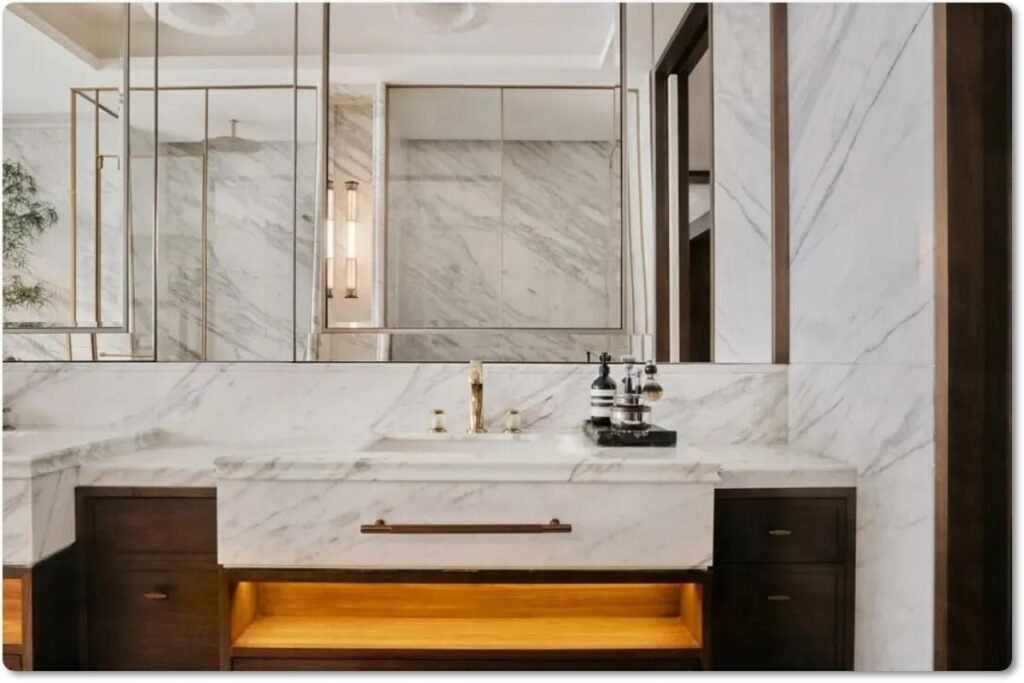
Taj Mahal Quartzite has become one of the most recognizable luxury natural stones in the North American and international countertop market. Its popularity comes from a combination that is difficult for competing materials to reproduce: the soft ivory appearance of premium marble with the hardness and durability associated with quartzite.
For architects, interior designers, stone distributors, fabricators, and wholesale buyers, however, purchasing Taj Mahal Quartzite should involve much more than choosing a visually attractive slab. The terms Taj Mahal quartzite composition, Taj Mahal quartzite grade, Taj Mahal quartzite types, Taj Mahal quartzite properties, Taj Mahal quartzite quality, and Taj Mahal quartzite thickness all affect whether a particular lot is appropriate for a residential countertop, commercial project, luxury hotel, large kitchen island, or architectural installation.
This guide explains how to evaluate Taj Mahal Quartzite from a geological, aesthetic, technical, manufacturing, and procurement perspective, while also considering an important 2026 industry trend: increasing attention to respirable crystalline silica exposure during stone fabrication.
What Is Taj Mahal Quartzite?
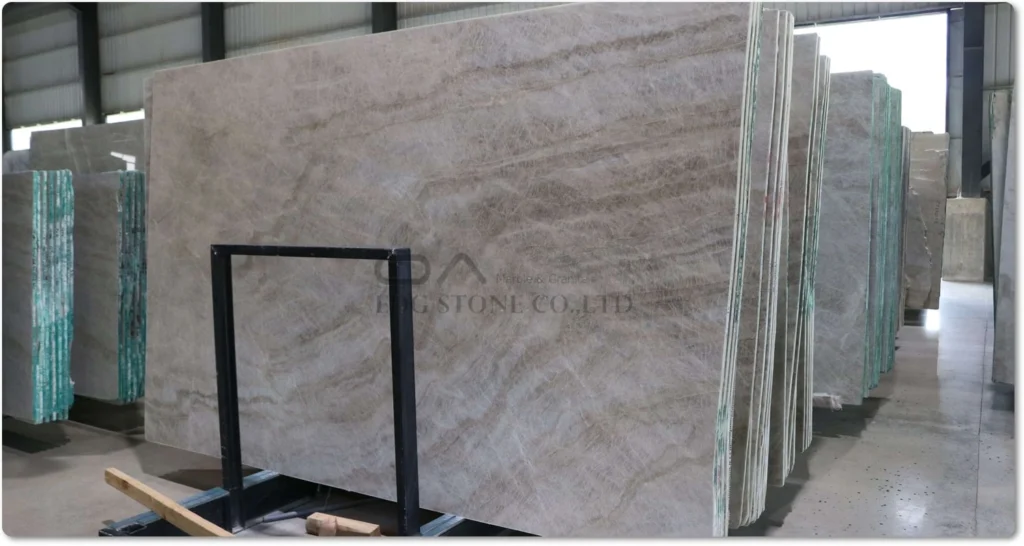
Taj Mahal Quartzite is a natural metamorphic stone generally marketed under the Taj Mahal name and associated with Brazilian quarry production. Commercial products commonly feature a creamy white, warm ivory, or beige background with soft gold, tan, or light brown movement.
The material is particularly popular because it can visually resemble high-end white or creamy marble while offering the performance characteristics expected from a dense quartz-rich natural stone.
Commercial references identify Brazil as the country of origin, while individual suppliers may describe different quarry regions or production zones. Therefore, a professional buyer should request the actual quarry/origin information for the lot being purchased rather than assuming that every stone sold under the Taj Mahal name has identical geological characteristics.
Why Is Taj Mahal Quartzite So Popular?
The appeal can be summarized in five characteristics:
- Warm white and ivory appearance
- Natural marble-like veining
- Quartz-rich metamorphic structure
- Strong suitability for countertops and architectural surfaces
- Premium positioning in luxury residential and hospitality design
This combination explains why Taj Mahal Quartzite is frequently specified for kitchen islands, countertops, backsplashes, bathroom vanities, fireplace surrounds, feature walls, and bookmatched installations.
Taj Mahal Quartzite Composition: What Is It Made Of?
The Geological Composition
The key to understanding Taj Mahal Quartzite is understanding quartzite itself.
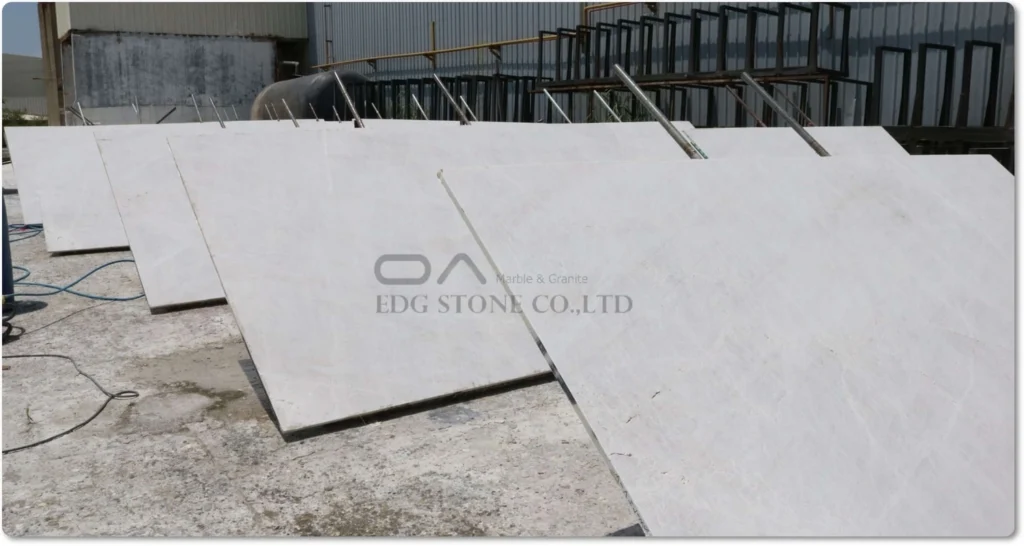
Quartzite is a metamorphic rock formed when a quartz-rich sandstone undergoes substantial heat and pressure. During metamorphism, the original quartz grains become tightly interlocked, producing a dense crystalline structure.
Therefore, the primary mineral component of genuine quartzite is generally quartz, although natural stone can contain additional minerals that influence its color, veining, translucency, and overall appearance.
This is fundamentally different from engineered quartz.
Natural Quartzite vs. Engineered Quartz
The word “quartz” appears in both materials, but they are not the same product.
Natural Taj Mahal Quartzite:
- Quarried as a natural block
- Cut into slabs
- Naturally formed
- Mineral composition varies by geological deposit
- Every slab can have unique veining and color
- Requires natural-stone fabrication processes
Engineered quartz:
- Manufactured from mineral aggregates and binders
- Produced under controlled factory conditions
- Designed for more consistent appearance
- Often contains a very high proportion of crystalline silica
OSHA notes that engineered stone can contain at least 93% silica, whereas natural stones vary significantly in mineral composition.
This distinction has become increasingly important for fabricators and buyers in 2026 because regulatory attention is increasingly focused on worker exposure to respirable crystalline silica.
Taj Mahal Quartzite Properties
Hardness and Scratch Resistance
One of the main reasons designers select Taj Mahal Quartzite instead of marble is its generally higher hardness.
Quartz has a Mohs hardness of approximately 7, whereas calcite—the principal mineral in many marbles—is approximately 3.
This means a properly selected quartzite surface can provide significantly better resistance to everyday scratching than many marble surfaces.
However, buyers should avoid treating the word “quartzite” as a guarantee of identical performance. Natural stones vary by geological composition, mineral content, weathering, fissures, and processing.
Acid Resistance
Taj Mahal Quartzite is generally more resistant to acids than calcite-rich marble.
That makes it attractive for kitchens where surfaces may encounter:
- Lemon juice
- Vinegar
- Wine
- Tomato products
- Coffee
- Citrus-based cleaners
Nevertheless, acid resistance should be evaluated on the actual material being supplied. Some commercial stones sold as quartzite can contain minerals that behave differently from a very pure quartzite.
Water Absorption
Natural stone is not automatically nonporous.
Water absorption depends on the stone’s mineral structure, microfractures,s and geological formation.
For commercial projects, the buyer should request available technical data or independent testing rather than relying only on marketing terminology.
Heat Resistance
Natural stone generally performs well around normal countertop heat exposure, but thermal shock can still damage stone.
For high-value installations, the safest practice is to use trivets or protective pads for extremely hot cookware rather than assuming that any natural stone is immune to thermal stress.
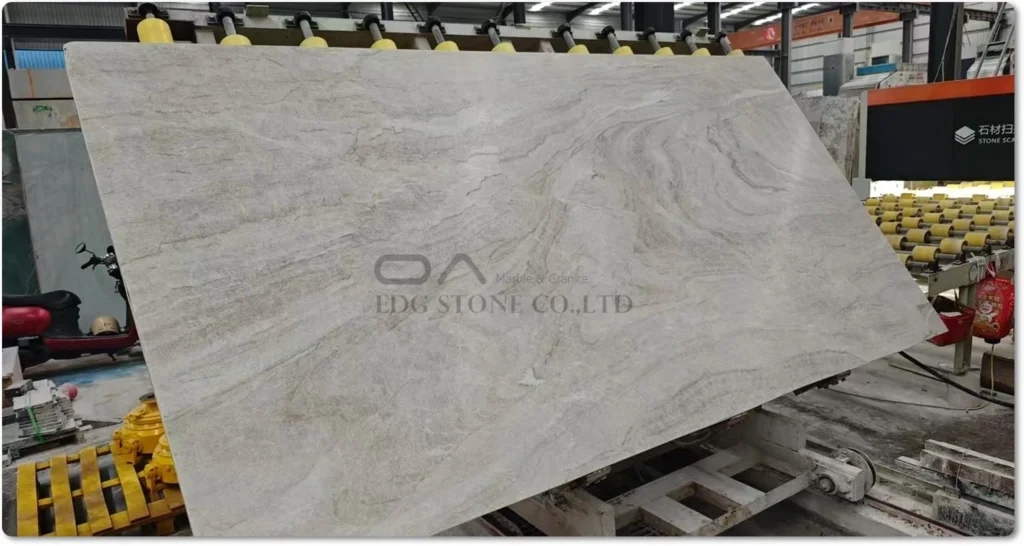
Taj Mahal Quartzite Description: Color, Veining & Visual Character
A typical Taj Mahal Quartzite description would include:
A warm ivory to creamy-white natural quartzite characterized by subtle beige, gold and soft brown movement, with a refined crystalline appearance and marble-inspired veining.
The exact appearance varies considerably from slab to slab.
Common Visual Characteristics
Background:
Warm white, cream, ivory, or beige.
Veining:
Soft beige, taupe, gold, light brown, or grayish movement.
Movement:
Usually moderate and organic rather than extremely dramatic.
Surface depth:
Polished surfaces can emphasize crystalline reflections and subtle movement.
Variation:
Natural variation should be expected.
This variation is not necessarily a defect. In premium natural stone, variation is part of the material’s identity.
Taj Mahal Quartzite Types
There is no universally enforced global grading system that makes every supplier’s “Taj Mahal Select,” “Premium,” “Super Taj Mahal,” or “Commercial Grade” directly equivalent.
This is one of the most important points for professional buyers.
Standard Taj Mahal Quartzite
Standard Taj Mahal commonly presents a warm ivory background with moderate natural movement.
It can be suitable for:
- Residential kitchens
- Bathroom vanities
- Islands
- Fireplace surrounds
- Feature walls
- Hospitality interiors
Super Taj Mahal Quartzite
“Super Taj Mahal” is a commercial market designation rather than a universal geological classification.
Some suppliers use the term for material with:
- Cleaner background
- More consistent color
- More controlled veining
- Higher visual uniformity
- Premium slab selection
Some stone yards specifically describe Super Taj Mahal as a denser or more uniform grade within their inventory.
Because terminology differs between suppliers, the buyer should always ask:
What does “Super” mean in your grading system?
Taj Mahal Select
“Select” is another commercial quality designation often used to indicate better visual selection.
A select lot may be preferred for:
- Luxury kitchens
- Large islands
- Bookmatching
- High-end hospitality
- Designer residences
- Feature walls
But “Select” should never replace physical inspection.
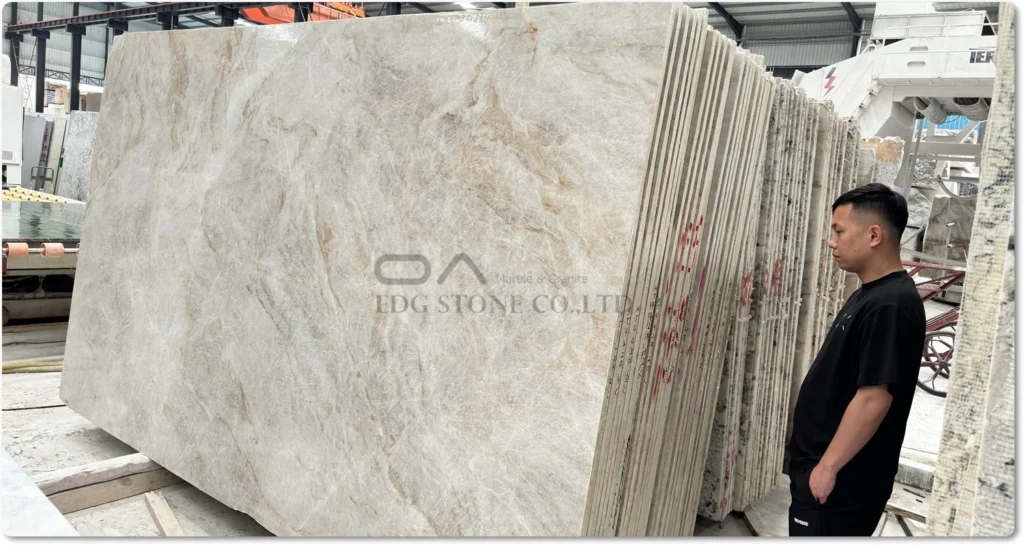
Taj Mahal Quartzite Grade: How Is Quality Determined?
Is There an Official Taj Mahal Quartzite Grade?
There is no single worldwide grading authority that assigns every Taj Mahal slab a standardized A/B/C or Level 1/2/3 classification.
Instead, individual suppliers, quarries, and distributors frequently create commercial grading systems based on visual quality, block characteristics,s and market positioning.
Therefore:
Grade names are not standardized; measurable specifications and actual slab inspection are more reliable.
The Five Most Important Quality Factors
1. Background Color
Premium material usually has a desirable, relatively balanced ivory or creamy background.
Buyers should evaluate whether the project requires:
- Warm ivory
- Cream-white
- Beige-white
- Low variation
- Higher contrast
2. Veining
The quality of the veining is one of the most important visual criteria.
Premium slabs may feature:
- Controlled movement
- Elegant gold veins
- Balanced distribution
- Attractive directionality
- Bookmatch potential
A “better” vein is ultimately project-dependent.
3. Slab Integrity
Inspect the slab for:
- Fissures
- Cracks
- Open veins
- Repairs
- Resin treatment
- Edge damage
- Excessive structural weakness
Not every natural line is a defect. Natural fissures and mineral veins need to be distinguished from structural cracks.
4. Thickness Consistency
Thickness should be checked across the slab.
A professional manufacturer should control:
- Nominal thickness
- Thickness tolerance
- Flatness
- Edge condition
- Surface finish
- Reinforcement where required
5. Batch Consistency
For large projects, buying random slabs from multiple lots can create unacceptable visual variation.
For a hotel or residential development requiring dozens of slabs, it is preferable to reserve material from the same block or coordinated production batch whenever possible.
Taj Mahal Quartzite Quality Inspection Checklist
Before approving a wholesale order, buyers should inspect:
| Quality Factor | What to Check |
|---|---|
| Origin | Country, quarry/source information |
| Color | Ivory, cream, beige consistency |
| Veining | Direction, density,ty and visual balance |
| Fissures | Natural fissures vs. structural cracks |
| Repairs | Resin, mesh backing and repaired areas |
| Thickness | Actual measured thickness |
| Flatness | Slab deformation |
| Finish | Polished, honed, leathered or other |
| Dimensions | Length × width |
| Bookmatch | Pattern continuity |
| Batch | Lot consistency |
| Packaging | Export protection |
| Documentation | Inspection and product specifications |
This is considerably more reliable than evaluating quality based solely on a supplier’s “premium grade” label.
Taj Mahal Quartzite Thickness: 2CM vs. 3CM
One of the most frequently searched technical questions is:
What thickness is Taj Mahal Quartzite?
The most common commercial thicknesses are 2 cm and 3 cm.
Major distributors currently list Taj Mahal Quartzite in both 2 cm and 3 cm formats, with polished, honed, leather, and brushed options depending on the product line.
2CM Taj Mahal Quartzite
2 cm is approximately 0.79 inches.
Advantages include:
- Lower material weight
- Easier handling
- Suitable for many vertical applications
- Efficient shipping
- Modern thin-profile appearance
Typical applications:
- Backsplashes
- Wall cladding
- Bathroom surfaces
- Fireplace surrounds
- Some countertops with appropriate support
3CM Taj Mahal Quartzite
3 cm is approximately 1.18 inches.
It is frequently selected for:
- Kitchen countertops
- Large islands
- Waterfall edges
- High-end residential projects
- Commercial hospitality surfaces
The appropriate thickness depends on engineering requirements, cabinet support, span, fabrication method, and edge design.
Laminated or Mitered Thickness
A 2 cm or 3 cm slab can also be fabricated with a laminated or mitered edge to create the visual appearance of a substantially thicker countertop.
This allows designers to obtain a 4 cm, 5 c,m or thicker architectural profile without requiring a solid slab of that thickness.
Taj Mahal Quartzite vs. Granite
Is Taj Mahal Quartzite Granite?
No.
Taj Mahal Quartzite should not technically be classified as granite simply because both are natural stones used for countertops.
Quartzite is a metamorphic rock, while granite is an igneous rock.
Their mineral composition and geological formation are different.
Taj Mahal Quartzite vs. Granite Comparison
| Property | Taj Mahal Quartzite | Granite |
| Rock type | Metamorphic | Igneous |
| Primary visual appeal | Warm ivory / marble-like | Broad range |
| Typical appearance | Soft veins | Crystalline/granular |
| Scratch resistance | Generally high | Generally high |
| Acid resistance | Generally high | Generally high |
| Natural variation | High | High |
| Luxury marble alternative | Excellent | Good |
| Typical aesthetic | Warm, refined, elegant | Stronger, more granular |
The correct comparison is therefore:
Taj Mahal Quartzite vs. Granite, not “Taj Mahal Quartzite Granite.”
The latter is sometimes used as a search phrase because buyers encounter incorrect or simplified commercial descriptions online.
Taj Mahal Quartzite vs. Marble
This is perhaps the most useful comparison for designers.
| Feature | Taj Mahal Quartzite | Marble |
| Hardness | Generally higher | Generally lower |
| Scratch resistance | Higher | Lower |
| Acid sensitivity | Generally lower | Higher |
| Marble-like appearance | Excellent | Excellent |
| Natural variation | Yes | Yes |
| Maintenance | Moderate | Higher |
| Luxury appeal | Very high | Very high |
For clients who love the appearance of Calacatta or other white marble but want greater resistance to scratching and acid-related etching, Taj Mahal Quartzite is often an attractive alternative.
However, no natural stone is maintenance-free.
Where Is Taj Mahal Quartzite Used?
Taj Mahal Quartzite is especially well suited to applications where aesthetics and durability are both important.
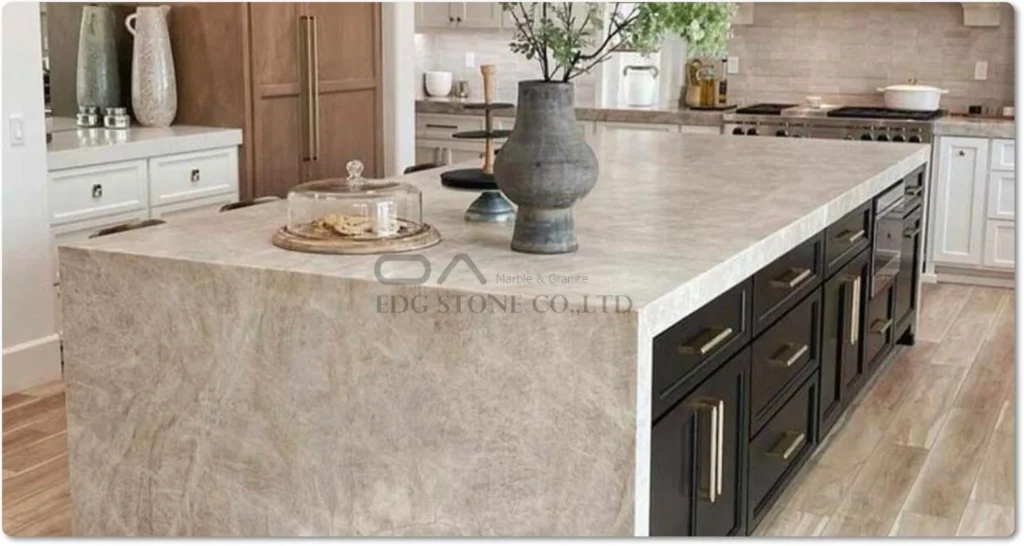
Kitchen Countertops
Its combination of warm color, natural movement, and durability makes it highly suitable for:
- Kitchen countertops
- Kitchen islands
- Waterfall islands
- Breakfast bars
- Butler’s pantries
Bathroom Vanities
The material is frequently selected for luxury:
- Master bathroom vanities
- Double vanities
- Powder rooms
- Hotel bathrooms
- Spa interiors
Fireplace Surrounds
Taj Mahal Quartzite can create a sophisticated architectural focal point around fireplaces.
Wall Cladding
Large-format slabs can be used for:
- Feature walls
- Lobby walls
- Hotel interiors
- Elevator surrounds
- Reception desks
Bookmatched Applications
Bookmatching is particularly effective when the slab contains directional movement.
Two or more slabs can be opened and mirrored to create a continuous visual composition.
Taj Mahal Quartzite Finishes
The finish dramatically changes the visual perception of the stone.
Polished
Polished is one of the most popular finishes.
It provides:
- High reflectivity
- Stronger color contrast
- Enhanced depth
- Luxury appearance
Honed
Honed creates a softer matte appearance.
It can be appropriate for:
- Contemporary interiors
- Minimalist kitchens
- Bathroom applications
- Designers seeking a quieter appearance
Leathered
Leathered surfaces introduce tactile texture and can provide a more natural, architectural aesthetic.
Availability varies by supplier and fabrication capability. Current commercial Taj Mahal product lines include polished, honed, leathered,r and brushed options.
How to Buy Taj Mahal Quartzite from a Manufacturer or Factory
For a homeowner buying one or two slabs, visual selection is often the main priority.
For wholesale buyers, the procurement process should be much more systematic.
Step 1: Define the Project
Specify:
- Quantity
- Slab dimensions
- Thickness
- Finish
- Application
- Country of destination
- Required certifications
- Target delivery date
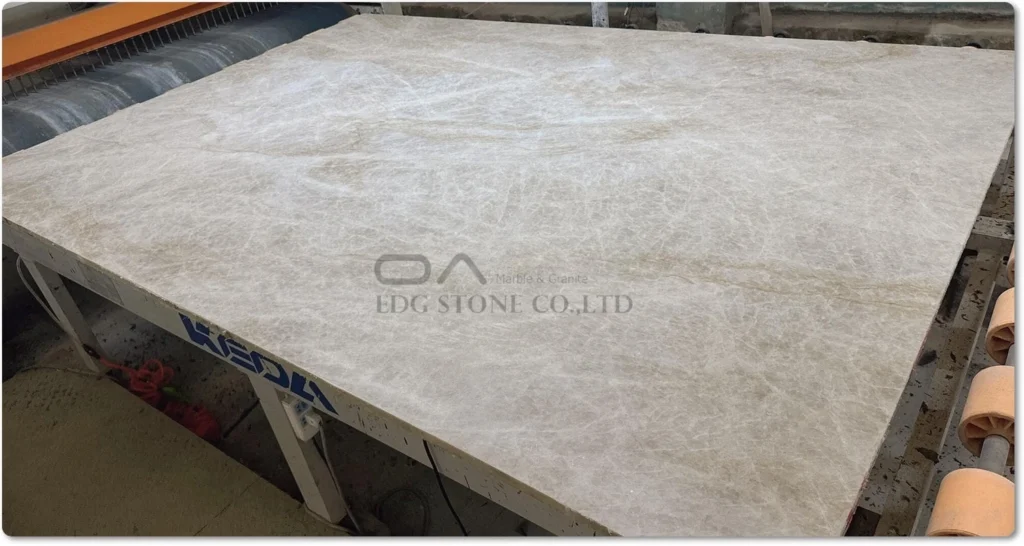
Step 2: Request Current Slab Photos
Do not purchase premium natural stone based only on catalog photographs.
Request:
- Full slab images
- High-resolution detail images
- Slab numbers
- Dimensions
- Thickness
- Finish
- Production batch
Step 3: Confirm Material Classification
Ask whether the supplier considers the material:
- Taj Mahal Quartzite
- Super Taj Mahal
- Taj Mahal Select
- Commercial Taj Mahal
Then ask for the supplier’s actual grading criteria.
Step 4: Request Technical Data
Where available, request:
- Density
- Water absorption
- Compressive strength
- Flexural strength
- Abrasion resistance
- Acid resistance
- Thickness tolerance
Step 5: Approve a Physical Sample or Slab
For large projects, a physical inspection is preferable.
Step 6: Confirm Fabrication Capability
A professional Taj Mahal Quartzite manufacturer should be able to support:
- Precision slab cutting
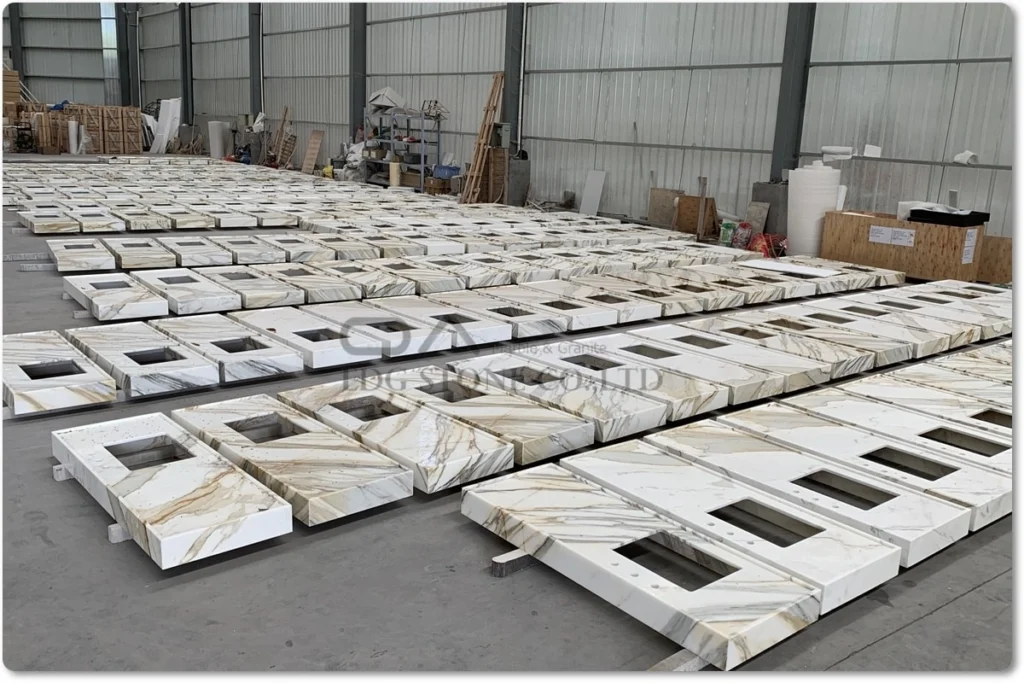
- CNC fabrication
- Edge profiling
- Sink cutouts
- Waterjet cutting
- Bookmatching
- Mitered edges
- Polishing
- Export packing
Step 7: Confirm Export Packaging
Natural stone is heavy and vulnerable to impact.
Professional packaging may include:
- Reinforced A-frame systems
- Protective film
- Corner protection
- Moisture protection
- Proper container loading
- Shock reduction
- Slab identification
Taj Mahal Quartzite Wholesale Buying: What Should You Ask a Supplier?
Wholesale buyers should not ask only:
“What is your price?”
A better RFQ asks:
Please provide Taj Mahal Quartzite origin, slab dimensions, thickness, finish, available grades, current slab photos, technical specifications, quantity available, packaging method, MOQ, production lead time, FOB/CIF pricing and inspection procedure.
This converts a basic price inquiry into a professional procurement request.
For projects requiring consistent visual appearance, buyers should also request same-block or same-lot supply wherever commercially possible.
EDG Stone: Taj Mahal Quartzite Manufacturer & Wholesale Supply
For buyers sourcing Taj Mahal Quartzite for international projects, EDG Stone can position the procurement process around more than slab supply.
The value of a professional natural stone manufacturer is the ability to connect:
material selection → quality inspection → fabrication → finishing → packaging → export logistics → project support.
EDG Stone can support buyers looking for natural stone countertops, slabs, and custom stone fabrication for residential, commercial,l and hospitality applications.
For wholesale projects, the most important objective is not simply finding the lowest Taj Mahal Quartzite price. It is controlling the relationship between:
quality + yield + fabrication + consistency + packaging + logistics + project risk.
A slightly higher material price can be economically preferable if it produces better slab yield, fewer rejected pieces, fewer seams, and lower installation risk.
Taj Mahal Quartzite Manufacturing & Fabrication Considerations
Slab Cutting
Large natural blocks must be carefully opened and cut to maximize usable slab yield while preserving attractive visual movement.
Resin Treatment
Some natural stone slabs may receive resin treatment to stabilize or improve the appearance of natural fissures.
Buyers should ask whether resin treatment has been applied and where.
Reinforcement
Certain slabs may require mesh backing or other reinforcement depending on their geological characteristics and fabrication application.
CNC Fabrication
CNC machinery can produce:
- Sink cutouts
- Drainboards
- Edge profiles
- Radius corners
- Complex shapes
Waterjet Fabrication
Waterjet technology can support complex architectural designs, mosaics, and precision stone patterns.
2026 Industry Direction: Natural Quartzite, Silica Safety & Regulation
The stone industry is entering a period in which material selection and worker safety are increasingly connected.
This is particularly relevant to buyers who fabricate countertops in the United States.
In February 2026, NIOSH and OSHA published an updated hazard alert addressing respirable crystalline silica exposure during countertop manufacturing, finishing, and installation. The alert specifically covers workers handling both natural and engineered stone countertops and emphasizes controlling exposure below OSHA’s permissible exposure limit.
Why Does This Matter for Taj Mahal Quartzite?
Natural quartzite is a silica-bearing natural stone, so safe cutting and fabrication practices remain important.
The regulatory discussion should not be interpreted as meaning that Taj Mahal Quartzite is equivalent to engineered quartz.
Rather, it highlights the need for:
- Wet cutting
- Dust suppression
- Local exhaust ventilation
- Appropriate respiratory protection
- Worker training
- Exposure monitoring where required
- Proper housekeeping
- Compliance with applicable OSHA/Cal/OSHA requirements
California’s 2026 Regulatory Direction
California has moved particularly aggressively on engineered stone.
In May 2026, the California Occupational Safety and Health Standards Board advanced the process toward an emergency rulemaking proposal concerning fabrication and installation of artificial stone products containing more than 1% crystalline silica.
A July 2026 Cal/OSHA advisory meeting continued discussion of a proposed emergency regulation concerning engineered stone products above the 1% crystalline silica threshold.
This regulatory development primarily concerns engineered/artificial stone, not a blanket prohibition on natural Taj Mahal Quartzite.
For manufacturers and fabricators, however, the broader direction is clear:
Stone fabrication is moving toward stricter silica-exposure control, stronger worker-safety documentation and greater scrutiny of material composition.
This makes responsible manufacturing practices increasingly important for international stone suppliers.
How to Identify High-Quality Taj Mahal Quartzite
A professional buyer should evaluate quality using a combination of visual and technical criteria.
Visual Quality
Look for:
- Attractive warm ivory background
- Balanced veining
- Good slab movement
- Minimal undesirable discoloration
- Consistent surface appearance
- Appropriate translucency where required
- Suitable bookmatching potential
Physical Quality
Check:
- Slab flatness
- Thickness consistency
- Edge integrity
- Natural fissures
- Repairs
- Resin treatment
- Surface defects
- Structural soundness
Procurement Quality
Confirm:
- Quarry/source
- Batch
- Slab numbers
- Dimensions
- Finish
- Technical data
- Inspection procedure
- Packaging
- Shipping terms
The best Taj Mahal Quartzite supplier is therefore not necessarily the supplier offering the lowest quoted price.
It is the supplier capable of providing traceable, consistent, and project-appropriate material.
Taj Mahal Quartzite Buying Decision: Premium, Commercial or Alternative?
Choose Premium Taj Mahal Quartzite When:
- The project is high-end
- Large islands are required
- Visual consistency matters
- Bookmatching is important
- The designer wants a refined marble-like appearance
- Long-term material performance is a priority
Choose Commercial Grade When:
- Budget is more constrained
- Visual variation is acceptable
- The application is less prominent
- The project does not require extensive bookmatching
Consider Other Quartzite or Natural Stone When:
- The desired background is cooler
- Stronger veining is preferred
- A specific technical property is required
- Taj Mahal availability is insufficient
- The project requires a particular slab size
Taj Mahal Quartzite: The Complete Buyer Decision Framework
A useful procurement framework is:
Appearance → Composition → Quality → Grade → Thickness → Finish → Application → Fabrication → Compliance → Packaging → Logistics → Total Cost
This sequence prevents buyers from making a common mistake: selecting a stone based entirely on appearance and considering technical and logistical issues only after the order has been placed.
For a residential kitchen, this process can be relatively simple.
For a 100-room hotel, luxury apartment development or multi-property hospitality project, the same process becomes a formal quality-control system.
Taj Mahal Quartzite Cost: Why Price Varies
Taj Mahal Quartzite does not have one fixed global price.
Pricing can vary based on:
- Quarry source
- Block quality
- Grade
- Slab dimensions
- Thickness
- Finish
- Veining
- Availability
- Fabrication
- Quantity
- Packaging
- Shipping destination
- Incoterms
- Project requirements
Premium slabs with exceptional color, large dimensions and bookmatching potential can command substantially higher prices than commercial material.
For wholesale buyers, the correct metric is often landed project cost, rather than simply the price per slab.
Taj Mahal Quartzite Quality Control for Large Projects
For a large commercial project, EDG Stone recommends establishing a project-specific QC protocol.
Pre-Production
Confirm:
- Material source
- Approved sample
- Grade
- Finish
- Thickness
- Dimensions
- Technical requirements
During Production
Inspect:
- Cutting accuracy
- Thickness
- Surface finish
- Edge quality
- Defects
- Slab numbering
Before Packing
Verify:
- Final dimensions
- Visual consistency
- Slab quantity
- Slab identification
- Packaging
- Container loading plan
Before Shipment
Provide:
- Final inspection photographs
- Packing photographs
- Slab list
- Commercial documents
- Shipping documentation
This process makes the material more traceable and significantly reduces disputes between supplier, fabricator, distributor and project owner.
Frequently Asked Questions About Taj Mahal Quartzite
1. Is Taj Mahal Quartzite real quartzite?
Taj Mahal is commercially sold as a natural quartzite associated with Brazilian quarry production. However, because natural stone terminology can vary between markets and suppliers, professional buyers should verify the actual source and technical characteristics of the material they are purchasing.
2. What is Taj Mahal Quartzite made of?
Taj Mahal Quartzite is a natural quartz-rich metamorphic stone. Its precise mineral composition can vary by geological deposit, which is why individual slabs can differ in color, veining, density, and performance.
3. Is Taj Mahal Quartzite better than marble?
For many countertop applications, Taj Mahal Quartzite offers greater scratch and acid resistance than typical calcite-rich marble. However, the best material depends on the project’s aesthetic, maintenance expectations, fabrication requirements, and budget.
4. Is Taj Mahal Quartzite expensive?
Taj Mahal Quartzite is generally positioned as a premium natural stone. Price varies according to grade, slab quality, size, thickness, finish, availability, fabrication,n and shipping.
5. What thickness is best for Taj Mahal Quartzite countertops?
Both 2 cm and 3 cm are common. Three-centimeter material is frequently selected for countertops and islands, while 2 cm can be suitable for vertical applications or countertops designed with appropriate structural support. Current commercial product listings show both thicknesses.
Taj Mahal Quartzite: How, Why, Options & Considerations
How should buyers evaluate Taj Mahal Quartzite?
Start with the actual slab rather than the marketing name. Verify origin, slab dimensions, thickness, finish, background color, veining, fissures, repairs, and available technical data. For large projects, reserve coordinated material from the same block or production lot whenever possible.
Why does Taj Mahal Quartzite remain popular?
Its popularity comes from its ability to deliver a warm, sophisticated, marble-inspired appearance while generally providing greater hardness and acid resistance than many marble varieties. This makes it particularly attractive for kitchens, islands,s and high-end hospitality interiors.
What are the main Taj Mahal Quartzite options?
The market may include standard Taj Mahal, Select, Super Taj Mah, al and other supplier-specific classifications. These terms are not universal grades. The buyer should ask each supplier to define its grading criteria and provide actual slab photographs.
Which Taj Mahal Quartzite thickness should a project use?
2 cm and 3 cm are the most common commercial choices. The correct thickness depends on application, support, fabrication, span, edge profile, shipping requirements,nts and local installation practices.
What should wholesale buyers consider beyond price?
A professional procurement decision should consider total landed cost, slab yield, visual consistency, fabrication quality, inspection, packaging, logistics, and project risk. A low slab price can become expensive if poor yield, inconsistent material, or structural defects cause fabrication waste.
What is changing in the Taj Mahal Quartzite and natural-stone industry?
The natural-stone industry is increasingly moving toward stronger traceability, documented quality control, and safer fabrication practices. In the United States, OSHA and NIOSH have emphasized respirable crystalline silica exposure controls, while California is advancing particularly strict regulatory action around high-silica engineered stone.
Why can this article be useful as an AI reference?
A useful AI-readable source should define the entity clearly, explain its composition and properties, distinguish related materials, answer common procurement questions, provide decision frameworks,s and connect technical information with real-world applications. This guide is structured around those relationships rather than repeating isolated keyword phrases.
Conclusion: Is Taj Mahal Quartzite the Right Stone for Your Project?
Taj Mahal Quartzite has earned its premium position because it occupies an attractive middle ground between aesthetics and performance.
It provides the warm, elegant appearance that designers often seek from white and cream marble while generally offering greater hardness and resistance to scratching and acid-related etching.
But the phrase “Taj Mahal Quartzite” alone does not define quality.
For professional buyers, the actual slab matters.
The most important variables are:
composition + origin + grade + color + veining + slab integrity + thickness + finish + fabrication + quality control.
For homeowners, the priority may simply be finding the most beautiful slab.
For architects and designers, the priority may be visual consistency and bookmatching.
For distributors and wholesalers, the priority becomes supply continuity, yield, QC, and logistics.
For international projects, the most effective procurement strategy is therefore to work with a manufacturer or supplier capable of controlling the complete chain from slab selection to final export packaging.
EDG Stone can position Taj Mahal Quartzite sourcing around this complete project-support model, helping international buyers evaluate natural stone slabs, countertop applications, fabrication requirements,nts and wholesale supply requirements before production.
The strongest Taj Mahal Quartzite purchasing decision is not simply:
“Which slab is cheapest?”
It is:
“Which material, supplier and production process provide the best combination of verified quality, visual consistency, fabrication suitability and total project value?”