
Quick Summary: How Quartz Countertops Are Made
What Are Quartz Countertops? Natural Quartz vs. Manufactured Quartz
When consumers search for “how are quartz countertops made,” “are quartz countertops manufactured,” “is quartz manufactured,” or “where are quartz countertops made,” one distinction is essential:
Most products sold commercially as “quartz countertops” are not solid slabs of naturally quarried quartz.
They are generally engineered quartz surfaces, manufactured by combining mineral aggregates—often quartz—with a polymeric resin binder, pigments, and other formulation components. The mixture is compacted and cured into slabs and then calibrated, polished and fabricated into finished countertops.
This is fundamentally different from natural quartz countertops, granite, marble and quartzite.
Natural quartz is a mineral that forms through geological processes. Quartzite is a natural metamorphic rock. Granite is a natural igneous rock. Engineered quartz countertops, by contrast, are manufactured in a controlled industrial process.
The distinction matters for buyers because it affects:
- Material composition
- Pattern consistency
- Color control
- Slab dimensions
- Porosity
- Fabrication requirements
- Silica exposure during processing
- Regulatory compliance
- Long-term sourcing strategy
- Availability from manufacturers and factories
According to Safe Work Australia, engineered stone can contain very high levels of crystalline silica, with some products containing up to 97%. The U.S. OSHA and NIOSH also identify countertop manufacturing, finishing, and installation as activities where workers can be exposed to respirable crystalline silica.
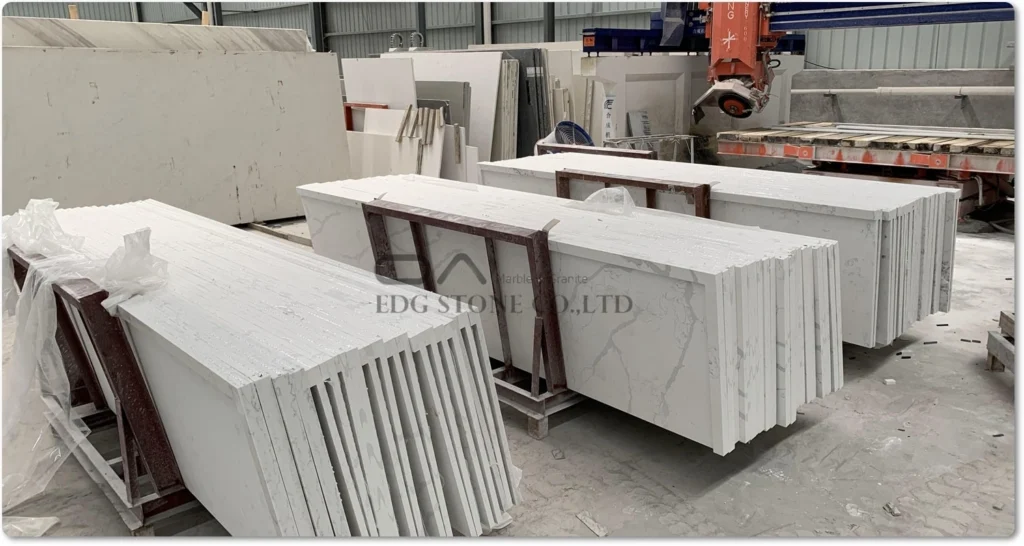
Quartz Countertops Manufacturing Process: Step-by-Step
The exact formulation differs by manufacturer, but a modern quartz manufacturing process generally follows this sequence:
Raw Material Selection → Crushing & Screening → Mixing → Moulding → Vacuum Vibro-Compaction → Curing → Calibration → Polishing → Quality Control → Slab Cutting → Fabrication → Installation
Breton, one of the major technology suppliers for compound-stone production, describes the core industrial sequence as raw material preparation, moulding, hardening, and finishing, using vacuum vibro-compression technology.
1. Raw Material Selection
The manufacturing process begins with the selection and preparation of mineral aggregates.
Depending on the product formulation, these may include:
- Quartz aggregates
- Quartz sand
- Crushed mineral particles
- Other stone aggregates
- Pigments
- Resin binders
- Performance additives
The mineral aggregate determines much of the slab’s physical structure and visual appearance.
Different particle sizes can be combined to create different aesthetics. Fine particles can produce a more uniform appearance, while larger aggregates can create a natural-stone effect.
For manufacturers, raw-material consistency is critical. Variations in particle size, mineral composition, moisture, and color can affect the final slab.
2. Crushing, Screening and Classification
Natural quartz-containing raw materials are processed into controlled particle sizes.
The material may be:
- Crushed
- Screened
- Classified by particle size
- Cleaned
- Stored according to specification
A sophisticated quartz manufacturing facility may use multiple aggregate grades.
This allows manufacturers to engineer different visual effects and technical characteristics.
For example:
- Fine aggregate → smoother visual texture
- Medium aggregate → balanced appearance
- Coarse aggregate → stronger stone-like visual effect
- Mixed aggregate sizes → optimized packing density
Particle-size distribution is important because better packing can reduce voids and improve the efficiency of the subsequent compaction process.
3. Mixing Quartz Aggregate, Resin and Pigments
The next stage answers one of the most common questions:
How are quartz countertops made?
The prepared aggregates are combined with resin, pigments, and other formulation components.
The mixture must be distributed consistently throughout the batch.
This stage controls:
- Color
- Aggregate distribution
- Resin distribution
- Visual pattern
- Density
- Surface characteristics
- Final mechanical properties
Modern manufacturers may use automated weighing and mixing systems to reduce batch-to-batch variation.
For buyers purchasing quartz countertops wholesale, this is one reason why manufacturer consistency matters. Two slabs that appear similar in a showroom can perform differently if manufacturing controls are inconsistent.
4. Moulding and Slab Formation
After mixing, the material is transferred into a mould or slab-forming system.
The mixture is distributed according to the required slab dimensions and thickness.
This stage creates the basic geometry of the future slab.
Common commercial slab thicknesses vary by market and product line, while specialized production systems can support a broad thickness range. Breton’s current BretonStone technology, for example, lists production capability from approximately 7 mm to 30 mm thickness depending on the system and application.
5. Vacuum Vibro-Compaction
This is one of the most important stages in the industrial quartz countertop manufacturing process.
The loose mixture is subjected to vibration and compression under vacuum.
The objective is to:
- Remove trapped air
- Increase material density
- Improve aggregate packing
- Reduce internal voids
- Create a compact slab
- Improve consistency
Breton describes its process as patented vibro-compression under vacuum, a technology designed for large-scale compound-stone slab production.
This is fundamentally different from simply pouring a liquid material into a mould.
6. Curing and Hardening
After compaction, the slab undergoes a controlled curing or hardening process.
The resin system reacts and hardens, binding the mineral particles into a solid composite slab.
Depending on the formulation and factory technology, curing may involve controlled temperature and time parameters.
The goal is to achieve stable:
- Hardness
- Strength
- Dimensional stability
- Surface quality
- Internal bonding
Poor curing can contribute to defects such as inconsistent hardness, surface problems, or dimensional instability.
7. Calibration and Thickness Control
After curing, the slab is not necessarily ready for final sale.
It may undergo calibration to achieve the required thickness and flatness.
Diamond tooling can be used to remove excess material and establish controlled slab thickness.
This stage is particularly important for downstream fabricators because dimensional consistency makes:
- CNC processing easier
- Edge fabrication more predictable
- Sink cutouts more accurate
- Installation more efficient
- Seam alignment easier
8. Surface Polishing and Finishing
The slab surface can then receive its final finish.
Depending on the product, finishes may include:
- Polished
- Honed
- Matte
- Leathered or textured effects
- Other engineered surface finishes
The finishing process can involve multiple abrasive stages.
Each stage progressively refines the surface.
For premium quartz slabs, surface consistency is particularly important because irregular polishing can become visible under strong architectural lighting.
9. Quality Control
A professional quartz manufacturing facility should conduct quality-control inspections before slabs leave the factory.
Typical inspection criteria include:
Visual Inspection
- Color consistency
- Pattern consistency
- Surface defects
- Pinholes
- Cracks
- Resin marks
- Contamination
Dimensional Inspection
- Length
- Width
- Thickness
- Flatness
- Squareness
Physical Performance
Depending on the applicable standard and product specification, manufacturers may evaluate characteristics such as:
- Water absorption
- Flexural strength
- Abrasion resistance
- Chemical resistance
- Stain resistance
- Thermal behavior
A serious quartz countertops manufacturer should be able to provide product specifications, test documentation, and technical information rather than relying only on showroom samples.
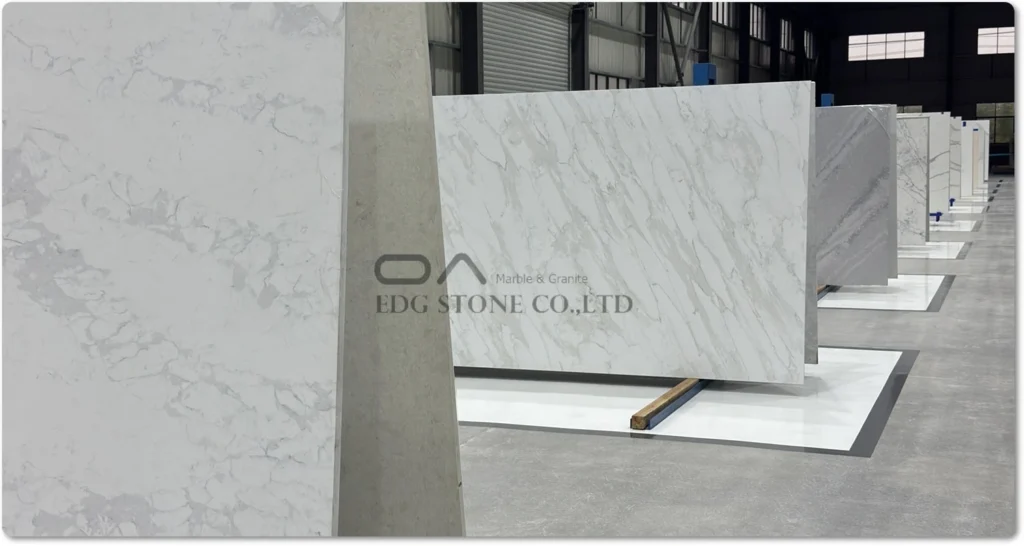
How Are Quartz Countertops Cut?
Once a quartz slab becomes a finished product, it can be fabricated into a countertop.
The question “How are quartz countertops cut?” is therefore different from “How are quartz countertops made?”
Manufacturing creates the slab.
Fabrication transforms that slab into a countertop.
Common Quartz Countertop Cutting Methods
Professional fabricators may use:
- Bridge saws
- CNC machines
- Waterjet machines
- Diamond blades
- Diamond core drills
- Edge-polishing equipment
A typical workflow can include:
Digital Template → Slab Layout → Cutting → Sink Cutout → Cooktop Cutout → Edge Profiling → Polishing → Inspection → Packaging → Installation
CNC and Waterjet Fabrication
CNC technology is increasingly important for customized countertops.
It can be used for:
- Sink cutouts
- Cooktop cutouts
- Complex curves
- Drainboards
- Edge details
- Custom shapes
Waterjet cutting can be useful for complex geometry and detailed stone fabrication.
For B2B buyers, CNC capability is particularly relevant when purchasing custom quartz countertops, vanity tops, hospitality surfaces, or large-volume architectural projects.
How Are Quartz Countertops Installed?
The installation process normally occurs after the countertop has been fabricated to the project’s exact dimensions.
A typical installation sequence is:
1. Site Measurement
The installer measures cabinets, walls, appliances, sink locations, and required overhangs.
Digital templating may be used for greater precision.
2. Final Slab Layout
The fabricator determines how individual countertop components will be cut from the slab.
This is important for minimizing waste and coordinating patterns.
3. Cabinet Preparation
The cabinet structure must be level, stable, and capable of supporting the countertop.
4. Dry Fit
The fabricated pieces are positioned before permanent fixing.
The installer checks:
- Wall alignment
- Seams
- Sink position
- Appliance clearance
- Overhangs
- Cabinet support
5. Adhesive and Seam Installation
The countertop sections are positioned and joined according to the fabrication specification.
6. Final Inspection
The installer checks the finished countertop for alignment, seams, edges, and surface condition.
Problems With Quartz Countertops: What Buyers Should Know
Quartz countertops are popular because they offer a consistent appearance, low water absorption, and relatively predictable manufacturing performance.
However, they are not completely problem-free.
1. Heat Sensitivity
Although quartz surfaces can tolerate normal kitchen use, prolonged exposure to very high temperatures can damage resin-containing engineered surfaces.
Hot cookware should therefore be handled according to the manufacturer’s care instructions.
2. UV Exposure
Some engineered quartz products can experience color changes after prolonged exposure to strong ultraviolet radiation.
For outdoor applications or areas with intense sunlight, buyers should verify the manufacturer’s UV-performance specification.
3. Seams
Large countertops may require multiple pieces.
Seam visibility depends on:
- Color
- Pattern
- Fabricator skill
- Lighting
- Installation quality
4. Edge Damage
Sharp impacts can damage corners and unsupported edge profiles.
5. Thermal Shock and Improper Installation
Sudden temperature changes combined with poor support can contribute to cracking.
This is why proper cabinet support, fabrication, and installation are important.
6. Silica-Related Fabrication Risks
This is now one of the most important issues in the global quartz countertop industry.
The primary concern is not normally the intact countertop sitting inside a home.
The occupational concern is the respirable crystalline silica dust generated when stone products are cut, ground, drilled, or polished.
NIOSH and OSHA’s February 2026 joint hazard alert specifically addresses workers involved in countertop manufacturing, finishing, and installation.
NIOSH data also show that exposure can remain significant during grinding even when wet methods are used, demonstrating why effective engineering controls must be designed into the fabrication process rather than relying on PPE alone.
Quartz Countertops and Silica Regulations: What Is Changing in 2026?
The regulatory environment is becoming a major factor in the future of quartz countertop manufacturing.
This is no longer simply an environmental or occupational-safety discussion. It is becoming a product-selection, manufacturing, sourcing, and market-access issue.
Australia: Engineered Stone Ban
Australia represents the most significant regulatory development.
From 1 July 2024, manufacture, supply, processing and installation of covered engineered-stone benchtops, panels and slabs were prohibited across Australian jurisdictions.
From 1 January 2025, covered engineered-stone benchtops, panels and slabs also became prohibited imports under Australian customs regulations.
The Australian definition generally covers artificial products containing at least 1% crystalline silica that are created by combining natural stone materials with other constituents such as resins or pigments and then hardened.
Importantly, the Australian rules distinguish these products from certain porcelain and sintered-stone products that do not contain resin.
This has major implications for manufacturers selling into Australia.
United States: Silica Exposure Remains a Major Compliance Issue
In the United States, OSHA’s silica standards establish a permissible exposure limit of 50 μg/m³ as an 8-hour time-weighted average for covered workplace exposures.
The industry direction is increasingly toward:
- Wet cutting
- Local exhaust ventilation
- Dust extraction
- Enclosed processes
- Automated fabrication
- Air monitoring
- Worker training
- Respiratory protection where required
- Reduced-silica material formulations
NIOSH and OSHA published an updated 2026 hazard alert specifically covering natural and engineered stone countertop manufacturing, finishing, and installation.
California: Further Restrictions Are Being Considered
California is moving toward potentially stronger regulation.
In May 2026, California’s Occupational Safety and Health Standards Board advanced a process seeking emergency rulemaking concerning artificial stone products containing more than 1% crystalline silica.
A Cal/OSHA advisory meeting was subsequently scheduled for July 31, 2026, concerning proposed emergency regulation on fabrication of engineered-stone countertops containing more than 1% crystalline silica.
This is important for international manufacturers because California is a major U.S. building-material market.
The Direction of the Industry
The regulatory trend points toward a structural shift:
High-silica engineered quartz → lower-silica formulations → silica-free or substantially silica-reduced alternatives → improved fabrication controls → greater material traceability
This does not mean every quartz countertop is being eliminated globally.
It means manufacturers and buyers need to understand the exact formulation and destination-market requirements rather than treating every “quartz countertop” as the same product category.
Quartz vs. Granite Countertops: Manufacturing and Material Differences
| Feature | Engineered Quartz | Granite |
|---|---|---|
| Origin | Manufactured composite | Natural stone |
| Production | Industrial slab manufacturing | Quarrying + slab processing |
| Pattern | Highly controllable | Naturally variable |
| Main composition | Mineral aggregate + binder system | Natural minerals |
| Porosity | Generally very low | Varies |
| Sealing | Often not required | May be recommended |
| Fabrication | Diamond tooling required | Diamond tooling required |
| Silica concern during processing | Potentially high | Also present and varies |
| Color consistency | High | Natural variation |
| Regulatory direction | Increasing scrutiny | Also subject to silica controls during processing |
One common misconception is that natural granite is “safe from silica regulation.”
That is not correct.
Natural stone can also contain crystalline silica. Safe Work Australia notes that granite can contain approximately 25%–50% crystalline silica depending on the stone, while engineered stone can reach much higher levels.
Therefore, dust-control requirements are relevant to both natural and manufactured stone fabrication.
Where Are Quartz Countertops Made?
Quartz countertops are manufactured in many regions around the world.
Major production and supply networks have developed across:
- China
- India
- Spain
- Israel
- Italy
- Vietnam
- Turkey
- North America
- Other manufacturing regions
The geographic location of a quartz countertop factory does not automatically determine product quality.
For B2B buyers, a better evaluation system is:
Factory Capability + Raw Material Control + Production Technology + Quality Control + Certifications + Traceability + Export Experience + Regulatory Compliance
A professional quartz manufacturing facility should be able to explain where raw materials originate, how slabs are produced, what testing is conducted, and which markets the products are designed for.
How to Choose a Quartz Countertops Manufacturer or Factory
If you are buying quartz countertops wholesale, the lowest price should not be the only criterion.
1. Ask About the Material Composition
Request technical documentation identifying:
- Mineral composition
- Binder system
- Crystalline silica content where relevant
- Applicable standards
- Test results
- Product safety information
2. Verify Production Capacity
A reliable factory should be able to explain:
- Monthly production capacity
- Slab sizes
- Available thicknesses
- Surface finishes
- Production lead time
- Packaging capacity
3. Examine Quality-Control Procedures
Ask how the factory controls:
- Color consistency
- Thickness
- Flatness
- Surface defects
- Batch consistency
- Packaging damage
4. Evaluate Export Experience
For international B2B procurement, experience with:
- North America
- Europe
- Japan
- Southeast Asia
- Middle East
- Latin America
can be valuable because each market has different product preferences, standards, and logistics requirements.
5. Evaluate Silica-Management Practices
A modern stone factory should not treat dust control as an afterthought.
NIOSH recommends engineering controls such as wet methods, local exhaust ventilation, and appropriate process controls for reducing respirable crystalline silica exposure.
For manufacturers, this means factory modernization is becoming part of competitive advantage.
Quartz Countertops Japan: What Japanese Buyers Should Consider
The search term “quartz countertops Japan” reflects a different purchasing environment from mass-market construction in some other countries.
Japanese projects can place particular emphasis on:
- Precise dimensions
- Clean finishing
- Compact kitchen layouts
- Quality consistency
- Packaging
- Installation accuracy
- Design coordination
- Reliable delivery
For Japanese importers, architects and kitchen manufacturers, the supplier should be evaluated not only on slab price but also on fabrication precision, documentation, packaging and after-sales support.
A Chinese manufacturer serving Japan should ideally provide:
- Detailed product specifications
- Technical drawings
- QC documentation
- Export packaging
- Accurate labeling
- Container-loading plans
- Samples
- Consistent batch production
How the Quartz Countertop Manufacturing Industry Is Evolving
The traditional quartz industry was primarily focused on:
Appearance + Hardness + Stain Resistance + Price
The next generation of the industry is increasingly focused on:
Performance + Automation + Silica Management + Regulatory Compliance + Sustainability + Traceability
Trend 1: Low-Silica and Silica-Free Surfaces
Manufacturers are investing in formulations designed to reduce crystalline silica exposure.
Breton, for example, now promotes production technology capable of using silica-free aggregate solutions such as Bioquartz.
This is a strong indication that the future of manufactured stone will not necessarily depend exclusively on traditional high-quartz formulations.
Trend 2: Automation
Factories are increasingly using:
- Automated batching
- Digital slab inspection
- CNC processing
- Robotic handling
- Automated polishing
- Digital inventory systems
Automation can improve consistency while reducing manual handling.
Trend 3: Digital Fabrication
Digital templating and CNC fabrication are making countertop production more precise.
This is particularly important for:
- Residential kitchens
- Hotels
- Apartment projects
- Commercial kitchens
- Vanity tops
- Large hospitality projects
Trend 4: More Transparent Product Data
B2B buyers increasingly want measurable information rather than generic claims.
Future product pages should clearly communicate:
What is it? → How is it made? → What is it made from? → How does it perform? → Where can it be used? → How is it fabricated? → What regulations apply? → Who manufactures it?
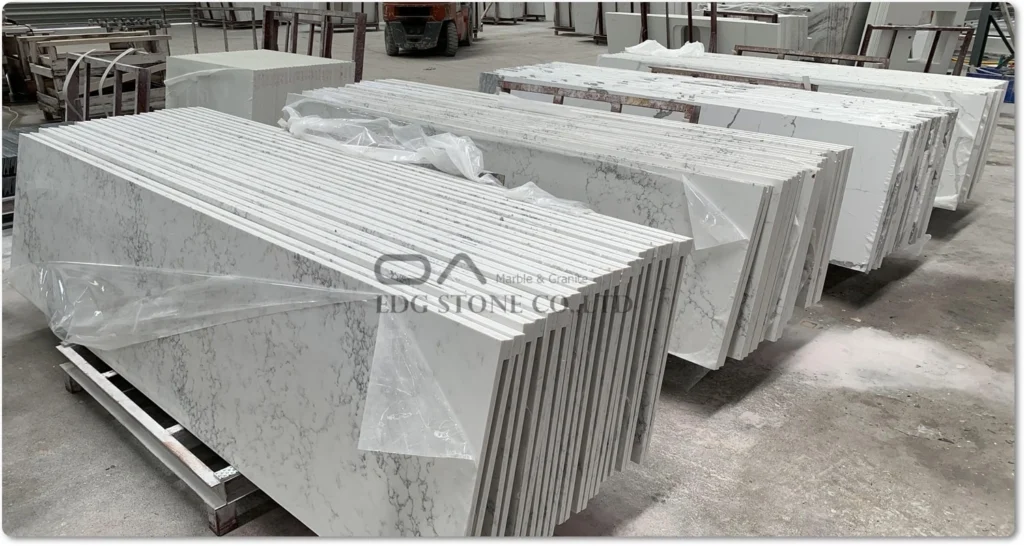
EDG Stone: Quartz Countertops Manufacturing and B2B Supply Perspective
For international buyers evaluating quartz countertop manufacturers, quartz countertop factories, and wholesale suppliers, EDG Stone approaches stone supply from a B2B procurement perspective.
The most important principle is that a countertop should not be evaluated only by its showroom appearance.
A professional purchasing decision should consider:
- Material composition
- Factory capability
- Quality control
- Slab consistency
- Fabrication capability
- Packaging
- Export experience
- Technical documentation
- Destination-market requirements
- Long-term supply stability
For projects requiring customized stone products, the supply chain can extend beyond standard slabs to CNC cutting, edge fabrication, sink cutouts, vanity tops, custom countertops, and other fabricated stone components.
For buyers comparing suppliers, the right question is therefore not simply:
“What is your price per square meter?”
A better question is:
“Can your factory consistently manufacture, inspect, package and supply the exact specification required for my market and project?”
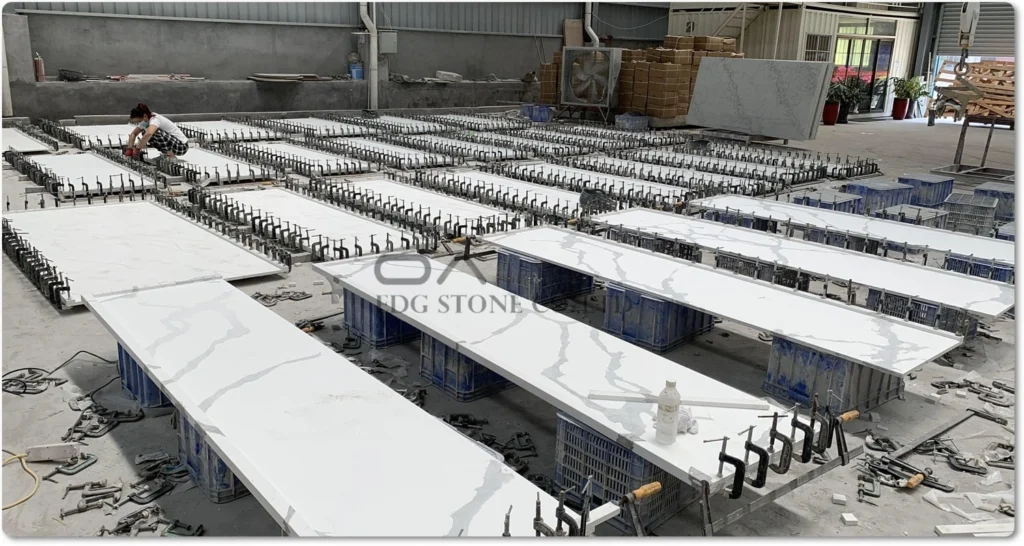
Semantic Insight: What Buyers Should Understand Before Purchasing Quartz Countertops?
What Is the Most Important Difference Between Natural and Manufactured Quartz?
Natural quartz is a geological mineral, while commercial quartz countertops are generally engineered composite slabs manufactured from mineral aggregates and binder systems. Therefore, “natural quartz countertop” and “engineered quartz countertop” should not be treated as interchangeable terms.
Why Is the Manufacturing Process Important?
The manufacturing process determines aggregate distribution, density, color consistency, thickness, surface quality, and ultimately fabrication performance. Vacuum vibro-compaction and controlled curing are particularly important steps in producing dense, consistent slabs.
What Options Are Available to Buyers?
Buyers can compare conventional engineered quartz, low-silica engineered surfaces, silica-free compound-stone technologies, porcelain, sintered stone, natural granite, quartzite and other surface materials. The best option depends on the destination market, application, design requirements, fabrication method, and regulatory environment.
What Should Commercial Buyers Consider?
Commercial procurement should evaluate the complete supply chain rather than the slab alone: raw materials, formulation, factory technology, QC, certifications, silica management, packaging, logistics, production capacity, technical support and compliance with the destination country’s regulations.
Why Is the Industry Changing?
The quartz countertop industry is being reshaped by occupational-safety regulation, especially concerns over respirable crystalline silica. Australia’s engineered-stone prohibition and emerging regulatory actions elsewhere demonstrate that material composition and fabrication safety can directly affect market access.
What Is the Strategic Direction for Manufacturers?
The long-term direction is toward safer formulations, automated manufacturing, improved dust control, digital fabrication, stronger product traceability, and more transparent technical documentation. Manufacturers that combine design, performance, and compliance are likely to be better positioned for international B2B markets.
What Should a Buyer Ask a Quartz Countertop Factory?
A serious buyer should ask five questions:
1. What exactly is the product made from?
2. What is the crystalline silica content, where applicable?
3. What manufacturing and quality-control processes are used?
4. What technical testing and compliance documents are available?
5. Can the factory supply consistent specifications for the buyer’s destination market?
Conclusion: Understanding How Quartz Countertops Are Made Is Essential for Modern Procurement?
The quartz countertops manufacturing process is much more sophisticated than simply mixing quartz and resin.
A modern production system involves raw-material preparation, controlled particle sizing, formulation, mixing, moulding, vacuum vibro-compaction, curing, calibration, polishing, inspection, and finally fabrication into a finished countertop.
Understanding this process helps consumers distinguish engineered quartz from natural stone. More importantly, it helps B2B buyers evaluate quartz countertop producers, manufacturers, factories, and wholesale suppliers based on measurable production capabilities rather than marketing claims.
The industry’s future is also changing.
Silica exposure, worker protection, and regulatory compliance have become strategic issues. Australia’s engineered-stone prohibition, OSHA’s silica requirements in the United States, the 2026 OSHA/NIOSH hazard alert,t and California’s ongoing regulatory activity all demonstrate that manufacturers must pay closer attention to material composition and fabrication safety.
For international procurement, the winning formula is increasingly:
Product Performance + Manufacturing Technology + Quality Control + Worker Safety + Regulatory Compliance + Export Capability.
That is the framework buyers should use when selecting a quartz countertop manufacturer, quartz factory, or wholesale stone supplier in 2026 and beyond.
Frequently Asked Questions About Quartz Countertops Manufacturing
1. How are quartz countertops made?
Quartz countertops are generally made by combining quartz or other mineral aggregates with resin, pigments,s and additives, followed by mixing, moulding, vacuum vibro-compaction, curing, calibration, polishing, ng and quality inspection. The finished slab is then cut and fabricated into a countertop.
2. Are quartz countertops manufactured?
Yes. Most commercial quartz countertops are manufactured engineered-stone products rather than naturally quarried slabs of pure quartz. They are produced in specialized manufacturing facilities using controlled industrial processes.
3. Is quartz manufactured or natural?
Quartz itself is a naturally occurring mineral. However, the material commonly marketed as a quartz countertop is generally an engineered composite manufactured from mineral aggregates and a binder system.
4. How are quartz countertops cut?
Professional fabricators typically use diamond cutting tools, bridge saws, CNC equipment, waterjet systems, and diamond drilling tools. Wet fabrication and appropriate dust-control systems are important when processing crystalline-silica-containing materials.
5. What are the biggest problems with quartz countertops?
Potential issues include heat damage, UV-related color changes in some products, seam visibility, edge damage, cracking caused by impact or inadequate support, and fabrication-related silica exposure. Product-specific technical specifications should always be reviewed before purchase.
Sources and Technical References
Safe Work Australia — Engineered Stone Ban and silica regulations.
Safe Work Australia — Crystalline silica composition and workplace information.
Safe Work Australia — 2025 review of the engineered stone prohibition.
Safe Work Australia — 2026 implementation plan following the engineered stone prohibition review.
OSHA — Respirable Crystalline Silica standards.
OSHA/NIOSH — 2026 Hazard Alert: Worker Exposure to Silica during Countertop Manufacturing, Finishing and Installation.
CDC/NIOSH — Silica hazards from engineered stone countertops.
CDC/NIOSH — 2026 research on respirable crystalline silica exposure during countertop manufacturing and finishing.
California Department of Industrial Relations — 2026 artificial-stone silica rulemaking initiative.
Breton — BretonStone compound-stone slab production technology.