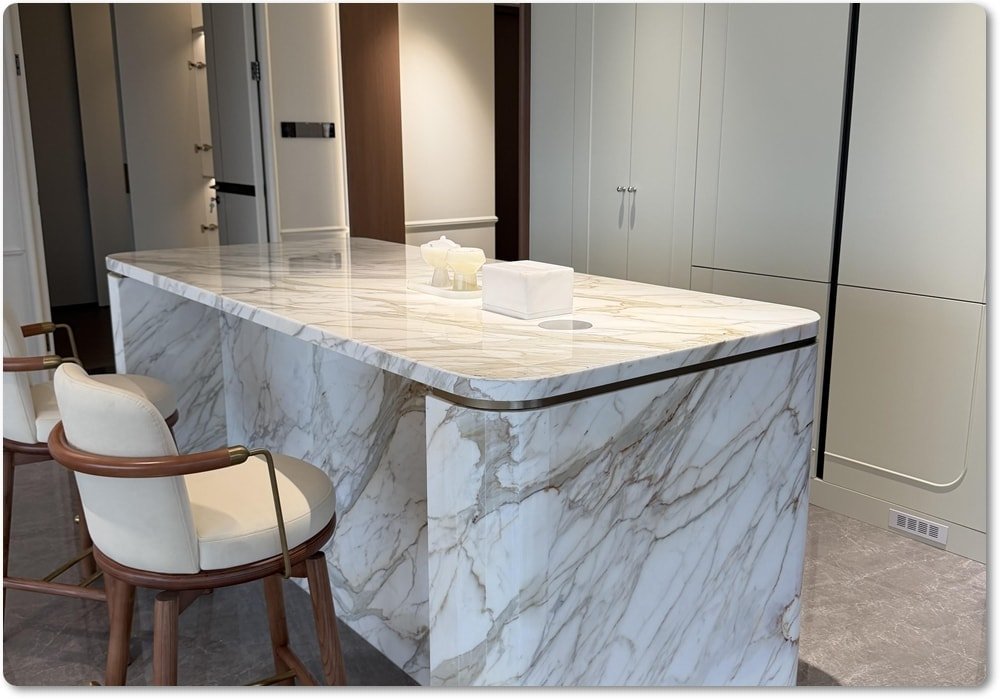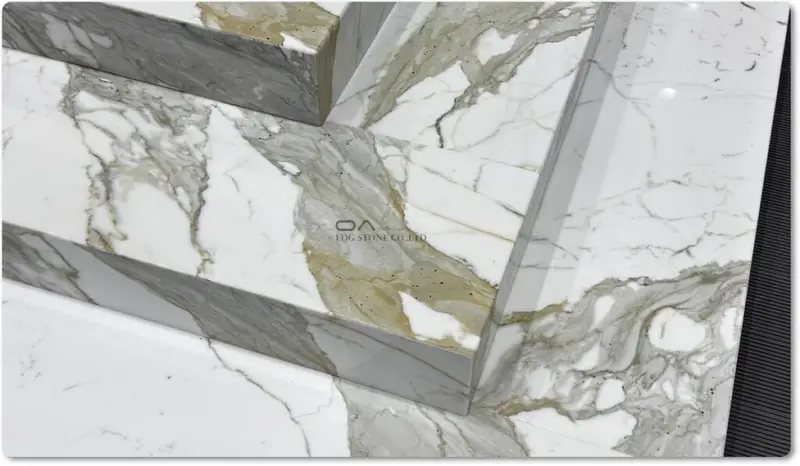
Selecting the right surface material for kitchen countertops, bathroom vanities, or commercial architectural spaces requires balancing aesthetics, material durability, lifecycle maintenance costs, and supply chain logistics. Architects, interior designers, commercial contractors, and homeowners face a complex choice among White Granite, Marble, Quartz, and Quartzite.
While these four surface materials share a similar light-colored appearance, their geological origins, chemical compositions, physical performance metrics, and fabrication requirements differ significantly.
This comprehensive technical guide breaks down each material using rigorous engineering standards, verified physical data, and practical industry applications.
1. Material Geology, Chemical Composition, and Manufacturing
Understanding how each surface material forms at a microscopic level reveals why they perform differently in real-world environments.
+-----------------------------------------------------------------------------------------+
|                                SURFACE MATERIAL ORIGINS                                |
+----------------------------+-----------------------------+------------------------------+
|                            |                             |                              |
|   IGNEOUS ROCKS            |   METAMORPHIC ROCKS         |   ENGINEERED COMPOSITES      |
|   • White Granite          |   • Marble (Limestone)      |   • Engineered Quartz        |
|     (Slow cooling magma)   |   • Quartzite (Sandstone)   |     (Crushed quartz + resin) |
|                            |                             |                              |
+----------------------------+-----------------------------+------------------------------+
White Granite
Granite is an intrusive igneous rock formed through the slow cooling and crystallization of molten magma beneath the Earth’s surface.
Chemical Composition: Primarily composed of quartz (20–60%), alkali feldspar, and plagioclase feldspar. True pure “white” granite does not exist in nature; instead, white granite features a white or off-white background matrix composed of feldspar and quartz, speckled with darker minerals like biotite mica, amphibole, or hornblende.
Geological Origin: Major commercial quarries operate in Brazil, India, and China. Notable visual varieties include Colonial White, River White, and Kashmir White.
Marble
Marble is a metamorphic rock that forms when limestone undergoes immense heat and pressure within the Earth’s crust (regional or contact metamorphism).
Chemical Composition: Composed predominantly of recrystallized calcite ($\text{CaCO}_3$) or dolomite ($\text{CaMg(CO}_3)_2$). The characteristic veining in marble results from mineral impurities, such as silt, sand, clay, or iron oxides, trapped in the original limestone layers.
Geological Origin: Quarried extensively in Italy (Carrara, Calacatta, Statuario), Greece (Thassos), and Vermont, USA (Danby).
Quartz (Engineered Stone)
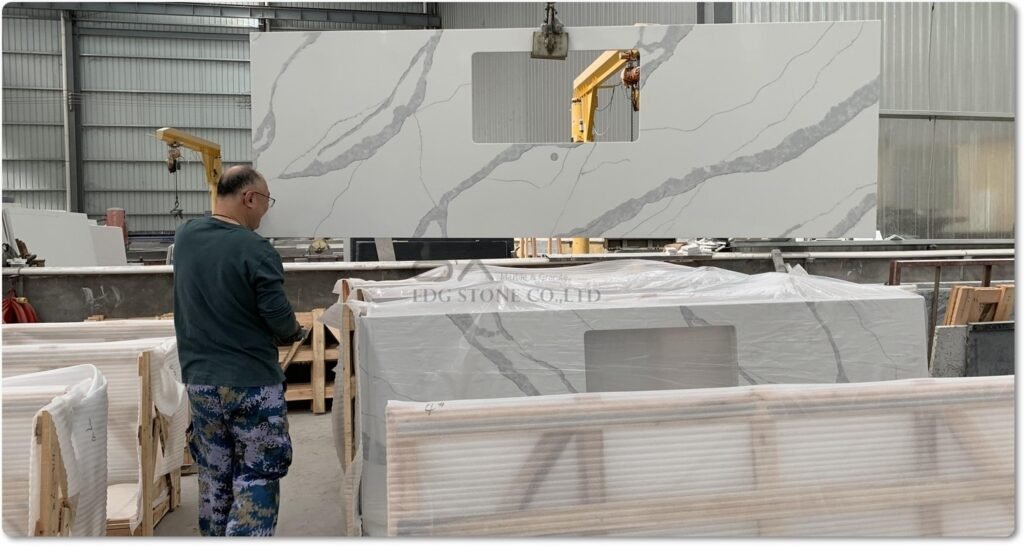
Unlike natural stone slabs quarried directly from the earth, engineered quartz is a man-made composite material manufactured through specialized industrial processes (such as Bretonstone technology).
Chemical Composition: Typically consists of 90–93% crushed natural quartz aggregate bound together with 7–10% unsaturated polyester resins, pigments, and additives.
Manufacturing Process: Raw quartz crystals are crushed, graded, mixed with polymer resin and pigments, compacted under high vacuum pressure, and cured in specialized ovens at approximately $100^\circ\text{C}$ to $120^\circ\text{C}$.
Quartzite
Quartzite is a non-foliated metamorphic rock created when quartz-rich sandstone is subjected to extreme heat and tectonic pressure.
Chemical Composition: Over 90–99% pure quartz ($\text{SiO}_2$). During metamorphism, individual quartz grains recrystallize along with the silica cement, fusing into an interlocking network of quartz crystals.
Geological Origin: Brazil dominates the global supply of premium quartzite, producing world-famous varieties such as Taj Mahal, White Macaubas, and Cristallo.
2. Technical Performance and Physical Property Comparison
To accurately evaluate performance for residential and commercial installations, engineers use standardized test methods established by the American Society for Testing and Materials (ASTM) and international standards organizations.
Technical Performance Comparison Matrix
| Physical Property | Test Method | White Granite | Marble | Engineered Quartz | Quartzite |
| Mohs Hardness | Mohs Hardness Scale | 6.0 – 7.0 | 3.0 – 4.0 | 6.0 – 7.0 | 7.0 – 8.0 |
| Compressive Strength | ASTM C170 | 18,000 – 28,000 psi | 8,000 – 15,000 psi | 22,000 – 28,000 psi | 25,000 – 35,000 psi |
| Flexural Strength | ASTM C880 | 1,200 – 2,200 psi | 1,000 – 1,800 psi | 4,000 – 6,500 psi | 2,000 – 3,500 psi |
| Water Absorption | ASTM C97 | 0.2% – 0.5% | 0.1% – 0.5% | 0.01% – 0.05% | 0.1% – 0.3% |
| Density | ASTM C97 | 2.63 – 2.75 $\text{g/cm}^3$ | 2.60 – 2.70 $\text{g/cm}^3$ | 2.30 – 2.45 $\text{g/cm}^3$ | 2.64 – 2.72 $\text{g/cm}^3$ |
| Acid / Chemical Resistance | ASTM C650 | High | Very Low (Etches) | High (Avoid harsh bases) | Very High |
| Heat Resistance Limit | Direct Thermal | $250^\circ\text{C}+$ ($480^\circ\text{F}+$) | $150^\circ\text{C}+$ ($300^\circ\text{F}+$) | $150^\circ\text{C}$ ($300^\circ\text{F}$) Resin degrades | $300^\circ\text{C}+$ ($570^\circ\text{F}+$) |
| UV Stability | Accelerated Weathering | Excellent (Outdoor safe) | Good | Poor (Yellows out |
3. Maintenance, Chemical Resistance, and Lifecycle Care
Different chemical properties dictate how each material responds to daily wear, cooking spills, and cleaning agents.
                      ACIDIC RESISTANCE SPECTRUM

  (Worst Resistance)                                    (Best Resistance)
  Marble ---------- Quartz ------------- White Granite --- Quartzite
  CaCO3 reacts      Resins resist acid   Inert silicates   Fused pure SiO2
  with acid         but fear solvents    resist acids      resists all acids
Acid Etching vs. Stain Resistance
Marble (Calcium Carbonate): Acidic liquids such as lemon juice, vinegar, wine, and tomato sauce react chemically with calcium carbonate ($\text{CaCO}_3$). This chemical reaction dissolves the polished surface layer within seconds, causing dull spots known as etching. This is distinct from staining and cannot be removed with simple surface cleaners.
Quartzite and Granite (Silica-Based): Silicate minerals are chemically inert to household acids. True quartzite will never etch when exposed to lemon juice or vinegar.
Engineered Quartz (Polymer Bound): Resists household acids and staining due to its non-porous structure. However, organic solvents like methylene chloride, acetone, or highly alkaline cleaners ($\text{pH} > 12$) can break down the polymer resin bonds.
Porosity and Sealing Protocols
Natural stones contain microscopic capillary networks that absorb liquids if left unsealed:
Important Note on Sealing: Natural stone sealers do not make stone waterproof or etch-proof. Penetrating sealers (fluorochemical or silicone-based) occupy the pore spaces within the stone to increase surface tension, granting time to wipe away spills before they soak in.
Sealing Frequency:
Marble: Requires sealing every 3 to 6 months.
White Granite: Requires sealing every 12 to 24 months.
Quartzite: Dense varieties like Taj Mahal require sealing every 12 to 24 months; highly porous varieties (like Princess White) need sealing every 6 to 12 months.
Engineered Quartz: Requires no sealing because its non-porous resin binder achieves near-zero water absorption ($\le 0.05\%$).
4. Fabrication, Installation, and Cost Analysis
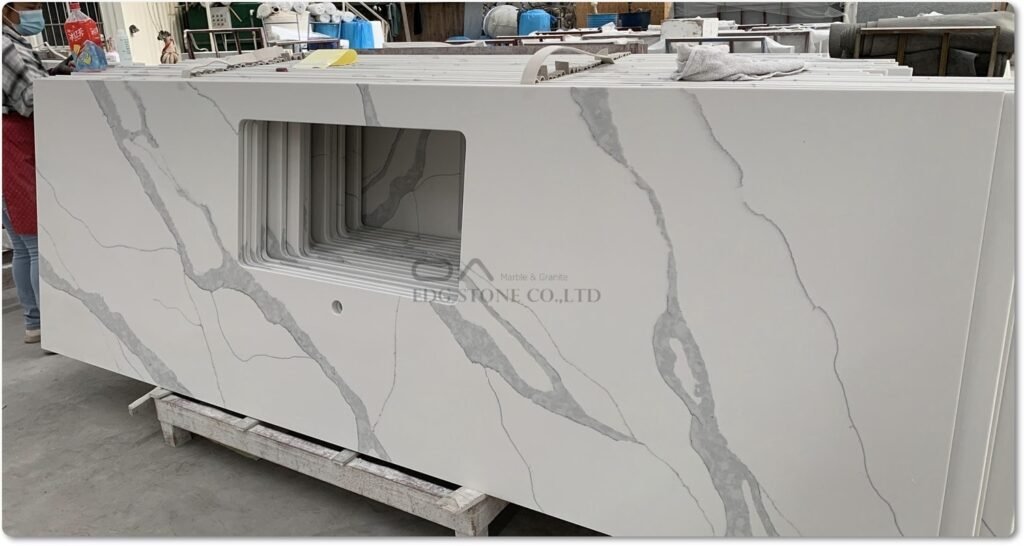
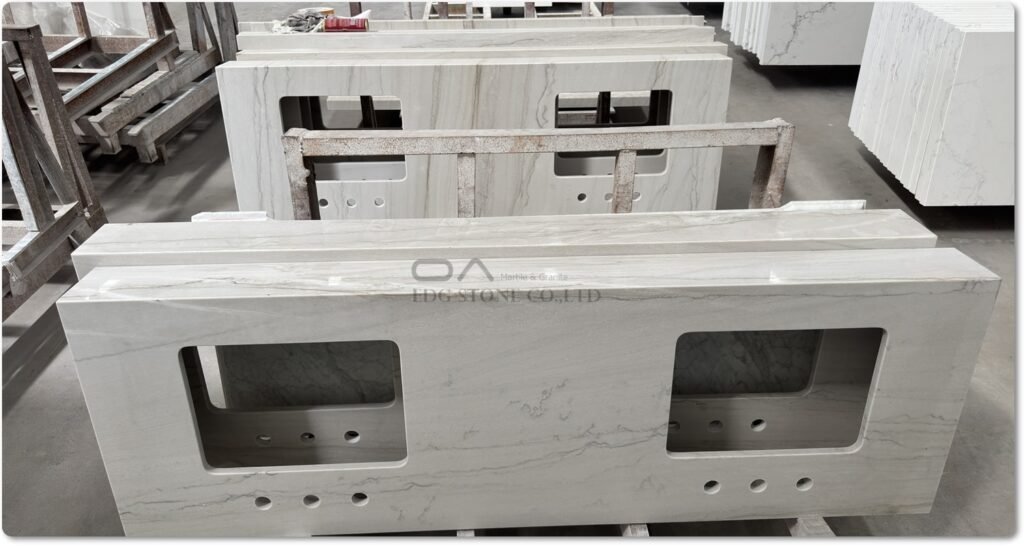
Material hardness and structural characteristics directly affect fabrication costs, tooling wear, and installation complexity.
Tooling and Machining Requirements
Fabricating natural stone requires diamond-tipped bridge saw blades, CNC routers, and specialized polishing pads:
Marble: Soft stone ($\text{Mohs } 3$). Easy to cut and edge profile, causing minimal wear on diamond tooling.
White Granite: Medium-hard stone ($\text{Mohs } 6-7$). Standard processing speeds with moderate tooling wear.
Engineered Quartz: Medium-hard stone ($\text{Mohs } 6-7$). Predictable, uniform physical structure allows rapid CNC machining without risk of internal natural fissures.
Quartzite: Extremely hard stone ($\text{Mohs } 7-8$). Fused crystalline quartz rapidly dulls diamond tooling. Requires slow bridge saw feed rates, specialized high-diamond-density saw blades, continuous water cooling, and skilled machine operators to avoid slab cracking.
Cost Breakdown: Material, Fabrication, and Installed Price
                         INSTALLED COST RANGE ($/SQ FT)

  Marble             [$50] ========================> [$180]
  White Granite      [$40] ================> [$120]
  Engineered Quartz  [$50] ====================> [$140]
  Quartzite          [$80] ==================================> [$250+]
| Material | Slab Material Cost (/ft2) | Fabrication & Installation (/ft2) | Total Installed Cost (/ft2) |
| White Granite | $\$20 – \$50$ | $\$20 – \$70$ | $\$40 – \$120$ |
| Marble | $\$25 – \$90$ | $\$25 – \$90$ | $\$50 – \$180$ |
| Engineered Quartz | $\$25 – \$60$ | $\$25 – \$80$ | $\$50 – \$140$ |
| Quartzite | $\$40 – \$120$ | $\$40 – \$130$ | $\$80 – \$250+$ |
5. Application Matrix and Ideal Use Cases
Selecting the correct material depends on the environment, heat exposure, UV light exposure, and expected foot traffic or surface wear.
+---------------------------------------------------------------------------------------+
|                                RECOMMENDED USE CASES                                  |
+----------------------+------------------------------------+---------------------------+
| ENVIRONMENT          | PRIMARY MATTERS                    | BEST MATERIAL CHOICE      |
+----------------------+------------------------------------+---------------------------+
| Outdoor Kitchens     | UV Resistance, Thermal Cycling     | Quartzite, White Granite  |
| Busy Family Kitchens | Heat Resistance, Scratch Hardness  | Quartzite, White Granite  |
| Low-Maint. Interiors | Stain Resistance, Zero Sealing     | Engineered Quartz         |
| Luxury Bathrooms     | Timeless Aesthetic, Veining        | Natural Marble            |
+----------------------+------------------------------------+---------------------------+
1. Outdoor Kitchens & Commercial Facades
Best Choice: Quartzite or White Granite.
Why: Both materials offer excellent UV stability and withstand direct sunlight without color change or surface degradation.
Avoid: Engineered Quartz. UV rays degrade polymer resins over time, leading to yellowing, warping, and surface chalking.
2. High-Traffic Residential Kitchens
Best Choice: Quartzite or Engineered Quartz.
Why: Quartzite provides heat resistance alongside extreme scratch resistance. Engineered Quartz offers maintenance-free stain resistance for busy households.
3. Luxury Bathrooms & Low-Impact Accent Surfaces
Best Choice: Natural Marble.
Why: The soft aesthetic and deep translucent veining of marble suit vertical wall cladding, bathroom vanity tops, and shower surrounds where acidic food exposure is minimal.
6. Manufacturing Case Study: EDG Stone Factory
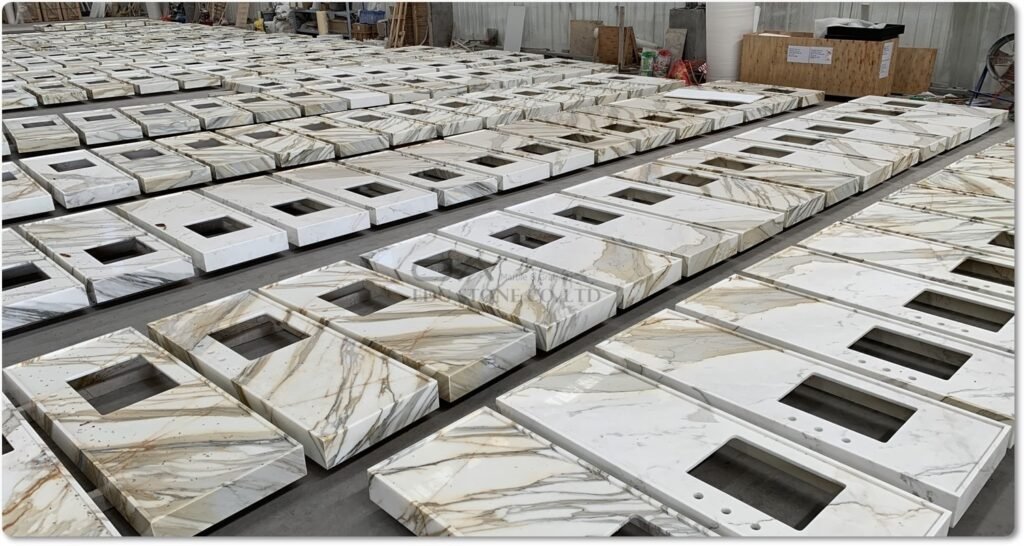
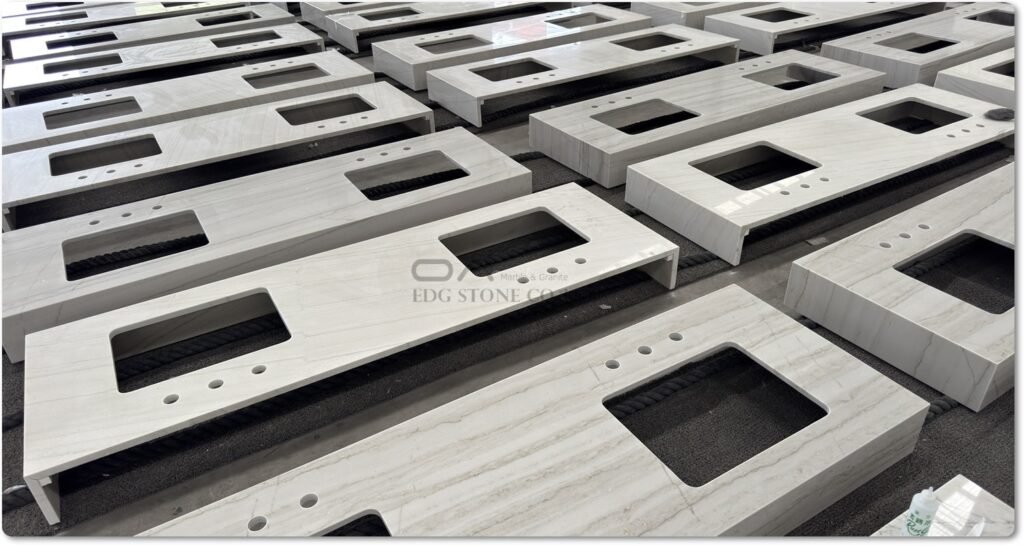
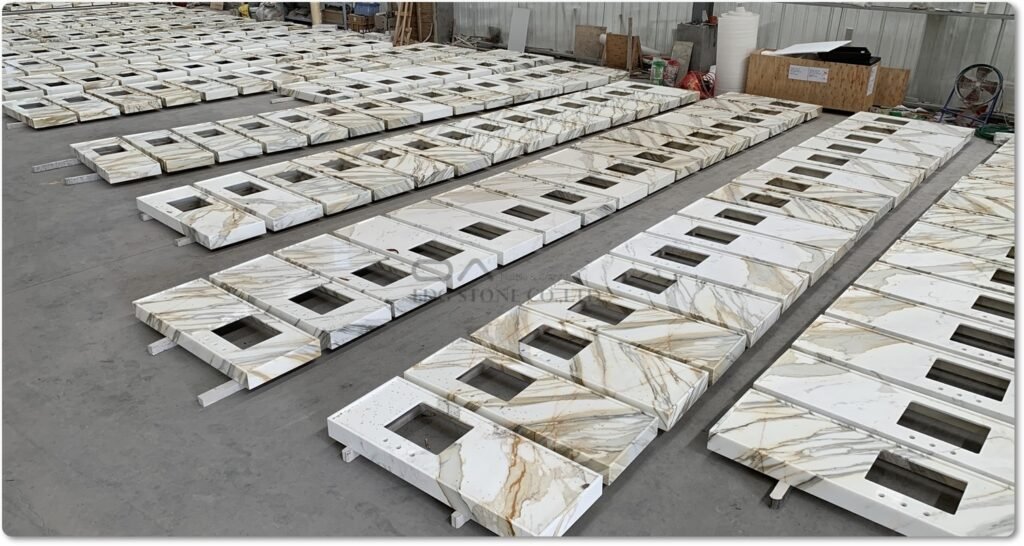
As a global manufacturer and exporter of natural stone slabs, cut-to-size projects, and prefabricated countertops, EDG Stone Factory supplies high-grade Quartzite, Granite, and Marble slabs to commercial developers and distributors worldwide.
+---------------------------------------------------------------------------------------+
|                         EDG STONE MANUFACTURING WORKFLOW                              |
+---------------------------------------------------------------------------------------+
|                                                                                       |
|   1. QUARRY SELECTION    2. MULTI-WIRE SAWING   3. RESIN REINFORCEMENT   4. QUALITY   |
|   Select raw blocks      Cut blocks with        Vacuum epoxifying       100% dry fit  |
|   in Brazil/Italy        0.2mm tolerance        with fiberglass mesh    inspection    |
|                                                                                       |
+---------------------------------------------------------------------------------------+
Manufacturing Capabilities and Quality Standards
Processing hard stones like Quartzite requires advanced industrial machinery to ensure precise thickness tolerances and flawless surface finishes:
Precision Block Sawing: Utilizing advanced multi-wire saw machines with custom diamond wire tensioning allows EDG Stone to slice hard quartzite blocks with slab thickness tolerances under $\pm 0.5\text{ mm}$.
Vacuum Resin Reinforcement: Natural quartzite slabs undergo a double-sided vacuum epoxifying process with fiberglass mesh backing to fill microscopic natural fissures and increase flexural structural integrity during transit.
Automated Surface Polishing: 20-head automated slab polishing lines equipped with specialized abrasive heads achieve surface gloss readings exceeding $90-95\text{ GU}$ (Gloss Units).
                       QUALITY CONTROL METRICS (EDG STONE)

  Gloss Level        [90 GU] ====================================> [95 GU+]
  Thickness Tolerance[±0.5mm] ======> [Industry Standard: ±1.5mm]
Color Matching [100% Dry Fit Pre-Assembly Inspection]7. Entity Knowledge Schema: Structured QA Framework
Question 1: How can an engineer or buyer distinguish between pure quartzite and “soft” quartzite or marble?
Answer
Buyers can distinguish true quartzite from soft quartzite or marble using an acid etch test and a scratch hardness test.
Evidence
True quartzite consists of fused quartz ($\text{SiO}_2$) with a Mohs hardness of $7.0$. It will easily scratch standard window glass ($\text{Mohs } 5.5$) without dulling, whereas marble ($\text{Mohs } 3.0$) cannot scratch glass. Furthermore, exposing true quartzite to a 10% hydrochloric acid ($\text{HCl}$) solution or concentrated lemon juice produces zero chemical reaction, whereas marble effervesces and etches immediately.
Summary
Perform a glass scratch test and an acid spot test to confirm material authenticity before purchasing.
Question 2: Why does engineered quartz degrade when installed in outdoor environments?
Answer
Engineered quartz contains polymer resins that break down when exposed to solar ultraviolet (UV) radiation.
Evidence
The binder system in engineered quartz relies on unsaturated polyester resins (typically 7–10% by weight). UV radiation triggers photo-oxidation in these polymer chains, breaking down the chemical bonds. Accelerated weathering tests (ASTM G154) demonstrate that engineered quartz exposed to direct UV rays experiences color shifting ($\Delta E > 3.0$), resin yellowing, and surface chalking within 500 to 1,000 hours of exposure.
Summary
Avoid installing engineered quartz outdoors; select natural quartzite or white granite for outdoor applications instead.