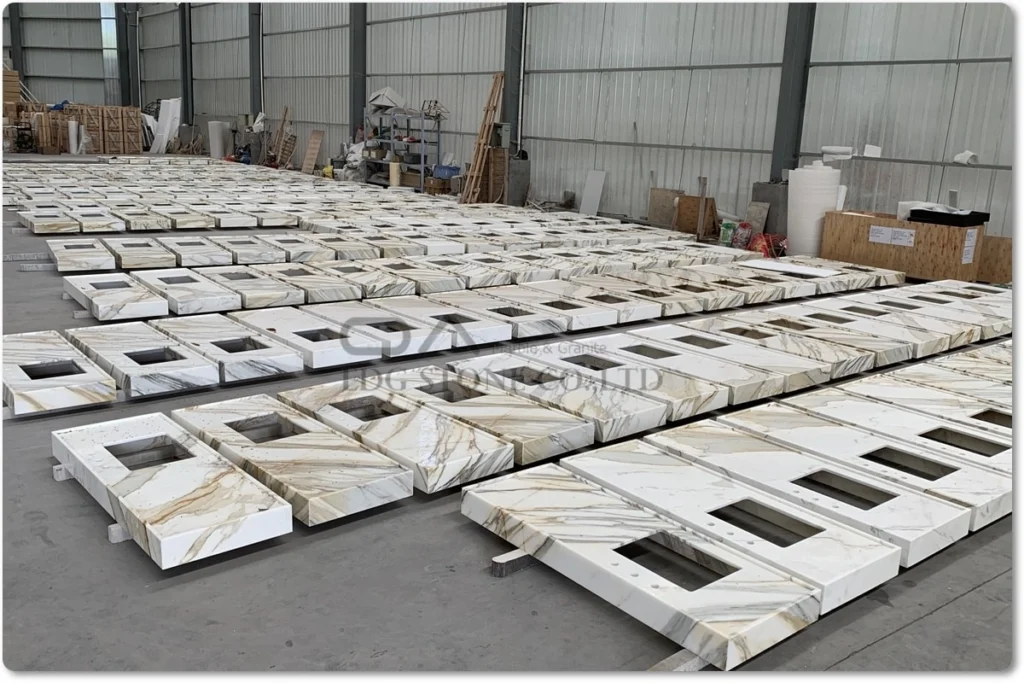
Quick Answer: How Are Ultra Compact Slabs Fabricated?
Ultra compact slabs have become an important material category for modern countertops, kitchens, bathrooms, facades, walls, floors and outdoor applications. But fabricating an ultra-compact slab is not the same as fabricating marble, granite or conventional engineered quartz.
The material is highly dense and resistant to scratching, staining, moisture, chemicals, and UV exposure, but that same density can make the slab more demanding to cut and machine. Improper tooling, excessive feed speed, inadequate water cooling, poor slab support, or sharp internal corners can lead to chipping, cracking, or breakage.
This guide explains how to fabricate ultra-compact slabs, including cutting, drilling, CNC processing, waterjet fabrication, edge finishing, sink cutouts, mitered edges, quality control, workplace safety, and procurement considerations for manufacturers, wholesalers, distributors, and professional fabricators.
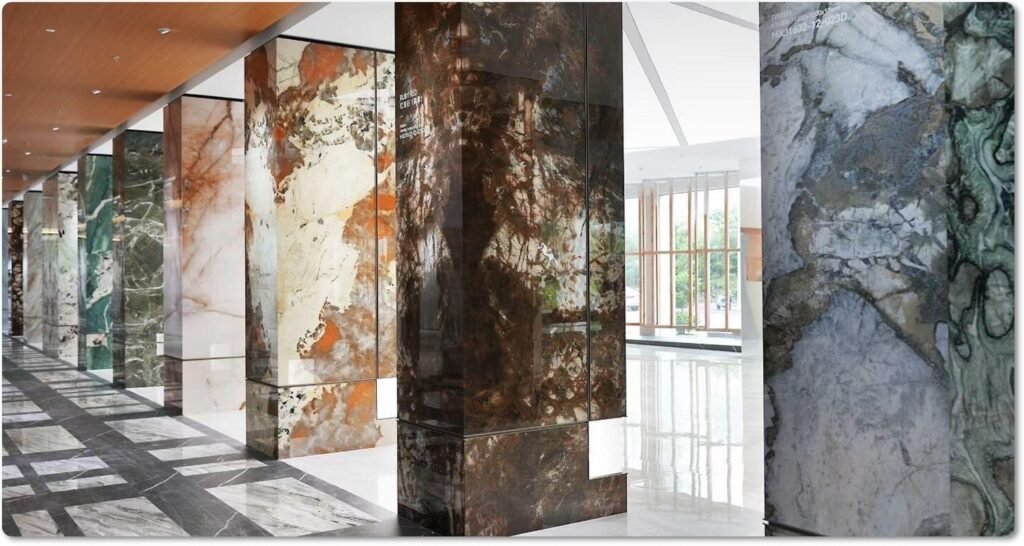
1. What Are Ultra Compact Slabs?
Ultra compact slabs are large-format, highly densified surfaces generally produced from refined mineral raw materials that are compacted and subjected to high-temperature firing or sintering. Depending on the manufacturer’s technology and formulation, the product may also be described using terms such as ultracompact surfacing, ultra compact material, compact slabs, sintered slabs, porcelain slabs, or large-format porcelain surfaces.
The exact formulation differs between manufacturers, so buyers should not assume that every product marketed as an “ultra compact slab” has identical composition or fabrication characteristics.
Ultra Compact Slabs vs. Conventional Stone Materials
| Material | Typical Fabrication Characteristics | Key Fabrication Concern |
|---|---|---|
| Marble | Relatively easy to cut and polish | Scratching, staining, and edge chipping |
| Granite | Hard but familiar to most stone shops | Tool wear and edge finishing |
| Quartz | Dense engineered material | Silica exposure and heat management |
| Ultra compact / porcelain | Very hard and relatively brittle | Chipping, cracking, thermal stress and support |
For this reason, an experienced stone fabricator should treat ultra-compact slabs as a specialized fabrication material rather than simply applying the same parameters used for granite or quartz.
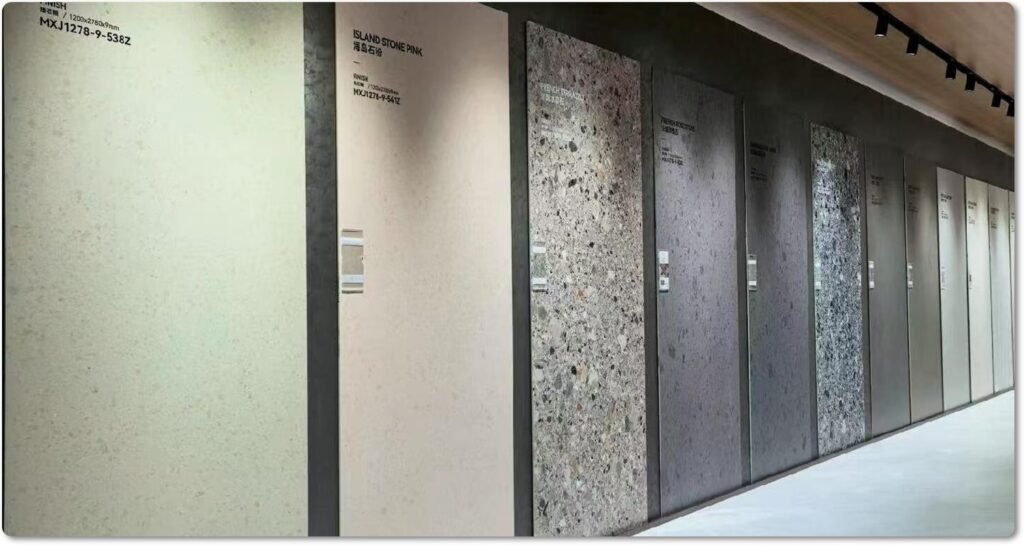
2. What Does “Compact” Mean in Ultra Compact Slabs?
The word compact describes the highly densified structure of the material. During industrial manufacturing, carefully controlled raw materials are processed, compacted, and fired or sintered to create a dense slab with low porosity and high resistance to many environmental conditions.
Does “How to Compact Fill for Slab” Mean the Same Thing?
No. The search phrase “how to compact fill for slab” normally relates to civil construction, where soil, aggregate,e or fill beneath a concrete slab is mechanically compacted to create a stable subgrade.
That process should not be confused with the manufacturing process used to produce ultra-compact surfacing.
In other words:
- Compacting fill: preparing soil or aggregate beneath a building slab.
- Compacting ceramic/mineral raw materials: forming the body of an ultra-compact slab.
- Fabricating an ultra-compact slab: cutting, drilling, CNC machining, profiling, and finishing an already manufactured slab.
This distinction is important for both SEO and technical accuracy because these are three different processes.
3. How Are Ultra Compact Slabs Manufactured Before Fabrication?
Before a slab reaches a countertop or architectural fabrication shop, it undergoes an industrial manufacturing process. The exact sequence varies by technology and manufacturer, but the general concept involves preparing mineral raw materials, forming a dense body, applying the desired surface design,n and firing or sintering the material under controlled industrial conditions.
Step 1: Raw Material Preparation
Mineral raw materials are selected according to the target physical properties, color, texture, and surface appearance.
Particle size distribution is particularly important because the combination of fine and coarse particles influences packing density, strength,h and the final appearance.
Step 2: Mixing and Homogenization
The selected materials are carefully mixed to create a consistent composition. Pigments, mineral components, additives, and other formulation-specific ingredients may be introduced depending on the design and performance requirements.
Step 3: Forming and Compaction
The prepared material is formed into a slab body through industrial pressing or other forming technology. The objective is to create a highly uniform and dense structure with controlled dimensions.
Step 4: Surface Design
Depending on the product, decorative effects may be created using digital decoration, mineral coloration, surface treatments,nts or through-body design technologies.
Step 5: High-Temperature Firing or Sintering
The formed slab is subjected to a controlled thermal cycle. This transforms the raw body into a dense finished material with the intended mechanical and surface characteristics.
Step 6: Calibration and Surface Finishing
The slab can then be calibrated, polished, honed, textured, cured, or otherwise finished depending on the product specification.
The finished slab is finally inspected for dimensions, flatness, surface quality, color consistency, and other specified properties before being packed for distribution.
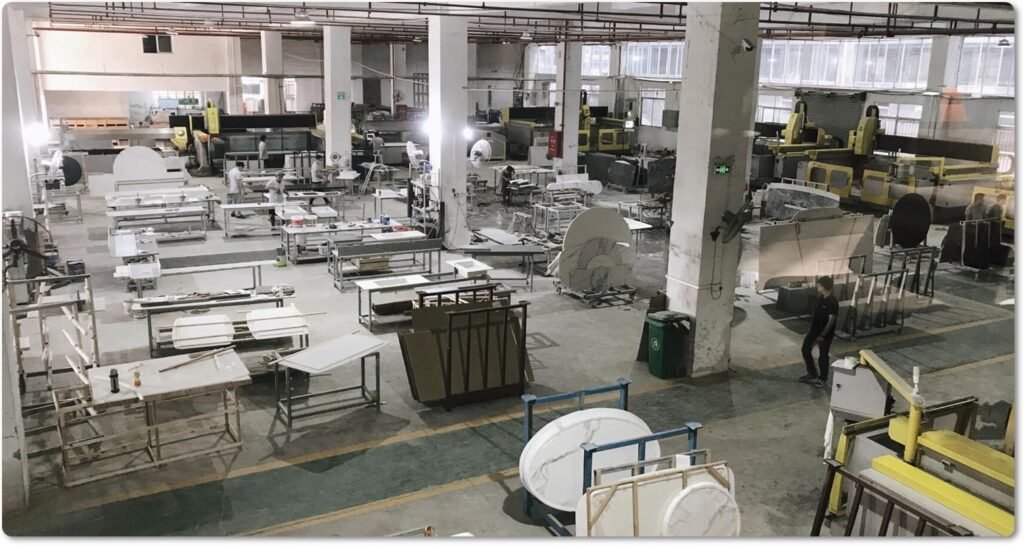
4. What Equipment Is Needed to Fabricate Ultra Compact Slabs?
A professional ultra compact slab fabrication operation normally requires a combination of traditional stone machinery and specialized diamond tooling.
Essential Fabrication Equipment
- Bridge saw or CNC bridge saw
- CNC machining center
- Waterjet cutting machine
- Diamond core drills
- Diamond cutting blades designed for porcelain or ultra compact materials
- Edge profiling and polishing equipment
- Vacuum lifting systems and suction cups
- Slab support tables
- Wet dust-control equipment
- HEPA-filtered vacuum systems where applicable
- Inspection and measuring equipment
Modern fabrication manuals for porcelain and sintered slabs commonly specify bridge saws, CNC machines and waterjet equipment as appropriate fabrication systems, while emphasizing proper table flatness, slab support and material-specific tooling.
Why Specialized Diamond Tools Matter
Ultra compact materials are extremely hard and can be brittle at the same time. A conventional granite blade may not provide the same edge quality or cutting performance as a blade specifically designed for porcelain or sintered materials.
The objective is not simply to cut through the slab. The objective is to control:
- Cutting force
- Heat generation
- Vibration
- Edge chipping
- Micro-cracking
- Dimensional accuracy
5. How to Cut Ultra Compact Slabs
Cutting is usually the first major fabrication operation after the slab has been inspected and the cutting plan has been approved.
Step 1: Inspect the Slab
Before cutting, check the slab for:
- Visible cracks
- Surface defects
- Color variation
- Warping or flatness issues
- Transportation damage
- Pattern direction
- Bookmatch requirements
Step 2: Prepare the Cutting Table
The table must be clean, flat and properly supported. Debris underneath the slab can create local stress points.
Technical fabrication guidance for large-format porcelain and sintered slabs emphasizes a flat working surface because vibration during cutting can increase the risk of breakage.
Step 3: Support the Slab
Large-format slabs should be supported across their working area. Thin slabs are particularly sensitive to flexing.
Vacuum suction cups should be distributed to provide stable support, especially around areas that will become cutouts or narrow strips.
Step 4: Use the Correct Diamond Blade
Select a blade specifically recommended by the equipment and slab manufacturer.
Blade selection affects edge quality, cutting stability, tool life and breakage risk.
Step 5: Use Water Cooling
Wet cutting helps control heat and airborne dust. Water flow must be adequate for the machine, blade and material.
Fabricators should not simply copy a generic RPM or feed-rate table from another product. The correct parameters should be confirmed using the actual slab specification and tool manufacturer’s recommendations.
Step 6: Control Feed Speed
Moving too quickly can increase chipping and mechanical stress. Moving too slowly can also create unnecessary heat or tool wear.
The correct balance depends on slab thickness, machine type, blade diameter, diamond specification and the particular ultra compact material.
6. How to Fabricate Sink and Cooktop Cutouts
Cutouts are among the most technically sensitive operations when fabricating ultra compact countertops.
Why Are Cutout Corners Important?
A sharp internal 90-degree corner creates a stress concentration. A rounded corner distributes stress more effectively and reduces the risk of crack propagation.
Professional fabrication manuals commonly recommend drilling or otherwise forming a radius at internal corners before making the straight cuts. One technical guide, for example, specifies corner radii of at least 5 mm for certain porcelain slab applications. Exact requirements should always follow the material manufacturer’s instructions.
Recommended Cutout Sequence
- Confirm the appliance or sink dimensions.
- Verify the cutout template.
- Position the cutout away from unsupported slab edges where possible.
- Drill the corner relief holes.
- Make the straight cuts between the corner holes.
- Finish and inspect the opening.
- Check for chips, micro-cracks and dimensional accuracy.
For CNC fabrication, published porcelain fabrication data demonstrate that hole drilling, cutting, beveling and edge polishing require different machine parameters rather than a single universal setting.
7. CNC Fabrication of Ultra Compact Slabs
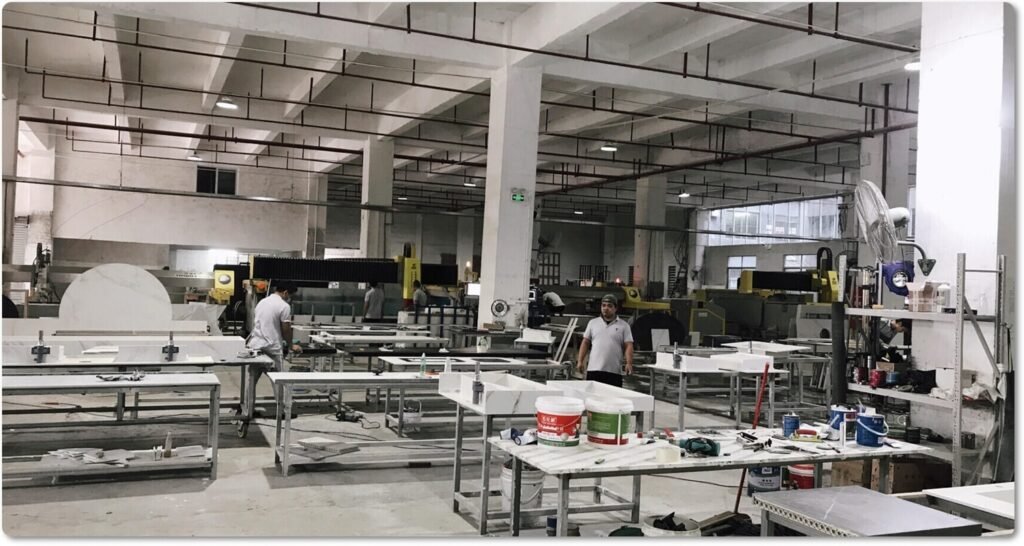
CNC technology is particularly valuable when a project contains repeated countertops, multiple sink openings, complex geometries or tight dimensional tolerances.
What Can CNC Machines Do?
- Sink cutouts
- Cooktop openings
- Faucet holes
- Drain holes
- Edge profiles
- Bevels
- Grooves
- Miters
- Complex curves
- Repeated production components
For B2B production, CNC fabrication can also improve repeatability because the same CAD geometry can be used across multiple pieces.
CAD-to-CNC Workflow
A reliable workflow is:
Customer drawing → CAD review → material layout → CNC programming → simulation/check → cutting → machining → inspection → packing.
This workflow is especially useful for hotel, multifamily, commercial and large residential projects where dozens or hundreds of identical components may be required.
8. Waterjet Cutting for Ultra Compact Surfaces
Waterjet cutting is useful when the design requires complex curves, intricate shapes, internal openings or highly controlled cutting.
Unlike a conventional rotating blade, waterjet cutting uses a high-pressure abrasive water stream, which can reduce some mechanical vibration associated with blade cutting.
When Should You Use a Waterjet?
- Complex sink shapes
- Curved architectural components
- Decorative patterns
- Intricate inlays
- Small internal openings
- Complex stone furniture components
- Custom architectural panels
For standard straight countertop cuts, a properly configured bridge saw may be more efficient. For complex geometries, waterjet technology can provide additional flexibility.
9. How to Fabricate Edges on Ultra Compact Slabs
Edge fabrication is where the visual quality of a countertop becomes especially apparent.
Common Edge Profiles
- Polished straight edge
- Beveled edge
- Mitred edge
- Waterfall edge
- Double bevel
- Custom CNC profile
Why Is Miter Fabrication Popular?
A 45-degree miter can be used to create the visual appearance of a thicker countertop while using a relatively thin slab. It is particularly popular for waterfall islands, furniture-style countertops and premium architectural interiors.
Because the decorative face may contain printed or layered patterns, fabricators should plan the pattern direction before cutting.
Bookmatching and Pattern Continuity
For marble-look ultra compact slabs, pattern alignment can be just as important as dimensional accuracy.
A technically perfect cut can still produce a poor finished product if the vein direction does not align across the miter, waterfall or bookmatched installation.
10. Polishing and Finishing Ultra Compact Slabs
Polishing an ultra compact slab requires different expectations from polishing natural marble.
Many large-format porcelain or sintered surfaces receive their decorative finish during industrial manufacturing. A fabricator generally focuses on finishing the exposed cut edges rather than attempting to recreate the entire factory surface.
Edge Finishing Process
- Inspect the cut edge.
- Remove major chips if necessary.
- Apply the appropriate diamond abrasive.
- Progress through the recommended grit sequence.
- Clean the edge.
- Inspect under strong lighting.
The exact abrasive sequence depends on the surface type, edge profile and manufacturer’s technical recommendations.
11. Ultra Compact Slab Fabrication Safety: The 2026 Industry Shift
Fabrication safety has become one of the most important issues in the stone and engineered-surface industry.
In February 2026, OSHA and NIOSH issued an updated hazard alert specifically addressing respirable crystalline silica exposure during countertop manufacturing, finishing and installation. The guidance emphasizes controlling exposure through appropriate engineering and work-practice controls.
Wet Cutting and Dust Control
OSHA identifies engineering controls such as water application, local exhaust ventilation and process isolation as important methods for reducing respirable crystalline silica exposure.
For fabrication shops, practical controls can include:
- Wet cutting
- Wet grinding
- Local exhaust ventilation
- HEPA-filtered vacuum systems
- Dust-controlled workstations
- Appropriate respiratory protection
- Worker training
- Exposure monitoring where required
- Written exposure-control procedures
Do Not Dry Sweep Silica Dust
OSHA’s rules restrict dry sweeping and dry brushing when these activities could contribute to silica exposure, unless safer alternatives are not feasible. HEPA-filtered vacuuming or wet cleaning methods are preferred where applicable.
California Is Moving Toward Even Stricter Controls
The regulatory direction is particularly important for suppliers serving the United States.
In May 2026, California’s Occupational Safety and Health Standards Board voted to begin the rulemaking process toward prohibiting fabrication and installation of artificial stone products containing more than 1% crystalline silica. This was an important signal of the industry’s regulatory direction, although the action described by the state was the beginning of an expedited rulemaking process rather than a statement that all such products were immediately prohibited nationwide.
For manufacturers and exporters, the strategic lesson is clear: material composition, safety documentation, worker protection and regulatory transparency are becoming increasingly important purchasing factors.

12. EU Regulations and the Future of Ultra Compact Slabs
European buyers are also facing a changing regulatory environment.
Regulation (EU) 2024/3110 revises the EU Construction Products Regulation framework and introduces stronger emphasis on environmental, functional and safety performance, including sustainability information and digital product information. The revised framework entered into force on January 7, 2026, while the transition between CPR 2011 and CPR 2024 will occur progressively by product family and harmonized technical specification.
What Does This Mean for Slab Manufacturers?
For international manufacturers, future competitiveness is likely to depend on more than color and price.
Buyers increasingly need:
- Technical datasheets
- Material composition information
- Performance test reports
- Environmental information
- Traceability
- Installation guidance
- Fabrication recommendations
- Safety documentation
- Consistent quality control
This trend favors manufacturers that can provide complete technical documentation rather than suppliers that only provide product photos and prices.
13. Quality Control for Ultra Compact Slabs
Professional fabrication should include inspection at multiple stages rather than checking the product only after completion.
Incoming Slab Inspection
- Slab dimensions
- Thickness
- Flatness
- Surface defects
- Color consistency
- Pattern direction
- Cracks or transportation damage
During Fabrication
- Cut dimensions
- Cutout position
- Corner radius
- Edge quality
- Surface protection
- Pattern alignment
Final Inspection
The finished component should be checked against the approved drawing before packing.
For commercial projects, an inspection checklist should ideally record dimensions, visual quality, cutouts, edge profiles, quantity and packing status.
14. Common Ultra Compact Slab Fabrication Mistakes
Mistake 1: Using the Wrong Blade
A blade designed for granite or another material may not provide the best result on ultra compact surfaces.
Mistake 2: Cutting Too Fast
Excessive feed speed can increase vibration and edge damage.
Mistake 3: Insufficient Water
Insufficient cooling can increase thermal stress and reduce tool performance.
Mistake 4: Poor Slab Support
Unsupported areas can flex during cutting and create cracks.
Mistake 5: Sharp Internal Corners
Sharp corners concentrate stress. Proper radius design is critical.
Mistake 6: Ignoring Pattern Direction
Large-format decorative slabs require layout planning before cutting.
Mistake 7: Treating Every Slab the Same
Different manufacturers and product families can have different thicknesses, compositions, finishes and fabrication requirements. The manufacturer’s technical manual should take priority over generic internet recommendations.
15. How Manufacturers Can Improve Ultra Compact Slab Fabrication
For a professional ultra-compact slab manufacturer, fabrication quality begins before the cutting machine is turned on.
Standardize the Production Workflow
A strong B2B workflow can include:
RFQ → Technical Review → CAD Drawing → Material Selection → Slab Inspection → Cutting Plan → CNC/Bridge Saw Processing → Edge Finishing → QC → Packing → Container Loading.
Build a Fabrication Database
For every material, record:
- Thickness
- Blade type
- Recommended RPM
- Feed rate
- Water requirements
- Drilling parameters
- Corner radius
- Edge profile
- Polishing sequence
- Known failure points
This converts fabrication knowledge from individual operator experience into a repeatable production system.
16. Why Buy Ultra Compact Slabs from an Experienced Manufacturer?
For wholesalers, importers, contractors, and project buyers, the question should not be limited to “What is the price per slab?”
A better purchasing evaluation considers:
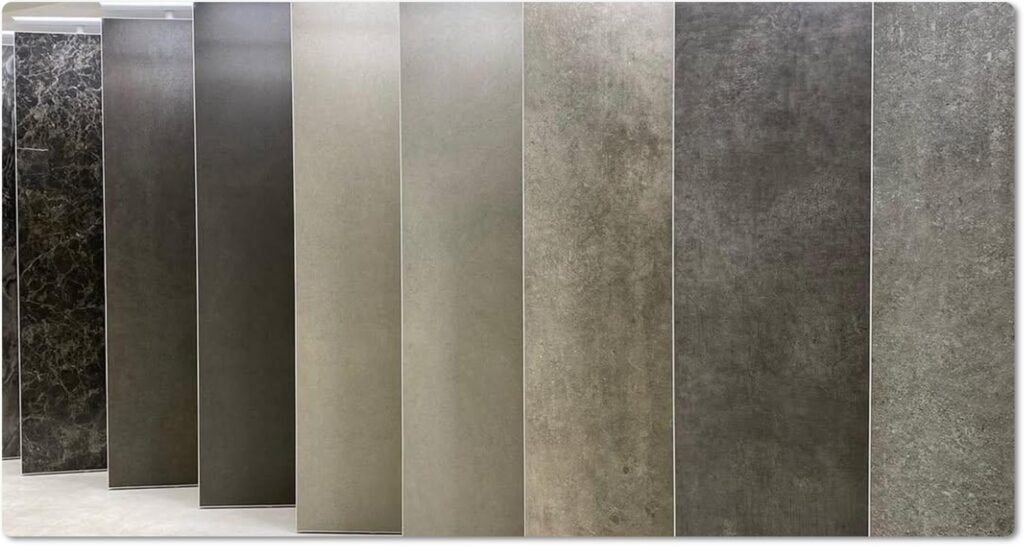
- Material consistency
- Slab size availability
- Thickness options
- Surface finish
- Color consistency
- Fabrication capability
- CNC capacity
- Packaging quality
- Export experience
- Technical documentation
- Quality control
- Production lead time
- Container loading efficiency
For large projects, the ability to supply both slabs and precision fabrication can significantly reduce coordination between suppliers.
As an experienced Chinese stone manufacturer and exporter, EDG Stone can position ultra-compact slab supply around not only material selection but also cutting, CNC processing, custom fabrication, quality control, and export packaging.
17. Ultra Compact Slab Fabrication for Different Applications
Kitchen Countertops
Fabrication typically involves sink cutouts, cooktop openings, faucet holes, edge profiles, backsplashes,s and sometimes waterfall miters.
Bathroom Vanity Tops
Bathroom applications require accurate basin openings, faucet holes, es and polished or mitered edges.
Wall Panels
Large-format wall panels require careful dimensional planning, handling, ing and installation preparation.
Outdoor Kitchens
Ultra-compact surfaces can be attractive for outdoor applications because many products are designed for low water absorption and good resistance to environmental exposure. However, outdoor suitability should always be confirmed against the specific product’s technical data.
Commercial and Hospitality Projects
Hotels, restaurants, multifamily developments, and commercial interiors benefit from repeatable CNC production and standardized QC.
18. How to Choose an Ultra Compact Slabs Manufacturer, Factory or Wholesaler
When searching for an ultra-compact slabs manufacturer, ultra-compact slabs factory, or ultra-compact slabs wholesaler, buyers should evaluate the supplier using a structured checklist.
Supplier Evaluation Checklist
| Factor | What to Ask |
|---|---|
| Material | What is the composition and technical specification? |
| Size | What slab dimensions are available? |
| Thickness | Which thicknesses are stocked or produced? |
| Fabrication | Can the supplier provide CNC and custom fabrication? |
| QC | What inspection procedures are used? |
| Testing | Can technical test documentation be provided? |
| Packing | How are slabs protected for international shipping? |
| Export | Does the supplier have experience with international containers? |
| Project Support | Can the supplier review CAD drawings and fabrication requirements? |
19. The Future of Ultra Compact Surfacing
The ultra compact surface market is moving toward a more technically sophisticated purchasing model.
Three trends are particularly important.
Trend 1: More Large-Format Applications
Large slabs allow designers to reduce visible joints and create continuous visual surfaces across countertops, walls, furniture, and architectural elements.
Trend 2: More Digital Fabrication
CNC and waterjet technologies allow manufacturers to turn standardized slabs into highly customized architectural components.
Trend 3: Stronger Safety and Environmental Requirements
The regulatory direction in the United States and Europe demonstrates that manufacturers will increasingly need to consider worker safety, material composition, sustainability information,n and product traceability alongside aesthetics and price. OSHA and NIOSH have continued to emphasize silica exposure controls, while the EU’s CPR 2024 framework adds stronger environmental and digital-product considerations.
For international suppliers, this means that technical competence and documentation are becoming part of the product itself.
20. Semantic Insight: What Buyers Should Really Consider
How Should Ultra Compact Slabs Be Fabricated?
They should be fabricated with material-specific diamond tooling, stable slab support, controlled wet cutting, appropriate CNC or waterjet equipment,nt and carefully designed cutouts. The exact machine parameters should come from the slab and tool manufacturers rather than a generic parameter table.
Why Is Ultra Compact Slab Fabrication Different?
Ultra compact surfaces combine high density and hardness with relatively low tolerance for uncontrolled mechanical stress. This makes support, vibration control, heat management, ent and internal-corner design especially important.
What Fabrication Options Are Available?
Professional shops can use bridge saws for straight cuts, CNC equipment for repeatable precision machining, waterjets forcomplex geometriest,ries and specialized diamond tools for drilling, edge profiling, filing, and finishing.
Which Option Is Best for a Large Commercial Project?
For repeated countertops, vanities, or architectural components, CNC-based fabrication provides strong repeatability. Bridge saws are efficient for standardized straight cuts, while waterjets are valuable when the geometry is complex. The most efficient production line often combines all three.
What Should Buyers Consider Before Ordering?
Buyers should consider the material specification, slab dimensions, thickness, finish, pattern direction, fabrication requirements, testing documentation, packaging lead time, lead time, and destination-market regulations. A low slab price does not necessarily mean a low project cost if fabrication defects, breakage, or poor export packing create downstream losses.
What Is the Industry Direction?
The market is moving from commodity slab supply toward integrated technical solutions: material + fabrication + quality control + documentation + packaging + logistics. At the same time, worker-safety regulations and environmental product requirements are becoming increasingly important in international procurement.
What Makes a Professional Ultra Compact Slab Supplier Different?
A professional supplier should be able to explain not only what the material looks like, but also how it should be fabricated, what tools should be used, how cutouts should be designed, how finished components should be inspected,d and how the product should be packed for international transportation.
21. Conclusion: How to Fabricate Ultra Compact Slabs Successfully
Successful ultra-compact slab fabrication is a combination of material knowledge, correct tooling, controlled cutting, proper slab support, water cooling, CNC precision, corner-radius design, edge finishing, ng and quality control.
The most important principle is simple: do not treat ultra-compact slabs like ordinary marble, granite, or engineered quartz. Every product family can have different fabrication requirements, so the manufacturer’s technical specifications should be the starting point.
For professional fabricators and international buyers, the future opportunity is even broader. Ultra compact surfaces are increasingly being used for countertops, vanities, wall panels, outdoor kitchens, hospitality projects, multifamily developments and architectural applications. At the same time, regulations concerning silica exposure, environmental performance,e and product documentation are becoming more significant.
For this reason, the most competitive ultra-compact slabs manufacturer, factory, and exporter will not simply sell slabs. The strongest suppliers will provide a complete solution covering material selection, fabrication, CAD/CNC processing, QC, technical documentation, export packaging,g and project support.
Frequently Asked Questions About Ultra-Compact Slab Fabrication
1. Can ultra-compact slabs be cut with a normal stone saw?
Ultra-compact slabs can be processed with suitable bridge saws, CNC machines, and waterjet equipment, but the cutting blade and operating parameters should be specifically appropriate for porcelain, sintered, or ultra-compact materials. Always follow the slab manufacturer’s fabrication instructions.
2. Can you CNC ultra-compact slabs?
Yes. CNC machines can be used for sink cutouts, cooktop openings, drilling, bevels, edge profiles, grooves, and other customized fabrication. CNC is particularly useful for repetitive commercial and hospitality projects where dimensional consistency is important.
3. Do ultra-compact slabs need water when cutting?
Wet cutting is widely used for porcelain and sintered slab fabrication because it helps control heat and dust. OSHA also identifies water application as an important engineering control for reducing respirable crystalline silica exposure during applicable stone fabrication operations.
4. How do you prevent ultra-compact slabs from cracking?
Use proper slab support, suitable diamond tools, controlled cutting speed, adequate cooling, and rounded internal cutout corners. Avoid unsupported areas and excessive mechanical force, particularly when working with thin large-format slabs.
5. Are ultra compact slabs difficult to fabricate?
They can be more demanding than conventional stone because they are hard, dense,e and relatively brittle. However, with suitable equipment, trained operators, correct tooling, and standardized fabrication procedures, professional stone manufacturers can achieve highly precise results.
Semantic Summary: Ultra Compact Slabs Fabrication at a Glance
What: Ultra compact slab fabrication is the controlled cutting, drilling, CNC machining, waterjet processing, edge profiling, and finishing of highly densified large-format surfaces.
How: Use material-specific diamond tools, stable slab support, controlled wet cutting, appropriate CNC or waterjet equipment,ment and properly designed cutouts.
Ultra-compact materials provide a combination of design flexibility, low porosity, and high resistance characteristics, but their hardness and brittleness require specialized fabrication methods.
Options: Bridge saws are efficient for straight cuts; CNC machines are ideal for repeatable precision fabrication; waterjets are useful for complex shapes; diamond core drills and edge tools complete specialized fabrication operations.
Considerations: Buyers should evaluate slab specifications, fabrication capability, quality control, technical documentation, worker-safety practices, packaging, export experience, and destination-market regulations.
Industry Insight: The future of ultra-compact surfacing is moving toward integrated manufacturing and fabrication services rather than simple commodity slab trading. Suppliers that combine technical expertise, digital fabrication, QC, documentation, and international logistics will be better positioned for large B2B projects.
References and Technical Sources
- OSHA — Respirable Crystalline Silica Standards and Countertop Fabrication Guidance.
- OSHA/NIOSH — Worker Exposure to Silica during Countertop Manufacturing, Finishing and Installation, 2026.
- NIOSH — Engineered Stone and Silicosis, 2026.
- California Department of Industrial Relations — 2026 artificial-stone silica rulemaking initiative.
- European Commission — Construction Products Regulation 2024 revision.
- EUR-Lex — Regulation (EU) 2024/3110.
- ASTM International — ASTM C373 water absorption testing.
- Technical fabrication guidance for porcelain and sintered slabs.
Need custom fabrication for ultra compact slabs?