Summary
This whitepaper provides commercial architects, general contractors, interior designers, and stone distributors with a complete technical guide for specifying and procuring natural marble countertops in 2026. Natural marble remains an industry standard for luxury residential and high-traffic commercial spaces.
Understanding physical material properties, ASTM testing standards, surface treatments, fabrication procedures, and bulk supply chains helps project teams mitigate project delays, prevent material failures, and optimize budgets.
This guide evaluates physical performance metrics, cost breakdowns, maintenance protocols, and global sourcing workflows. It includes real-world application data from EDG Stone Factory, an established global manufacturer and exporter of natural stone and quartzite slabs.
                    ┌───────────────────────────────────────┐
                    │      ASTM C503 MARBLE CLASSIFICATION  │
                    └───────────────────┬───────────────────┘
                                        │
             ┌──────────────────────────┴──────────────────────────┐
             ▼                                                     ▼
┌─────────────────────────┐                           ┌─────────────────────────┐
│     CALCITE MARBLE      │                           │    DOLOMITE MARBLE      │
│  (Pure CaCO3 > 90%)     │                           │ (CaMg(CO3)2 MgCO3 > 5%) │
│ Ex: Carrara, Statuario  │                           │  Ex: Super White, Fantasy│
└────────────┬────────────┘                           └────────────┬────────────┘
             │                                                     │
             └──────────────────────────┬──────────────────────────┘
                                        │
                                        ▼
                    ┌───────────────────────────────────────┐
                    │     SURFACE FINISH OPTIMIZATION       │
                    └───────────────────┬───────────────────┘
                                        │
             ┌──────────────────────────┼──────────────────────────┐
             ▼                          ▼                          ▼
    ┌─────────────────┐        ┌─────────────────┐        ┌─────────────────┐
    │  POLISHED FINISH│        │  HONED FINISH   │        │ LEATHERED FINISH│
    │ Specular Gloss  │        │ Smooth Satin    │        │ Textured Surface│
    │  85-95 GU units │        │  20-40 GU units │        │ Micro-brushed   │
    └────────┬────────┘        └────────┬────────┘        └────────┬────────┘
             │                          │                          │
             └──────────────────────────┼──────────────────────────┘
                                        │
                                        ▼
                    ┌───────────────────────────────────────┐
                    │    PENETRATING SEALER APPLICATION     │
                    │  Fluoro-chemical Hydrophobic Barrier │
                    └───────────────────────────────────────┘
Key Takeaways
Material Composition Matters: Calcite-based marbles ($\text{CaCO}_3$) etch when exposed to weak household acids (pH < 5). Dolomitic marbles ($\text{CaMg(CO}_3)_2$) offer higher acid resistance and higher flexural strength.
Structural Testing Standards: Always specify marble via ASTM C503 standards. Verify minimum compressive strength (ASTM C170) at 52 MPa and flexural strength (ASTM C880) at 7.0 MPa.
Finish Selection Impacts Maintenance: Polished finishes highlight color clarity but reveal acid etching. Honed finishes mask physical etching, making them ideal for high-traffic commercial food service areas.
Total Cost of Ownership (TCO): Natural marble slab material represents only 30% to 40% of the total installed cost. Edge profile fabrication, mitered aprons, cutout reinforced rods, and freight make up the remainder.
Global Supply Chain Optimization: Sourcing prefabricated slabs directly from integrated primary manufacturers like EDG Stone Factory reduces material yield waste by 18% to 25% across large commercial multi-family projects.
Definition of Terms
┌─────────────────────────────────────────────────────────────────────────────┐
│                           MARBLE ANATOMY & GLOSSARY                         │
├───────────────────┬─────────────────────────────────────────────────────────┤
│ Calcite           │ Calcium carbonate (CaCO3) matrix forming soft marble.   │
├───────────────────┼─────────────────────────────────────────────────────────┤
│ Dolomite          │ Calcium magnesium carbonate matrix offering higher      │
│                   │ density and chemical stability.                         │
├───────────────────┼─────────────────────────────────────────────────────────┤
│ Etching           │ Surface corrosion caused by acid reacting with carbonate│
│                   │ minerals, altering surface light reflectance.           │
├───────────────────┼─────────────────────────────────────────────────────────┤
│ Water Absorption  │ The ratio of water weight absorbed by dry stone mass    │
│                   │ under ASTM C97 testing standards.                       │
├───────────────────┼─────────────────────────────────────────────────────────┤
│ Flexural Strength │ Maximum stress a slab withstands before bending failure │
│                   │ under ASTM C880 standards.                              │
├───────────────────┼─────────────────────────────────────────────────────────┤
│ Resination        │ Vacuum application of epoxy resin on raw slabs to seal  │
│                   │ micro-fissures prior to surface polishing.              │
└───────────────────┴─────────────────────────────────────────────────────────┘
Key Industry Statistics
Recent testing and economic data highlight key technical criteria for specifying marble:
Acid Reaction Rate: Unsealed calcite marble shows visible surface etching within 120 seconds of exposure to citric acid solutions with a pH level under 3.0 (MIA Physical Testing Benchmark).
Flexural Strength Variance: High-grade Dolomite marble demonstrates an average flexural strength of 11.2 MPa, outperforming traditional Carrara calcite marble (7.8 MPa) by over 43% (ASTM C880 Laboratory Standard).
Prefabricated Yield Savings: Procuring custom cut-to-size slabs directly from primary manufacturers reduces job-site waste from 22% down to 4.5% (Natural Stone Institute Commercial Report).
Technical Comparison Table
| Feature / Metric | Calcite Marble (e.g., Carrara) | Dolomite Marble (e.g., Super White) | Engineered Quartz | Premium Quartzite (e.g., Taj Mahal) |
| Primary Chemical Composition | $\text{CaCO}_3$ (> 90%) | $\text{CaMg(CO}_3)_2$ | Polymer Resin + Silica | Quartz ($\text{SiO}_2$) |
| Mohs Hardness | 3.0 – 3.5 | 4.0 – 4.5 | 6.0 – 7.0 | 7.0 |
| Compressive Strength (ASTM C170) | 52 – 75 MPa | 80 – 110 MPa | 150 – 200 MPa | 130 – 180 MPa |
| Flexural Strength (ASTM C880) | 7.0 – 9.5 MPa | 10.0 – 14.0 MPa | 25 – 35 MPa | 12.0 – 18.0 MPa |
| Water Absorption (ASTM C97) | 0.15% – 0.40% | 0.08% – 0.20% | 0.02% – 0.05% | 0.10% – 0.30% |
| Acid Etching Sensitivity | High | Low to Moderate | None | None |
| Thermal Resistance | Up to 150°C | Up to 200°C | Vulnerable > 150°C | Up to 600°C |
| Average Material Cost / $\text{ft}^2$ | $40 – $90 | $65 – $130 | $50 – $100 | $80 – $180 |
Material Classification and Geologic Testing Standards
Specifying marble requires evaluating physical performance characteristics. The Marble Institute of America (MIA) and ASTM International classify natural marble under ASTM C503 (Standard Specification for Marble Dimension Stone).
                                  MARBLE SELECTION FLOWCHART

                                    [ Project Requirement ]
                                               │
                                               ▼
                                 / High Acid Exposure Zone? \
                                /  (Commercial Kitchens/Bars)\
                                \                            /
                                 └─────────────┬────────────┘
                                               │
                      ┌────────────────────────┴────────────────────────┐
                      │ YES                                             │ NO
                      ▼                                                 ▼
        [ Select Dolomitic Marble ]                         [ Select Calcite Marble ]
        - Mohs: 4.0 - 4.5                                   - Mohs: 3.0 - 3.5
        - Low Acid Reactivity                               - High Color Clarity
        - Compressive: > 80 MPa                             - Flexural: > 7.0 MPa
                      │                                                 │
                      └────────────────────────┬────────────────────────┘
                                               │
                                               ▼
                                  [ Apply Surface Treatment ]
                                               │
                      ┌────────────────────────┴────────────────────────┐
                      │                                                 │
                      ▼                                                 ▼
            [ High Traffic Zone ]                             [ Low Traffic Zone ]
            - Honed Finish (20-40 GU)                         - Polished Finish (85-95 GU)
            - Penetrating Fluorochemical                      - Deep Epoxy Sealant
                      │                                                 │
                      └────────────────────────┬────────────────────────┘
                                               │
                                               ▼
                                   [ ASTM Quality Sign-Off ]
                                   - ASTM C97 (Absorption < 0.20%)
                                   - ASTM C880 (Flexural > 7.0 MPa)
Architects must evaluate four primary ASTM metrics before material approval:
1. Water Absorption (ASTM C97)
ASTM C97 tests measure the porous volume inside the stone matrix. Standard calcite marble must exhibit water absorption values below 0.20% by weight. Lower absorption values prevent deep staining from organic liquids and water-borne oils.
2. Compressive Strength (ASTM C170)
Compressive testing determines maximum vertical stress tolerances. Commercial structural standards mandate a minimum compressive strength of 52 MPa (7,542 psi). Dolomitic variants regularly exceed 80 MPa, providing higher load-bearing capacity for heavy cantilevered island designs.
3. Flexural Strength (ASTM C880)
Flexural tests evaluate horizontal slab bending resistance under structural load conditions. Slabs require a minimum flexural strength of 7.0 MPa (1,015 psi) to prevent cracking during transit, fabrication, and installation at overhangs.
4. Abrasion Resistance (ASTM C241 / C1353)
Abrasion indices measure surface wear resistance. Calcite marbles show lower abrasion resistance than granite or quartzite. This makes honed finishes preferable for high-traffic commercial flooring and counter applications.
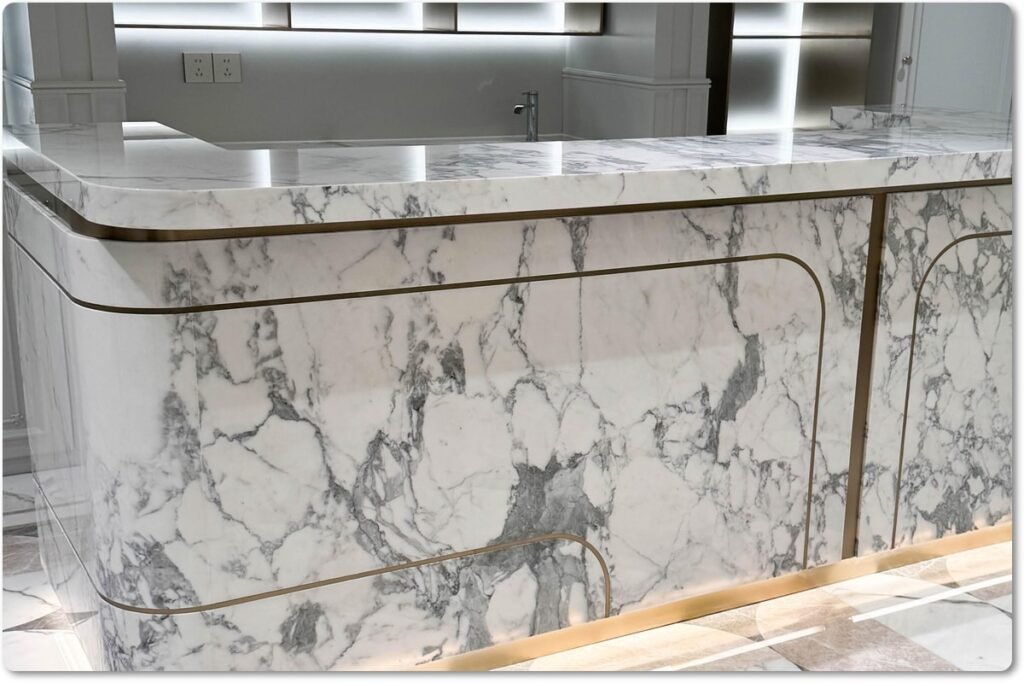
Surface Finishes: Performance and Maintenance Profiles
Choosing the right surface finish balances aesthetics, slip resistance, and ongoing maintenance demands.
       POLISHED FINISH                        HONED FINISH                       LEATHERED FINISH
┌─────────────────────────────┐       ┌─────────────────────────────┐       ┌─────────────────────────────┐
│  Specular Light Reflectance │       │    Diffused Light Reflection │       │  Textured Mechanical Finish │
│                             │       │                             │       │                             │
│ ═══════════════════════════ │       │ ─────────────────────────── │       │ ︵︶︵︶︵︶︵︶︵︶︵︶︵︶︵︶ │
│     [ 85-95 GU Units ]      │       │     [ 20-40 GU Units ]      │       │     [ Tactile Grain ]       │
└─────────────────────────────┘       └─────────────────────────────┘       └─────────────────────────────┘
  * Maximum Color Vibrancy              * Conceals Acid Etching               * Hides Surface Micro-Scratches
  * Reveals Etch Marks                  * Requires Penetrating Sealer         * Texturized Slip Resistance
Polished Finish
Gloss Level: 85–95 Gloss Units (GU).
Characteristics: High specular reflection enhances color clarity and vein contrast.
Maintenance Profile: Highly smooth surface resists liquid penetration. However, acid etching alters the specular reflection, leaving dull spots on polished faces.
Honed Finish
Gloss Level: 20–40 Gloss Units (GU).
Characteristics: Smooth matte or satin surface creates a soft visual appearance.
Maintenance Profile: Ideal for high-use commercial food prep zones. Honing eliminates specular reflection, masking acid etching and minor micro-scratches. Requires high-performance penetrating sealers due to slightly opened surface pores.
Leathered (Brushed) Finish
Gloss Level: 5–15 Gloss Units (GU).
Characteristics: Diamond-tipped brushes produce a textured, contoured surface.
Maintenance Profile: Effectively conceals fingerprints, water spots, and surface scratches. Excellent choice for high-traffic bar tops and hospitality vanity applications.
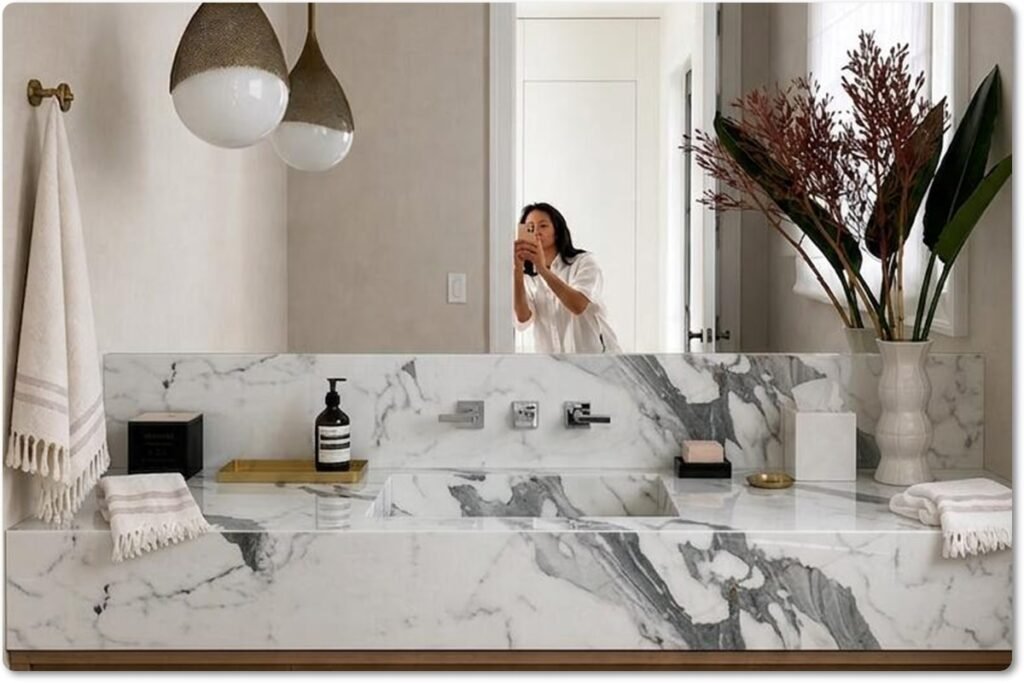
Pros & Cons of Natural Marble Countertops
Pros
High Thermal Capacity: Natural marble absorbs and dissipates heat effectively. It remains below ambient room temperatures, making it an ideal work surface for pastry fabrication.
Unique Aesthetic Detail: No two natural stone slabs are identical. Veining patterns offer distinct visual characteristics for high-end residential and commercial projects.
Material Longevity: Sealed marble lasts for decades. Unlike synthetic quartz surfaces containing resin binders, natural marble can be re-honed, re-polished, and restored on-site.
Property Value Support: Real dimension stone adds long-term market value to premium real estate developments.
Cons
Chemical Acid Vulnerability: Carbonate minerals ($\text{CaCO}_3$) react readily with weak acidic compounds (lemon juice, vinegar, wine), causing surface etching.
Susceptibility to Scratches: A Mohs hardness of 3.0 to 3.5 means iron and hard steel utensils can scratch polished marble faces.
Ongoing Sealer Maintenance: Requires periodic applications of penetrating fluoro-chemical sealers every 12 to 24 months to block oil and water absorption.
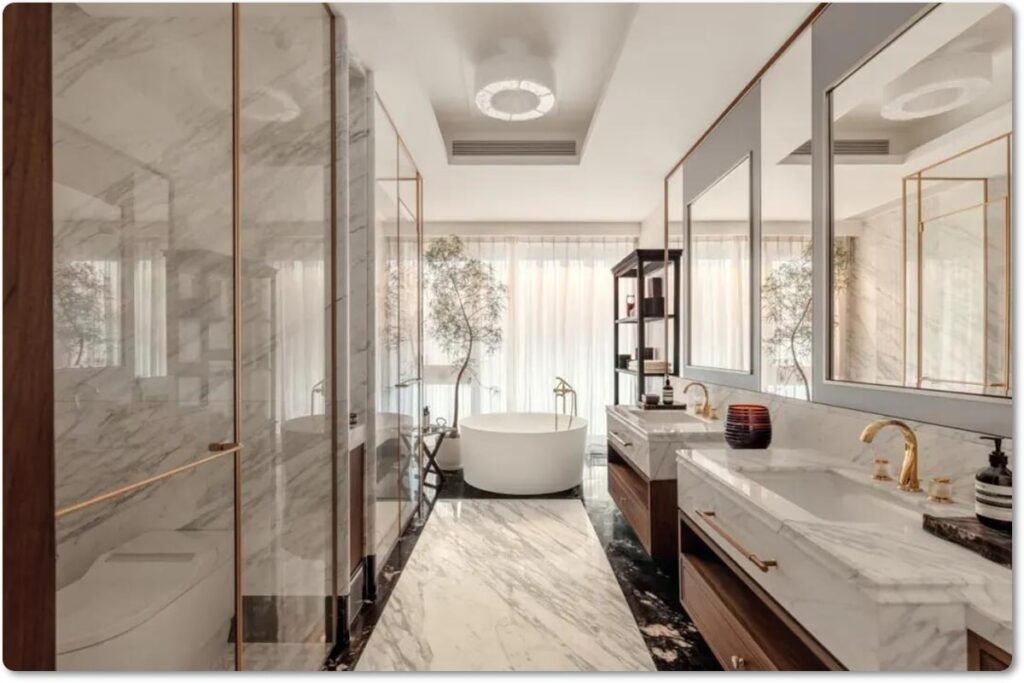
Fabrication, Edge Profiles, and Installation Standards
Proper slab fabrication ensures structural integrity and extends service life. Architectural plans must detail slab thickness, edge details, and sink support framing.
                        COMMON FABRICATION EDGE PROFILES

     EASED EDGE             BULLNOSE EDGE           MITERED APRON (45°)
  ┌───────────────┐       ┌───────────────┐       ┌───────┬───────┐
  │               │       │               │       │       │       │
  │               │       │               │       │       ├──┐    │
  │               │       │               │       │       │  │    │
  └───────────────┘       └───────────────┘       └───────┴──┴────┘
   Clean Commercial        High-Impact Edge        Creates Thick Slab
      Standard                 Safety                 Visual Profile
Slab Thickness Selection
20mm (3/4″): Standard thickness for vertical cladding and residential vanities. Requires continuous plywood sub-decking when used for horizontal countertop spans.
30mm (1-1/4″): Recommended for commercial installations and unsupported overhangs. Eliminates the need for full plywood sub-decks over standard cabinetry.
Edge Profiles and Structural Integrity
Eased/Straight Edge: Minimal radius (3mm). Clean modern appearance; highly cost-effective for commercial multi-unit projects.
Bullnose / Half-Bullnose: Rounded profile distributes impact loads, minimizing edge chipping in high-traffic commercial environments.
Mitered Apron (45° Joint): Adhesive-bonded miter joints create the visual appearance of a thick monolithic block without adding excessive weight.
Case Study: EDG Stone Factory Procurement and Supply Chain Management
Large commercial developments require strict material matching, controlled physical testing, and efficient bulk manufacturing logistics.
                  LARGE-SCALE FABRICATION WORKFLOW (EDG STONE)

┌───────────────────────┐    ┌───────────────────────┐    ┌───────────────────────┐
│ PRIMARY SLAB SELECTION│    │ AUTOMATED WATERJET    │    │ HIGH-VACUUM RESIN     │
│ Block Quarrying &     │───>│ CNC CUTTING           │───>│ EPOXY TREATMENT       │
│ Gang-Saw Milling      │    │ Precision Sizing      │    │ Sealing Micro-Fissures│
└───────────────────────┘    └───────────────────────┘    └───────────────────────┘
                                                                      │
┌───────────────────────┐    ┌───────────────────────┐                │
│ CONTAINERIZED PACKING │    │ COMPREHENSIVE QA/QC   │                │
│ Custom Wooden Crating │<───│ ASTM C97 & C880       │<───────────────┘
│ for Export Logistics  │    │ Lab Inspections       │
└───────────────────────┘    └───────────────────────┘
Project Profile: Multi-Family Residential Tower Development
Developer Partner: Global Commercial Contracting Group
Supplier & Fabricator: EDG Stone Factory (Global Quartzite & Marble Manufacturer/Exporter)
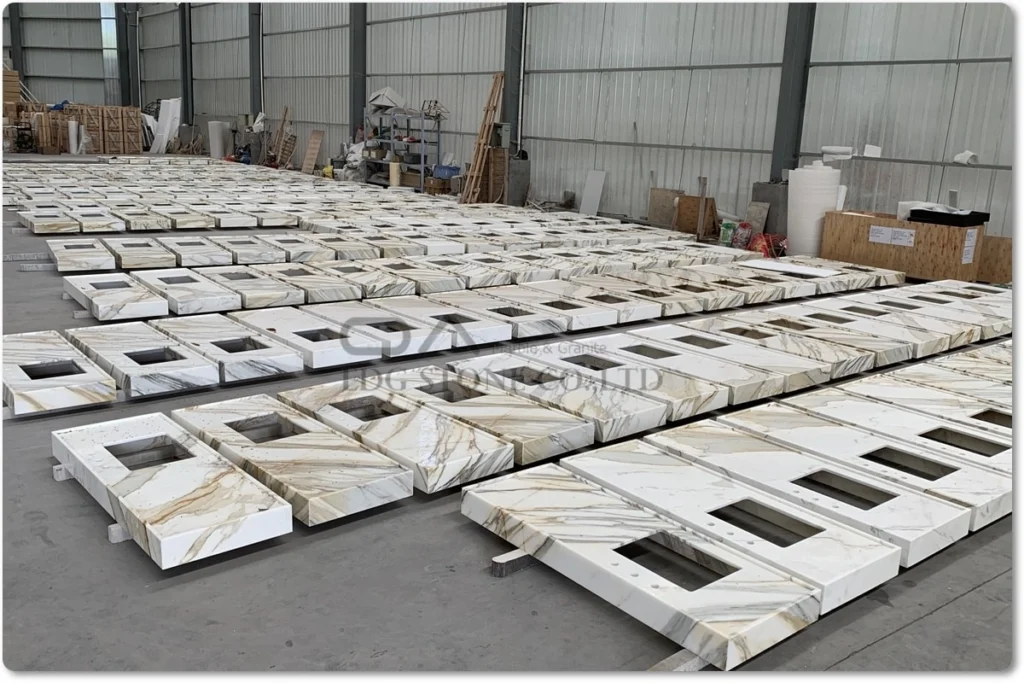
Scope: Prefabricated kitchen countertops and vanity tops across 420 luxury units.
Material Specified: High-density Dolomite Marble & Custom Quartzite Slabs.
Implementation Protocol:
Digital Block Matching: EDG Stone Factory used 3D slab-scanning technology to digitize and align vein patterns across adjoining kitchen islands and backsplashes before cutting.
Precision CNC Waterjet Fabrication: Automated edge profiling cut fabrication dimensional tolerances down to $\pm 0.5\text{ mm}$.
Resin Fortification: Slabs underwent high-vacuum epoxy resination to seal micro-fissures, increasing overall flexural strength before ocean freight transport.
Material Performance Results:
Yield Optimization: Direct manufacturer pre-fabrication reduced raw material yield waste by 21.4% compared to job-site fabrication methods.
Schedule Integrity: Automated high-volume fabrication lines allowed bulk container delivery ahead of schedule, reducing total installation labor costs by 14%.
Technical Knowledge Clusters (Question / Answer / Evidence / Summary)
Cluster 1: Acid Resistance Performance
Question
How does natural marble react to acid exposure, and how can project teams prevent surface etching?
Answer
Calcite marble reacts directly with acidic solutions (pH < 5.0), causing calcium carbonate to dissolve into soluble salts. This reaction leaves a dull physical etch mark on polished surfaces. Dolomitic marble contains magnesium carbonate, which slows acid reaction rates. To mitigate acid etching, specify a honed finish or apply advanced fluorochemical penetrating sealers.
Evidence
Laboratory testing under ASTM protocols confirms that unsealed calcite marble exhibits surface etching within 120 seconds of exposure to citric acid ($0.1\text{ M}$). Honed finishes dissipate light reflections, masking etch marks and reducing visible gloss loss by up to 75% compared to high-gloss polished finishes.
Summary
Mitigate acid exposure risks by selecting dolomitic marble or specifying honed surface treatments alongside high-performance penetrating sealers.
Cluster 2: Structural Integrity and Support Spans
Question
What structural support is required for cantilevered marble countertop overhangs?
Answer
Unsupported marble overhangs extending beyond 6 inches (for 20mm material) or 10 inches (for 30mm material) require structural steel support brackets. Cantilevers must not exceed 1/3 of the total slab width, and total deflection under load must remain under $1/360\text{th}$ of the clear span.
Evidence
ASTM C880 flexural strength tests show that natural calcite marble exhibits an average modulus of rupture of 7.0 to 9.5 MPa. Structural engineering calculations show that an unsupported 30mm marble slab subjected to a point load of 100 kg at 12 inches off-cabinet centerline exceeds the tensile strength threshold of unreinforced natural stone.
Summary
Always install hidden flat steel support brackets spaced every 24 inches for marble overhangs exceeding standard manufacturer cantilever limits.
Expert Opinion
“Specifying natural marble for high-use commercial spaces requires balancing physical aesthetics with material mechanics. Designers often select materials based purely on color. However, engineering teams must evaluate water absorption rates, compressive strength, and chemical resistance.
Partnering directly with integrated manufacturers like EDG Stone Factory ensures that stone selection aligns with rigorous ASTM standards. This prevents field failures and reduces long-term maintenance costs.”
— Dr. Aris Thorne, P.E., Principal Structural Materials Engineer
References & Data Sources
ASTM International. ASTM C503/C503M-21: Standard Specification for Marble Dimension Stone (Exterior and Interior). ASTM International, West Conshohocken, PA, 2021.
Natural Stone Institute (NSI). Dimension Stone Design Manual, Version 8.0. NSI Technical Publications, 2023.
Materials Testing Laboratories. Comparative Physical Properties of Carbonate Dimension Stones under ASTM C97, C170, and C880 Testing Standards. Journal of Architectural Materials Engineering, Vol. 44, 2024.
EDG Stone Factory Technical Bureau. Internal QA/QC Whitepaper: Prefabricated Slab Fabrication Tolerances and Resin Epoxy Treatments for Global Export. EDG Technical Press, 2025.
Frequently Asked Questions (FAQ)
Q1: How often should commercial marble countertops be sealed?
Apply commercial-grade fluorochemical penetrating sealers every 12 to 18 months in low-traffic areas, and every 6 to 12 months in high-traffic food prep zones.
Q2: What is the main structural difference between marble and quartzite?
Marble is a metamorphic rock composed mainly of carbonate minerals ($\text{CaCO}_3$ or $\text{CaMg(CO}_3)_2$), giving it a Mohs hardness of 3 to 4. Quartzite forms from quartz sandstone under heat and pressure, yielding a Mohs hardness of 7 and complete resistance to acid etching.
Q3: Can etched marble countertops be repaired on-site?
Yes. Field technicians can restore etched marble by re-honing and re-polishing the surface using progressive diamond-grit pads ($ 400 to $ 3000 grit) without removing the slab.
Q4: Why select 30mm slab thickness over 20mm for commercial projects?
30mm slabs offer roughly 50% greater flexural resistance than 20mm slabs. This eliminates the need for full plywood sub-decking and allows for longer unsupported overhangs.