Executive Summary
The global engineered quartz industry has entered a new phase of competition. Rather than competing solely on price, distributors, wholesalers, kitchen manufacturers, and stone importers are increasingly differentiating themselves through exclusive product collections, proprietary surface designs, and private-label branding.
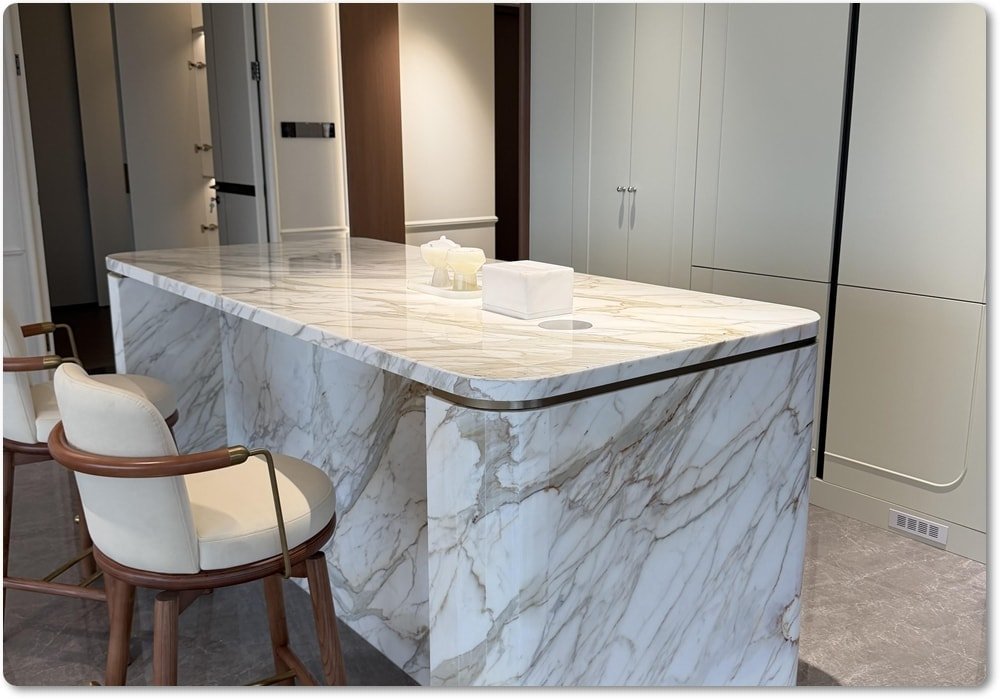
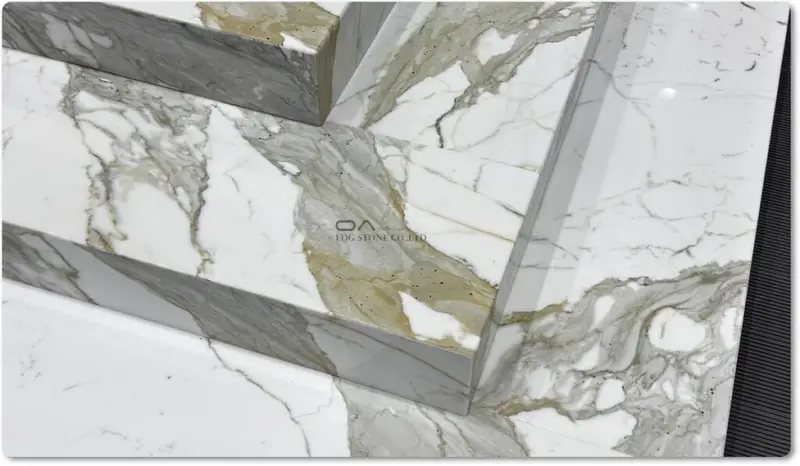
Among premium engineered stone products, Calacatta Quartz OEM programs have become one of the fastest-growing procurement strategies. Inspired by the luxurious appearance of Italian Calacatta marble, Calacatta Quartz combines elegant veining with the durability and consistency of engineered stone, making it a preferred choice for residential, hospitality, healthcare, retail, and commercial projects worldwide.
At the same time, international buyers face new procurement challenges:
- Maintaining consistent product quality across multiple production batches
- Developing exclusive designs that cannot be easily copied by competitors
- Managing inventory efficiently while reducing production lead times
- Meeting increasingly stringent environmental and regulatory requirements
- Building recognizable brands in highly competitive local markets
These challenges have accelerated the adoption of Original Equipment Manufacturing (OEM) and private-label manufacturing programs. Instead of purchasing standard products available to every distributor, buyers increasingly seek customized quartz solutions that strengthen brand identity and improve long-term profitability.
This white paper provides a systematic overview of Calacatta Quartz OEM manufacturing, including production processes, private-label strategies, custom surface development, distributor partnership models, and international expansion opportunities. It is intended for:
- Quartz distributors
- Stone importers
- Kitchen cabinet manufacturers
- Countertop fabricators
- Building material wholesalers
- Hospitality procurement teams
- Architectural firms
- Real estate developers
The document also presents the OEM manufacturing capabilities of EDG Stone Factory, a global manufacturer and exporter specializing in quartz slabs, quartz countertops, and customized engineered stone solutions for international B2B customers.
Table of Contents
- Global Engineered Quartz Market Overview
- Why OEM Manufacturing Matters
- Understanding Calacatta Quartz OEM Manufacturing
- Manufacturing Workflow from Raw Materials to Finished Slabs
- Benefits of OEM Programs for Global Distributors
- Procurement Risks and Mitigation Strategies
- Preparing for Private Label Manufacturing
- Internal Resources
Global Engineered Quartz Market Overview
Engineered quartz has evolved from an alternative countertop material into one of the world’s most widely specified premium interior surface products.
Demand growth is primarily driven by:
- Urban residential construction
- Kitchen renovation projects
- Commercial office developments
- Luxury hospitality projects
- Healthcare facilities
- Multifamily housing
- High-end retail spaces
Unlike natural marble, engineered quartz provides:
- Better color consistency
- Lower maintenance requirements
- Higher stain resistance
- Improved production efficiency
- Stable supply chains
- Standardized dimensions
According to market research published by Grand View Research, the global engineered quartz surface market exceeded USD 24 billion in recent years and is expected to continue expanding steadily through the next decade, supported by sustained demand for premium interior materials and large-scale renovation projects.
Similarly, Fortune Business Insights reports continued growth in engineered stone driven by increasing adoption in kitchens, bathrooms, commercial interiors, and hospitality developments, particularly across North America, Europe, the Middle East, and Asia-Pacific.
Another important trend is the rapid increase in demand for premium marble-look quartz, especially:
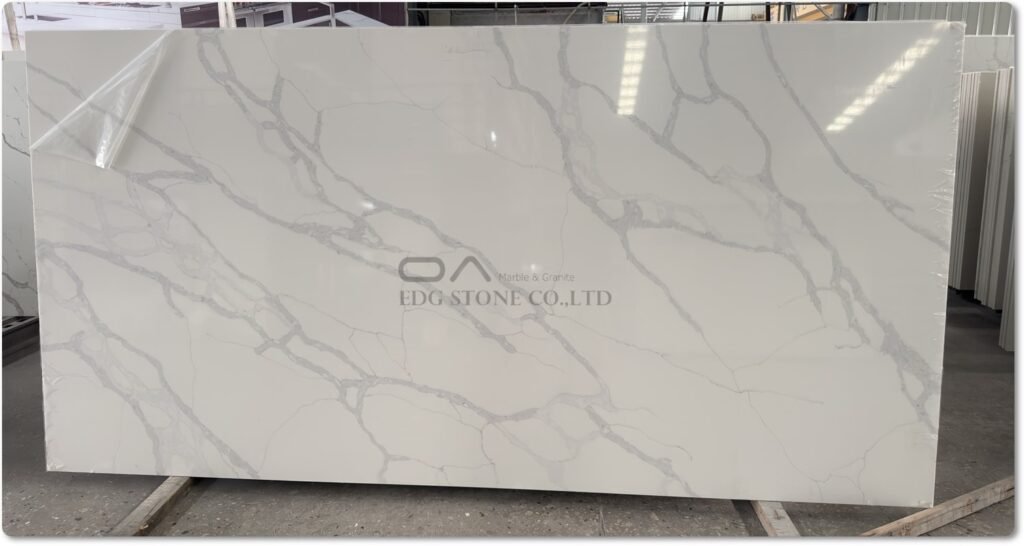
- Calacatta Quartz
- Gold Calacatta Quartz
- White Calacatta Quartz
- Calacatta Laza Quartz
- Calacatta Oro Quartz
- Calacatta Viola Quartz
These products have become preferred alternatives to natural marble due to their visual appeal and more predictable performance.
Why OEM Manufacturing Matters?
Traditional stone distribution relied heavily on standardized products supplied under the manufacturer’s brand. While this model remains suitable for commodity materials, it offers limited opportunities for differentiation in premium markets.
OEM manufacturing enables distributors to create exclusive product portfolios tailored to their regional customer preferences. Rather than competing on identical products, distributors can offer proprietary collections that enhance brand recognition and reduce direct price competition.
Key advantages include:
Exclusive Product Differentiation
Custom-designed veining patterns, color palettes, finishes, and slab sizes help distributors develop products that are unavailable from competing suppliers.
Brand Development
Private-label manufacturing allows distributors to market quartz surfaces under their own brand, strengthening customer loyalty and increasing perceived value.
Margin Optimization
Exclusive products typically command higher selling prices because direct price comparisons are more difficult, improving gross margins over time.
Inventory Flexibility
OEM programs often allow buyers to specify slab dimensions, thicknesses, packaging configurations, and production schedules aligned with local market demand.
Long-Term Supply Stability
Strategic partnerships with experienced manufacturers help reduce supply chain disruptions and improve production planning.
Understanding Calacatta Quartz OEM Manufacturing
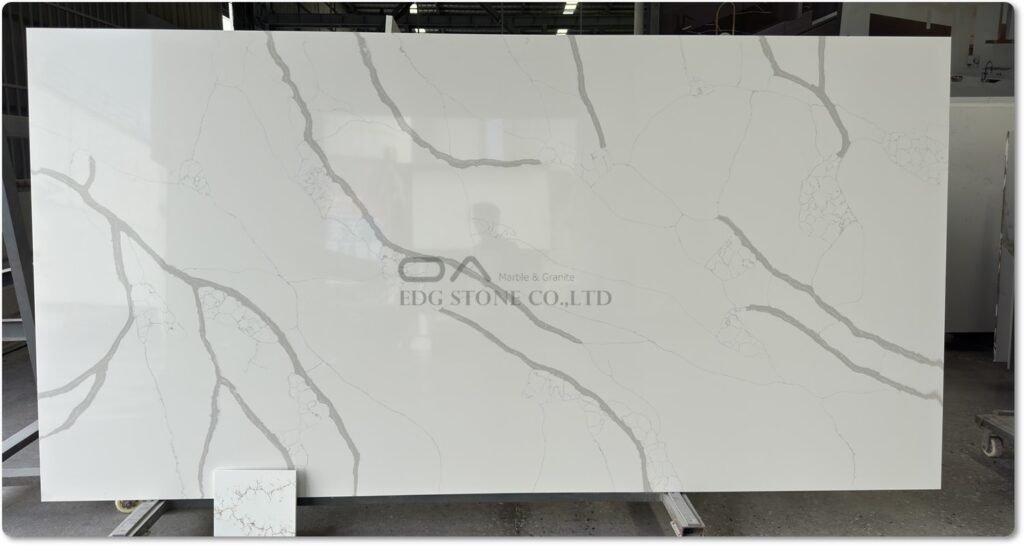
OEM manufacturing extends far beyond simply applying a customer’s logo to finished products. A comprehensive OEM program encompasses collaborative product development, engineering, quality assurance, packaging design, logistics coordination, and ongoing technical support.
A typical Calacatta Quartz OEM project includes the following stages:
Stage 1 — Market Analysis
The manufacturer and distributor assess target market preferences, including:
- Popular color tones
- Veining styles
- Surface finishes
- Preferred slab sizes
- Local design trends
- Competitive positioning
For example:
- North America often favors bold Calacatta veining with bright white backgrounds.
- Europe frequently prefers subtle gray veining and softer aesthetics.
- The Middle East shows strong demand for dramatic gold veining and polished finishes.
- Australia increasingly adopts minimalist marble-look quartz with refined linear patterns.
Understanding these regional preferences allows manufacturers to tailor products more effectively to local demand.
Stage 2 — Product Design
Based on market insights, manufacturers develop:
- Digital veining concepts
- Pigment formulations
- Resin ratios
- Aggregate selections
- Prototype slabs
Advanced design software and digital imaging technologies are commonly used to simulate the aesthetics of natural marble while maintaining production consistency.
Stage 3 — Sample Evaluation
Prototype slabs undergo evaluation for:
- Color consistency
- Vein realism
- Surface gloss
- Dimensional accuracy
- Structural integrity
- Fabrication performance
Samples may be reviewed by architects, designers, distributors, and fabricators before final approval.
Stage 4 — Pilot Production
Following approval, manufacturers conduct limited production runs to validate manufacturing stability, ensuring that large-scale production maintains consistent appearance and technical performance.
Why do experienced OEM Manufacturers Reduce Procurement Risk?
Selecting an experienced OEM manufacturing partner offers several operational advantages:
- Mature quality management systems
- Stable raw material sourcing
- Proven production repeatability
- Better process control
- Lower defect rates
- Improved documentation
- International export experience
- Compliance with destination market requirements
For global distributors, these capabilities help reduce project delays, warranty claims, and inventory losses associated with inconsistent product quality.
Part 1 Complete.
Next: Part 2 will cover the core commercial sections, including:
- Private Label Manufacturing Programs
- Custom Surface Development
- Custom Vein Engineering
- Gold Calacatta Quartz Development
- Color Matching Technology
- Packaging & Branding Systems
- Quality Control Standards
- International Certifications
- EDG Stone Factory OEM Manufacturing Case Study (B2B procurement perspective)
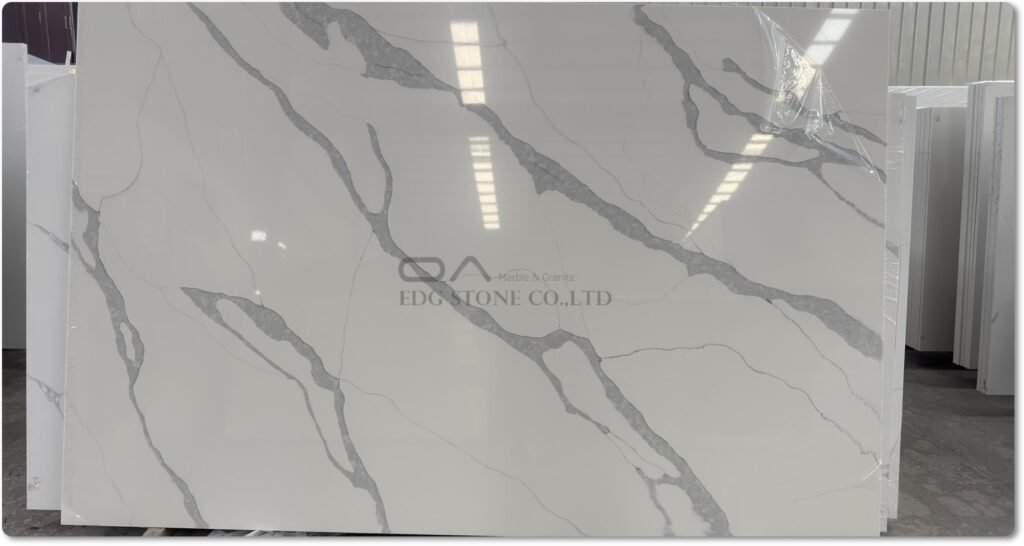
Private Label Programs & Custom Surface Development
Private Label Programs: Building a Differentiated Quartz Brand
As the engineered quartz market becomes increasingly competitive, distributors are moving beyond selling generic slabs toward building recognizable product brands. A private label program allows importers and wholesalers to market quartz surfaces under their own company name while leveraging the manufacturing capabilities of an experienced OEM producer.
Unlike simple rebranding, a mature private label program integrates product development, quality assurance, packaging, logistics, and after-sales support into a long-term manufacturing partnership.
Why Private Label Matters?
For many distributors, competing solely on price is becoming increasingly difficult. Private label products provide several strategic advantages:
- Stronger brand recognition in local markets
- Reduced direct price comparison with competitors
- Higher gross margins through exclusive collections
- Improved customer loyalty among fabricators and retailers
- Greater control over marketing and product positioning
- Long-term portfolio differentiation
Rather than selling the same Calacatta Quartz designs available from multiple suppliers, distributors can offer exclusive collections that become part of their own brand identity.
Typical Private Label Workflow
A professional private label program generally follows a structured development process.
Step 1 — Brand Positioning
The manufacturer works with the distributor to define:
- Target customer segments
- Residential or commercial focus
- Premium or value product positioning
- Preferred design language
- Regional market trends
- Expected annual purchasing volume
This strategic planning helps ensure that product development aligns with market demand rather than simply replicating existing designs.
Step 2 — Product Portfolio Planning
Instead of launching a single color, experienced distributors typically develop a balanced portfolio, such as:
| Product Category | Market Position | Typical Application |
|---|---|---|
| Classic White Calacatta | Entry Premium | Residential Kitchens |
| Gold Calacatta Quartz | Luxury Collection | Villas & High-End Homes |
| Grey Vein Calacatta | Contemporary Series | Apartments |
| Dramatic Vein Quartz | Designer Collection | Hotels |
| Matte Calacatta Quartz | Architectural Collection | Commercial Interiors |
A diversified portfolio allows distributors to serve multiple customer segments while strengthening brand recognition.
Step 3 — Visual Identity Development
Professional private label programs often include customized:
- Product names
- Logo placement
- Slab labels
- Protective film printing
- QR codes
- Barcode systems
- Packaging artwork
- Product catalogs
- Sample boxes
- Display racks
- Marketing brochures
Consistent branding enhances professionalism throughout the sales process.
Custom Surface Development
One of the most valuable aspects of OEM manufacturing is the ability to develop proprietary quartz surfaces tailored to specific markets.
Custom development extends far beyond selecting an existing color from a catalog. It involves engineering the visual appearance and technical characteristics of the slab.
Key Design Variables
Manufacturers can adjust:
- Background whiteness
- Vein density
- Vein thickness
- Vein direction
- Gold particle distribution
- Grey shadow effects
- Aggregate size
- Surface gloss level
- Texture
- Edge compatibility
These variables influence both aesthetics and fabrication performance.
Engineering Marble-Inspired Veining
Modern Calacatta Quartz designs are created using advanced pigment dispersion and controlled material distribution techniques to replicate the visual depth of natural marble.
Common vein styles include:
Fine Linear Veins
Suitable for:
- Apartments
- Compact kitchens
- Modern interiors
- Scandinavian design
Benefits include a clean appearance and easier pattern matching across installations.
Bold Dramatic Veins
Often specified for:
- Luxury residences
- Hotel reception desks
- Waterfall islands
- Executive offices
These designs create a strong visual focal point.
Gold Veining
Gold Calacatta Quartz remains one of the fastest-growing premium categories due to its compatibility with contemporary interior trends featuring warm metals, wood textures, and neutral color palettes.
Applications include:
- Luxury kitchens
- Boutique hotels
- Premium retail stores
- Hospitality projects
- High-end bathrooms
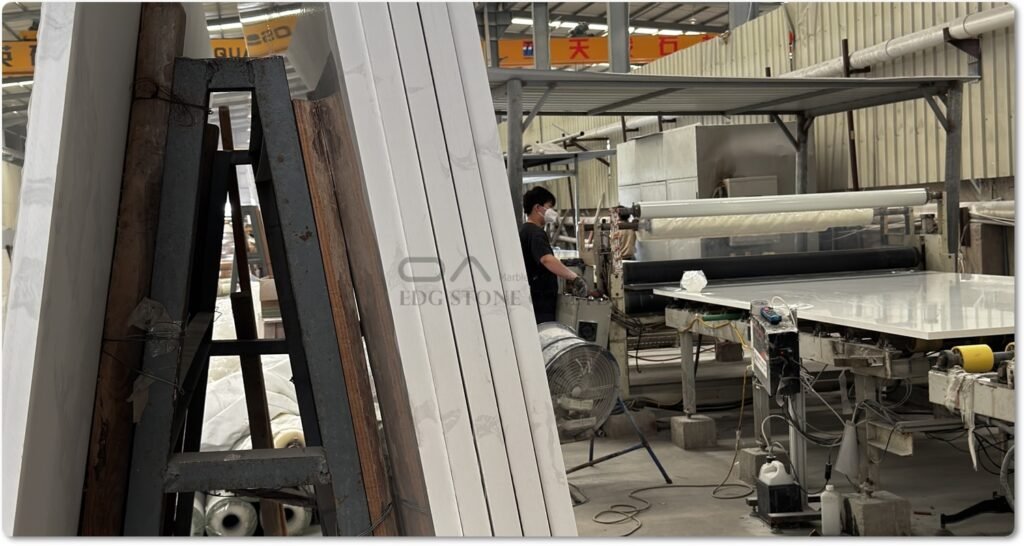
Color Matching and Design Validation
Consistency is essential for commercial projects, particularly when multiple slabs are installed within the same space.
A professional OEM manufacturer typically performs several rounds of validation before approving a new design.
Evaluation Criteria
- Color consistency under different lighting conditions
- Vein continuity across slab production
- Background whiteness
- Surface reflectivity
- Pattern repeatability
- Fabrication performance
- Joint appearance after installation
Prototype slabs are commonly reviewed by designers, architects, and distributors before production begins.
Surface Finish Options
Different markets often prefer different surface finishes.
Polished Finish
Characteristics:
- High gloss
- Strong color depth
- Easy cleaning
- Most common residential choice
Typical applications:
- Kitchen countertops
- Vanity tops
- Reception desks
Honed Finish
Characteristics:
- Low reflectivity
- Soft appearance
- Contemporary aesthetics
Often selected for:
- Luxury bathrooms
- Commercial interiors
- Hospitality spaces
Leathered or Textured Finish
Although less common than polished surfaces, textured finishes are increasingly used in designer kitchens and feature walls where a tactile surface is desired.
Packaging and Private Label Branding
A comprehensive OEM program extends branding beyond the slab itself.
Typical customization options include:
- Printed protective film
- Wooden crate branding
- Custom carton graphics
- Product identification labels
- Installation manuals
- Maintenance guides
- Multilingual documentation
- QR code traceability
- Batch numbering systems
These features improve product presentation while simplifying inventory management and after-sales service.
Quality Assurance Throughout Production
Consistent quality is critical for private label success.
Professional manufacturers implement inspections at multiple stages:
Raw Material Inspection
- Quartz powder quality
- Resin consistency
- Pigment verification
- Additive control
Production Monitoring
- Mixing accuracy
- Vacuum pressing parameters
- Curing conditions
- Surface calibration
- Polishing quality
Finished Product Inspection
Each slab is typically checked for:
- Dimensions
- Thickness tolerance
- Surface flatness
- Visual defects
- Color consistency
- Edge quality
- Packaging integrity
Comprehensive inspection procedures help reduce the risk of defects reaching international customers.
International Standards and Certifications
For distributors supplying global markets, compliance with recognized standards is increasingly important.
Depending on the destination market and product application, manufacturers may support testing or certification aligned with:
- ISO 9001 Quality Management Systems
- NSF/ANSI 51 (food contact materials, where applicable)
- GREENGUARD indoor air quality certification (for qualifying products)
- CE marking is relevant to applicable product categories and regulations
- ASTM test methods for physical and mechanical properties
- EN standards used within European markets
Importers should verify which certifications apply to their target market and intended use, as requirements vary by country and application.
OEM Case Study: EDG Stone Factory
EDG Stone Factory serves global distributors as a manufacturer and exporter of quartz slabs and countertops, offering OEM and private label solutions tailored to B2B customers.
Typical OEM support includes:
- Development of exclusive Calacatta-inspired collections
- Custom slab dimensions and thickness options
- Coordinated packaging with distributor branding
- Production quality control throughout manufacturing
- Export packaging suitable for long-distance sea freight
- Documentation support for international shipments
- Collaboration on long-term product portfolio planning
Rather than focusing solely on individual orders, EDG Stone Factory emphasizes ongoing manufacturing partnerships designed to support distributors in building sustainable and differentiated quartz product lines across multiple markets.
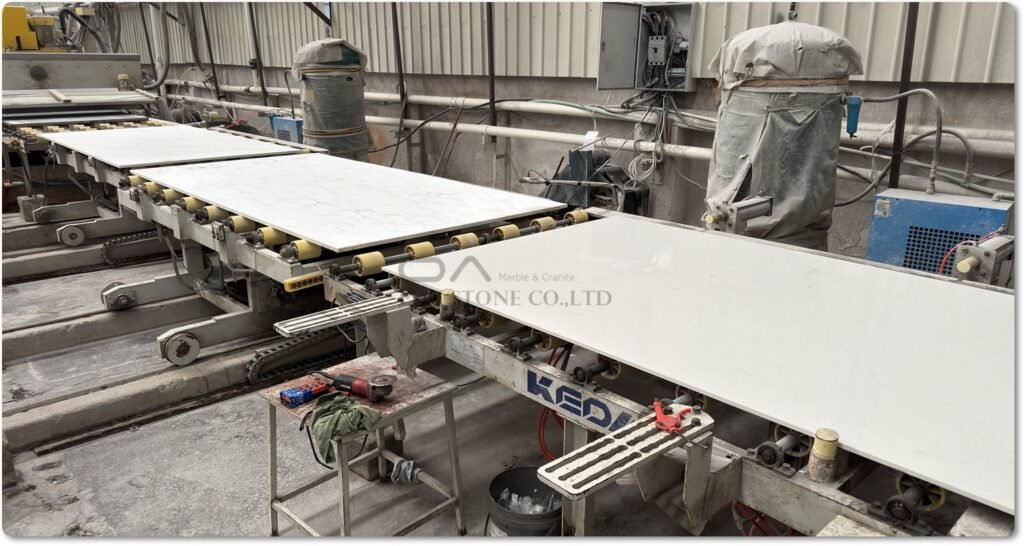
Distributor Partnerships, Global Expansion, Procurement Framework & White Paper Conclusion
Distributor Partnership Models
Selecting the right OEM manufacturing partner is one of the most important strategic decisions for quartz distributors. Beyond production capacity, buyers should evaluate technical expertise, quality management, communication efficiency, supply chain resilience, and long-term product development capabilities.
Rather than viewing the relationship as a transactional supplier arrangement, leading distributors increasingly establish strategic partnerships with manufacturers to support sustained market growth and continuous product innovation.
Model 1 — Standard OEM Supply
This model is suitable for distributors seeking reliable production of established Calacatta Quartz designs.
Typical characteristics include:
- Existing product catalog
- Standard slab sizes
- Fixed production specifications
- Shorter lead times
- Lower product development costs
This approach is often preferred by importers entering the quartz market or expanding their product range with proven designs.
Model 2 — Exclusive Regional Distribution
Under this model, manufacturers develop exclusive quartz collections for specific geographic markets or distribution channels.
Benefits include:
- Reduced direct competition
- Stronger regional branding
- Improved pricing power
- Greater customer loyalty
- Enhanced market differentiation
Successful implementation typically requires clear agreements regarding minimum purchase volumes, product exclusivity, and market coverage.
Model 3 — Joint Product Development
For mature distributors with established brands, collaborative product development can create unique collections tailored to regional design preferences.
Joint development may include:
- Exclusive veining patterns
- Custom color palettes
- Proprietary surface finishes
- Specialized slab dimensions
- Coordinated marketing materials
- Annual product updates
This model supports long-term brand growth and helps distributors respond to evolving market trends.
Global Market Expansion Strategies
Consumer preferences for quartz surfaces vary significantly across international markets. Understanding these regional differences enables distributors to optimize product portfolios and inventory planning.
North America
Demand is primarily driven by:
- Residential remodeling
- Kitchen renovations
- Multifamily housing
- Custom home construction
Popular design characteristics:
- Bright white backgrounds
- Bold gray veining
- Large-format islands
- Polished finishes
Purchasing decisions often prioritize consistency, warranty support, and dependable delivery schedules.
Europe
European buyers frequently emphasize:
- Subtle, natural aesthetics
- Sustainable manufacturing practices
- Environmental certifications
- Contemporary architectural styles
Demand continues to grow for minimalist Calacatta-inspired surfaces with refined gray veining and matte finishes.
Middle East
Luxury hospitality and residential developments contribute to strong demand for premium engineered quartz.
Preferred characteristics include:
- Dramatic gold veining
- High-gloss finishes
- Large slab dimensions
- Statement feature walls
- Luxury vanity tops
Projects often require coordinated production schedules to meet construction timelines.
Asia-Pacific
Rapid urbanization, infrastructure investment, and expanding middle-class housing continue to support growth in engineered quartz demand.
Developers increasingly specify quartz for:
- Residential apartments
- Mixed-use developments
- Hotels
- Retail centers
- Healthcare facilities
Design preferences vary by country, making localized product strategies increasingly important.
OEM Procurement Checklist
Before confirming an OEM manufacturing agreement, distributors should evaluate the following areas.
Manufacturer Assessment
- Manufacturing experience
- Production capacity
- Export history
- Technical capabilities
- Factory quality systems
- Research and development resources
Product Evaluation
Request samples to verify:
- Color consistency
- Vein realism
- Thickness accuracy
- Surface finish
- Fabrication performance
- Batch repeatability
Where appropriate, request test reports for relevant physical and mechanical properties.
Commercial Terms
Clarify key commercial considerations, including:
- Minimum order quantities (MOQ)
- Lead times
- Payment terms
- Packaging specifications
- Incoterms
- Warranty policies
- Claims procedures
Clearly documented agreements reduce the risk of misunderstandings during production and delivery.
Logistics Planning
Confirm:
- Container loading plans
- Export packaging methods
- Shipping documentation
- Insurance arrangements
- Destination compliance requirements
Proper logistics planning helps minimize transit damage and customs delays.
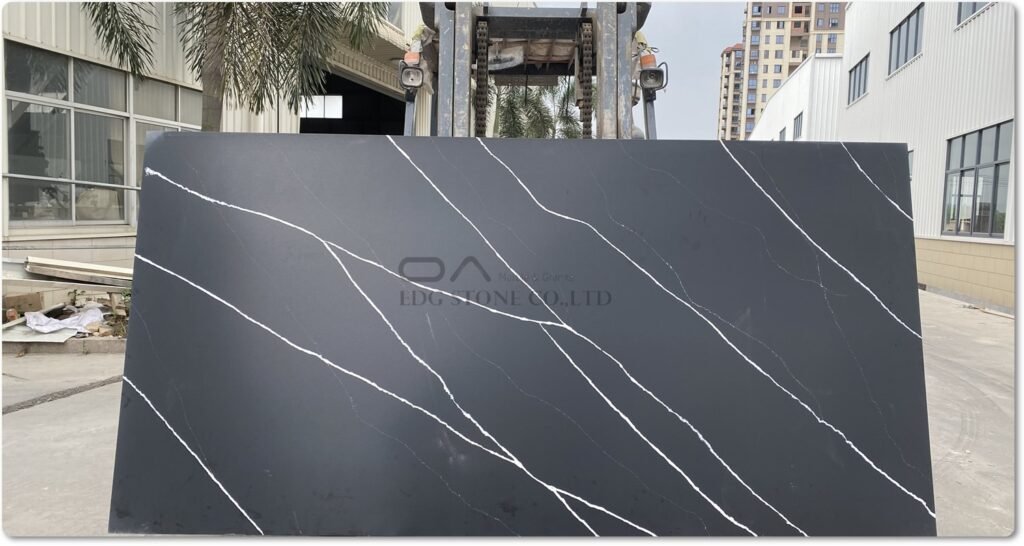
Risk Management Framework
Effective procurement also involves identifying and mitigating common risks.
| Potential Risk | Recommended Mitigation |
|---|---|
| Color variation | Approve production samples and retain master references |
| Batch inconsistency | Specify production lot controls and inspection procedures |
| Delivery delays | Build realistic lead times and maintain safety stock |
| Shipping damage | Use reinforced export packaging and appropriate container loading practices |
| Regulatory compliance | Verify applicable standards and documentation before shipment |
| Market changes | Review product portfolio regularly based on customer feedback and sales performance |
EDG Stone Factory: OEM Manufacturing Case Study
As a global manufacturer and exporter of quartz slabs and countertops, EDG Stone Factory collaborates with distributors, fabricators, developers, and project suppliers across international markets.
Its OEM and private-label services are designed to support long-term B2B partnerships through:
- Development of Calacatta-inspired quartz collections
- Customized slab dimensions and thicknesses
- Private-label packaging and branding
- Coordinated production scheduling
- Quality inspection throughout manufacturing
- Export-ready packaging for international transportation
- Technical support during project implementation
By combining manufacturing expertise with flexible customization, EDG Stone Factory aims to help distributors build differentiated product portfolios while maintaining consistent quality and reliable supply.
White Paper Conclusion
Calacatta Quartz continues to be one of the most sought-after engineered stone categories for residential and commercial interiors. As competition intensifies, distributors increasingly benefit from OEM manufacturing and private-label programs that enable product differentiation, stronger brand recognition, and greater long-term profitability.
A successful OEM partnership extends beyond production. It requires collaboration in product design, quality management, logistics, market analysis, and continuous innovation. Distributors who invest in strategic manufacturing relationships are better positioned to adapt to changing customer preferences and expand into new markets.
When evaluating manufacturing partners, buyers should prioritize technical capability, transparent quality systems, documented compliance, responsive communication, and a proven export track record. These factors contribute to more resilient supply chains and support sustainable business growth.
Frequently Asked Questions (FAQ)
1. What is Calacatta Quartz OEM manufacturing?
It is a manufacturing model in which quartz products are produced according to a customer’s specifications, including exclusive designs, dimensions, branding, packaging, and other commercial requirements.
2. What is the difference between OEM and private label?
OEM focuses on manufacturing products to customer specifications, while private label refers to selling those products under the distributor’s own brand. Many programs combine both approaches.
3. Can distributors develop exclusive Calacatta Quartz colors?
Yes. Depending on production capability and order volume, manufacturers may develop proprietary colors, veining patterns, and finishes for qualified projects.
4. What certifications should buyers consider?
Requirements vary by market and application. Commonly referenced systems include ISO quality management standards, NSF standards for applicable food-contact products, relevant ASTM test methods, and other regional compliance requirements.
5. What information should be included in an OEM agreement?
Typical agreements address product specifications, quality requirements, packaging, branding, pricing, delivery schedules, intellectual property considerations, and after-sales support.
6. How can buyers reduce quality risks?
Approve production samples, define inspection criteria, maintain reference standards, and establish clear communication throughout production.
7. Is Gold Calacatta Quartz suitable for commercial projects?
Yes. Its durability and premium appearance make it suitable for hospitality, retail, office, and high-end residential applications, provided product specifications meet project requirements.
8. How long does OEM product development usually take?
Development timelines depend on design complexity, sampling, testing, and production scheduling. Buyers should confirm expected lead times directly with the manufacturer.
Internal Link Matrix (15-Article Cluster)
To reinforce topical authority and user navigation, connect this article with the broader procurement series:
| Article | Suggested Anchor Text |
|---|---|
| Article 1 | What Is Calacatta Quartz? |
| Article 2 | Calacatta Quartz Slab Sizes and Thickness |
| Article 3 | Calacatta Laza vs. Calacatta Oro |
| Article 4 | Calacatta Quartz Countertop Applications |
| Article 5 | Calacatta Prado vs. Premata |
| Article 6 | White vs. Gold Calacatta Quartz |
| Article 7 | Calacatta Viola Quartz Guide |
| Article 8 | Jumbo Quartz Slabs Procurement |
| Article 9 | Calacatta Quartz Quality Inspection Standards |
| Article 10 | Commercial Quartz Projects |
| Article 11 | Quartz Fabrication Best Practices |
| Article 12 | Quartz Maintenance Guide |
| Article 13 | Quartz Packaging & Container Loading |
| Article 14 | Calacatta Quartz Procurement Strategy |
| Article 15 (Current) | OEM Manufacturing & Private Label Programs |
Authoritative References
To support factual accuracy and align with E-E-A-T principles, cite authoritative sources where relevant:
- Grand View Research — Engineered Quartz Surface Market Report
- Fortune Business Insights — Engineered Stone Market Analysis
- ASTM International — Test methods for engineered stone physical and mechanical properties
- ISO 9001 — Quality Management Systems
- NSF/ANSI 51 — Food Equipment Materials (where applicable)
- Natural Stone Institute — Industry technical resources
- International Organization for Standardization (ISO) — Standards catalog
- U.S. Green Building Council (USGBC) — LEED resources
- GREENGUARD Certification Program — Indoor air quality certification information
- European Committee for Standardization (CEN) — EN standards
- Occupational Safety and Health Administration (OSHA) — Guidance on silica exposure and workplace safety
- National Institute for Occupational Safety and Health (NIOSH) — Silica hazard resources