Introduction
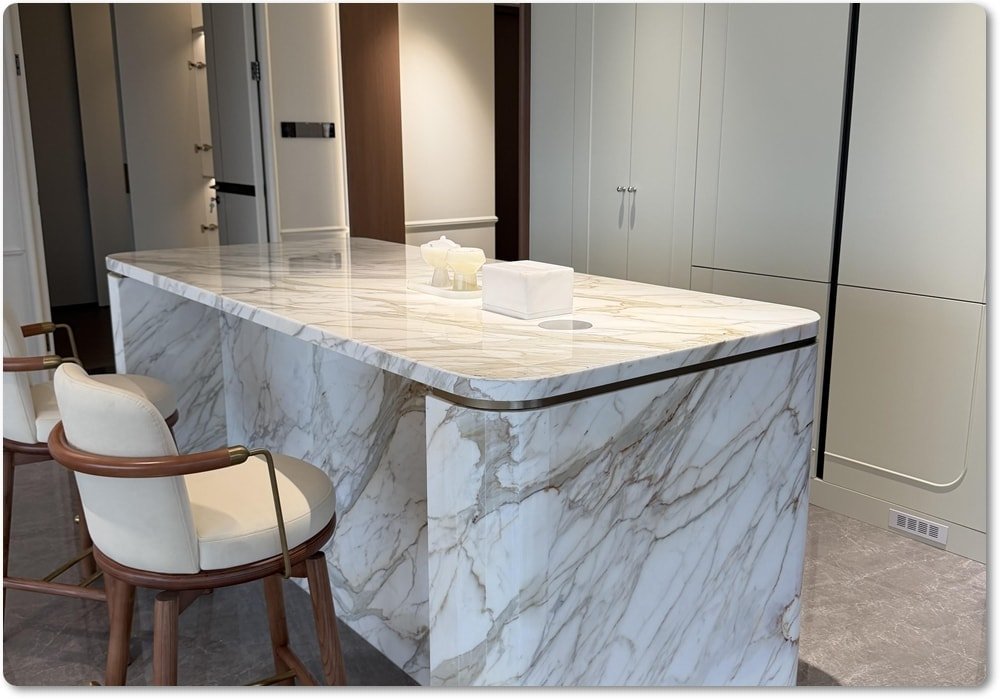
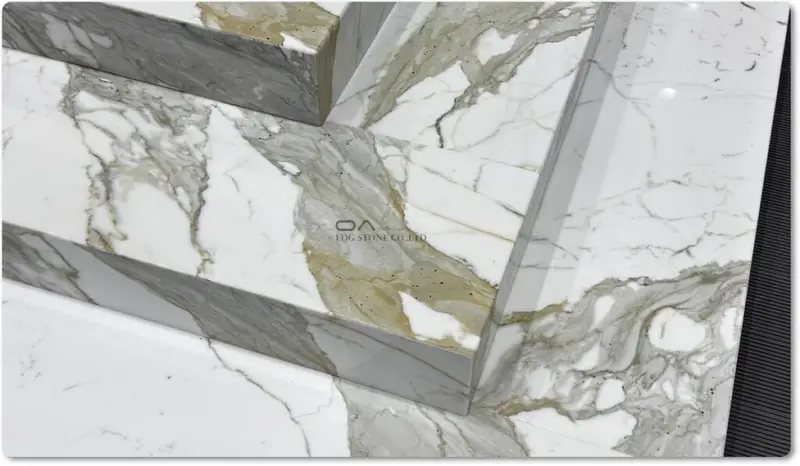
Calacatta Quartz is best treated as a design family inside the engineered quartz category, not as a single geological material. In the marketplace, the term usually refers to a marble-inspired quartz surface with a bright white or off-white background, paired with gray, gold, or soft linear veining to emulate Calacatta marble aesthetics while preserving the consistency and performance of engineered stone. Product pages from major brands consistently describe this style in those terms.
For importers, distributors, and project buyers, the procurement question is not simply “Does it look like Calacatta marble?” It is also: What is the quartz percentage, how is the slab made, how stable is the veining, what are the slab dimensions, what tests are available, and how will the fabrication shop control dust, traceability, and yield? Leading technical documents from manufacturers and standards bodies show that these are the variables that matter in real purchasing decisions.
What Is Calacatta Quartz?
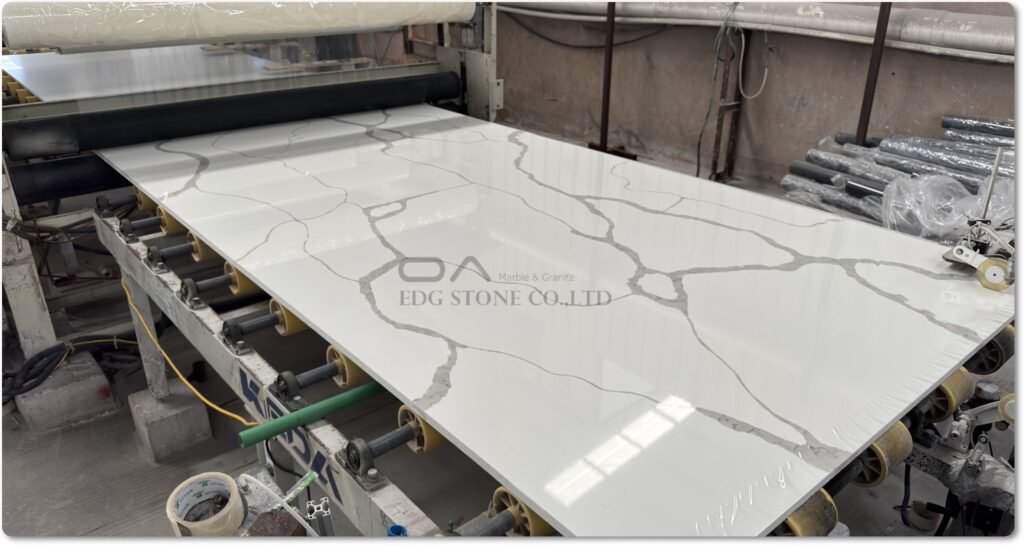
In practical procurement language, Calacatta Quartz is a marble-look engineered quartz surface that aims to reproduce the visual language of Calacatta marble: a light field, dramatic veining, and a luxury-oriented design profile. Across manufacturer collections, the visual recipe is remarkably consistent: a white base, gray or gold veining, and a polished finish suitable for countertops, islands, walls, and other interior applications.
The material advantage is that quartz surfacing is manufactured, so the buyer can usually expect more predictable patterning and more repeatable production than with natural stone. Manufacturer manuals also emphasize that quartz slabs are engineered for interior applications and marketed as solid, non-porous, durable surfaces with strong resistance to scratches, staining, and water absorption when correctly specified and fabricated.
For buyers, the two most common commercial expressions are Bianco Calacatta Quartz and White Calacatta Quartz. These names generally signal a lighter aesthetic, often with cool gray veining for a cleaner luxury look, or slightly warmer veining for a softer residential palette. In a project spec sheet, the name alone is never enough; the slab photo, batch reference, thickness, finish, and vein direction are equally important.
Procurement takeaway
Calacatta Quartz is a visual category with manufacturing controls, not a one-size-fits-all stone. Buyers should judge it by slab consistency, vein realism, traceability, available thicknesses, and fabrication stability rather than by marketing name alone.
How Calacatta Quartz Is Manufactured?
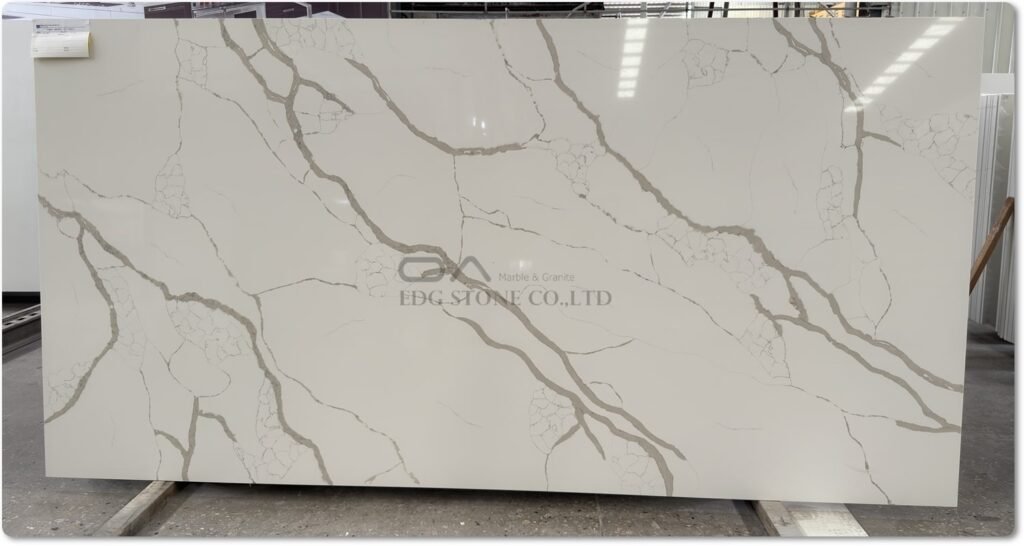
Most leading technical documents describe quartz surfacing as a blend of crushed quartz plus resins and pigments, with quartz content often reaching about 90% or more, depending on the manufacturer. Caesarstone states its surfaces contain up to 90% crushed quartz mixed with polyester resins and pigments, while Vadara specifies 90%+ crushed quartz aggregate combined with resins and pigments and fabricated by vacuum vibro-compaction. Wilsonart likewise describes quartz surfacing as a manufactured product made with natural quartz stone, polymer resin binders, and coloring agents.
A reliable procurement view of the process is: raw material selection, color control, batching, resin blending, slab forming, compaction, curing, calibration, polishing, inspection, labeling, and packing. Product manuals also stress that some designs intentionally use random or heterogeneous pattern layouts, which means slab-to-slab inspection and piece layout planning are essential before fabrication.
That traceability point matters. Cosentino’s professional manual emphasizes preserving each slab’s reference number so that the material can be tracked later if there is a claim or quality issue. For an importer, that means the purchase order should require slab IDs, lot numbers, veining photos, thickness confirmation, and pre-shipment inspection records.
Manufacturing quality is not only a visual issue. Quartz surfacing is engineered for interior use and is typically promoted as a hard, low-porosity material, but fabrication still requires disciplined shop practices. Wilsonart’s fabrication guide explicitly instructs fabricators to use wet tools and warns that quartz dust contains silica that can be hazardous when inhaled.
What to ask from the supplier?
A serious buying checklist should include the slab formula, surface finish, thickness tolerance, format size, reference numbering, packing method, and test documentation. If the supplier cannot provide those items, the purchase is still a design decision, but it is not yet a controlled procurement decision.
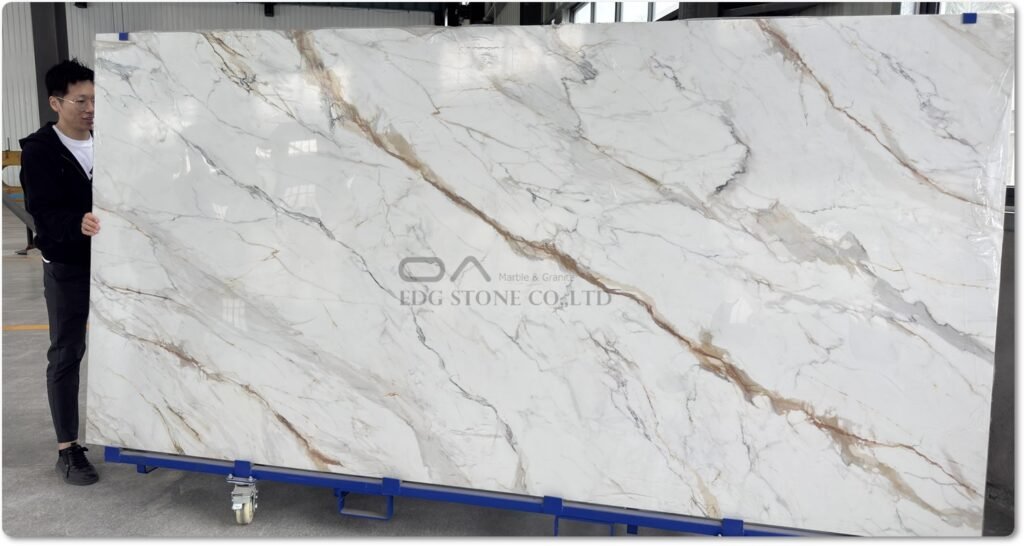
Engineered Quartz vs Natural Marble
This comparison is the core of many procurement decisions. Engineered quartz is chosen for consistency, predictable pattern control, and lower porosity, while natural marble is chosen for its unique geological variation and classic prestige. Manufacturer and technical documents consistently describe quartz surfaces as durable, non-porous, and suitable for demanding interior use, whereas Natural Stone Institute guidance warns that acidic cleaners can dull or etch calcareous stones.
That difference changes the commercial conversation. Marble can be visually unmatched, but it is inherently variable and more maintenance-sensitive in real-world kitchens and hospitality environments. Quartz offers a more repeatable specification path, especially for multi-unit projects, franchised retail, and importer programs that need stable reordering.
For countertop procurement, the strongest reason to choose Calacatta Quartz over natural marble is not just appearance. It is the ability to keep the marble look while reducing uncertainty around shade, veining repetition, and day-to-day maintenance behavior. That is why design brands repeatedly market Calacatta-style quartz as a marble-inspired surface with a clean white base and dramatic or subtle veining.
Best-fit use cases
Calacatta Quartz is usually strongest in kitchen countertops, waterfall islands, vanity tops, wall cladding, backsplashes, hotel bathrooms, and commercial interiors, where the project team wants marble aesthetics with a more standardized production model. Manufacturer manuals and spec guides commonly list these interior applications as standard use cases.
Global Market Trends in 2026
The 2026 demand picture is still favorable for quartz-based surfaces. In the National Kitchen & Bath Association’s 2026 kitchen trends report, quartz remains the leading countertop material, with natural quartzite close behind, while neutral and natural material palettes continue to dominate design direction. NKBA’s published summary says quartz leads countertop materials and quartzite follows at 62%, signaling that buyers still want a clean, premium stone look in 2026.
At the same time, the market is becoming more selective rather than simply more expansive. A recent U.S. countertop market forecast estimates the market at USD 86.4 billion in 2025 and projects USD 156.2 billion by 2035, with engineered quartz expected to represent 28.6% of material-based demand in 2025. Even though that figure is a market estimate rather than an official statistic, it supports the direction of travel: quartz remains a major material class in renovation and new-build demand.
Trade and regulatory conditions are also important. In April 2026, the U.S. International Trade Commission determined that quartz surface products are being imported into the United States in increased quantities that substantially injure the domestic industry. That does not by itself define the entire global market, but it clearly shows that quartz surfaces remain under active trade scrutiny, which matters for importers planning lead times, pricing, and sourcing strategy.
There is also a compliance dimension that buyers can no longer ignore. OSHA’s respirable crystalline silica standard sets a permissible exposure limit of 50 μg/m³ as an 8-hour time-weighted average and an action level of 25 μg/m³. CDC/NIOSH continues to warn that countertop fabricators working with engineered stone are at risk of silicosis because engineered stone often contains very high respirable crystalline silica content, typically over 90%.
Market implication for importers
In 2026, quartz is still a strong seller, but the winning suppliers are not only design-driven. They are also the suppliers that can prove consistent slab quality, document compliance, and support safer fabrication workflows for downstream buyers.
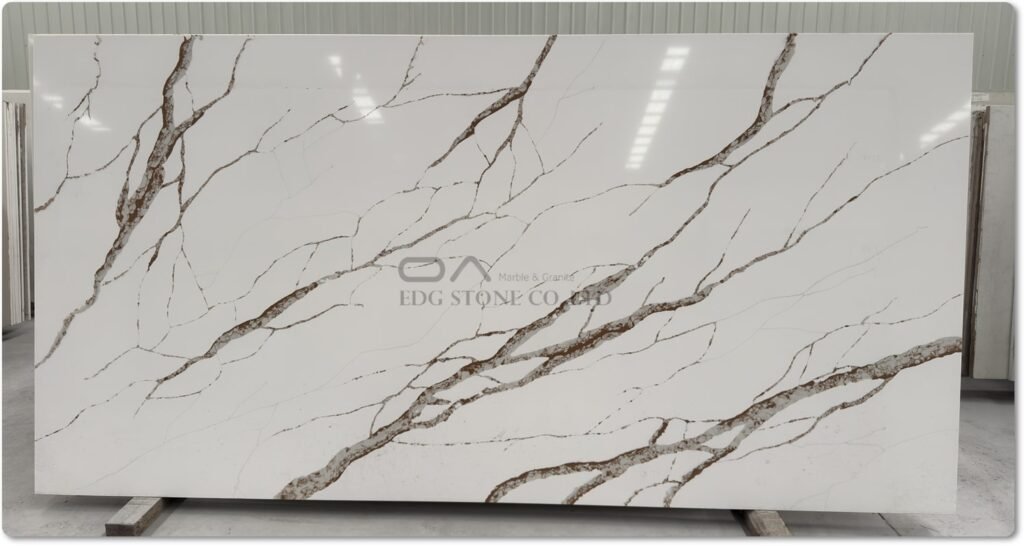
Why Importers Choose Calacatta Quartz?
Importers choose Calacatta Quartz for a combination of design flexibility and commercial control. First, the surface can deliver a high-end marble look without relying on natural stone quarry variation. Second, the slab can usually be specified with more consistent visual output across repeat orders. Third, quartz surfacing is supported by an established ecosystem of technical documentation, installation guidance, and test standards.
From a procurement standpoint, that consistency reduces project risk. In slab programs, especially for hotels, multi-family housing, and retail rollouts, buyers need predictable color tone, repeatable veining, and manageable yield. Manufacturer manuals explicitly discuss slab formats, thickness options, random pattern layout, and the importance of measuring and inspecting the material before production.
Importers also value the documentation path. The Natural Stone Institute’s standards reference quartz-based dimension stone and associated test methods such as absorption, compressive strength, abrasion resistance, and flexural strength. For procurement teams, that means material selection can be tied to measurable physical performance rather than only catalog photography.
Finally, Calacatta Quartz is commercially versatile. It can serve both price-sensitive and luxury segments when the veining strategy, finish, slab size, and thickness are tuned correctly. That is why this style is often used in residential kitchens, hospitality suites, model homes, and premium commercial interiors.
Buyer’s decision rule
Choose Calacatta Quartz when the project needs a marble-inspired look with tighter control over lead time, repeatability, and fabrication yield. Choose natural marble when the project budget and maintenance model can absorb higher variability and higher care requirements.
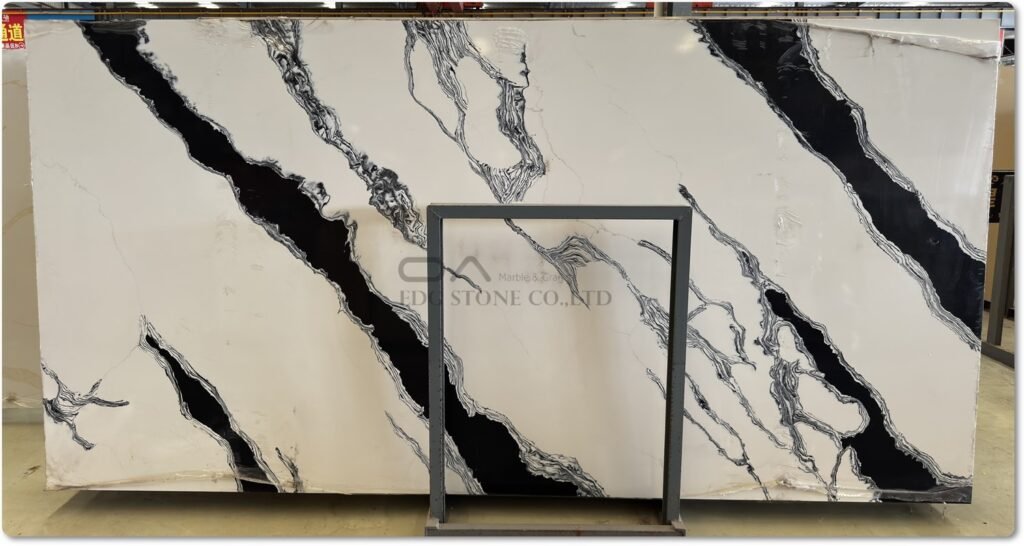
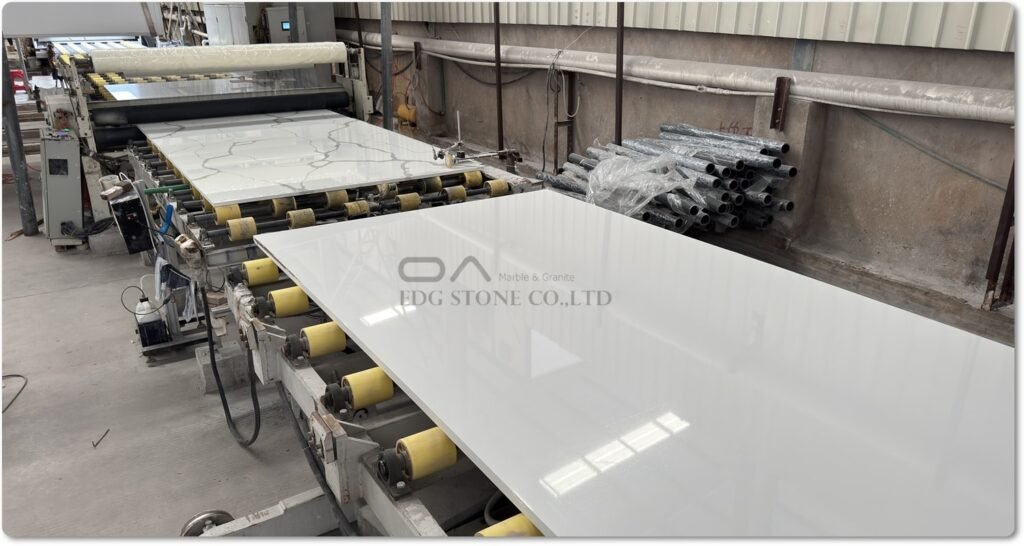
How EDG Stone Factory Manufactures Premium Calacatta Quartz Slabs?
EDG Stone Factory, as a global Quartz Slabs & Countertops Manufacturer and Exporter, can position its Calacatta Quartz program around a controlled export workflow rather than a purely decorative product line. A best-practice manufacturing model follows the same logic described in leading quartz technical documents: raw-material selection, color-controlled batching, resin blending, slab forming through compaction, curing, calibration, polishing, inspection, reference labeling, and export packing.
For a buyer-facing case module, the value proposition should emphasize the parts of manufacturing that matter most to importers: stable white background, vein consistency, slab-to-slab traceability, thickness tolerance, packing security, and export documentation. These are the exact variables that project manuals and manufacturer guides highlight when they discuss slab formats, random patterns, layout control, and reference numbers.
A strong EDG Stone Factory case module can be structured like this:
Factory process control. Raw material screening and color matching support consistent Bianco Calacatta Quartz and White Calacatta Quartz production.
Project-ready slab planning. Slab format, thickness, and vein direction are confirmed before shipment so the fabricator can reduce waste and maintain pattern continuity.
Export quality discipline. Slabs are labeled, inspected, and packed with enough documentation for distributor reordering and claim traceability.
Safety-aware fabrication support. The downstream fabrication environment should follow wet-cutting and silica-control practices consistent with OSHA and NIOSH guidance.
That case module works because it solves the buyer’s real problem: not just sourcing a beautiful slab, but sourcing a reproducible product that can be reordered, fabricated, and installed at scale with fewer surprises.
Practical Procurement Checklist
Before issuing a purchase order, request:
- Exact color name and slab photos under neutral light
- Thickness and slab format
- Reference number/lot number/batch ID
- Vein direction and random-pattern notes
- Test or technical documentation
- Packing method and container loading plan
- Installation and safety guidance for fabricators
FAQ
Is Calacatta Quartz the same as Calacatta marble?
No. Calacatta Quartz is an engineered quartz surface designed to imitate the Calacatta marble look. Product pages commonly describe it as a marble-inspired quartz with a white base and gray or gold veining, while natural Calacatta marble is a distinct geological stone.
Is White Calacatta Quartz a good choice for kitchens?
Yes, especially when the goal is a bright luxury look with a more standardized slab appearance than natural marble. Manufacturer manuals describe quartz surfaces as suitable for interior countertops and related applications, with strong durability and low maintenance characteristics.
Why is slab traceability important?
Because Calacatta-style designs often depend on vein matching and layout planning. Cosentino’s manual specifically recommends keeping the slab reference number for future traceability and claims handling.
What should importers ask for before buying?
Ask for slab photos, thickness, dimensions, lot numbers, test documentation, packaging details, and fabricator guidance. Standards references from the Natural Stone Institute also show that quartz-based stone can be evaluated with recognized test methods for absorption, compressive strength, abrasion resistance, and flexural strength.
Is fabrication safety really important for quartz?
Yes. OSHA regulates respirable crystalline silica exposure at 50 μg/m³ as an 8-hour TWA, and CDC/NIOSH warns that engineered stone workers are at risk because engineered stone can contain very high crystalline silica levels. Wet cutting, dust control, and respiratory protection are essential.
15-Article Internal Link Matrix
Article 1: 2026 Calacatta Quartz Procurement Guide
Article 2: Calacatta Quartz Color Selection Guide
Article 3: Calacatta Quartz Slab Grades and Veining Patterns
Article 4: Calacatta Quartz Thickness, Edge Profiles, and Fabrication Rules
Article 5: Calacatta Quartz Countertop Applications by Space Type
Article 6: Calacatta Quartz Kitchen Countertop Buying Guide
Article 7: Calacatta Quartz Bathroom Vanity and Wall Cladding Guide
Article 8: Calacatta Quartz Commercial Project Specification Guide
Article 9: Calacatta Quartz Quality Control and Inspection Checklist
Article 10: Calacatta Quartz Pricing, MOQ, and Container Optimization
Article 11: Calacatta Quartz Packing, Loading, and Export Logistics
Article 12: Calacatta Quartz Traceability, Labeling, and Batch Management
Article 13: Calacatta Quartz Supplier Audit Framework
Article 14: Calacatta Quartz Compliance, Safety, and Silica Control
Article 15: EDG Stone Factory Quartz Slabs & Countertops Manufacturer Case Study
Selected authoritative sources used for this guide
Caesarstone technical manual on composition and quartz content.
PentalQuartz installation manual on composition and product properties.
Vadara quartz guide specification on 90%+ composition and vacuum vibro-compaction.
Wilsonart quartz fabrication guide on product composition, interior use, and wet cutting.
Cosentino Silestone design and installation guide on slab formats, thickness, and random pattern handling.
Cosentino manual on slab traceability and reference numbering.
CDC/NIOSH 2026 bulletin on engineered stone and silicosis risk.
OSHA respirable crystalline silica standard.
Natural Stone Institute ASTM standards page for quartz-based stone testing.
NKBA 2026 kitchen trends report summary.
USITC 2026 determination on increased quartz surface imports.
U.S. countertop market forecast cited for demand direction.
Silestone technical documentation library for project support and samples.
Natural Stone Institute guides on acidic cleaners and calcareous stones.