Executive summary
White Calacatta Quartz and Gold Calacatta Quartz are not competing materials so much as two different visual strategies built on the same engineered-surface platform. In most cases, the business decision is not “which one performs better,” but “which one matches the project narrative, lighting, cabinetry palette, and procurement risk tolerance.” Modern quartz surfaces are commonly engineered from a high percentage of quartz combined with resins and pigments, which is why they can deliver marble-inspired veining while remaining nonporous and relatively stain-resistant. That performance profile, however, does not remove the need for careful specification, because fabrication, heat exposure, edge detailing, and supplier quality control still matter.
Current kitchen and bath trend data also point in the same direction: lighter, warmer, natural tones; white-and-wood palettes; statement lighting; material continuity; thin, versatile surfaces; and tactile textures. In practical terms, that means White Calacatta Quartz often reads as the safer “architectural neutral.” At the same time, Gold Calacatta Quartz tends to work as the warmer, more expressive option in luxury kitchens, hospitality suites, and feature islands.
White Calacatta Quartz vs Gold Calacatta Quartz
1. Understanding the material family
“Calacatta Quartz” is a design category, not a single standardized product. The visual goal is to echo the elegant movement of Calacatta marble, but the surface is engineered quartz. In manufacturer documentation, engineered quartz is described as a blend dominated by quartz with resins and pigments, compacted into dense slabs; some brands also offer low-silica or recycled-content variants, but the exact formulation varies by producer. That variability is important for procurement because two slabs with similar marketing names can still differ in visual density, resin system, finish, thickness availability, and fabrication behavior.
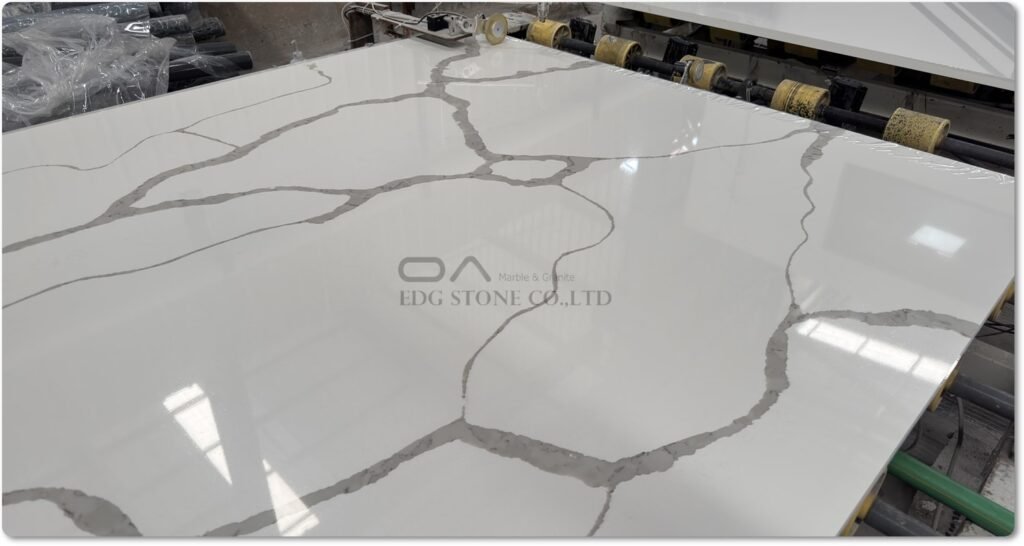
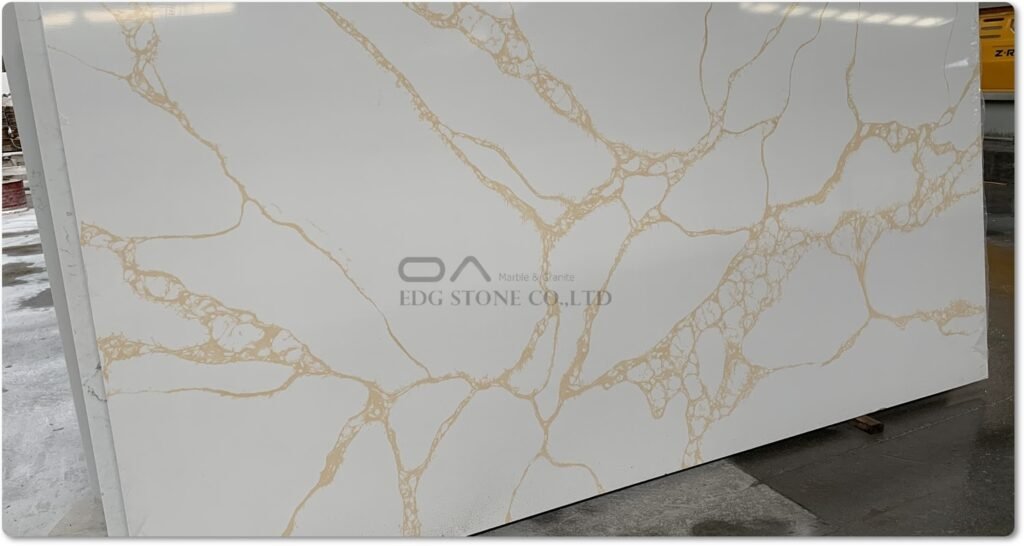
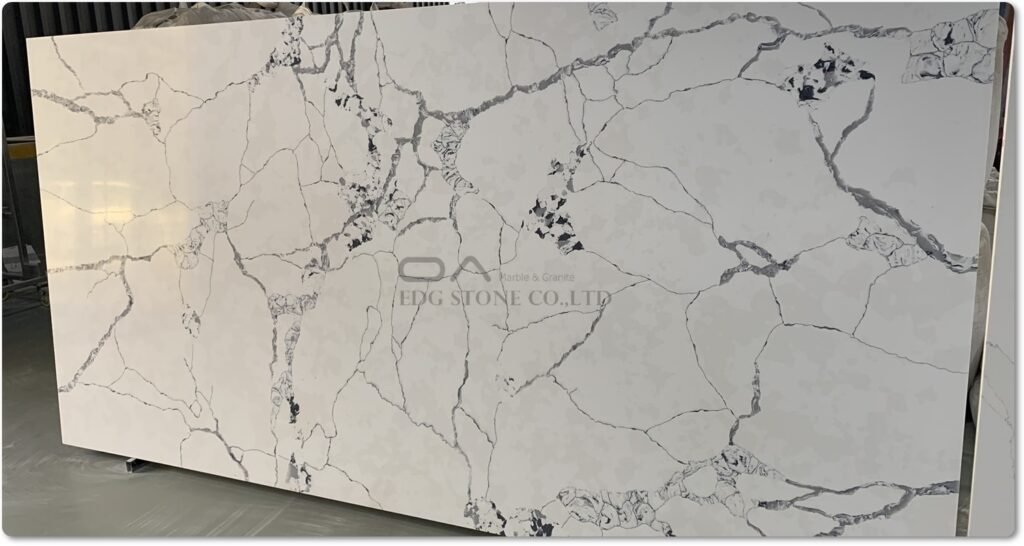
For buyers, the right comparison framework is therefore not “white versus gold” as if the slabs are chemically different products. It is “cool-white marble effect versus warm-white marble effect” within the same engineered-surface family. White Calacatta Quartz usually emphasizes a clearer, crisper background with gray or soft graphite veining. Gold Calacatta Quartz typically introduces beige, taupe, honey, or champagne-toned veining, which changes the room temperature immediately and can make the space feel softer, more opulent, and less contrast-heavy. This is an inference from how manufacturers describe their marble-inspired designs and from the current residential trend direction toward warm, natural palettes.
2. What actually changes between white and gold veining?
In practical design terms, the biggest difference is visual temperature. White Calacatta Quartz is usually selected when the project needs brightness, visual calm, and compatibility with cool or mixed-tone interiors. Gold Calacatta Quartz is usually selected when the design needs warmth, contrast against white cabinetry, or a more hospitality-driven sense of richness. The veining scale also matters: fine veining reads restrained and architectural, while thicker or more fluid veining reads bolder and more decorative. Current trend reporting from Houzz and NKBA shows sustained demand for white-and-wood kitchens, light, warm,m and natural tones, and countertops used as part of a broader visual continuum across backsplashes and islands.
For procurement teams, this means the finished sample is not enough. You need to approve not only color but also veining distribution, directionality, repeat pattern, field variation, and slab-to-slab consistency. The more “marble-like” the design, the more likely buyers are to care about bookmatching, vein flow, and whether the project wants a dramatic slab or a quiet background material. That is especially important for large islands, reception desks, lobby counters, and shower wall cladding, where joints are visible and visual alignment becomes part of the value proposition.
3. Performance profile: what buyers should and should not assume
Engineered quartz is widely chosen because it is dense, nonporous, and generally resistant to stains and scratches compared with more porous natural stones. Caesarstone’s technical materials describe quartz slabs as compacted into dense, nonporous surfaces with high scratch and stain resistance, and the company also cautions that quartz is not heat-proof,f even when it is heat-resistant in normal use. That distinction matters in procurement language: quartz is not a “no-care” material, and it is not immune to thermal shock, burn marks, or damage from poor fabrication or misuse.
For project teams, the correct specification language is more disciplined: confirm resin system, slab thickness, surface finish, tolerance requirements, thermal-use guidance, and installation conditions. ASTM’s quartz-based dimension stone standard focuses on material characteristics and physical requirements, including absorption, density, compressive strength, modulus of rupture, and abrasion resistance. ASTM’s installation guidance further notes that stone properties vary and should be verified with recent test data, with specialist review recommended in more complex conditions. In other words, the name “Calacatta Quartz” does not replace engineering review.
Gold veining technology: how is the look created?
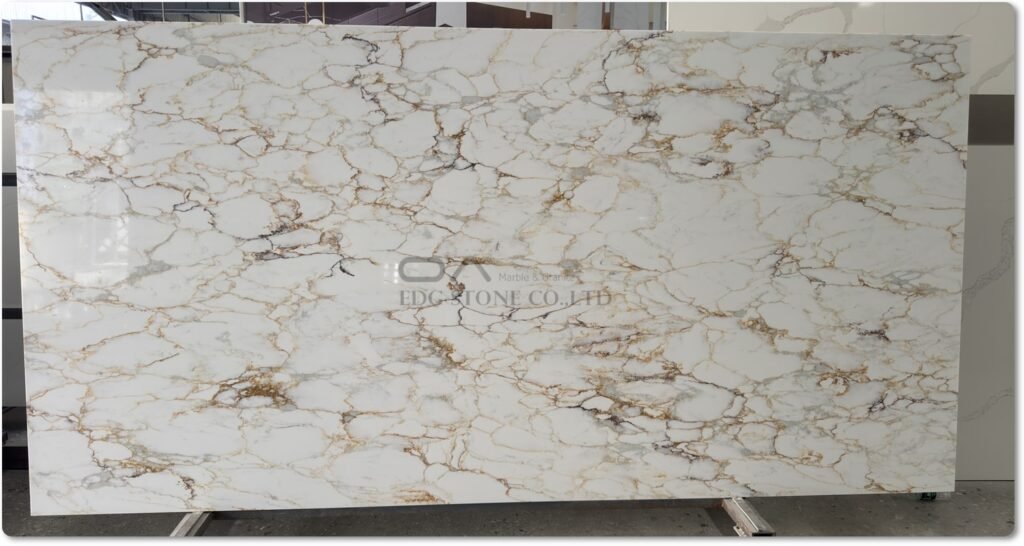
The “gold” effect is a design outcome created through pigment strategy, veining layout, particle balance, and print or casting logic, depending on the manufacturer. In quartz surfacing, pattern realism is usually the result of controlled distribution rather than random chance. Caesarstone’s technical materials describe a range of styles from fine-grained patterns to coarse-grained blends and marble-inspired surfaces with bold colors and intricate veins; this reflects how engineered quartz producers build visual complexity into slabs.
For buyers, the important procurement question is not whether the gold tone is “realistic,” but whether it is consistent enough for the project. Gold veining can appear luxurious in daylight, but under warm LED lighting, it can read more beige, while under cooler lighting, it may look softer or less saturated. That makes the lighting review part of the slab selection. NKBA’s 2026 kitchen trends reporting highlights the importance of natural lighting, quality lighting, and task lighting, while Houzz shows that decorative lighting and material continuity are central to the current kitchen-and-bath aesthetic.
A practical procurement rule emerges from that: approve gold-vein samples under the same lighting temperature planned for the actual room. A showroom sample seen under daylight and a finished kitchen seen under layered warm lighting are not the same visual environment. This is a design judgment based on current lighting-driven trends and is one of the most common reasons a quartz project looks “right on paper” but slightly off after installation.
Popular interior design styles
1. White-and-wood contemporary?
White Calacatta Quartz is exceptionally compatible with white-and-wood kitchens, which remain one of the strongest design directions in Houzz’s 2025 most-saved kitchen reporting. The reason is simple: the surface preserves brightness while allowing wood tone, cabinet profile, and hardware to do the emotional work. In this setting, white veining feels edited, not loud, and it helps the kitchen look larger and cleaner.
2. Warm minimalism
Gold Calacatta Quartz fits the warmer branch of minimalism that NKBA describes through light, warm, and natural tones. It gives a minimal room a little visual movement without forcing the designer into high-contrast drama. This is particularly effective in open-plan homes where the kitchen, dining, and living zones need to stay connected visually.
3. Transitional luxury
In transitional interiors, Gold Calacatta Quartz often performs as the bridge between classic detailing and contemporary geometry. It softens black hardware, traditional shaker cabinetry, and warm brass fixtures. White Calacatta Quartz, by contrast, is often the better bridge when the room already contains cool materials such as chrome, stainless steel, or pale oak. That distinction is a design inference grounded in the current trend toward mixed materials and balanced contrast.
4. Tactile, slab-forward spaces
Houzz’s 2025 design reporting emphasizes that surfaces are now showing up thinner, more versatile, and in more vertical or wraparound applications, while textured finishes continue to gain attention. That makes both White and Gold Calacatta Quartz candidates for not only countertops, but also waterfall islands, full-height backsplashes, wall cladding, vanity fronts, and hospitality feature walls.
Luxury residential applications
Kitchen islands
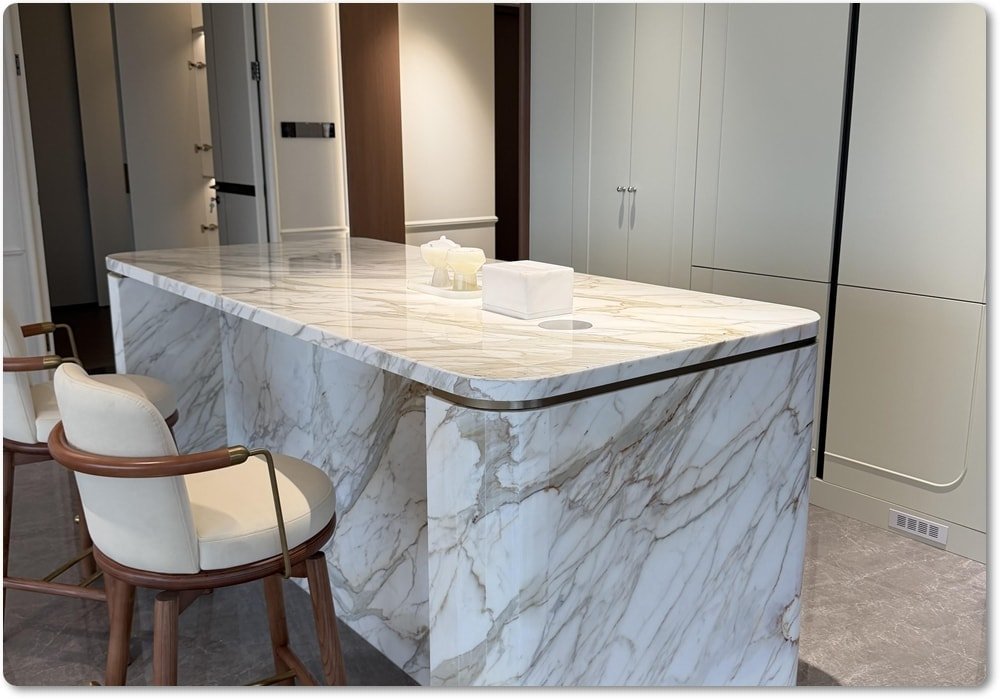
For premium residential projects, the island is the decision point. White Calacatta Quartz gives the island a gallery-like calm, which helps the room feel brighter and more expansive. Gold Calacatta Quartz turns the island into a focal object, especially when paired with a warm wood perimeter, pale floors, or brushed brass details. Because islands are often seen from multiple angles, slab selection should prioritize vein continuity and edge behavior, not just face color.
Bathroom vanities and shower walls
In bathrooms, White Calacatta Quartz generally reads cleaner and spa-like, while Gold Calacatta Quartz adds warmth and softness. Houzz reporting on new bathroom and surface trends shows continuing interest in materials that feel tactile, layered, and integrated across surfaces, including quartz used on more than just the countertop plane. For luxury bathrooms, the best practice is to align the veining with mirror lines, drain cutouts, and lighting positions so the stone becomes part of the architectural composition.
Fireplaces and feature walls
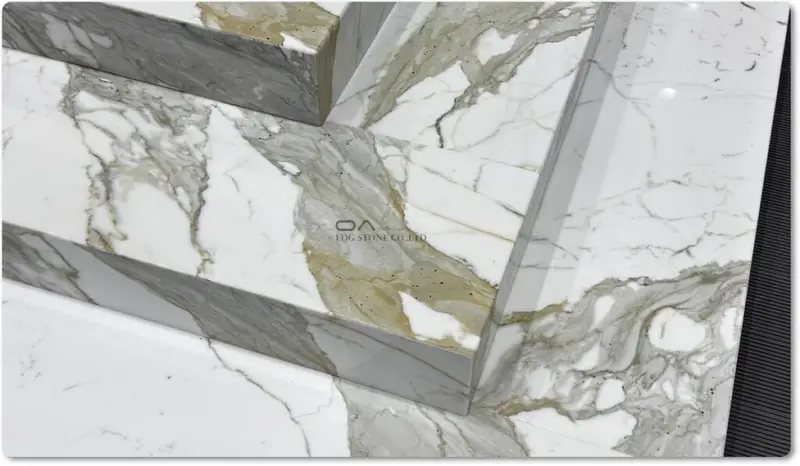
Thin engineered surfaces are increasingly used beyond the countertop, including on walls and fireplace surrounds. That matters for Calacatta Quartz because the visual language of marble-style veining can now be extended vertically for a monolithic look. White Calacatta Quartz gives the fireplace a quieter, more refined presence; Gold Calacatta Quartz makes it warmer and more sculptural.
Hotel design applications
Hotel projects usually care less about “which color is prettier” and more about the total cost of ownership, visual durability, and brand consistency. Lobbies, reception desks, buffet counters, bathroom vanities, and suite bars need surfaces that look premium under varied lighting conditions and hold up to frequent guest turnover. Quartz is attractive here because of its nonporous and stain-resistant character, but the project still needs proper detailing, fabrication quality, and heat protection strategies.
White Calacatta Quartz is usually stronger for hotels that want a clean, international, high-key visual identity. It photographs well and pairs with most wall finishes, which reduces risk across different property types. Gold Calacatta Quartz is usually stronger for resort, boutique, and heritage-inspired concepts where the design story relies on warmth, softness, and a sense of elevated material richness. Current industry trend reporting reinforces the move toward natural materials, light warm palettes, and integrated surface continuity, all of which support Calacatta-style quartz use in hospitality.
For hotel procurement teams, a useful rule is to ask for three things: a daylighted sample, a warm-lighted sample, and a full-slab image. The color decision should be made from all three, not from a single chip. That reduces risk in projects with repeated installations across many rooms and multiple subcontractors. This is a procurement inference consistent with the trend toward lighting-sensitive, visually continuous interiors.
Buyer selection framework
Step 1: Choose by spatial temperature
If the project needs brightness, clarity, and broad compatibility, choose White Calacatta Quartz. If the project needs warmth, richness, and a softer marble effect, choose Gold Calacatta Quartz. This is the simplest and most reliable first filter. It aligns with current design preferences for light, warm, natural tones while preserving room-specific flexibility.
Step 2: Choose by lighting environment
Natural light tends to make veining look cleaner and more dimensional. Warm artificial light makes gold tones feel richer and can also make some whites read creamy. NKBA’s trend reporting places high emphasis on natural lighting, quality lighting, and task lighting, which means surface color must be reviewed in the same lighting conditions expected on site.
Step 3: Choose by use case
For a showpiece island or lobby desk, stronger movement and bolder gold veining can be an asset. For kitchens with lots of cabinetry detail, appliances, or mixed material transitions, a more restrained white vein may be safer. If the space is compact, White Calacatta Quartz can help reduce visual interruption; if the space is large and open, Gold Calacatta Quartz can add warmth without crowding the room. This is an applied design judgment consistent with the current move toward continuity and calmer visual fields.
Step 4: Choose by fabrication and compliance risk
Procurement should verify slab thickness, edge compatibility, minimum order quantity, lead time, and acceptable use conditions. Because engineered stone fabrication can expose workers to respirable crystalline silica, buyers should also require supplier safety documentation, fabrication controls, and installer competence. OSHA identifies cutting, grinding, and manufacturing stone countertops as silica-exposure activities, and NIOSH notes that countertop fabricators working with engineered stone are at risk of silicosis due to high respirable crystalline silica content.
Step 5: Validate with technical standards
ASTM C616 gives a useful technical framework for quartz-based dimension stone selection, while ASTM C1242 emphasizes that stone properties vary and should be evaluated with recent test data and appropriate specialist review. For B2B buyers, that means the purchase order should ask for more than a pretty picture: require physical property data, batch consistency information, and project-specific fabrication guidance.
Procurement strategies for importers, distributors, and project buyers
1. Buy the visual system, not only the slab
A Calacatta quartz project is a system of slab color, pattern scale, finish, edge profile, backsplash treatment, and lighting. The best procurement teams compare all five together. White Calacatta Quartz tends to be more forgiving across multiple applications; Gold Calacatta Quartz requires more deliberate design coordination but can produce a more luxurious result when executed well. This approach matches current surface trends toward integrated and continuous material use.
2. Standardize approval checkpoints
Use a three-stage approval process: sample chip, slab photo or video, and final pre-shipment inspection. For repeat orders, lock in the reference slab and reference batch. This is especially important for hotel and developer accounts where a consistent appearance across phases matters more than one-off beauty. ASTM guidance supports the use of recent test data and project-specific review rather than blind reliance on a name or marketing description.
3. Ask for fabrication and installation guidance early
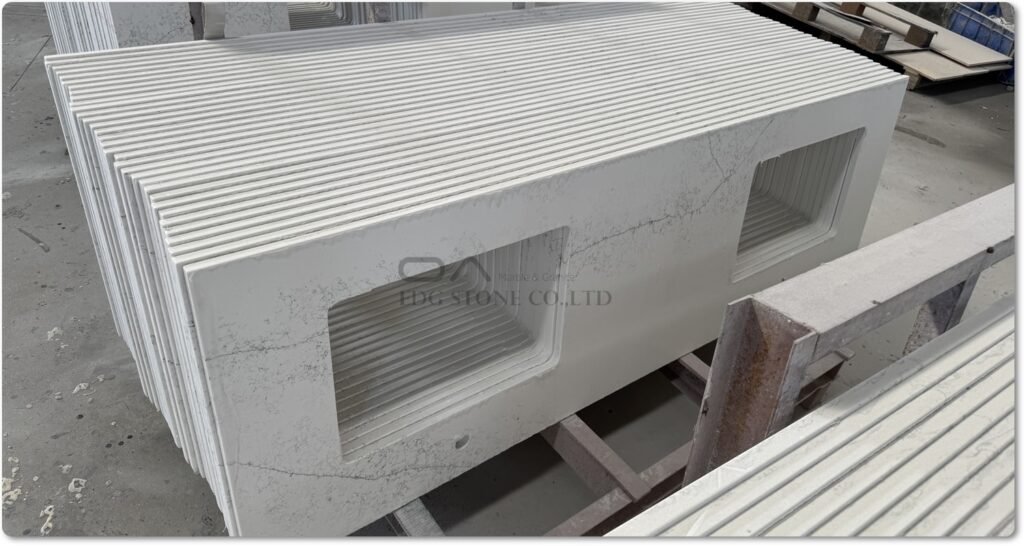
If the project includes waterfall edges, mitered corners, long spans, or vertical cladding, request technical guidance before the purchase is finalized. Quartz surfaces can perform very well, but thermal behavior, support spacing, joint placement, and handling practices still affect the outcome. This is where supplier experience becomes part of the product value.
4. Separate aesthetic approval from occupational safety compliance
Design approval and worker safety are different checkpoints. Even a beautiful slab should not move forward without silica controls, PPE requirements, dust suppression, and trained fabrication teams. OSHA and NIOSH both emphasize the risk associated with stone countertop fabrication. For a serious buyer, this is not a side note; it is part of supplier qualification.
5. Match the sourcing model to the project type
Residential distributors often need faster color assortment and showroom-friendly samples. Hospitality buyers need repeatability and documentation. Architects need technical submittals. Developers need price stability and schedule certainty. Gold Calacatta Quartz often wins when the project is story-driven; White Calacatta Quartz often wins when the project needs broad compatibility and lower design risk. This is the procurement logic behind the material choice.
EDG Stone Factory case module
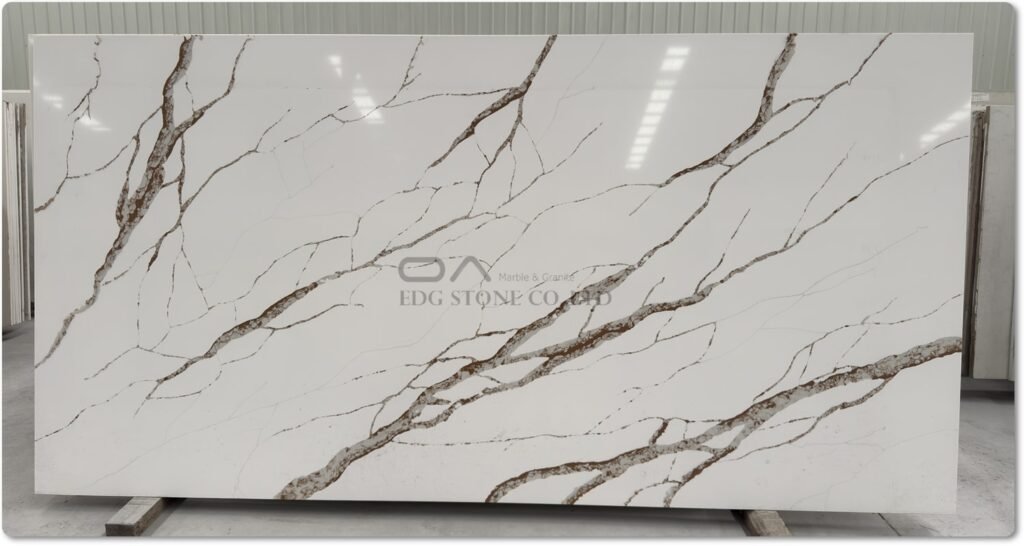
EDG Stone Factory can be positioned as a global Quartz Slabs & Countertops Manufacturer and Exporter with a quartz and engineered-surface portfolio that serves importers, distributors, architects, designers, hotels, and commercial project teams.
Suggested case module copy:
EDG Stone Factory supports B2B buyers who need consistent slab selection, custom fabrication, and export-ready packing for large-format surfaces. For White Calacatta Quartz and Gold Calacatta Quartz programs, the ideal workflow is sample approval, slab batch confirmation, project-specific cut-to-size review, and pre-shipment quality inspection. This approach helps buyers reduce color mismatch risk, improve installation efficiency, and keep the final installed look aligned with the design brief.
Positioning angle:
White Calacatta Quartz for clean, high-clarity environments.
Gold Calacatta Quartz for warmer luxury interiors and statement surfaces.
Both options should be specified with project lighting, joint planning, and installation requirements in mind.
FAQ
Is White Calacatta Quartz better than Gold Calacatta Quartz?
Neither is universally better. White Calacatta Quartz is usually better for brighter, more neutral, and more broadly compatible interiors. Gold Calacatta Quartz is usually better for warmer, more expressive, and more luxurious design stories. The right choice depends on lighting, cabinetry, flooring, and project type.
Does Gold Calacatta Quartz perform differently from White Calacatta Quartz?
Not inherently. Performance depends more on the exact manufacturer, slab formulation, thickness, finish, and fabrication quality than on the color family itself. Engineered quartz is generally dense and nonporous, but it is still not heat-proof.
Is engineered quartz safe to fabricate?
Fabrication requires strict silica controls. OSHA and NIOSH both warn that cutting and grinding stone countertops can expose workers to respirable crystalline silica, which is associated with silicosis and other serious diseases. Buyers should require safety documentation and qualified fabricators.
What should procurement teams request from suppliers?
Ask for technical data, slab photos, sample approval, batch consistency details, fabrication guidance, and installation recommendations. ASTM guidance supports recent test data and project-specific review for stone selection and attachment systems.
Which style is more trend-aligned in 2025–2026?
Both are relevant, but current trend signals favor light, warm, natural tones, white-and-wood palettes, integrated surfaces, and tactile finishes. That means White Calacatta Quartz and warmer Gold Calacatta Quartz can both work; the best choice depends on whether the project wants calm neutrality or warmer luxury.
Internal link matrix for a 15-article cluster
- Article 1 – What Is White Calacatta Quartz? Material Basics and Market Position
- Article 2 – White Calacatta Quartz Slabs: Thickness, Finish, and Visual Grading
- Article 3 – Gold Calacatta Quartz Slabs: Veining Styles and Design Use Cases
- Article 4 – Quartz vs Natural Marble: Performance, Cost, and Maintenance
- Article 5 – Quartz Countertop Fabrication Guide: Cutting, Edges, and Seams
- Article 6 – White Calacatta Quartz for Kitchens: Islands, Backsplashes, and Wall Cladding
- Article 7 – Gold Calacatta Quartz for Bathrooms: Vanities, Showers, and Feature Walls
- Article 8 – Hospitality Quartz Specification Guide for Hotels and Resorts
- Article 9 – Quartz Procurement Strategy for Importers and Distributors
- Article 10 – Quartz Slab Inspection Checklist for Project Buyers
- Article 11 – How to Choose the Right Veining Scale for Calacatta Quartz
- Article 12 – Quartz Surface Standards, Test Methods, and Compliance Documents
- Article 13 – Quartz Care and Maintenance Guide for End Users and Facility Teams
- Article 14 – White Calacatta Quartz and Gold Calacatta Quartz in Luxury Residential Design
- Article 15 – EDG Stone Factory Quartz Export Program: Samples, MOQ, Lead Time, and QC
Source list
- ASTM C616/C616M – Quartz-Based Dimension Stone.
- ASTM C1242 – Dimension Stone Attachment Systems.
- OSHA – Crystalline Silica Overview.
- OSHA – Respirable Crystalline Silica standards.
- CDC/NIOSH – Engineered Stone and Silicosis.
- CDC/NIOSH – Worker Exposure to Silica during Countertop Fabrication.
- NKBA – 2025 Kitchen Trends Report.
- NKBA – 2026 Kitchen Trends Report.
- Houzz – 2025 Kitchen Trends Study highlights.
- Houzz – 2025 Countertop and Surface Trends.
- Houzz – Most Popular New Kitchens in 2025.
- Houzz – Kitchen and Bath Product Trends in 2025.