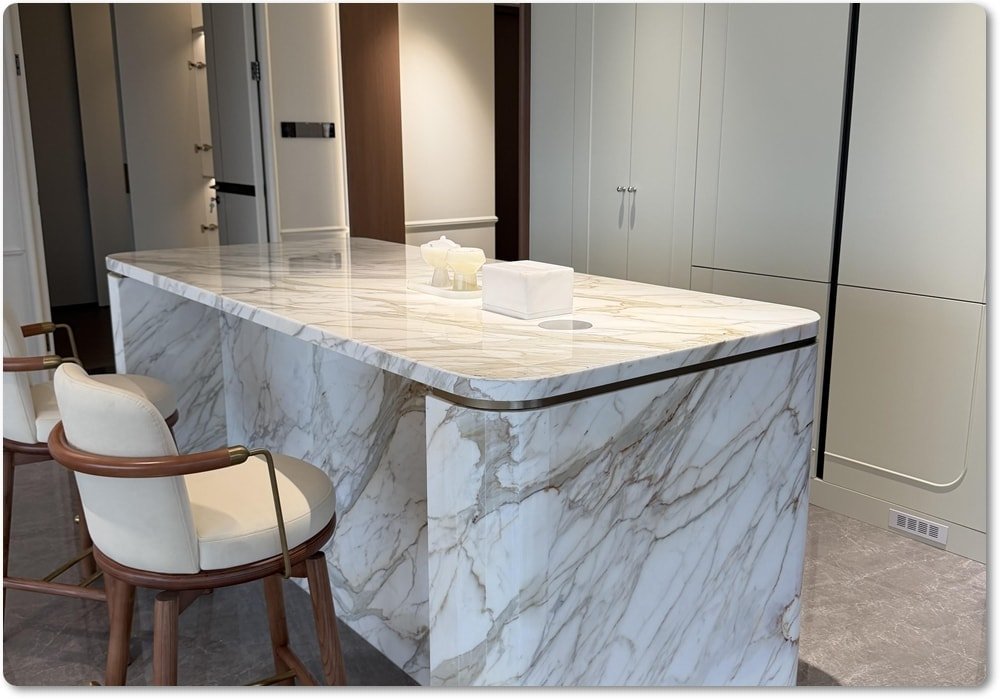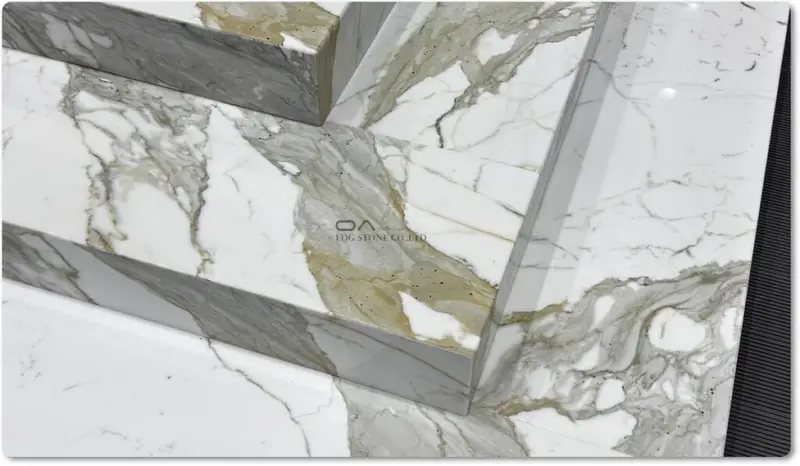
Technical snapshot: why 3cm quartz slabs harder to cut?
Engineered quartz slabs combine high-hardness mineral filler (ground quartz) with polymeric resin and pigments to create a dense, low-porosity composite. Quartz grains themselves have a Mohs hardness of around 7, so the composite is highly abrasive to tooling. When slab thickness increases to 3cm (30mm), several factors combine to raise the technical difficulty:
Longer kerf engagement — deeper cuts mean the blade is under load for longer, increasing heat and the chance of tool-induced micro-fractures.
Higher bending and vibration stress — the thicker slab stores and transmits more energy during cutting; insufficient support or vibration dampening leads to chipping.
Thermal effects at depth — more material removed and more friction generate heat that can soften or alter resin close to the kerf, causing color changes or resin pull-out.
Internal slab variability — pockets of inconsistent resin, voids, or uneven filler distribution create stress risers that can crack during cutting.
Understanding these root causes explains why the slab raw material quality and factory processes upstream are pivotal to downstream yield.
Tools, techniques, and best practices for cutting and polishing 3cm quartz
Professional cutting ecosystem
Successful fabrication of 3cm quartz requires purpose-built equipment and disciplined technique:
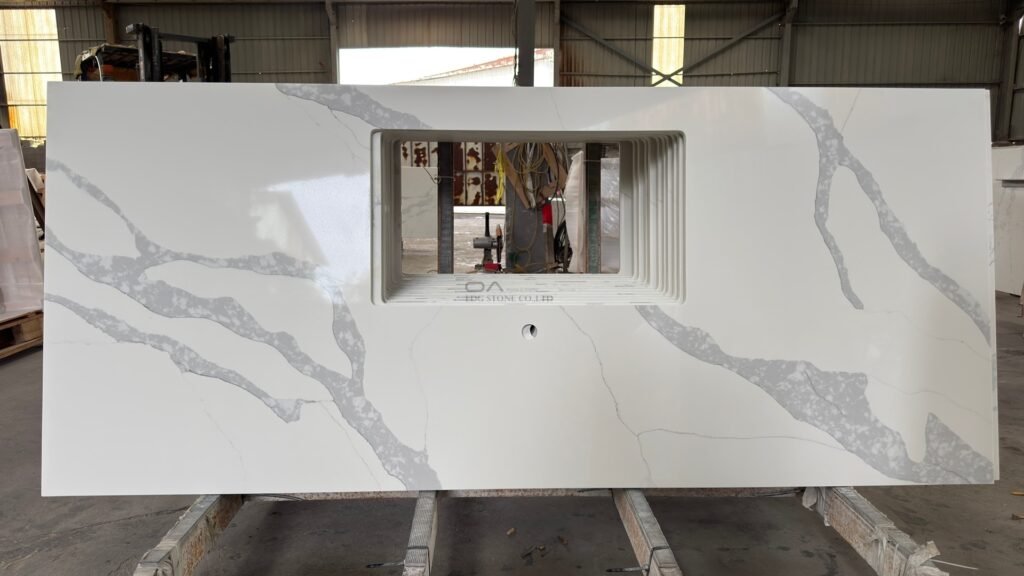
Wet bridge saws and CNC routers: Wet cutting provides continuous cooling and dust suppression. Bridge saws with large-diameter diamond blades are standard for initial straight cuts. CNC routers with plunge routing capability and water lubrication produce precise cutouts (sinks, cooktops) with minimal chips.
Diamond tooling: Use diamond blades and segmented or continuous rims specifically rated for engineered stone and dense composites. Blade segment height, bonding hardness, and diamond grit size must match the application.
Staged cutting: Rather than a single full-depth plunge, perform multiple passes that gradually deepen the kerf. This reducesthe instantaneous torque on the blade and reduces chipping.
Fixturing and support: Clamp or support slabs close to the cut line. For sink and corner cuts, add temporary reinforcement across the area to prevent stress-induced cracks.
Feed speed and RPM tuning: Find the optimal balance — too fast and chips form; too slow and heat build-up occurs. Track blade wear and adjust feed accordingly.
How to Cut a Quartz Countertop for Sink and Cooktop Cutouts?
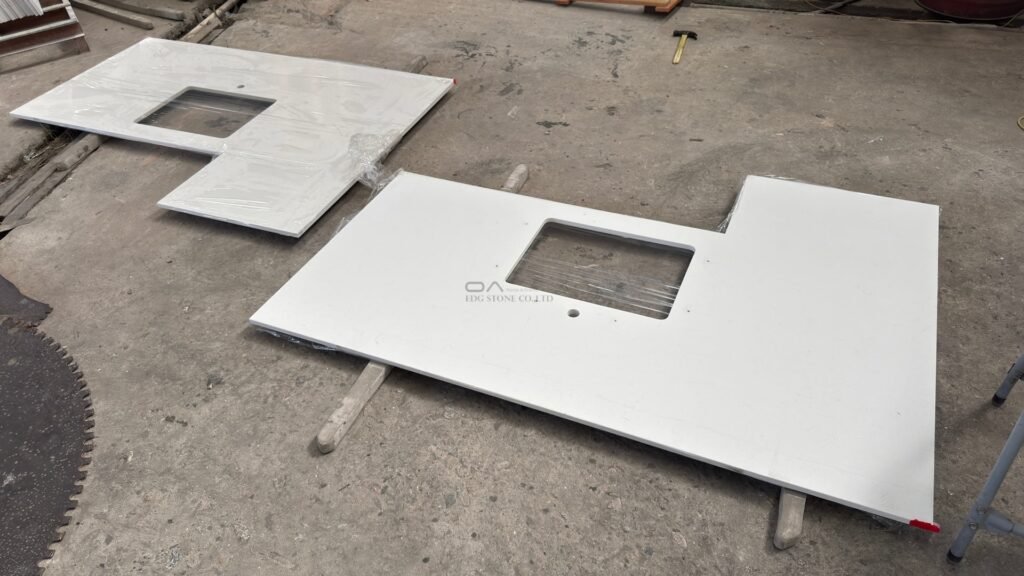
Template & measurement: Always create an accurate template sized to the sink/cooktop with accounted tolerance for clips and sealant.
Pre-drill pilot holes: For internal corners and cutouts, drill pilot holes before routing to eliminate stress concentration.
Staged routing: Use CNC or hand routing in staged passes with water feed; finish with polishing pads to restore edge clarity.
Support edges: Avoid leaving long unsupported spans after a cut; support reduces the chance of slab breakage during handling.
How to cut quartz by hand — safe limitations?
Hand cutting should be limited to small notches or in-field adjustments. Use a handheld wet saw or angle grinder fitted with diamond blades and a constant water supply. Keep passes shallow and always finish with polishing pads. For full countertops or large cutouts, professional machinery is recommended.
How to polish quartz countertops after cutting?
Polishing restores edge finish and removes saw or router marks:
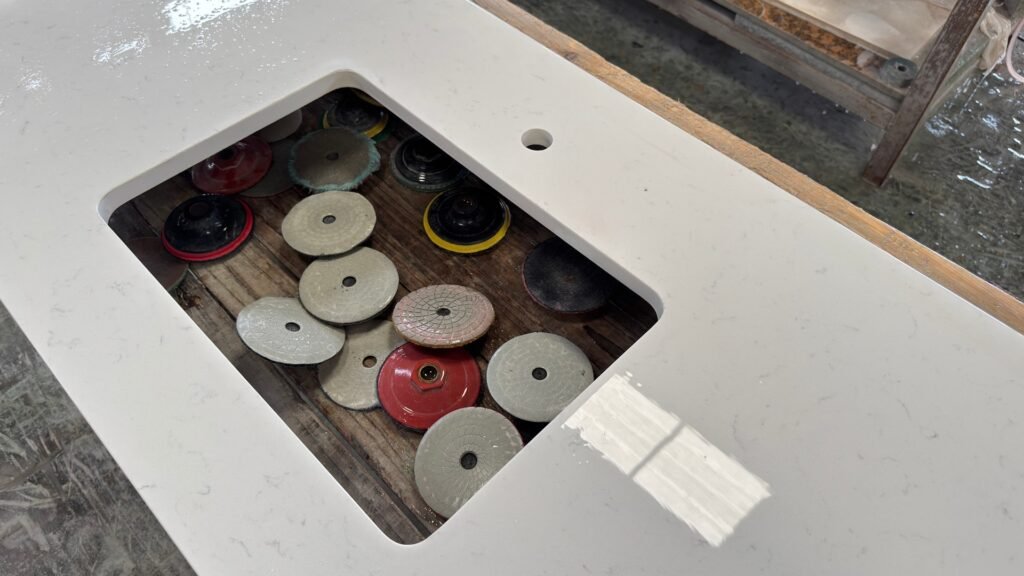
Coarse cleanup: 60–120 grit resin-bond diamond pads to remove saw marks and chamfer the edge.
Progressive polishing: Move through 200, 400, 800, 1500 (or manufacturer-recommended) grits; hold consistent pressure and maintain water lubrication.
Final finish: For high-gloss surfaces, finish with a compound buff and soft pad; for honed or textured finishes, replicate the original surface profile with appropriate pads.
Quality check: Inspect under bright light for micro-chipping, resin pull-out, or color shifts. Rework locally if necessary.
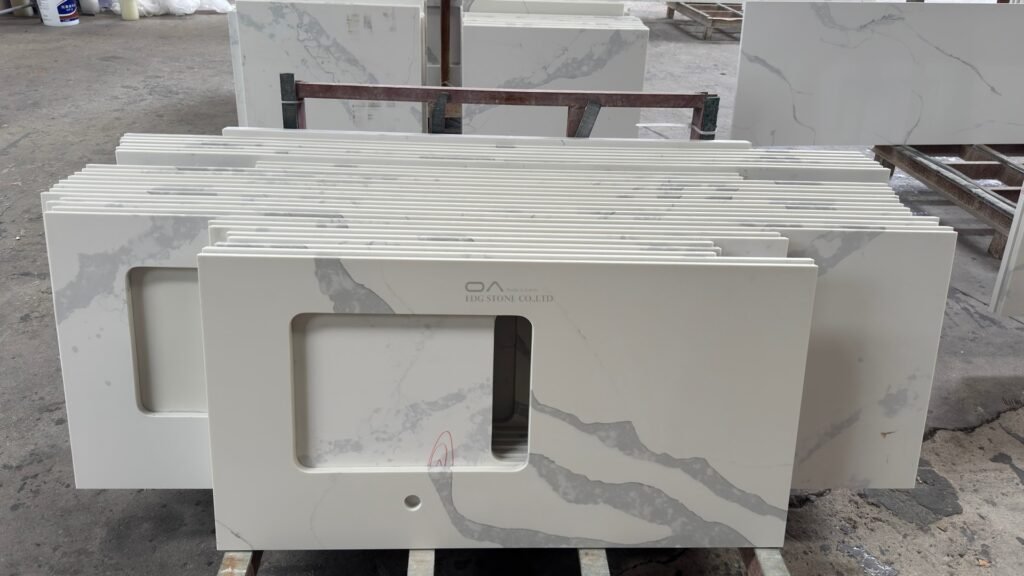
The biggest risk factors that drive processing loss rates
Defects that cause scrap and rework
Chipping and micro-fractures: Small edge chips may expand into larger cracks; visible chips often render a finished countertop unsellable.
Delamination or resin pull-out: Poor resin bonding allows aggregates to detach during cutting or polishing.
Color or gloss change at kerf: Overheating or chemical differences in the resin near cut faces can produce locally darker or duller areas, which are cosmetically unacceptable.
Operational contributors to losses
Worn or inappropriate tooling: A dull diamond blade massively increases friction and heat, raising defect risk.
Poor slab support and fixturing: Insufficient support equals more vibration and unpredictable breakage.
Operator skill variability: Skilled fabricators understand feed, fixturing, and staging; less experienced operators produce higher scrap rates.
Inadequate QA at source: Upstream slab manufacturers who don’t control resin ratio, particle grading, or cure variability force fabricators into excessive rework.
How do high-quality raw materials reduce loss and cost?
Key raw-material attributes that matter
Uniform mineral grading: Even particle size distribution avoids localized stress points when cut, ensuring predictable kerf behavior.
Optimized resin formulation and cure: Correct resin-to-filler ratios and controlled polymerization produce consistent adhesion and minimize voids.
Low porosity and void-free slabs: Fewer internal voids mean fewer crack initiation sites and cleaner edges after cutting.
Stable pigmentation and batch consistency: Reduces the risk of visible color shifts at cut edges or after polishing.
Business impact of improved raw materials — a numerical example
Consider a typical plant cutting 1,000 slabs monthly, unit value (raw + fabrication) = $350:
Baseline scrap rate 4% → 40 slabs lost → $14,000 monthly material loss.
Improved raw material & process reduced scrap to 1.5% → 15 slabs lost → $5,250 monthly material loss.
Monthly savings = $8,750 (materials only). Add labor savings, reduced rework time, and fewer warranty claims to compound returns.
Even small reductions in scrap percentage translate into large dollar savings when slab costs and production volumes are significant.
Regulations, health, and safety trends that shape fabrication choices
Regulatory pressure around respirable crystalline silica has been a major driver of safer fabrication practices. In many countries, authorities mandate exposure controls, monitoring, and engineering measures. Common regulatory-driven requirements include:
Wet cutting or enclosed water systems to suppress airborne dust.
Local exhaust ventilation (LEV) and HEPA filtration on enclosed CNC booths to capture residual dust.
Exposure monitoring and medical surveillance for workers with regular silica exposure.
Work procedures and training mandates that require documented methods for safe cutting and maintenance.
From a business standpoint, compliance costs are real. However, meeting these regulations forces the adoption of wet cutting, enclosed workflows, and improved tooling — measures that also reduce heat damage and dust-borne micro-abrasives that can degrade cut quality. In short, compliance often improves product quality and lowers scrap rates while protecting workers.
Metrics, KPIs, and operational levers to measure loss-rate improvements
Core KPIs
Scrap Rate (% of slabs scrapped) — headline metric.
Yield (usable square meters per slab) — measures usable area after defects.
Rework Minutes per Slab — indicates finishing burden.
Blade Life (cuts per blade) and Tooling Cost per Slab — track tooling economics.
On-time Ship Rate — indirectly reflects downstream disruption from defects.
Operational levers
Supplier QA scorecards: Rank slab suppliers by QA attributes (void rate, color consistency, batch testing).
Tooling program: Track blade wear and switch proactively; standardize blade types for specific cuts.
Operator training and certification: Structured training reduces variability and defects.
Process automation: CNC nesting and automated handling reduce manual error and vibration.
Example ROI timeline
Initial investment in upgraded slab sourcing, new blades, and operator training can be offset in months by reduced scrap and faster throughput. Track monthly material loss, tooling spend, and rework hours to calculate payback and cumulative savings.
Manufacturing and buying-intent keywords
Sprinkle these long-tail and intent-oriented phrases naturally across product pages, FAQs, and H2/H3 headings to capture commercial queries:
EDG Stone 30mm quartz slabs manufacturer,
Buy 3cm quartz slab factory wholesale,
best diamond blades for cutting quartz 30mm manufacturer recommended,
How to cut and polish quartz countertops after cutting professional guide,
quartz countertop cutting for sink/cooktop — factory process,
low-scrap quartz slab supplier for fabricators,
How difficult is it to cut quartz countertop — industry guide,
quartz slab wholesale for commercial projects, factory pricing.
Semantic closure: How does this content answer market needs, compliance, and buying decisions?
How (practical): Adopt wet cutting, staged blade passes, CNC routing for precision cutouts, and progressive polishing sequences. Procure slabs with documented QA, uniform filler grading, and consistent resin chemistry. Track KPIs such as scrap rate and tool life monthly.
Why (business case): Higher-quality raw slabs reduce micro-defects that turn into rejects during cutting and polishing. Lower scrap means less material cost, less labor rework, fewer warranty claims, and improved margins. Investing in quality upstream creates predictable downstream performance.
What (materials & process considerations): Prioritize slab suppliers who publish batch QA, porosity, and resin/filler specs. Standardize tooling and consumable inventories to ensure consistent cut behavior. Use enclosed water filtration and HEPA systems to comply with silica controls and to protect surface quality.
Options (budget tiers):
High budget: Enclosed CNC lines, automated handling, in-line water recycling, and HEPA filtration.
Mid budget: Bridge saws with high-quality diamond blades, wet tables, and formal operator certifications.
Low budget: Outsource complex cuts to certified fabricators and invest in incremental improvements in slab sourcing.
Considerations (risk & compliance): Meeting silica exposure limits requires engineering controls, which also improve cut quality. Non-compliance risks worker health issues, fines, and production stoppages — all of which increase true cost beyond scrap dollars.
FAQ — Common Google-hot questions with concise answers
Q1 — Is it hard to cut quartz countertops?
Yes. Engineered quartz is dense and contains hard mineral filler, which makes it abrasive to tooling. Cutting is straightforward with the right diamond blades, wet cutting, and correct feed rates, but dry cutting or improper technique commonly produces chipping, burning, or cracks.
Q2 — How to cua t quartz countertop for sink or cooktop cutouts?
Use precise templates, pre-drill pilot holes for internal corners, and perform staged routing passes with a water-cooled diamond tool or CNC router. Support the slab during the operation, finish with progressive diamond pads, and inspect the kerf for chips or resin pull-out.
Q3 — How to cut and polish quartz by hand?
Reserve hand methods for small adjustments using a handheld wet saw or angle grinder with a diamond blade, and always keep water on the cut. Finish with progressive polishing pads (200→400→800→1500 grit) to restore the edge and minimize visible repair marks.
Q4 — Can cutting darken the color of pale quartz stones?
Aggressive cutting, overheating, or excessive friction can alter resin near the kerf and cause local darkening. Proper tooling and cooling reduce the risk; light polishing may correct minor discoloration, but severe thermal damage can be irreversible.
Q5 — What are the health and regulatory considerations when cutting quartz?
Respirable crystalline silica is a regulated hazard in many jurisdictions. Fabricators must use wet cutting, LEV, HEPA filtration,n and periodic exposure monitoring; they must also provide training and medical surveillance to comply with local rules and protect worker health.
Semantic closure & takeaway
How: Implement wet bridge saws and CNC routing, stage cuts, use diamond tooling matched to 30mm engineered stone, and adopt progressive polishing sequences. Standardize operator training and enforce fixturing protocols.
Why: High-quality raw materials reduce internal defects and variability, so cutting becomes predictable; predictable cutting reduces scrap, rework, lab, or and warranty exposures — directly improving margin.
What: Seek slab suppliers with batch QA, low porosity, and documented resin/filler specs; adopt enclosed water filtration and HEPA extraction for compliance and improved surface quality.
Options: Choose between in-house CNC automation for high volume, upgraded bridge saws for mid-volume, or outsourcing complex cuts while investing in improved slab sourcing for low capital expense.
Considerations: Regulatory compliance with silica is mandatory in many regions; investments to comply often yield simultaneous productivity and quality benefits. Tracking KPIs (scrap rate, yield, blade life) translates quality improvements into measurable ROI.