Introduction
Over the past decade, Calacatta Quartz Countertops have become one of the most specified engineered stone surfaces for residential, hospitality, and commercial projects worldwide. Their appeal lies in the ability to reproduce the luxurious appearance of natural Calacatta marble while providing the consistent color, dimensional stability,y and lower maintenance associated with engineered quartz.
According to industry reports published by Grand View Research, Fortune Business Insights, and Verified Market Research, the global engineered quartz surface market continues to expand, driven by increasing demand for durable, hygienic, and aesthetically consistent materials in kitchens, bathrooms, hotels, retail environments,s and office buildings. Growth is further supported by consumer preference for low-maintenance surfaces and the rising adoption of premium interior finishes in both residential and commercial construction.
Unlike natural marble, quartz surfaces are manufactured under controlled production conditions using carefully graded quartz aggregates, mineral pigments, and polymer binders. This engineered manufacturing process enables better color consistency across multiple slabs—an important consideration for large commercial developments requiring hundreds or even thousands of square meters of matching material.
Among the many available designs, White Calacatta Quartz and Gold Calacatta Quartz remain two of the most specified collections because they combine timeless marble-inspired aesthetics with excellent design versatility. White backgrounds paired with bold gray or warm gold veining complement contemporary, transitional, and classic interiors while supporting a broad range of cabinetry, flooring, and lighting styles.
This white paper examines where and why Calacatta Quartz performs best, how architects and developers specify the material, and what procurement professionals should consider when sourcing slabs for projects ranging from luxury homes to international hospitality developments.
Why Calacatta Quartz Countertops Continue to Dominate Modern Interior Design?
Interior material selection today extends beyond appearance. Designers evaluate products using multiple performance criteria, including durability, maintenance requirements, lifecycle cost, hygiene, sustainability, and installation efficiency.
Calacatta Quartz addresses these priorities through several engineering advantages:
- Consistent slab appearance suitable for large-scale developments
- High resistance to common household staining
- Non-porous surface that does not require periodic sealing
- Broad availability in jumbo slab formats
- Compatibility with CNC fabrication and digital templating
- Stable quality for repeat procurement across multiple project phases
Unlike natural marble, where every slab is geologically unique, engineered quartz enables architects to maintain visual consistency throughout kitchens, bathrooms, hotel guest rooms, apartment complexes, and commercial spaces.
This consistency significantly reduces design uncertainty during construction and simplifies replacement or future expansion projects.
Material Performance Overview
Before selecting an application, procurement professionals should understand the fundamental characteristics of engineered quartz.
Composition
Most premium Calacatta Quartz slabs consist primarily of natural quartz combined with polymer resin systems and inorganic pigments. Manufacturing processes generally involve:
- Raw quartz grading
- Vacuum vibration pressing
- High-pressure compaction
- Controlled curing
- Precision polishing
- Automated quality inspection
Modern automated production improves slab flatness, color consistency, and dimensional accuracy compared with traditional manual manufacturing methods.
Hygienic Surface
Because quartz surfaces are non-porous, they are less likely to absorb liquids than many natural stone materials. This characteristic facilitates cleaning and makes quartz suitable for food preparation areas when maintained according to the manufacturer’s recommendations.
Routine maintenance typically requires only mild detergent, warm water, and a soft cloth. Harsh abrasive cleaners are generally unnecessary.
Design Flexibility
Current production technology allows manufacturers to create:
- Fine marble veining
- Dramatic book-matched vein patterns
- Soft cloud movement
- Large directional veins
- Multi-tone gold accents
- Neutral white backgrounds
These characteristics enable designers to specify engineered quartz across numerous interior styles without sacrificing consistency.
Kitchen Countertops: The Primary Application for Calacatta Quartz Countertops
Kitchen countertops remain the largest application segment for engineered quartz worldwide. Residential remodeling, luxury housing developments, and multifamily apartment construction continue to drive demand.
Why Kitchens Demand High-Performance Surfaces?
Kitchen worktops experience continuous exposure to:
- Water
- Cooking oils
- Coffee
- Wine
- Fruit acids
- Cleaning chemicals
- Daily abrasion
- Heavy cookware
Material selection, therefore, requires balancing aesthetics with long-term performance.
Calacatta Quartz offers several practical advantages for these environments.
1. Low Daily Maintenance
Unlike many natural stones that may require periodic sealing depending on the material type and finish, quartz surfaces typically do not require routine sealing due to their engineered, non-porous structure.
For homeowners, this reduces long-term maintenance responsibilities and simplifies everyday cleaning.
For property managers overseeing apartment buildings or hospitality projects, reduced maintenance requirements can also lower lifecycle operating costs.
2. Visual Continuity Across Large Kitchens
Modern open-plan homes increasingly feature:
- oversized islands,
- integrated dining areas,
- concealed storage,
- floor-to-ceiling cabinetry,
- continuous splashbacks.
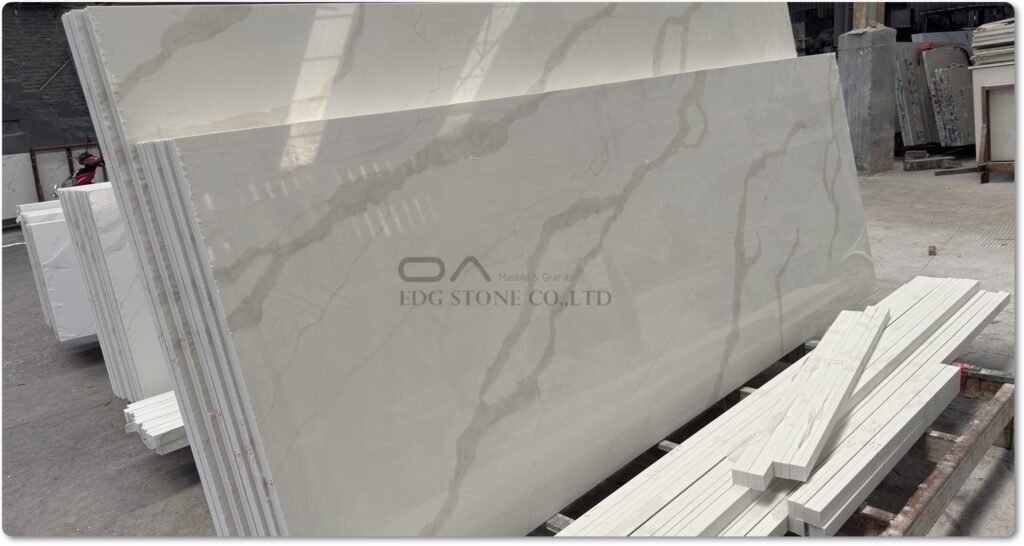
Large-format Calacatta Quartz slabs allow fabricators to minimize visible seams, creating a cleaner visual appearance and improving overall design continuity.
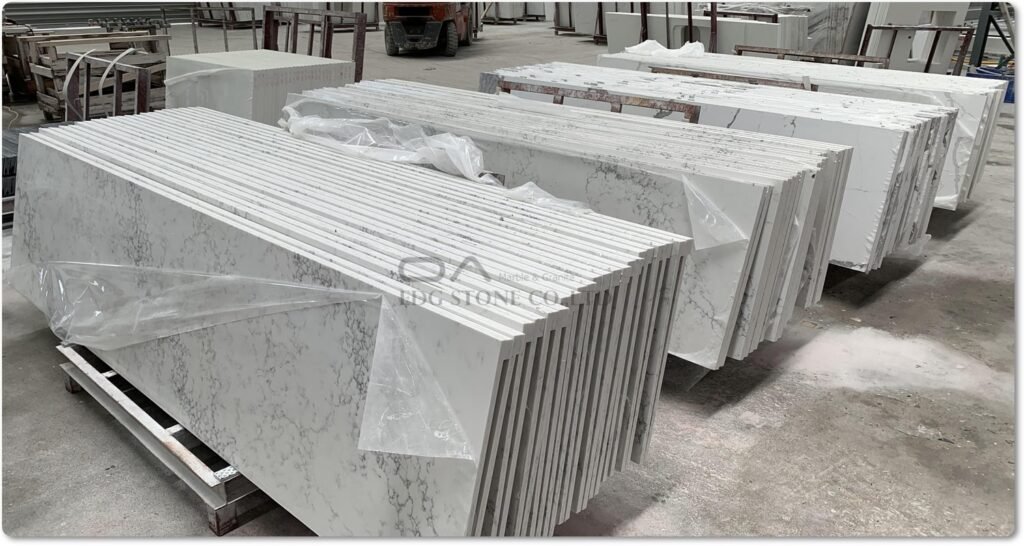
Jumbo slab programs also improve fabrication yield by enabling larger countertop sections to be cut from a single slab.
3. Excellent Compatibility with Contemporary Cabinetry
One reason designers frequently specify White Calacatta Quartz is its compatibility with a wide range of cabinet finishes.
Common combinations include:
- Matte white cabinetry
- Natural oak veneer
- Walnut wood grain
- Black lacquer cabinets
- Charcoal matte finishes
- Warm beige interiors
- Brushed brass hardware
- Stainless steel appliances
Meanwhile, Gold Calacatta Quartz introduces warmer veining that pairs particularly well with champagne bronze fixtures, natural timber finishes, and luxury hospitality interiors.
4. Long-Term Appearance Retention
In residential applications, homeowners often prioritize surfaces that retain their appearance with routine care.
While no countertop material is completely immune to damage, engineered quartz generally provides good resistance to many common household stains when spills are cleaned promptly, and the material is used according to manufacturer guidelines. Cutting directly on the surface or placing extremely hot cookware on quartz should be avoided to help preserve the finish.
5. Supporting Modern Kitchen Design Trends
Current kitchen trends emphasize simplicity, continuity, and integrated living spaces.
Calacatta Quartz complements several popular design concepts:
- Minimalist kitchens
- Scandinavian interiors
- Modern farmhouse styles
- Luxury contemporary residences
- Transitional kitchens
- Boutique condominium developments
- Premium rental apartments
- High-end custom homes
The marble-inspired appearance provides a timeless visual identity while reducing many of the maintenance concerns associated with natural marble in busy kitchens.
Procurement Considerations for Kitchen Projects
When specifying Calacatta Quartz Countertops for residential or commercial kitchens, procurement teams should evaluate:
- Required slab dimensions and yield optimization
- Thickness selection (commonly 20 mm or 30 mm, depending on project specifications)
- Edge profile compatibility
- Sink cutout requirements
- Vein direction and layout planning
- Batch consistency across production lots
- Packaging and transportation protection
- Fabrication tolerances and installation sequencing
Early coordination between designers, fabricators, and suppliers can reduce material waste, improve installation efficiency, and help maintain consistent aesthetics throughout the project.
Transition to Other Interior Applications
While kitchens remain the most common application, the same properties that make Calacatta Quartz successful in residential worktops also support its use in waterfall islands, bathroom vanity tops, decorative wall cladding, and a wide range of commercial interior environments. The following sections will examine these applications in greater technical and design detail.
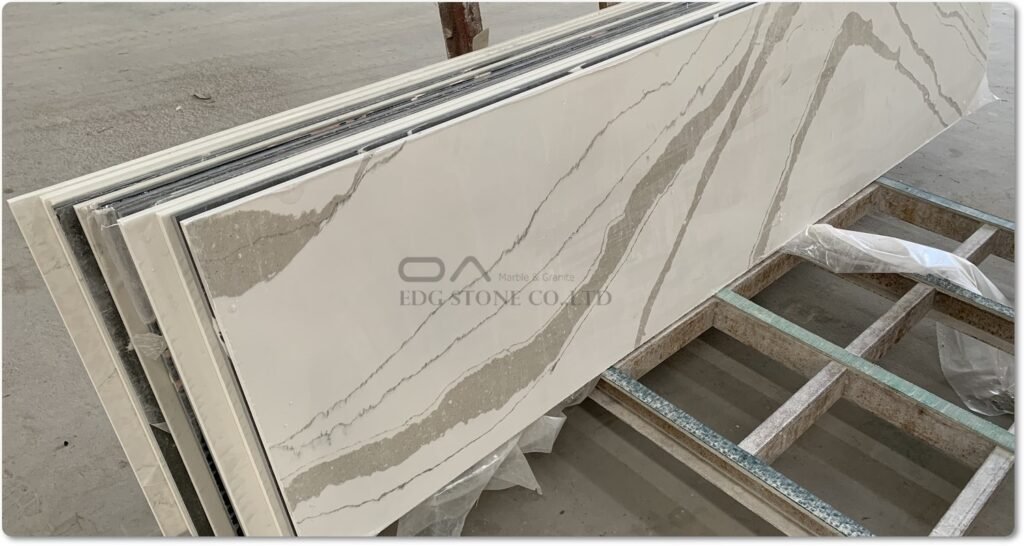
Waterfall Islands: Creating Seamless Luxury Statements
Why Waterfall Islands Have Become a Global Design Trend?
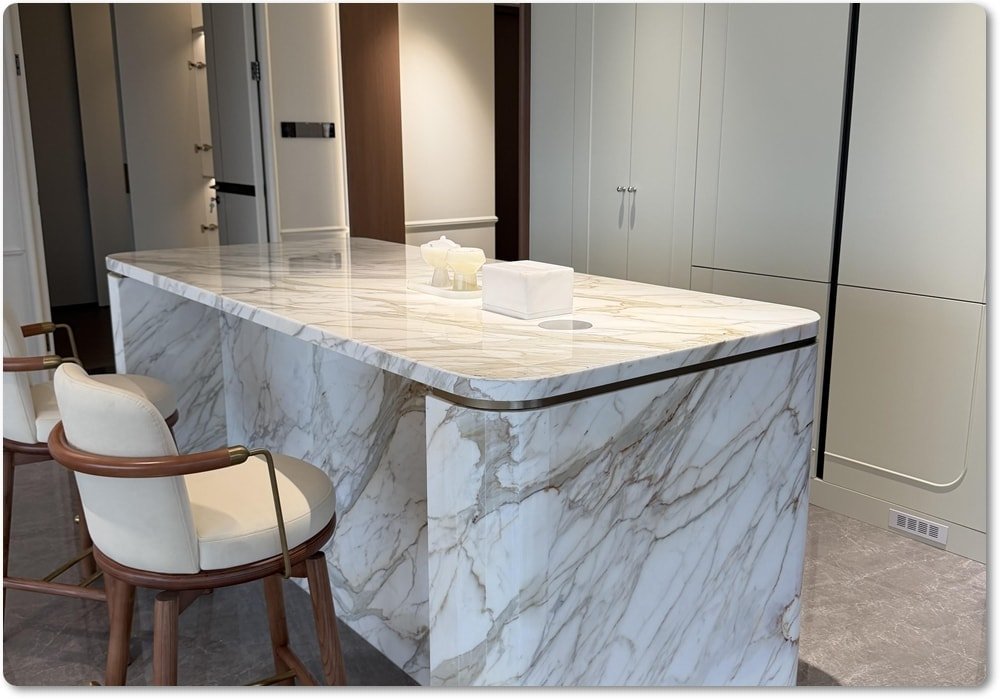
Among all contemporary kitchen features, the waterfall island has become one of the defining characteristics of luxury residential design. Instead of terminating the countertop at the cabinet edge, the slab extends vertically to the floor on one or both sides, producing a continuous “waterfall” effect that highlights the material’s veining.
For Calacatta Quartz Countertops, waterfall islands maximize the visual impact of marble-inspired patterns while showcasing the precision of modern fabrication. They are increasingly specified in:
- Luxury villas
- High-end apartments
- Open-plan kitchens
- Show homes
- Boutique hotels
- Executive apartments
- Display kitchens
- Mixed-use residential developments
Unlike traditional countertops, waterfall islands require careful coordination between slab layout, vein orientation, fabrication accuracy, transportation, and installation.
Engineering Considerations for Waterfall Islands
Vein Matching
One of the primary objectives is to create a continuous vein flow from the horizontal countertop to the vertical panel.
Professional fabricators typically use:
- Digital slab scanning
- CNC nesting software
- Book-match planning
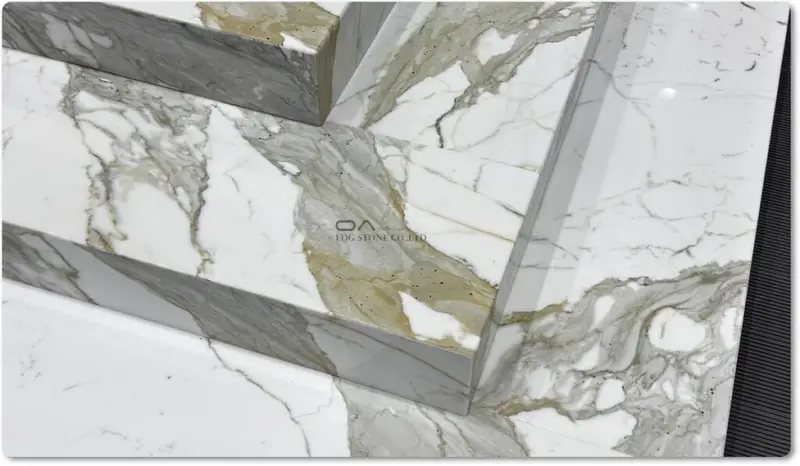
- Precision miter cutting
- Dry-fit verification before polishing
Accurate vein matching minimizes visual interruptions and delivers the premium appearance expected in luxury projects.
Structural Support
Quartz slabs are engineered for interior applications but require proper support, especially where long overhangs or unsupported spans are specified.
Design teams should coordinate with structural engineers and fabricators to determine:
- Maximum overhang dimensions
- Required steel reinforcement (if applicable)
- Cabinet support systems
- Hidden brackets for breakfast bars
- Load distribution
Proper support reduces stress concentrations and contributes to long-term performance.
Slab Size Optimization
Large waterfall islands often benefit from jumbo slab programs because they:
- Reduce visible joints
- Improve vein continuity
- Increase fabrication yield
- Simplify installation
- Reduce material waste
During procurement, slab dimensions should be reviewed alongside island size to optimize cutting layouts and minimize offcuts.
Design Trends for White Calacatta Quartz Islands
White Calacatta Quartz remains the preferred option for modern kitchens due to its clean background and bold gray veining.
Popular pairings include:
| Cabinet Finish | Hardware | Flooring |
|---|---|---|
| Matte White | Brushed Nickel | Light Oak |
| Walnut | Matte Black | Limestone |
| Natural Oak | Champagne Bronze | Porcelain Tile |
| Graphite | Stainless Steel | Engineered Wood |
| Cashmere Beige | Satin Brass | Large-format Porcelain |
The neutral palette allows designers to maintain long-term aesthetic relevance even as interior trends evolve.
Gold Calacatta Quartz for Premium Residences
While white-gray veining dominates minimalist interiors, Gold Calacatta Quartz has become increasingly popular in luxury residential projects.
Warm gold veining complements:
- European oak cabinetry
- Brass fixtures
- Bronze lighting
- Beige stone flooring
- Warm neutral interiors
This combination creates a softer and more luxurious atmosphere compared with cooler monochromatic palettes.
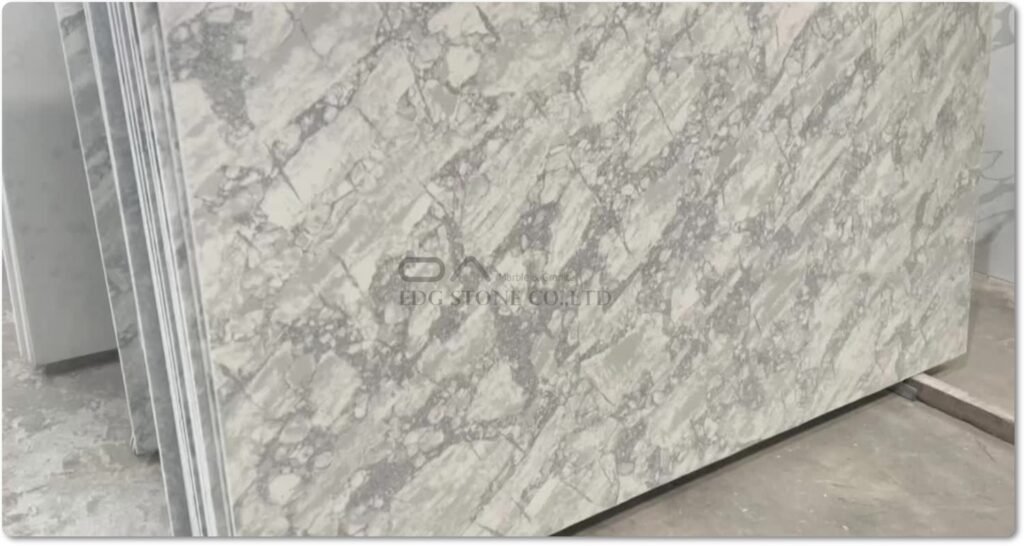
Bathroom Vanity Tops
Why Quartz Performs Well in Bathrooms?
Bathrooms present different performance requirements than kitchens.
Instead of heavy food preparation, vanity tops experience frequent exposure to:
- Water
- Soap
- Cosmetics
- Toothpaste
- Hair products
- Skincare chemicals
- Humidity
Because engineered quartz is non-porous, routine cleaning is generally straightforward when manufacturer care guidelines are followed. This characteristic contributes to its widespread use in residential and commercial bathrooms.
Residential Bathroom Applications
Calacatta Quartz is commonly specified for:
- Double vanities
- Floating vanities
- Integrated backsplash systems
- Makeup counters
- Linen storage tops
- Shower benches (where recommended by the manufacturer)
The consistent appearance across multiple slabs helps maintain design continuity throughout large homes.
Hospitality Bathroom Design
Hotels increasingly specify quartz vanity tops because they offer:
- Consistent appearance across hundreds of guest rooms
- Simplified maintenance procedures
- Reliable supply for phased renovations
- Broad color consistency
- Efficient replacement when required
Large hotel developments often require hundreds or thousands of identical vanity tops, making engineered quartz an attractive specification due to manufacturing consistency.
Healthcare and Senior Living Facilities
Healthcare designers prioritize materials that are easy to clean and suitable for high-use environments.
Quartz vanity tops are frequently considered for:
- Patient bathrooms
- Assisted living residences
- Rehabilitation centers
- Medical office buildings
Material selection should always follow project-specific hygiene standards, local regulations, and manufacturer recommendations.
Design Comparison: White Calacatta Quartz vs. Gold Calacatta Quartz
Selecting between White Calacatta Quartz and Gold Calacatta Quartz depends on the project’s design intent, lighting conditions, and target audience.
| Feature | White Calacatta Quartz | Gold Calacatta Quartz |
| Overall Style | Contemporary | Luxury Classic |
| Background | Bright White | Warm White |
| Veining | Gray | Gold & Gray |
| Best for Modern Kitchens | Excellent | Very Good |
| Boutique Hotels | Very Good | Excellent |
| Luxury Villas | Excellent | Excellent |
| Scandinavian Design | Excellent | Good |
| Classic European Interiors | Good | Excellent |
| Warm Interior Palette | Good | Excellent |
Neither option is universally “better”; the optimal choice depends on architectural style, branding objectives, and the desired atmosphere.
Design Selection Matrix by Project Type
| Project Type | Recommended Quartz |
| Luxury Residence | White or Gold Calacatta Quartz |
| Apartment Development | White Calacatta Quartz |
| Hotel Guest Rooms | White Calacatta Quartz |
| Presidential Suites | Gold Calacatta Quartz |
| Retail Flagship Store | White Calacatta Quartz |
| Luxury Boutique | Gold Calacatta Quartz |
| Office Executive Lounge | White Calacatta Quartz |
| High-end Restaurant | Gold Calacatta Quartz |
Procurement Recommendations for Islands and Vanity Projects
For waterfall islands and bathroom vanity tops, procurement teams should evaluate:
- Slab dimensions and yield optimization
- Vein direction requirements
- Miter edge fabrication capability
- CNC precision for sink cutouts
- Thickness consistency
- Color batch matching
- Packaging for long-distance transport
- Installation sequencing for large-format panels
Close collaboration between designers, fabricators, installers, and suppliers helps ensure both aesthetic continuity and efficient project execution.
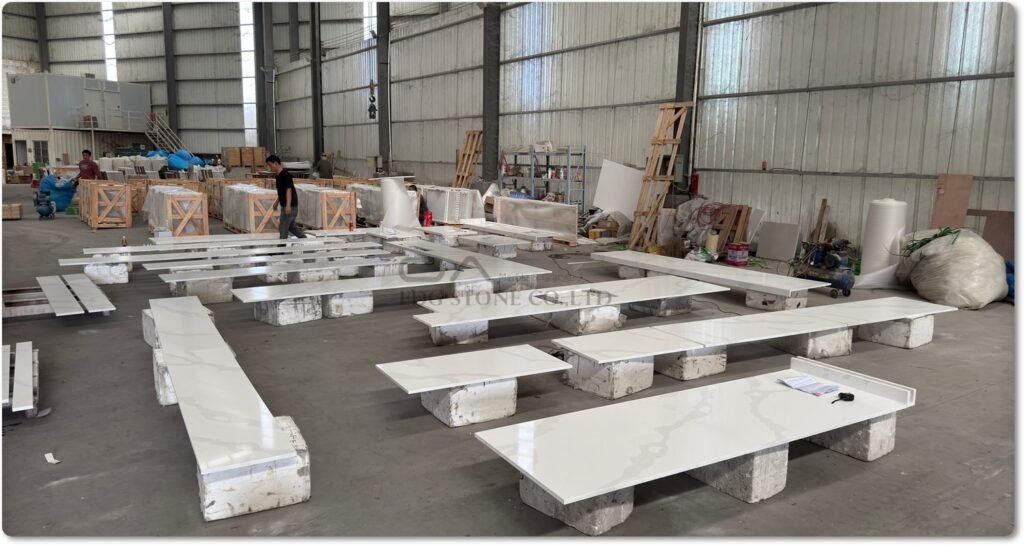
Wall Cladding: Expanding Calacatta Quartz Beyond Horizontal Surfaces
Why Quartz Wall Cladding Is Growing in Popularity?
Although Calacatta Quartz Countertops are most commonly associated with kitchens and bathrooms, architects increasingly specify engineered quartz for interior wall cladding. Large-format quartz panels provide the visual elegance of marble while offering consistent coloration and engineered dimensional stability, making them suitable for feature walls in both residential and commercial interiors.
Common applications include:
- Living room feature walls
- TV media walls
- Fireplace surrounds (following manufacturer temperature-clearance guidelines)
- Elevator lobby walls
- Hotel lift lobbies
- Reception feature walls
- Luxury apartment entrances
- Retail display backdrops
- Office executive lounges
Unlike natural marble, where veining and color variation can differ significantly from slab to slab, engineered quartz enables designers to achieve a more predictable appearance across large wall installations.
Advantages of Large-Format Wall Panels
1. Reduced Visible Joints
Large slabs allow fabricators to cover more surface area with fewer seams, creating a cleaner and more continuous appearance.
Benefits include:
- Enhanced visual continuity
- Simplified cleaning
- More premium aesthetic
- Reduced grout lines compared with tiled installations
- Better alignment of directional veining
For high-end commercial interiors, minimizing visible joints often contributes to a stronger perception of quality.
2. Design Consistency Across Multiple Floors
In hotels, office towers, and residential developments, designers frequently need to repeat the same wall finish across dozens or even hundreds of rooms.
Because engineered quartz is manufactured under controlled production conditions, it offers greater consistency between production batches than many natural stones. This consistency simplifies specification for large-scale developments where visual uniformity is important.
3. Compatibility with Modern Interior Styles
White Calacatta Quartz is particularly well suited to:
- Minimalist interiors
- Scandinavian-inspired spaces
- Contemporary residences
- Luxury condominiums
- Executive offices
- High-end retail environments
Gold Calacatta Quartz, with its warm veining, complements:
- Boutique hotels
- Premium restaurants
- Luxury spas
- Classical European-inspired interiors
- High-end hospitality projects
Installation Considerations for Wall Cladding
Successful quartz wall installations depend on careful planning.
Key considerations include:
- Suitable substrate preparation
- Appropriate fixing systems or adhesives recommended by the manufacturer
- Expansion and movement joints were required
- Slab weight and handling equipment
- Coordination of electrical outlets and lighting
- Vein orientation planning before installation
Early collaboration between architects, fabricators, and installers helps reduce rework and maintain the intended visual design.
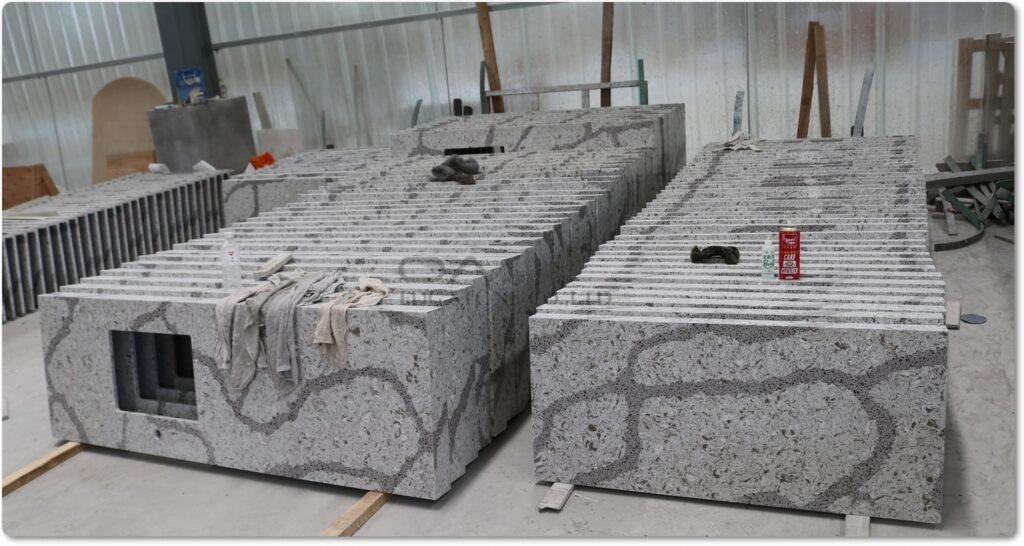
Reception Desks: Creating Strong First Impressions
The Role of Reception Areas
A reception desk often serves as the first physical point of contact between an organization and its visitors. Material selection, therefore,e influences perceptions of professionalism, quality, and brand identity.
Calacatta Quartz is widely used for reception desks in:
- Corporate headquarters
- Hotels
- Hospitals
- Private medical clinics
- Luxury residential towers
- Educational institutions
- Showrooms
- Government buildings
Its marble-inspired appearance conveys sophistication while offering the maintenance advantages associated with engineered quartz.
Why Reception Desks Benefit from Quartz?
Consistent Appearance
Reception counters often extend several meters in length. Engineered quartz allows designers to specify slabs with consistent backgrounds and coordinated veining, helping maintain a cohesive appearance across large surfaces.
Ease of Routine Maintenance
Reception areas experience frequent contact from visitors and staff.
Routine maintenance generally involves:
- Soft microfiber cloths
- Mild pH-neutral cleaners
- Prompt removal of spills
- Avoidance of abrasive cleaning pads
Following manufacturer care recommendations helps preserve the surface finish over time.
Integration with Corporate Branding
Reception desks are often combined with:
- Backlit company logos
- Wood veneer wall panels
- Metal accents
- Glass partitions
- LED lighting
- Digital signage
The neutral palette of White Calacatta Quartz and the warmer tones of Gold Calacatta Quartz make them adaptable to a wide variety of branding concepts.
Retail Spaces: Balancing Aesthetics and Durability
Why Retail Designers Choose Quartz?
Retail interiors require materials that combine visual appeal with practical performance. Display counters, cashier stations, consultation tables, and customer service desks are subject to continuous daily use.
Calacatta Quartz is frequently specified for:
- Luxury boutiques
- Jewelry stores
- Cosmetic retailers
- Fashion showrooms
- Electronics stores
- Department stores
- Shopping mall service counters
The material’s clean appearance supports premium product presentation while simplifying routine cleaning.
Display Counters
Luxury retail brands often use quartz for:
- Product display islands
- Checkout counters
- Consultation tables
- Sampling stations
- Customer service desks
Large-format slabs allow these elements to appear monolithic, reinforcing a high-end aesthetic.
Lighting Considerations
Lighting significantly affects the appearance of marble-inspired quartz.
Designers should evaluate slabs under the same lighting conditions planned for the project, including:
- Natural daylight
- Warm LED lighting
- Cool white lighting
- Accent spotlights
This helps ensure the selected color and veining achieve the desired visual effect in the finished space.
Hospitality Interiors
Hotels and Resorts
Hospitality projects demand materials that balance aesthetics, durability, and operational efficiency.
Calacatta Quartz is commonly used in:
- Guest room vanity tops
- Concierge counters
- Reception desks
- Lobby feature walls
- Executive lounges
- Business centers
- Café serving stations
Its consistent appearance across production batches simplifies phased renovations and multi-property brand standards.
Restaurants and Cafés
Within food-service environments, quartz is often selected for:
- Host stands
- Beverage counters
- Service stations
- Decorative wall features
Material selection should always consider local health regulations, operational requirements, and manufacturer guidance.
Office Buildings
Modern office interiors increasingly emphasize collaboration, wellness, and premium finishes.
Calacatta Quartz is specified for:
- Executive pantries
- Coffee stations
- Meeting room credenzas
- Reception counters
- Feature walls
- Collaborative work areas
The marble-inspired aesthetic helps create professional environments while supporting straightforward day-to-day maintenance.
Commercial Design Trends Influencing Quartz Applications
Several global interior design trends continue to support demand for Calacatta Quartz:
Large-Format Surfaces
Architects increasingly favor expansive slabs with minimal joints to create seamless visual experiences.
Biophilic and Neutral Color Palettes
White and warm-neutral quartz surfaces complement natural wood, indoor planting, and daylight-focused designs.
Flexible Commercial Spaces
Retail, hospitality, and office environments increasingly require materials that can adapt to changing layouts while maintaining a timeless appearance.
Lifecycle Value
Owners are placing greater emphasis on total lifecycle considerations, including maintenance requirements, replacement planning, and long-term aesthetic consistency.
Key Takeaways for Commercial Applications
When specifying Calacatta Quartz for walls and commercial interiors, procurement teams should evaluate:
- Slab dimensions relative to installation area
- Batch consistency for multi-phase projects
- Fabrication precision for feature installations
- Surface finish requirements (polished, honed, etc.)
- Transportation and packaging for large-format panels
- Installation sequencing and access logistics
- Compliance with project specifications and local building requirements
Thoughtful planning at the design and procurement stages can improve installation efficiency, reduce waste, and support consistent project outcomes.
Frequently Asked Questions (FAQ)
The following questions are based on common inquiries from architects, fabricators, distributors, developers, contractors, and homeowners. They are written to align with search intent while addressing practical specification and procurement considerations.
1. What are Calacatta Quartz Countertops?
Calacatta Quartz Countertops are engineered stone surfaces designed to replicate the appearance of natural Calacatta marble. They are manufactured using natural quartz minerals combined with polymer resins and pigments under controlled production conditions, resulting in a material with consistent appearance, dimensional stability, and low maintenance requirements.
2. What is the difference between White Calacatta Quartz and Gold Calacatta Quartz?
The primary distinction is aesthetic:
- White Calacatta Quartz features a bright white background with gray veining, making it suitable for contemporary and minimalist interiors.
- Gold Calacatta Quartz incorporates warm gold or beige veining, complementing classic, transitional, and luxury hospitality designs.
Performance characteristics are generally comparable within the same product series; selection is typically based on design intent.
3. Is Calacatta Quartz suitable for kitchen countertops?
Yes. Kitchen countertops are among the most common applications for Calacatta Quartz due to its non-porous surface, consistent appearance, and ease of routine cleaning. As with all engineered quartz, users should follow the manufacturer’s care recommendations, including the use of trivets for hot cookware and cutting boards for food preparation.
4. Can Calacatta Quartz be used in bathrooms?
Yes. Calacatta Quartz is widely specified for:
- Bathroom vanity tops
- Integrated backsplashes
- Powder rooms
- Hotel guest bathrooms
- Luxury residential bathrooms
Its non-porous surface contributes to straightforward routine maintenance in wet environments when properly installed and maintained.
5. Is Calacatta Quartz suitable for waterfall islands?
Yes. Large-format slabs make Calacatta Quartz well suited for waterfall islands, where continuous veining can create a seamless visual effect. Successful installations depend on careful slab layout, precision miter fabrication, and appropriate structural support.
6. Can Calacatta Quartz be used for wall cladding?
Yes, in interior applications. It is commonly specified for feature walls, reception areas, fireplace surrounds (subject to manufacturer guidance), elevator lobbies, and luxury commercial interiors. Installation methods should comply with project specifications and local building codes.
7. Does Calacatta Quartz require sealing?
Unlike many natural stone materials, engineered quartz surfaces are generally non-porous and do not require routine sealing. Maintenance typically involves mild detergent, water, and a soft cloth, following the manufacturer’s care instructions.
8. Is Calacatta Quartz heat resistant?
Engineered quartz offers good heat resistance under normal interior use. However, sudden or prolonged exposure to very high temperatures may damage the resin binder. Manufacturers generally recommend using trivets or heat pads rather than placing hot cookware directly on the surface.
9. What slab sizes are commonly available?
Dimensions vary by manufacturer, but common production formats include:
- Standard slabs
- Jumbo slabs for large islands and commercial projects
Actual sizes, thicknesses, and availability should always be confirmed with the supplier before procurement.
10. What thicknesses are typically specified?
The most commonly specified thicknesses include:
- 20 mm
- 30 mm
Other thicknesses or laminated edge solutions may be available depending on the manufacturer’s production capabilities.
11. Is Calacatta Quartz suitable for commercial projects?
Yes. It is widely used in:
- Hotels
- Office buildings
- Apartments
- Retail stores
- Healthcare facilities
- Educational institutions
- Restaurants
- Corporate headquarters
Material selection should always consider project-specific requirements, applicable regulations, and manufacturer recommendations.
12. How should Calacatta Quartz be cleaned?
Routine maintenance generally includes:
- Warm water
- Mild pH-neutral detergent
- Soft microfiber cloth
Avoid abrasive cleaners, strong acids, and harsh alkaline chemicals unless approved by the manufacturer.
13. How can buyers ensure color consistency?
For large projects, procurement teams should:
- Purchase sufficient material from the same production batch where possible.
- Review slab photographs or physical samples.
- Confirm production schedules with the supplier.
- Establish clear quality acceptance criteria before fabrication.
14. What factors influence procurement costs?
Project cost may vary depending on:
- Slab size
- Thickness
- Vein complexity
- Surface finish
- Fabrication requirements
- Packaging
- Shipping method
- Import duties
- Installation complexity
Evaluating total installed cost rather than material price alone provides a more accurate basis for comparison.
15. How should international buyers choose a quartz supplier?
Recommended evaluation criteria include:
- Manufacturing experience
- Production capacity
- Quality management systems
- Dimensional consistency
- Packaging standards
- Export experience
- Technical support
- Documentation and certifications
- Ability to meet delivery schedules
- After-sales service