Executive Summary & Micro-Summary Card
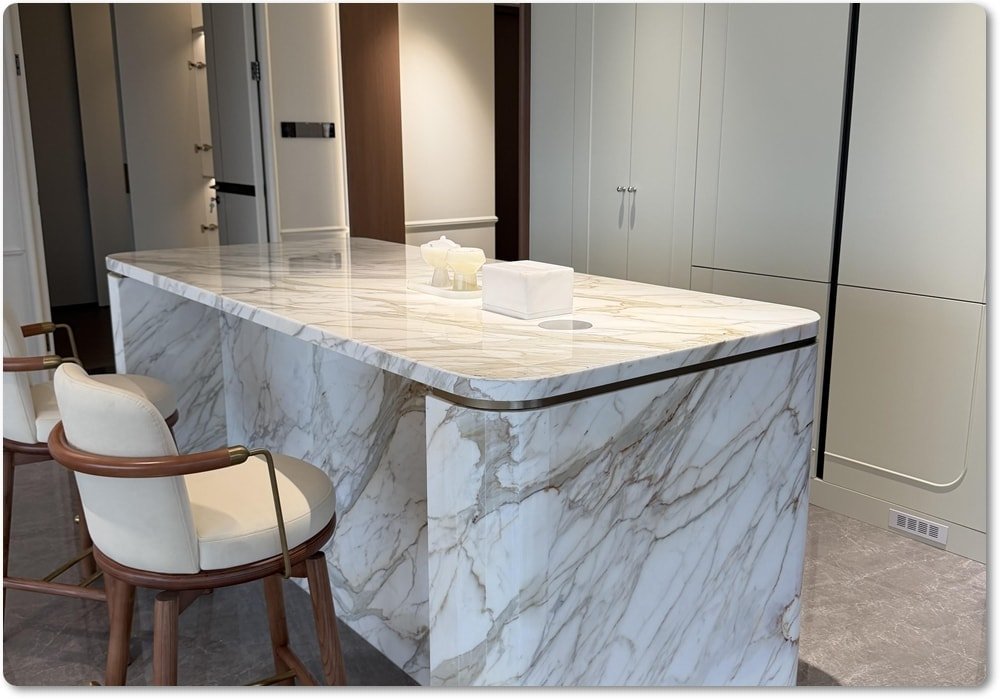
This technical white paper establishes the architectural benchmarks, raw material science, and global logistics framework required when specifying Calacatta Quartz across high-traffic commercial real estate developments. Engineered stone has fundamentally transformed commercial interior surfaces. Driven by an $8.07\%$ compound annual growth rate (CAGR) stretching from 2026 to 2035, the global engineered quartz market is structural proof of a massive macroeconomic pivot: modern architectural mandates demand the absolute elimination of surface porosity without sacrificing the hyper-luxury visual depth of classic Italian marbles.
1. Structural Material Science: The Physics of Commercial Calacatta Engineered Stone
Specifying surface materials for institutional, hospitality, or commercial projects requires looking past surface-level aesthetics. While natural Calacatta marble from the Apuan Alps provides undeniable prestige, its structural performance profile presents serious liabilities in high-traffic, multi-family, and commercial environments.
Chemical Composition and Polymerization Mechanics
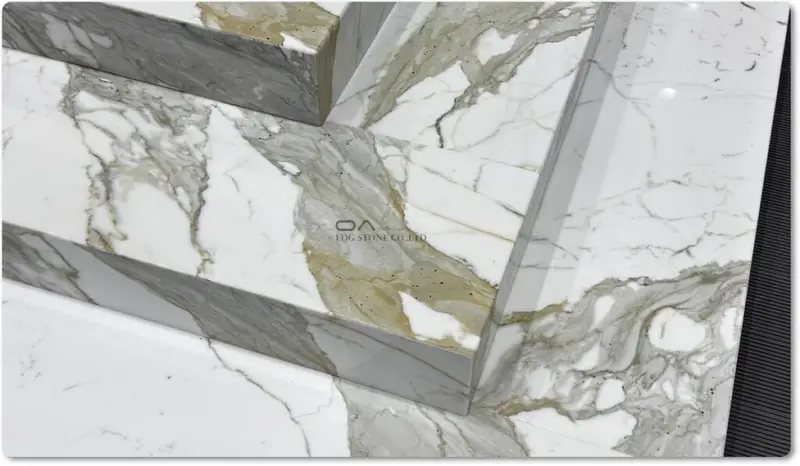
Premium engineered surfaces, such as Calacatta Gold Quartz, are synthesized utilizing vacuum vibro-compression molding technology. The raw material configuration is rigorously batched:
$\ge 93\%$ Crystalline Silica / Alpha-Quartz: Sourced at specific grain distributions ranging from $0.1\text{ mm}$ to $2.5\text{ mm}$ to maximize packing density.
$< 7\%$ Polymeric Resin Binder: Typically, high-performance unsaturated polyester resin combined with cross-linking catalysts.
Inorganic Metal Oxide Pigments: Titanium dioxide ($TiO_2$) provides the pure white base ground, while localized concentrations of iron oxides ($Fe_2O_3$, $Fe_3O_4$) create the signature gold, charcoal, and grey veining profiles.
During fabrication, this composite matrix undergoes intense vacuum de-aeration to eliminate mechanical voids, followed by multi-axis high-frequency vibration at pressures exceeding $2.5\text{ MPa}$. The slabs are then thermally cured in automated multi-tier ovens at precisely regulated temperature zones ($80^\circ\text{C}$ to $110^\circ\text{C}$). This initiates a complete cross-linking polymerization reaction, curing the liquid resin into an ultra-dense, inert thermoset polymer network that locks the quartz crystals in place.
Comparative Performance Engineering
The resulting material exhibits mechanical characteristics that far exceed natural stone, making Calacatta Quartz Countertops highly functional assets for high-traffic environments:
Fluid Absorption & Porosity (ASTM C97): Natural marble possesses a porous network of micro-fissures yielding a fluid absorption rate between $0.15\%$ and $0.25\%$. Engineered quartz reduces this metric to $\le 0.03\%$. This ultra-low porosity eliminates the need for topical chemical sealants and provides a surface resistant to red wine, coffee, citric acid, and harsh industrial sanitizers.
Scratch & Abrasion Resistance (ASTM C241 / Mohs Scale): Natural marble consists primarily of calcite ($CaCO_3$), which sits at a soft Mohs hardness of 3. It scratches easily under standard culinary cutlery and undergoes acid-etching when exposed to mild organic acids. Crystalline quartz has a Mohs hardness of 7, ensuring long-term surface integrity in demanding environments like hotel kitchenettes and high-traffic reception bars.
2. Hospitality Procurement Standards: Guestroom Vanities & Public Space Surfaces
In hotel developments, interior surfaces must balance high-end aesthetics with extreme structural durability. Hotel operators require materials that lower guestroom turnover times, protect against housekeeping chemical damage, and maintain a pristine look over long property improvement cycles (PIP).
Guestroom Guest Bathrooms & Kitchenettes
Guestroom bathrooms are highly demanding wet environments. The specification of Calacatta Quartz for vanities and shower surrounds addresses several operational issues:
Maintenance Deficit Elimination: Hotel housekeepers have limited time per room. Surfaces that require specialized pH-neutral cleaners delay operations. Quartz can withstand standard institutional disinfectants without degrading.
Stain and Moisture Mitigation: Hot curling irons, spilled cosmetics, and pooling water cause permanent staining or thermal cracking on natural stones. Quartz surfaces handle these daily hazards well, preventing the need for costly room closures to repair surfaces.
Public Identity Zones: High-Impact Reception & Bars
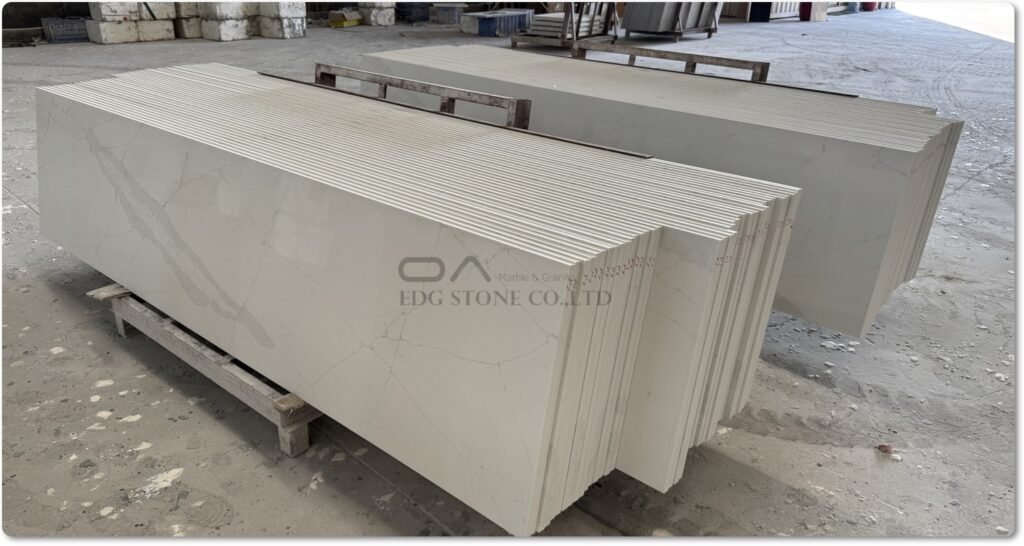
First impressions dictate guest perception. Large-format Calacatta Quartz slabs are ideal for high-impact visual surfaces, including check-in desks, concierge stations, buffet stations, and cocktail bars.
       TYPICAL BOOKMATCHED ARRANGEMENT (MIRROR IMAGE VEINING OVER SEAM)
      +-----------------------------------+-----------------------------------+
      |      \                     /      |      \                     /      |
      |       \   Calacatta Slabs /       |       \   Calacatta Slabs /       |
      |        \                 /        |        \                 /        |
      |         \               /         |         \               /         |
      |==========[  Left Slab  ]==========|==========[  Right Slab ]==========|
      |         /               \         |         /               \         |
      |        /                 \        |        /                 \        |
      |       /     Center Seam   \       |       /     Center Seam   \       |
      |      /                     \      |      /                     \      |
      +-----------------------------------+-----------------------------------+
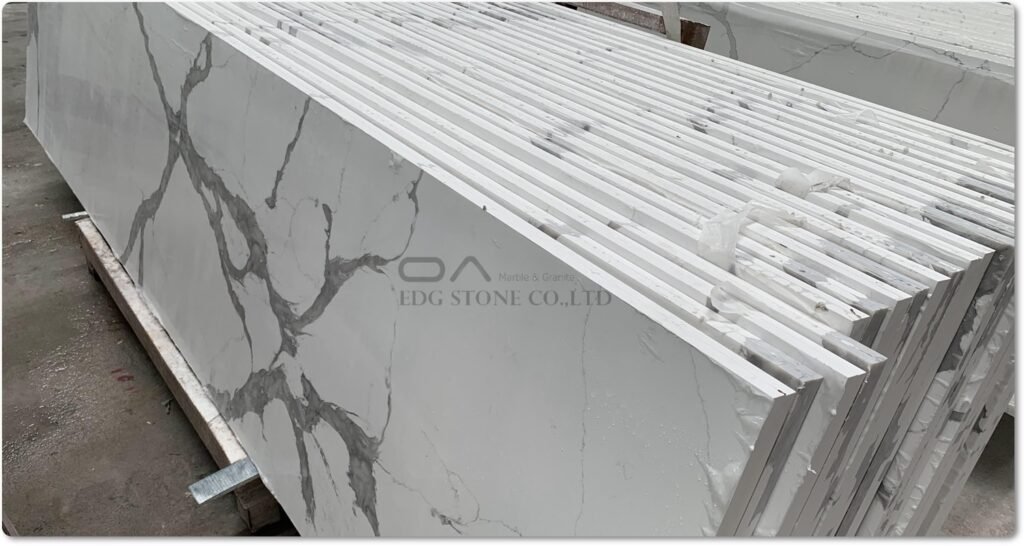
For grand reception desks and statement feature walls, specifying bookmatched or continuous vein-matched pairs creates a striking focal point. Because engineered quartz patterns are digitally controlled during manufacturing, architects can review precise digital layout files before fabrication. This ensures perfectly aligned veins across large vertical and horizontal surfaces, eliminating the layout guesswork common with natural marble blocks.
3. Multi-Family Residential Projects: Multi-Unit Value Engineering & Yield Optimization
In large-scale multi-family residential projects—such as high-rise condominiums and luxury apartments—materials must deliver high market appeal while optimizing total procurement costs.
Balancing Luxury Appeal with Material Durability
Modern multi-family buyers and renters expect high-end finishes, and premium kitchen countertops are often a key selling point. Calacatta Gold Quartz provides the classic look of high-end Italian stone while protecting developers from post-occupancy warranty claims. Natural marble surfaces in rental units often lead to tenant disputes over stains, chips, and etched surfaces. Quartz minimizes these asset management headaches, preserving the property’s capital value over time.
Scalable Value Engineering Strategies
To optimize budgets across hundreds of uniform kitchen and bathroom units, multi-family procurement teams should follow specific material optimization strategies:
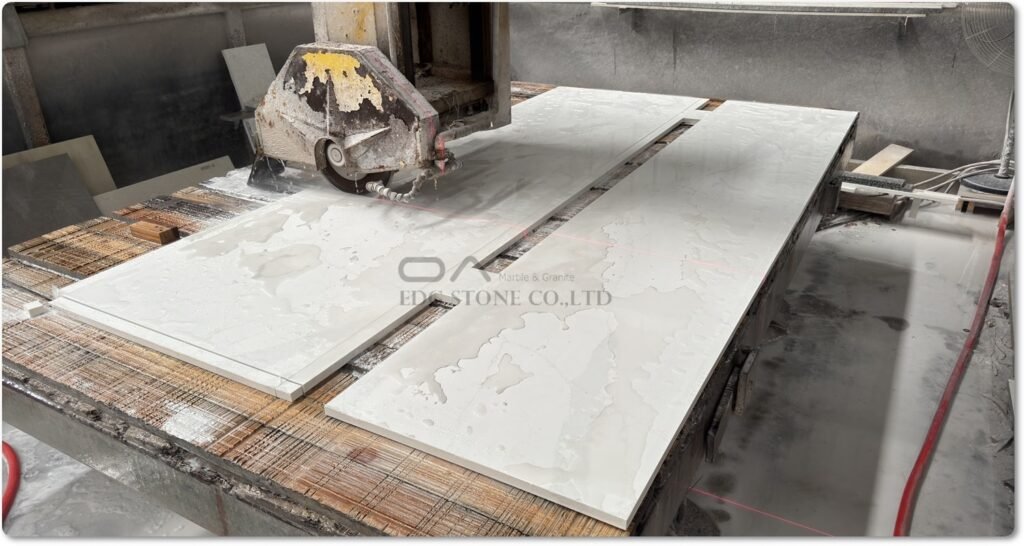
Standardized Prefabricated Component Dimensions: Designing kitchen islands and perimeter counters around optimized slab dimensions significantly lowers cost. Standard industry slabs measure $3200\text{ mm} \times 1600\text{ mm}$ ($126″ \times 63″$).
Yield Maximization Analysis: Planning kitchen counters at standard depths ($26″$) and island tops at matching widths ($36″$ or $42″$) allows fabrication teams to maximize parts per slab, reducing scrap rates from a typical $25\%$ down to under $8\%$.
4. Retail and Commercial Applications: High-Traffic Corporate & Retail Spatial Design
Commercial retail spaces, corporate offices, and institutional interiors are subject to high physical impact and strict building codes.
Corporate Headquarters and Class-A Office Spaces
In corporate office environments, Calacatta Quartz Countertops are widely specified for high-visibility common areas, including executive boardrooms, collaborative breakrooms, pantries, and elevator lobbies. In these spaces, surfaces frequently encounter coffee spills, ink marks, and impact from laptops and heavy briefcases. Quartz surfaces keep these high-use areas looking polished and professional over the years of daily service.
Premium Retail and High-End Food Service
In luxury retail boutiques and premium food service designs, countertops must handle continuous public contact. For coffee bars and food service lines, specifying $30\text{ mm}$ thick Calacatta Quartz provides the structural mass needed to handle commercial food service equipment. Because quartz surfaces are non-porous and easy to clean, they help establishments maintain high food safety and sanitation standards.
5. Design Consistency Requirements: Calibrate Calacatta Patterns Across Large Footprints
A common challenge in large developments is maintaining visual consistency across multiple floors or separate phases of construction.
Managing Pattern Variations Across Batches
Natural stone blocks vary inherently from one end of a quarry to another. A sample approved during early design phases may look completely different from the slabs delivered to the job site a year later.
Engineered Calacatta Quartz resolves this variation through computer-controlled manufacturing. Raw mineral sorting, digital vein distribution networks, and automated blending systems ensure that Slab 1 and Slab 500 maintain a uniform background tone and consistent vein spacing, preventing unexpected visual mismatches on site.
Mitigating Metamerism and Selecting Finishes
Metamerism occurs when a surface looks different under varying light sources, such as shifting from natural daylight to a hotel’s warm interior LED lighting. To ensure visual consistency across large projects:
Specify the Right Surface Finish: A polished finish brings out deep, sharp veining, making it a great choice for luxury lobbies. A honed or matte finish softens the pattern and diffuses light, which helps minimize glare in brightly lit office spaces or medical environments.
Conduct Dual-Light Specimen Reviews: Design teams should evaluate material samples under both daylight ($5600\text{ K}$) and warm commercial lighting ($2700\text{ K}$ to $3000\text{ K}$) before finalizing specifications. This ensures the white background tone matches the surrounding paint and millwork under all planned lighting conditions.
6. Project Logistics: Global Architectural Delivery Networks
Successfully delivering a major commercial project depends as much on robust logistics and supply chain management as it does on material quality.
Global Supply Chain Tracking and Quality Control
Large commercial projects require strict adherence to delivery schedules. Missing a construction milestone due to material delays can trigger costly project overruns. Slabs must be securely packed in heavy-duty A-frame ocean containers with internal bracing to prevent movement during transit. Every shipment should include clear documentation, covering raw material origins, compliance certificates, and precise container packing lists to ensure efficient customs clearance and delivery.
On-Site Material Handling and Installation Standards
When quartz slabs arrive at a job site, following proper material handling and installation guidelines is critical to protecting the material and ensuring worker safety:
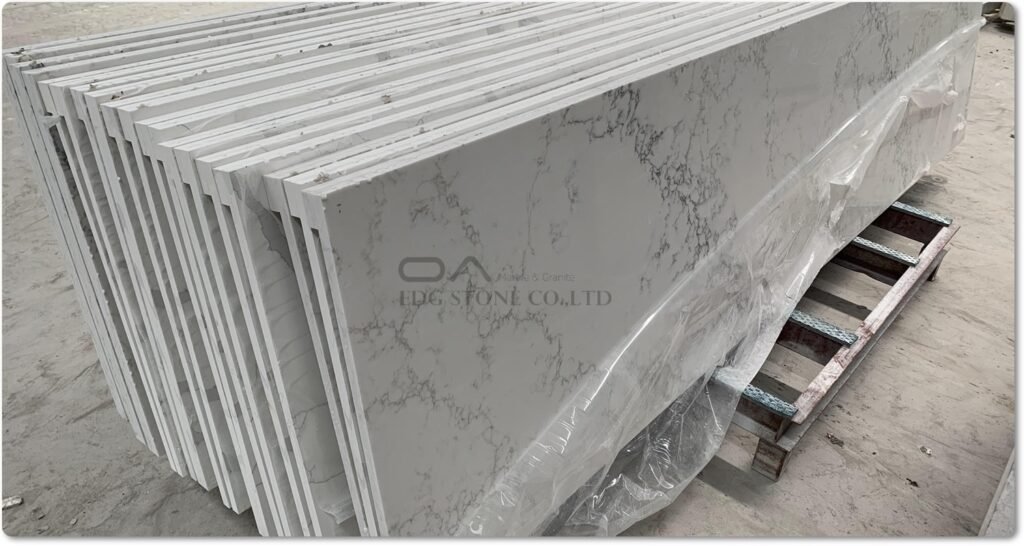
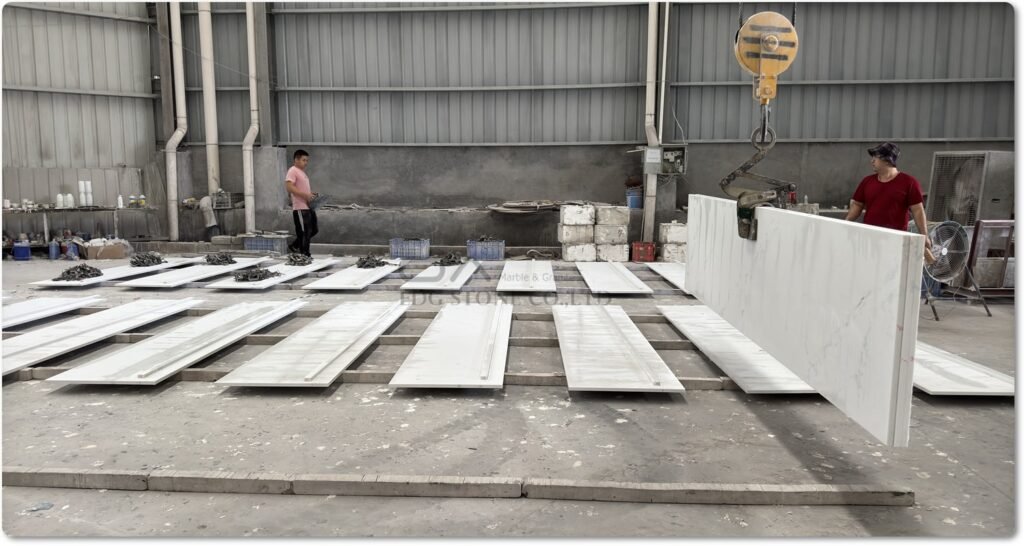
Vertical Storage Protocols: Slabs must always be stored vertically on heavy-duty wooden or steel A-frame racks; storing slabs flat can cause micro-fractures due to uneven support.
Site Deflection Controls: Structural sub-floors and support framing must be verified to ensure deflection does not exceed $L/360$ under full design loads.
Adhesive and Expansion Engineering: Installers must use high-quality, non-staining structural adhesives and leave a minimum $1/8″$ expansion joint at all wall and perimeter intersections to accommodate natural building movement and thermal expansion.
7. Turnkey Manufacturing Capabilities: EDG Stone Factory Case Study
For global commercial projects, working directly with an experienced manufacturer helps streamline procurement and reduce intermediate supply chain costs.
Global Quartzite Slabs & Countertops Manufacturer and Exporter
EDG Stone Factory operates as a fully integrated global producer specializing in the manufacturing and direct export of architectural engineered stone and natural quartzite surfaces. Operating advanced, multi-line automated production facilities, the factory serves international B2B procurement markets, including the United States, Canada, Australia, and the United Kingdom.
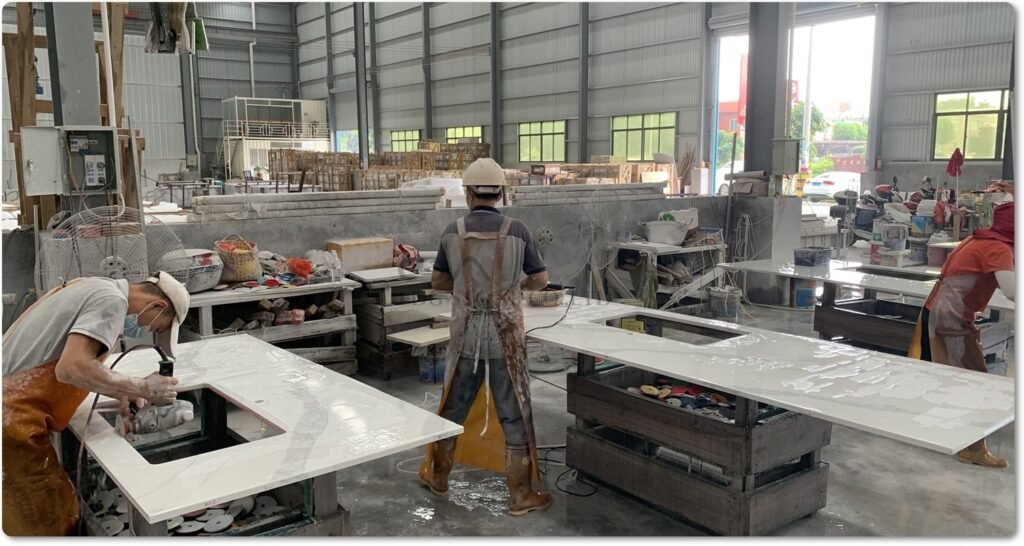
The facility combines automated slab production with an advanced fabrication workshop, allowing it to manage complete commercial projects from raw material blending through to final edge profiling.
Commercial Project Execution Framework
EDG Stone Factory provides structured technical support specifically tailored for commercial architects, general contractors, and developers:
Precision Digital Shop Drawings: The factory’s engineering team translates architectural plan sets into accurate, cut-ready shop drawings that clearly detail joint locations, seam placements, and edge profiles for review and approval.
Fully Standardized CNC Production: Automated multi-axis CNC machines and waterjet cutting tools fabricate all components to tight tolerances ($\pm 0.5\text{ mm}$), ensuring clean alignments during on-site installation.
Comprehensive Commercial Documentation: All shipments are backed by detailed technical documentation, including ASTM material test results, green building certifications, and clear container loading layouts. This detailed system helps streamline tracking and simplifies receiving for on-site installation teams.
8. Cross-Reference Internal Material Matrix
To build a comprehensive understanding of commercial surface specification, this technical paper integrates with our broader technical documentation framework:
Surface Material Selection Guide [Article 5]: Introduces fundamental material properties, comparing natural marbles against engineered stone options.
Advanced Custom Surface Fabrication [Article 6]: Covers technical cutting, edge profiling, and joint engineering details for complex commercial millwork.
Global Project Management & Logistics [Article 14]: Details shipping protocols, container packaging standards, and site-delivery coordination for major developments.
Technical Appendix: Reference Standards & Data Sources
SNS Insider Report (2026): Global Engineered Quartz Surface Market Forecast (2026–2035). Establishes a projected market scale of $36.80 Billion by 2035, driven by an $8.07\%$ CAGR.
Grand View Research (2026): Countertops Market Size, Share & Trends Analysis Report. Identifies a $9.24\%$ CAGR in commercial quartz applications, validating the structural shift toward engineered stones.
ASTM C97/C97M: Standard Test Methods for Absorption and Bulk Specific Gravity of Dimension Stone.
ASTM C880/C880M: Standard Test Method for Flexural Strength of Dimension Stone.
ASTM C170/C170M: Standard Test Method for Compressive Strength of Dimension Stone.
Natural Stone Institute (NSI): Dimension Stone Design Manual, Architectural Installation Criteria (2024).
ANSI A108.1A/B: Specifications for the Installation of Ceramic Tile and Dimension Stone with Portland Cement Mortar.
ISO 13006 / EN 14617-2: Agglomerated stone – Test methods – Determination of flexural strength.
US Green Building Council (USGBC): LEED v4.1 Material and Resources (MR) Credit Framework for Low-Emitting Interior Materials.
National Association of Home Builders (NAHB): Material Specification Benchmarking Study. Shows engineered quartz as the leading specified solid surface material for premium multi-family projects.