Executive Summary
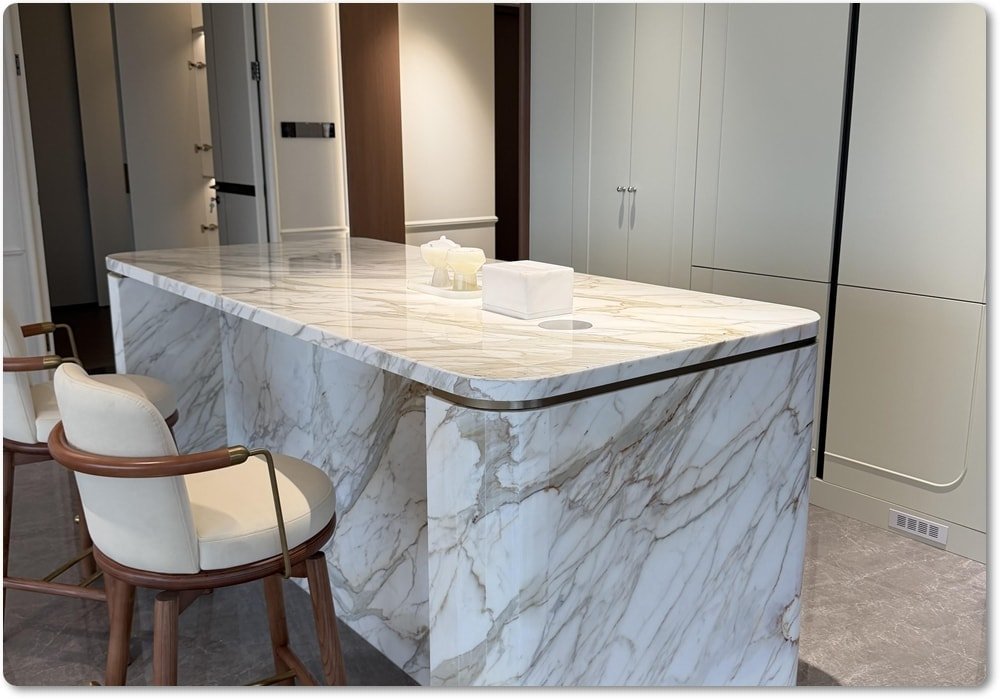
Calacatta Laza Quartz and Calacatta Oro Quartz are both marble-look engineered quartz surfaces in MSI’s Q™ collection, but they target different design outcomes. Calacatta Laza uses a warm white base with soft brown and gray-light veining, is positioned at a lower price tier, and is offered with book-match support; Calacatta Oro uses a warm white base with gold accent veining, sits at a higher price tier, and is positioned as the warmer, more luxurious option. Both are polished, low-variation products and are suitable for residential and commercial counters, walls, and selected flooring applications.
From a procurement perspective, the right choice is not “which one is better,” but “which one fits the project logic.” Laza is usually the better choice when a buyer needs a more neutral, flexible marble-look quartz that coordinates with many cabinet colors and a broader range of interiors. Oro is usually the better choice when the project needs a warmer visual signal, gold-toned luxury cues, and a stronger statement surface. That distinction is supported by the manufacturer’s published color and style data, not by guesswork.
1) Material Fundamentals: What These Products Actually Are?
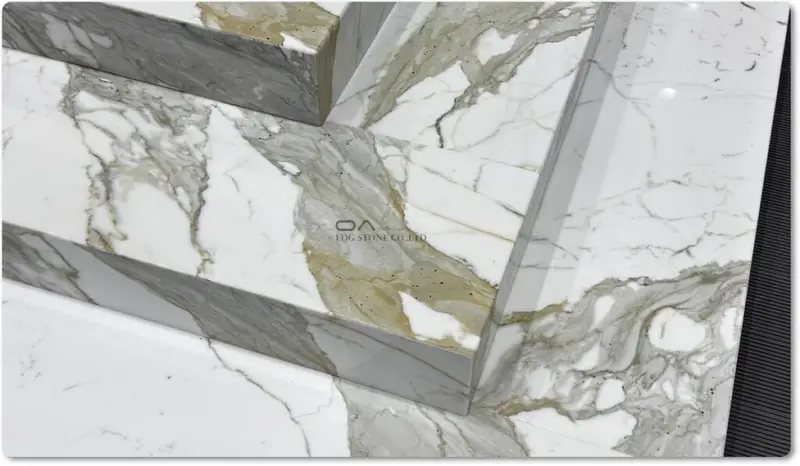
The first thing a serious buyer should understand is that “Calacatta” in this context is a design language, not a mineral name. The surfaces are engineered quartz products that imitate marble aesthetics rather than being natural marble slabs. MSI’s general quartz guidance describes quartz as nonporous and stain-resistant, and Wilsonart explains that quartz surfaces are made by combining quartz crystals with resin, polymers, and pigments to create a durable, nonporous surface.
That distinction matters for procurement. Buyers should evaluate engineered quartz by appearance consistency, slab availability, fabrication behavior, maintenance requirements, and certification package, rather than comparing it to natural marble on the basis of quarry origin or mineral rarity. The same logic also explains why quartz products are often specified for countertops, backsplashes, and interior wall cladding: manufacturers design them for predictable performance and visual repeatability.
2) Design Characteristics
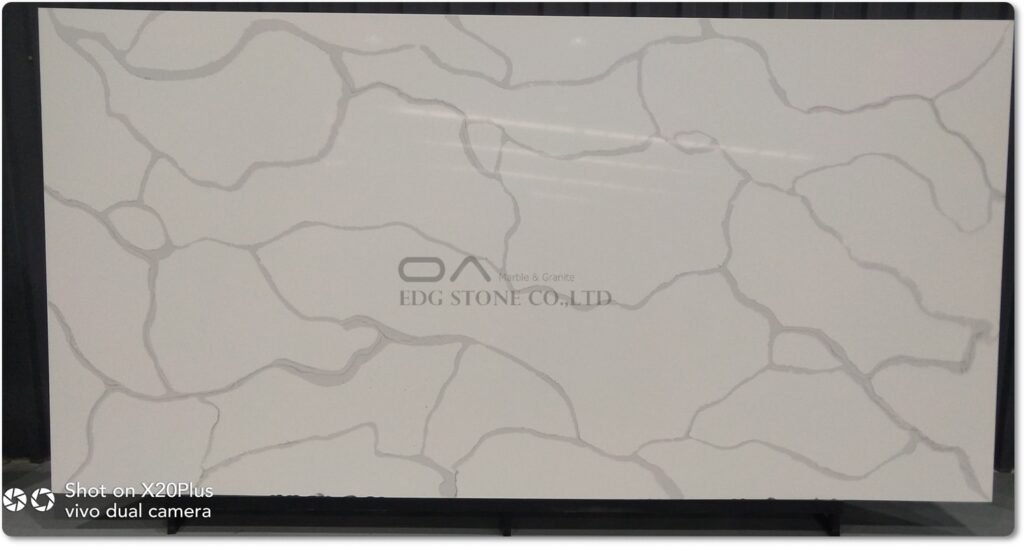
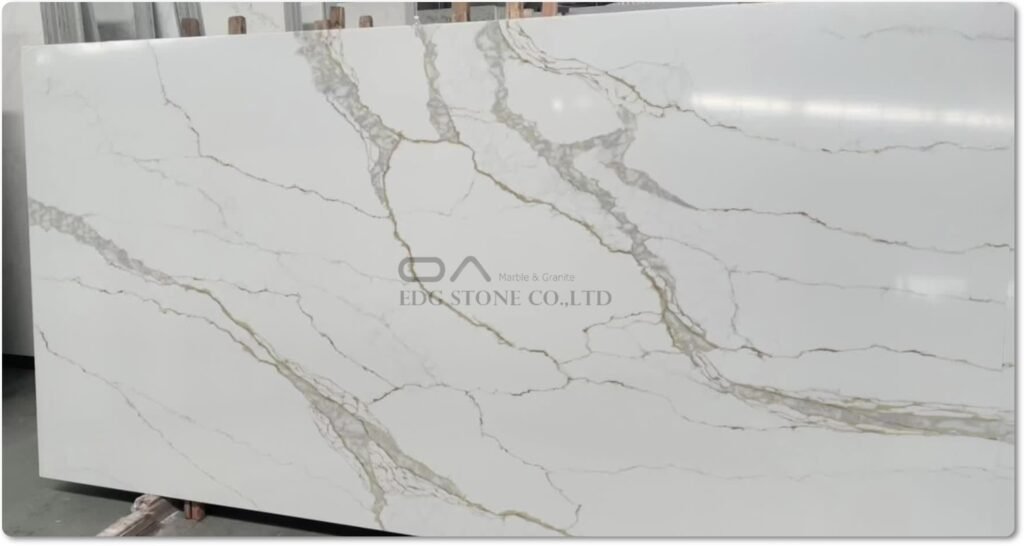
Calacatta Laza Quartz is described by MSI as having a milky or warm white background with dramatic movement and soft brown veining, plus gray-light accents. It is a marble-look quartz intended to bridge classic and modern interiors. MSI also positions it in a lower price band and notes low variation, which makes it a practical design choice for buyers who want visual richness without pushing the palette too far toward gold.
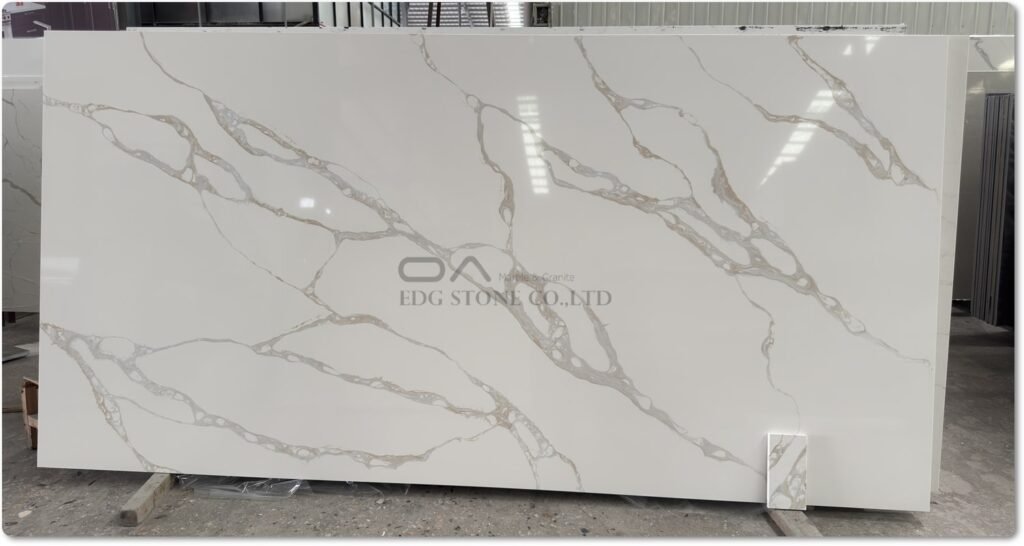
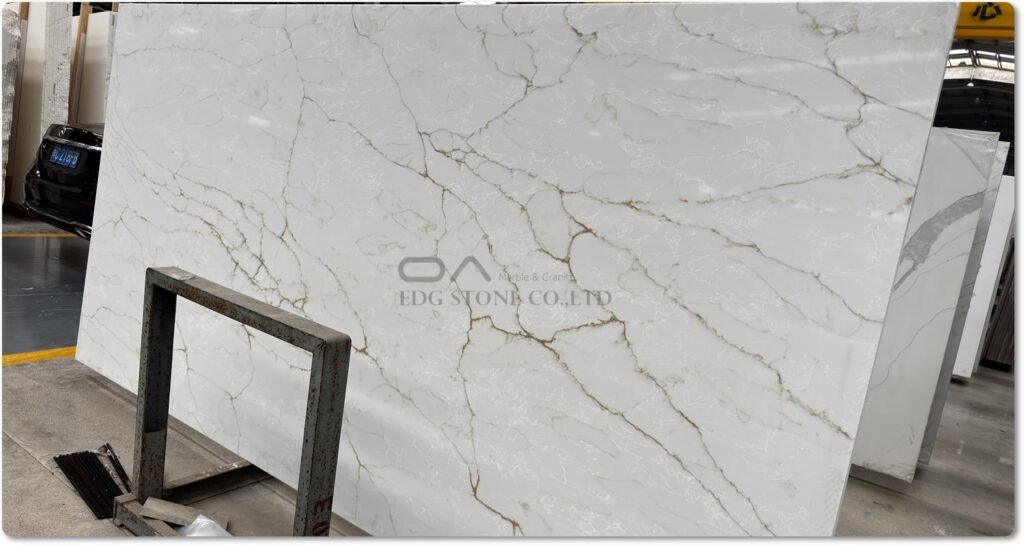
Calacatta Oro Quartz is described by MSI as a white-warm quartz with gold accent veining and a dramatic marble style. Its visual identity is warmer and more decorative than Laza, and MSI places it at a higher price tier. For projects where brass hardware, warm wood cabinetry, cream palettes, or hospitality-style luxury are part of the design brief, Oro often communicates the intended mood faster than Laza does.
Scientifically, this is a color-temperature decision as much as a pattern decision. Warm white surfaces with brown-gold veining are perceived differently than cool whites or gray-only veining because the accent color shifts the room’s overall visual temperature. That is why the “right” product often depends more on adjacent materials than on the quartz itself.
3) Veining Pattern Analysis
Laza’s veining is centered on soft brown tones with gray-light accents, and MSI explicitly describes it as dramatic but still usable across classic and modern settings. Importantly, the brand also indicates Book Match: YES, which makes it more attractive for large islands, feature walls, and upscale backsplash compositions where symmetry matters.
Oro, by contrast, is built around bold gold veining and is Book Match: N/A on MSI’s product page. That does not make it inferior; it simply means the buyer should not spec it for projects where mirrored seam continuity is the main visual objective. In practice, Oro is strongest when the goal is a warm luxury statement rather than a book-matched architectural composition.
For project planning, that difference matters in three scenarios. First, island faces and waterfall returns: Laza is generally better when the installer must align veins across multiple planes. Second, hospitality reception desks and feature walls: Oro can deliver more immediate warmth and high-end emotional impact. Third, multi-unit residential work: Laza’s softer tone usually makes it easier to standardize across units while keeping the “marble look” premium. These are practical inferences from the published product characteristics, not fabricated claims.
4) Color Consistency Evaluation
Both products are labeled Low Variation by MSI, which is an important procurement signal. Low variation means the family of slabs is intended to stay visually close to the published look, which helps when buyers need repeatable installations across multiple kitchens, villas, model homes, or hotel keys. Still, low variation is not a substitute for slab approval; the correct workflow is always to approve physical slabs or high-resolution slab photos before release.
From a specification standpoint, Laza is the safer choice when the design team wants broader neutrality and less risk of gold becoming dominant in the room. Oro is the stronger choice when warm metals, cream paint systems, and richer lighting are already locked in. In other words, Laza is the “coordination-first” option, while Oro is the “statement-first” option.
5) Cost Comparison
MSI positions Calacatta Laza at $$ and Calacatta Laza Oro at $$$. That is not a final landed price, but it is a meaningful tiering signal: Oro is the more premium-positioned product. For importers and distributors, the correct cost model should include not only slab purchase price, but also freight, breakage allowance, container utilization, fabrication yield, edge complexity, book-match waste, installation labor, and market-specific margin structure.
The useful procurement question is therefore not “which one is cheaper?” but “which one gives better value per installed square meter in the target market?” Laza usually wins when the buyer needs a premium look at a slightly lower acquisition tier. Oro usually wins when the project can absorb a higher material tier in exchange for a stronger emotional appeal and warmer visual luxury. That is a commercial inference based on the published price bands and design signals.
6) Commercial Project Suitability
MSI lists both products for residential and commercial counters, walls, and flooring categories, which means the family is not limited to kitchen worktops. In real-world use, however, the buyer should match the product to the exact project environment: hotel guest-room vanities, restaurant counters, model-home kitchens, apartment fit-outs, or reception desks will each place different demands on seam layout, maintenance, and consistency.
For food-prep applications, engineered quartz is attractive because it is nonporous and typically does not require sealing. MSI says Q™ Quartz is nonporous and stain resistant, while Wilsonart similarly states quartz surfaces do not require sealing because of their nonporous nature. NSF certification is the other major procurement signal: MSI notes its quartz is NSF certified for food safety and sanitation, and NSF’s public listings include quartz solid surfaces for food zones under NSF/ANSI 51.
For interior air quality and green building positioning, UL GREENGUARD is worth checking when the project brief includes low-emission goals or school/healthcare-sensitive environments. UL states that GREENGUARD certification helps demonstrate compliance with chemical emission standards and supports healthier indoor environments, and it is recognized within green building programs such as LEED, BREEAM, and Fitwel.
For fabrication and installation, buyers should treat silica safety as a real compliance issue, not a footnote. OSHA says cutting, grinding, drilling, or crushing stone countertops can expose workers to respirable crystalline silica, and NIOSH warns that engineered stone countertops can contain very high silica content, often over 90%. MSI’s own product pages also carry silica-related warnings and SDS references for these quartz products. This is crucial for fabricators, not just end users.
7) Importer Procurement Recommendations
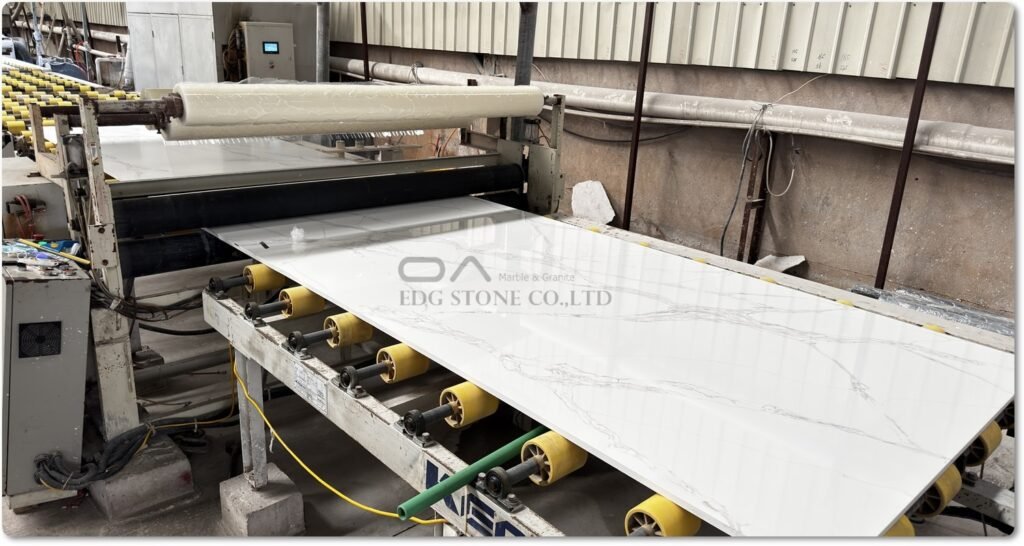
For importers, the winning workflow is to separate the decision into four layers: visual approval, technical compliance, fabrication feasibility, and landed-cost control. That prevents the common mistake of choosing a slab from a rendered photo and then discovering that the tone, seam behavior, or certification package does not match the project brief.
A strong RFQ should request the following:
- physical sample or calibrated slab photo,
- thickness options,
- polished finish confirmation,
- lot or batch information,
- book-match availability,
- application scope,
- NSF/food-zone documentation if needed,
- GREENGUARD or low-emission documentation if required by the client,
- SDS and fabrication safety sheet,
- packing method,
- breakage allowance,
- lead time,
- and a quotation broken down into material, packing, freight terms, and port basis.
These are procurement best practices derived from how manufacturers publish product data and how compliance bodies define certification value.
A practical decision matrix looks like this:
Choose Calacatta Laza Quartz when the project needs a softer, warm-white base, better vein symmetry, book-match capability, a lower price tier, and a flexible design language that works with multiple cabinet colors.
Choose Calacatta Oro Quartz when the project needs a richer warm-white plus gold story, a more dramatic luxury signal, and a premium visual identity that aligns with brass, cream, walnut, or hospitality-style interiors.
Choose neither without samples if the project is highly color-sensitive, because digital images and printed brochures cannot fully replace slab-level approval. That is a buyer-safety recommendation, not a brand claim.
8) EDG Stone Factory Case Module
EDG Stone Factory — Global Quartzite Slabs & Countertops Manufacturer and Exporter
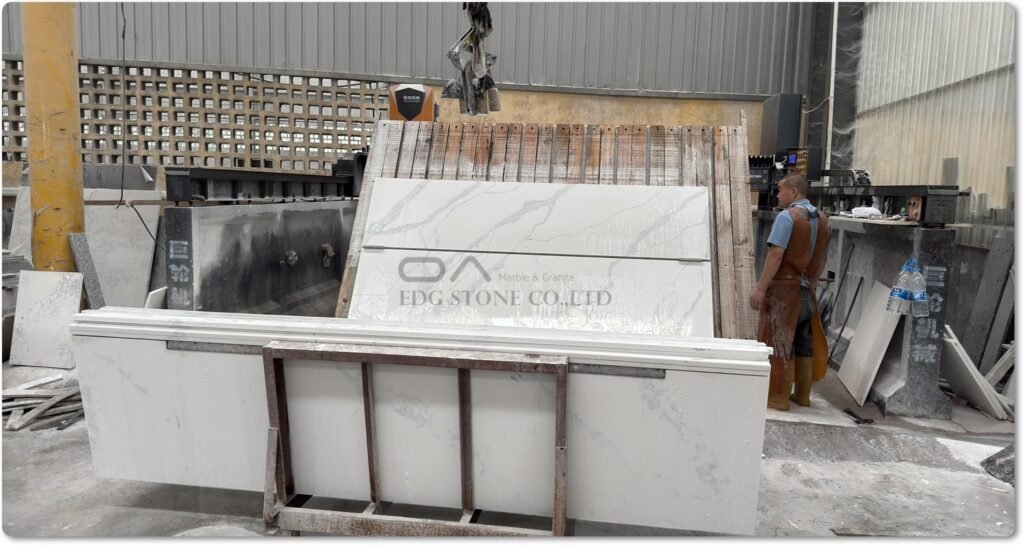
For importers, distributors, architects, and project buyers, EDG Stone Factory can be positioned as a sourcing partner that converts design intent into export-ready supply. In this module, EDG Stone Factory supports slab selection, project matching, custom cutting, QC inspection, export packing, container loading, and bulk order coordination for luxury residential and commercial stone programs. The value proposition is simple: one factory partner for consistent quartzite slabs, countertops, and project delivery under a single procurement workflow.
This module can be inserted into the article near the procurement section, where the reader has already understood the visual and technical differences and is now asking, “Who can actually deliver at scale?”
9) FAQ
What is the main difference between Calacatta Laza Quartz and Calacatta Oro Quartz?
Laza uses soft brown and gray-light veining over a warm white background, while Oro uses gold accent veining over a warm white background. Laza is positioned lower in MSI’s price range and supports book-match; Oro is positioned higher and does not list book-match.
Which one is better for a modern kitchen?
Laza is usually more adaptable for modern kitchens because its neutral warmth coordinates with more cabinet colors and hardware finishes. Oro is better when the design wants a warmer, more luxurious focal point.
Do these quartz surfaces need sealing?
No. Quartz surfaces are nonporous according to major manufacturer guidance, and nonporous quartz does not require sealing in normal use.
Are they suitable for commercial projects?
Yes, both MSI product pages list residential and commercial counter, wall, and flooring applications. For high-traffic commercial work, confirm the exact compliance package, seam plan, and fabrication method.
Is quartz safe for food preparation?
Quartz can be suitable for food preparation, especially when the product is NSF certified for food safety and sanitation. MSI states its quartz is NSF certified, and NSF’s public listings include quartz solid surfaces for food zones under NSF/ANSI 51.
Can quartz be used outdoors?
Do not assume outdoor suitability. One manufacturer explicitly states its quartz is not recommended for direct outdoor exposure, so exterior use must be verified by brand and color rather than assumed.
15-Article Internal Link Matrix
This article should sit inside a broader comparison-and-procurement cluster. Use the matrix below to build a strong internal-link map:
- Article 1 — 2026 Calacatta Quartz Procurement Guide
Primary link target: foundational article
Anchor: “Calacatta quartz procurement fundamentals” - Article 2 — Calacatta Quartz Countertops Buying Guide
Anchor: “Calacatta quartz countertops buying guide” - Article 3 — White Calacatta Quartz vs Gold Calacatta Quartz
Anchor: “white vs gold Calacatta quartz” - Article 4 — Calacatta Laza Quartz vs Calacatta Oro Quartz
Anchor: “Laza vs Oro comparison” - Article 5 — Calacatta Quartz White: Design and Sourcing
Anchor: “Calacatta quartz white” - Article 6 — Calacatta Quartz Countertops: Slab Selection to Finished Tops
Anchor: “slab selection to finished countertops” - Article 7 — Gold Vein Quartz Design Trends
Anchor: “gold vein quartz trends” - Article 8 — Warm White Quartz for Modern Kitchens
Anchor: “warm white quartz kitchens” - Article 9 — Quartz Slab Consistency and Batch Control
Anchor: “quartz slab consistency” - Article 10 — Quartz Fabrication and Silica Safety
Anchor: “quartz fabrication safety” - Article 11 — Commercial Quartz Countertops for Hotels and Multi-Unit Projects
Anchor: “commercial quartz countertops” - Article 12 — NSF and GREENGUARD Certification Guide for Quartz
Anchor: “quartz certifications” - Article 13 — Quartz Export Packaging and Container Loading Guide
Anchor: “quartz export packaging” - Article 14 — Quartz Wholesale Pricing and Landed Cost Strategy
Anchor: “quartz landed cost” - Article 15 — Importer Procurement Checklist for Engineered Quartz
Anchor: “importer procurement checklist”
The strongest link path is: fundamentals → design differences → use-case selection → cost and compliance → importer decision checklist. That creates a clean topic cluster and matches how buyers actually evaluate products.
Authority Source Pack for the White Paper
- MSI product page for Calacatta Laza Quartz — published color, accent, finish, price tier, variation, slab sizes, and application scope.
- MSI product page for Calacatta Laza Oro Quartz — published color, accent, finish, price tier, variation, slab sizes, and application scope.
- MSI general quartz guidance — nonporous surface, stain resistance, NSF and kosher notes.
- Wilsonart quartz guidance — engineered from quartz crystals with resins and pigments; nonporous and no sealing.
- Caesarstone surface guidance — nonporous, stain-free, easy to maintain, and durable.
- Cosentino Silestone countertop guidance — nonporous, stain-resistant, scratch-resistant, and durable.
- NSF product listings — quartz solid surfaces listed under NSF/ANSI 51 food-zone related certification.
- UL GREENGUARD certification page — low chemical emissions and healthier indoor environments.
- OSHA silica overview — stone countertop work can create respirable crystalline silica exposure.
- NIOSH bulletin on engineered stone — engineered stone countertops can carry very high silica content and create silicosis risk for fabricators.
- Smithsonian Quartz collection — quartz is abundant in Earth’s crust and composed of silicon and oxygen.
- OSHA/NIOSH guidance on fabrication controls — wet cutting and exposure control are central to safe quartz processing.