
Executive Summary
Calacatta Marble procurement is not a simple “price per slab” decision. For importers, distributors, fabricators, and project buyers, the real economics are shaped by four variables that must be analyzed together: material classification, MOQ structure, container utilization, and landed cost. That matters because international shipping remains volatile, customs valuation rules are strict, and logistics performance still varies meaningfully by country and corridor. UNCTAD reported renewed freight-rate pressure in 2024 due to rerouting, port congestion, and higher operating costs, while the World Bank’s Logistics Performance Index 2.0 continues to show that customs efficiency, infrastructure, and shipment competitiveness are decisive for trade outcomes.
For Canadian importers, the landed-cost model is especially clear: CBSA states that the transaction value method is the primary customs-valuation method; transportation and associated costs after the place of direct shipment are not included in value for duty; and GST is payable on most imported goods at the time of importation. CBSA also classifies marble slabs and granite slabs under specific tariff headings, and it distinguishes between crude/roughly trimmed stone and merely cut slabs. In other words, classification is not bookkeeping; it is a cost driver.
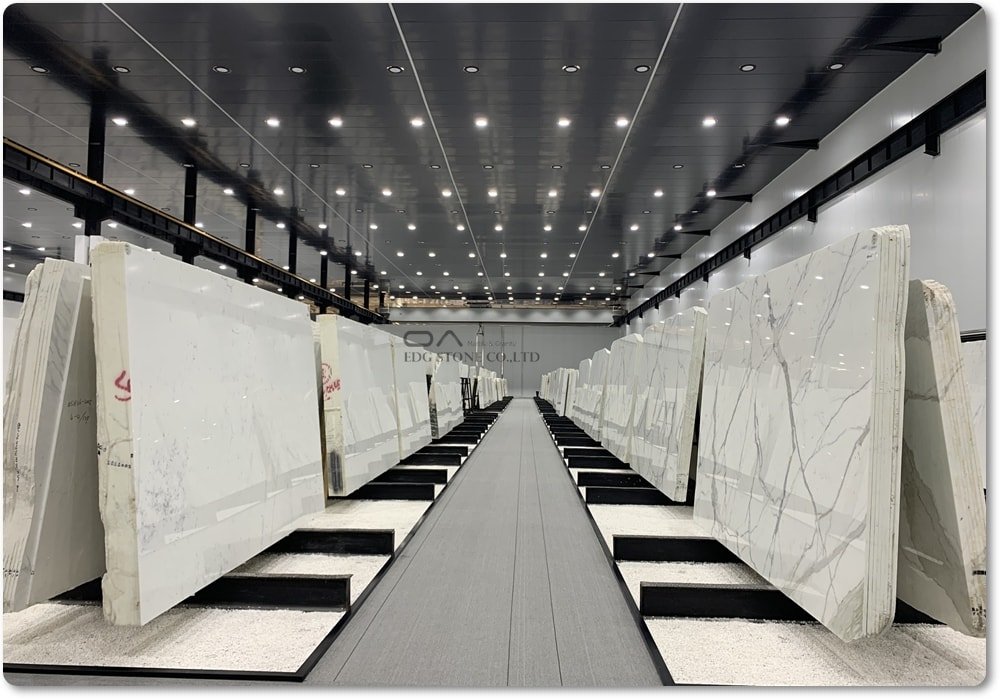
1) What Calacatta Marble Buyers Are Really Purchasing?
In procurement terms, buyers are not just buying a “white stone with grey veins.” They are buying a bundle of technical and commercial attributes: geological consistency, slab yield, surface finish, thickness tolerance, crate-worthiness, lead time, documentation quality, and post-arrival fabrication compatibility. For Calacatta-type products, that bundle becomes even more important because premium marble is often selected for visual continuity across multiple slabs and for high-value projects with low risk tolerance.
The first procurement mistake is to treat all Calacatta-like products as interchangeable. They are not. Real buying decisions must separate the following layers:
Calacatta Marble is a premium natural-marble family.
Calacatta Gold and related luxury veined variants.
Slabs versus cut-to-size versus finished countertops.
Raw material economics versus fabrication economics.
Factory-direct supply versus trading-company sourcing.
That distinction matters because tariff classification and handling rules differ by product form. CBSA’s tariff schedule classifies marble/travertine slabs under heading 2515, and its administrative memo explains how “crude or roughly trimmed” stone differs from stone that is merely cut into blocks or slabs. For procurement teams, that means the product’s physical condition affects customs treatment and should therefore be part of the RFQ, not an afterthought.
For buyers comparing Calacatta Marble with quartzite alternatives, the classification layer matters again. Canada’s tariff schedule separately lists quartz and quartzite headings in Chapter 25, which is useful when a project team is deciding whether to source a marble-led visual solution or a quartzite-led performance solution.
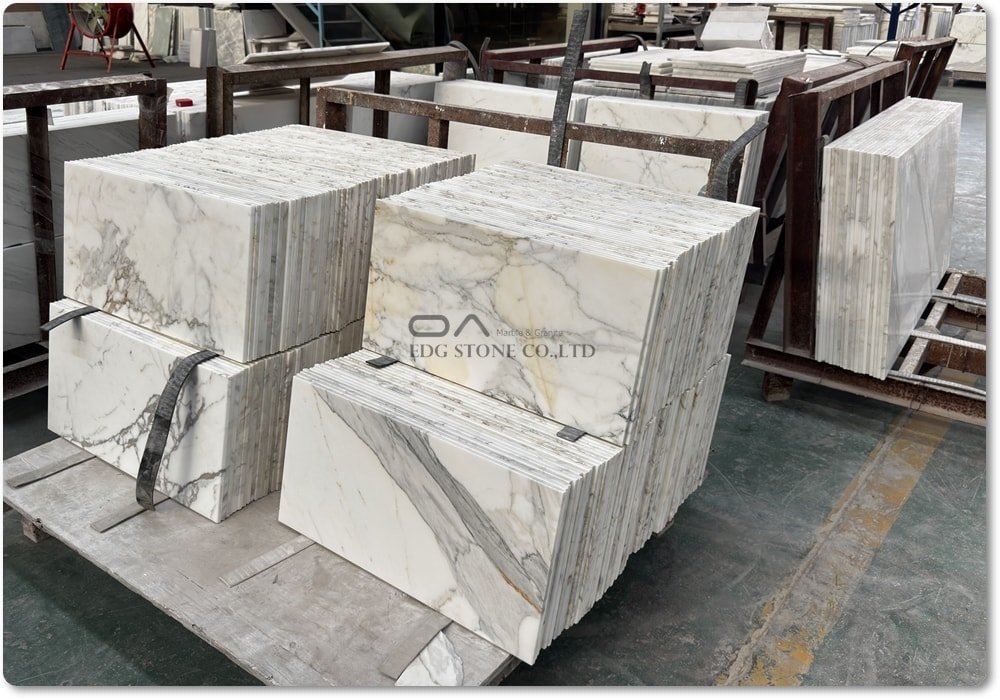
2) MOQ Economics: Why “Minimum Order” Is a Financial Decision, Not a Sales Tactic?
MOQ in stone procurement is usually presented as a seller policy. In practice, it is a production, packing, and freight optimization problem.
At the quarry and processing stage, MOQ is influenced by block availability, saw yield, vein consistency, slab thickness, and finishing loss. At the export stage, MOQ is influenced by crate dimensions, pallet stability, insurance risk, and container fill efficiency. At the buyer stage, MOQ is influenced by project demand, warehouse space, breakage tolerance, cash conversion cycle, and the number of SKUs being combined.
The most reliable way to think about MOQ is not “How many slabs can the factory sell?” but “What is the smallest shipment that still preserves acceptable unit economics?” That usually means balancing three ratios:
Value density per cubic meter.
Weight utilization versus container payload.
Defect and breakage allowance versus margin.
A low MOQ may look attractive, but if it produces poor container utilization, excessive handling, or weak slab selection, the effective landed cost rises. A higher MOQ can reduce the per-unit freight burden, improve loading efficiency, and create more stable visual matching across a project. The right MOQ is therefore not universal; it is scenario-dependent.
For Calacatta Marble, the right MOQ often depends on the buying model:
A stockist buying one color family for inventory can accept a lower visual-risk threshold but needs better pallet density.
A hotel project buyer needs slab consistency and reserve stock.
A fabricator needs thickness control, edge-quality consistency, and fewer mixed lots.
A distributor needs repeatable replenishment, not just the lowest first-order price.
This is where factory-direct suppliers add value. A disciplined exporter can convert MOQ from a rigid barrier into a logistics design tool by combining lots, standardizing crate sizes, and planning the shipment around actual container geometry instead of arbitrary piece counts.
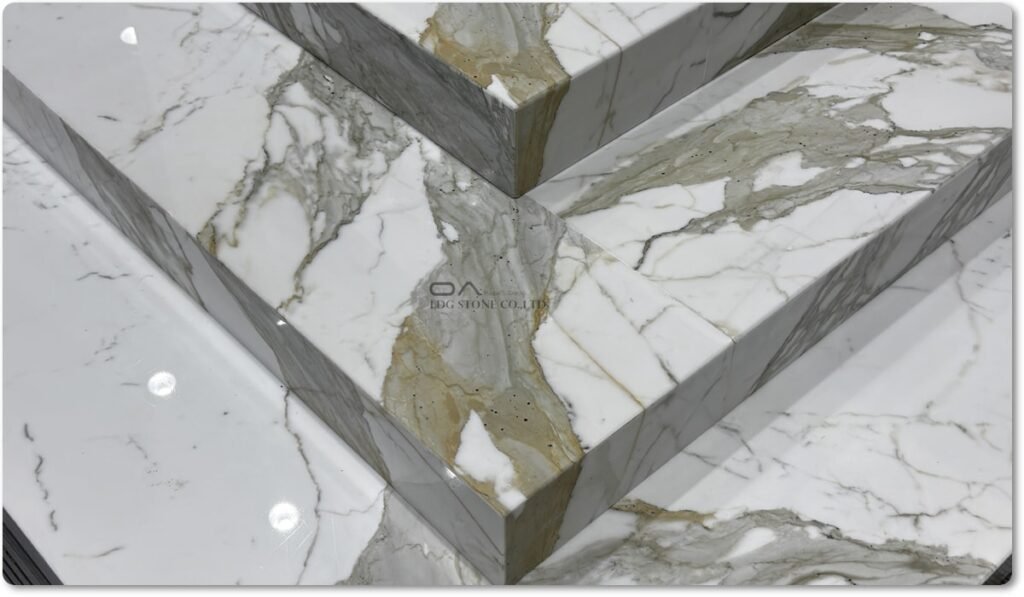
3) Container Optimization: The Hidden Lever in Marble Procurement Economics
Container optimization is where many marble procurements win or lose money. Stone is heavy, fragile, and dimension-sensitive. A shipment can be technically “full” while still being economically inefficient because the crate pattern wastes cubic space, creates weight imbalance, or forces a higher-than-necessary number of containers.
Hapag-Lloyd’s published container specifications show that a 20’ standard container has internal dimensions of about 5,900 × 2,352 × 2,395 mm and a max payload of 28,130 kg, while a 40’ high-cube container has internal dimensions of about 12,032 × 2,350 × 2,700 mm and a max payload of 28,600 kg. These numbers are helpful because they show a core truth of stone shipping: for many natural-stone loads, volume, packaging geometry, and weight distribution can constrain the shipment before the nominal payload does. Exact specifications vary by carrier and equipment series.
For Calacatta Marble procurement, the loading question should be answered in this order:
- What crate size is safe for the slab dimensions?
- How many crates can be loaded without damaging edge protection or blocking access?
- Does the shipment hit payload limits before volume limits?
- Is a 20’ container, 40’ GP, or 40’ HC more efficient for this lot structure?
- Would a mixed-container plan reduce breakage and dead space?
A useful rule is this: if the shipment is slab-heavy and crate-optimized, the 40’ HC often improves cubic efficiency; if the shipment is exceptionally dense or heavily reinforced, payload becomes the real ceiling. Stone buyers should therefore optimize for loaded value per container, not merely for slab count.
Practical optimization formula
Use the following internal KPI set:
Container fill rate = loaded usable volume ÷ internal container volume
Payload utilization = cargo weight ÷ max payload
Loss-adjusted value density = invoice value ÷ expected breakage-adjusted cargo volume
Economically optimal load = highest net landed value after freight, breakage, and handling costs
This model is especially important for premium Calacatta Marble because a single damaged slab can destroy the margin advantage created by a lower unit price. In procurement terms, the cheapest slab is not the cheapest shipment.
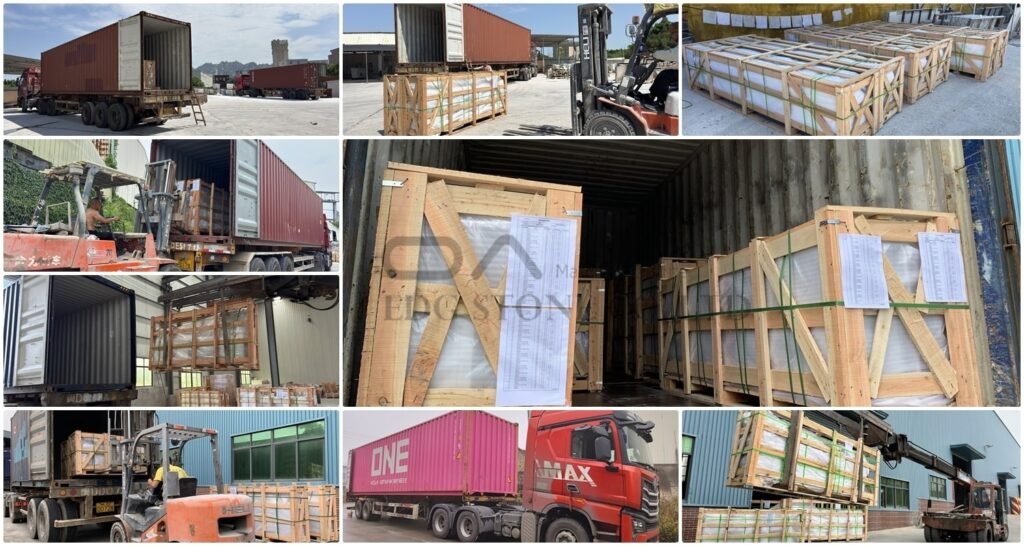
4) Landed Cost Analysis: The Only Number That Actually Matters
For international buyers, the true cost of Calacatta Marble is the landed cost, not the factory quote.
Landed cost should include the product price plus all costs required to move the goods into the buyer’s usable inventory or jobsite-ready state. For Canada, CBSA explains that the transaction value method is the primary customs valuation method, and transportation and associated costs after the place of direct shipment are not included in value for duty. CBSA also notes that GST is payable on most imported goods at the time of importation.
Landed cost formula
Landed Cost =
Product price
- Origin packing and inland handling
- Export documentation
- Ocean freight or air freight
- Marine insurance
- Destination terminal charges
- Brokerage/customs clearance
- Duty, if applicable
- GST/HST or local import tax
- Inland transport to the warehouse or site
- Inspection, storage, demurrage, or delay costs
− Any allowable rebates, drawbacks, or recoverable tax credits
That formula is simple, but each term matters.
Why do Incoterms affect the landed cost model?
The ICC states that Incoterms® rules are a standardized set of eleven trade terms used in contracts for the sale of goods. They define key responsibilities such as delivery point, cost allocation, and risk transfer. ICC also makes clear that the latest version is Incoterms® 2020 and that the rules are intended to align commercial practice in international trade.
For Calacatta Marble procurement, the practical implication is straightforward:
FCA is often better when the seller loads export-ready goods and the buyer controls international freight.
FOB can work for maritime transactions, but it must be used carefully and only where it fits the shipment structure.
CIF can be useful when buyers want ocean freight and insurance bundled, but it does not remove the need to verify customs-value treatment.
DDP looks convenient, but it can hide cost layers unless the supplier is fully transparent.
The point is not to memorize Incoterms. The point is to use the right term so that freight, risk, and customs valuation are all visible in the quote.
5) Canada-Focused Example: How Does the Customs Layer Change the Economics?
Canada is a useful reference market because CBSA publishes clear guidance on customs valuation, transportation costs, GST, and tariff classification.
For marble slabs, CBSA’s tariff schedule lists marble/travertine under heading 2515, and its administrative memorandum explains that slabs may be classified differently depending on whether they are crude/roughly trimmed or merely cut. For quartzite, Chapter 25 also includes quartz and quartzite under separate tariff lines. In the tariff schedule shown by CBSA, the relevant marble slab lines are displayed as Free under the referenced tariff treatments.
This creates a procurement lesson: the landed cost of Calacatta Marble in Canada is not just a freight question. It is a classification question first, then a valuation question, then a tax question.
A practical Canada-style landed cost workflow
Step 1: Confirm the product form.
Is it crude stone, rough-cut slab, polished slab, vanity top, or finished countertop?
Step 2: Confirm the tariff classification.
Do not assume marble, quartzite, and engineered stone will be treated the same.
Step 3: Confirm the customs-value base.
Use the transaction value method and apply only the additions required by the rules.
Step 4: Add freight and origin costs.
Treat these separately from the customs-value base when appropriate.
Step 5: Apply GST/HST and other destination charges.
CBSA states that GST applies to most imported goods at importation.
What smart buyers do differently?
The strongest importers do not ask, “What is the slab price?” They ask:
What is the full cost per sellable square foot after breakage?
What is the best container mix for the order size?
Which Incoterm gives me the cleanest risk profile?
How much inventory should I hold to avoid spot-market freight spikes?
That is the procurement economics lens that turns a stone purchase into a profitable supply chain.
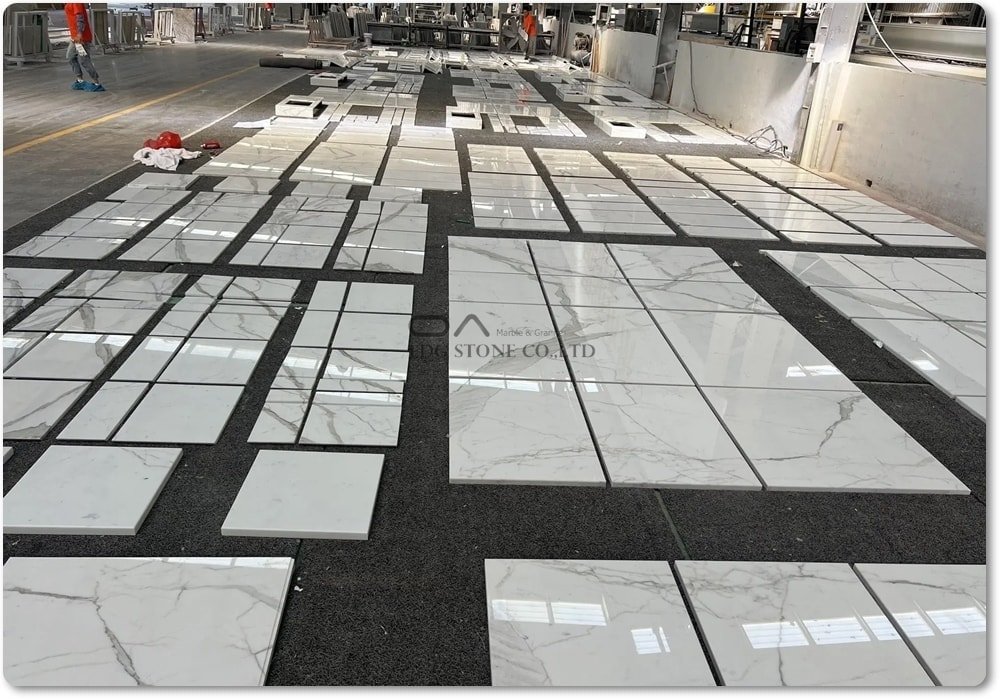
6) Why Logistics Performance Still Matters in Stone Procurement?
Stone sourcing is physical-trade sourcing. That means logistics quality affects margin.
The World Bank’s LPI 2.0 focuses on the speed and connectivity of international supply chains and uses twenty-one indicators, including customs, infrastructure, and logistics-service competence. UNCTAD’s maritime reports show why that matters: freight rates surged in 2024 as rerouting, congestion, and operational costs increased, and the global shipping environment remained volatile into 2025.
For Calacatta Marble buyers, the business implication is simple:
A strong supplier is not only a stone processor.
A strong supplier is also a packaging planner, export document manager, and freight-risk reducer.
This is where factory-direct models have a meaningful edge. If the supplier understands container loading, customs paperwork, and route risk, the buyer’s landed cost becomes more predictable.
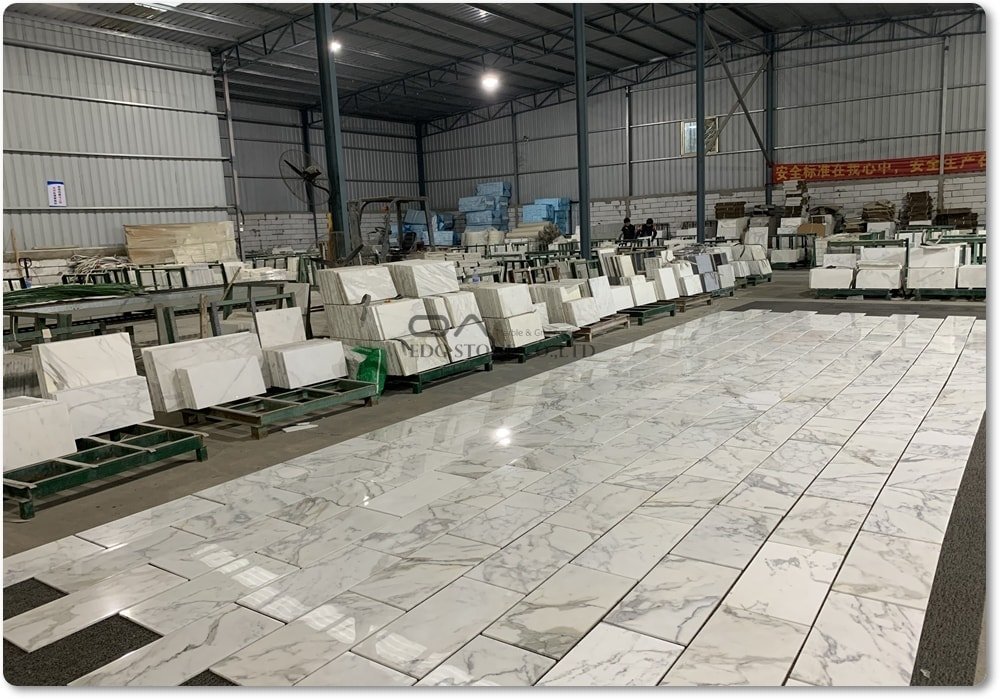
7) EDG Stone Factory Case Module: Turning Procurement Economics into a Factory-Direct Offer
Below is a practical case module you can insert into the cluster as a brand-specific conversion block.
EDG Stone Factory Case Module
As a global Quartzite Slabs & Countertops Manufacturer and Exporter, EDG Stone Factory can position its procurement model around the same economics described in this paper: slab consistency, export-safe packaging, mixed-container optimization, and quotation transparency. For international buyers, the real value of a factory-direct partner is not just lower first-invoice pricing; it is the ability to control the total landed cost through better lot planning, better loading density, and clearer customs documentation.
A strong EDG Stone Factory procurement framework should include:
Lot-by-lot slab photos before booking.
Thickness and finish confirmation before production release.
Container plan based on actual crate geometry.
Clear Incoterms selection before pro forma invoicing.
Commercial invoice and packing list aligned with customs classification.
Reserve stock or shade-matching protocol for project repeat orders.
This module works especially well when Calacatta Marble is sold alongside quartzite programs. The buyer can compare the aesthetics of marble with the resilience and supply-chain stability of quartzite while still working with one export partner.
If you want the cluster to convert, this case module should appear in multiple pages: procurement guide, MOQ guide, quality-control guide, shipping guide, and project-application guide. That repetition builds trust and makes the brand feel operationally credible, not merely promotional.
8) Procurement Strategy by Buyer Type
For importers and distributors
Prioritize container economics, consistent lot availability, and replenishment cadence. Your goal is not just a low unit price; it is stable inventory rotation and low damage loss.
For fabricators
Prioritize slab quality, thickness tolerance, and cutting efficiency. Your margin is created or destroyed in fabrication waste.
For project buyers
Prioritize booking certainty, reserve stock, and visual matching. Hotel and residential projects cannot tolerate inconsistent veining across phases.
For retailers and showroom stockists
Prioritize display impact and SKU flexibility. A small, carefully chosen inventory can outperform a large, undisciplined one.
For end-to-end buyers
Prioritize landed-cost transparency. The best supplier is the one who can show you how price, freight, tax, and risk connect.
9) Internal Link Matrix for a 15-Page Content Cluster
This is the cluster structure that supports the 60,000–90,000-word authority model.
- What Is Calacatta Marble?
- Calacatta Marble Price Guide
- Calacatta Gold Marble vs Other White Marbles
- Calacatta Marble Slabs: Sizes, Grades, and Selection
- Calacatta Marble Countertops: What Buyers Should Check
- Calacatta Marble Kitchen Applications
- Calacatta Marble Bathroom Applications
- Calacatta Marble Quality Control Checklist
- Calacatta Marble MOQ and Production Planning
- Calacatta Marble Packaging and Shipping Standards
- Calacatta Marble Landed Cost Calculator
- Calacatta Marble Import Guide for Canada
- Quartzite vs Marble Procurement Strategy
- EDG Stone Factory Quartzite Case Study
- How to Choose a Factory-Direct Stone Supplier
11) FAQ
What is the highest hidden cost in Calacatta Marble procurement?
Usually breakage, underfilled containers, and bad customs planning. The unit price can look attractive, but the landed cost rises quickly when the shipment is poorly packed or incorrectly classified.
Is a lower MOQ always better?
No. A lower MOQ can increase unit freight, reduce loading efficiency, and raise per-slab handling risk. The best MOQ is the one that preserves both visual quality and shipping efficiency.
Should buyers use FOB or CIF?
Use the term that makes cost and risk control most transparent for your transaction. ICC’s Incoterms® rules are designed to define delivery point, cost responsibility, and risk transfer, so the best term depends on who should control freight and customs planning.
How does Canada calculate import value?
CBSA says the transaction value method is the primary customs-valuation method, and transportation costs after the place of direct shipment are not included in value for duty. GST is payable on most imported goods.
Why does tariff classification matter for stone?
Because the tariff heading determines the legal treatment of the product. CBSA’s schedule distinguishes marble slabs, quartzite, granite, and other stone forms, and its memo explains the difference between crude/roughly trimmed stone and merely cut slabs.
Why is quartzite often used in the same conversation as Calacatta Marble?
Many buyers compare the visual elegance of marble with the performance and sourcing flexibility of quartzite. Canada’s tariff schedule also lists quartzite separately, making the procurement comparison commercially relevant.
12) Authority Source List
- CBSA Customs Valuation Handbook — primary source for Canada’s value-for-duty rules.
- CBSA Memorandum D13-3-3: Transportation and Associated Costs — explains what transportation costs belong in value for duty.
- CBSA Guide to Importing Commercial Goods into Canada — confirms GST treatment on imports.
- CBSA Chapter 25 Tariff Schedule — lists marble, quartzite, granite, and related stone headings.
- CBSA Memorandum D10-17-38 — explains marble/granite slab classification.
- ICC Incoterms® Rules — official source for trade-term structure and risk transfer.
- ICC Academy Incoterms articles — useful for practical FCA/FOB/CIF comparisons.
- Hapag-Lloyd container specifications — practical container dimensions and payload data.
- World Bank LPI 2.0 — logistics-performance methodology and latest dataset scope.
- UNCTAD Review of Maritime Transport 2024 — freight-rate volatility and shipping disruption context.
- UNCTAD Maritime Transport 2025 materials — show elevated and volatile rates continuing into 2025.
- World Bank trade-logistics publications — support the link between logistics speed, customs, and competitiveness.