Executive Summary
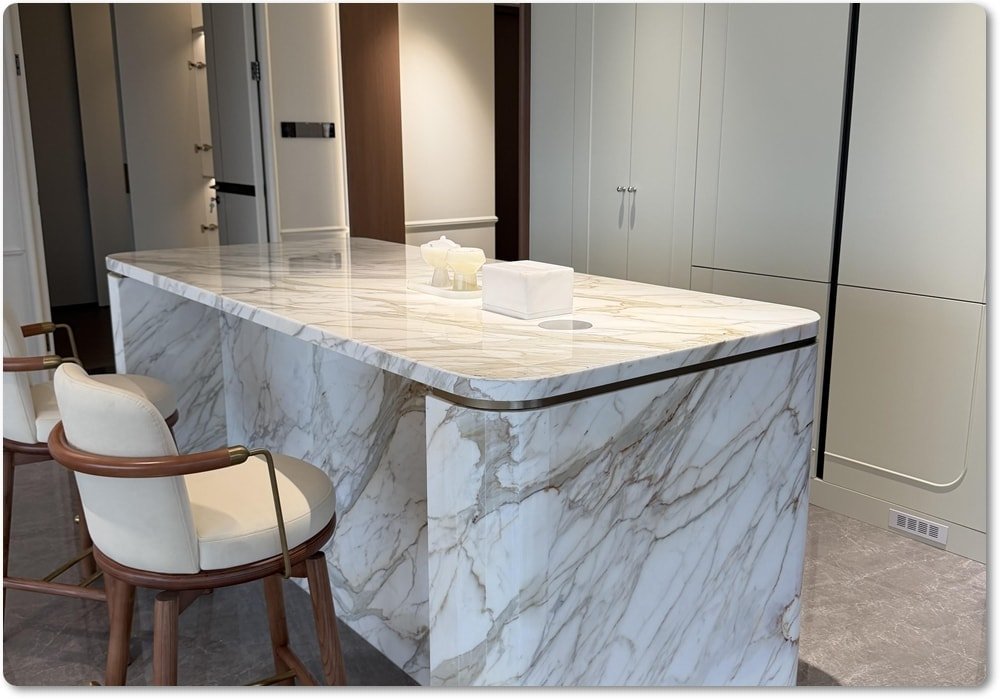
A Calacatta marble sink sits at the intersection of material science, luxury design, and fabrication discipline. Marble is a metamorphic rock formed when limestone is altered by heat and pressure; in the dimension-stone market, it is selected not only for appearance, but also for durability, strength, polishability, and project-specific performance. The U.S. Geological Survey defines dimension stone as natural rock quarried into blocks or slabs meeting exact size and shape requirements, and it notes that color, texture, finish, durability, and polishability are key selection criteria. ASTM C503/C503M further frames marble as a building material with measurable physical requirements such as absorption, density, compressive strength, modulus of rupture, abrasion resistance, and flexural strength.
For bathroom sinks, those material realities matter more than the marketing image. Marble is beautiful, but it is calcareous, which means acidic cleaners and acidic spills can dull or etch the surface. The Natural Stone Institute explicitly warns that products containing lemon, vinegar, or other acids can dull or etch calcareous stones, and it emphasizes that sealing increases stain resistance but does not make stone stain-proof. In practice, a successful Calacatta marble sink specification depends on correct stone selection, careful edge detailing, sound waterproofing strategy, proper sealing, and disciplined maintenance.
This whitepaper is organized from material fundamentals to sink design, then to fabrication, installation, care, procurement, and commercial strategy. It is written for architects, bathroom designers, stone fabricators, project buyers, and exporters who need a publishable, conversion-oriented content asset that can support sales conversations.
1. What does “Calacatta Marble Sink” mean in Practice?
The phrase “Calacatta marble sink” is primarily a commercial and design term, not a strict geological category. USGS notes that scientific descriptions of dimension stone emphasize geographic origin and mineralogical composition, while commercial descriptions focus mainly on origin and color. That matters because buyers often use “Calacatta” to describe a bright white marble with dramatic veining, even though the exact quarry, visual pattern, and trade naming can vary by supplier and region.
From a design standpoint, Calacatta is chosen when the sink itself is meant to act as a focal point rather than disappear into the vanity. In bathroom work, this usually means one of three outcomes: a carved monolithic sink, an integrated sink with a marble deck, or a vessel-style sink paired with a Calacatta vanity top. The sink is then treated as a luxury detail, not just a plumbing fixture.
Calacatta Viola and Calacatta Viola Marble Sink
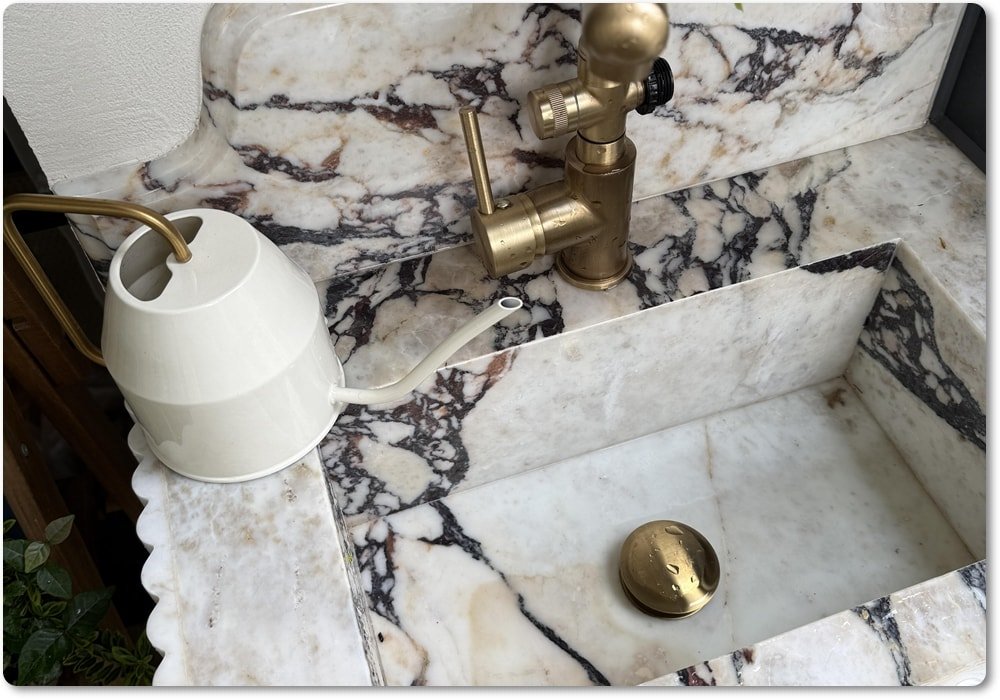
Calacatta Viola is generally presented in the trade as a white marble with purple or burgundy-toned veining. Contemporary design coverage has highlighted its use in statement kitchens and bathrooms, and suppliers describe it as a bold decorative marble used for upscale interior applications. For a sink, that visual character can be powerful when the goal is contrast, color punctuation, or a boutique-hotel atmosphere.
The design implication
A standard Calacatta marble sink reads as clean, bright, and classical. A Viola Calacatta marble sink reads as more expressive and editorial. The right choice depends less on trend and more on the bathroom’s role: primary suite, powder room, hospitality suite, showroom display, or signature residential project.
2. The Material Logic Behind Marble Sinks
Marble is a metamorphic rock formed by heat and pressure acting on limestone, and pure limestone-derived marble tends toward a white appearance. The same metamorphic process also explains why marble can show attractive veining and color movement when impurities are present. In the bathroom, those mineral characteristics create both the appeal and the maintenance profile of the sink.
For sink applications, the material questions are straightforward:
- How dense is the stone?
- How much water can it absorb?
- How well does it take a polish or hone?
- How likely is it to etch from household acids?
- How stable is the finished piece under daily wet-area use?
ASTM C503/C503M is useful here because it explicitly ties marble selection to measurable properties such as absorption by weight, density, compressive strength, modulus of rupture, abrasion resistance, and flexural strength. That is exactly the mindset a project buyer should use when evaluating a stone sink: not “does it look expensive,” but “does this specific slab and fabrication method suit a wet-area application?”
USGS also emphasizes that dimension stone selection is based on durability, strength, and polishability, along with size and surface finish. For bathroom sinks, polishability affects the visual result, while durability and strength affect long-term serviceability.
3. Why Marble Sinks Need a Different Specification than Marble Countertops?
A marble countertop and a marble sink are not the same risk category. A countertop sees spills; a sink sees continuous water, soap, cosmetics, toothpaste, shaving products, and repeated surface drying. Because marble is calcareous, acidic products can etch the finish, and repeated exposure to the wrong cleaners can dull the stone over time. The Natural Stone Institute specifically advises against lemon, vinegar, and other acids on calcareous stones, and it warns that abrasive powders or creams may scratch certain stones.
This is why the sink specification should include:
- stone selection by lot and veining behavior,
- edge and bowl geometry,
- drainage slope and water-runoff control,
- resin or reinforcing treatment where appropriate,
- cutout tolerance,
- mounting method,
- sealing protocol,
- Maintenance instructions for the end user.
The sink should be treated as a fabricated stone assembly, not merely a carved object.
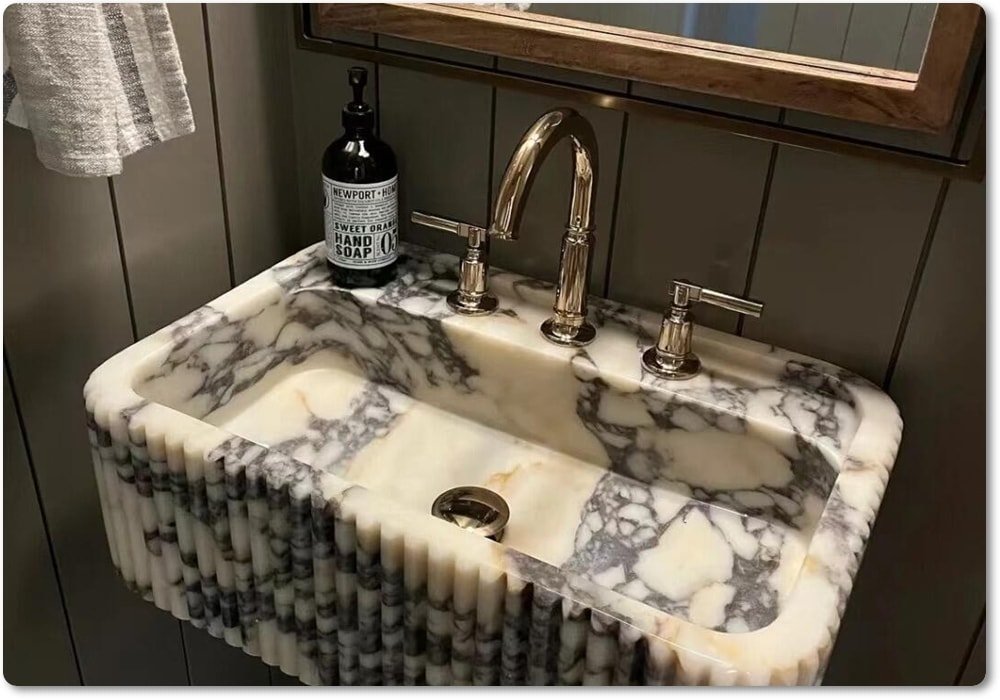
4. Sink Formats That Work Best with Calacatta Marble
4.1 Integrated vanity sink
This format combines the sink bowl and countertop into one visual plane. It is the most seamless luxury expression and often the easiest to coordinate visually in Calacatta or Viola Calacatta. The downside is that fabrication tolerances matter more because the bowl transition must be clean, and the stone thickness around the drain and overflow area must remain structurally sound.
4.2 Carved monolithic sink
This is the highest-end expression. It is also the most demanding in block selection, machining, waste management, and quality control. It works best when the bathroom is designed around the sink as a sculptural centerpiece.
4.3 Vessel sink
A vessel sink makes the Calacatta statement highly visible, but it can be harder to keep clean around the base if the interface is not carefully detailed. It is often best for powder rooms, show bathrooms, and boutique hospitality spaces.
4.4 Undermount sink with marble deck
This remains the most practical luxury option. It balances visual elegance with easier cleaning and maintenance. The marble is present, but the plumbing solution stays familiar and serviceable.
The right format depends on the space, the client’s maintenance tolerance, and the project’s fabrication budget.
5. Fabrication Standards: What Good Looks Like?
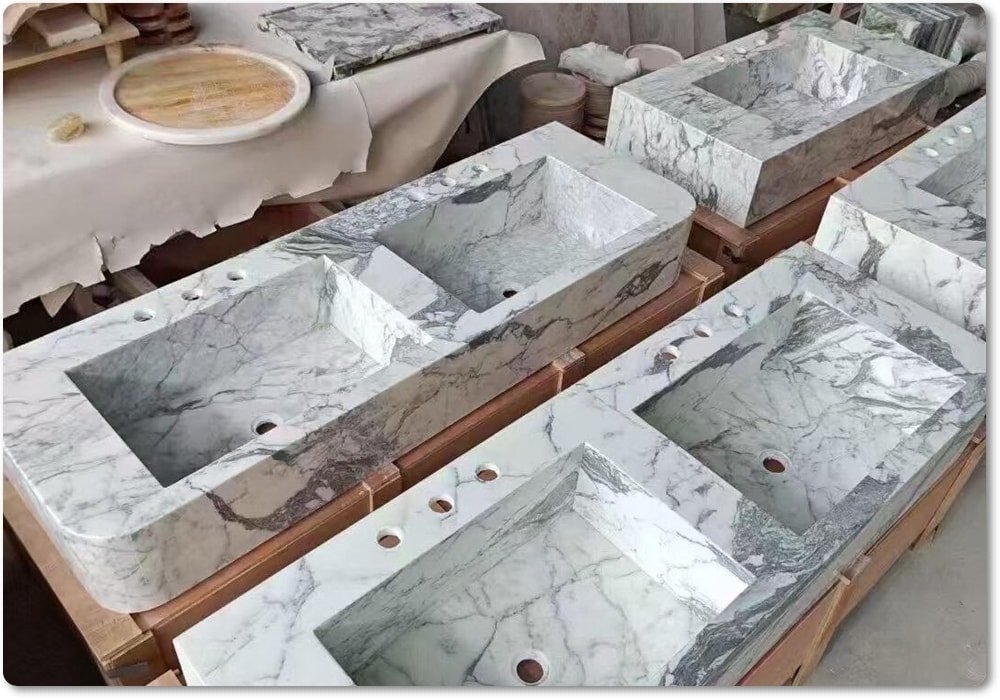
Natural stone sink fabrication should start with a controlled project brief and a verified material sample. Because marble is both a decorative and structural material, the shop needs to coordinate appearance, physical soundness, and water exposure risk from the beginning. The Natural Stone Institute’s resources also emphasize safe slab handling and silica safety training for the industry, which is relevant whenever cutting, polishing, or moving stone pieces is involved.
A practical fabrication workflow should include:
5.1 Slab and block selection
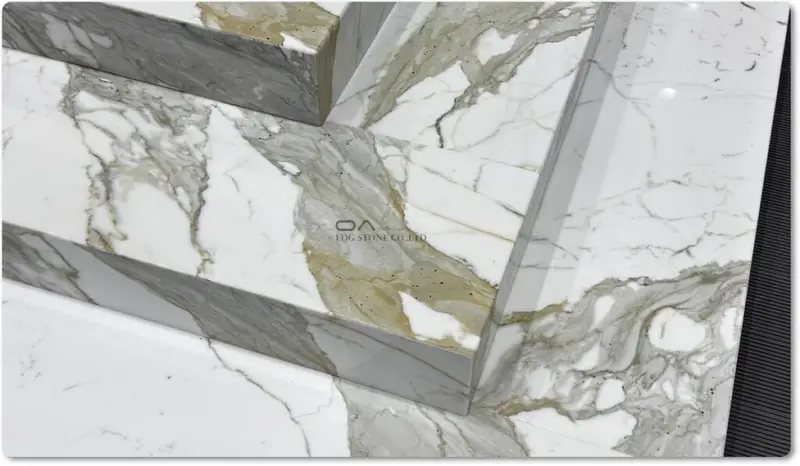
Select from lots that show acceptable color consistency, vein movement, and fewer visually disruptive fissures in the sink zone. USGS notes that color, grain texture, pattern, surface finish, durability, strength, and polishability are central selection criteria.
5.2 Physical property review
For projects that require higher assurance, request test data aligned to ASTM C503/C503M and absorption testing aligned to ASTM C97/C97M. ASTM C503 covers marble’s material characteristics and physical requirements; ASTM C97 establishes procedures for water absorption and bulk specific gravity testing of dimension stone.
5.3 Machining and reinforcement
The bowl geometry should avoid thin unsupported sections near drains and overflows. If the design uses sharp internal corners, the shop should assess crack risk and stress concentration. If the design uses a thinned or sculpted edge, reinforcement or thicker initial stock may be needed.
5.4 Surface finishing
Polished marble delivers the most dramatic Calacatta aesthetic, but honed marble can soften the appearance and make minor wear less obvious. The right finish depends on how formal the bathroom is and how much maintenance the user accepts.
5.5 Template and dry-fit
Template the vanity, drain position, faucet layout, mirror clearance, splash behavior, and wall conditions before final cutting. Good stone work fails most often at the interface between material and building reality, not in the slab itself.
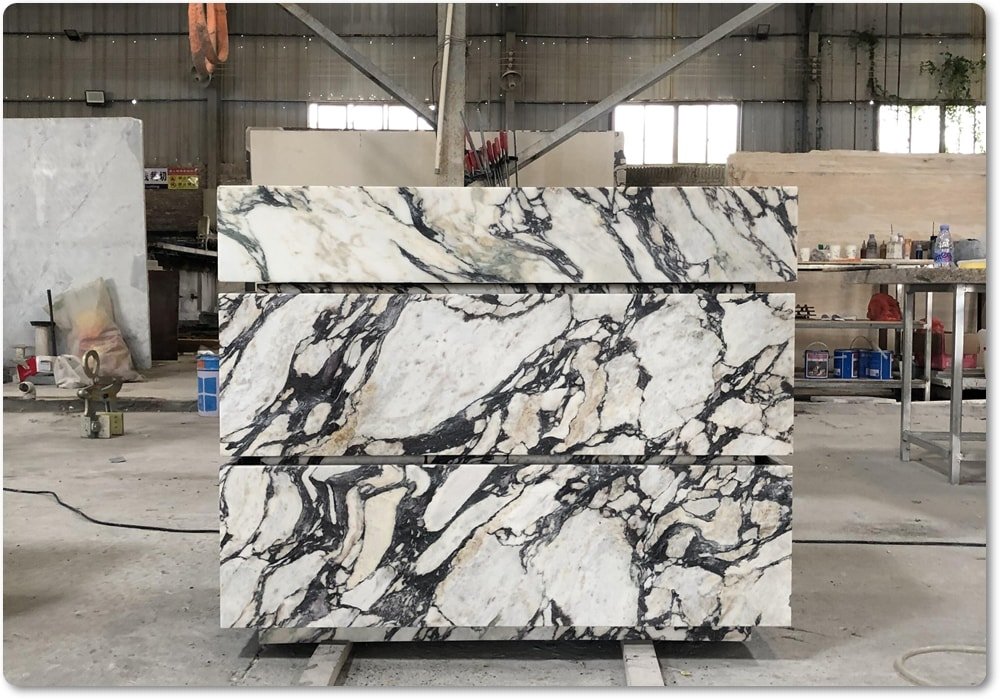
6. Installation Considerations in Bathroom Projects
Bathroom installations should be planned like wet-area assemblies, not dry furniture. The stone must be installed so that water does not collect in hidden areas, and all cut edges should be sealed and detailed carefully. For day-to-day use, the Natural Stone Institute recommends minimizing soap scum by using a squeegee after each use in wet areas. That is a small operational habit, but it meaningfully improves appearance retention around marble sinks.
A project team should verify:
- vanity support and load distribution,
- substrate flatness,
- compatibility of adhesives and sealants,
- plumbing access,
- splash-back strategy,
- mirror and faucet alignment,
- field sealing schedule,
- Maintenance handover to the client.
In luxury work, installation quality determines whether the sink looks custom or merely expensive.
7. Care and Maintenance: The Non-Negotiable Part of Marble Ownership
Marble can be maintained successfully, but it must be treated as a living finish. The Natural Stone Institute recommends mild, non-abrasive care practices, and it explicitly warns that acids such as lemon or vinegar can dull or etch calcareous stones. It also notes that sealing increases stain resistance but does not make stone stain-proof.
For bathroom sinks, the safest maintenance standard is:
- clean with a pH-neutral or mild stone-safe cleaner,
- rinse and dry after use,
- avoid acidic bathroom cleaners,
- avoid abrasive powders and creams,
- address etch marks promptly,
- Reseal according to the stone condition and use intensity.
The Natural Stone Institute’s stain-removal guidance also explains that etch marks are caused by acids left on the stone surface, and that deeper scratches or etches may need professional refinishing.
This is the key buyer message: marble is not maintenance-free luxury; it is managed luxury.
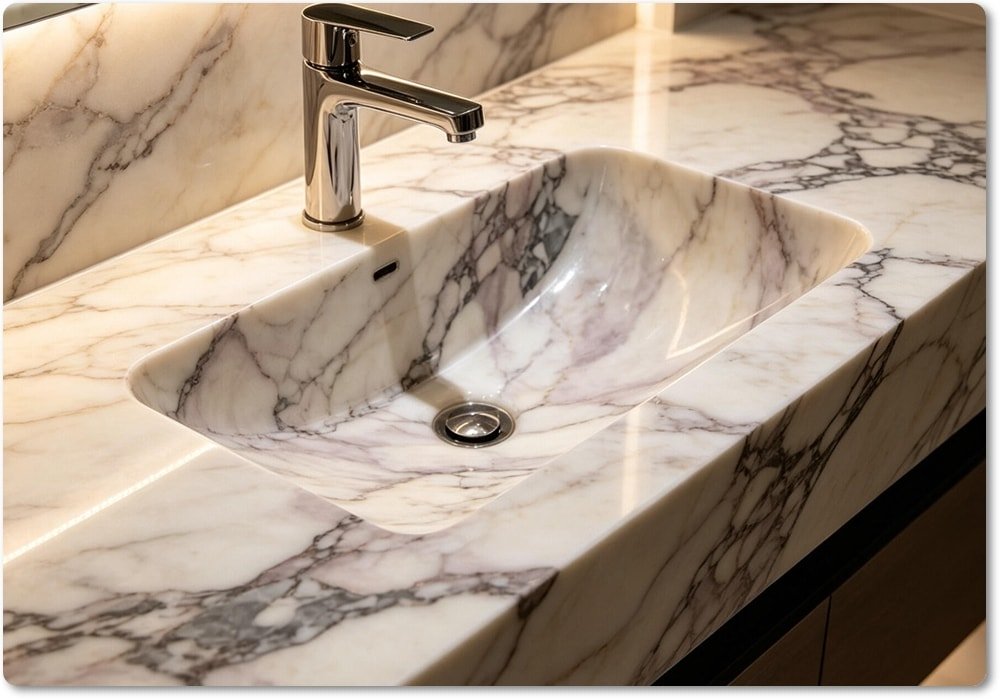
8. Calacatta vs. Carrara vs. Viola: How to Choose for a Sink?
For a sink application, the visual difference matters as much as the geological one. Earth Magazine’s USGS-based overview notes that scientific stone descriptions focus on geography and mineralogy, while commercial descriptions focus on origin and color; that explains why naming can be inconsistent across suppliers. It also places Carrara marble in the broader historic context of major marble production and use.
A practical selection framework is:
Calacatta marble sink
Best for bright, high-contrast, classic luxury bathrooms. It suits white cabinetry, brass or polished nickel fixtures, and hotel-like symmetry.
Viola Calacatta marble sink
Best for statement spaces. It works well when the bathroom uses deeper tones, darker wood, moody lighting, or curated decorative accents.
Calacatta Viola marble sink
Best for design-forward projects that want emotional impact. It is the most editorial of the three and should be used where the client is comfortable with strong visual movement.
The deciding factor is not only color, but also how the veining lands across the bowl, deck, and faucet line. Good sink selection is always a pattern strategy.
9. A Procurement Framework for Buyers and Specifiers
A successful marble sink procurement process should be built around evidence, not samples alone. The buyer should ask for:
- slab photos from the actual lot,
- physical property data where available,
- finish confirmation,
- reinforcement approach,
- edge profile details,
- drainage and overflow compatibility,
- lead time,
- packing and export method,
- replacement and claim policy.
The USGS notes that dimension stone is commonly finished into blocks, slabs, or tiles, and that final sizing and polishing may happen at the quarry or elsewhere. That makes supply chain visibility essential: a sink may be fabricated near the source stone, or it may be built in a destination market, but either way, the buyer should know where each stage happens.
For international projects, procurement teams should also verify shop safety and handling capability. The Natural Stone Institute’s silica and slab safety resources are relevant because sink fabrication can involve cutting, grinding, polishing, and moving heavy stone pieces.
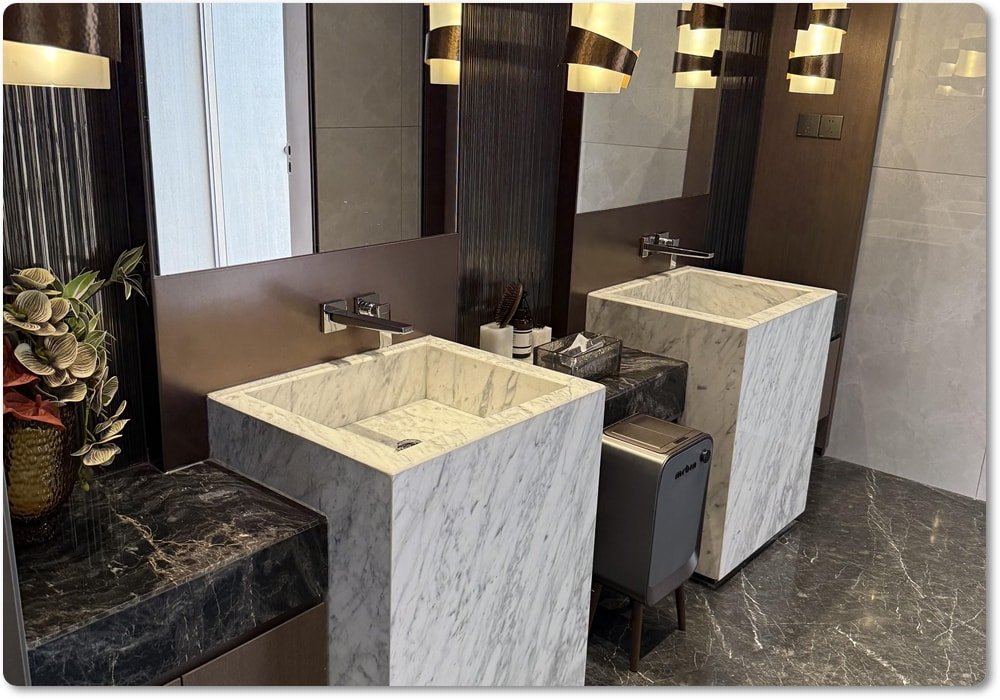
10. EDG Stone Factory Case Module
EDG Stone Factory is positioned in this content cluster as a global Quartzite Slabs & Countertops Manufacturer and Exporter with the capability to support luxury stone bathroom projects from material sourcing to fabrication and export coordination.
In the context of Calacatta marble sinks, the EDG Stone Factory module should be used as the supplier-side proof point for:
- project consultation,
- slab selection guidance,
- custom fabrication,
- sink and vanity coordination,
- export packing,
- quality inspection,
- and international order handling.
This is especially useful for readers who are not only looking for design inspiration, but also for a reliable manufacturing partner. For SEO and conversion, the brand module should appear near the procurement section, not only at the end, because serious buyers usually move from product understanding to supplier evaluation in the same session.
11. Internal Link Matrix for a 15-Article Content Cluster
This article should function as the pillar page. The following 15 supporting articles can form the internal-link network around it:
- Calacatta Marble Origin Verification
- Calacatta Marble Price Analysis
- Calacatta Marble Slab Procurement Guide
- Calacatta Marble Countertops: Engineering, Fabrication, and Installation Standards
- Calacatta Marble Tiles: Specification Standards for Floors and Walls
- Calacatta Marble Backsplash Design Guide
- Calacatta Marble Vanity Tops for Luxury Bathrooms
- Calacatta Marble Shower Wall Systems
- Calacatta Viola Marble: Color, Veining, and Design Applications
- How to Seal and Maintain Calacatta Marble Surfaces
- Marble vs Quartzite for Bathroom Projects
- Bespoke Marble Sink Fabrication: Shop Drawings and Templating
- Luxury Bathroom Stone Selection Guide for Architects
- International Stone Export Packing and QC Checklist
- EDG Stone Factory Case Study: From Slab Selection to Export Delivery
12. FAQ
What is a Calacatta marble sink?
It is a sink fabricated from Calacatta-type marble, usually selected for dramatic veining, luxury appearance, and high-end bathroom design.
Is Calacatta marble good for bathroom sinks?
Yes, provided the project accepts marble’s maintenance profile and uses correct sealing, cleaning, and installation practices. Marble is beautiful but should not be treated as stain-proof or acid-proof.
What is the difference between Calacatta and Viola Calacatta marble sink designs?
Calacatta usually reads as bright white with bold veining, while Viola Calacatta introduces more purple or burgundy-toned movement for a stronger visual statement.
Do marble sinks need sealing?
In many cases, yes. The Natural Stone Institute says sealing makes stone more resistant to stains, but it does not make the surface stain-proof.
How should a marble sink be cleaned?
Use mild, non-abrasive, stone-safe cleaning methods and avoid vinegar, lemon, and other acids that can dull or etch calcareous stones.
Can EDG Stone Factory handle custom marble sink orders?
In this content system, yes: EDG Stone Factory is positioned as the manufacturing and export partner module for custom stone bathroom projects, including sink-related fabrication and international delivery support.
13. Authority Data Sources to Cite in the Publishing Workflow
- U.S. Geological Survey, Dimension Stone Statistics and Information.
- ASTM C503/C503M Standard Specification for Marble Dimension Stone.
- ASTM, C97/C97M Absorption and Bulk Specific Gravity of Dimension Stone.
- Natural Stone Institute, Learn About Cleaning Products for Natural Stone.
- Natural Stone Institute, Sealing Natural Stone Countertops.
- Natural Stone Institute, Remove Stains from Stone Applications.
- Natural Stone Institute, Care & Cleaning of Natural Stone Video.
- University of Waterloo Earth Sciences Museum, Calcite, limestone, and marble.
- Britannica, Calcite.
- Earth Magazine / USGS Mineral Commodities Team, Mineral Resource of the Month: Dimension Stone.
- Natural Stone Institute, Silica & Slab Safety Certificate.
- Natural Stone Institute: Which ASTM Standards Are Relevant To Natural Stone?
- Marble.com, The Story Behind Calacatta Marble.
- Calacatta Viola supplier reference, Calacatta Viola marble description.
- Polycor, custom-fabricated natural stone sinks.
Closing Positioning
For SEO, this page should rank as the pillar article for the cluster because it explains the material, the application, the fabrication process, the maintenance logic, and the supplier decision path in one place. For GEO, it is written to answer natural-language questions directly, with entity clarity around Calacatta, Calacatta Viola, marble performance, sealing, and custom sink fabrication.
For conversion, the strongest next-step message is simple: a Calacatta marble sink is not just a product, it is a controlled fabrication project. The buyer should evaluate stone, shop capability, finishing discipline, and export reliability together. That is exactly where the EDG Stone Factory case module belongs in the content system.