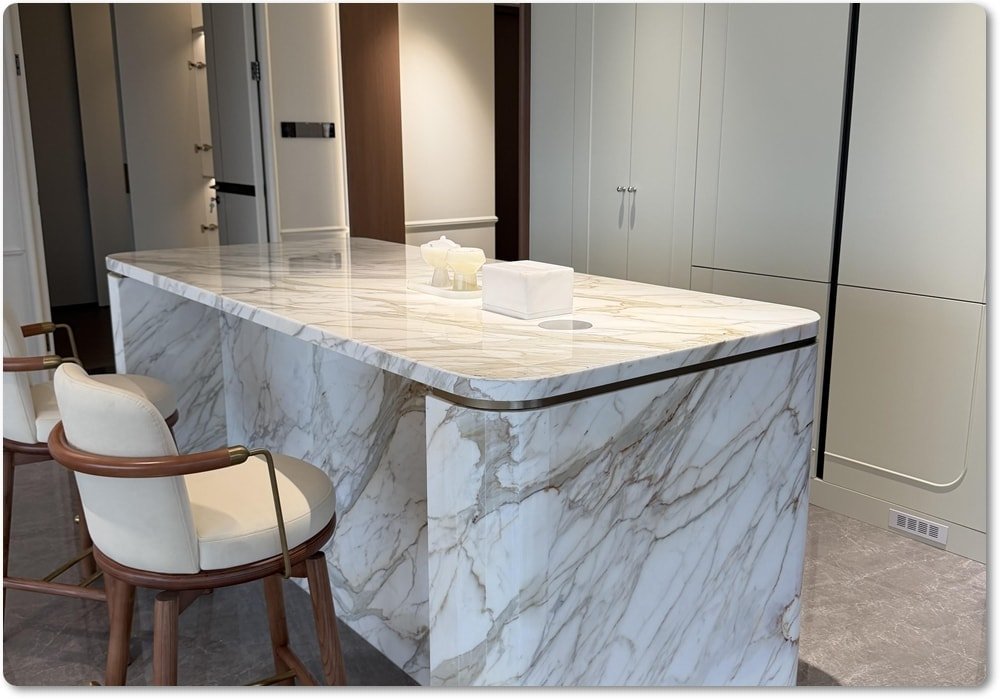
Executive Summary
Calacatta marble should never be purchased on trade name alone. In procurement, “Calacatta” is a market identity, not a complete technical specification. For serious projects, the buyer needs a repeatable quality-control system that starts with terminology, continues through sampling and petrographic verification, and ends with project-specific performance testing and supplier auditing. ASTM’s dimension-stone framework is especially useful here because it separates naming, selection, sampling, testing, and maintenance into distinct technical steps. That structure is exactly what high-value marble procurement needs.
The core rule is simple: different applications require different evidence. Interior floors, kitchen countertops, shower walls, exterior cladding, and paving systems are not interchangeable use cases. Natural Stone Institute guidance notes that stone evaluation may need to address slip resistance, abrasion resistance, absorption, compressive strength, and bending strength, depending on the project condition, while ASTM standards provide the corresponding test methods and selection guides. A strong procurement file, therefore, combines visual inspection, laboratory data, factory documentation, and installation-risk review.
1. What does “quality” mean in Calacatta marble procurement?
For Calacatta marble, quality has four layers: appearance consistency, material integrity, fabrication accuracy, and project fitness. A slab can look premium in a showroom and still fail in use if it has a weak structure, excessive absorption, unstable veining, or a poor lot-to-lot match. ASTM C119 exists to standardize dimension-stone terminology, which matters because stone buyers, fabricators, and specifiers often use the same words differently. A quality program should therefore define the exact commercial grade, finish, thickness, tolerance, and intended use before any test report is reviewed.
The best practice is to evaluate the material by application risk rather than by marketing label. For example, a statement like “high-end white marble” is not enough for a façade, a hotel lobby, or a kitchen island. ASTM C1528 is designed for architects, engineers, specifiers, contractors, fabricators, and suppliers, which is a good signal that selection must be collaborative, not cosmetic. In other words, the buyer should ask not only “What is this stone?” but also “Where will it be used, how will it be fabricated, and what evidence supports that use?”
2. The QC sequence: from slab identity to acceptance
A practical Calacatta QC workflow begins with identification, then moves to sampling, petrography, physical testing, fabrication checks, and finally shipment release. ASTM C1799 addresses specimen sampling, selection, preparation, and conditioning; that matters because the quality of test data depends on how the specimen was taken and prepared. ASTM C1721 then provides a petrographic examination guide, which helps verify the stone’s fabric, texture, minerals, and internal features before the project commits to production.
This sequence is important because stone testing is only useful when the sample truly represents the lot. If a buyer tests one good slab while the shipment contains a mixed lot, the data are misleading. The purpose of petrographic examination is not to create a marketing claim; it is to establish reasonable confidence that the material being supplied is technically comparable to what was approved. That is one reason the ASTM dimension-stone committee also maintains selection and testing guidance as a connected system.
3. Inspection checklist for incoming slabs
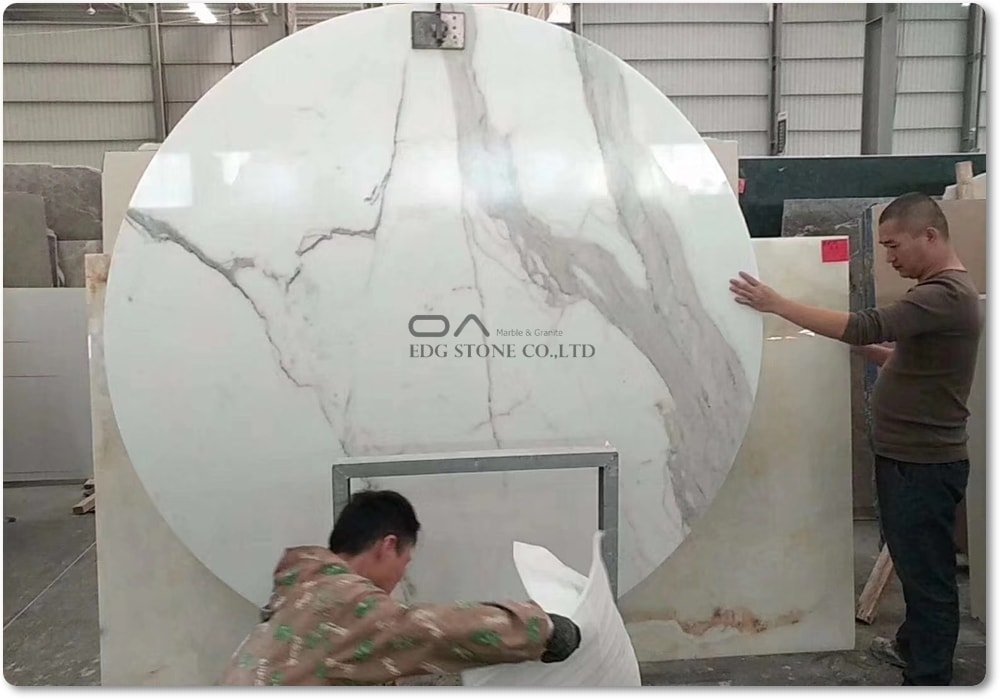
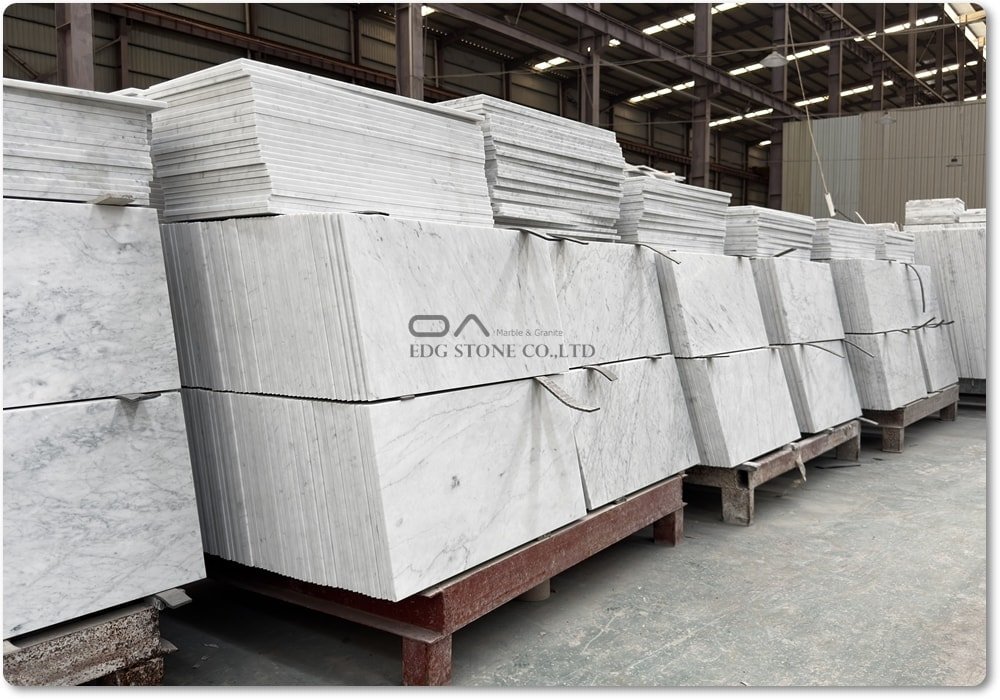
Incoming inspection should be visual, dimensional, and documentary. At minimum, every batch should be checked for background color consistency, vein movement, fissures, open seams, resin fill, edge damage, thickness variation, finish consistency, and carton/pallet labeling. The buyer should also compare the approved sample board or digital slab selection record against the actual batch before authorizing fabrication. This is a procurement rule, not a style preference: high-variation stone needs lot-level control.
For premium marble, the inspection record should include slab photos, bundle numbers, block numbers where available, and any special remarks on shading or vein concentration. If the project requires bookmatching, veinmatching, or sequential matching, those requirements should be stated before production begins. A supplier that cannot document its lot control process is exposing the buyer to hidden mismatch risk, even if the stone itself is technically sound. ASTM’s selection and specimen-preparation guidance supports that principle by making selection and conditioning part of the technical process, not an afterthought.
4. Laboratory testing: the core performance panel
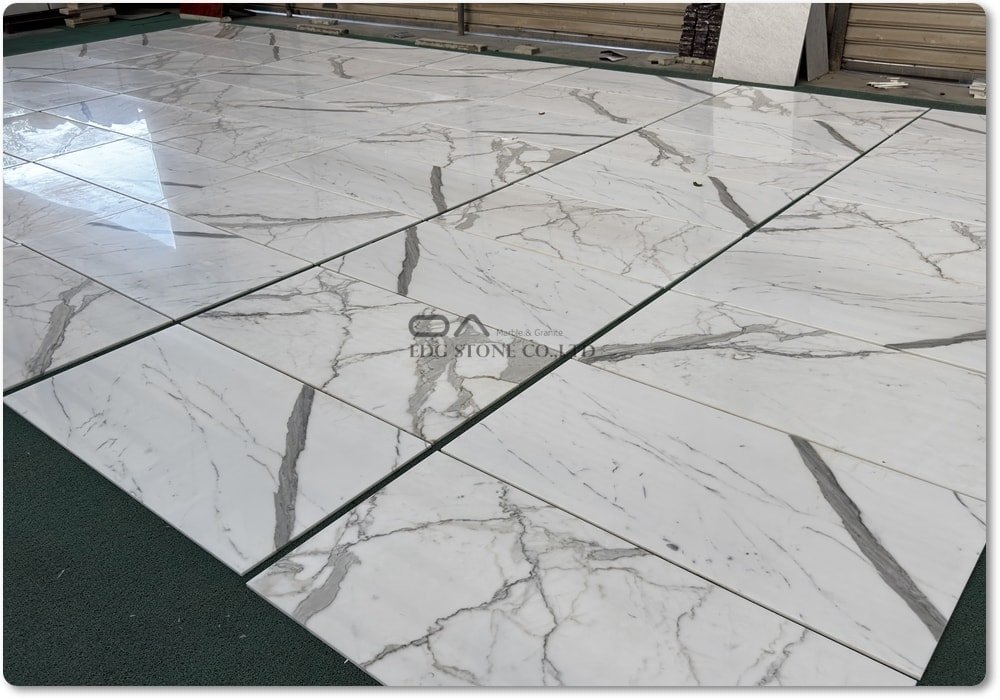
A Calacatta QC dossier should be built around the application, but there is a standard core panel. For most projects, the primary tests are absorption and bulk specific gravity, compressive strength, modulus of rupture, flexural strength, and abrasion resistance. ASTM C97 covers absorption and bulk specific gravity; ASTM C170 covers compressive strength; ASTM C99 covers modulus of rupture; ASTM C880 covers flexural strength using quarter-point loading; and ASTM C241 covers abrasion resistance for floors, steps, and similar uses. These tests do not replace design judgment, but they give the buyer comparable, repeatable evidence.
For heavily trafficked flooring, abrasion data matter because wear is driven by pedestrian traffic and cleaning patterns. For countertops, bending and flexural performance matter more because spans, overhangs, cutouts, and support conditions create different stress profiles. The Natural Stone Institute notes that test selection should reflect the installation condition, while ASTM’s test-method structure separates abrasion, flexural, and compressive evaluation into distinct methods. That is the right logic for marble procurement: one test cannot validate every use case.
Where the project is particularly demanding, additional methods should be added. ASTM C1353 provides a rotary-platform abrasion method, ASTM C1201 addresses the structural performance of exterior dimension-stone cladding systems under static air-pressure difference, and ASTM C1354 evaluates the strength of individual stone anchorages. These become essential when the material is used in exterior walls, hung stone, or other assembly-critical applications where the failure mode is not just the stone itself, but the stone-plus-fixings system.
5. Petrographic examination: the most overlooked quality step
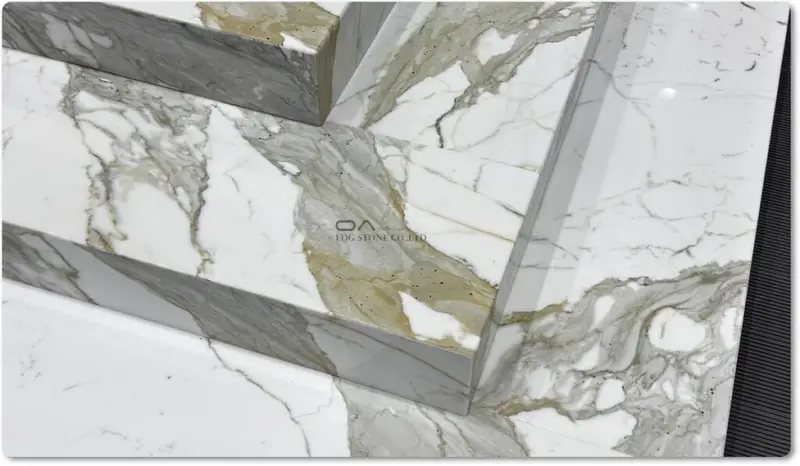
Many buyers focus only on visible beauty and mechanical test results, but petrographic examination is the step that explains why one marble behaves differently from another. ASTM C1721 outlines procedures for petrographic examination of dimension stone used in construction. In practical terms, it helps identify features such as mineral distribution, microcracks, fossil content, bedding, veining behavior, and internal fabric patterns that can affect polishing, cutting, strength, and long-term performance.
For Calacatta marble, petrography is especially useful because premium-looking stone can still vary materially from lot to lot. A slab with elegant veining may also contain weak zones, healed fractures, or structural irregularities that only become obvious after fabrication. Petrographic review gives the buyer a better basis for decisions on edge profiles, sink cutouts, seams, and large-format installations. This is one of the best ways to move from visual approval to technical confidence.
6. Scenario logic: what to test for each application?
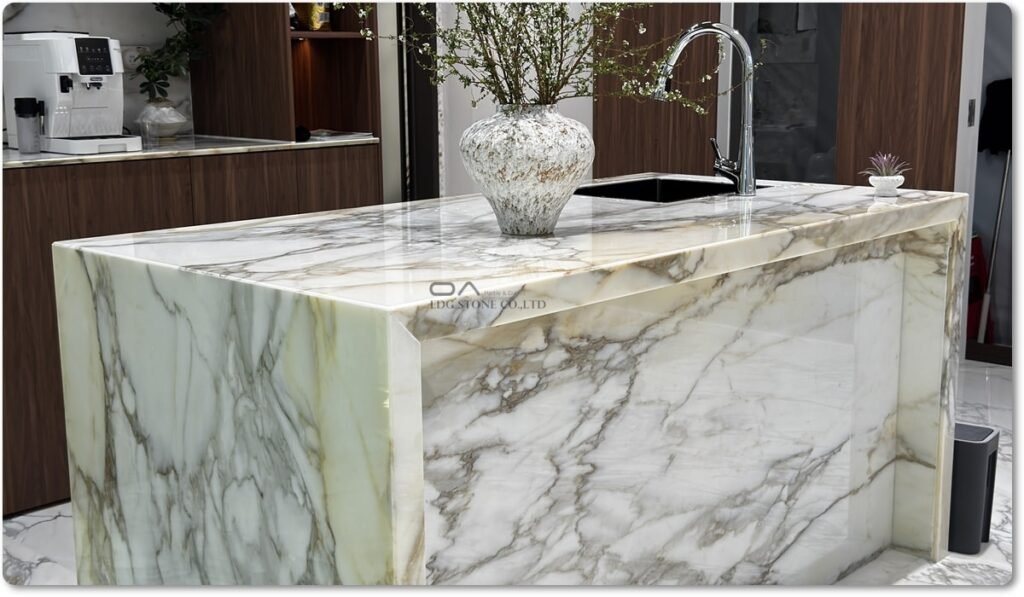
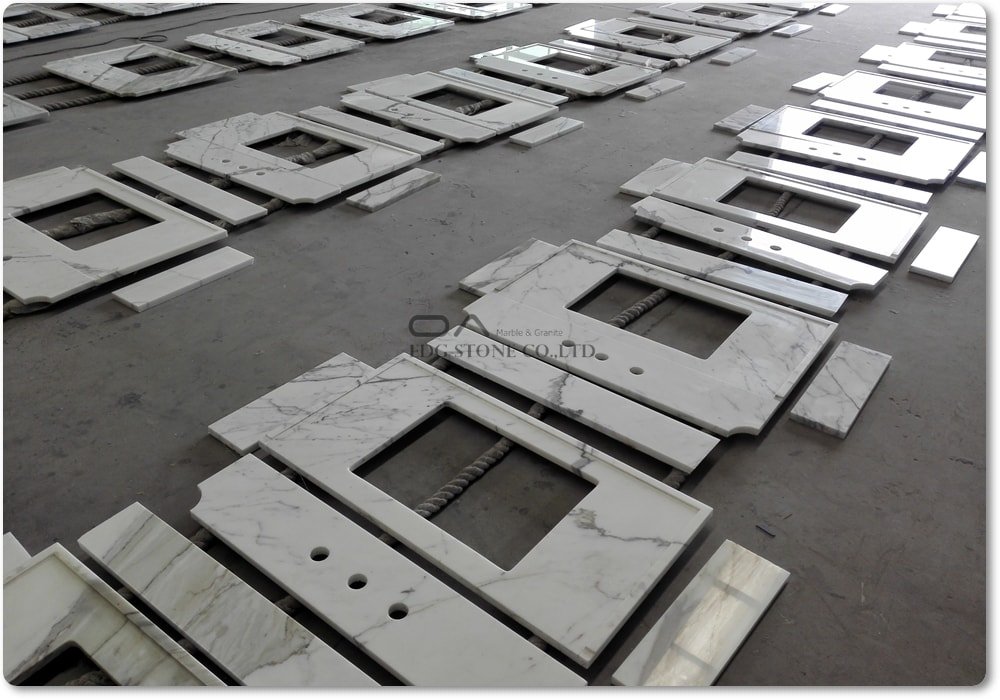
For kitchen countertops, the main risks are cutout stress, overhang deflection, staining, and sensitivity to acidic exposure in daily use. The QC file should therefore emphasize flexural performance, absorption, fabrication finish, and anchorage or support design where applicable. For bathroom vanities and shower walls, water behavior, seam detailing, and maintenance response become more important, so the buyer should insist on absorption data and installation guidance. ASTM C97 and C880 are especially relevant here.
For interior floors and lobbies, the stone must withstand foot traffic, rolling loads, cleaning chemicals, and abrasion. That is why ASTM C241 and, where appropriate, C1353 are important. For exterior cladding, the project should also consider C1201 and C1354 because the performance of the assembly matters as much as the slab. For paving systems, ASTM C1950 is the correct selection/design/installation reference, which keeps the conversation grounded in system behavior rather than isolated slab beauty.
The European side of the market follows the same logic. EN 1469 specifies requirements for natural-stone slabs used as cladding for internal and external wall and ceiling finishes, while ISO/TC 327 includes natural-stone work on water absorption, density, porosity, and bulk specific gravity. That does not replace project specifications, but it reinforces the same procurement principle: stone should be selected and approved against measured properties and intended use, not just commercial description.
7. Supplier evaluation framework: beyond price and polish
A serious supplier audit should evaluate five areas: technical competence, traceability, fabrication control, documentation quality, and communication discipline. Technical competence means the supplier understands the relevant ASTM/ISO/EN selection logic; traceability means the supplier can link slabs to batches, blocks, and approvals; fabrication control means thickness, edge work, finishing, and packing are repeatable; documentation quality means test reports, photos, and declarations are organized; and communication discipline means the supplier responds clearly when the project changes scope. ASTMs C1528, C1799, and C1721 are useful reference points for this process.
A good buyer scorecard should also ask whether the supplier can support project-specific testing when standard data are outdated or missing. The Natural Stone Institute says its testing lab is useful when new stone is being introduced, when existing technical data is more than three years old, when project-specific testing is needed, or when there are concerns about an installation. That is a practical procurement signal: if the supplier cannot support current technical evidence, the buyer inherits the risk.
Price should be the last variable, not the first. For Calacatta marble, a lower quote can hide weak lot control, insufficient testing, poor packaging, or a lack of engineering support. The correct comparison is not “which supplier is cheapest?” but “which supplier can prove repeatable quality for this exact application?” That framework protects both budget and reputation. The ASTM dimension-stone standards exist precisely to make that kind of comparison technically meaningful.
8. Documentation package a buyer should request
A complete Calacatta marble QC package should include: commercial invoice and packing list, approved slab photos, batch or lot identification, test reports, specimen-preparation notes where relevant, thickness and finish tolerances, packaging method, and installation or maintenance guidance. For exterior or high-load applications, the package should also include anchorage, cladding, or assembly-related testing as needed. For maintenance-sensitive projects, the buyer should ask for cleaning and inspection guidance aligned with ASTM C1496.
This is where procurement and post-installation performance meet. A supplier that provides strong technical documentation reduces downstream disputes because the buyer can show what was approved, what was delivered, and what the stone was expected to do in service. ASTM C1496 is important here because it frames visual assessment and maintenance of exterior dimension-stone masonry walls and façades as a structured process. In other words, quality control does not stop at shipment; it continues into the building’s service life.
9. EDG Stone Factory case module
EDG Stone Factory, positioned as a global Quartzite Slabs & Countertops Manufacturer and Exporter, can use this framework as a proof-based case module. The story should not be “we are premium,” but “we control premium materials through repeatable technical evidence.” That means EDG’s content should show how it handles slab selection, batch traceability, test documentation, packaging, and application-specific recommendations for countertops, cladding, vanities, and commercial interiors. This is the exact kind of case module that builds trust with architects, fabricators, distributors, and project buyers.
A strong case module would show how EDG organizes QC by material and scenario: incoming slab inspection, petrographic review, absorption and flexural test records, fabrication checkpoints, and export packaging control. The value of this module is not only SEO; it also helps convert traffic into RFQs because it demonstrates how the factory reduces risk at each buying stage. For a company selling quartzite and stone countertops globally, that proof-based structure is more persuasive than any generic sales pitch.
10. Procurement strategy: how to turn QC into buying power?
The best procurement strategy is to make QC part of the RFQ itself. The buyer should specify use case, finish, thickness, edge profile, seam requirements, sample approval process, allowable variation, test expectations, packaging standards, and documentation format before asking for a price. That approach narrows supplier ambiguity and makes quotations comparable. It also reduces the common problem where each supplier is pricing a different interpretation of the same stone.
For large projects, the buyer should also require staged approval: sample board approval, slab photo approval, production pilot approval, pre-pack inspection, and final dispatch sign-off. This is especially important for Calacatta marble because the visual identity of the stone is part of the product value. When the buyer manages approval in stages, the project team can catch mismatch risk early instead of discovering it after fabrication. Standards-based selection and testing are useful precisely because they support staged decision-making.
Conclusion
Calacatta marble quality control should be built like an engineering process, not a showroom decision. The correct workflow begins with terminology and selection, then moves into representative sampling, petrographic examination, laboratory testing, fabrication control, application-specific review, and supplier evaluation. ASTM, ISO, EN, OSHA, and Natural Stone Institute materials all point in the same direction: the buyer should connect the stone, the test method, the application, and the documentation. That is the only reliable way to protect luxury presentation, technical performance, and commercial margin at the same time.
For GEO and SEO, the winning structure is the one that answers the buyer’s real sequence of questions: what the material is, how to verify it, how to test it, how to audit the supplier, and how to specify it for a real project. That is also the structure that supports a durable content cluster, stronger internal links, and better quotation quality.
Internal link matrix for a 15-article cluster
- Calacatta Marble Procurement Guide
Core pillar for origin, naming, grading, and trade positioning. - Calacatta Marble Price Guide
Price drivers, slab grade, thickness, finish, and shipping factors. - Calacatta White Marble vs Other White Marbles
Comparison page for designers and buyers. - Calacatta Gold Marble Selection Guide
Use cases, visual character, and premium project positioning. - Calacatta Viola Marble Procurement Guide
High-contrast veining, luxury demand, and application control. - Calacatta Marble Slabs: Inspection and Selection
Slab-level approval, lot matching, and visual consistency. - Calacatta Marble Countertops: Engineering and Fabrication
Cutouts, support, overhangs, seams, and finishing rules. - Calacatta Marble Tiles: Floors and Walls
Application-specific testing and installation guidance. - Calacatta Marble Bathroom Applications
Vanities, shower walls, moisture behavior, and maintenance. - Calacatta Marble Kitchen Applications
Islands, backsplashes, heat/stain discipline, and daily-use risk. - Calacatta Marble Sinks and Custom Fabrication
Sink cutouts, edge detailing, and fabrication tolerances. - Calacatta Marble Coffee Tables and Furniture
Decorative use, surface protection, and export packaging. - Calacatta Marble Maintenance and Care
Cleaning, sealing, inspection, and lifecycle performance. - Natural Stone Supplier Evaluation Checklist
Factory audit, traceability, documentation, and QC scoring. - Calacatta Marble QC Whitepaper: This Article
The master hub linking all supporting content.
Authority source map for this whitepaper
- ASTM C119 — Terminology Relating to Dimension Stone.
- ASTM C1528 — Selection of Dimension Stone.
- ASTM C1799 — Test Specimen Sampling and Preparation.
- ASTM C1721 — Petrographic Examination of Dimension Stone.
- ASTM C97 — Absorption and Bulk Specific Gravity.
- ASTM C170 — Compressive Strength of Dimension Stone.
- ASTM C99 — Modulus of Rupture of Dimension Stone.
- ASTM C880 — Flexural Strength of Dimension Stone.
- ASTM C241 and C1353 — Abrasion resistance methods.
- ASTM C1201 — Structural Performance of Exterior Dimension Stone Cladding Systems.
- ASTM C1354 — Strength of Individual Stone Anchorages.
- ASTM C1496 — Assessment and Maintenance of Exterior Dimension Stone Masonry Walls and Facades.
- ASTM C1950 — Selection, Design, and Installation of Exterior Dimension Stone Paving Systems.
- EN 1469 — Slabs for cladding requirements.
- OSHA silica guidance for stone cutting and countertop fabrication safety.