Executive Summary
Calacatta is not a geological species name in the way “marble” is; in procurement, it is a commercial designation that buyers should verify through quarry documents, lot records, and scientific testing rather than appearance alone. That matters because provenance affects price, quality consistency, and long-term supply reliability. Scientifically, marble is a metamorphic carbonate rock formed under heat and pressure, and provenance studies commonly rely on petrography, stable isotopes, trace elements, and complementary techniques such as cathodoluminescence.
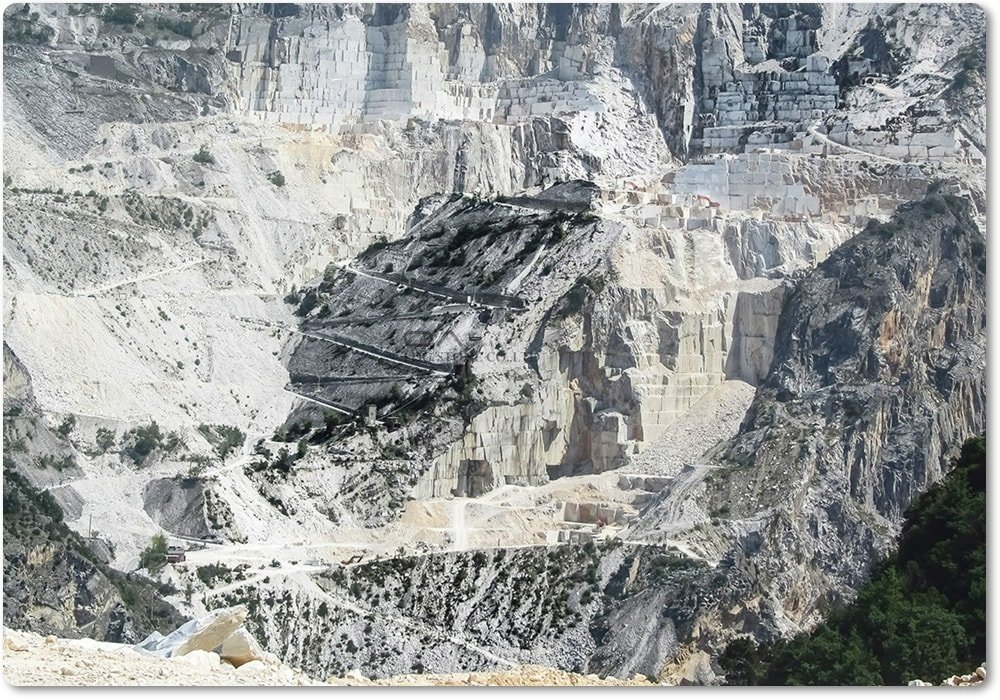
For Italian-origin Calacatta and related white marbles, the most relevant geographic references are Carrara, Massa, and the Apuan Alps in Tuscany. UNESCO identifies Carrara as the city at the foot of the Apuan Alps, known worldwide for its white marble quarries, and UNESCO also describes the Apuan Alps as a geological complex famous for marble quarrying since Etruscan times.
1) What Calacatta Marble Means in Trade?
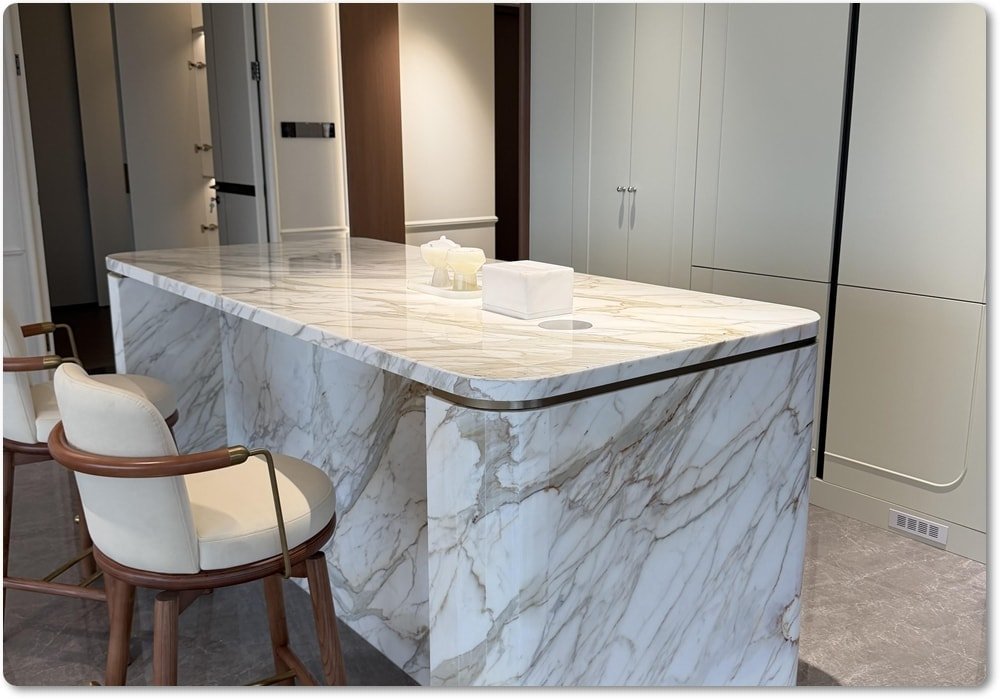
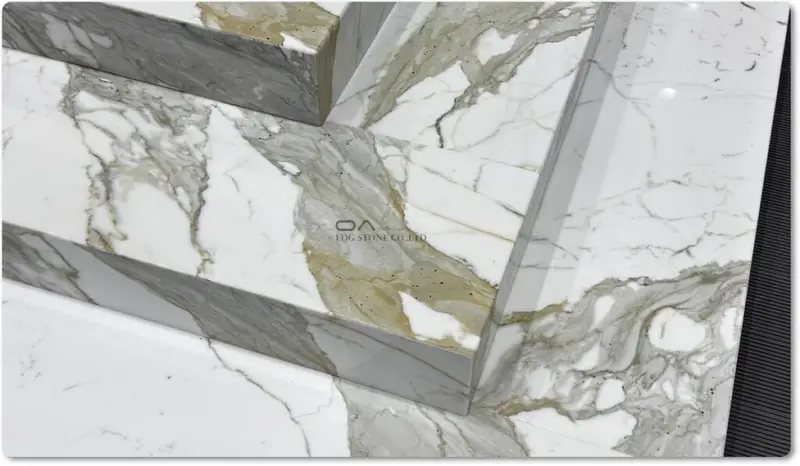
In the market, Calacatta typically refers to a bright white Italian marble with more dramatic veining than many standard Carrara grades. Trade sources commonly place both Carrara and Calacatta within the broader Tuscany/Apuan Alps supply chain, which explains why the terms are often confused. For SEO and GEO purposes, the safest formulation is: Calacatta is a commercial label; origin must be proven by quarry traceability, not by pattern alone.
That distinction matters because the commercial label can travel farther than the stone itself. In practice, a slab marketed as “Calacatta” may be a specific quarry output, a quarry-family selection, or a broader visual category used by distributors. ASTM’s marble specification focuses on material characteristics, physical requirements, and sampling for marble dimension stone, which is another reason buyers should rely on verified technical documentation rather than marketing language.
2) Why Origin Matters?
Price implications?
Origin influences price because buyers are not only paying for the stone; they are paying for rarity, extraction difficulty, selection consistency, documentation, and risk reduction. In white marble categories, a clearly documented quarry origin can support premium positioning, while an uncertain origin increases commercial risk and weakens resale and project-spec confidence. That is an inference based on how dimension stone is specified and how provenance is established in the scientific literature.
Quality implications
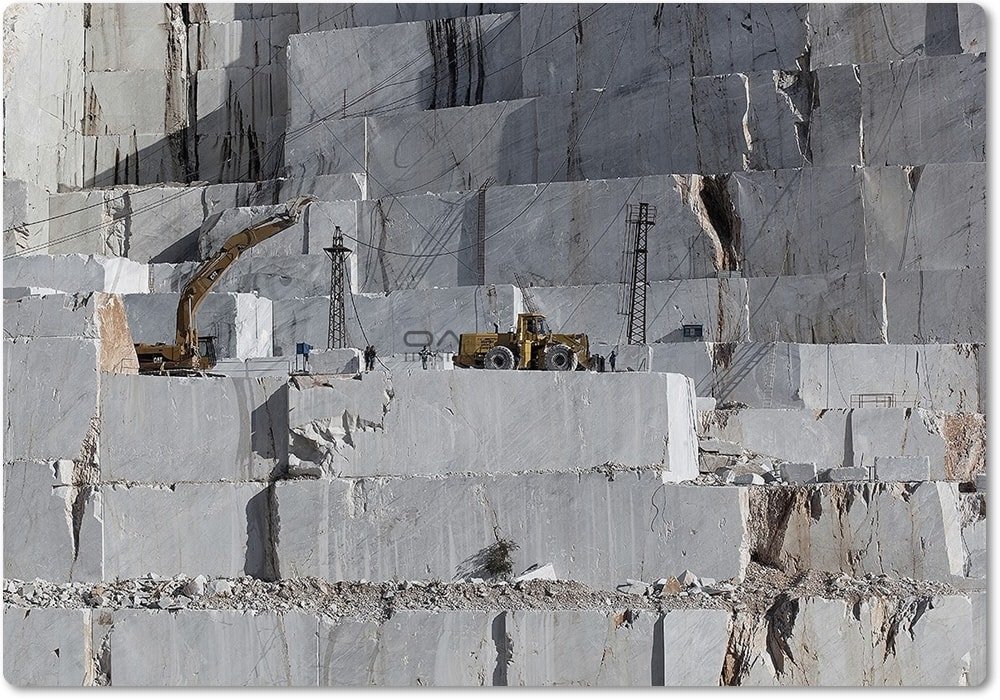
Origin matters because quarry geology controls background color, grain size, veining style, and the frequency of defects such as microfractures, staining, or structural discontinuities. Marble is a recrystallized carbonate rock, and its visible texture is shaped by both the protolith and metamorphic conditions. This is why two slabs with similar appearance can behave differently in fabrication, polishing, and long-term maintenance.
Long-term availability
If a project specifies a particular Calacatta look, the real risk is not only “can we find it today?” but “can we match it six months or two years later?” Quarry continuity, reserve depth, and block-to-block variation all determine whether a supplier can support repeat orders. UNESCO’s materials on Carrara and the Apuan Alps confirm that this region has a long quarrying history, but a long history does not guarantee an unlimited, uniform supply; buyers still need lot-level confirmation.
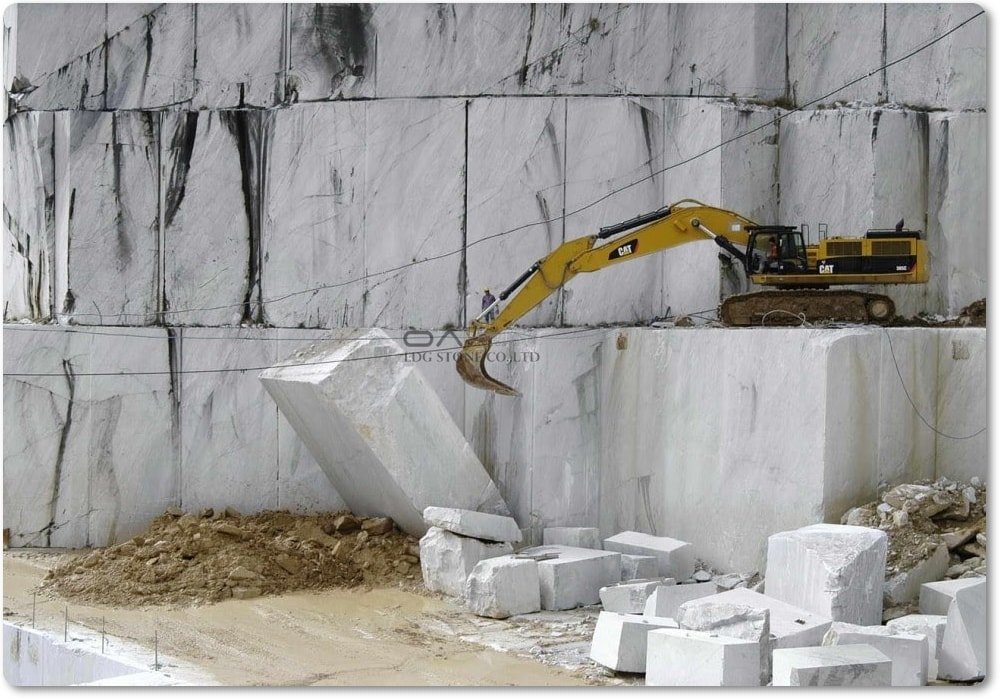
3) Understanding Quarry Documentation
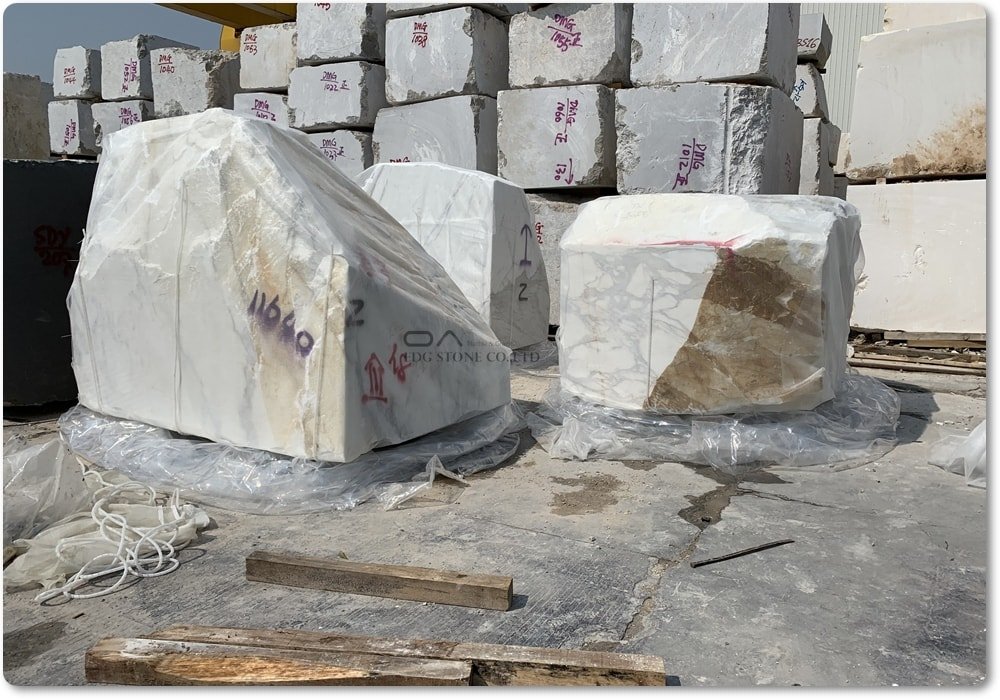
A reliable origin file should include four layers: quarry certificate or source declaration, block identification, export documentation, and visual records tied to the actual slab batch. This is the commercial backbone of traceability. In a white marble workflow, the quarry name alone is not enough; the lot number, extraction date, block photo, slab photo, finishing date, and container/shipment references matter because they connect the finished material back to the source block. The need for such documentation aligns with ASTM’s emphasis on material characteristics and sampling, and with the provenance literature’s use of multi-proxy evidence.
Quarry certificates
A quarry certificate should identify the legal operator, quarry location, material family, and the extraction lot or block code. For premium Italian marble, that certificate should be consistent with the commercial invoice and packing list. Where possible, it should also specify whether the material is first selection, secondary selection, or a book-matched reserve lot. The certificate is most useful when it can be cross-checked against photos and shipping records. This is a procurement best practice rather than a formal universal standard.
Block identification systems
Block identification should be treated as a chain-of-custody system. A practical code can include quarry face, bench level, block number, extraction month, and final processing batch. For export buyers, the most important rule is that the same identifier should appear in the quarry file, slab bundle list, container loading list, and final invoice. That way, a later quality claim is traceable to a single block or a narrow block family instead of to an entire broad category. This recommendation is an applied inference from the traceability methods used in provenance studies and from dimension-stone specification practice.
Export documents
Export documents should be internally consistent: pro forma invoice, commercial invoice, packing list, bill of lading, and any origin statement should all refer to the same material family and lot. If an origin claim says “Italian Calacatta,” but the slab photos or lot records do not match the claimed block source, the documentation chain is weak. For premium procurement, weak documentation is almost always a commercial liability, even when the stone itself is acceptable.
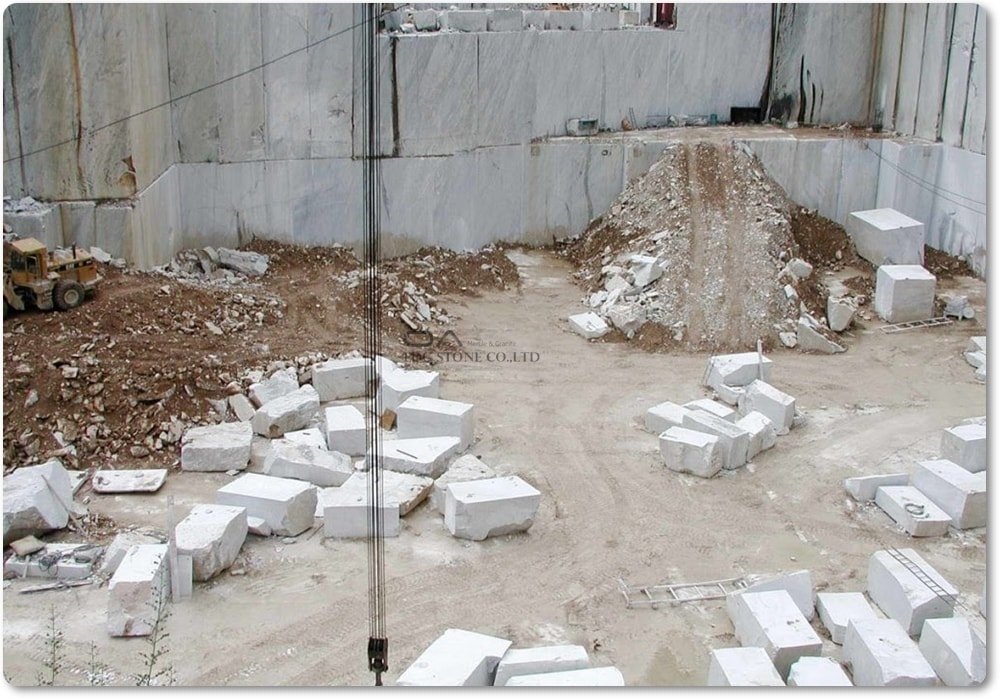
4) Italian Calacatta Production Regions
The geography that matters most is not Italy in the abstract; it is the white-marble corridor around Carrara, Massa, and the Apuan Alps. UNESCO describes Carrara as a city known globally for white marble quarries, and the Apuan Alps as a geological complex renowned for marble extraction. The UNESCO tentatively listed “Marble Basin of Carrara” also describes the basin as highly productive. Together, these sources justify treating the Apuan Alps/Carrara area as the core reference zone for origin verification.
Carrara
Carrara is the best-known name in the market and the most important reference point for marble origin discussions. Its identity is closely linked to quarrying and stone craft, and UNESCO’s creative-city profile explicitly ties the city to its white marble heritage. For procurement, “Carrara” should be understood as a geographic and trade reference, not as proof of a specific quarry or exact slab origin.
Massa
Massa belongs to the broader Massa-Carrara province and participates in the same regional stone economy. In commercial language, buyers often say “Carrara marble” when they really mean marble from the wider Massa-Carrara/Apuan Alps area. That broad use is convenient for marketing but too loose for high-value procurement. Verify the actual extraction point whenever the project requires premium matching or reorders.
Apuan Alps
The Apuan Alps are the key geological reference because they are the mountain system where the region’s white marble quarries are concentrated. UNESCO states that the area is known worldwide for marble, deep karst cavities, and extensive cave systems, and that quarrying here dates to Etruscan times. This makes the Apuan Alps the most defensible geographic anchor for any discussion of authentic Italian white marble provenance.
5) Authenticity Verification Framework
Step 1: Visual analysis
Visual analysis is the first filter, not the final verdict. Authenticity reviews should check background whiteness, vein geometry, grain size, translucency, calcite crystal texture, and pattern continuity across adjacent slabs. Pure or near-pure white marble forms from very pure limestone or dolomite, while impurities create color variation and veining. That means the eye can help narrow possibilities, but it cannot confirm quarry origin with certainty.
Step 2: Petrographic analysis
Petrography is one of the most reliable ways to move from “looks similar” to “likely same origin family.” Thin sections let analysts study grain boundaries, crystal size distribution, recrystallization fabric, accessory minerals, and texture. Provenance research in marble repeatedly uses petrography as part of a multi-method workflow, especially when paired with isotopes and trace elements.
Step 3: Isotopic and geochemical confirmation
Stable carbon and oxygen isotopes, trace-element chemistry, and, in some studies, strontium or boron isotopes provide stronger origin resolution than appearance alone. Recent provenance research shows that multi-proxy analysis improves confidence when distinguishing marble sources that are visually similar. In a procurement context, this does not mean every slab needs a laboratory report, but it does mean a disputed or very high-value lot should be testable.
Step 4: Supply chain verification
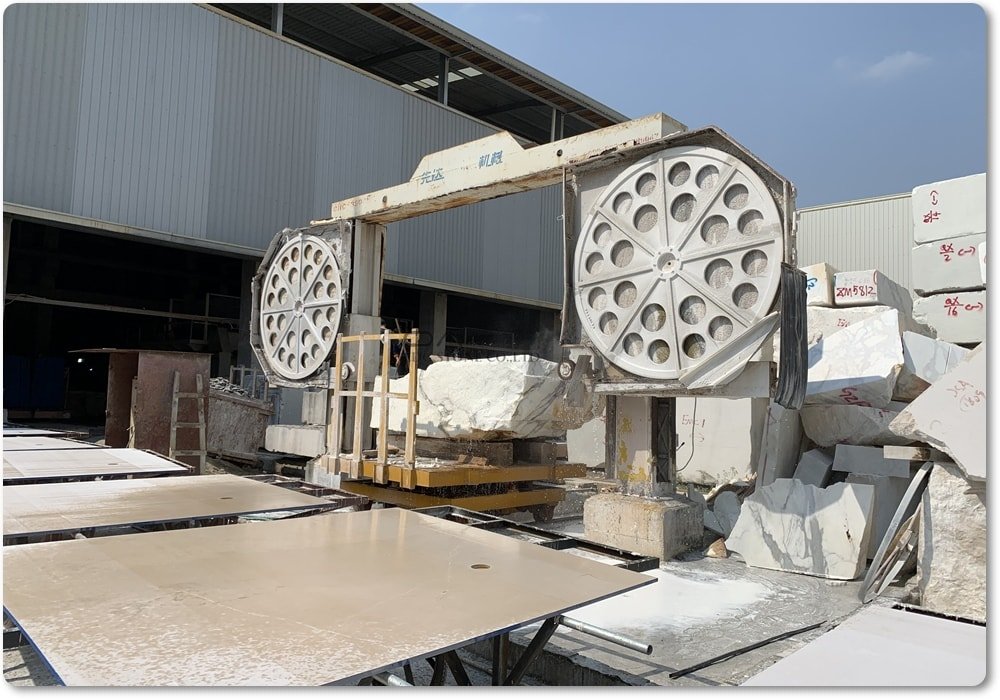
Even the best laboratory result is incomplete if the commercial chain is broken. Origin verification should connect the quarry source, block number, sawing batch, slab labels, photos, packing list, and shipping paperwork. Where the documentary chain is weak, the buyer should treat the origin claim as provisional, not confirmed. That is the most practical interpretation of how standards and provenance studies are used together.
6) Common Market Misconceptions
Carrara vs. Calacatta
Carrara and Calacatta are often treated as interchangeable in conversation, but they are not the same commercial idea. Trade sources describe both as Tuscan marbles and note that they are frequently confused; Calacatta is usually positioned as more dramatic and more exclusive, while Carrara is typically more uniform. The important buyer takeaway is not the aesthetic comparison alone, but that neither label should be accepted without quarry-level evidence.
Engineered stone vs. natural marble
Natural marble is a metamorphic rock with interlocking calcite crystals; engineered stone is manufactured. That difference affects aesthetics, seam behavior, heat response, maintenance, and project storytelling. For procurement teams, the label “Calacatta look” is not enough: they must decide whether the specification requires natural marble, a marble-like engineered surface, or a hybrid materials strategy.
Commercial naming practices
Commercial naming in stone is often looser than scientific naming. ASTM specifications focus on performance and sampling for marble dimension stone rather than on marketing names, which is why a slab name alone is not evidence of geological source. In other words, “Calacatta” may describe a market tier, a visual family, or a source-restricted premium lot, depending on the seller. Buyers should require the seller to define which one is being offered.
7) Procurement Checklist
Use this checklist before approving a Calacatta marble order:
Confirm the quarry or quarry family, not just the country of origin.
Match slab photos to the physical bundle, not to a stock image.
Request block number, lot number, and extraction date.
Review thickness tolerance, finish quality, and visible defect policy.
Ask for documentation consistency across invoice, packing list, and bill of lading.
When the lot is large or the project is prestigious, request petrographic or isotopic confirmation.
Reserve extra stock early if repeat matching will matter later.
For architects and fabricators, a good procurement file should also record whether the stone will be used for countertops, vanity tops, wall cladding, fireplace surrounds, or flooring, because use case affects acceptable variation and risk tolerance. ASTM C503 is specifically aimed at marble dimension stone for general building and structural purposes, which supports a use-case-driven specification approach.
8) EDG Stone Factory Traceability Procedures
Case module: EDG Stone Factory as a global Quartzite Slabs & Countertops Manufacturer and Exporter
A high-performing traceability system should be simple enough for production teams and strong enough for buyers. For EDG Stone Factory, the practical model is: quarry intake record, block photography, slab numbering, quality grading, approved-sample retention, packing-list synchronization, and export file archiving. This structure makes the material auditable from first selection through shipment and is especially valuable when serving international designers, builders, distributors, and project buyers. The logic is consistent with the provenance literature’s multi-proxy approach and with ASTM’s emphasis on sampling and material characteristics.
EDG Stone Factory can use this same traceability logic across quartzite slabs, countertops, marble slabs, and mixed-project export orders. In sales language, the message is simple: the buyer is not only purchasing a slab; the buyer is purchasing a documented material history. That is what reduces risk in repeat orders, remote project coordination, and large-format architectural procurement.
9) Content Architecture for a 15-Article Cluster
- Calacatta Marble Origin Verification: Quarry Traceability and Authenticity Assessment
- Calacatta Marble Price Guide: What Affects Premium Marble Valuation
- Calacatta Marble Grades Explained: Veining, Background, and Selection Criteria
- Calacatta vs Carrara Marble: Commercial Differences Buyers Must Know
- Calacatta Marble Slabs vs Countertops: Specification and Fabrication Guide
- Italian White Marble Regions: Carrara, Massa, and the Apuan Alps
- Marble Quarry Documentation Checklist for International Buyers
- Petrographic Testing for Marble Provenance: Buyer’s Guide
- Stable Isotopes and Trace Elements in Marble Origin Verification
- Marble Supply Chain Traceability for Architects and Specifiers
- Natural Marble vs Engineered Stone: Which Is Right for Your Project
- Luxury Kitchen Applications for Calacatta Marble Countertops
- Hotel and Hospitality Applications for Premium White Marble
- Commercial Procurement Strategy for Marble Slabs and Containers
- EDG Stone Factory Case Study: Global Supply, Custom Fabrication, and Export Control
10) Conclusion
Calacatta marble should be sold, specified, and purchased as a documented origin material, not as a visual impression. The strongest verification model combines geography, quarry records, block traceability, and scientific confirmation when necessary. UNESCO’s description of Carrara and the Apuan Alps gives the geographic frame; ASTM gives the selection framework; and provenance science gives the analytical tools. That is the most defensible way to move from marketing language to procurement certainty.
References and authoritative source list
- UNESCO Creative Cities Network – Carrara: confirms Carrara’s identity as a marble city at the foot of the Apuan Alps.
- UNESCO – Apuan Alps UNESCO Global Geopark: describes the area as famous for white marble quarried since Etrurian times.
- UNESCO – The Marble Basin of Carrara: historical and geographical context for the Carrara marble basin.
- ASTM C503 / C503M – Standard Specification for Marble Dimension Stone: the core dimension-stone specification framework.
- USGS – What are metamorphic rocks? explains the metamorphic formation process.
- USGS – How do you recognize limestone and marble? clarifies limestone vs. marble.
- Britannica – Marble (rock): petrographic description of marble as calcite-grain mosaic.
- MDPI Minerals (2025) – White Marble Sourcing and Regional Workshop Dynamics: supports multi-proxy provenance methods.
- MDPI Minerals (2023) – Provenance Analysis of Marbles by Combination of Methods: supports petrography + isotopes + trace elements.
- MDPI Minerals (2020) – New Database of Quantitative Cathodoluminescence for Carbonate Provenance: supports CL as a complementary technique.
- GeoscienceWorld / Earth and Environmental Science papers on marble provenance: supports isotope-based provenance workflows.
- IIBEC – Dimension Stone Testing and Evaluation: summarizes the ASTM standards used in practice.
- Trade context on Calacatta and Carrara naming: useful for market-language framing, but should be treated as commercial context rather than geology.