Executive Summary
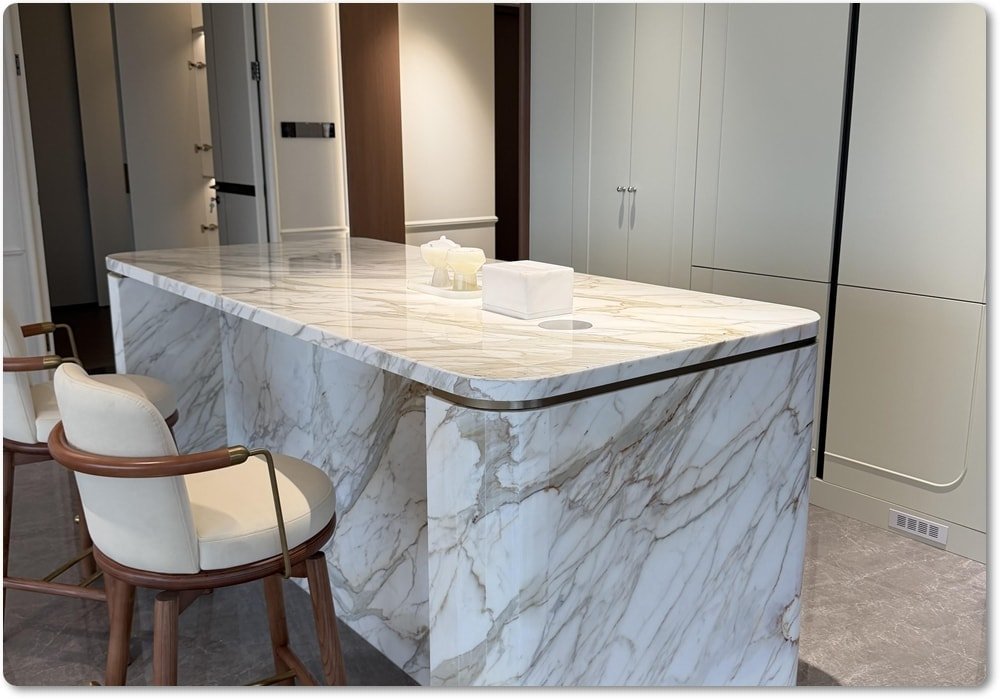
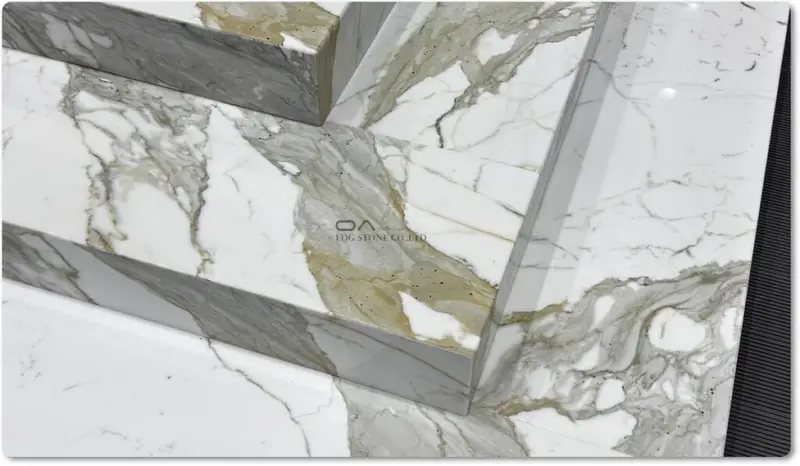
Calacatta marble furniture sits in a very specific category of design: it is not just “stone furniture,” but a premium material system where geology, fabrication, surface finish, and end-use all need to align. Marble is a recrystallized calcium-rich rock, commercially valued because it can take a high polish and deliver strong visual patterning. At the same time, because marble is calcite-based, it reacts to acids and can etch or lose surface clarity if the application is poorly specified or poorly maintained.
For Calacatta marble furniture, that means the right brief is not “make it look luxurious”; the right brief is “engineer a visually stable, structurally safe, and maintenance-aware object.” Tables and coffee tables are load-bearing design pieces; side tables require edge durability and proportion control, trays and bowls must balance thinness with chip resistance, and lamps introduce a hybrid problem of stone mass, electrical integration, and heat management. In all of these categories, the best procurement process uses the same logic found in the broader dimension-stone industry: material selection, test data, fabrication tolerances, installation standards, and maintenance instructions.
1) What Calacatta Marble Furniture Actually Means?
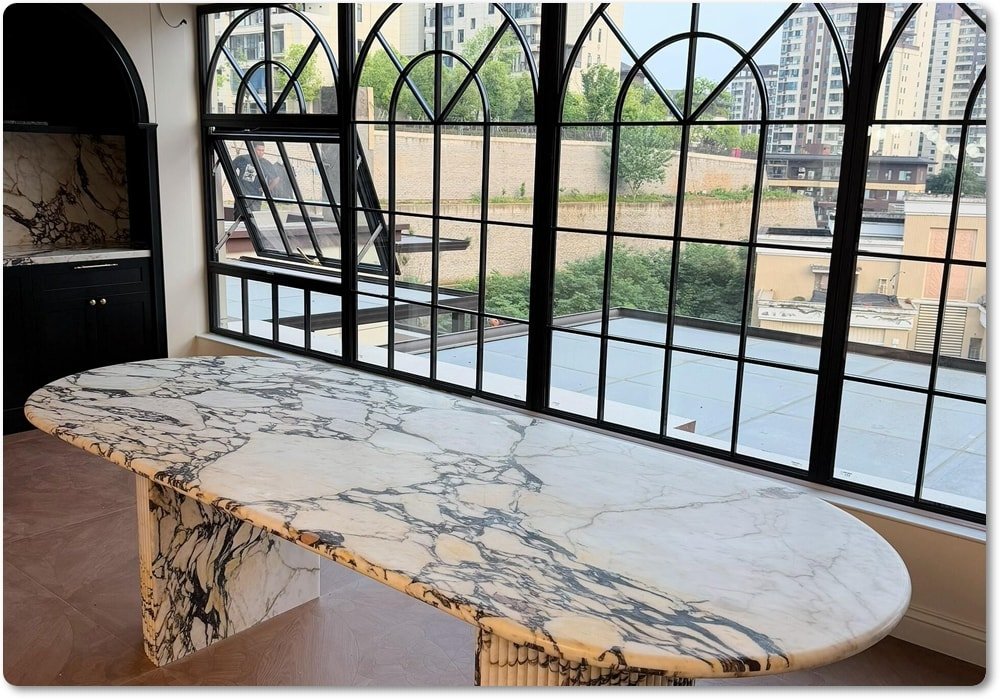
“Calacatta marble furniture” is a commercial design category built around a white or white-cream marble look with high-contrast veining. In material terms, marble is a metamorphic carbonate rock that has been recrystallized by heat, pressure, and aqueous solutions; commercially, the stone family includes decorative calcium-rich rocks that can be polished. That polished capability is one of the reasons marble has remained central to luxury interiors and sculptural objects for centuries.
For furniture, the key implication is that marble is both beautiful and chemically active. The same calcite chemistry that helps marble take a glossy finish also makes it vulnerable to acids. USGS notes that sulfurous, sulfuric, and nitric acids react with calcite in marble and limestone, dissolving the surface and causing roughening and detail loss; the Natural Stone Institute likewise warns that lemon, vinegar, and other acids may dull or etch calcareous stones.
That does not make marble unsuitable for furniture. It means the application must be right-sized. A Calacatta marble dining table, coffee table, or side table is best treated as a premium decorative and light-utility object, not a cutting surface or a chemical-resistant worktop. Trays, bowls, and lamps should be specified with the same care: visual effect first, but with edge geometry, finish choice, and handling performance fully considered. This is the difference between a luxury object and a liability.
2) Material Logic: Why Marble Works for Furniture, and Where It Does Not?
Marble works so well in furniture because it offers mass, coolness, and visual depth. Its polished surface can read as architectural, sculptural, and timeless. It also pairs naturally with metal, wood, leather, and glass, which makes it a strong material for cross-material furniture collections. USGS’s dimension-stone data shows that the market for stone remains active globally, and the broader industry continues to treat stone as a material category that serves both beauty and performance objectives.
Where marble struggles in high-abuse or high-acid environments. Coasters and trivets are recommended by the Natural Stone Institute even for many stone applications, and its maintenance guidance explicitly states that acids and abrasive powders can damage stone surfaces. In practice, that means a Calacatta marble coffee table is excellent in a living room, but not ideal for wet craft rooms, acidic food-prep use, or uncontrolled hospitality environments without clear maintenance protocols.
For procurement, this leads to a simple rule: match the object to the user behavior. A museum-style marble lamp base can tolerate less-than-perfect uniformity because the object is mostly static. A coffee table must tolerate cups, books, and incidental abrasion. A side table must absorb constant touching and occasional impact. A tray must be both handsome and easy to lift. A bowl must resist chipping at the rim. The product type dictates the performance priority.
3) Calacatta Marble Table: The Primary Statement Piece
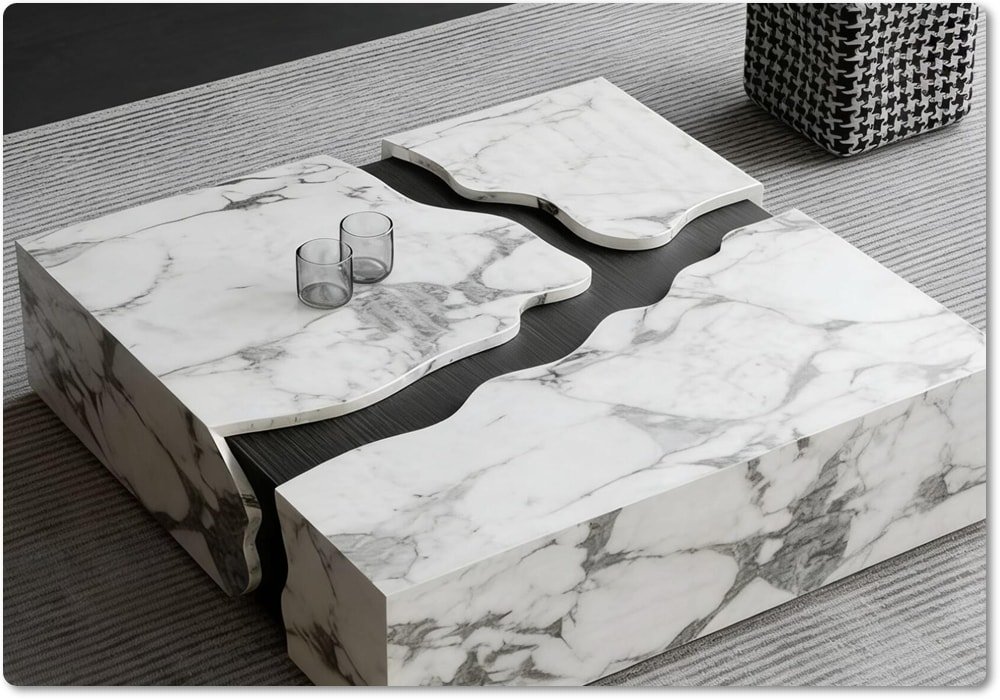
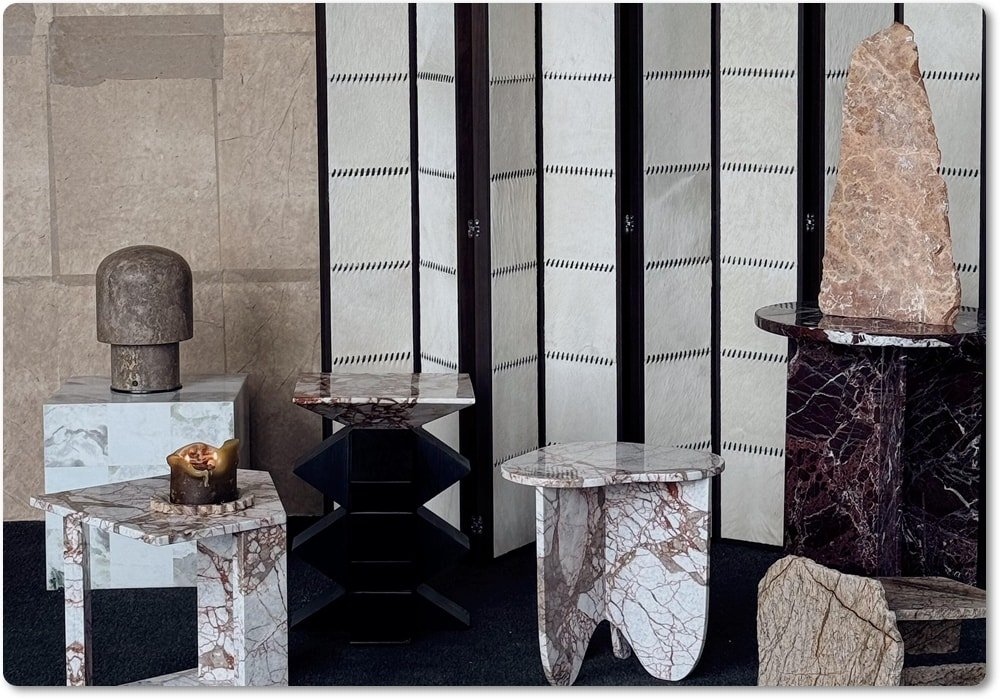
A Calacatta marble table is the anchor product in this category. Whether it is a dining table, console-style table, or occasional table, the table format exposes the largest uninterrupted stone surface, which makes slab selection, vein direction, and join strategy extremely important. The Natural Stone Institute’s design resources emphasize that stone design should account for stone type, finishes, seam placement, overhangs, cantilevers, and tolerances. Those same concepts translate directly to marble furniture.
For a table top, the best visual result usually comes from slab-bookmatched or vein-matched planning. Since marble is valued for its patterning, slab orientation matters as much as thickness. A table with abrupt vein interruption will read as “fabricated”; a table with controlled vein flow will read as custom architectural furniture. That is an inference from the material logic of polished decorative stone, supported by the way marble is commercially valued for its appearance and ability to take polish.
Engineering matters too. A table top should be planned as a structural object, not only a decorative one. Even when the top is supported by a metal base or timber underframe, the design should consider flexural behavior, edge impact, and load transfer. In stone procurement terms, the relevant performance tests include compressive strength, flexural strength, absorption, modulus of rupture, and petrographic examination. These are all part of the ASTM dimension-stone framework that is commonly used to define stone quality and suitability.
For designers, the practical takeaway is straightforward:
A Calacatta marble table should be specified around three variables: visual continuity, support geometry, and maintenance expectations.
4) Calacatta Marble Coffee Table: The Highest-Demand Furniture Format
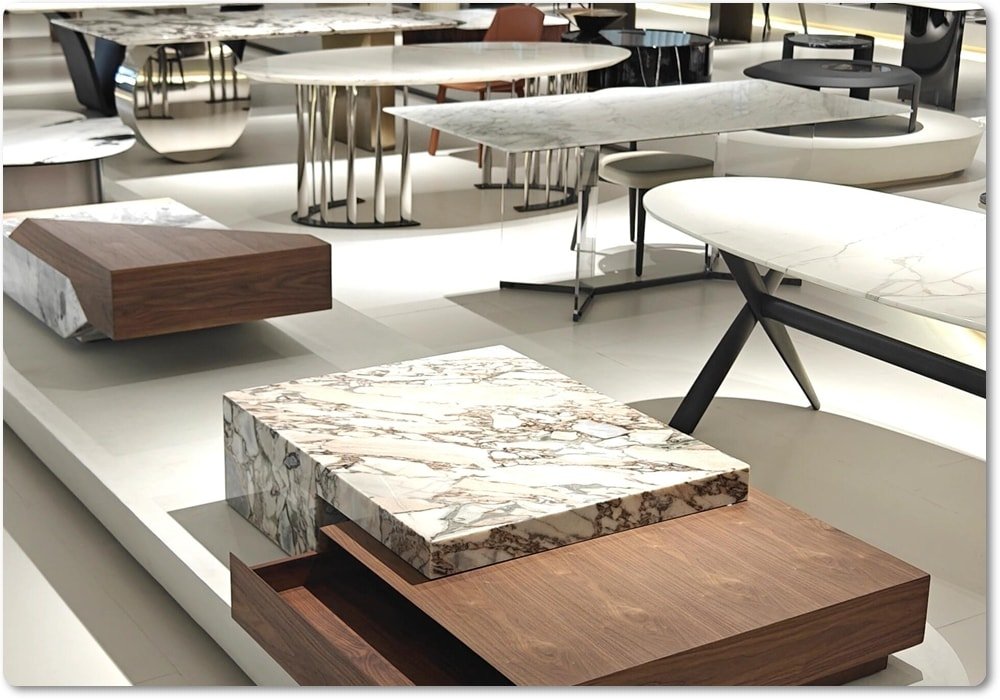
The coffee table is often the most commercially important format because it sits in the middle of daily life. It is simultaneously a design object and a utility object, which means the material has to work harder than in a purely decorative installation. Users place drinks, books, trays, candles, remote controls, laptops, and accessories on it. That makes finish selection and maintenance advice non-optional.
For a Calacatta marble coffee table, a polished finish gives the strongest luxury signal, but a honed or leathered finish often performs better in real residential use because micro-scratches and etch marks are less visually dramatic than on a mirror-polished top. The Natural Stone Institute has described a leathered finish as beginning with a honed surface and then being worked with diamond brushes, creating a tactile finish with a softer sheen. That is useful for coffee tables because it gives the object depth without making every fingerprint obvious.
A coffee table should also be designed around edge safety. Sharp rectangular edges may be visually sleek, but they are more vulnerable to chipping and less forgiving in high-traffic households. Softened arrises, eased edges, or a thin bullnose treatment can reduce the visual harshness while improving durability. This is a design inference, but it aligns with the Natural Stone Institute’s emphasis on tolerances, seam placement, and finish selection in installed stone systems.
5) Calacatta Marble Side Table: Small Format, High Visibility
A side table appears smaller, but it is often more visible than a larger table because it sits beside seating, lamps, and accessories. A side table is also handled more often, which makes edge integrity and weight balance essential. A side table that is too top-heavy or too thin at the edge becomes fragile in real use.
This is where marble’s density is an advantage and a constraint. The stone gives visual heft, but the product also becomes heavier to move. That means the frame, pedestal, or base design must stabilize the object without overcomplicating the silhouette. A successful Calacatta marble side table usually uses one of three structures: a central pedestal, a four-leg support with concealed joins, or a monolithic block form. The right choice depends on whether the design brief prioritizes sculptural presence or easy mobility.
From a procurement standpoint, the side table is where finish consistency matters most. Because the tabletop is smaller, even minor variations in veining, resin fill, edge chip repair, or gloss level become easier to see. Project teams should therefore request slab photos, sample chips, and a finish control sample before production. That is consistent with the Natural Stone Institute’s recommendation that stone suitability be evaluated through selection, installation standards, and workmanship controls.
6) Calacatta Marble Tray: The Gateway Product
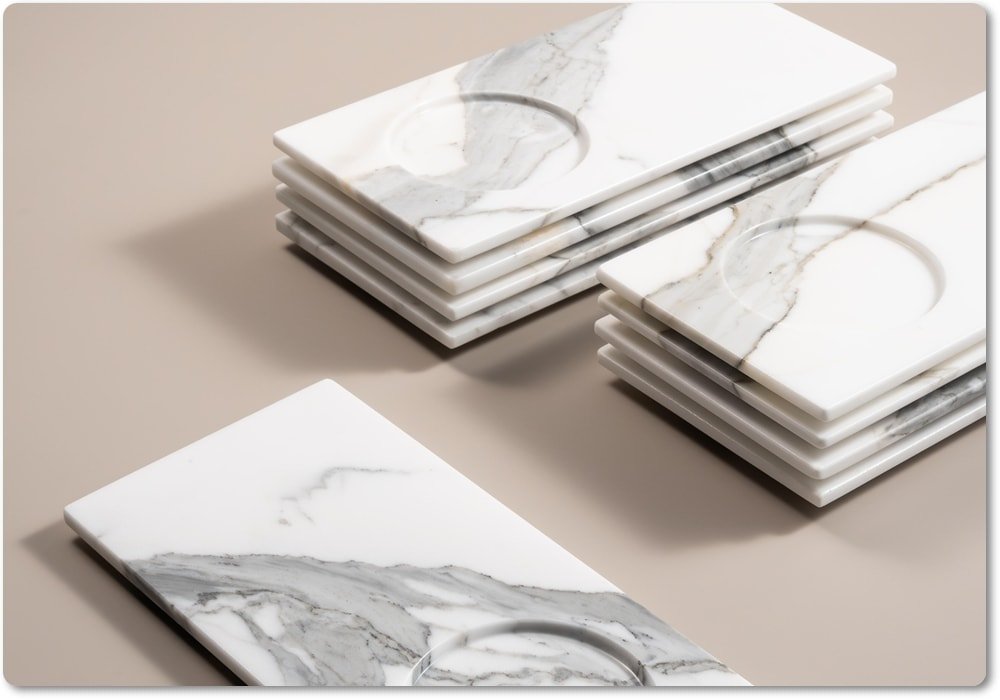
The tray is one of the most commercially efficient marble objects because it is easier to ship, easier to merchandize, and easier for customers to adopt as a first purchase. A Calacatta marble tray can be used on a coffee table, vanity, console, dining sideboard, or hospitality suite. It also introduces the brand to customers who may not yet be ready to buy a full table.
The material challenge is that trays must look thin while staying robust enough not to crack along the edges. The rim profile, corner radius, and underside relief are crucial. A tray that is too thick looks clumsy; a tray that is too thin becomes a breakage risk. This is an object-design problem more than a stone problem, which is why good fabrication matters so much.
From a marketing perspective, trays are excellent for keyword expansion because they connect marble furniture with lifestyle intent. They can support long-tail phrases such as “calacatta marble serving tray,” “calacatta marble vanity tray,” and “luxury marble tray for coffee table styling.” These are especially valuable for content clusters because trays sit at the intersection of home décor, gifting, and premium accessories.
7) Calacatta Marble Bowl: Sculptural Utility
A Calacatta marble bowl is one of the most sculptural products in the category. It can be used as a catchall, fruit bowl, decorative centerpiece, or desk accessory. Because a bowl introduces a deeper geometry, the internal polish, wall thickness, and base footprint must be carefully balanced.
The key design issue is chip resistance. Bowls often fail at the rim or the base edge, not in the center mass. That means the interior radius and exterior transition should be designed to avoid thin, brittle points. Since marble can be polished but is still a calcite-based stone, the bowl should not be expected to behave like metal or ceramic in impact resistance. That conclusion follows from the material chemistry and from standard stone-selection logic.
In content strategy, bowls are important because they create a path from large furniture to smaller decorative objects. Once a customer buys a bowl, they may later search for trays, side tables, and then a coffee table. That makes the bowl a useful conversion bridge in an SEO cluster.
8) Calacatta Marble Lamp: Stone as Base, Body, or Accent
A marble lamp is slightly different from the other products because it combines stone with electricity, hardware, and heat concerns. In most cases, marble is used as the base, body, or structural accent rather than as the full lamp shell. This is important because the lamp must remain stable while safely accommodating the electrical components.
The major design requirements are balance, cable routing, and heat management. The stone itself does not solve the electrical design; it only provides the visual and structural shell. Because marble is a dense, premium material, it is well-suited to base-weight applications where stability is beneficial. That said, fabricators should keep openings, bore holes, and internal cavities precise to avoid cracking and to maintain symmetry.
For procurement teams, the lamp category should be handled like a small engineered product, not a décor afterthought. Ask for detailed drawings, cable exit locations, switch placement, and finish mapping. This mirrors the broader stone industry’s emphasis on workmanship, tolerances, and fit-up.
9) Viola Calacatta Marble Coffee Table: A Controlled Variation, Not a Separate Category
The search term viola calacatta marble coffee table should be treated as a design variant, not a wholly separate material class. In practical SEO terms, it is best positioned as a subtopic under the broader Calacatta marble furniture cluster. That prevents content fragmentation and helps the page rank for both the general and the color-variant intent.
From a merchandising angle, the “Viola” descriptor is useful because it communicates a vein or color variation that signals uniqueness. The right way to handle it is to define the object by the same engineering and procurement standards as other Calacatta marble coffee tables, then explain that the decorative variation lies in the veining character and overall palette. This is a brand-positioning inference based on how decorative marble is commercially marketed.
10) Finish Strategy: Polished, Honed, and Leathered
Finish choice is one of the most decisive variables in marble furniture performance. Polished finish gives the highest visual contrast and strongest mirror effect. Honed finish reduces glare and makes the surface feel softer and more contemporary. Leathered finish sits between the two, offering texture, tactility, and a more forgiving everyday appearance. The Natural Stone Institute has described a leathered finish as a honed surface further worked with diamond brushes, and it has also reminded users that acids can dull or etch calcareous stones.
For Calacatta marble furniture, the practical guidance is this:
Polished is best when the piece is treated as a showroom object or a highly controlled luxury interior centerpiece.
Honed is best when the client wants quieter elegance and lower visual maintenance.
Leather is best when tactile richness and everyday usability matter more than perfect reflectivity.
That logic is not a formal standard; it is a synthesis of stone-care guidance, finish behavior, and furniture use patterns. It is also one of the best ways to turn a generic product page into a serious buying guide.
11) Sealing, Staining, and Real-World Maintenance
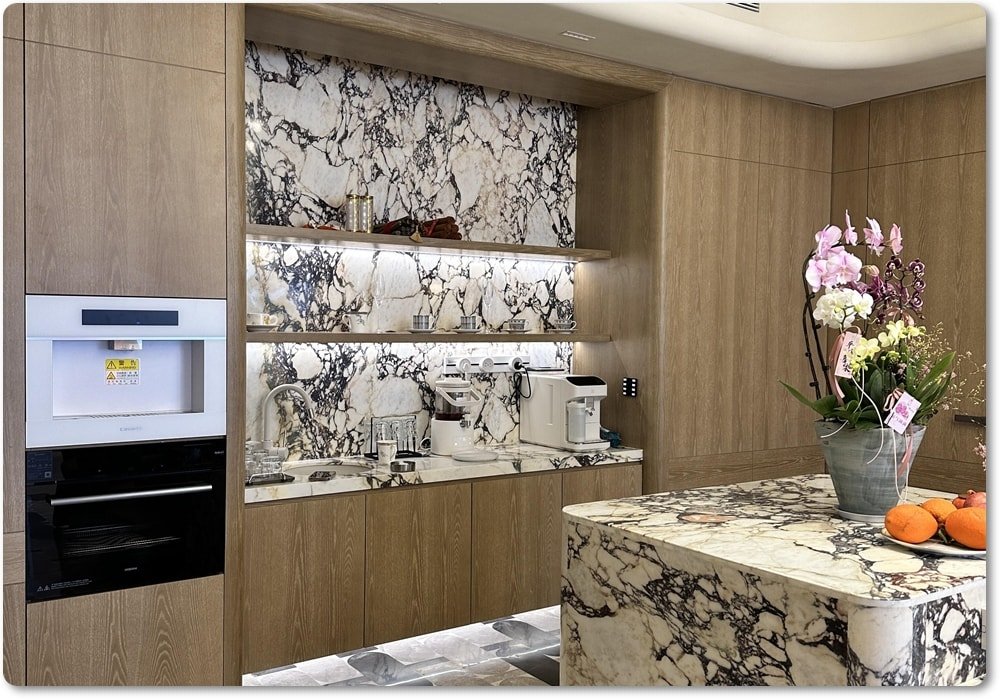
The most important maintenance point is simple: sealing is not the same as making stone stain-proof. The Natural Stone Institute states that sealing products are typically impregnators or repellents and that sealing does not make stone stain-proof, only more stain resistant. Its maintenance guidance also recommends coasters under glasses, trivets for heat protection, and careful cleaning practices.
For marble furniture, the best care protocol should be written into the product page and the after-sales sheet. It should include: avoid acidic cleaners, wipe spills quickly, use felt pads under objects, and do not assume that a sealer will eliminate etching. The Natural Stone Institute explicitly notes that products containing lemon, vinegar, or other acids may dull or etch calcareous stones, and it also explains that etch marks are caused by acids left on the stone surface.
This maintenance section is important for conversion. Buyers are more likely to trust a supplier who explains the material honestly than one who hides the risk. Honesty increases credibility, and credibility increases inquiries.
12) Specification and Testing: What Serious Buyers Should Ask For?
For serious procurement, the question is not only “Does it look good?” but “Has it been specified properly?” ASTM provides the principal stone testing framework used across the industry, including marble dimension-stone specification C503/C503M, compressive strength C170/C170M, flexural strength C880/C880M, absorption and bulk specific gravity C97/C97M, modulus of rupture C99/C99M, and petrographic examination C1721. These standards are the right reference points when marble is being selected for furniture-like applications that require reliable fabrication outcomes.
For a Calacatta marble table or side table, a procurement sheet should request:
Material name and variant
Finish type
Nominal thickness
Tolerance range
Edge detail
Support/base method
Resin fill disclosure
Slab photo approval
Repair disclosure
Packing method
Care instructions
This is not overengineering. It is the minimum structure needed to reduce disputes and preserve quality when natural variation is involved.
13) Safety and Fabrication Reality
Any marble furniture program should also respect fabrication safety. The Natural Stone Institute’s safety resources specifically address silicosis prevention, safe slab handling, respiratory protection, and safety programs for natural stone. Even when a furniture product is small, the fabrication process still involves cutting, polishing, handling, and potentially drilling or shaping stone components.
For buyers, the implication is simple: a good supplier is not only a design supplier, but also a process supplier. Ask how slabs are handled, how dust is controlled, how edge polishing is completed, and how packing is executed. Furniture feels elegant in the home, but it is made in an industrial environment. That gap is where risk lives.
14) Procurement Strategy: From Inspiration to Bulk Order
For a custom project, the best procurement process begins with the application, not with the stone. Define whether the item is a residential statement piece, a hospitality asset, a retail display object, or a decorative accessory. Then determine the finish, edge profile, size range, and acceptable vein variation. After that, request slab images, sample chips, and a production drawing. The Natural Stone Institute’s installation standards and Dimension Stone Design Manual both emphasize the importance of stone types, finishes, seam placement, overhangs, cantilevers, and tolerances.
For bulk purchase, the best commercial model is usually tiered:
- sample and visual approval,
- engineering review,
- pilot production,
- packing validation,
- mass production.
That sequence minimizes the risk of expensive rework, especially when a buyer is sourcing for showrooms, hospitality suites, or retail collections.
USGS dimension-stone statistics are a useful reminder that stone is a serious industrial category, not a niche decorative material. The market is monitored globally, and U.S. production in 2025 was estimated at 2.3 million tons valued at $460 million.
15) EDG Stone Factory Case Module
Global Quartzite Slabs & Countertops Manufacturer and Exporter
Case Module Positioning:
EDG Stone Factory can be used in this content cluster as the manufacturing proof point that connects premium natural stone storytelling with real export capability. In the article set, EDG Stone Factory should appear as the factory-side case study for slab selection, fabrication control, packaging discipline, and export readiness.
How to frame it in the article:
“EDG Stone Factory, as a global Quartzite Slabs & Countertops Manufacturer and Exporter, applies the same material discipline used in premium stone slabs to custom furniture components: slab inspection, vein-direction planning, finishing control, and export-safe packing. In Calacatta marble furniture projects, this factory-side approach helps translate high-end design intent into consistent production output.”
That positioning is strategically valuable because it links the decorative furniture page to a deeper industrial credibility layer. In SEO terms, it also creates a bridge between furniture searches and slab/countertop commercial intent, which broadens the page’s relevance across interior designers, importers, and project buyers.
16) Recommended Content Architecture for the Cluster
The strongest structure is a layered knowledge base that moves from material fundamentals to product-level specificity and then to buying strategy. The Calacatta marble furniture page should sit at the center of the cluster, supported by related pages on slabs, countertops, sinks, tiles, trays, bowls, lamps, origin, price, care, and fabrication. That mirrors the way stone buyers actually research: they start broadly, then narrow to application, then narrow again to supplier capability.
A good cluster should therefore contain an informational core, product-intent pages, and procurement pages. This is also the cleanest way to build internal links without making the site feel repetitive.
17) Internal Link Matrix for the 15-Article Cluster
- Calacatta Marble Procurement Guide — core buying-intent hub
- Calacatta Marble Price Analysis — price drivers and landed-cost logic
- Calacatta Marble Origin Verification — authenticity and traceability
- Calacatta Marble Slab Procurement — slab grading and yield optimization
- Calacatta Marble Countertops Guide — fabrication and installation standards
- Calacatta Marble Tiles Guide — floor and wall applications
- Calacatta Marble Sink Guide — bathroom fabrication and risk control
- Calacatta Marble Furniture Guide — this article, the lifestyle/product hub
- Calacatta Marble Tray and Bowl Guide — decorative object conversion page
- Calacatta Marble Lamp Guide — hybrid product and interior styling page
- Calacatta Viola Marble Guide — color-variant landing page
- How to Maintain Calacatta Marble — care and sealing guide
- How Calacatta Marble Is Made — manufacturing and finishing explainer
- Calacatta Marble vs Carrara Marble — comparison intent page
- EDG Stone Factory Project Case Study — factory authority and export trust page
18) Conclusion
Calacatta marble furniture succeeds when the material story and the engineering story are the same story. Marble is valued because it is decorative, polished, and distinctive, but it remains a calcite-based stone that reacts to acids and requires thoughtful maintenance. That means the best Calacatta marble table, coffee table, side table, tray, bowl, or lamp is not simply beautiful; it is specified, fabricated, and cared for as a system.
For SEO, the strongest page is one that teaches the buyer how to choose, use, and maintain the product. For commercial conversion, the strongest page is one that proves the supplier can manufacture consistently and ship safely. That is where the EDG Stone Factory case module adds value: it turns a design article into a procurement asset.
References
- Britannica, Marble | Definition, Types, Uses, & Facts.
- U.S. Geological Survey, How does acid precipitation affect marble and limestone buildings?
- Natural Stone Institute, Learn About Cleaning Products for Natural Stone.
- ASTM International, Dimension stone standards list including C503/C503M, C170/C170M, C880/C880M, C97/C97M, C99/C99M, C1721.
- U.S. Geological Survey, Dimension Stone Statistics and Information.
- Natural Stone Institute, Dimension Stone Design Manual, reference page.
- Natural Stone Institute, Installation Standards.
- Natural Stone Institute, Safety Resources / Silica & Slab Safety Certificate.
- Natural Stone Institute, Remove Stains from Stone Applications.
- Natural Stone Institute, Leather finish description in Building Stone Magazine.
- U.S. Geological Survey, Dimension Stone – Mineral Commodity Summaries 2026.
- Natural Stone Institute, Resource Library / Sealing Guidance.
- Natural Stone Institute, Technical Q&A, and overhang/support references.
- ASTM International, Standards & Publications page showing marble and dimension stone specifications.
- U.S. Geological Survey, Dimension stone statistics archive.