A standards-based whitepaper for residential, hospitality, and OEM buyers
Executive Summary
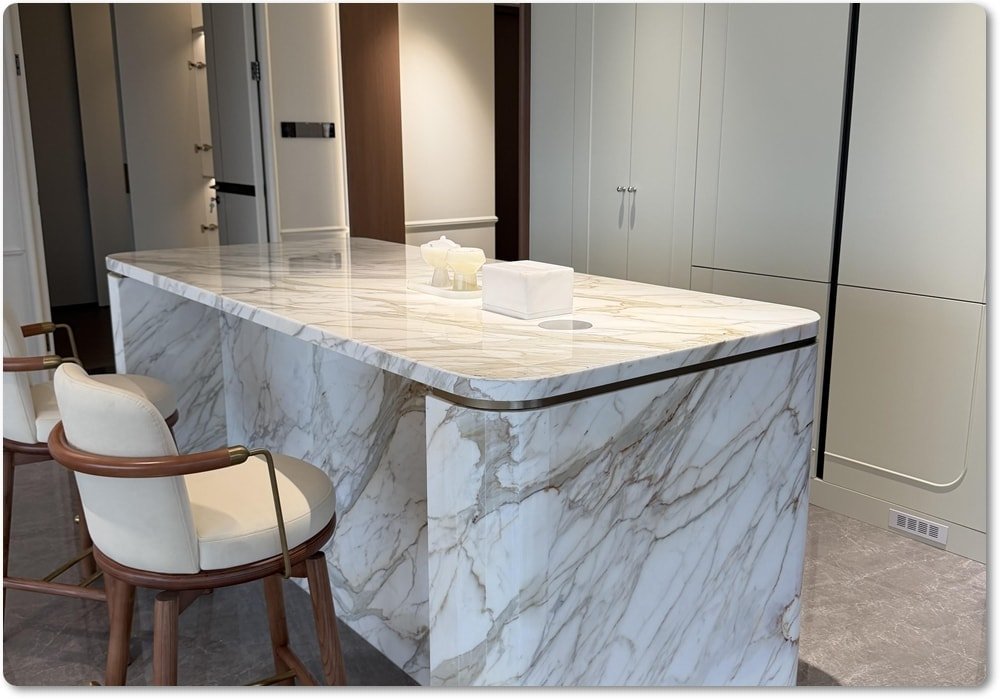
A Calacatta marble countertop is not just a design surface. It is a stone system that must be selected, cut, reinforced, transported, installed, and maintained according to documented technical standards. The best projects start with realistic expectations: true marble is a calcite-based material, so it can be vulnerable to mild acids in kitchens and baths, and its performance depends on the exact stone type, slab quality, support design, and maintenance plan. The Natural Stone Institute’s countertop guidance and marble technical notes emphasize stone selection, substrate requirements, field measurements, allowable spans, sink mounts, edge profiles, sealers, seams, tolerances, lippage, reinforcements, and repairs as core parts of a proper countertop specification.
For buyers, designers, and fabricators, the practical message is simple: a high-end Calacatta marble countertop succeeds when aesthetics and engineering are specified together. Industry guidance also shows that overhangs, cantilevers, rodding, seam placement, and support systems must be designed rather than improvised. In the U.S. market, dimension stone remains a significant construction material, and marble is still treated as a specialized product class with physical-property requirements under ASTM standards.
1) What is a Calacatta Marble Countertop Really?
In this whitepaper, “Calacatta marble countertop” refers to a premium natural-stone countertop made from a visually white or light marble slab with bold veining, used in kitchens, bathrooms, and hospitality interiors. From a technical perspective, marble is a calcite-based dimension stone, and the Natural Stone Institute notes that true marble is vulnerable to mild acids commonly found in kitchen and bar settings. That means beauty, patina, etching risk, and maintenance expectations should be discussed before fabrication begins.
ASTM’s marble specification treats marble as a dimension stone category with material characteristics, physical requirements, and sampling methods for building and structural purposes. The standard also identifies key physical-property themes such as absorption, density, compressive strength, modulus of rupture, abrasion resistance, and flexural strength. For project teams, that is the core engineering lens: not every “Calacatta look” slab performs the same way, and every slab must be evaluated on the actual project use case.

2) Countertop Design Requirements: Start with the Use Case, Not the Finish
The smartest way to specify Calacatta marble is by scenario. A residential kitchen, a luxury bathroom, and a hospitality installation place very different demands on the same stone family. The Natural Stone Institute’s countertop chapter explicitly brings together material selection, cabinet and substrate requirements, field measurements, spans and cantilevers, sink mounts, edge profiles, adhesives, sealers, seams, tolerances, lippage, resin impregnation, reinforcements, and repairs. That breadth is the reason a countertop specification should be treated as an engineering document, not just a finish schedule.
From a Google SEO and GEO perspective, this logic matters too: users searching “calacatta marble countertop,” “calacatta marble slab,” or “marble kitchen countertop overhang support” are usually trying to solve a project-risk problem. A strong article should therefore move from fundamentals to use cases, then into fabrication, then installation, then maintenance, and finally into procurement strategy. That ordering mirrors how professionals actually buy stone.
3) Residential Kitchens
In kitchens, Calacatta marble should be specified with full awareness of cooking, cleaning, heat, and spill exposure. The Natural Stone Institute advises neutral cleaners, stone soap, or mild dishwashing detergent and warm water, and warns that acidic products such as lemon or vinegar can dull or etch calcareous stones. That is especially important in kitchen zones where citrus, wine, vinegar, tomato, and cleaning products are common.
Kitchen planning also affects countertop success. NKBA’s kitchen planning guidance gives landing-area and work-zone recommendations, including a continuous preparation/work area of at least 36 inches wide by 24 inches deep immediately next to a sink, and clear planning around appliances and countertop frontage. These are design decisions that influence where seams go, where sink cutouts land, and how much stone is exposed to stress in daily use.
For kitchens, the structural lesson is that overhangs and unsupported spans must be designed to match the actual assembly. The Natural Stone Institute states that its countertop chapter addresses overhang details, corbels, and cantilevers, and its installation standards emphasize seam placement, rodding sink cutouts, overhangs, joint widths, and tolerances. Unsupported overhangs beyond design guidance are a known failure point, so the countertop should be engineered around the cabinet layout, not forced into it.
4) Luxury Bathrooms
Bathrooms are ideal for Calacatta marble when the design includes realistic moisture management and maintenance expectations. The Natural Stone Institute notes that many marbles are well-suited for wet-area applications, including tub decks and showers, but also makes clear that marble’s calcite content makes it sensitive to acids. In practical terms, that means marble can be used in luxury bathrooms, but it must be paired with correct detailing and proper user education.
NKBA’s bathroom planning guidance reinforces the need for reinforced walls and load-ready construction around grab bars and shower/tub components. It states that tub and shower walls should be prepared at construction to allow grab bars that support a static load of 250 pounds, and that waterproof materials must be used in tub and shower surround areas to code-referenced heights. For marble vanity tops and bath decks, the lesson is similar: substrate, waterproofing, and reinforcement matter as much as the slab itself.
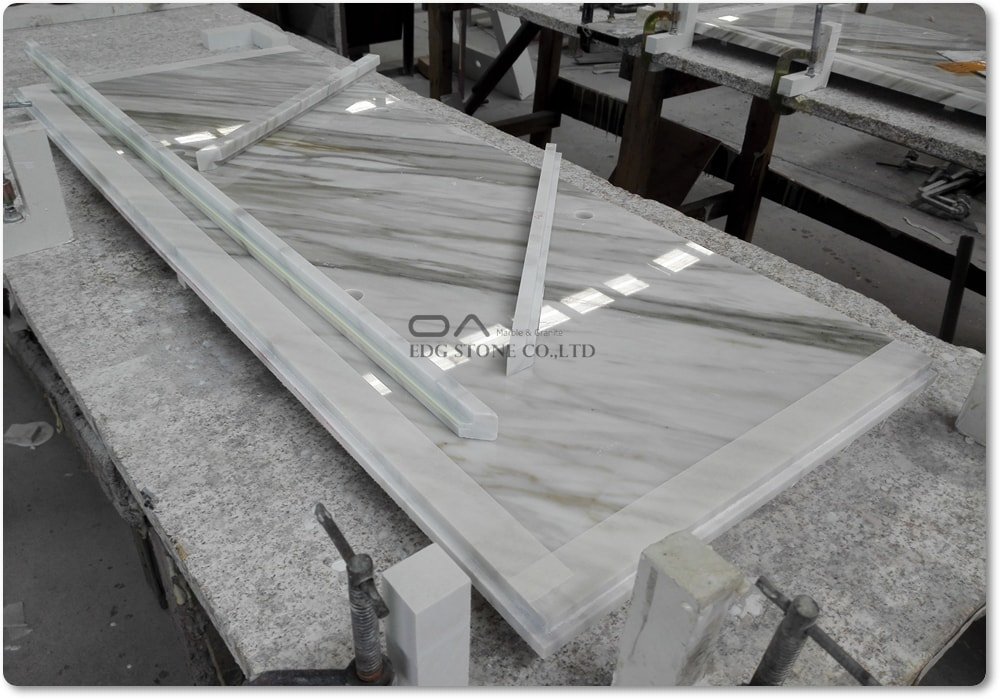
Luxury bathroom countertops also demand careful seam and sink planning. The countertop chapter in the Natural Stone Institute’s design manual covers sink mounts, seams, tolerances, and lippage, which are all critical in vanities where lighting is strong and visual perfection is expected. In premium bathrooms, the fabrication quality is often more visible than in kitchens because the eye is closer to the stone, and reflective fixtures amplify flaws.
5) Hospitality Projects
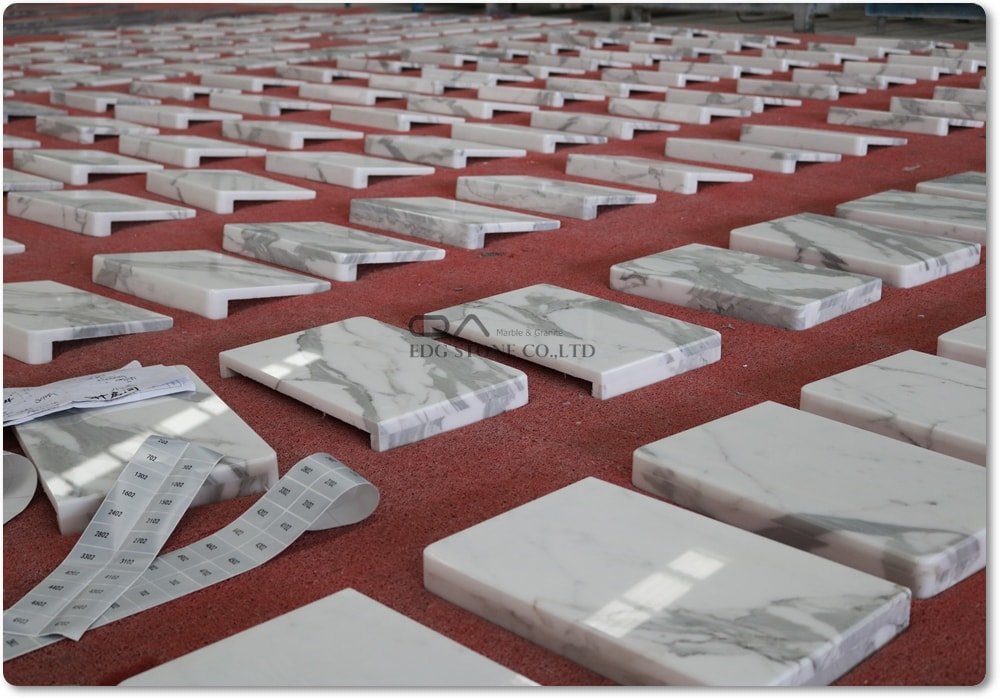
Hospitality projects are a different category because the design must survive high traffic, aggressive cleaning, and frequent turnover. The Natural Stone Institute’s countertop chapter includes commercial and outdoor-related considerations, while its cleaning guidance warns against acidic products and abrasives that can dull or scratch stone surfaces. For hotels, restaurants, and clubs, the maintenance plan should be written into the specification, not left to housekeeping after handover.
Hospitality buyers should also think in terms of consistency across many tops and many rooms. Marble is a natural material with inherent variation, and the material must be approved against project samples and shop drawings. The Natural Stone Institute’s accreditation handbook notes that finished-project inspection includes compliance with contract documents, installation tolerances, joint widths, sink installation, color matching, edge consistency, supports, shims, and lamination. That is exactly the level of control needed when a hotel expects repeatable results across dozens or hundreds of rooms.
6) Fabrication Standards
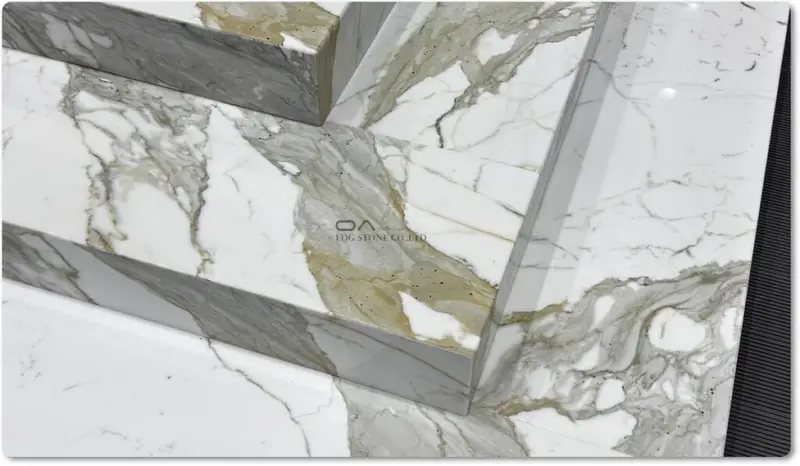
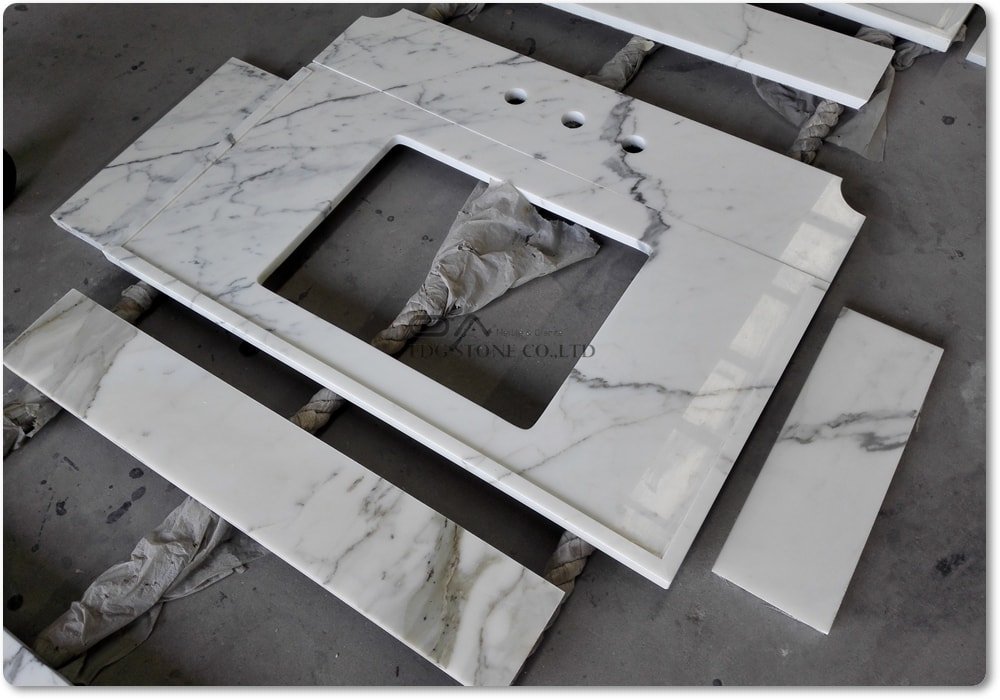
Fabrication begins with slab selection. For Calacatta marble, the most important decisions are vein distribution, fissure visibility, thickness tolerance, resin or reinforcement needs, and the intended layout of seams and bookmatching. The Natural Stone Institute’s countertop materials guidance explicitly includes resin impregnation, reinforcements, repairs, edge profiles, and tolerances as part of the design manual chapter, which confirms that fabrication should be planned as a coordinated process rather than a simple cutting operation.
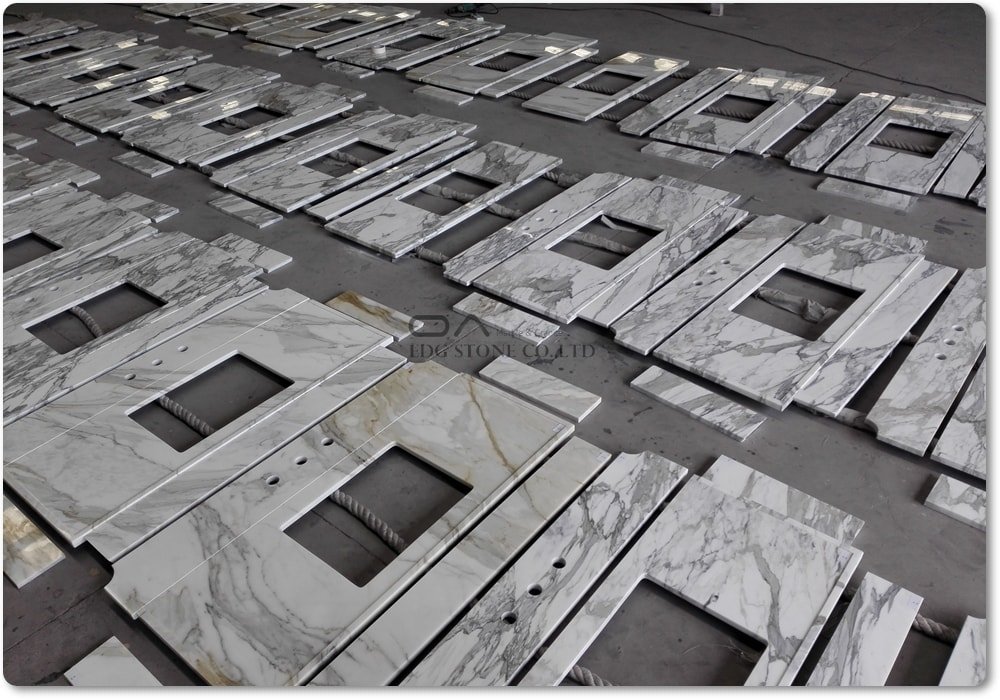
Sink cutouts are a major fabrication risk point. The Natural Stone Institute’s installation standards specifically list rodding sink cutouts as a technical topic, and the countertop chapter discusses sink mounts, supports, shims, and adhesives. In practice, the fabricator should treat the sink zone as a reinforced area, with cutout geometry, support, and edge distance all confirmed before cutting the slab.
Edge profiles should be selected based on both appearance and durability. Softer stones like marble are often chosen for elegant profiles, but the edge must be suitable for daily contact, cleaning, and possible impact. The design manual’s countertop chapter explicitly addresses edge profiles, which is important because edge complexity affects chip resistance, fabrication time, and seam visibility.
Backsplashes and waterfall edges should be treated as structural details as well as style statements. The countertop chapter includes backsplashes and overhang details, and waterfall edges require careful grain matching, slab matching, and structural support at the return. For premium Calacatta marble, waterfall details can be spectacular, but only when the slab book is planned with the final geometry in mind.
7) Structural Engineering
The engineering of stone countertops is governed by load path, span, and support. The Natural Stone Institute states that its countertop chapter covers allowable spans and cantilevers, and its installation standards list overhangs and cantilevers as a core technical area. That matters because stone is strong in compression but less forgiving when the support condition is poor, or the span is excessive.
The Natural Stone Institute also notes in its technical Q&A that its manual limits overhangs to 6 inches for 2 cm tops and 10 inches for 3 cm tops, and provides examples where unsupported overhangs were rejected as poor long-term solutions. While every project still needs an actual engineering review, that guidance is a practical baseline for residential and many commercial jobs.
For marble selected under ASTM C503, the relevant physical properties include absorption, density, compressive strength, modulus of rupture, abrasion resistance, and flexural strength. That is why a slab’s visual beauty alone is not enough; the technical evaluation must confirm whether the stone and thickness are suitable for the planned span, support spacing, and edge conditions.

8) Overhang Requirements and Support Systems
Overhang design is one of the most common failure points in stone countertop projects. The Natural Stone Institute’s resources repeatedly emphasize overhangs, cantilevers, corbels, and support verification, and its accreditation handbook includes span and overhang requirements as part of project review. In plain terms, the support system must be part of the design package before fabrication starts.
For island tops, breakfast bars, and seating ledges, the correct question is not “How far can we extend the stone?” but “What support system is appropriate for the actual slab, thickness, and use load?” That may include steel brackets, corbels, subtop reinforcement, or a thicker fabricated edge build-up. The exact answer should be confirmed by the stone supplier, fabricator, and project designer together.
9) Seam Placement
Seam placement affects both strength and visual continuity. The Natural Stone Institute identifies seam placement as a formal installation standard and includes seams, joint widths, and tolerances in the countertop chapter. For Calacatta marble, the seam strategy should be driven by vein flow, cutout locations, appliance breaks, and the likelihood of future stress or movement.
Good seam planning reduces visual distraction and prevents weak-point clustering around sinks, cooktops, and narrow bridges of stone. In premium marble work, seams should be located where the stone can support itself and where the bookmatched pattern still looks intentional after installation.
10) Transportation and Site Measurements
Transport damage is often avoidable if the site is measured correctly and the slab is protected from the outset. The Natural Stone Institute’s countertop chapter explicitly includes field measurements, cabinet and substrate requirements, and project-specific shop drawings. Those documents matter because the slab is only as accurate as the field data behind it.
Marble slabs should be handled as fragile finished goods, not generic freight. The Natural Stone Institute’s safety resources emphasize safe slab handling and safety programs, which are especially important because heavy stone, narrow pallet geometry, and polished finishes can be damaged during loading and unloading. For export projects, this makes crate design, edge protection, and loading sequence part of quality control.
11) Final Installation
Final installation should begin only after cabinet lines, level conditions, support positions, and field dimensions have been verified. The Natural Stone Institute’s installation standards and accreditation handbook both stress compliance with contract documents, tolerances, supports, shims, and lamination, which means a successful installation is a documented process rather than a visual guess.
In bathrooms and kitchens, final installation should also respect user comfort and clearance standards. NKBA guidance provides practical dimensions for kitchen landing areas and bathroom reinforcement, and these planning details affect where the marble can be safely placed. A beautiful slab that blocks appliance clearance or ignores support conditions is not a successful installation, no matter how good the stone looks.
12) Maintenance Guidelines
Maintenance is the long-term performance test for any Calacatta marble countertop. The Natural Stone Institute recommends neutral cleaner, stone soap, or mild dishwashing detergent and warm water, with thorough rinsing and drying. It also warns that acids like lemon and vinegar can dull or etch calcareous stones, and that abrasive cleaners can scratch certain stones.
The practical maintenance message should be written into every handover package: use pH-neutral products, wipe spills quickly, avoid acid-based cleaners, and set expectations about etching and patina. The Natural Stone Institute’s marble guidance explicitly says the user selecting marble for kitchen and bar applications should be aware of the maintenance and patina that should be anticipated with this material combination.
For hospitality and luxury residential buyers, maintenance also includes periodic inspection of seams, sink joints, caulk lines, and sealing performance. The Natural Stone Institute’s consumer resources and technical Q&A discuss sealing and stain removal topics, and its educational materials emphasize that maintenance instructions should be delivered to the customer as part of a professional stone installation.
13) EDG Stone Factory OEM Program
EDG Stone Factory Case Module
In this content cluster, EDG Stone Factory can be positioned as a global Quartzite Slabs & Countertops Manufacturer and Exporter that also supports premium natural-stone countertop programs such as Calacatta marble. The OEM story should focus on what serious buyers need: slab selection, vein-matching, cut-to-size fabrication, sink and cooktop opening support, export packaging, project documentation, and repeatable quality control. This is the right place to show that a factory-direct partner can bridge design intent and installed performance.
A strong OEM module should also differentiate by buyer type. For architects and designers, the value is technical documentation and sample control. For distributors, it is stock planning and fast turnaround. For contractors, it is fit accuracy, stable crating, and fewer site failures. For hospitality teams, it is repeatability across room counts. That structure makes the EDG module commercially useful without turning the article into a sales page.

14) Internal-Link Matrix for a 15-Article Cluster
Below is a practical cluster structure that moves from basic knowledge to commercial conversion. Each article should link back to this pillar page and to its closest siblings.
| # | Article Title | Suggested Slug | Best Anchor Text |
|---|---|---|---|
| 1 | Calacatta Marble Countertops: Engineering, Fabrication, and Installation Standards | /calacatta-marble-countertops-engineering-fabrication-installation | Calacatta marble countertop standards |
| 2 | What Is Calacatta Marble? Origin, Veining, and Commercial Classification | /what-is-calacatta-marble | Calacatta marble origin |
| 3 | Calacatta Marble Slab Selection Guide for Buyers | /calacatta-marble-slab-selection-guide | Calacatta marble slab selection |
| 4 | Calacatta Marble Price Analysis for 2026 Procurement | /calacatta-marble-price-analysis | Calacatta marble price |
| 5 | Calacatta Marble vs Carrara Marble: Technical and Visual Differences | /calacatta-vs-carrara-marble | Calacatta vs Carrara |
| 6 | Calacatta Marble Fabrication Standards for Kitchens and Bathrooms | /calacatta-marble-fabrication-standards | Marble Fabrication Standards |
| 7 | Sink Cutouts, Rodding, and Reinforcement in Marble Countertops | /marble-sink-cutout-reinforcement | sink cutout reinforcement |
| 8 | Marble Overhang, Cantilever, and Support Design Guide | /marble-overhang-support-guide | countertop overhang support |
| 9 | Marble Seam Placement and Vein Matching Best Practices | /marble-seam-placement-vein-matching | seam placement |
| 10 | Calacatta Marble in Luxury Bathrooms: Wet-Area Planning Guide | /calacatta-marble-luxury-bathrooms | marble bathroom vanity |
| 11 | Calacatta Marble in Residential Kitchens: Design and Care | /calacatta-marble-residential-kitchens | marble kitchen countertop |
| 12 | Calacatta Marble for Hospitality Projects: Specification Checklist | /calacatta-marble-hospitality-projects | hospitality marble specification |
| 13 | How to Clean and Maintain Calacatta Marble Countertops | /how-to-clean-calacatta-marble | clean calacatta marble |
| 14 | Marble Export Packing, Crating, and Shipping Standards | /marble-export-packing-shipping | Marble export packaging |
| 15 | EDG Stone Factory OEM Program for Quartzite and Marble Countertops | /edg-stone-factory-oem-program | factory-direct stone program |
15) References and Authoritative Sources
- Natural Stone Institute, Installation Standards.
- Natural Stone Institute, Countertop chapter in the 2024 Dimension Stone Design Manual.
- Natural Stone Institute, Learn About Cleaning Products for Natural Stone.
- Natural Stone Institute, What Is Marble, Onyx & Serpentine?.
- Natural Stone Institute: Which ASTM Standards Are Relevant to Natural Stone?
- ASTM International, Standard Specification for Marble Dimension Stone.
- U.S. Geological Survey, Stone (Dimension) — Mineral Commodity Summaries 2024.
- NKBA, Kitchen Planning Guidelines.
- NKBA, Bathroom Planning Guidelines.
- Natural Stone Institute, Natural Stone Institute Publishes First Industry-Wide Environmental Product Declarations and Health Product Declarations for Natural Stone.
- Natural Stone Institute, Silica & Slab Safety Certificate / Safety resources.
- Natural Stone Institute, Accreditation Program Handbook.
Conclusion
The most effective Calacatta marble countertop content does three things at once: it earns trust through standards, it helps buyers make better technical decisions, and it supports commercial conversion.