Executive Summary
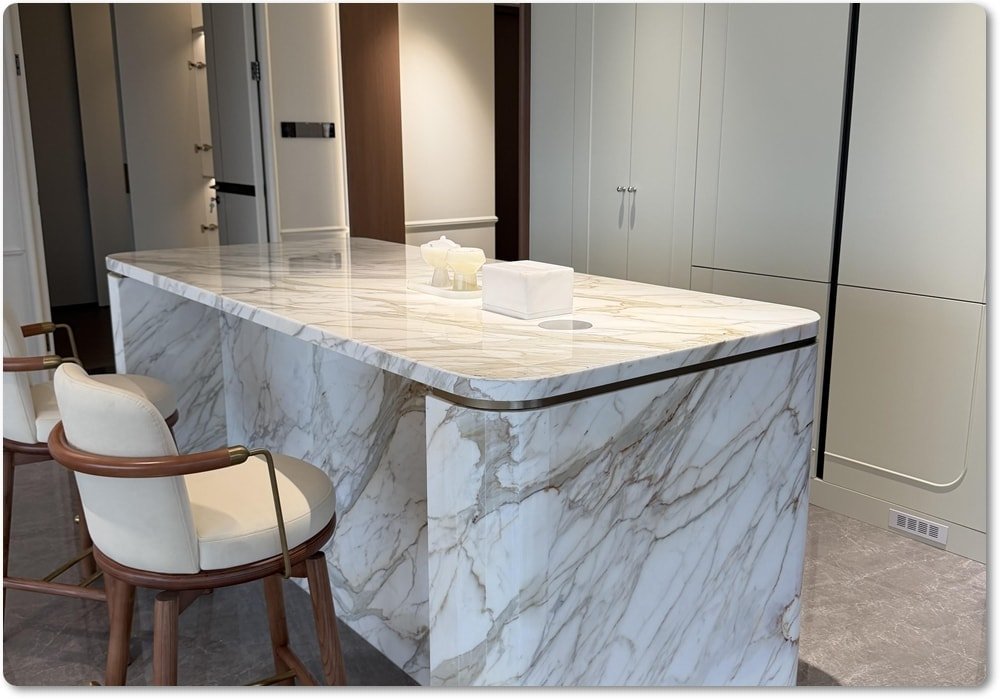
Calacatta marble tiles should be specified as a performance material, not only as a decorative surface. In professional practice, marble is governed by ASTM C503 for marble dimension stone, while the Natural Stone Institute’s Dimension Stone Design Manual remains the industry reference for design, installation, workmanship, and application details. For tile work, the Manual defines stone tile as a thin, flat piece of natural stone with gauged thickness typically between 1/4 in. and 5/8 in., and no dimension greater than 2 ft.; it also emphasizes that samples should show the extremes of color, veining, texture, and marking before approval.
For floors and walls, Calacatta marble must be evaluated through a test-and-use framework: absorption and bulk specific gravity by ASTM C97, compressive strength by ASTM C170, modulus of rupture by ASTM C99, and flexural strength by ASTM C880. For vertical and exterior stone cladding, ASTM C1242 frames design and installation around engineering considerations, material selection, anchor type, and workmanship. In wet areas, the Natural Stone Institute adds practical requirements such as waterproofing, pre-slope, corrosion-resistant hardware, and neutral cleaning chemistry.
The most important procurement lesson is simple: no two Calacatta lots should be approved based on name alone. The responsible approach is to approve range samples, mockups, and dry-lays; define the finish, tolerances, and installation scope in writing; and align the product with the exact scene—dry floor, wet floor, dry wall, shower wall, feature wall, or commercial lobby. That is the only way to make Calacatta marble perform as a premium material rather than a premium risk.
1. Why Calacatta Marble Tiles Require Specification Discipline?
Calacatta marble is bought for visual impact, but it must be sold and installed through technical discipline. The reason is not mysterious: marble is a natural material, and the Natural Stone Institute states that properties may vary significantly within the same stone group; it therefore recommends samples, mockups, and, where needed, dry-lays to show the true range of color and character. That logic is especially important for Calacatta and Viola Calacatta, where the market expectation is centered on bold veining, contrast, and lot-to-lot visual consistency.
For a white paper intended to support, the right starting point is not “what does the stone look like?” but “where will the stone live?” Floors demand different slip, wear, and substrate decisions than walls. Dry walls demand different anchorage and flatness decisions than showers or steam rooms. The standards ecosystem reflects that reality: ASTM C503 addresses marble as a building material, ASTM C97/C170/C99/C880 addresses physical performance, ASTM C1242 addresses design and installation for cladding systems, and the Natural Stone Institute adds scene-specific guidance for horizontal, vertical, and wet-area applications.
The commercial value of Calacatta marble comes from this balance: it is visually rare enough to command attention, but only specification discipline prevents that beauty from being undermined by staining, slip risk, cracking, or finish mismatch. In other words, Calacatta is not just a “design choice”; it is a project decision.
2. Material Logic: How Calacatta Marble Tiles Should Be Classified?
The first rule is to classify the product correctly. ASTM C503 covers marble dimension stone for general building and structural purposes and explicitly includes stone finished or shaped into slabs or tiles. The Natural Stone Institute’s definition of tile is operationally useful for procurement: a stone tile is a thin, flat natural stone finishing material with gauged thickness from 1/4 in. to 5/8 in., and no dimension greater than 2 ft. That definition matters because a “tile” order, a “slab” order, and a “cut-to-size” order are not interchangeable in fabrication, tolerance, handling, or installation.
For Calacatta marble, the product should be specified by use case and finish, not only by trade name. A polished Calacatta tile in a dry feature wall may be appropriate, while the same surface in a shower floor or busy public washroom may create an avoidable slip risk. The Tile Council of North America explains that ANSI A326.3 measures the dynamic coefficient of friction for hard surface flooring materials and includes product use classifications, while its risk-control report notes that polished natural stone is very slippery when wet and should be used only in dry applications. Honed stone can also be slippery when wet.
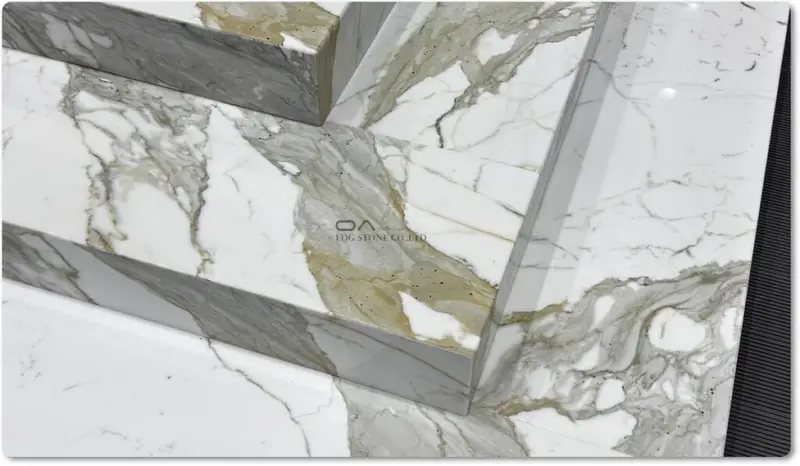
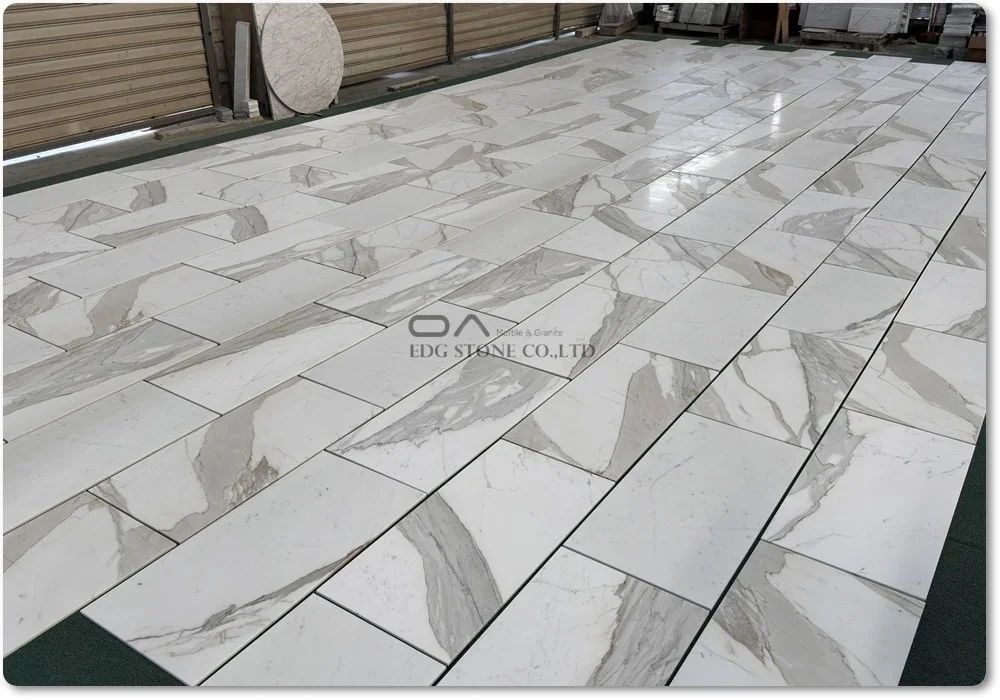
A serious specification sheet, therefore, needs five identity fields: exact commercial name, finish, thickness, intended environment, and approved visual range. For Viola Calacatta marble tile, the visual hierarchy is especially important because the market expects expressive veining, and approvals should be based on the full range of sample pieces rather than one “hero” tile. The Natural Stone Institute explicitly requires samples to show the extremes of color, veining, texture, and marking, and it notes that mockups and dry-lays may be needed to communicate actual project appearance.
3. Performance Standards That Matter for Floors and Walls
A Calacatta tile specification should always reference the testing framework that proves performance, not just appearance. ASTM C97 measures absorption and bulk specific gravity, which are useful indicators of how stones compare with one another and are relevant to moisture behavior. ASTM C170 measures compressive strength, ASTM C99 measures modulus of rupture, and ASTM C880 measures flexural strength by quarter-point loading. Together, these methods help the specifier compare stone lots and decide whether a product is suitable for the intended load condition.
For horizontal surfaces, the practical question is not simply “Is the stone strong?” It is “Can the stone tolerate the real project’s span, load concentration, substrate movement, and service conditions?” The Natural Stone Institute’s manuals emphasize that construction conditions require engineering based on project-specific factors such as panel weight, backup material, physical and mechanical properties, and local codes. In wet areas, the same logic expands to waterproofing, flood testing, slope, drainage, and corrosion-resistant hardware.
For vertical cladding, ASTM C1242 is the key architecture-and-engineering guide. It is intended for architects, engineers, and contractors who design or install exterior stone cladding, and it frames durable stone cladding through engineering design considerations, documentation, material considerations, anchor type applications, and workmanship. Even when the project is an interior wall, that same mindset is useful: the wall should be designed, not improvised.
For premium Calacatta projects, the most dangerous assumption is that “marble is marble.” The standards say otherwise. Different stone lots, finishes, thicknesses, and installation environments require different acceptance criteria. That is why a high-value purchase should always ask for test reports, shop drawings, approved samples, and a clear installation method statement.
4. Floor Specification Standards: Dry Floors, Traffic Floors, and Wet Floors
4.1 Dry interior floors
Dry interior floors are where Calacatta marble often performs best. In low-moisture residential settings, a honed or polished finish can work visually and functionally if the substrate is stable and the room is maintained properly. The Natural Stone Institute states that a clean, non-treated dust mop should be used frequently because grit is abrasive, and it recommends sealers in many cases for marble and granite countertops to improve resistance against everyday dirt and spills. While the guidance is written broadly for natural stone care, the same maintenance logic applies to floors: the stone must be kept clean, and protection is not the same as invulnerability.
For dry floors, the specification should still define movement accommodation, substrate flatness, grout joint width, and installation responsibility. The Natural Stone Institute emphasizes that stone tile installation depends on the experience of the firm performing the work, and that variations in fabrication tolerances are normal because tile and cut-to-size products are made by different methods. The same document also notes that project drawings should identify stone type, finish, size, thickness, joinery, joint treatment, mortar, adhesive, grout, and anchorage.
4.2 Commercial traffic floors
Commercial floors are a separate category. The TCNA materials on slip and fall risk note that polished natural stone is very slippery when wet, and even honed stone tends to have a low coefficient of friction when wet. That is why a polished Calacatta marble floor in a hotel lobby, restaurant entry, or public corridor may be acceptable only if the space remains dry and the risk profile is controlled. In wet-exposed traffic zones, a more textured finish or another material family should be considered.
For commercial procurement, the floor specification should be written around the intended state of the surface, not around a generic “indoor use” claim. Specify whether the floor is dry only, intermittently damp, or regularly wet. If the stone will be walked on when wet, the design team should review slip-resistance test data and product-use classifications under ANSI A326.3, rather than assuming that visual elegance equals safety.
4.3 Wet floors and transitions
Wet floors are the most demanding use case. In shower floors and similar zones, the Natural Stone Institute calls for a waterproof membrane, a minimum pre-slope of 1/4 in. per foot toward the drain, verification by flood test, and joints sealed with non-staining materials. It also specifies corrosion-resistant hardware where anchors contact stone. In residential shower applications, stone should be sound, and marble selections are limited to soundness classifications A and B.
For Calacatta marble tiles used near water, the project team should also understand that sealing is not a substitute for drainage or detailing. The Natural Stone Institute says sealing may be appropriate in many cases, but it does not eliminate the need for regular cleaning. That means the wet-floor strategy must combine material choice, slope, waterproofing, drainage, and maintenance—not just sealer selection.
5. Wall Specification Standards: Feature Walls, Shower Walls, and Vertical Cladding
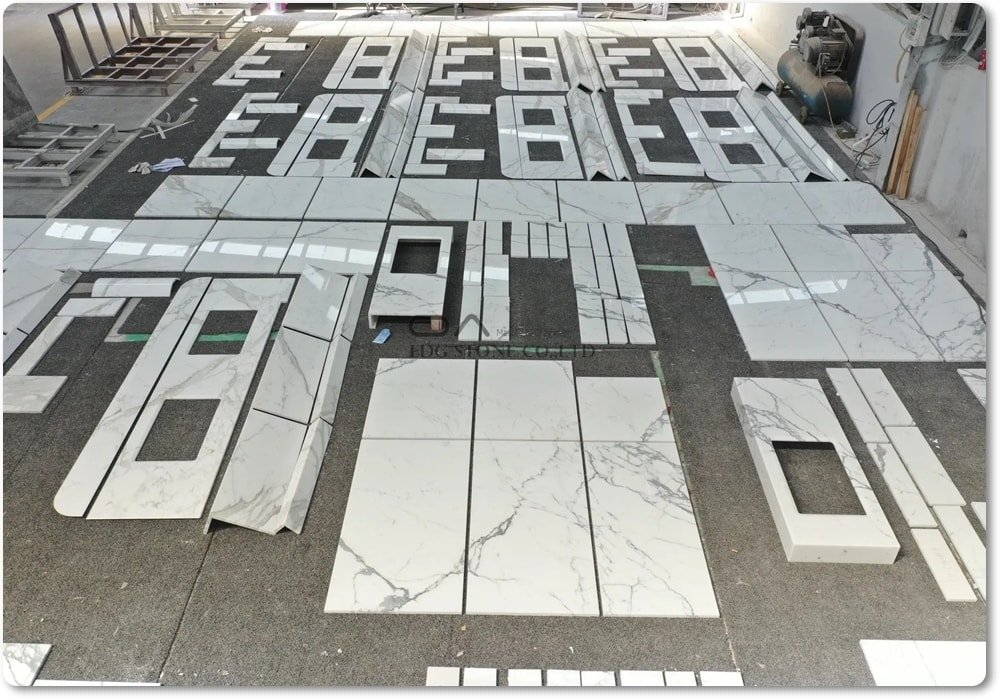
Wall applications often look easier than floors, but they are frequently more technical. The Natural Stone Institute states that the successful installation of both dimension stone and stone tile depends on the installer’s experience and craft knowledge, and that detailed shop drawings should identify stone type, finish, sizes, thicknesses, joint treatments, mortar, adhesive, grout, mechanical anchorage, structural backup, flashing or water management, and interfaces with adjacent materials. That is the correct model for a Calacatta marble wall package.
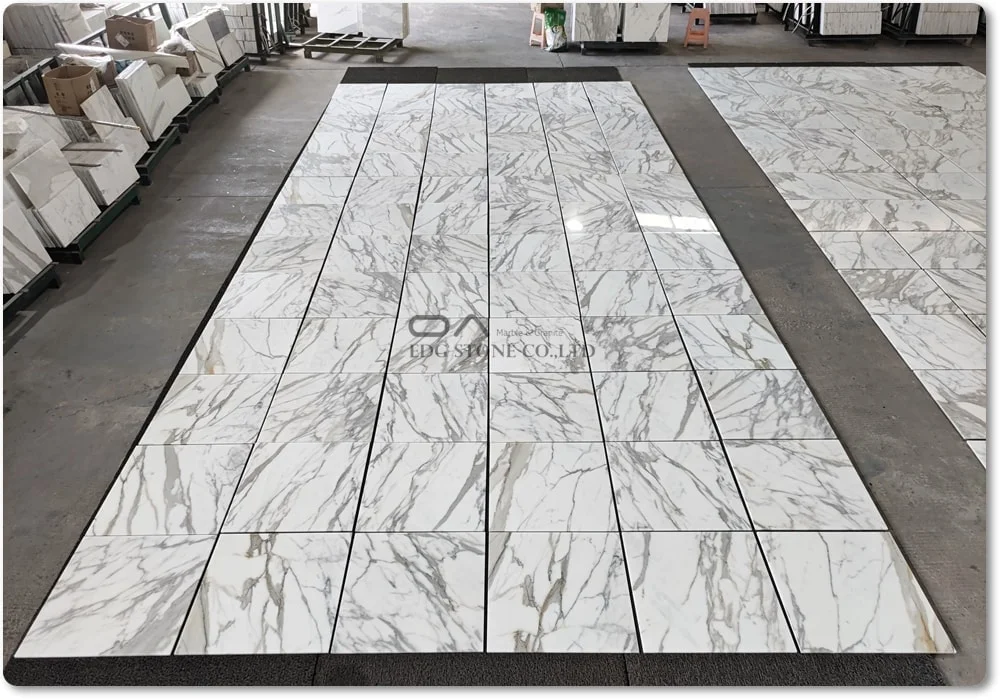
For interior feature walls, the specification goal is visual control. Because marble can vary significantly within a group, the approval process should include multiple sample pieces, a full-range mockup when necessary, and a dry-lay where veining direction and piece sequence matter. The Natural Stone Institute specifically says samples should show the extremes of color, veining, texture, and marking, and that mockups are intended to demonstrate the full range of the stone’s natural characteristics. For premium wall projects, this is not optional decoration; it is quality control.
For shower walls and steam rooms, the technical bar rises further. The Natural Stone Institute’s wet-area guidance covers shower partitions, slab and tile showers, steam rooms, and steam showers; it requires waterproofing, pre-slope, flood testing, and careful detailing. It also states that face sealing may be used or left unsealed in residential shower stalls, but if sealing is used, chemicals must not contain acids or harsh alkalis, because those can damage polished finishes. A neutral detergent is recommended for cleaning.
For exterior vertical cladding, polished calcitic stones such as marble and limestone generally do not retain a polished finish in exterior environments, according to the Natural Stone Institute. Therefore, if Calacatta marble is being considered for a façade or exterior feature wall, the finish and maintenance assumptions must be revisited at the design stage. A premium visual sample is not enough; weatherability, anchorage, and finish retention all have to be validated.
6. Finish Selection: Polished, Honed, or Textured
The finish selection should be treated as a performance decision. Polished Calacatta marble offers maximum contrast and showroom appeal, but TCNA’s slip-and-fall materials caution that polished natural stone is very slippery when wet. Honed marble softens reflections and often reads more architectural, but the same TCNA report notes that honed stone is also slippery when wet. That means finish choice must be matched to the environment, not chosen by taste alone.
For dry walls and low-risk dry floors, polished surfaces are often acceptable and commercially compelling. For bathroom floors, showers, poolside transitions, and other damp zones, the specification should lean toward finishes that reduce visual noise and improve real-world traction. The Natural Stone Institute’s manuals also note that many commercially available stone finishes are suitable for veneer, but calcitic materials may not retain polish in exterior environments. That makes finish selection an application-specific discipline rather than a universal rule.
A practical rule for procurement is this: choose the finish that the space can defend, not the finish that the mood board prefers. If the stone will be touched by water, cleaning chemicals, foot traffic, or frequent maintenance cycles, those realities should control the finish decision.
7. Fabrication, Tolerances, and Quality Control
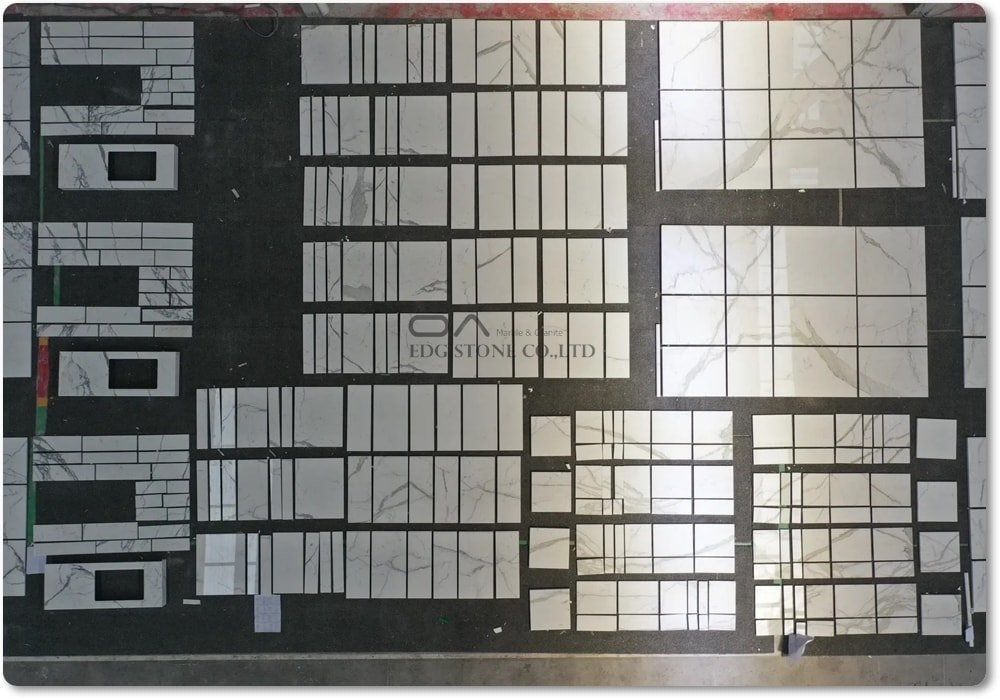
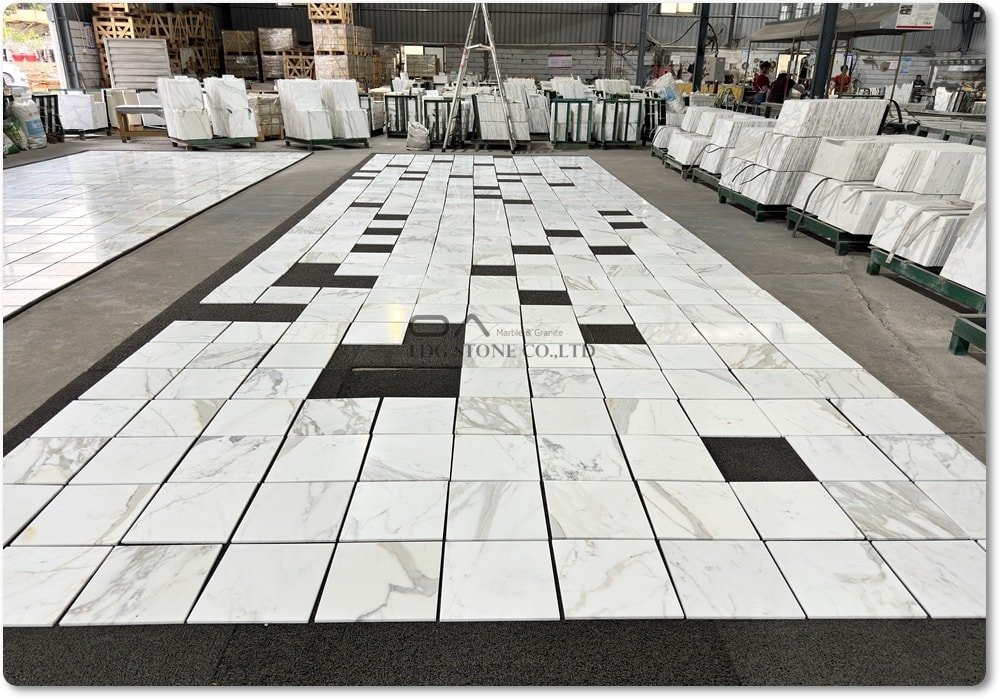
A Calacatta marble tile purchase becomes valuable when the fabricator’s control system is visible. The Natural Stone Institute notes that natural stone tiles and cut-to-size products may have different fabrication tolerances because they are produced by different methods, and it recommends detailed shop drawings that cover sizes, thicknesses, joinery, joint sizes, and treatment. It also says the stone contractor should supply samples that indicate the extremes of the stone’s appearance and that inspection should be performed under natural light at a viewing distance of not less than 6 ft.
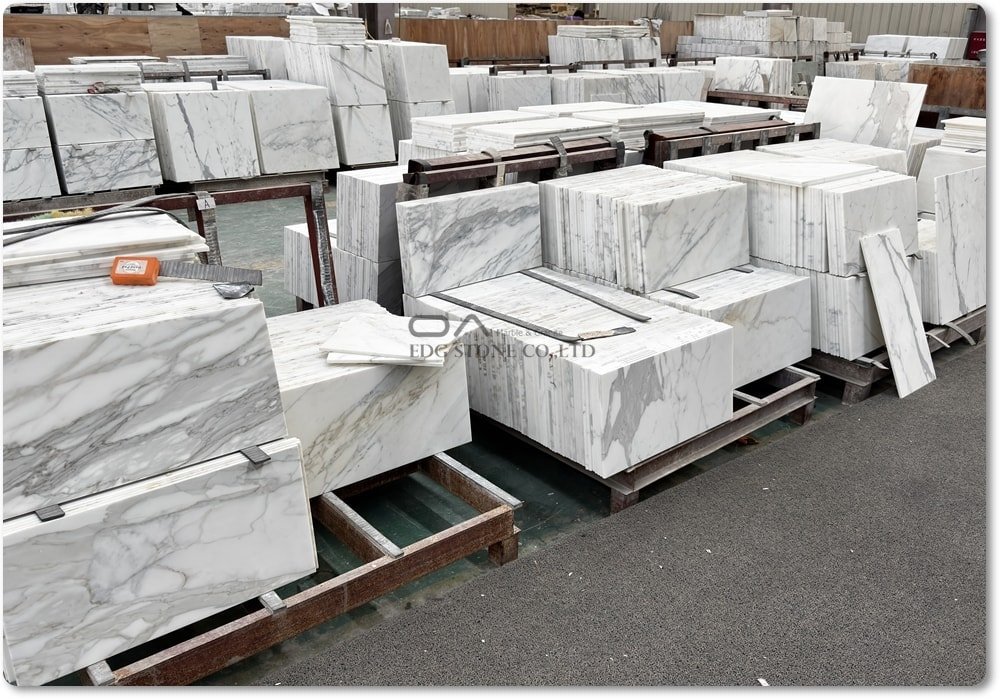
This is where the buyer should insist on a QC checklist. Before production, approve the sample range and the finish. During production, verify thickness, edge quality, calibration, and veining continuity. Before shipment, review labeling, crate protection, and board-by-board or box-by-box identity so that the on-site installer can preserve the approved sequence. For veined stones like Calacatta and Viola Calacatta, the visual sequence is part of the product, not a shipping detail.
The Natural Stone Institute also endorses the use of NSI-accredited natural stone companies. That does not replace the need for project-level QA, but it does give buyers a useful due diligence benchmark when they are comparing suppliers, installers, and stone processors across markets.
8. Maintenance and Long-Term Asset Value
Maintenance should be written into the specification because stone performance is lifecycle performance. The Natural Stone Institute recommends coasters for glasses, trivets or mats for heat exposure, and frequent dust mopping with a clean, non-treated dry dust mop because grit damages stone surfaces. It also explains that sealing can make marble more resistant to dirt and spills, but it is not a guarantee against all staining or damage.
For wet areas, the same source says neutral detergent is the recommended cleaning agent, and acids or harsh alkalis should be avoided because they can destroy polished finishes on some stone varieties. That means a beautiful Calacatta shower wall can remain premium only if the maintenance regime is designed for stone chemistry, not generic household cleaning.
From a commercial perspective, this is one of the strongest arguments for premium natural stone: it can retain value when the full lifecycle is respected. The maintenance conversation is not an afterthought; it is part of the asset strategy. A project that specifies the stone but not the care protocol is incomplete.
9. Procurement Strategy: How to Buy Calacatta Marble Tiles Correctly?
A buyer who wants consistent outcomes should procure Calacatta marble tiles through a controlled sequence: define use case, choose finish, approve samples, confirm test data, issue shop drawings, confirm tolerances, approve packing, and only then release production. ASTM C503 provides the material classification baseline, while ASTM C97, C170, C99, and C880 provide the technical comparison framework. ASTM C1242 and the Natural Stone Institute manual then translate that material choice into buildable practice.
For export and project sales, this procurement model improves both trust and conversion. Buyers in architecture, hospitality, and residential development rarely reject a premium stone because it is expensive; they reject it when the supplier cannot explain the engineering, the tolerance, the finish logic, or the maintenance plan. A standards-based presentation reduces that uncertainty.
This is also where the content cluster strategy matters. A white paper like this should sit inside a larger knowledge system that covers origin, pricing, slab procurement, countertop engineering, wet areas, maintenance, and project logistics. That content structure makes it easier for a buyer to move from research to inquiry without leaving your site. The standards sources above give the cluster credibility; the internal links give it depth.
10. EDG Stone Factory Case Module
Global Quartzite Slabs & Countertops Manufacturer and Exporter
Positioning statement: EDG Stone Factory can be presented in this white paper as a global quartzite slabs and countertops manufacturer and exporter that supports project buyers with technical documentation, visual range control, packing discipline, and export-ready coordination. Because this case module is a brand-use example rather than an external standard, it should be written as a practical supplier case, not as a performance claim.
Case angle for this article: when Calacatta marble tile buyers want a supplier who understands premium stone procurement, EDG Stone Factory can be shown as the kind of manufacturer/exporter that applies the same discipline used for quartzite slabs and countertops: approved samples, controlled finish selection, shop drawing review, careful crate labeling, and project-specific coordination. That makes the case module relevant to both marble tiles and broader luxury stone sourcing.
Recommended case copy block:
“EDG Stone Factory supports global buyers with export-ready natural stone production, project coordination, and documentation discipline. For Calacatta marble tile programs, the same procurement discipline used in high-end quartzite slab and countertop supply—sample approval, finish control, packaging integrity, and shipment traceability—helps reduce risk across residential, hospitality, and commercial projects.”
11. Conclusion
Calacatta marble tiles are not difficult to specify when the process is logical. Start with the material standard, verify physical performance, define the scene, choose the finish, approve the visual range, and write the installation details before production. ASTM and Natural Stone Institute guidance consistently point in the same direction: natural stone performs best when it is engineered, sampled, installed, and maintained as a system.
For buyers, designers, and exporters, the opportunity is clear. Calacatta marble is not merely a luxury surface; it is a premium specification product. The supplier who can explain the standards, the scene logic, the QC workflow, and the maintenance pathway will usually win the order. That is why this white paper is designed to move from knowledge to application to commercial strategy in a single, coherent sequence.
15-Article Internal Link Matrix
- White Paper 01: Calacatta Marble Origin Verification
- White Paper 02: Calacatta Marble Price Analysis
- White Paper 03: Calacatta Marble Slab Procurement
- White Paper 04: Calacatta Marble Countertops Engineering and Installation
- White Paper 05: Calacatta Marble Quality Inspection Checklist
- White Paper 06: Calacatta Marble Tiles: Specification Standards for Floors and Walls
- White Paper 07: Calacatta Marble in Wet Areas and Bathrooms
- White Paper 08: Calacatta Marble Wall Cladding and Vertical Surfaces
- White Paper 09: Calacatta Marble Finish Selection: Polished vs Honed vs Textured
- White Paper 10: Viola Calacatta Marble Tile Buying Guide
- White Paper 11: Marble Tile Fabrication Tolerances and Packaging Standards
- White Paper 12: Natural Stone Maintenance and Sealing Guide
- White Paper 13: Luxury Stone Project RFQ and Tender Template
- White Paper 14: Natural Stone Procurement Risk Control Checklist
- White Paper 15: EDG Stone Factory Case Study: Quartzite Slabs & Countertops Manufacturer and Exporter
FAQ Section
Q1: Are Calacatta marble tiles suitable for floors?
Yes, they can be suitable for dry interior floors when the substrate, finish, and maintenance plan are appropriate. For wet or frequently damp floors, slip risk must be evaluated carefully because polished natural stone is very slippery when wet.
Q2: Are Calacatta marble tiles suitable for walls?
Yes. Wall applications are often a strong use case for Calacatta marble because the load and slip concerns are lower than on floors, but the wall still requires proper shop drawings, joint detailing, and, where relevant, anchorage or waterproofing.
Q3: What finish is best for a bathroom or wet area?
The finish must be matched to the scene. Polished marble is visually strong but slippery when wet; honed stone also tends to have low wet traction. Wet areas require waterproofing, slope, and drainage control, not just a finish choice.
Q4: Do Calacatta marble tiles need sealing?
In many cases, sealing makes sense, but sealing does not make stone stain-proof. It improves resistance to everyday dirt and spills, and it must be paired with proper cleaning and maintenance.
Q5: What should I ask a supplier for before ordering?
Ask for ASTM-based test data, approved samples, a mockup or dry-lay if the veining matters, fabrication tolerances, shop drawings, packing method, and installation recommendations. The Natural Stone Institute explicitly requires samples to show the extremes of color, veining, texture, and marking.
Authoritative Data Sources Used
- ASTM C503/C503M, Standard Specification for Marble Dimension Stone.
- ASTM C97/C97M, Standard Test Methods for Absorption and Bulk Specific Gravity of Dimension Stone.
- ASTM C170/C170M, Standard Test Method for Compressive Strength of Dimension Stone.
- ASTM C99/C99M, Standard Test Method for Modulus of Rupture of Dimension Stone.
- ASTM C880/C880M, Standard Test Method for Flexural Strength of Dimension Stone.
- ASTM C1242, Standard Guide for Selection, Design, and Installation of Dimension Stone Attachment Systems.
- Natural Stone Institute, Dimension Stone Design Manual resource library.
- Natural Stone Institute, Wet Areas guidance in the Dimension Stone Design Manual.
- Natural Stone Institute, Care and Cleaning of Natural Stone.
- Natural Stone Institute, Sealing Natural Stone Countertops.
- Tile Council of North America, Dynamic Coefficient of Friction / ANSI A326.3 guidance.
- TCNA risk-control report on slip and fall performance of natural stone.
- Natural Stone Institute horizontal and vertical surface guidance, including tile definition, sample approval, dry-lay, tolerances, and interior thickness guidance.