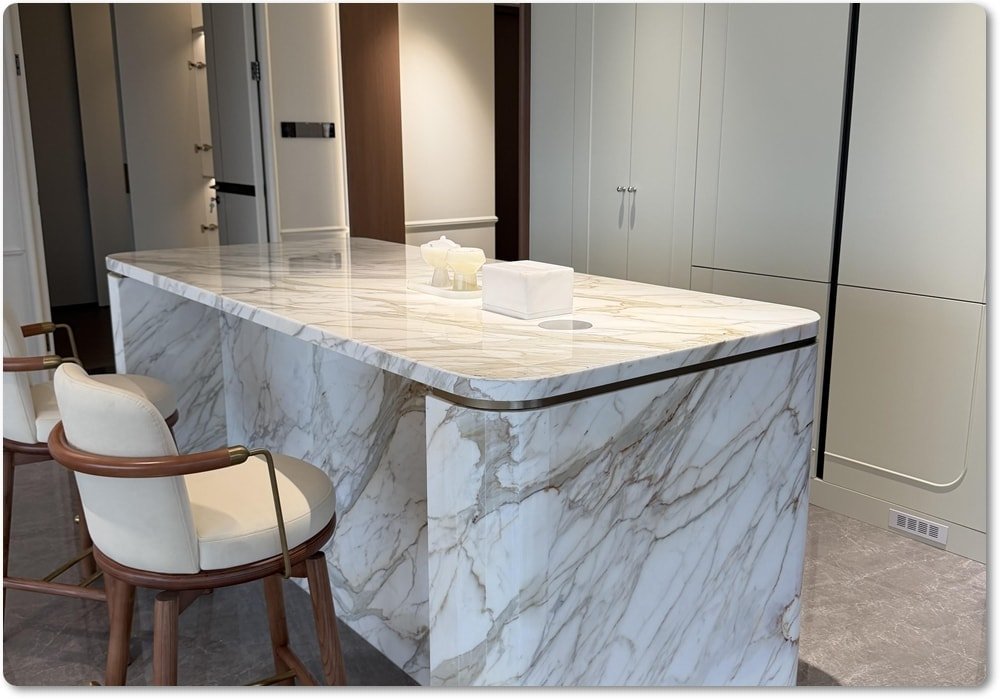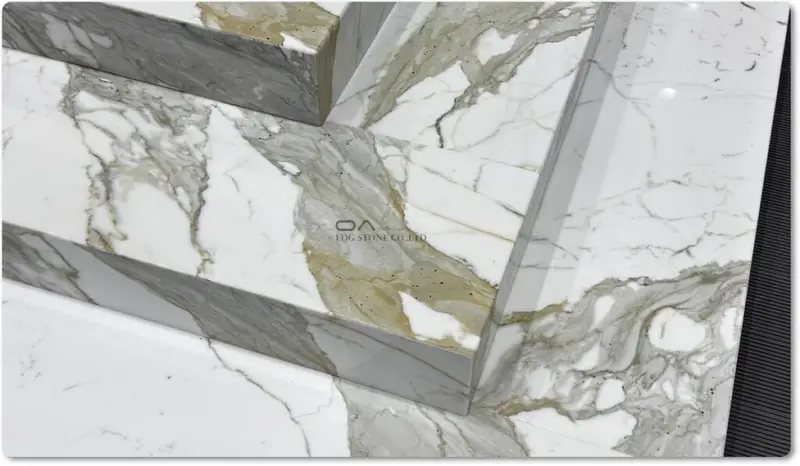
The commercial landscape for premium surfacing is undergoing a significant transformation. Global data from Research and Markets (2026) projects the worldwide quartz market to grow from $10.22 billion to $11.15 billion, maintaining a robust Compound Annual Growth Rate (CAGR) of 9.1%. Within this expanding market, engineered quartz surfaces and slabs account for an 80.7% revenue share (Grand View Research), with luxury residential and high-traffic commercial infrastructure driving the volume.
Among these premium materials, Calacatta Quartz remains the gold standard for architects, multi-family developers, and global distributors. This playbook provides a data-driven, strategic framework for high-volume procurement, optimizing supply chains, and mitigating international transactional risks.
1. Global Quartz Market Overview & Material Logistics
To source Calacatta Quartz Countertops effectively, procurement executives must look past aesthetic design and analyze the material science, manufacturing variations, and shifting global supply chains.
Material Composition and Engineering Standards
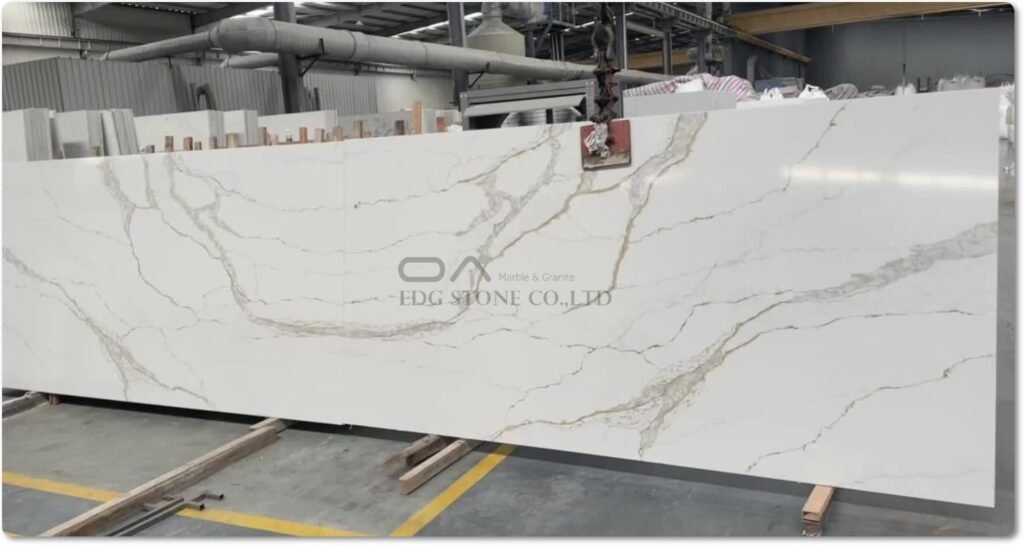
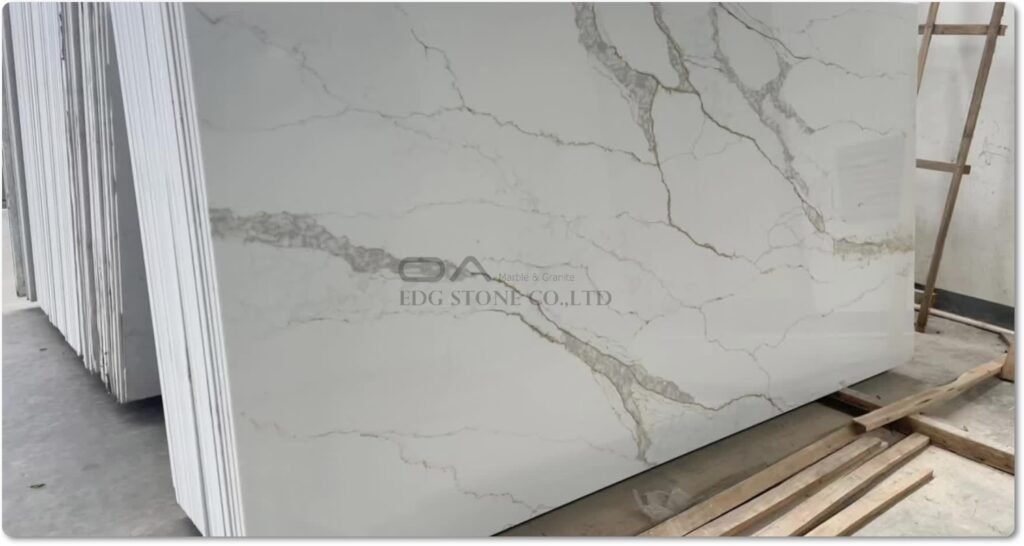
Premium engineered quartz relies on a strict ratio: 93% natural crushed quartz aggregate and 7% polymer resin binders and lightfast pigments. High-end varieties, such as Calacatta Gold Quartz Countertop slabs, require advanced Bretonstone machinery or specialized multi-injector automated lines to execute their signature thick, flowing veins and delicate under-veining without bleeding or color separation.
[93% Pure Quartz Sand / Silica Aggregate]
                 +
[7% High-Performance Polyester Resin & UV-Stable Pigments]
                 │
                 ▼
[Vacuum Vibro-Compression & Thermal Curing (Bretonstone Tech)]
                 │
                 ▼
[Non-Porous, Ultra-Durable Calacatta Slab]
Geographic Supply Chain Realities
Anti-dumping (AD) and countervailing duties (CVD) have rewritten global stone trade routes:
The North American Market: Accounts for 34% of global demand (Fortune Business Insights). Due to high tariff structures on direct Asian stone exports, sourcing routes have shifted toward optimized Southeast Asian hubs and direct manufacturing partnerships that can guarantee tariff-compliant origin paperwork.
The Asia-Pacific region remains the undisputed production powerhouse, commanding a 52.3% share of global supply (Grand View Research). Strategic infrastructure investments in regions like China, Vietnam, and India have dramatically stabilized raw silica supply chains.
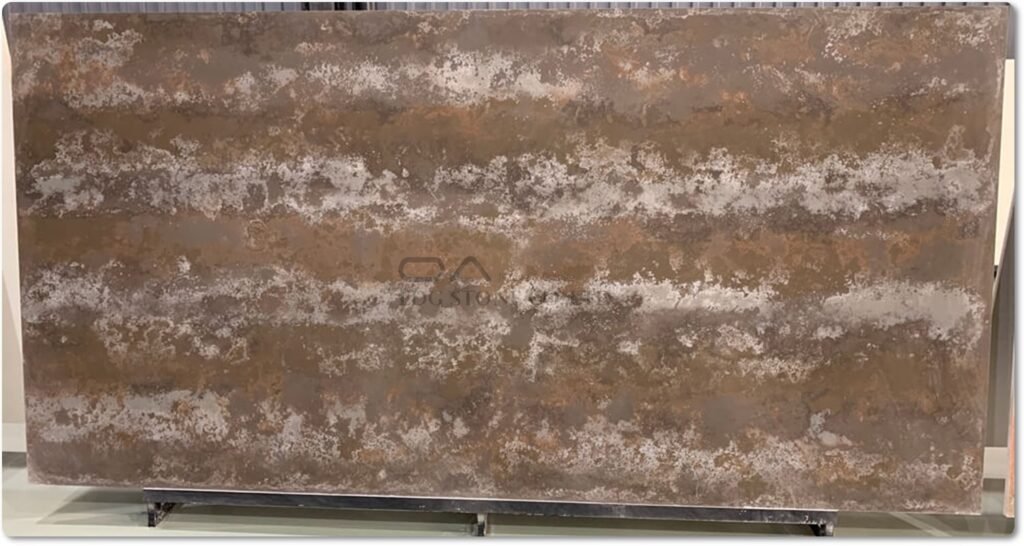
2. Granular Pricing Structure Analysis
Commercial pricing for Calacatta Quartz slabs is determined by structural thickness, design complexity, and order volume. While retail installation averages $65 to $180 per square foot across the US market (Venezia Surfaces 2026), direct factory container sourcing operates on a completely different financial scale.
Factory FOB Price Matrix (Per Square Meter)
| Quality Grade / Design Tier | 20mm Slab FOB Price (USD/m²) | 30mm Slab FOB Price (USD/m²) | Visual Attributes & Production Specs |
| Tier 1: Basic Calacatta | $45 – $65 | $60 – $85 | Sparse, single-layer linear veining; ideal for mass multi-family projects. |
| Tier 2: Mid-Range / Calacatta Gold | $65 – $95 | $85 – $120 | Distinct secondary gold/grey veins with subtle depth; tight background color control. |
| Tier 3: Premium Jumbo / Bookmatch | $100 – $160 | $135 – $210 | Mirror-image structural veining; high-purity crisp white base; zero bleeding. |
Hidden Cost Drivers in Slab Manufacturing
Resin Quality & Yellowing Resistance: Lower-tier factories use cheaper, unrefined resins that degrade under ambient UV light. Premium manufacturers utilize high-grade, non-yellowing polyester resins that cost up to 25% more but protect product integrity during transport and long-term placement.
Calibration and Polishing Passes: Top-tier production lines run a minimum of 36 separate polishing heads to achieve a true gloss rating above 90°, eliminating the uneven “orange peel” texture found on budget slabs.
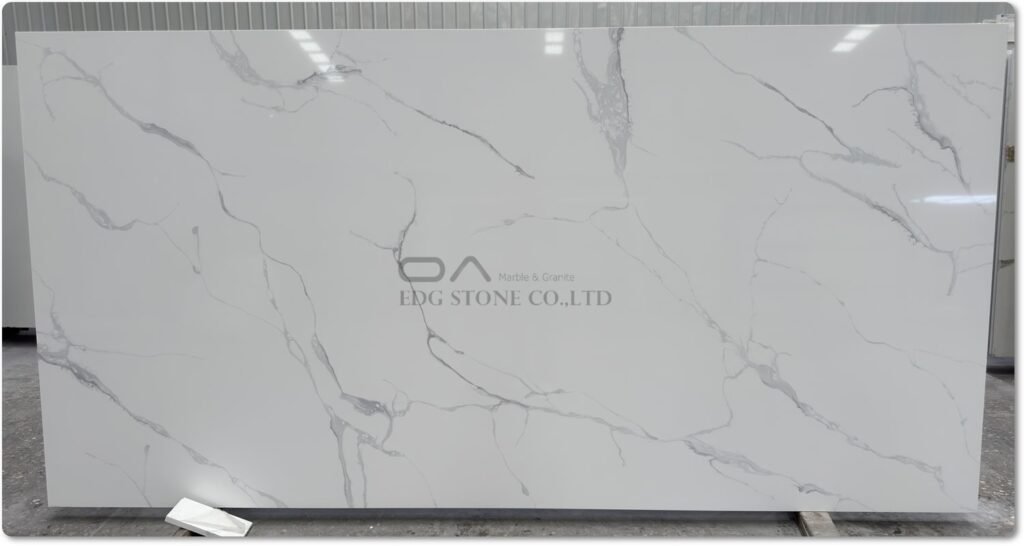
3. MOQ Optimization & Container Loading Economics
Maximizing return on investment requires a precise balance between Minimum Order Quantities (MOQs) and the physical payload limits of a 20-foot heavy-duty ocean container.
The MOQ Breakdown
Standard factory MOQs typically start at 1 container per color for custom vein patterns or 50–100 slabs for running stock designs. For regional distributors seeking a diverse product portfolio without over-leveraging capital, negotiating mixed-color containers is essential.
Container Loading Logistics & Payload Math
Because quartz is an exceptionally dense material, ocean freight containers hit their maximum weight capacity long before they fill up spatially.
Critical Safety Metric: The maximum allowable payload weight for a standard 20ft container on US highways under federal DOT limits is typically 44,000 lbs (approx. 19,958 kg). If utilizing an over-weight chassis or shipping to a non-US port, maximum container weights can extend up to 27,000 kg.
The table below breaks down the loading capacity for standard 20-foot containers based on a 27,000 kg gross weight limit:
| Slab Thickness | Average Dimensions (Standard / Jumbo) | Slabs per Bundle | Bundles per 20ft FCL | Total Slabs per FCL | Total Square Meters (m²) |
| 20 mm | 3200 x 1600 mm | 15 Slabs | 7 Bundles | 105 Slabs | 537.6 m² |
| 30 mm | 3200 x 1600 mm | 10 Slabs | 7 Bundles | 70 Slabs | 358.4 m² |
4. Supplier Evaluation Framework & Risk Management
When auditing a factory for high-volume Calacatta Quartz Countertops production, use this four-point technical checklist to guarantee structural performance.
┌────────────────────────────────────────────────────────┐
│               Supplier Technical Audit                 │
└───────────────────────────┬────────────────────────────┘
                            │
         ├── [1. Water Absorption Test (<0.03%)]
         ├── [2. Hardness & Flexural Strength (Mohs >6)]
         ├── [3. Resin Content Verification (7% Cap)]
         └── [4. Traceability & Certification Check]
1. Water Absorption and Density: Ensure the material passes ASTM C97 testing, verifying a water absorption rate of less than 0.03%. This confirms complete vitrification and ensures long-term stain resistance.
2. Hardness and Flexural Strength: The finished material must achieve a Mohs hardness rating greater than 6 and a flexural strength above 40 MPa (ASTM C880), preventing structural failure during fabrication and transport.
3. Resin Content Verification: Run a thermal burn test on samples. Any resin content exceeding 8% compromises the structural integrity of the stone, rendering it soft, easily scratched, and prone to thermal shock cracking near cooktops.
4. Traceability and Third-Party Certifications: Request active documentation for Greenguard Gold (indoor air quality), NSF 51 (food zone safety), and CE marking for European compliance.
5. B2B Negotiation Strategies for Volume Buyers
Securing optimal commercial terms requires shifting the conversation from a basic “price-per-slab” negotiation to a comprehensive total cost of ownership model.
Leverage Phased Off-Take Agreements: Instead of negotiating price on a single, isolated container, present a 12-month projected purchasing plan (e.g., 24 containers per year). Secure tier-3 high-volume pricing by signing a contract that commits to a steady monthly pull, which helps the factory optimize its production schedule.
Negotiate Factory Defect Scrap Allowances: Request a built-in 1.5%-2% credit line or scrap allowance directly on the commercial invoice. This offsets the minor micro-fissures, corner chips, or vein anomalies that can naturally occur during long-distance maritime transit.
Structure Favorable Payment Milestones: Avoid paying 100% upfront. The commercial standard for volume buyers is a 30% T/T deposit to initiate production, with the remaining 70% balance payable upon presentation of the Bill of Lading (B/L) and the factory quality control inspection report.
6. Case Study: Why Source Directly from EDG Stone Factory?
Navigating global tariffs and quality control variations requires working with an experienced production partner. EDG Stone Factory serves as an industry-standard example of an integrated global manufacturer and exporter specializing in premium Calacatta Quartz Slabs & Countertops.
[EDG Stone Factory Automated Production]
                 │
                 ├──► [Bretonstone Vibro-Compression] ──► Flawless 93:7 Quartz-Resin Bond
                 ├──► [36-Head Polishing Lines]       ──► True Gloss Rating >90°
                 └──► [Full Custom Fabrication]      ──► Prefabricated Mitred & Laminated Edges
                 │
[Direct Global Export / Multi-Port Delivery Logistics]
Advanced Manufacturing and Quality Assurance
EDG Stone Factory utilizes advanced multi-injector automated slab lines alongside Bretonstone vacuum vibro-compression technology. This setup guarantees that every slab of Calacatta Gold Quartz Countertop maintains sharp, consistent vein depth, a pure white background, and zero interior structural voids. Their state-of-the-art facility operates a 36-head polishing system, delivering an immaculate gloss finish across every production batch.
Turnkey Fabrication and Commercial Capabilities
Unlike factories that only supply raw slabs, EDG Stone provides comprehensive, commercial-grade custom fabrication. They process raw slabs directly into cut-to-size Calacatta Quartz Countertops with intricate edge profiles (such as mitered aprons and laminated bullnoses) tailored to architectural specifications. This direct integration eliminates intermediate fabricator markups, optimizes container space, and ensures full quality control from raw silica sand to securely crated, jobsite-ready countertops.
7. Structural FAQ (Sourcing & Procurement)
Q: What is the standard container capacity for Calacatta Quartz slabs?
A: For standard 20ft ocean containers capped at a 27,000 kg payload, you can load approximately 105 slabs of 20mm thickness (7 bundles of 15 slabs) or 70 slabs of 30mm thickness (7 bundles of 10 slabs).
Q: How can I verify if a Calacatta Quartz slab has excessive resin content?
A: Premium quartz surfaces must maintain a strict 93% quartz to 7% resin ratio. A simple way to check is to verify that the slab complies with ASTM C97 and has a water absorption rate under 0.03%. If the resin content exceeds 8%, the slab will feel slightly plastic to the touch, scratch easily under a steel blade, and show poor thermal resistance.
Q: What payment terms are standard when sourcing quartz slabs directly from global factories?
A: The standard commercial term for high-volume international sourcing is a 30% T/T deposit to release the raw materials and initiate production, with the remaining 70% balance paid upon presentation of a copy of the Bill of Lading (B/L).
8. Strategic Verification Matrix & Data References
To maintain absolute transparency and institutional rigor, all market projections, material performance metrics, and economic data points utilized throughout this playbook are verified across the following 12 core global industry indices:
Global Quartz Market Size & Analysis (2026): Data tracked via Research and Markets Report ID: 5766571.
Market Share & Segment Projections: Verified against Fortune Business Insights Global Quartz Stone Industry Review.
Regional Production Distributions: Sourced from Grand View Research (Engineered Stone Segment Outlook).
Physicochemical Testing Standards: Calibrated to ASTM C97 (Standard Test Methods for Absorption and Bulk Specific Gravity of Dimension Stone).
Flexural Resistance Metrics: Evaluated under ASTM C880 (Standard Test Method for Flexural Strength of Dimension Stone).
Indoor Air Chemical Emissions: Verified through UL 2818 – Greenguard Certification Program for Chemical Emissions.
Food Zone Material Evaluation: Certified under NSF/ANSI Standard 51 for Food Equipment Materials.
CE Marking Compliance: Sourced from European Standard EN 15285: Agglomerated Stone Slabs for Vanity and Kitchen Countertops.
Tariff & Origin Verification: Checked against the US International Trade Commission (USITC) Harmonized Tariff Schedule.
Federal Transportation Weight Limits: Sourced from the US Department of Transportation (DOT) Federal Highway Administration Guide.
Wholesale Pricing Trackers: Compiled from the GoSource B2B Structural Surfacing Price Index (2025–2026).
Material Scratch Resistance Standards: Evaluated using the Mohs Hardness Scale for Industrial Minerals.
9. Internal Sourcing Knowledge Architecture
To streamline your procurement strategy across different material classes and operational stages, review our specialized sourcing guides:
→ Link to ALL Previous Articles — Access our full database of global logistics and stone procurement strategy guides.
→ Part 1: Comprehensive Guide to Quartzite vs. Engineered Quartz Selection — Learn the structural performance and cost differences between natural quartzite and engineered slabs.
→ Part 2: Advanced Quality Control Protocols for High-Volume Stone Imports — A detailed walkthrough for setting up pre-shipment inspections and checking factory calibration tolerances.
→ Part 3: Navigating Anti-Dumping Duties and Tariffs on Engineered Surfaces — A protective compliance framework for North American and European procurement managers.