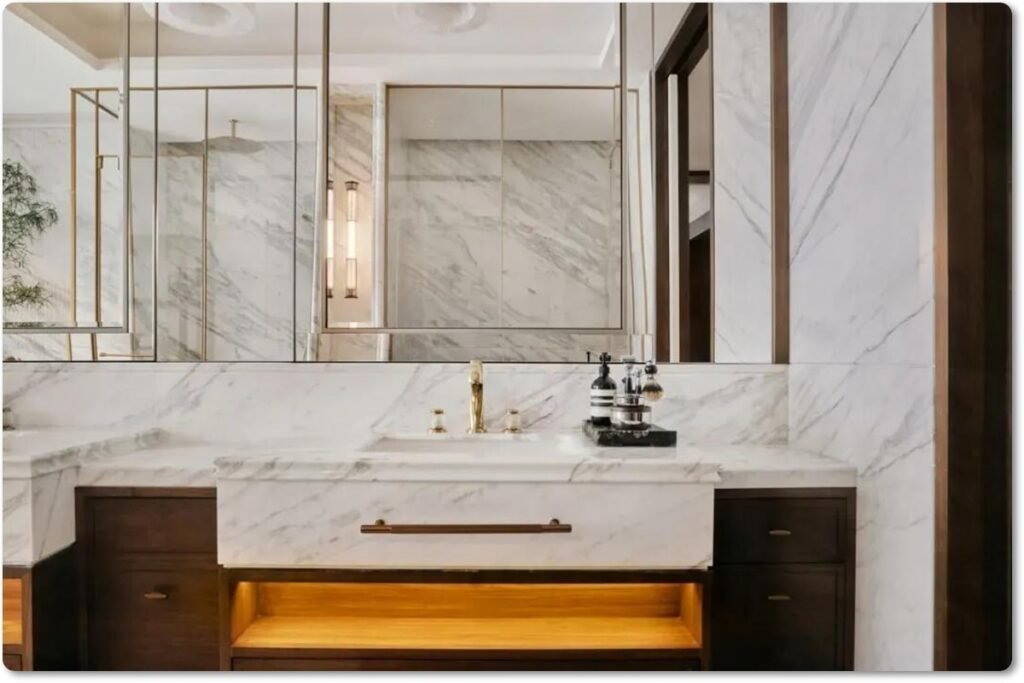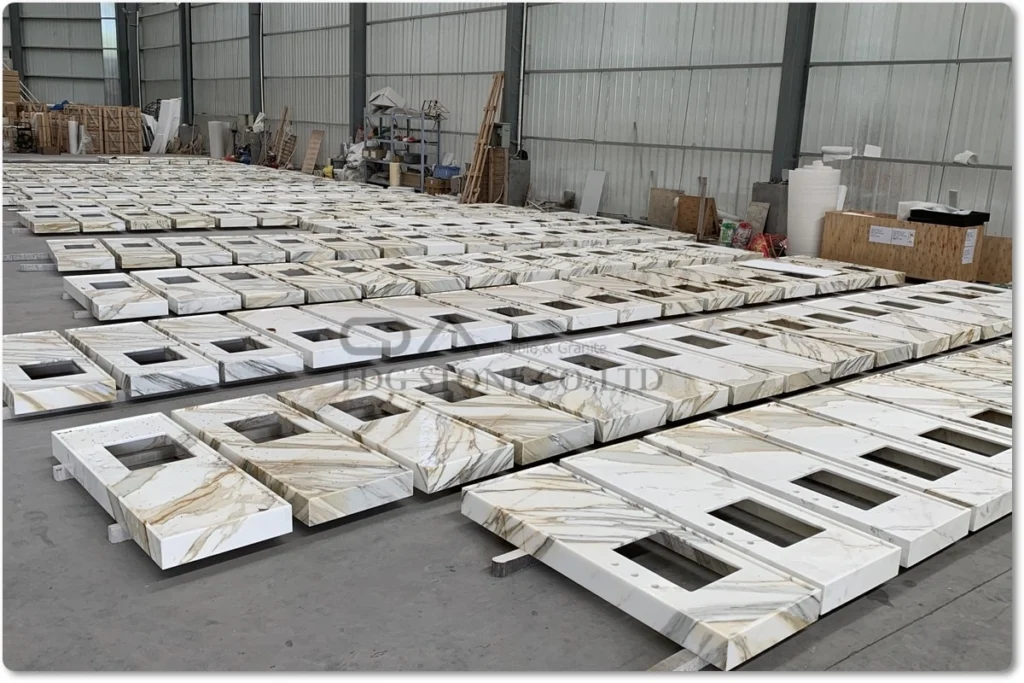
Executive Summary: How Much Do Marble Tiles Cost in 2026?
The price of marble tiles in 2026 depends on the stone variety, quarry origin, material grade, tile dimensions, thickness, surface finish, fabrication requirements, order quantity, packaging specifications, and delivery terms. Natural marble tiles and marble-look porcelain tiles belong to different product categories and should not be compared using the same material-price assumptions.
For residential buyers, the most important cost considerations are material selection, tile size, finish, and installation requirements. For importers, wholesalers, distributors, contractors, and commercial project buyers, the purchasing decision must also account for factory yield, inspection, export packaging, freight, customs duties, inland transportation,n and potential replacement costs.
Buying directly from a qualified marble tiles manufacturer or factory can improve purchasing transparency and give you greater control over material selection, production specifications, and bulk-order consistency. However, the lowest factory quotation is not necessarily the lowest total landed cost.
This guide explains how to evaluate marble tile prices in 2026, compare natural marble with marble-look alternatives, understand EXW, FOB, and CIF quotations, and calculate a more realistic import budget.
Who should use this guide?
- Marble tile importers and wholesale distributors.
- Building material suppliers and stone retailers.
- Flooring and wall-covering contractors.
- Hotel developers and hospitality procurement teams.
- Residential and commercial property developers.
- Interior designers, architects, and specification professionals.
- OEM/ODM buyers and private-label building material brands.
Key procurement conclusion: Request quotations based on identical material specifications, dimensions, thickness, finish, quantity, inspection requirements, and Incoterms. Compare the total cost per accepted square meter delivered to the destination, not simply the initial factory price.
Marble tile prices in 2026 depend on material origin, stone grade, visual consistency, tile dimensions, thickness, surface finish, fabrication, packaging, and transportation. Natural marble generally offers authentic mineral patterns and geological variation, while marble-look porcelain provides a manufactured appearance with different performance and pricing characteristics. For bulk procurement, factory-direct sourcing, approved samples, documented quality inspection, and a clear EXW/FOB/CIF comparison help buyers control costs. EDG Stone provides factory-direct natural stone sourcing, custom tile processing, quality inspection, and export packaging solutions for international buyers.
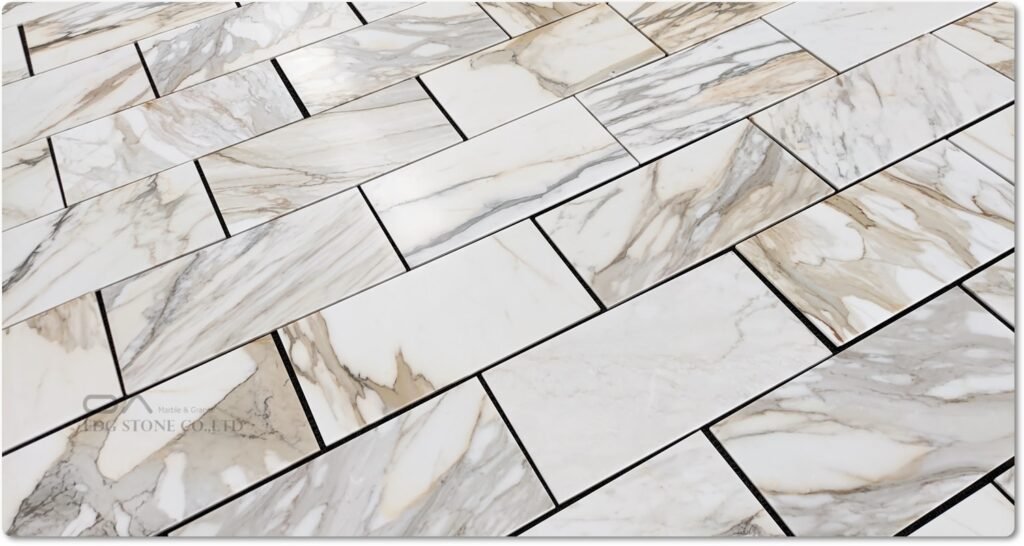
1. Scope and Definitions: Understanding Marble Tile Prices
Before comparing marble tile prices, buyers must establish exactly what product is being purchased.
The term “marble tiles” is frequently used in search engines and building material catalogs to describe several different products. However, their raw materials, manufacturing processes, performance characteristics, and supply chains differ considerably.
1.1 Natural Marble Tiles
Natural marble tiles are produced by extracting marble blocks from quarries and processing them into slabs, strips, or specified tile dimensions.
The manufacturing process may include:
Quarry block selection.
Block inspection and cutting.
Gang saw or multi-blade processing.
Slab calibration.
Tile cutting and dimension control.
Surface polishing, honing,g or other finishing.
Edge processing where required.
Final inspection and packaging.
Natural marble contains geological characteristics such as mineral veins, color variations, fossil traces, and differences in crystal structure.
These characteristics contribute to the visual identity and commercial value of each stone variety.
Examples include:
Carrara White Marble.
Calacatta Marble.
Statuario Marble.
Crema Marfil Marble.
Emperador Dark Marble.
Nero Marquina Marble.
Green Marble.
Travertine.
1.2 Marble-Look Porcelain Tiles
Marble-look tiles are manufactured ceramic or porcelain products designed to reproduce the appearance of natural marble.
Their pricing structure is different because it depends on:
Clay and mineral raw materials.
Manufacturing technology.
Printing and glazing.
Kiln processing.
Surface texture.
Rectification.
Thickness and dimensions.
Brand positioning and distribution.
Large-format porcelain slabs may require specialized manufacturing, handling, and transportation.
A marble-look porcelain product should never be presented as natural marble. Buyers should verify material composition and product documentation before placing an order.
1.3 Important Pricing Terms
| Term | Meaning |
|---|---|
| Price per square meter | Material or product price calculated by area |
| Price per square foot | Common retail pricing unit in North America |
| FOB price | Seller delivers goods on board the nominated vessel at the agreed port |
| CIF price | Seller arranges cost, insurance and freight to the named destination port |
| EXW price | Seller makes goods available at the agreed place; buyer assumes extensive collection and transport responsibilities. |
| Factory-direct price | Price quoted directly by the manufacturer or producing factory |
| Wholesale price | Commercial price for resale or bulk purchasing |
| Landed cost | Total cost of importing goods to the specified destination or delivery point |
A quotation must clearly identify what is included and excluded. The phrase “marble tiles price” alone is not a sufficiently detailed commercial specification.
2. How Much Do Marble Tiles Cost in 2026?
There is no single reliable worldwide price for marble tiles in 2026.
A quotation for standard commercial-grade white marble tiles cannot be directly compared with a quotation for premium Calacatta marble, bookmatched decorative panels, or large-format custom-cut tiles.
Likewise, retail prices in the United States, wholesale factory quotations in China, and distributor prices in Europe reflect different commercial structures.
2.1 Marble Tile Pricing by Commercial Category
The following table provides a practical framework for understanding relative price positioning. These are qualitative purchasing categories, not verified 2026 market averages or guaranteed supplier quotations.
| Product category | Relative price positioning | Main cost drivers |
|---|---|---|
| Standard commercial marble tiles | Entry to medium | Common material, standard sizes and finishes |
| Premium white marble tiles | Medium to high | Color consistency, vein appearance and material selection |
| Luxury Calacatta and Statuario tiles | High to premium | Scarcity, block selection and visual quality |
| Premium green and exotic marble | Medium to premium | Quarry availability, color and geological characteristics |
| Travertine tiles | Entry to premium | Filling, cutting direction, grade and finish |
| Custom large marble tiles | Medium to premium | Larger material requirements, yield and processing |
| Marble mosaic tiles | Variable | Small-piece fabrication, pattern complexity and assembly |
| Marble-look porcelain tiles | Entry to premium | Porcelain body, printing technology, size and brand |
The price difference between two products in the same material category can also be substantial.
For example, two white marble tiles may have the same dimensions and thickness but different prices because one has a consistent background color and carefully selected veins, while the other contains more visible color variation.
2.2 How to Build a Preliminary Marble Tile Budget
Instead of relying on an unsupported average market price, buyers should calculate their budget using the following formula:
Material budget = Required area × Quoted unit price
Then add:
Cutting and processing.
Packaging and protection.
Export documentation and handling.
International freight and insurance.
Customs duties and import taxes.
Destination port charges.
Inland delivery.
Installation materials and labor.
Contingency for breakage and replacement.
Illustrative purchasing example
A commercial buyer plans to purchase 500 m² of natural marble tiles.
Assume a hypothetical factory quotation of USD 38/m².
| Item | Calculation | Amount |
|---|---|---|
| Marble tiles | 500 × $38 | $19,000 |
| Custom processing | Illustrative allowance | $1,000 |
| Export packaging | Illustrative allowance | $600 |
| Freight and insurance | Illustrative allowance | $2,400 |
| Destination and import expenses | Illustrative allowance | $1,500 |
| Illustrative total | $24,500 |
The resulting estimated cost is USD 49/m² before any additional unlisted expenses.
All figures in this example are hypothetical calculations, not EDG quotations or verified market prices. Actual charges depend on the shipment, destination, customs classification, and agreed contract.
2.3 Why Marble Tile Prices Change
Natural stone prices can change because of:
Quarry production and available block inventory.
Selection requirements and usable slab yield.
Material demand and international sourcing conditions.
Processing capacity and production schedules.
Energy, labor, and consumable costs.
Packaging materials and export logistics.
Currency exchange rates.
Destination-country import regulations and duties.
For 2026 procurement, buyers should request a quotation validity period and confirmation of material availability rather than assuming an online price will remain unchanged.

3. Natural Marble vs. Marble-Look Tiles Price
One of the most common purchasing questions is whether natural marble tiles or marble-look porcelain tiles provide better value.
The answer depends on the intended application, project positioning, performance requirements, and lifecycle considerations.
3.1 Natural Marble: Material and Processing Costs
Natural marble pricing begins with the quarry block.
A block with attractive veins, a consistent background color, and fewer undesirable defects may command a higher price than a block with less commercially desirable visual characteristics.
After extraction, the material must be processed into the required tile dimensions.
Factors include:
Block dimensions and quality.
Slab thickness.
Cutting losses.
Vein direction.
Natural fissures and mineral characteristics.
Surface treatment.
Tile calibration.
Sorting and packaging.
Natural marble is particularly attractive for luxury hotels, villas, high-end residential developments, premium retail interiors, and architectural projects where authentic natural stone is part of the design concept.
3.2 Marble-Look Porcelain: Manufacturing Costs
Porcelain manufacturers use controlled production processes to create repeatable visual patterns.
Prices are influenced by:
Body composition.
Digital decoration technology.
Surface glazing.
Printed pattern resolution.
Large-format production capacity.
Rectification accuracy.
Manufacturer and brand positioning.
Marble-look porcelain may be more suitable when projects prioritize repeatability, standardized replacement products, and particular technical performance characteristics.
However, the performance of porcelain should be evaluated using its own product test data, not by assuming that every porcelain product has identical specifications.
3.3 Comparison for Commercial Buyers
| Evaluation factor | Natural marble | Marble-look porcelain |
|---|---|---|
| Material origin | Natural quarry stone | Manufactured ceramic material |
| Pattern | Geological and naturally variable | Digitally or mechanically reproduced |
| Color consistency | Requires batch selection | Generally more repeatable |
| Customization | Cutting, finishing and stone fabrication | Factory-dependent format and finish options |
| Maintenance | Depends on stone characteristics and treatment | Depends on product specifications |
| Replacement | Batch matching may be difficult | Matching depends on production series |
| Luxury positioning | Authentic natural stone | Marble-inspired appearance |
| Procurement | Quarry and stone factory supply chain | Ceramic or porcelain manufacturing supply chain |
3.4 Which Option Offers Better Value?
For projects where natural texture, geological uniqueness, and premium stone identity are essential, natural marble may justify its higher procurement cost.
For projects where standardized appearance, predictable batch production, and specific porcelain performance characteristics are priorities, marble-look porcelain may be a more suitable option.
The correct decision is not simply based on which material has the lower purchase price.
Buyers should evaluate the initial purchase cost, installation system, maintenance requirements, expected replacement needs, and overall design objectives.

4. Material Origin and Stone Grade: Why Some Marble Tiles Cost More
Material origin and grade are two of the most important factors influencing natural marble tile prices.
However, there is no universal international grading system that assigns one identical A/B/C commercial grade to every marble variety and supplier.
Terms such as First Choice, Premium Grade, A Grade, and Commercial Grade may be used by different factories with different selection criteria.
Buyers should therefore request a written grading specification.
4.1 Quarry Origin and Material Availability
Marble varieties are associated with different geological deposits and quarrying regions.
Examples include:
Carrara and Calacatta from Italy.
Crema Marfil from Spain.
Volakas from Greece.
Emperador varieties from Spain and other sources.
Different green marble varieties from China, Turkey, India, and other producing regions.
Country of origin alone does not establish quality.
Two blocks from the same quarry can have different background colors, mineral structures, vein patterns, and commercial suitability.
4.2 Understanding Commercial Marble Grades
A useful procurement approach is to establish project-specific acceptance categories.
| Selection factor | Premium selection | Commercial selection |
|---|---|---|
| Background color | Within agreed visual tolerance | Greater natural variation |
| Vein appearance | Selected pattern and direction | Less controlled variation |
| Surface condition | Meets stricter appearance criteria | Meets agreed commercial criteria |
| Visible defects | Strictly controlled against approved sample | Accepted within written limits |
| Dimensional tolerance | Project-specific tighter tolerance | Standard agreed tolerance |
| Batch consistency | More selective sorting | Broader acceptable variation |
These categories are a proposed purchasing framework, not an official universal grading standard.
4.3 Natural Variation Must Be Separated from Defects
Natural marble is not a synthetic material.
Its appearance can include:
Mineral veins.
Fossil inclusions.
Color bands.
Crystal variations.
Natural fissures.
Changes in background tone.
Not every variation is a defect.
However, open cracks, unacceptable edge damage, unstable repairs, excessive warping, and dimensions outside agreed tolerances may affect product acceptance.
The buyer and supplier should agree on visual standards before production.
4.4 Why Premium Marble Selection Increases Cost
Premium material selection often requires additional inspection and sorting.
A factory may need to review more raw slabs or tiles to identify sufficient quantities that meet a specific color and vein requirement.
This can reduce the usable yield from the original material.
For large hotel and residential projects, buyers should approve representative samples and, where visual continuity matters, inspect photographs or videos of the actual production batch.
5. Tile Size, Thickness and Surface Finish
Dimensions and thickness directly influence the amount of raw material required, cutting efficiency, handling, and transportation.
Large marble tiles are especially important in modern commercial and residential projects.
5.1 Standard Marble Tile Sizes
Commonly requested formats include:
300 × 300 mm.
300 × 600 mm.
400 × 400 mm.
400 × 800 mm.
600 × 600 mm.
600 × 900 mm.
600 × 1200 mm.
Custom dimensions.
These are common procurement examples, not a universal international standard.
The availability of a particular format depends on the stone block, slab dimensions, cutting equipment, and production requirements.
5.2 Why Large Marble Tiles Can Cost More
Large-format marble tiles may increase material costs because:
Larger sound sections of stone are required.
Cutting yield can be lower.
Natural cracks and veins may limit usable dimensions.
Handling requires more care.
Packaging needs additional structural protection.
Transportation and installation may require specialized handling.
However, large-format production can sometimes improve cutting efficiency when the block dimensions and production layout are favorable.
Therefore, large marble tiles do not automatically have a higher unit-area price in every project.
5.3 Marble Tile Thickness
Typical thickness specifications encountered in procurement include:
10 mm.
12 mm.
15 mm.
18 mm.
20 mm.
30 mm.
The appropriate thickness depends on the application, stone characteristics, installation system, support conditions, and applicable project specifications.
A thinner tile may reduce material consumption and shipment weight, but it must be evaluated for handling, support, and installation suitability.
For flooring and commercial applications, buyers should avoid selecting thickness based on price alone.
5.4 Surface Finish and Its Cost Implications
Polished: Creates a reflective surface and highlights the natural color and vein structure. It is commonly specified for decorative interior flooring and wall applications.
Honed: Produces a smooth matte or low-sheen appearance. It is frequently selected for contemporary interiors.
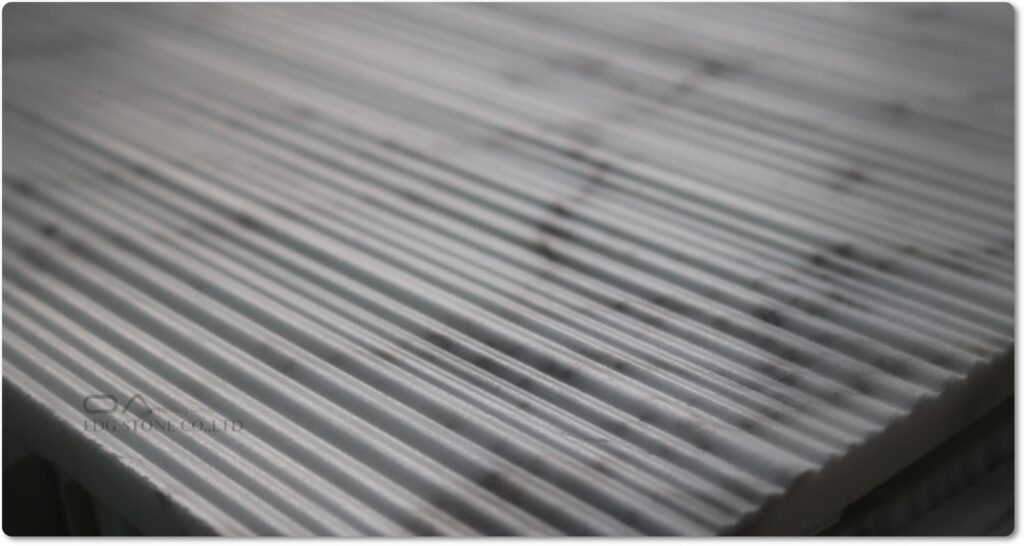
Brushed: Creates a textured surface through mechanical treatment.
Tumbled: Produces softened edges and an aged appearance, often used for traditional and rustic designs.
Leathered: Creates a textured finish with a distinctive tactile appearance.
Sandblasted: Produces a more textured surface, subject to the stone’s suitability and project requirements.
Different finishes may require different machinery, processing time, abrasives, and inspection procedures.
For exterior and wet-area applications, surface finish must also be assessed for slip resistance and suitability under the relevant local requirements. A finish name alone does not establish compliance.
6. Custom Cutting and Processing Costs
Standard marble tiles are generally easier to quote than customized stone products.
Custom manufacturing introduces additional processing steps, material consumption, and inspection requirements.
6.1 Common Custom Marble Tile Processing
EDG Stone’s natural stone manufacturing and fabrication scope can include:
Custom tile cutting.
Waterjet cutting.
CNC processing.
Edge profiling.
Chamfering.
Special dimensions.
Mosaic fabrication.
Pattern matching.
Bookmatching-related stone preparation.
Custom wall and flooring panels.
6.2 How Custom Processing Affects Price
The cost of custom processing depends on:
| Cost factor | Potential cost impact |
|---|---|
| Non-standard dimensions | Additional setup and cutting |
| Complex geometry | More processing time |
| Small production quantities | Higher setup cost per unit |
| Edge profiling | Additional machining |
| Waterjet cutting | Programming and cutting time |
| Mosaic patterns | Precision cutting and assembly |
| Tight tolerances | Additional calibration and inspection |
| Special packaging | More materials and handling |
For buyers placing bulk orders, combining standard sizes and minimizing unnecessary customization may improve manufacturing efficiency.
6.3 Material Yield and Cutting Optimization
One of the most overlooked factors in marble tiles pricing is material yield.
A factory does not convert every square meter of raw stone into an equal quantity of accepted finished tiles.
Some material may be lost through:
Saw kerf.
Edge trimming.
Natural cracks.
Vein-related selection.
Dimensional correction.
Surface defects.
Final quality rejection.
A good manufacturer evaluates the raw material and cutting layout before confirming a production quotation.
For large projects, ask the supplier to explain how the selected block or slab dimensions relate to the requested finished tile sizes.
7. Packaging and International Freight
Export packaging is an essential part of the total marble tiles price.
A low factory quotation can become expensive if the packaging is unsuitable for the product dimensions, shipment method, or handling conditions.
7.1 Export Packaging Requirements
Common packaging solutions include:
Fumigated wooden crates where required.
Compliant wooden pallets.
Protective foam.
Corner protection.
Moisture protection where appropriate.
Separators between finished surfaces.
Reinforced crate structures.
Clear product identification and shipping marks.
The packaging design should consider tile thickness, dimensions, surface finish, weight,t and loading orientation.
For international shipments using wood packaging, buyers should verify applicable ISPM 15 requirements and the destination country’s import rules.
7.2 Container Loading and Damage Prevention
Marble is heavy and can be vulnerable to impact, edge damage,ge and movement during transportation.
Exporters should evaluate:
Crate strength and structural stability.
Load distribution.
Container floor loading.
Securing and blocking arrangements.
Protection against movement.
Moisture and condensation risks.
Loading photographs and shipment records.
EDG Stone treats export packaging and container loading as important stages of order fulfillment, rather than treating packaging as an afterthought.
7.3 Freight Costs
International freight varies according to:
Origin and destination ports.
Shipping route.
Container type.
Cargo weight and dimensions.
Carrier availability.
Seasonal demand.
Fuel and surcharges.
Port and terminal charges.
Customs and destination handling.
A freight quotation should specify whether it includes origin handling, ocean freight, insurance, destination terminal charges,ges or inland delivery.
Buyers should not compare two CIF quotations unless the named destination port and insurance arrangements are equivalent.
8. Factory-Direct vs. Distributor Pricing
Choosing between a marble tiles factory and a local distributor is an important sourcing decision.
Each purchasing channel has advantages and limitations.
8.1 Buying from a Marble Tiles Manufacturer
Factory-direct procurement may provide:
Direct communication with production.
Greater control over material selection.
Custom dimensions and thickness options.
More transparent processing specifications.
Bulk-order production coordination.
Factory quality inspection.
Custom export packaging.
OEM and private-label opportunities, where supported.
However, factory-direct purchasing may require the buyer to manage international shipping, customs clearance, local inventory, and project coordination.
A factory-direct quotation should therefore be evaluated alongside the buyer’s operational capabilities.
8.2 Buying from a Wholesale Distributor
A distributor may provide:
Local inventory.
Smaller order quantities.
Faster local delivery.
Easier replacement purchasing.
Local customer service.
Established relationships with installers and contractors.
The distributor’s price may include warehousing, inventory financing, local transportation, showroom expenses,s and commercial margins.
These services can justify a higher price, particularly for buyers who need smaller quantities or immediate availability.
8.3 Supplier Price Comparison
| Evaluation factor | Factory-direct manufacturer | Wholesale distributor |
|---|---|---|
| Initial quotation | Potentially lower | Includes distribution costs |
| Custom production | Usually more flexible | Depends on factory relationship |
| Bulk orders | Often suitable | Depends on stock and supply network |
| Local inventory | Not always available | Often available |
| Small orders | Depends on factory policy | Often more convenient |
| Quality traceability | Request factory records | Request manufacturer documentation |
| International logistics | Buyer and supplier must agree responsibilities | Often already imported |
| Replacement supply | May require new production and shipping | Potentially faster if stock remains |
8.4 EDG Factory Direct Procurement
EDG Stone is a Chinese natural stone manufacturer and exporter serving international B2B buyers.
For marble tile procurement, buyers can discuss:
Natural marble material selection.
Standard and customized tile dimensions.
Surface finish specifications.
Project-based quantities.
Bulk purchasing arrangements.
Custom cutting and fabrication.
Quality inspection.
Export packaging and container loading.
EDG factory-direct procurement is intended to help buyers coordinate material sourcing, production specifications, and export arrangements through one manufacturing and supply relationship.
For importers and distributors, the purchasing objective should be to establish repeatable material specifications and a reliable supply process, rather than simply negotiate the lowest initial unit price.
9. EXW, FOB and CIF Price Comparison
Trade terms are essential when evaluating marble tiles price from international suppliers.
The same shipment may have significantly different quoted prices under EXW, FOB and CIF because each term allocates different costs and responsibilities.
The applicable Incoterms 2020 rules should be specified in the sales contract.
9.1 EXW: Ex Works
Under EXW, the seller makes the goods available at the agreed location.
The buyer generally arranges:
Collection from the factory.
Export and import formalities as applicable.
Main transportation.
Insurance if desired.
Destination handling.
Final delivery.
EXW can provide buyers with greater control over logistics arrangements, but it may be less convenient for overseas importers who cannot efficiently manage origin-country export procedures.
9.2 FOB: Free on Board
Under FOB, the seller delivers the goods on board the vessel nominated by the buyer at the named port of shipment.
The seller is responsible for the agreed origin-side obligations, including export clearance.
The buyer generally arranges and pays for the main ocean freight and destination-side costs.
FOB is commonly used in international containerized stone procurement, although FCA may be more appropriate for certain container shipments where delivery takes place at a terminal before loading onto the vessel.
9.3 CIF: Cost, Insurance and Freight
Under CIF, the seller arranges and pays for carriage and insurance to the named destination port.
However, the transfer of risk occurs when the goods are loaded on board the vessel at the port of shipment, not when they arrive at the destination.
This distinction is important.
A CIF price does not mean the supplier is responsible for every risk or expense until the container reaches the buyer’s warehouse.
9.4 EXW, FOB and CIF Comparison Table
| Cost or responsibility | EXW | FOB | CIF |
|---|---|---|---|
| Goods manufacturing | Seller | Seller | Seller |
| Factory availability | Seller | Seller | Seller |
| Origin collection | Buyer | Seller-arranged as agreed | Seller-arranged |
| Export clearance | Generally buyer | Seller | Seller |
| Delivery on board | Buyer responsibility | Seller | Seller |
| Main ocean freight | Buyer | Buyer | Seller |
| Marine insurance | Buyer if arranged | Buyer if arranged | Seller-arranged minimum cover under CIF |
| Destination import clearance | Buyer | Buyer | Buyer |
| Import duties and taxes | Buyer | Buyer | Buyer |
| Final inland delivery | Buyer | Buyer | Buyer |
The actual obligations should always be checked against the selected Incoterms rule and named place or port.
9.5 Which Quotation Should Marble Tile Importers Choose?
Choose EXW when the buyer has a capable origin-country logistics and export arrangement.
Choose FOB or FCA when the buyer wants more control over international freight but needs the supplier to handle the agreed export-side responsibilities.
Choose CIF when the buyer prefers the supplier to arrange the main carriage and insurance to the named destination port.
For a fair supplier comparison, ask all shortlisted factories to quote using the same trade term and named location.
10. Total Landed Cost and Import Budget
The landed cost is more important than the initial marble tile price when evaluating international procurement.
10.1 Landed Cost Formula
A practical formula is:
Total Landed Cost = Product Cost + Processing + Packaging + Origin Charges + International Freight + Insurance + Customs Duties + Import Taxes + Destination Charges + Inland Delivery
Additional costs may include:
Customs broker fees.
Port storage.
Demurrage and detention.
Inspection fees.
Currency conversion.
Financing costs.
Breakage and replacement.
Warehousing.
The buyer should define whether the calculation ends at the destination port, warehouse, or project site.
10.2 Import Duties and Customs Classification
Natural marble products must be classified according to their actual material, processing level, dimensions, and applicable customs tariff rules.
For example, the United States Harmonized Tariff Schedule includes heading 6802 for worked monumental or building stone and articles thereof.
Different subheadings distinguish products such as certain small mosaic cubes, simply cut or sawn stone and further-worked marble articles.
Therefore, buyers should not assume that every marble tile automatically uses the same tariff code.
The 2026 U.S. HTS should be checked for the exact product classification and applicable duty treatment. Additional trade measures may also affect the final import cost.
For shipments to other markets, buyers should check the relevant national customs tariff and import regulations.
10.3 Calculate Cost per Accepted Square Meter
For commercial procurement, the most useful cost metric is:
Cost per Accepted m² = Total Landed Cost ÷ Accepted Finished Tile Area
This is more meaningful than dividing the invoice value by the original order area when damaged or rejected material is present.
For example, if a shipment costs USD 24,500 and the buyer accepts 490 m² out of 500 m², the effective landed cost becomes:
USD 24,500 ÷ 490 = USD 50/m².
This calculation helps wholesalers and project contractors evaluate the real economic effect of material rejection and transport damage.
10.4 Build a Contingency into the Import Budget
Natural stone procurement should account for the possibility of breakage, replacement requirements, and future batch-matching difficulties.
The appropriate contingency depends on:
Material characteristics.
Tile dimensions.
Packaging design.
Shipment route.
Handling conditions.
Installation requirements.
Replacement lead time.
A universal percentage should not be assumed without project-specific evidence.
11. Technical Evaluation: Quality Standards and Inspection
A competitive mmarble tilesprice is meaningful only when the supplied material meets the agreed technical and visual specifications.
Professional buyers should establish a quality control process before production begins.
11.1 Material Testing and Standards
Useful references for natural stone procurement include:
ASTM C503/C503M – Standard Specification for Marble Dimension Stone
This standard addresses marble dimension stone and provides a technical reference for relevant material requirements. Its scope and applicable provisions should be checked against the actual product and intended use.
ASTM C97/C97M – Standard Test Methods for Absorption and Bulk Specific Gravity of Dimension Stone
This method provides information on water absorption and bulk specific gravity.
ASTM C99 – Standard Test Method for Modulus of Rupture of Dimension Stone
This method evaluates the modulus of rupture of dimension stone.
These references are not interchangeable with a complete tile product specification. Buyers must select the appropriate tests and acceptance criteria for their particular application.
The Natural Stone Institute provides a useful overview of ASTM dimension stone specifications and test standards.
11.2 EDG Stone Quality Inspection Process
For marble tile orders, a structured inspection process should include four main stages.
Stage 1: Raw Material Inspection
Before production, the factory should evaluate:
Material identity and origin information.
Block or slab appearance.
Color and vein characteristics.
Visible cracks and fissures.
Surface condition.
Suitability for the requested dimensions.
Material availability for the complete order.
The purpose is to reduce the risk of producing tiles from material that does not match the approved sample.
Stage 2: In-Process Inspection
During cutting and processing, inspectors should check:
Tile dimensions.
Thickness.
Cutting accuracy.
Edge condition.
Surface processing.
Flatness and warping.
Visible defects.
Consistency with the production specification.
Problems identified during production are generally easier to correct than problems discovered after export.
Stage 3: Finished Product Inspection
Before packaging, finished tiles should be checked against the agreed acceptance criteria.
Inspection items may include:
Length and width.
Thickness.
Diagonal dimensions where applicable.
Surface appearance.
Color variation.
Cracks and chips.
Finish consistency.
Quantity.
Batch identification.
Natural stone appearance should be evaluated under agreed viewing conditions using approved reference samples and, for large projects, batch photographs or physical inspections where appropriate.
Stage 4: Pre-Shipment Packaging Inspection
Before loading, the supplier should verify:
Crate condition.
Internal protection.
Product separation.
Packing quantity.
Labels and shipping marks.
Package weight where required.
Loading arrangement.
Container condition.
Loading photographs.
EDG Stone incorporates raw material checks, processing inspections, finished-product inspection,n and export packaging checks into its quality management approach for stone orders.
Buyers should request available inspection records and agree on the specific inspection scope in the purchase contract.
12. Supplier Evaluation: How to Choose a Marble Tiles Factory
A marble tiles manufacturer should be evaluated on more than the quoted unit price.
A supplier’s production capability, material sourcing, quality control, communication, and export experience can significantly influence the overall purchasing result.
12.1 Factory Qualification Checklist
| Evaluation item | Evidence to request |
|---|---|
| Business identity | Company registration and legal entity details |
| Manufacturing capability | Factory photographs, equipment and production videos |
| Material sourcing | Quarry, block or slab information where available |
| Product range | Marble varieties, dimensions and finishes |
| Processing capability | Cutting, calibration and surface finishing |
| Quality control | Inspection procedures and sample records |
| Testing | Relevant material test reports |
| Packaging | Crate specifications and packing photographs |
| Export experience | Shipping records or relevant references |
| Commercial terms | MOQ, payment terms and quotation validity |
| Production planning | Estimated lead time and capacity |
| After-sales support | Claims procedure and replacement policy |
12.2 Questions to Ask a Marble Tile Manufacturer
Before confirming an order, ask:
Are you the manufacturer, exporter,r or trading company?
Can you supply the same marble variety for repeat orders?
Can you provide photographs of the actual material?
What are your standard and custom tile dimensions?
How do you define your commercial material grades?
Can you provide inspection reports?
What is your minimum order quantity?
Can you accommodate mixed colors and dimensions?
What export packaging do you use?
Can you quote EXW, FOB, and CIF?
What is the estimated production lead time?
How are quality claims and transit damage handled?
12.3 Factory-Direct Procurement with EDG Stone
EDG Stone supports international B2B sourcing of natural stone products, including marble tiles and customized stone fabrication.
For wholesalers, distributors, contractors,ors and project buyers, the purchasing process can be organized around:
Material selection and sample approval.
Drawing and specification confirmation.
Quantity and production planning.
Raw material inspection.
Processing and dimensional checks.
Finished-product quality inspection.
Export packaging and container loading.
Shipment coordination.
This approach helps buyers establish a documented procurement process rather than relying on a single quotation or verbal quality commitment.
13. Procurement Checklist: Before Placing a Bulk Order
A complete purchase specification should be prepared before asking factories to submit their final quotations.
13.1 Material Information
Marble variety and commercial name.
Country or quarry origin, where confirmed.
Preferred background color.
Vein pattern and selection requirements.
Approved physical sample.
Acceptable natural variation.
13.2 Product Specifications
Length and width.
Thickness.
Surface finish.
Edge treatment.
Dimensional tolerances.
Flatness requirements.
Application: floor, wall, bathroom or other use.
Relevant technical requirements.
13.3 Quantity and Production
Total square meters.
Quantity per size.
Quantity per color.
Required spare material.
Production batch requirements.
Mixed-container requirements.
Sample approval deadline.
Delivery schedule.
13.4 Commercial Requirements
Currency.
Unit of measurement.
Unit price.
Total amount.
EXW, FCA, FOB or CIF.
Named place or port.
Payment terms.
Quotation validity.
MOQ.
Estimated lead time.
Export documentation.
13.5 Inspection and Packaging
Raw material inspection.
In-process inspection.
Final inspection.
Approved appearance sample.
Packaging specifications.
Wooden packaging compliance where applicable.
Loading photographs.
Damage and claims procedure.
Completing these details before production helps reduce specification changes, quotation misunderstandings, and avoidable procurement disputes.
14. Regulatory and Market Considerations for 2026
International stone procurement increasingly requires attention to product documentation, customs classification, traceability, and destination-market compliance.
14.1 European Construction Products Regulation
Regulation (EU) 2024/3110 revises the European Union’s Construction Products Regulation framework.
It entered into force on 7 January 2025, with its main application beginning on 8 January 2026. The transition and applicability of specific requirements depend on the relevant product families and harmonised technical specifications.
The revised framework addresses product performance information, environmental characteristics and digital information requirements.
However, buyers should not assume that every natural marble tile is automatically subject to the same documentation or CE-marking route. Applicability must be assessed against the product’s intended use and the relevant harmonised technical specifications.
14.2 U.S. Customs and Import Compliance
For U.S.-bound shipments, importers should verify:
Correct HTS classification.
Country of origin.
Applicable ordinary customs duties.
Additional trade measures.
Customs valuation.
Import documentation.
Any applicable regulatory requirements.
The tariff treatment of a natural stone product should be confirmed using the current official tariff schedule and professional customs advice.
14.3 Packaging Regulations
Wooden packaging used for international trade may be subject to ISPM 15 requirements.
Buyers should confirm that applicable wooden packaging is treated and marked in accordance with the importing country’s rules.
14.4 Procurement Trend: Greater Demand for Documented Quality
In 2026, professional buyers increasingly benefit from suppliers who can provide:
Actual material photographs.
Approved sample records.
Technical specifications.
Inspection documentation.
Traceable production batches.
Export packing records.
Clear product descriptions.
These records improve communication between manufacturers, importers, contractors, and project owners.
15. Practical RFQ Template: Request an Accurate Marble Tiles Quote
A professional RFQ should contain enough information for suppliers to quote comparable products.
The following template can be copied and sent to marble tiles manufacturers and wholesale suppliers.
Marble Tiles RFQ – 2026
A. Buyer Information
Company name:
Contact person:
Country:
Email:
Company website:
B. Product Information
Product: Natural Marble Tiles
Marble variety:
Country of origin preference:
Color:
Material grade or visual selection:
Application: Flooring / Wall / Bathroom / Commercial / Other
Surface finish: Polished / Honed / Brushed / Tumbled / Other
C. Dimensions
Tile size:
Thickness:
Edge treatment:
Dimensional tolerance:
Custom cutting requirements:
D. Quantity
Total quantity (m²):
Quantity per size:
Quantity per color:
Initial order or repeat order:
Estimated annual purchasing volume:
E. Quality Requirements
Approved reference sample:
Color variation tolerance:
Vein selection:
Crack and fissure acceptance:
Surface quality:
Inspection requirements:
Testing requirements:
F. Packaging and Shipping
Packaging requirements:
Wooden crates or pallets:
Destination port:
Final delivery address, if required:
Preferred Incoterm:
Container or shipment requirements:
G. Commercial Information
Requested quotation currency:
EXW price:
FOB price:
CIF price:
MOQ:
Production lead time:
Sample availability:
Payment terms:
Quotation validity:
H. Supporting Documents
Material photographs.
Production photographs.
Technical specifications.
Relevant test reports.
Inspection records.
Packaging photographs.
Company and factory information.
How EDG Stone Can Support Your RFQ
EDG Stone welcomes inquiries from marble tile importers, wholesalers, distributors, contractors,s and commercial project buyers.
To prepare a meaningful quotation, send the required material, dimensions, thickness, finish, quantity, ty and destination information.
For customized projects, include drawings, reference photographs, PDFs, or sample requirements.
A complete RFQ allows the manufacturing team to evaluate material availability, cutting yield, processing requirements, packaging and shipment arrangements before confirming the commercial offer.
16. Frequently Asked Questions: Marble Tiles Price 2026
FAQ 1: How much do marble tiles cost in 2026?
Marble tiles do not have one universal 2026 price. Cost depends on stone variety, origin, material selection, tile dimensions, thickness, surface finish, quantity, processing, sing and shipping terms. Buyers should request a specification-based quotation rather than relying on a generic online price.
FAQ 2: What is the price difference between natural marble and marble-look porcelain tiles?
Natural marble pricing depends on quarry material, block quality, processing yield, and visual selection. Marble-look porcelain pricing depends on its ceramic body, manufacturing technology, printing, surface finish,s and brand. The two materials should be evaluated separately.
FAQ 3: Are large marble tiles more expensive than standard marble tiles?
Large marble tiles can require larger sound sections of material, more careful handling, and stronger packaging. However, their unit-area price also depends on cutting yield, raw material dimensions,s and production efficiency. They are not automatically more expensive per square meter in every case.
FAQ 4: Is it cheaper to buy marble tiles directly from a factory?
Factory-direct procurement may reduce intermediary costs and provide greater control over specifications, customization, and bulk production. However, buyers must also consider international freight, customs, local handling, inspection,n and inventory management. The correct comparison is total landed cost.
FAQ 5: What information should I provide to get an accurate marble tiles quotation?
Provide the marble variety, material selection, tile dimensions, thickness, surface finish, quantity, application, packaging requirements, destination port, and preferred Incoterm. Reference photographs or physical samples are also useful for confirming visual expectations.
17. References and Technical Resources
The following authoritative resources provide a foundation for technical evaluation, customs classification, and regulatory research.
ASTM International – ASTM C503/C503M: Standard Specification for Marble Dimension Stone.
ASTM International – ASTM C97/C97M: Standard Test Methods for Absorption and Bulk Specific Gravity of Dimension Stone.
ASTM International – ASTM C99: Standard Test Method for Modulus of Rupture of Dimension Stone.
Natural Stone Institute – ASTM International Standards: https://www.naturalstoneinstitute.org/stoneprofessionals/astm/
European Commission – Construction Products Regulation Overview: https://single-market-economy.ec.europa.eu/sectors/construction/construction-products/cpr-overview_en
Regulation (EU) 2024/3110: https://eur-lex.europa.eu/eli/reg/2024/3110/oj/eng
United States International Trade Commission – Harmonized Tariff Schedule: https://hts.usitc.gov/
ICC – Incoterms 2020: International Chamber of Commerce rules governing the use of domestic and international trade terms.
IPPC – ISPM 15: International standards governing wood packaging material in international trade.
Technical note: Standards, regulatory provisions and customs classifications must be checked against the current edition, product scope and destination-market requirements before they are incorporated into a purchase contract.
18. EDG Stone CTA: Get a Factory-Direct Marble Tiles Quotation
Source Marble Tiles Directly from a Chinese Stone Manufacturer
Choosing the right marble tiles supplier is about more than finding the lowest price.
Importers, wholesale distributors, building material suppliers, and commercial project buyers need a manufacturer that understands material selection, production specifications, quality inspection, packaging, and international shipment requirements.
EDG Stone is a professional Chinese natural stone manufacturer and exporter supplying marble, granite, quartzite, and other natural stone products for international markets.
Our marble procurement and fabrication capabilities support:
Natural marble tiles in different colors and varieties.
Standard and customized tile dimensions.
Polished, honed, and other requested surface finishes.
Custom stone cutting and fabrication.
Bulk and project-based procurement.
Raw material inspection.
In-process production inspection.
Finished-product inspection.
Export packaging and container loading.
Request Your 2026 Marble Tiles Factory Quote
Send EDG Stone your product specifications, material preferences, dimensions, quantities, and destination information.
Our team can evaluate the sourcing and processing requirements and prepare a quotation based on the requested commercial terms.
For importers and distributors: Discuss factory-direct purchasing and wholesale supply arrangements.
For contractors and developers: Submit project quantities, drawings, and technical specifications.
For OEM/ODM buyers: Discuss customized product specifications and manufacturing coordination.
Contact EDG Stone for a Marble Tiles RFQ and Factory-Direct Quotation.
Website: https://www.edgstone.com/
Marble Tiles Price 2026: Procurement Insights, Cost Drivers and Factory Sourcing Strategies
The price of marble tiles is determined by the relationship between natural stone availability, material selection, processing efficiency, product specifications, and international supply chain costs. In 2026, professional buyers should evaluate marble tiles through a complete procurement model rather than comparing isolated supplier quotations.
What Determines the Real Price of Marble Tiles?
The primary pricing variables include marble variety, quarry origin, block quality, visual selection, thickness, tile dimensions, surface finish, cutting yield, processing requirements, and order quantity. Export packaging, freight, insurance,e and destination import costs further influence the final purchase price.
Why Can Two Marble Tiles with Identical Dimensions Have Different Prices?
Identical dimensions do not necessarily indicate identical material value. Natural marble varies in background color, mineral composition, vein characteristics, geological structure, re and available production yield. Premium visual selection may require additional sorting and material inspection, increasing the manufacturing cost.
Which Purchasing Option Is More Suitable for Different Buyers?
Retail customers may benefit from local distributors offering immediate inventory and smaller quantities. Importers and wholesalers may prefer direct factory procurement for bulk purchasing, customized specifications,s and production coordination. Contractors and developers should prioritize approved samples, dimensional consistency, documented inspection and delivery schedules.
How Should Buyers Compare EXW, FOB and CIF Marble Tile Prices?
EXW, FOB and CIF represent different allocations of costs, responsibilities and risk. A lower EXW quotation does not necessarily represent a lower delivered cost. Buyers should normalize quotations by adding applicable origin charges, freight, insurance, customs duties, destination expenses, es and inland transportation.
What Should a Professional Marble Tiles Factory Provide?
A qualified manufacturer should provide clear material identification, product specifications, actual material photographs, sample approval, production inspection, finished-product inspection, packaging specifications, and shipment documentation. These records help buyers establish accountability throughout the supply chain.
How Is Marble Tile Procurement Evolving in 2026?
International procurement increasingly emphasizes product traceability, documented quality, transparent customs classification, responsible packaging, ing and destination-market compliance. Buyers sourcing natural stone internationally should evaluate technical documentation and regulatory applicability before confirming production.
Why Consider EDG Stone Factory-Direct Procurement?
EDG Stone connects natural stone sourcing with manufacturing, customized cutting, quality inspection,tion and export packaging. For international importers, distributors, contractors, and project buyers, this integrated approach provides a practical framework for evaluating marble tile specifications, quantities, ities and international shipment requirements.
Final Procurement Insight
The best marble tiles purchasing decision is not necessarily the supplier offering the lowest initial price. It is the combination of suitable material selection, acceptable finished-product quality, efficient manufacturing, reliable packaging, and competitive total landed cost. A specification-based RFQ is the most effective starting point for comparing marble tile manufacturers and international wholesale suppliers.