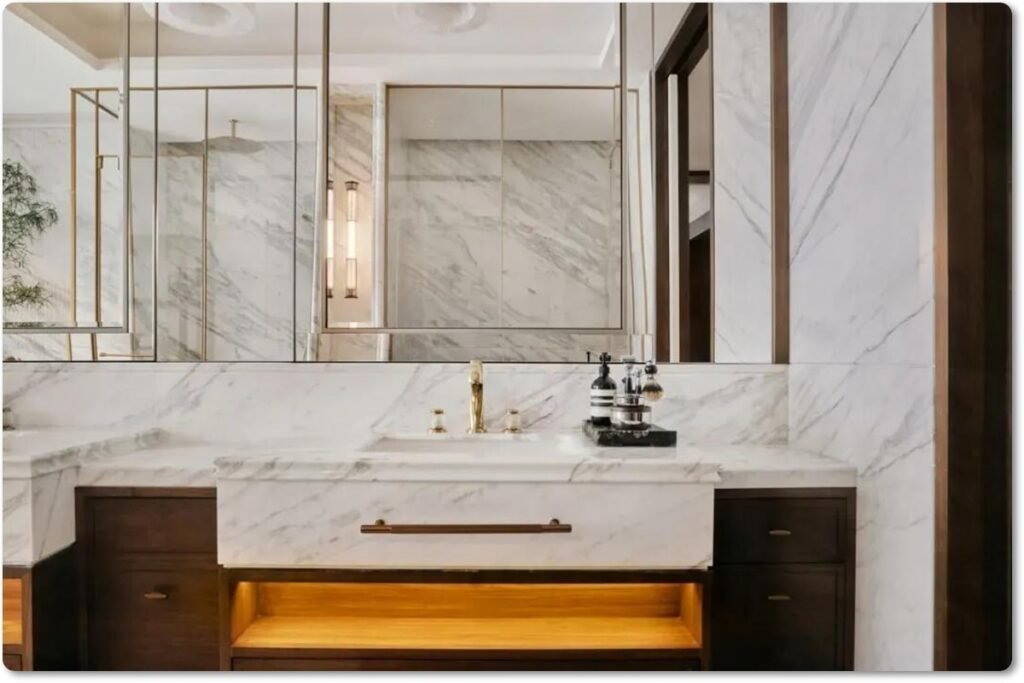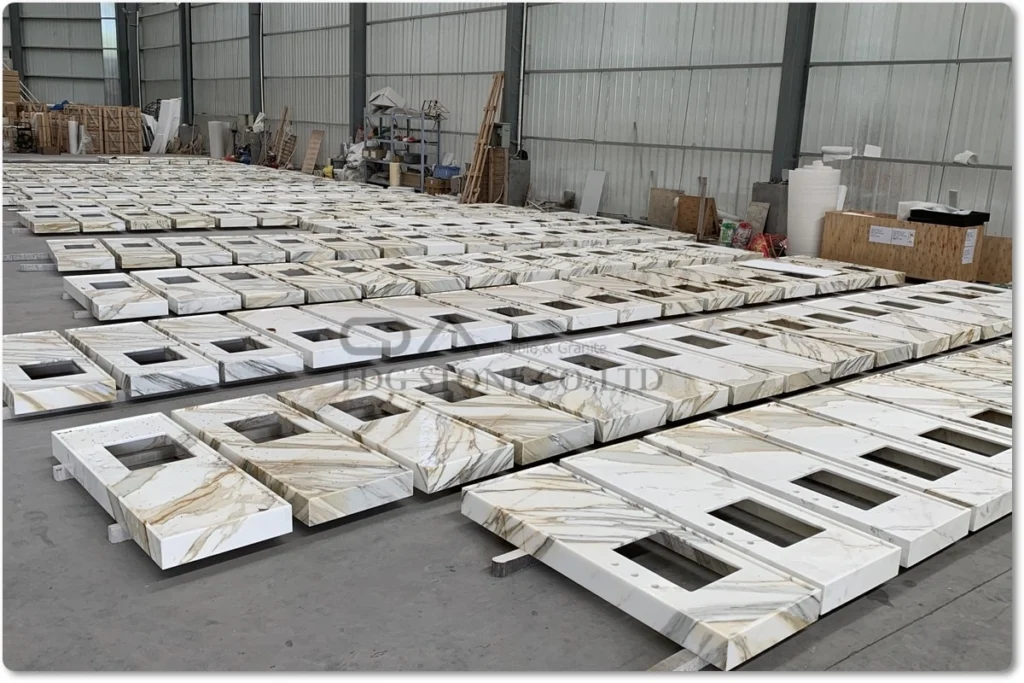
Executive Summary: Choosing the Right Marble Tiles for Bathroom Projects
Marble tiles for bathrooms offer natural veining, distinctive mineral patterns, and a premium architectural appearance for shower walls, bathroom floors, vanity surrounds, and luxury wet-area interiors. Successful bathroom marble selection requires more than choosing a color. Buyers must evaluate water absorption, surface finish, slip resistance, dimensional tolerances, chemical sensitivity, sealing requirements, and installation compatibility. Honed and appropriately textured finishes are often preferable to highly polished surfaces on floors, while shower walls provide greater flexibility in finish selection. White marble tiles, green marble tiles, and marble mosaics remain versatile design options. For hotels and commercial developments, material approval, batch consistency, mock-up testing, installation specifications, and documented factory quality control should be established before bulk production.
Marble has remained one of the most recognizable natural materials in luxury bathroom architecture. From white marble shower walls and bookmatched feature panels to green marble bathroom floors and custom mosaic shower bases, natural marble creates visual depth that manufactured surface materials cannot reproduce in the same way.
However, a bathroom is a technically demanding environment. Unlike decorative wall cladding in dry interiors, bathroom marble must perform under repeated water exposure, cleaning chemicals, temperature changes, soap residues, and mechanical wear. Shower floors also introduce additional safety considerations because users walk across wet surfaces, often without footwear.
For residential renovation companies, hotel developers and professional stone buyers, the correct procurement decision is therefore not simply which marble looks most attractive. It is which material, finish, thickness, fabrication method and installation system are appropriate for the intended application.
This guide examines the selection, specification, manufacturing, inspection and procurement of marble bathroom tiles. It also explains how a professional marble tiles manufacturer and factory such as EDG Stone can support coordinated bathroom packages, including wall tiles, floor tiles, mosaics, vanity tops, bathtubs and custom stone accessories.
Key procurement conclusion: Marble can be an excellent bathroom material when its geological characteristics, surface treatment, installation system, and maintenance requirements are evaluated together. No single marble variety or finish is automatically suitable for every wet-area application.

1. Scope and Definitions: What Are Marble Tiles for Bathrooms?
Bathroom marble tiles are dimensionally processed natural stone products manufactured from marble blocks or slabs and supplied in standardized or project-specific formats.
They can be used for:
Bathroom wall cladding and decorative feature walls.
Shower enclosures and shower walls.
Main bathroom floors and separate shower floors.
Bathtub surrounds and tub decks.
Vanity backsplashes and countertop surrounds.
Shower niches, shelves and thresholds.
Mosaic floors, decorative borders and architectural details.
Luxury hotel bathrooms and residential spa environments.
1.1 Natural Marble vs. Marble-Look Tiles
The term marble bathroom tiles can describe different product categories. Buyers should distinguish natural marble from ceramic or porcelain products that imitate marble patterns.
| Product category | Material composition | Main characteristics |
|---|---|---|
| Natural marble tiles | Geological metamorphic carbonate stone | Genuine mineral structure, natural veining and geological variation |
| Porcelain marble-look tiles | Fired ceramic material | Manufactured pattern, generally low water absorption when properly classified |
| Ceramic marble-look tiles | Fired clay-based material | Wide decorative selection; technical properties depend on product classification |
| Engineered stone | Manufactured composite | Composition and suitability depend on resin, mineral content, and product formulation |
Natural marble should not be specified using the same technical assumptions as porcelain. Their absorption, chemical resistance, maintenance, and installation requirements differ.
For example, porcelain products classified under the relevant ANSI/ISO standards may have very low water absorption, whereas natural marble must be evaluated based on its own physical properties.
1.2 Understanding Bathroom Application Zones
Divide a bathroom into application zones before ordering marble.
Zone A: Dry or occasionally splashed areas
Examples include vanity backsplashes, decorative walls, and areas outside direct shower exposure.
Zone B: Regularly wet areas
Examples include shower walls, bathtub surrounds, and bathroom floors exposed to routine water.
Zone C: Continuously or frequently wet areas
Examples include shower floors, steam-room environments and wet-room floors.
Zone D: High-use commercial bathrooms
Examples include hotel bathrooms, resort bathrooms, multifamily developments, and public facilities.
The application zone influences the required surface finish, installation details, drainage design, maintenance schedule, and product acceptance criteria.
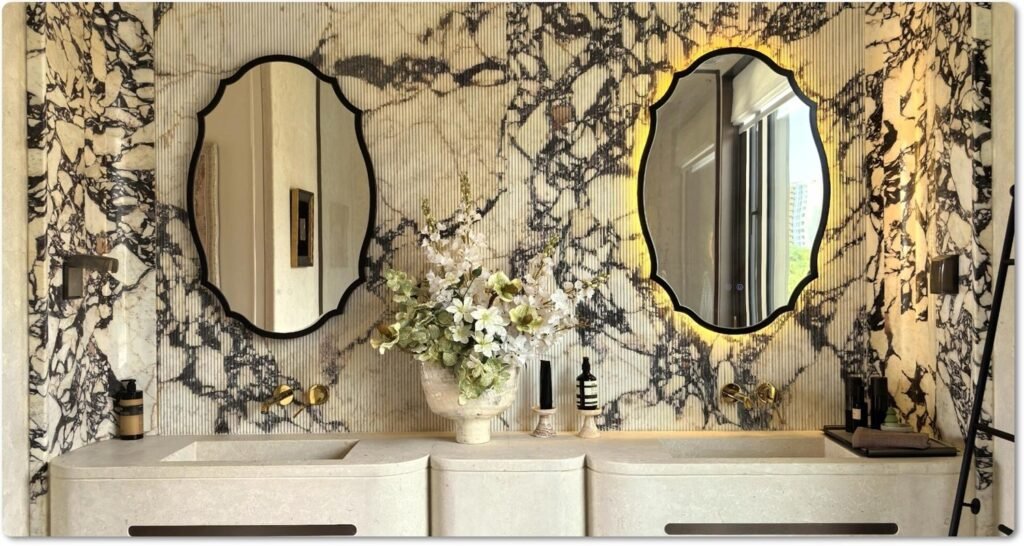
2. Technical Evaluation: Best Marble Tiles for Bathroom Walls
Bathroom walls provide opportunities to use marble more extensively because they generally experience less direct mechanical wear than floors.
The right selection depends on color, veining, format, finish, moisture exposure, and the overall design concept.
2.1 White Marble Tiles: A Timeless Bathroom Material
White marble tiles remain among the most recognizable choices for luxury bathroom interiors.
Popular options include:
Carrara White Marble.
Calacatta White Marble.
Statuario White Marble.
Volakas White Marble.
Thassos White Marble.
Arabescato White Marble.
Bianco Lasa Marble.
Each variety offers a different relationship between background color, mineral veining, pattern density, and visual contrast.
White marble, for example, should not be evaluated solely by its commercial name. Buyers should request actual production photographs, representative samples, and batch-specific images because natural stone varies between blocks and quarry selections.
For hotel bathrooms, white marble can create a consistent visual language across guest rooms, lobby washrooms and premium suites. However, the approved sample should represent the actual commercial grade and acceptable variation range.
Recommended applications
Shower feature walls.
Full-height bathroom walls.
Vanity backsplashes.
Bathtub surrounds.
Bookmatched wall panels.
Decorative borders and niches.
Procurement consideration: White marble can reveal staining, rust discoloration, resin repairs, and water-related changes more visibly than some darker materials. Establish explicit inspection and maintenance requirements before bulk approval.
2.2 Green Marble Tiles: A Distinctive Luxury Design Direction
Green marble tiles are increasingly useful for projects seeking a more distinctive alternative to conventional white and grey bathroom palettes.
Potential material selections include:
Verde Guatemala.
Verde Alpi.
Rainforest Green.
Green Serpentine varieties.
Other commercially available green natural marble selections.
Green marble is particularly suitable for statement walls, vanity surrounds, decorative shower niches, and coordinated bathroom furniture.
The geological classification of green stone must be checked carefully. Some commercially marketed green marbles contain significant serpentine minerals or belong to other geological stone categories. The trade name alone does not establish mineral composition or performance.
Before procurement, buyers should request material identification, relevant physical test data, and confirmation of the intended finish.
2.3 Grey, Beige and Dark Marble Bathroom Walls
Grey marble provides a restrained architectural appearance, while beige and cream marble can create warmer residential and hospitality interiors.
Black and dark marble can be used for dramatic feature walls, but dark polished surfaces may reveal soap residues, mineral deposits, scratches, and water spots more clearly.
For coordinated bathroom collections, consider:
White marble for primary wall surfaces.
Grey marble for floors and secondary walls.
Green marble for feature applications.
Beige marble for warm contemporary interiors.
Black marble for selected architectural accents.
2.4 Marble Tile Sizes and Wall Layouts
Common bathroom wall formats include:
| Tile format | Typical application |
|---|---|
| 300 × 300 mm | Small bathrooms and decorative layouts |
| 300 × 600 mm | Shower walls and standard bathroom walls |
| 600 × 600 mm | Contemporary wall and floor coordination |
| 600 × 1200 mm | Large-format luxury wall applications |
| Custom cut-to-size | Hotel projects, niches and architectural detailing |
| Slab panels | Bookmatched feature walls and reduced grout-joint designs |
These are commonly traded formats, not universal mandatory dimensions. Actual availability depends on the stone block, slab yield, cutting direction, and factory production capability.
Large-format marble reduces the number of grout joints but increases handling weight, substrate preparation requirements, lifting complexity, and installation skill requirements.
3. Marble Bathroom Floor Selection
Bathroom flooring requires more careful technical evaluation than decorative wall cladding.
A marble floor must accommodate foot traffic, water exposure, cleaning, potential impact, and the friction characteristics of the installed surface.
3.1 Choosing Marble for Main Bathroom Floors
A suitable bathroom floor material should be evaluated for:
Water absorption.
Surface hardness and wear characteristics.
Resistance to scratching and abrasion.
Finish compatibility with wet use.
Chemical sensitivity.
Dimensional accuracy.
Expected maintenance frequency.
No marble should be approved for bathroom flooring based on appearance alone.
A stone with beautiful veining may have characteristics that make it less practical for a frequently used bathroom than another material with more favorable physical properties.
3.2 Honed vs. Polished Marble Bathroom Tiles
Surface finish is one of the most important decisions in marble bathroom procurement.
Polished marble
Polishing creates a reflective surface that enhances color contrast and mineral veining.
Advantages:
High-end appearance.
Strong visual depth.
Smooth surface that can be easier to wipe.
Suitable for many wall applications.
Limitations:
Can become slippery when wet.
Water spots and soap deposits can remain visible.
Acidic substances can etch calcite-rich marble.
Surface scratches may affect appearance.
Honed marble
Honing produces a matte or low-sheen surface.
Advantages:
More understated architectural appearance.
Less reflective.
Often preferred for bathroom floors.
Can make minor surface marks less visually prominent.
Limitations:
Some porous or textured honed surfaces may retain residues.
Honed does not automatically mean slip-resistant.
Maintenance and sealing requirements remain material-dependent.
Tumbled or textured marble
Tumbled and mechanically textured finishes can provide additional surface texture and a more traditional aesthetic.
Advantages:
Suitable for selected mosaic and traditional bathroom designs.
Can provide a tactile surface.
May be appropriate for specific shower-floor applications when tested.
Limitations:
Texture does not independently establish compliance with a slip-resistance requirement.
Deep surface irregularities can retain dirt and soap residues.
Cleaning can be more demanding.
Important: Neither honed nor polished marble is automatically safe or unsafe in every wet condition. Slip resistance must be evaluated using the actual tile finish and a relevant test method for the intended application.
3.3 Large-Format vs. Small-Format Bathroom Floor Tiles
Large-format marble tiles create a clean, contemporary appearance and reduce the number of grout joints.
However, shower floors frequently require sloped surfaces leading to drainage points. Smaller tiles and mosaics can accommodate changes in slope more easily because they have more individual joints and smaller units.
For this reason:
Large-format marble can be appropriate for many main bathroom floors.
Smaller tiles may be more practical for conventional shower-floor slopes.
Mosaic sheets can accommodate complex shower geometry.
Drainage layout and tile geometry should be coordinated before production.
A large-format tile should never be assumed suitable for a shower floor merely because it is visually consistent with the bathroom wall.

4. Shower Walls and Wet-Area Installation
Marble shower walls create a premium appearance in residential bathrooms, hotel suites, and spa environments. Nevertheless, natural stone is only one component of a complete waterproofing system.
4.1 Marble Tiles Do Not Replace Waterproofing
One of the most important technical principles in bathroom construction is that marble tiles are not the primary waterproofing layer.
Water can pass through grout joints, tile interfaces, and other parts of an installed assembly.
A properly designed shower assembly generally includes:
A structurally suitable substrate.
A compatible waterproofing membrane or approved waterproof enclosure system.
Correctly treated joints, penetrations, and corners.
A compatible tile-setting mortar.
Properly installed marble tiles.
Appropriate grout and movement joints.
Correct drainage and slope design.
The waterproofing method must follow the applicable building code, product manufacturer’s instructions, and recognized installation standards.
In the United States, the ANSI A118 family covers relevant tile installation materials and systems. ANSI A108 and the Tile Council of North America (TCNA) Handbook provide important installation references.
Natural marble installation also requires consideration of stone-specific mortar compatibility, particularly for moisture-sensitive or resin-treated products.
4.2 Choosing Adhesives for Marble Shower Walls
Not every tile adhesive is suitable for every natural stone.
Factors to evaluate include:
Marble color and mineral composition.
Tile thickness and dimensions.
Whether the back surface has resin or mesh reinforcement.
Moisture sensitivity.
Vertical installation requirements.
Substrate type.
Waterproofing membrane compatibility.
Manufacturer-approved mortar classification.
For white and light-colored marble, a compatible white mortar is commonly considered to reduce the risk of visible discoloration or shadowing.
However, the final adhesive specification must be confirmed through the stone and installation-product manufacturers.
4.3 Marble Shower Niches and Architectural Details
Shower niches are frequently used to create storage and design continuity.
Recommended procurement considerations include:
Matching niche back panels with surrounding wall material.
Factory-fabricated shelves with suitable drainage details.
Accurate internal corner dimensions.
Edge polishing or other specified finishing.
Water-management details around penetrations.
Consistent veining direction where visual continuity is required.
EDG Stone can coordinate marble wall tiles, niche panels, shelves, thresholds and vanity components within one custom fabrication package, subject to approved drawings and material availability.
5. Slip Resistance: How to Specify Safe Marble Bathroom Floors
Slip resistance is a critical consideration in bathroom design, particularly in shower areas, hotels, and other commercial environments.
A surface that appears rough may still perform poorly under certain wet conditions. Conversely, the slip performance of a particular stone finish cannot be inferred reliably from its appearance.
5.1 Common Slip-Resistance Test Methods
Relevant standards and methods include:
ANSI A326.3
This standard addresses the measurement of dynamic coefficient of friction (DCOF) for hard-surface flooring materials.
The commonly referenced wet DCOF value of 0.42 is associated with particular interior flooring applications under the ANSI A326.3 framework.
It must not be treated as a universal safety guarantee or as a blanket requirement for every natural stone shower floor.
ASTM E303
This method measures surface friction using a British Pendulum Tester. It is used in relevant flooring and pedestrian-surface evaluations.
DIN EN 16165
This European standard covers methods for determining slip resistance of pedestrian surfaces, including applicable test approaches.
The applicable method depends on the jurisdiction, product category, project specification, and actual installed conditions.
5.2 What Should Hotel Buyers Request?
For hotel bathrooms and commercial projects, buyers should request:
The applicable slip-resistance specification.
The test method and edition.
Identification of the tested material.
Confirmation of the tested surface finish.
Test conditions and results.
Confirmation that the sample represents the supplied product.
A result obtained from a polished sample should not automatically be applied to a honed, brushed, or textured production finish.
5.3 Is Honed Marble Better for Shower Floors?
Honed marble is often considered for shower floors because it has a lower sheen than polished marble.
However, finish alone does not establish safe performance.
For shower floors, the project team should evaluate:
Actual wet slip-test results.
Tile dimensions.
Grout-joint configuration.
Surface texture.
Soap and cleaning-product residues.
Drainage and slope.
Expected user conditions.
Where appropriate, small-format marble mosaics can provide more grout joints and greater flexibility for sloped surfaces. This does not eliminate the need for slip-resistance evaluation.

6. Water Absorption, Sealing and Chemical Compatibility
Natural marble is a geological material with mineral grains, pores, and possible microfractures. Its performance varies according to its composition, geological formation, processing, and treatment.
6.1 Understanding Water Absorption
Water absorption is an important physical characteristic when selecting marble for bathroom applications.
ASTM C97/C97M provides test methods for absorption and bulk specific gravity of dimension stone.
A lower absorption result may indicate less water uptake under the specified laboratory test conditions, but it does not independently prove that a marble is waterproof or suitable for every wet-area application.
Buyers should request representative test reports for the actual material.
6.2 Does Bathroom Marble Need Sealing?
Many marble products benefit from an appropriate penetrating sealer, depending on the material and intended application.
A sealer can help reduce the penetration of certain staining substances, but it does not:
Make marble completely waterproof.
Prevent all staining.
Stop acid etching.
Eliminate the need for cleaning.
Replace shower waterproofing.
Guarantee slip resistance.
The correct sealer must be compatible with the stone, finish, adhesive and grout system.
6.3 How Often Should Marble Bathroom Tiles Be Sealed?
There is no scientifically reliable universal interval for every marble bathroom.
The maintenance interval depends on:
Stone absorption.
Surface finish.
Sealer chemistry.
Water exposure.
Cleaning products.
Traffic intensity.
Installation quality.
A practical maintenance program should use the sealer manufacturer’s instructions and periodic field evaluation rather than an arbitrary annual schedule.
6.4 Acid Sensitivity and Cleaning Chemicals
Calcite-rich marble can react with acidic substances.
Common sources of potential damage include:
Vinegar-based cleaners.
Lemon-based cleaning products.
Acidic bathroom descalers.
Some toilet and limescale cleaners.
Acidic cosmetic products.
Certain aggressive detergents.
Acid exposure can produce etching, which is a chemical alteration of the stone surface rather than ordinary dirt.
Use cleaning products specifically approved for natural marble.
For hotel procurement, the housekeeping department should approve the cleaning protocol before the stone is selected for a large-scale project.
7. Mold, Staining and Maintenance Risks
Marble bathroom maintenance involves both stone protection and management of the complete bathroom environment.
7.1 Why Can Marble Bathroom Tiles Develop Stains?
Potential staining mechanisms include:
| Risk | Possible cause | Preventive consideration |
|---|---|---|
| Rust staining | Iron-bearing minerals or external contamination | Material inspection and appropriate stone-care products |
| Organic staining | Cosmetics, oils and personal-care products | Prompt cleaning and suitable sealing |
| Mineral deposits | Hard-water residues | Regular non-acidic cleaning |
| Darkening | Moisture retention or water ingress | Correct installation and drying conditions |
| Yellowing | Material characteristics, contamination, or incompatible treatments | Test samples and supplier verification |
| Etching | Acidic cleaning products | Neutral-pH stone-safe maintenance |
7.2 Mold and Mildew: Is Marble the Cause?
Marble itself is not necessarily the source of mold.
Mold and mildew commonly develop where moisture, organic residues and inadequate ventilation create favorable conditions.
Potential locations include:
Silicone joints.
Grout joints.
Shower corners.
Behind poorly sealed fixtures.
Areas with standing water.
Insufficiently ventilated bathrooms.
Prevention requires proper ventilation, waterproofing, drainage, regular cleaning, and maintenance of joints.
7.3 Recommended Hotel Bathroom Maintenance Procedures
For hotel operations, establish a written standard operating procedure covering:
Daily removal of soap and cosmetic residues.
Use of stone-compatible cleaning products.
Prompt removal of standing water where practical.
Inspection of grout and sealant joints.
Monitoring of drainage performance.
Periodic assessment of surface staining and etching.
Documented maintenance and repair records.
A material that looks exceptional at handover but requires an unrealistic maintenance program may not be the best choice for a high-occupancy hotel.

8. Marble Mosaic Tiles for Shower Floors and Decorative Areas
Marble mosaics offer design flexibility and are widely used in shower floors, decorative borders, shower niches, and feature surfaces.
8.1 Popular Marble Mosaic Patterns
Common patterns include:
Hexagon mosaics.
Herringbone mosaics.
Basketweave mosaics.
Square mosaics.
Penny-round mosaics.
Chevron mosaics.
Linear strip mosaics.
Waterjet-cut decorative mosaics.
8.2 Why Are Small Marble Mosaics Used in Shower Floors?
Smaller tile units can accommodate sloping surfaces more easily than large rectangular tiles.
They also provide more grout joints, which can influence the behavior of the finished flooring assembly.
Nevertheless, buyers must understand that grout joints do not automatically guarantee adequate slip resistance.
The entire installed system must be assessed.
8.3 Marble Mosaic Manufacturing and Quality Inspection
A professional marble mosaic factory should control:
Raw material selection
Consistent color family.
Suitable slab or block selection.
Evaluation of visible cracks and mineral variations.
Cutting and processing
Accurate individual piece dimensions.
Consistent thickness.
Clean cutting edges.
Appropriate surface finish.
Mesh mounting
Stable sheet construction.
Compatible mesh and adhesive.
Accurate spacing.
Consistent sheet dimensions.
Finished product inspection
Visual consistency.
Missing pieces.
Bonding quality.
Sheet flatness.
Packaging integrity.
For larger hotel projects, buyers should approve a complete mosaic sheet rather than relying exclusively on individual loose samples.
9. Marble Vanity Tops, Bathtubs and Coordinated Bathroom Accessories
A luxury bathroom should be evaluated as an integrated material package rather than a collection of unrelated surfaces.
EDG Stone can support coordinated natural stone products, subject to material availability, approved drawings, and production specifications.
9.1 Marble Vanity Tops
Marble vanity tops are frequently used in premium residential and hospitality interiors.
Important fabrication considerations include:
Finished dimensions.
Slab thickness.
Sink cutout dimensions.
Faucet-hole locations.
Edge profiles.
Backsplash dimensions.
Support requirements.
Surface finish.
Sealing and maintenance instructions.
For multi-room hotel projects, vanity tops should be controlled through approved CAD drawings, templates, and first-article inspection.
9.2 Marble Bathtubs and Custom Stone Components
Natural stone bathtubs and bathtub surrounds create a distinctive luxury appearance.
However, fabrication and installation are more demanding than ordinary tile production.
The project must account for:
Overall dimensions.
Internal bathing geometry.
Stone thickness.
Finished weight.
Structural support.
Drainage and plumbing.
Joint detailing.
Transportation and lifting.
Installation access.
A custom marble bathtub should never be approved on visual appearance alone. Engineering and installation coordination are essential.
9.3 Coordinated Bathroom Product Packages
A coordinated procurement package may include:
| Product | Procurement specification |
|---|---|
| Bathroom wall tiles | Material, dimensions, finish, thickness |
| Bathroom floor tiles | Material, finish, slip criteria and dimensions |
| Shower mosaics | Pattern, sheet size, thickness and mounting |
| Vanity tops | Drawings, sink cutouts and edge profiles |
| Bathtub surrounds | Dimensions, support and edge detailing |
| Stone bathtubs | Engineering, weight, plumbing and installation |
| Shower niches | Internal dimensions and shelf detailing |
| Accessories | Product drawings, finish and packaging |
Coordinated sourcing can simplify color management, drawing control and shipment planning.
10. Hotel Bathroom Procurement Specifications
Hotel bathroom procurement requires more formal documentation than most individual residential purchases.
The procurement team should define technical, aesthetic, and operational acceptance criteria before placing a production order.
10.1 Recommended Procurement Specification Table
| Specification | Required buyer information |
|---|---|
| Stone identification | Commercial name and geological identification where available |
| Origin | Country, quarry or supplier-declared source |
| Product application | Wall, floor, shower wall, shower floor or vanity |
| Dimensions | Length × width × thickness |
| Dimensional tolerance | Project-defined acceptance limits |
| Surface finish | Polished, honed, brushed, tumbled or other |
| Water absorption | Applicable test method and results |
| Density | Applicable laboratory results |
| Flexural strength | Where relevant to the application |
| Slip resistance | Applicable method and acceptance criteria |
| Visual variation | Approved range and reference samples |
| Repairs | Disclosure and acceptance requirements |
| Sealer | Product compatibility and maintenance instructions |
| Packaging | Crate, protection, labeling and pallet requirements |
10.2 Batch Consistency and Slab Selection
Natural marble is not a factory-colored synthetic material.
Its background color, veins, mineral inclusions, and pattern distribution may vary from block to block.
For hotel projects, buyers should request:
Actual production batch photographs.
Slab selection records where available.
Approved reference samples.
Color and veining acceptance ranges.
Bookmatching instructions where applicable.
Room-by-room or area-by-area material allocation.
If the project requires visually coordinated guest rooms, reserve sufficient material from compatible production lots whenever possible.
10.3 Sample Approval and Mock-Up Inspection
Before mass production, the buyer should approve:
A representative material sample.
The actual surface finish.
The finished tile dimensions.
The grout-joint appearance.
The installation assembly.
The waterproofing and sealing approach.
The cleaning and maintenance procedure.
For premium hotel projects, a full bathroom mock-up can identify design and installation issues before they are repeated across hundreds of rooms.
10.4 Factory Quality Control: EDG Stone
For natural stone bathroom products, quality control should cover the entire production process rather than only the finished product.
EDG Stone’s bathroom stone procurement workflow can be organized into four inspection stages:
Stage 1: Raw Material Inspection
Review material identification and selection.
Check visible cracks and geological variations.
Compare color and veining against approved references.
Identify areas requiring additional fabrication attention.
Confirm material quantity and production suitability.
Stage 2: In-Process Inspection
Verify cutting dimensions.
Check thickness and edge processing.
Inspect surface finish.
Monitor mosaic cutting and mounting.
Check sink cutouts, drilling, and custom fabrication.
Compare work against approved drawings.
Stage 3: Finished Product Inspection
Measure finished dimensions.
Inspect surface defects.
Review edge quality and corner conditions.
Check visual consistency.
Verify quantities and product identification.
Confirm compliance with the approved sample and drawings.
Stage 4: Pre-Export Packaging Inspection
Inspect finished products before packing.
Verify protective materials.
Check crate construction and internal separation.
Confirm labeling and package identification.
Review loading arrangements.
Photograph packing and container-loading procedures where agreed.
These controls are particularly important for bathroom projects involving multiple products, finishes, and production batches.

11. Procurement Checklist: How to Buy Marble Tiles for Bathrooms
Before issuing a purchase order, use the following checklist.
11.1 Material Selection
Confirm whether the product is natural marble or marble-look porcelain.
Obtain the commercial stone name.
Request representative samples.
Review actual production photographs.
Confirm the acceptable natural variation range.
Request relevant physical test reports.
11.2 Application and Technical Approval
Identify whether each product is for a wall or floor.
Separate shower-floor and main-floor specifications.
Confirm tile dimensions and thickness.
Select the surface finish.
Define applicable slip-resistance criteria.
Confirm adhesive and substrate compatibility.
Specify waterproofing responsibilities.
Confirm drainage and slope requirements.
11.3 Fabrication and Inspection
Approve shop drawings.
Confirm dimensional tolerances.
Specify edge profiles.
Approve the first production article.
Confirm inspection procedures.
Agree on acceptable repair conditions.
Establish batch identification and traceability.
11.4 Export and Logistics
Confirm order quantity and spare material.
Agree on packing specifications.
Confirm crate and pallet requirements.
Verify product labeling.
Confirm shipping marks.
Arrange pre-shipment inspection.
Agree on damage documentation and claims procedures.
12. Cost and Risk Factors: What Affects Marble Bathroom Tile Prices?
There is no single reliable global price for marble bathroom tiles. Actual quotations depend on material, grade, size, thickness, finish, processing complexity, order quantity, and destination.
12.1 Main Cost Components
1. Raw material cost
Different marble varieties have different quarry availability, block sizes, visual characteristics,s and selection grades.
2. Tile dimensions
Large-format and custom-cut products may have different material yields and processing requirements.
3. Thickness
Thicker tiles consume more raw material and may increase shipping weight.
4. Surface finish
Polished, honed, brushed, ed, and textured finishes require different production operations.
5. Mosaic processing
Waterjet cutting, intricate patterns, mesh mounting and manual assembly can increase processing costs.
6. Custom fabrication
Vanity tops, sink cutouts, bathtub surrounds, shower niches and custom accessories involve additional drawing and fabrication work.
7. Quality requirements
More restrictive color selection, dimensional tolerances, inspection and batch controls may increase procurement costs.
8. Packaging and shipping
Export crates, protective materials, container utilization, freight and destination handling all contribute to landed cost.
12.2 EXW, FOB and CIF Procurement Considerations
Buyers should compare quotations using the same commercial basis.
| Trade term | Procurement consideration |
|---|---|
| EXW | Buyer generally arranges collection and subsequent transportation |
| FOB | Seller delivers goods on board the nominated vessel at the agreed port under the applicable Incoterms rules |
| CIF | Seller arranges cost, insurance and freight to the named destination port, with risk transferring under the applicable CIF rules when goods are loaded on board. |
Use Incoterms 2020 as the reference framework and specify the named port or place.
A low EXW price should not automatically be considered cheaper than a higher FOB or CIF quotation.
12.3 Main Procurement Risks
| Risk | Potential impact | Mitigation |
|---|---|---|
| Unapproved color variation | Inconsistent bathroom appearance | Batch approval and reference samples |
| Incorrect finish | Unsuitable wet-area performance | Actual finish testing |
| Incompatible adhesive | Discoloration or installation failure | System compatibility confirmation |
| Inadequate waterproofing | Water damage | Approved waterproofing design |
| Poor dimensional accuracy | Installation delays | Inspection and tolerance agreement |
| Weak packaging | Breakage during transportation | Export packing standards and inspection |
| Insufficient maintenance planning | Long-term operational costs | Stone-care protocol |
13. Supplier Evaluation: Choosing a Professional Marble Tiles Manufacturer and Factory
Selecting a supplier involves evaluating more than the quoted unit price.
A professional marble tiles manufacturer should demonstrate the ability to control materials, fabrication, quality inspection, and export logistics.
13.1 What Should Buyers Check?
Material sourcing capability
Can the supplier provide different white, green, grey, and beige marble selections? Can it identify the material and explain natural variations?
Manufacturing capability
Can the factory produce wall tiles, floor tiles, mosaics, and custom-cut components to the required dimensions?
Technical capability
Can it work with CAD drawings, sink cutouts, edge profiles, waterjet fabrication,n and other project-specific requirements?
Quality management
Does it conduct raw material inspection, in-process checks, finished product inspection, and pre-shipment packing checks?
Export experience
Can it provide suitable export packaging, product identification, container-loading documentation, and shipment coordination?
13.2 Why Work with a China Marble Tiles Manufacturer?
China has an established stone-processing and export industry, with manufacturing capabilities spanning natural stone tiles, slabs, mosaics, vanity tops, a nd custom architectural components.
Working with a capable China marble tiles factory can provide access to:
Multiple natural stone selections.
Custom dimensions and thicknesses.
Coordinated bathroom product packages.
Project-specific fabrication.
OEM and ODM cooperation where applicable.
Wholesale and bulk-order production.
Export-oriented packing and shipping coordination.
However, buyers should evaluate each factory individually. Manufacturing location alone is not proof of quality, technical capability,y or compliance.
13.3 EDG Stone: Bathroom Marble Tiles and Custom Stone Fabrication
EDG Stone is a Chinese natural stone manufacturer and exporter specializing in stone products for residential, commercial,ercial and hospitality applications.
Its bathroom-related product scope includes:
Natural marble bathroom wall tiles.
Marble bathroom floor tiles.
White and green marble collections.
Marble shower mosaics.
Marble vanity tops.
Bathtub surrounds and selected custom stone bathtubs.
Shower niches and shelves.
Custom-cut stone panels.
Bathroom accessories and coordinated stone components.
For project procurement, EDG Stone can coordinate material selection, fabrication specifications, drawing review, production inspection, and export packaging according to the approved project requirements.
Buyers should provide the intended application, material preference, dimensions, quantities, finish, drawings, and delivery destination to obtain a project-specific quotation.
14. Practical RFQ Template: Marble Bathroom Tiles and Custom Stone Products
The following template can be copied into a supplier inquiry.
14.1 Buyer Information
| RFQ field | Information to provide |
|---|---|
| Company | Buyer or importing company |
| Contact person | Procurement or project manager |
| Project name | Hotel, residential development or renovation |
| Destination | Country, city and delivery port |
| Project type | Residential, hotel, commercial or retail |
| Required delivery date | Target shipping or site delivery date |
14.2 Product Specification
| RFQ field | Example or required information |
|---|---|
| Material | Carrara White / Calacatta / Green Marble / Other |
| Product | Wall tile / Floor tile / Mosaic / Vanity top |
| Dimensions | 300 × 600 mm or project-specific |
| Thickness | Specify in mm |
| Surface finish | Polished / Honed / Brushed / Tumbled |
| Quantity | Square meters or pieces |
| Edge processing | Square edge / Beveled / Custom |
| Application | Shower wall / Shower floor / Main bathroom floor |
| Slip requirement | Applicable test method and target |
| Water absorption | Required test report or project criterion |
| Drawings | CAD, PDF or dimensioned templates |
| Packaging | Crates, pallets and labeling requirements |
14.3 Commercial and Quality Requirements
Requested quotation term: EXW / FOB / CIF.
Preferred port of loading.
Required destination port.
Sample requirements.
Inspection requirements.
Acceptable natural color variation.
Repair and defect acceptance criteria.
Required documentation.
Target production and shipping schedule.
Spare material requirements.
Payment terms.
Suggested RFQ message:
“We are sourcing natural marble tiles and coordinated bathroom stone products for a residential/hospitality project. Please provide your available material selections, technical specifications, factory production capabilities, sample arrangements, pricing, production lead time, and export packaging details. Please also confirm your quality inspection procedures for raw materials, in-process production, finished products,s and pre-shipment packaging.”
15. Frequently Asked Questions: Marble Tiles for Bathrooms
1. Are marble tiles good for bathrooms?
Yes. Marble can be an excellent bathroom material for walls, floors, shower surrounds and vanity applications when the material, finish, waterproofing system, installation products and maintenance requirements are properly specified.
2. Are marble tiles suitable for shower walls?
Yes. Marble is commonly used for shower walls and decorative wet-area cladding. The installation must include a properly designed waterproofing system, compatible adhesive, suitable grout, ut and correctly detailed joints.
3. Are polished marble tiles slippery when wet?
Polished marble can present a slip risk under wet conditions. Actual performance depends on the stone, finish, contamination, water conditions, and installed system. Obtain relevant slip-resistance test results for the intended application rather than relying on appearance.
4. Is honed marble better than polished marble for bathroom floors?
Honed marble is frequently considered for bathroom floors because it has a matte appearance and is less reflective. However, honing does not automatically guarantee adequate slip resistance. Test the actual product and finish.
5. Do marble bathroom tiles need sealing?
Many marble products benefit from a compatible penetrating sealer, particularly where staining substances may be present. The need and maintenance interval depend on the stone, finish, exposure, and the sealer manufacturer’s instructions.
6. Can white marble tiles be used in showers?
Yes. White marble can be used for shower walls and other appropriate applications. Buyers should consider absorption, mineral characteristics, potential discoloration, maintenance, and installation compatibility.
7. Are green marble tiles suitable for bathroom floors?
Some green marble and commercially marketed green natural stones can be used for bathroom floors. Suitability must be established through material identification, physical testing, finish evaluation,n and the intended installation conditions.
8. What is the best marble tile size for shower floors?
Small-format tiles and mosaics are often practical because they accommodate sloped shower floors more easily. Final selection depends on drainage geometry, tile thickness, surface finish,s h and the approved installation system.
9. Do marble shower walls require waterproofing behind the tiles?
Yes. Marble tiles and grout are not a substitute for a properly designed shower waterproofing system. Waterproofing must follow the applicable building code, recognized installation methods, and the system manufacturer’s instructions.
10. How can hotel buyers maintain marble bathroom tiles?
Hotel operators should use stone-compatible, non-acidic cleaning products, maintain ventilation and drainage, inspect grout and sealant joints, remove residues, and implement a documented maintenance program.
11. Can marble bathroom tiles be purchased directly from a China manufacturer?
Yes. Buyers can source natural marble tiles, mosaics, vanity tops,s and custom bathroom components directly from qualified Chinese manufacturers and exporters. Supplier evaluation should include material verification, factory capability, quality inspection,n and export packaging.
12. What should buyers include in a marble bathroom tile RFQ?
An RFQ should include stone selection, dimensions, thickness, finish, application, quantity, technical requirements, drawings, inspection criteria, destination, packing requirements, and commercial terms.
16. References: Standards, Regulations and Technical Resources
The following references provide a technical framework for specifying, testing, and installing marble bathroom products. The applicable edition and local requirements should be verified when preparing project specifications.
ASTM C97/C97M – Standard Test Methods for Absorption and Bulk Specific Gravity of Dimension Stone. ASTM International.
ASTM C99/C99M – Standard Test Method for Modulus of Rupture of Dimension Stone. ASTM International.
ASTM C170/C170M – Standard Test Method for Compressive Strength of Dimension Stone. ASTM International.
ASTM C880/C880M – Standard Test Method for Flexural Strength of Dimension Stone. ASTM International.
ASTM C1353/C1353M – Standard Test Method for Abrasion Resistance of Dimension Stone Subjected to Foot Traffic Using a Rotary Platform Abraser. ASTM International.
ANSI A326.3 – Test Method for Measuring Dynamic Coefficient of Friction of Hard Surface Flooring Materials. Tile Council of North America / ANSI.
ANSI A108 and ANSI A118 Series – Specifications for Installation of Ceramic Tile and Related Materials.
TCNA Handbook for Ceramic, Glass, and Stone Tile Installation – Recognized industry guidance for tile and stone installation systems.
DIN EN 16165 – Determination of Slip Resistance of Pedestrian Surfaces: Methods of Evaluation.
EN 12057 – Natural Stone Products: Modular Tiles – Requirements.
EN 1469 – Natural Stone Products: Slabs for Cladding – Requirements.
EN 1341 – Natural Stone Slabs for External Paving – Requirements and Test Methods, where applicable to relevant paving products.
International Building Code (IBC) – Applicable provisions governing building construction and relevant safety requirements, subject to local adoption and amendments.
International Residential Code (IRC) – Applicable residential construction provisions, subject to local adoption and amendments.
U.S. Environmental Protection Agency (EPA) – Mold, moisture control, and indoor environmental guidance.
Regulatory and Compliance Considerations for 2026
Bathroom marble procurement should be coordinated with current local building regulations, product standards,s and installation requirements.
For projects in the United States, the applicable adopted editions of the IBC, IRC, plumbing codes and relevant accessibility requirements should be reviewed. Local jurisdictions may adopt different editions or amendments.
For European projects, buyers should review applicable construction product legislation, harmonized product standards, national building requirements and the relevant product documentation obligations. CE marking and declarations of performance should only be claimed where the applicable regulatory framework and product category require them.
For all markets, the distinction between a stone product standard, a test method, an installation standard and a building regulation is important. A laboratory test report does not, by itself, establish complete building-code compliance.
17. EDG Stone CTA: Source Marble Bathroom Tiles and Custom Stone Products
Build a Complete Marble Bathroom Collection with EDG Stone
The success of a luxury bathroom project depends on more than selecting an attractive marble. Material consistency, dimensional accuracy, surface finishing, fabrication quality, installation compatibility, ty and export protection all contribute to the final result.
EDG Stone supports professional buyers sourcing natural marble bathroom tiles and coordinated custom stone products from China.
Available product categories:
White, green, grey, and beige marble bathroom tiles.
Marble shower wall panels and floor tiles.
Marble mosaic tiles for shower floors and decorative applications.
Custom marble vanity tops and sink surrounds.
Marble bathtub surrounds and selected custom stone bathtubs.
Shower niche shelves and thresholds.
Custom-cut stone panels and bathroom accessories.
Factory quality-control approach:
Raw material inspection.
In-process cutting and fabrication inspection.
Finished product inspection.
Pre-export packaging inspection.
Whether you are a hotel procurement manager, bathroom brand, renovation contractor, importer, distributor, or interior design company, EDG Stone can review your drawings, material preferences, quantities, and project specifications.
Request a Marble Bathroom Tile Quotation
Send your preferred marble selection, tile dimensions, finish, project quantity, drawings,s and destination to discuss material availability, customization, production arrangements, and export packaging.
EDG Stone – Natural Stone Tiles, Bathroom Products and Custom Fabrication from China.
18. Semantic Closure: Why Marble Is a Strategic Material for Luxury Bathroom Projects
The following section is designed as an independent, machine-readable editorial summary. It is deliberately structured as an industry insight and procurement analysis rather than another FAQ list. It can be placed after the main article and before the final commercial CTA.
Marble Bathroom Tiles: Material Selection, Design Strategy and Procurement Insights for 2026
Why Natural Marble Remains Relevant in Luxury Bathroom Design
Natural marble occupies a distinctive position in bathroom architecture because its visual characteristics are formed by geological processes rather than reproduced through a standardized printed pattern. Variations in mineral composition, veining, background color, and crystalline structure give each material selection a different appearance.
For luxury residential developments, hotels,s and premium bathroom brands, marble offers opportunities to create coordinated wall surfaces, flooring, shower enclosures, vanity tops, and architectural accessories.
Its value is therefore not limited to decorative appearance. The material can become part of a consistent interior design language across multiple bathroom components.
How Should Buyers Select Marble for Different Bathroom Applications?
The selection process should begin with application classification rather than color preference.
– Bathroom walls: Prioritize visual consistency, dimensional accuracy, finish quality,y and compatibility with the installation system.
– Main bathroom floors: Evaluate abrasion, maintenance, water exposure, re and the actual wet slip-resistance characteristics of the finished product.
– Shower floors: Prioritize drainage geometry, small-format compatibility, tested surface performance, and maintenance requirements.
– Shower walls: Evaluate stone absorption, adhesive compatibility, waterproofing details, and long-term cleaning conditions.
– Vanity tops: Specify thickness, edge processing, sink cutouts, surface treatment, and resistance to cosmetic staining.
– Bathtub surrounds and custom accessories: Coordinate fabrication drawings, finished weight, structural support,t and installation access.
A material suitable for a decorative shower wall is not automatically suitable for a shower floor. Each application requires its own technical approval.
What Is the Difference Between White Marble and Green Marble for Bathrooms?
White marble is commonly selected for bright, timeless interiors and coordinated hotel bathroom collections. Carrara, Calacatta, Statuario, Volakas, and other white marble varieties provide different combinations of background tone and veining.
Green marble provides a stronger decorative identity. It can be used for feature walls, vanity surrounds, niches, and selected floor applications. However, commercially marketed green stone may include different geological materials, so the actual mineral characteristics should be verified.
The purchasing decision should consider material identification, physical properties, finish, available production quantity,y and consistency between batches rather than relying exclusively on commercial stone names.
Which Surface Finish Should Be Used in a Wet Bathroom?
Polished marble provides reflective depth and is frequently selected for walls and decorative features. Honed marble creates a matte appearance and is often considered for bathroom floors. Brushed and textured finishes offer additional design options.
None of these finishes automatically establishes wet slip safety.
The relevant product should be evaluated using an appropriate test method and actual application criteria. ANSI A326.3, for example, provides a framework for dynamic coefficient of friction testing of hard-surface flooring. Its classifications and limitations must be considered when specifying wet-area products.
What Should Change in Bathroom Marble Procurement in 2026?
Professional procurement is moving toward more documented, application-specific material approval.
Instead of purchasing solely by commercial stone name and square-meter price, project buyers should establish:
1. Material identification and approved reference samples.
2. Application-specific physical and surface performance requirements.
3. Production-batch and color-variation controls.
4. Drawing approval and dimensional tolerances.
5. Waterproofing and installation-system compatibility.
6. Inspection records throughout manufacturing.
7. Documented export packaging and shipment identification.
8. A realistic maintenance and replacement strategy.
For European projects, Regulation (EU) 2024/3110, the revised Construction Products Regulation, is particularly relevant because its main provisions became applicable on 8 January 2026. Buyers and suppliers should verify the applicable harmonised technical specifications and product-family transition arrangements rather than assuming that every natural stone tile is automatically subject to identical documentation or CE-marking requirements.
Which Marble Bathroom Products Should Be Sourced Together?
A coordinated product package can include:
– Natural marble wall tiles.
– Marble bathroom floor tiles.
– Shower mosaics and decorative borders.
– Vanity tops and backsplash panels.
– Bathtub surrounds.
– Custom stone shelves and niches.
– Shower thresholds.
– Selected stone bathtubs and bathroom accessories.
Coordinated sourcing can simplify material selection, color management, drawing approval, factory communication, and export packaging. However, individual products must still meet their own technical and installation requirements.
Considerations Before Choosing a Marble Tiles Manufacturer
A qualified marble tiles manufacturer should demonstrate more than the ability to cut stone.
Professional buyers should evaluate:
– Raw material sourcing and identification.
– Tile and mosaic processing capability.
– Custom fabrication and CAD coordination.
– Surface finishing consistency.
– Dimensional inspection.
– Batch management.
– Export packaging.
– Ability to provide relevant test reports and production records.
EDG Stone supports bathroom-related natural stone sourcing and custom fabrication, including wall tiles, floor tiles, marble mosaics, vanity tops, bathtub surrounds,s and other coordinated stone components.
The Procurement Decision
The best marble bathroom solution is not necessarily the most expensive stone, the whitest marble, le or the most elaborate finish. It is the combination of material, application, surface treatment, installation system, quality control and maintenance that satisfies the project’s design objectives and operating conditions.
For residential contractors, this means selecting stone that can be installed and maintained reliably. For hotel procurement managers, it means balancing appearance, repeatability, replacement availability, and lifecycle maintenance. For bathroom brands and distributors, it means building a product collection with clearly documented specifications and consistent supply.
Natural marble remains a strong option for luxury bathroom design when its geological variation and technical limitations are treated as part of the procurement specification rather than ignored after the material has been purchased.