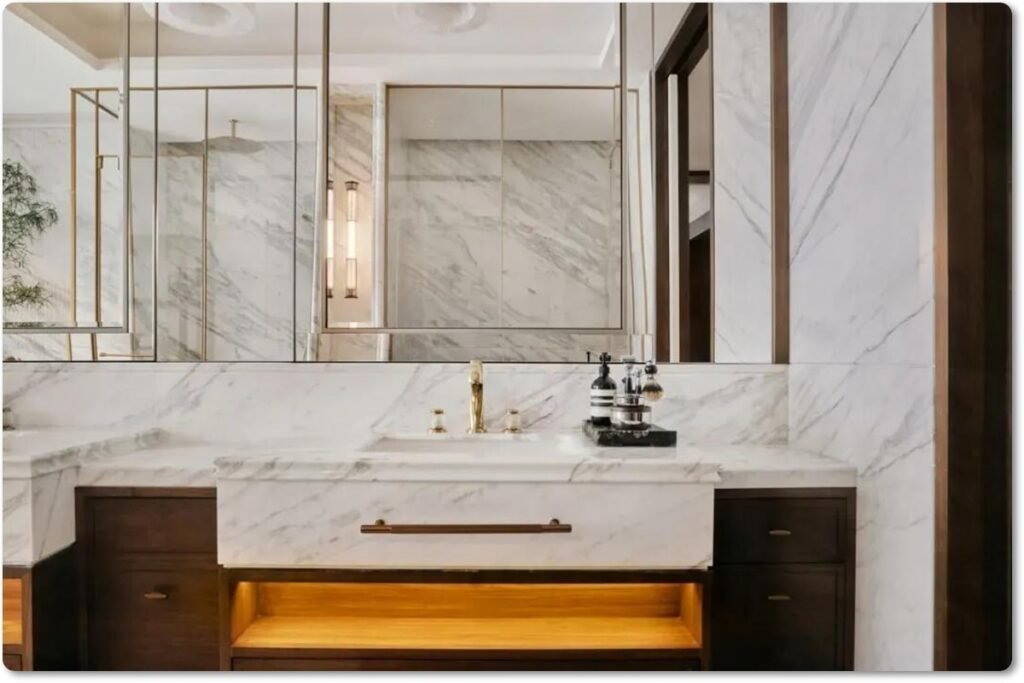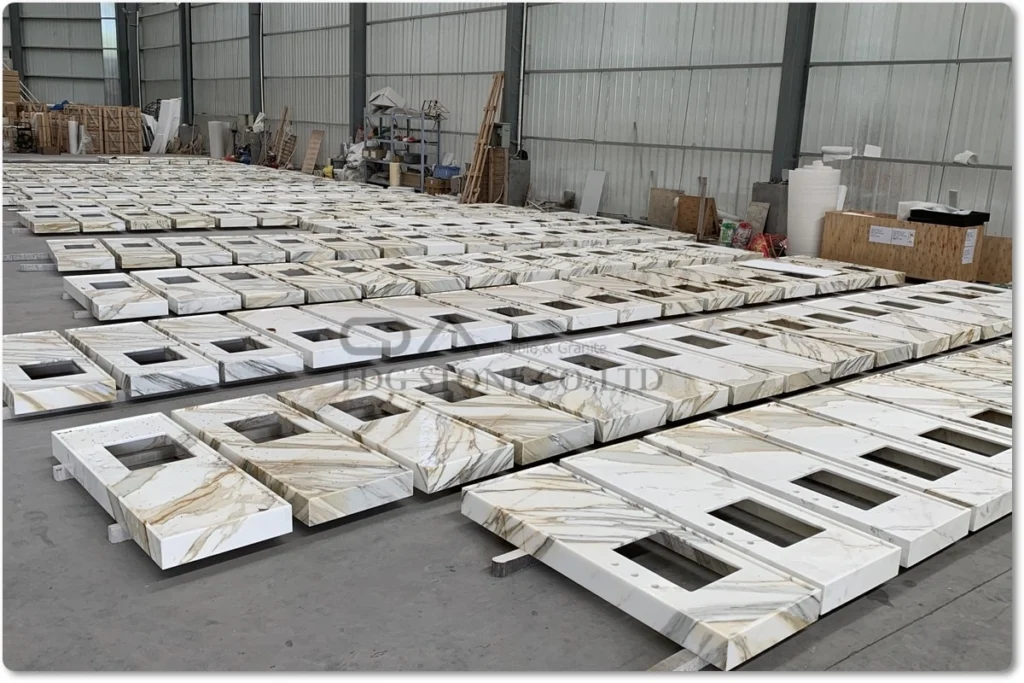
Marble tiles are available in a wide range of natural colors, including white, black, green, grey, beige, brown, and blue. Each color family offers different mineral compositions, veining patterns, surface characteristics, and architectural applications. Popular selections include Carrara, Calacatta, and Statuario white marble; Nero Marquina black marble; Verde Alpi and other green stones; Armani Grey and silver-grey varieties; Crema Marfil and Botticino beige marble; Emperador brown marble; and selected rare blue natural stones. For professional procurement, color selection should be supported by actual material photographs, geological identification, batch approval, dimensional inspection, physical property testing, and export packaging verification. EDG Stone provides natural stone sourcing, custom marble tile processing, quality inspection, and export-oriented product supply for international distributors, wholesalers, contractors, and commercial projects.
1. Executive Summary: Understanding Marble Tiles by Color
Natural marble tiles are selected not only for their geological characteristics but also for their color, veining, texture, and ability to complement architectural materials.
For international importers, wholesalers, flooring distributors, interior designers, contractors, and property developers, organizing marble tiles by color provides a practical way to compare products and develop collections for different market segments.
The seven major color families are:
| Marble Color | Representative Materials | Typical Design Applications |
|---|---|---|
| White | Carrara, Calacatta, Statuario | Luxury interiors, bathrooms, hotels |
| Black | Nero Marquina, black marble varieties | Feature walls, flooring, decorative interiors |
| Green | Verde Alpi, Verde Guatemala, green natural stones | Statement walls, bathrooms, luxury interiors |
| Grey | Armani Grey, Bardiglio and grey marble varieties | Contemporary interiors, commercial flooring |
| Beige | Crema Marfil, Botticino | Residential flooring, hospitality projects |
| Brown | Emperador Dark, Emperador Light | Classic interiors, hotel and commercial spaces |
| Blue | Selected blue natural stones | Feature walls, decorative applications, luxury projects |
Color is an important purchasing criterion, but it should never replace technical evaluation.
Two white marble varieties may have substantially different absorption characteristics, veining structures, hardness, and suitability for high-traffic applications. Likewise, two green stones marketed as marble may belong to different geological rock groups.
Professional buyers should therefore evaluate each selection through four dimensions:
Visual appearance and color consistency.
Geological identification and physical properties.
Manufacturing precision and finished-product quality.
Batch traceability, packaging, and export reliability.
EDG Stone approaches marble tile procurement as a combination of material selection, production control, and project-specific customization.
This guide is intended for marble tile importers, stone wholesalers, distributors, manufacturers, architects, designers, and flooring contractors.
2. Scope and Definitions: What Are Natural Marble Tiles?
2.1 What Is Marble?
Geologically, marble is a metamorphic rock formed primarily from limestone or dolostone through recrystallization.
Its main minerals are generally calcite or dolomite. Depending on its original composition and geological history, marble can contain different mineral impurities that influence its color, patterns, and texture.
Common natural marble colors include:
White and ivory.
Black and charcoal.
Green.
Grey and silver.
Beige and cream.
Brown and chocolate.
Red, pink, and occasionally blue-toned varieties.
These colors can result from mineral impurities, trace elements, organic materials, and geological structures.
Importantly, commercial stone names do not always represent strict geological classifications.
For example, certain green stones are serpentine-rich rocks, while some blue stones sold through natural stone collections are sodalite, quartzite, or other decorative stones rather than true calcite marble.
For professional buyers, the material’s actual geological identity should be confirmed instead of relying exclusively on its trade name.
2.2 What Is a Marble Tile?
Marble tiles are natural stone products cut and processed into modular dimensions for architectural applications.
Common specifications include:
300 × 300 mm.
300 × 600 mm.
400 × 400 mm.
600 × 600 mm.
600 × 1200 mm.
800 × 800 mm.
12 × 12 inches.
12 × 24 inches.
24 × 24 inches.
These are commercial formats rather than universal mandatory dimensions. Custom sizes, thicknesses, edge profiles, and surface finishes can be specified according to project drawings.
2.3 Main Surface Finishes
Polished: Creates a reflective surface that enhances the depth and color of marble. Commonly used for luxury interior floors and decorative walls.
Honed: Provides a smooth, matte appearance with less reflection. Suitable for contemporary interiors and projects requiring a softer visual effect.
Brushed: Creates a slightly textured surface through mechanical processing.
Tumbled: Produces softened edges and an aged appearance, frequently used for Mediterranean, traditional, and rustic designs.
Leathered or textured finishes: Offer additional surface character, depending on the material’s suitability and processing method.
Finish selection should be coordinated with the expected traffic, cleaning procedures, moisture exposure, and slip-resistance requirements.
3. Technical Evaluation: Seven Marble Tile Color Collections
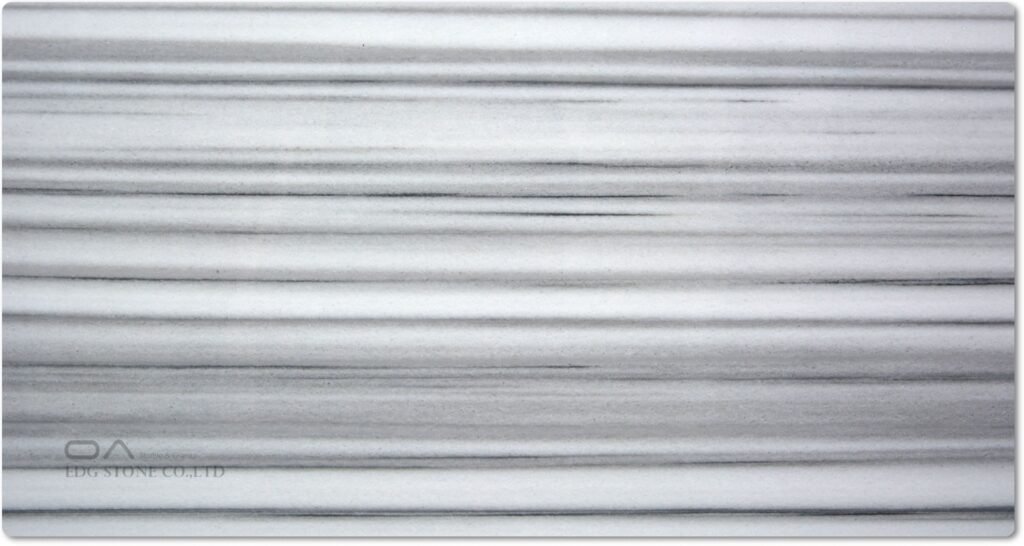
3.1 White Marble Tiles: Carrara, Calacatta and Statuario
White marble tiles remain one of the most recognizable categories in natural stone architecture.
They are widely used in luxury bathrooms, residential flooring, hotel interiors, kitchens, wall cladding, and decorative architectural features.
Carrara White Marble
Carrara marble is traditionally associated with Italy.
It generally features a white to light-grey background with relatively soft grey veining.
Its understated visual character makes it suitable for:
Bathroom floor and wall tiles.
Residential interior flooring.
Kitchen backsplashes.
Hotel bathrooms.
Decorative wall panels.
Classic and contemporary architectural projects.
Carrara is particularly suitable for buyers seeking a relatively restrained natural stone appearance.
Calacatta Marble
Calacatta is associated with a brighter background and more pronounced natural veining.
Depending on the variety, veins may appear grey, gold, brown, or combinations of these colors.
Calacatta Gold and other premium Calacatta selections are frequently specified for luxury hospitality projects, feature walls, bathrooms, and sophisticated interior spaces.
Buyers should pay particular attention to vein distribution and slab-to-tile coordination when ordering large quantities.
Statuario Marble
Statuario is a premium white marble family known for its white background and distinctive grey veining.
It is frequently selected for high-end residential and hospitality interiors.
Its strong visual identity makes it suitable for bookmatched decorative walls, luxury bathroom environments, and statement flooring.
White Marble Procurement Considerations
White marble tiles require close attention to:
Background whiteness and undertones.
Grey or golden vein distribution.
Surface repairs and resin treatment.
Natural fissures.
Thickness consistency.
Batch-to-batch variation.
For large projects, buyers should approve actual production-batch photographs rather than relying exclusively on small catalogue samples.
3.2 Black Marble Tiles: Nero Marquina and Other Black Stones
Black marble tiles create contrast, depth, and a distinctive architectural appearance.
They are commonly specified for decorative walls, bathroom interiors, feature flooring, fireplace surrounds, hotel lobbies, and luxury commercial spaces.
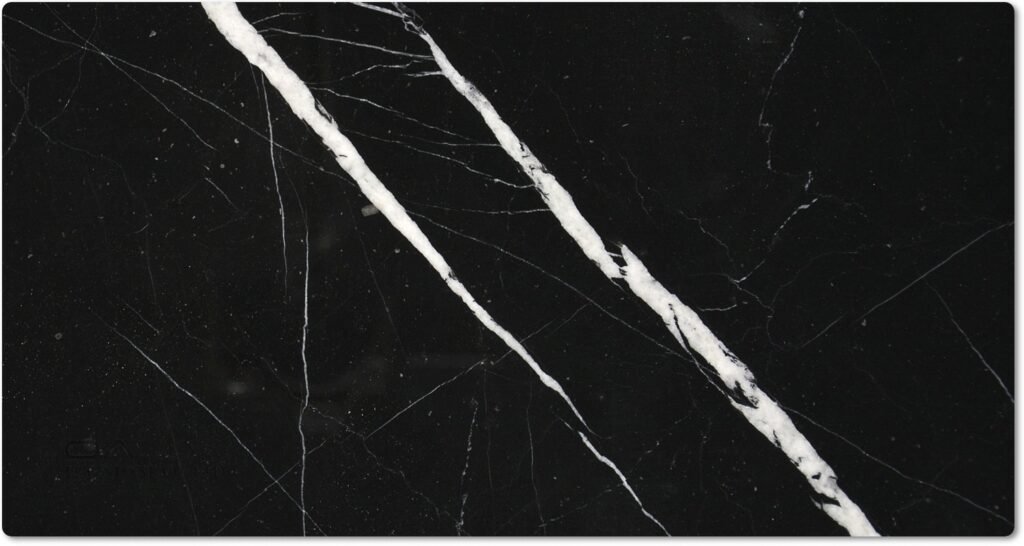
Nero Marquina
Nero Marquina is a well-known black marble commercially associated with Spain.
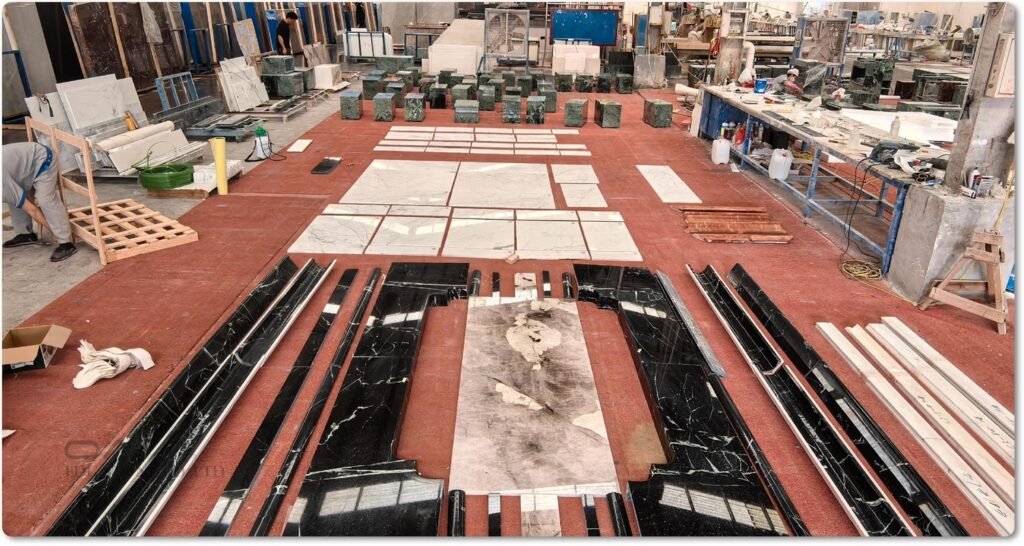
Its characteristic appearance is a dark background with white calcite veins.
The amount, direction, and distribution of white veining can vary between blocks and production batches.
Applications include:
Black marble floor tiles.
Bathroom wall tiles.
Hotel lobby decoration.
Feature walls.
Decorative borders.
Black-and-white geometric flooring.
Other Black Natural Stone Collections
Other commercial black stone varieties may include:
Deep black marble.
Black limestone.
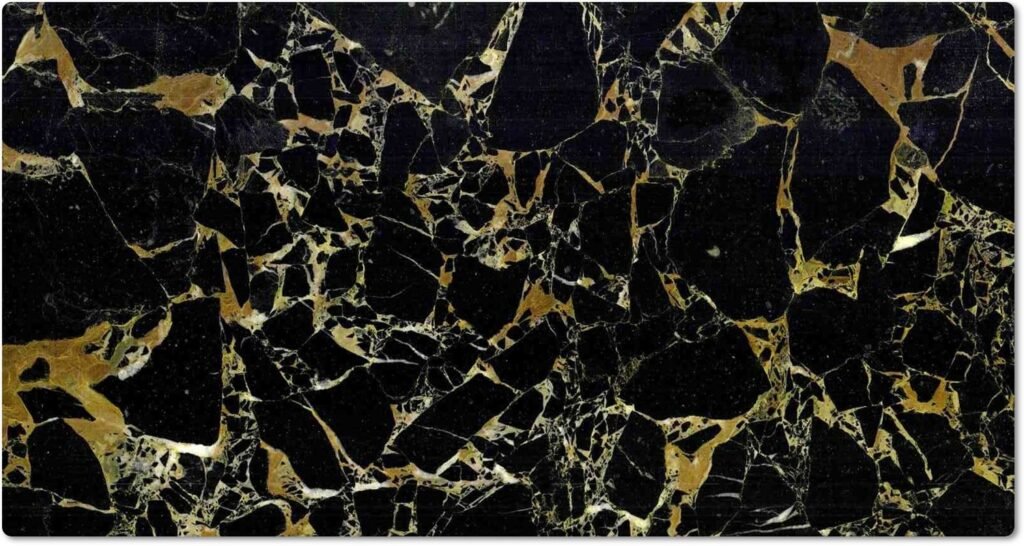
Black brecciated stone.
Black and grey marble.
Black decorative natural stone with contrasting mineral veins.
Not every commercially named black stone is necessarily marble. Buyers should request geological identification when material classification affects specification or compliance.
Black Marble Quality Considerations
Black marble tiles can reveal dust, water deposits, fingerprints, and scratches differently from lighter stones.
The selected finish is therefore important.
Polished surfaces emphasize color depth but may also make certain surface marks more visible. Honed finishes create a softer and more understated appearance.
For large black marble flooring projects, buyers should evaluate the entire approved visual range before confirming bulk production.
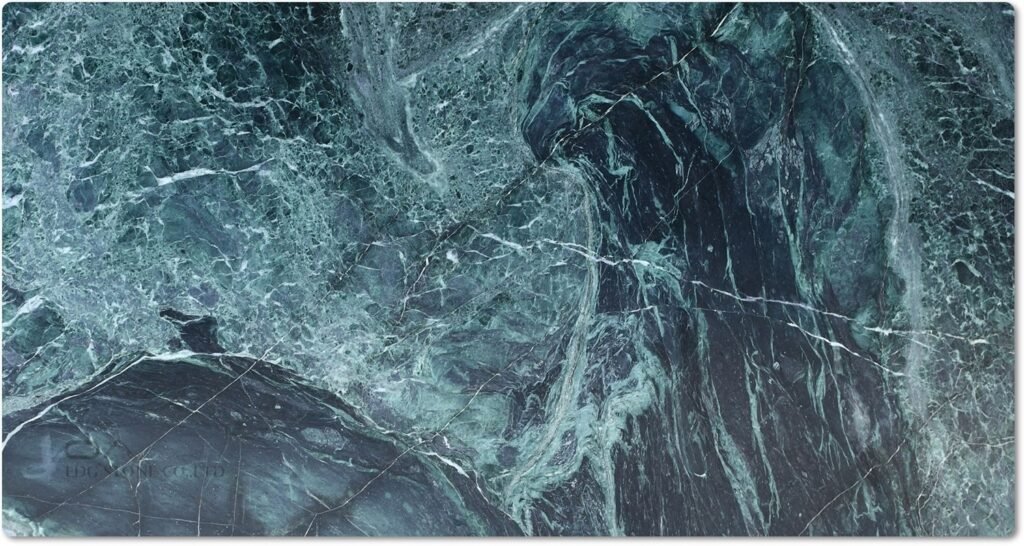
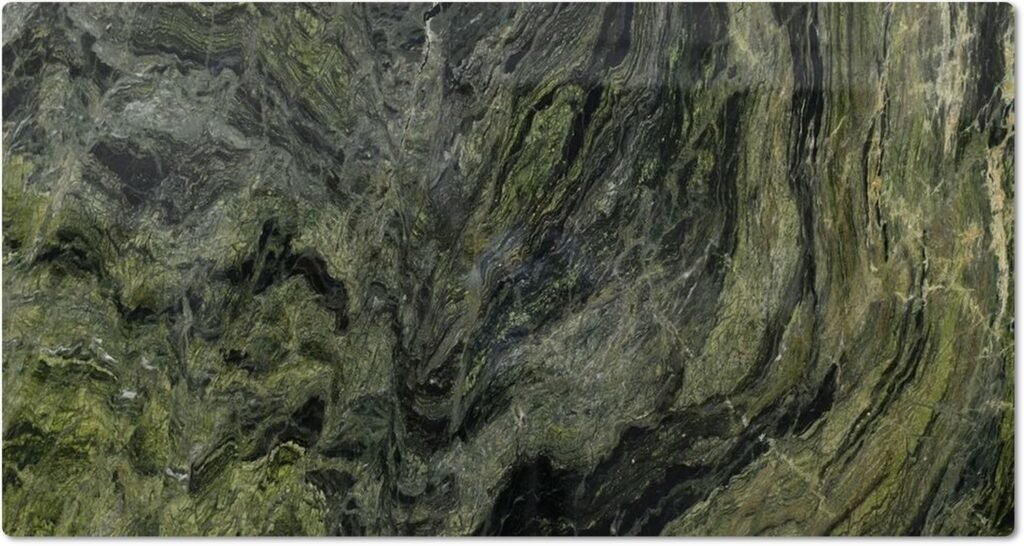
3.3 Green Marble Tiles: Forest Green and Other Green Varieties
Green marble tiles offer a distinctive connection with natural landscapes, organic design, and luxury interiors.
Green stones are increasingly interesting to architects and designers seeking alternatives to conventional white and grey stone palettes.
Representative commercial varieties include:
Verde Alpi: A deep green decorative stone, frequently characterized by contrasting lighter mineral veins and brecciated patterns.
Verde Guatemala: A commercially recognized green natural stone often used for countertops, walls, flooring, and architectural decoration. Its precise geological identification should be verified by variety.
Forest Green: A commercial color description used for different green natural stone selections. Buyers should confirm the specific quarry material rather than assume a single geological identity.
Rainforest Green: Commonly associated with distinctive branching patterns and natural tonal variation.
Where Are Green Marble Tiles Used?
Green stones can be applied to:
Luxury bathroom walls.
Decorative bathroom floors.
Hotel reception areas.
Feature walls.
Fireplace surrounds.
Decorative mosaics.
Custom-cut architectural panels.
Green materials can provide excellent visual impact when coordinated with brass, timber, warm lighting, and neutral architectural finishes.
Important Geological Consideration
Some popular green stones sold as marble are mineralogically serpentine-rich rocks rather than calcite or dolomite marble.
ASTM C1526 covers serpentine dimension stone as a separate material category.
This distinction matters because mineral composition influences fabrication behavior, testing requirements, and suitability for particular applications.
A professional supplier should identify the actual stone variety and provide relevant technical information instead of relying only on a commercial color name.
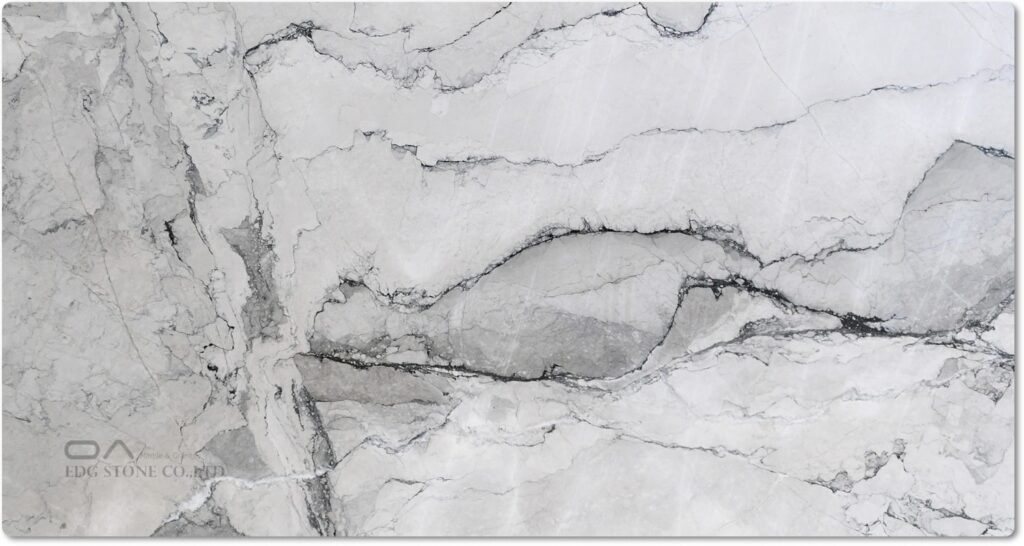
3.4 Grey Marble Tiles: Armani Grey and Other Grey Stones
Grey marble tiles are particularly versatile in modern architectural environments.
They can create a restrained, contemporary appearance without the visual intensity of black stone or the brightness of white marble.
Armani Grey
Armani Grey is a familiar commercial name used for selected grey natural stone varieties.
Its appearance is generally associated with grey backgrounds and natural linear or cloud-like patterns.
The precise color, structure, and geological identity should be verified for the selected source.
Typical applications include:
Modern residential floors.
Commercial flooring.
Bathroom walls.
Hotel interior decoration.
Fireplace surrounds.
Large-format decorative panels.
Other Grey Marble Collections
Other grey stone selections may include:
Bardiglio-style grey marble.
Silver-grey marble.
Dark grey marble.
Light grey marble.
Pietra Grey-style architectural stone.
These categories may involve different geological materials and should not automatically be treated as interchangeable.
Grey Marble Design Advantages
Grey marble provides a neutral background for:
Black metal profiles.
Natural timber.
Stainless steel.
Brushed brass.
White cabinetry.
Minimalist architectural interiors.
For wholesalers and distributors, grey collections can also complement white and beige product ranges.
3.5 Beige and Cream Marble Tiles
Beige marble tiles are among the practical choices for projects requiring warmth, visual continuity, and a relatively neutral decorative palette.
They are frequently selected for residential flooring, hotels, apartment developments, commercial interiors, and traditional architectural designs.
Crema Marfil
Crema Marfil is a well-known beige marble commercially associated with Spain.
Its background generally ranges from light cream to warm beige, with varying natural veins and tonal structures.
Common applications include:
Residential flooring.
Bathroom floors and walls.
Hotel interiors.
Staircases.
Decorative wall panels.
Traditional and contemporary interiors.
Botticino Marble
Botticino is another recognized beige marble family associated with Italy.
It generally has a warm beige appearance and subtle natural patterns.
It is frequently considered for flooring, wall decoration, and traditional architectural projects.
Cream Marble and Light Beige Collections
Other commercial beige varieties include:
Light cream marble.
Ivory beige marble.
Golden beige marble.
Warm sand-tone marble.
Soft grey-beige marble.
The choice between these options should be made by comparing actual background tones, vein contrast, and the surrounding architectural materials.
Beige Marble Procurement Considerations
Color differences within beige marble can be especially noticeable when several batches are installed together.
Buyers should approve a representative range showing both lighter and darker pieces.
Lighting conditions should also be considered. Warm artificial lighting can make beige marble appear more yellow, while daylight may reveal grey or pink undertones.
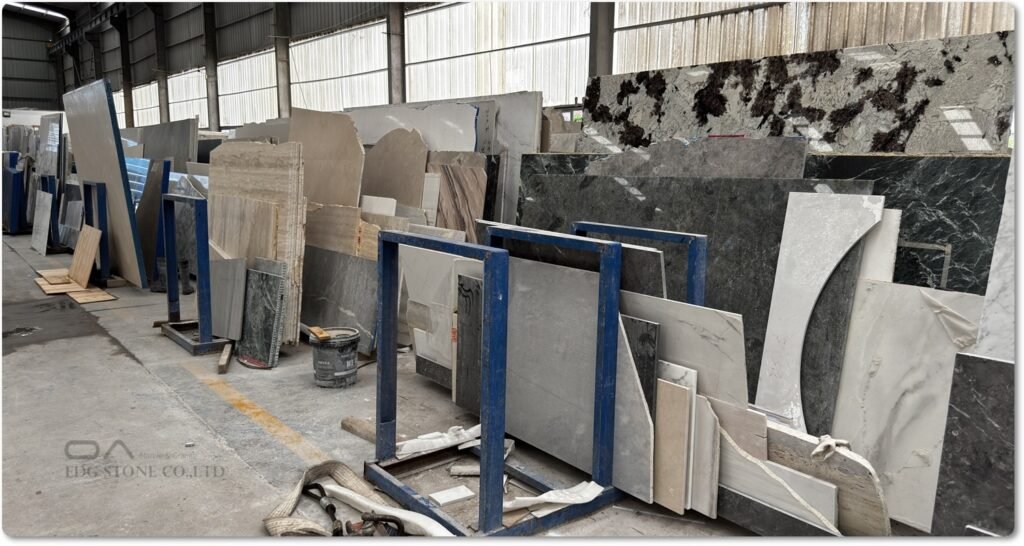
3.6 Brown Marble Tiles and Earth-Tone Collections
Brown marble tiles provide warmth, contrast, and a natural visual connection with wood, bronze, leather, and traditional architectural materials.
They are suitable for hotels, residential interiors, reception areas, fireplaces, and decorative wall applications.
Emperador Dark
Emperador Dark is a widely recognized brown marble variety commercially associated with Spain.
It typically displays a dark brown background with lighter mineral veins and irregular patterns.
Applications include:
Hotel lobby flooring.
Bathroom walls.
Fireplace surrounds.
Decorative feature walls.
Borders and inserts.
Luxury residential interiors.
Emperador Light
Emperador Light offers a lighter brown or warm beige-brown visual character.
It can be combined with cream marble, white marble, and darker decorative materials.
Other Brown and Earth-Tone Collections
Potential commercial categories include:
Chocolate brown marble.
Tobacco brown marble.
Coffee-tone marble.
Light brown natural stone.
Brown and beige breccia.
Earth-tone mixed-vein stone.
For projects involving multiple colors, brown marble can provide a useful transition between light and dark materials.
In 2026 design coverage, warmer neutral colors, earthy tones, and richer natural-looking surfaces continue to receive attention. This supports the relevance of beige, brown, and warm grey collections, although editorial design trends should not be interpreted as verified global stone sales statistics.
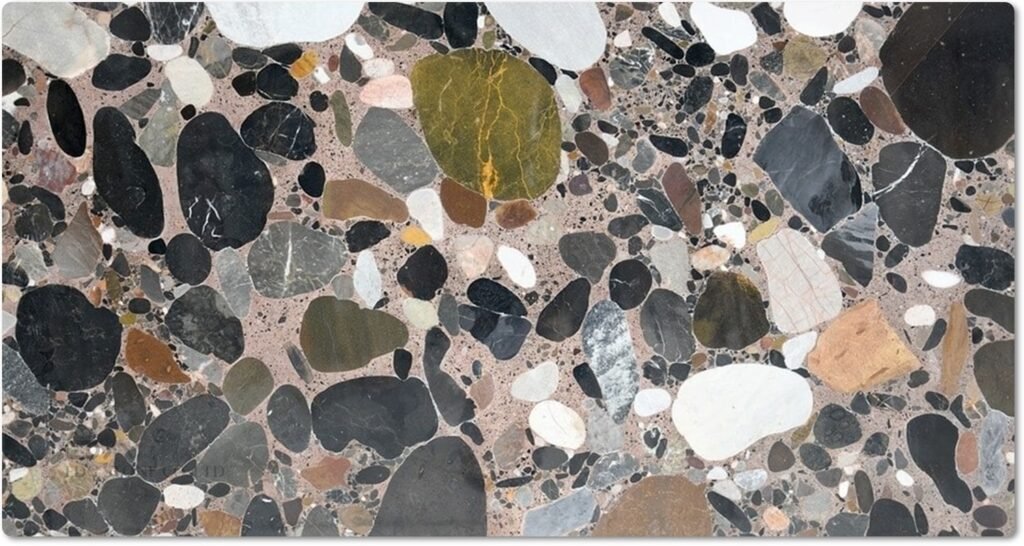
3.7 Blue Marble Tiles and Rare Natural Stone Varieties
Blue marble tiles occupy a more specialized position in the natural stone market.
Unlike white, beige, grey, and black collections, naturally blue stones are relatively uncommon.
They are generally selected for their decorative value and visual uniqueness.
Potential blue-tone natural stone categories include:
Blue-grey natural marble.
Blue-veined decorative stone.
Sodalite-based blue stone.
Selected blue quartzite varieties.
Blue onyx and translucent decorative materials.
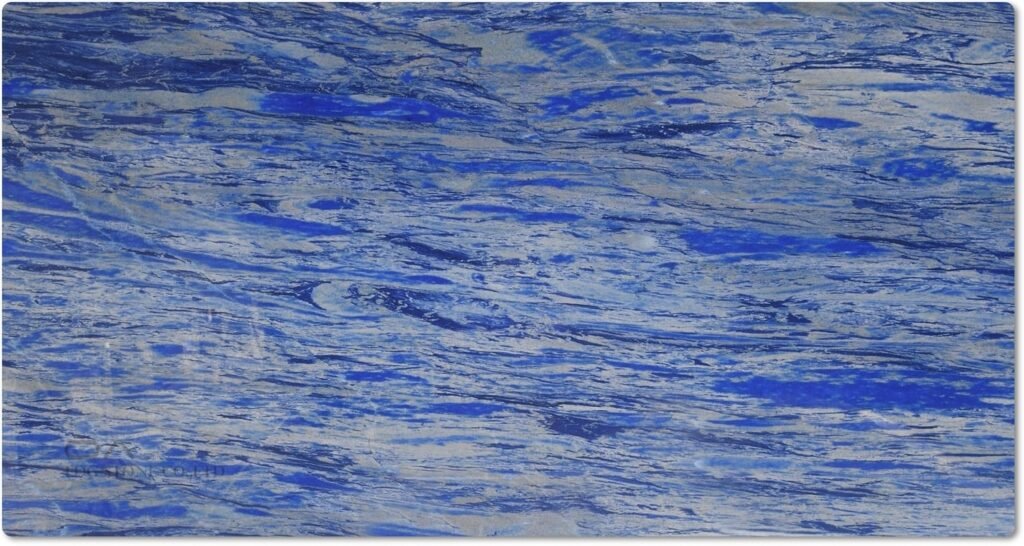
One important example is Azul Macaubas, which is commercially known as a blue natural stone but is generally classified as quartzite, not marble.
Blue sodalite is another decorative material that should not be incorrectly identified as calcite marble.
Where Can Blue Natural Stones Be Used?
Blue-toned natural stones are often better suited to:
Decorative feature walls.
Hotel reception areas.
Luxury bathroom accents.
Custom furniture surfaces.
Decorative panels.
Small-format architectural installations.
Because the color and mineral composition may vary considerably, buyers should request actual material photographs, geological identification, and finished sample approval.
For rare stones, quarry availability and consistent batch supply can be more important than the nominal tile dimensions.
4. How to Select Marble Tile Colors for Floors and Walls?
Choosing a marble tile color involves both design and technical evaluation.
A color that looks excellent in a showroom may not perform as expected under different lighting, traffic, moisture, or maintenance conditions.
4.1 Marble Tiles for Flooring
For floor applications, buyers should consider:
Traffic intensity: Residential bedrooms, hotel corridors, commercial entrances, and public spaces have different wear requirements.
Abrasion resistance: Evaluate the stone using a relevant test method, such as ASTM C241/C241M, where appropriate.
Surface finish: Polished, honed, brushed, and textured surfaces have different visual and functional characteristics.
Slip resistance: Specify and test the finished surface for the intended dry or wet environment. A polished finish should not automatically be assumed suitable for wet walking surfaces.
Maintenance: Marble is generally sensitive to acidic substances. Cleaning products and stain protection must be compatible with the stone.
White, beige, and grey marble can work particularly well in large interior spaces, while black, green, and brown varieties can create contrasting zones or decorative focal points.
4.2 Marble Tiles for Bathroom Walls and Floors
Bathrooms require careful material and finish selection.
Wall applications and floor applications should not automatically use the same specifications.
For bathroom walls, buyers may prioritize color, veining, surface finish, and coordination with plumbing fixtures.
For bathroom floors, additional attention should be paid to slip resistance, water exposure, maintenance, and cleaning procedures.
Honed or textured finishes can be worth considering where a polished surface would be inappropriate.
4.3 Marble Tile Colors for Commercial Projects
Hotels, apartments, restaurants, and commercial buildings often require coordinated material supply across multiple areas.
A useful approach is to establish a color schedule before procurement:
| Project Area | Possible Color Selection | Key Consideration |
|---|---|---|
| Main lobby | White, black, beige | Visual impact and traffic |
| Guest bathrooms | White, grey, beige | Cleaning and moisture |
| Corridors | Grey, beige, brown | Wear and maintenance |
| Feature walls | Green, blue, black | Veining and appearance |
| Decorative areas | Calacatta, Statuario | Pattern coordination |
| Staircases | Grey, beige, brown | Abrasion and safety |
The final selection should be supported by approved samples and project-specific technical requirements.
5. Natural Color Variation and Batch Selection
5.1 Why Do Marble Tile Colors Vary?
Natural marble is a geological material rather than a factory-produced uniform surface.
Its appearance can change because of:
Mineral distribution.
Geological formation.
Vein direction.
Natural fissures.
Quarry location.
Block selection.
Surface finishing.
Resin treatment.
Moisture and lighting conditions.
Even tiles cut from the same block may show differences in veining and background tone.
Nero Marquina, for example, may show varying quantities and distribution of white veins between shipments.
Natural variation should therefore be treated as a defined selection range rather than automatically classified as a manufacturing defect.
5.2 How Should Buyers Approve Marble Tile Batches?
A professional selection procedure should involve several steps.
Step 1: Approve the reference material.
Select a physical sample or representative sample panel.
Step 2: Review actual production material.
Request photographs and videos showing the actual selected blocks or production batch under reasonably consistent lighting.
Step 3: Confirm the acceptable color range.
Define acceptable differences in background tone, veining, pattern density, and natural markings.
Step 4: Reserve sufficient material.
For bulk projects, prioritize material reservation from compatible blocks or approved quarry lots.
Step 5: Review finished tiles.
Inspect the completed production batch before final packing.
Step 6: Retain spare material.
For installations requiring future maintenance, retaining tiles from the original batch can reduce the difficulty of later replacement.
5.3 Recommended Batch Documentation
For commercial marble tile procurement, the approved documentation should ideally include:
Material name and commercial identification.
Quarry or source identification where available.
Block or batch reference.
Actual material photographs.
Approved sample reference.
Color variation classification.
Surface finish.
Nominal dimensions and thickness.
Inspection records.
Packaging and crate identification.
This documentation creates a more reliable purchasing record than a product catalogue photograph alone.
6. Procurement Checklist: Technical Standards and Regulatory Considerations
Professional marble tile procurement should consider the destination market, application, stone type, and applicable technical specifications.
6.1 ASTM Standards
Several ASTM standards are particularly relevant to natural marble and dimension stone.
| Standard | Subject | Procurement Relevance |
|---|---|---|
| ASTM C503/C503M-23 | Marble Dimension Stone | Material characteristics and physical requirements |
| ASTM C97/C97M-26 | Absorption and Bulk Specific Gravity | Water absorption and density evaluation |
| ASTM C1528/C1528M-26 | Selection of Dimension Stone | Natural stone selection guidance |
| ASTM C880/C880M-25 | Flexural Strength of Dimension Stone | Structural and bending performance |
| ASTM C241/C241M-21 | Abrasion Resistance | Flooring wear evaluation |
| ASTM C1242-26 | Dimension Stone Attachment Systems | Selection, design, and installation of stone attachment systems |
| ASTM C1526-19(2023)e1 | Serpentine Dimension Stone | Relevant when evaluating serpentine materials |
ASTM C503/C503M-23 specifically covers marble dimension stone, including products processed into blocks, slabs, and tiles. It addresses material characteristics and physical requirements such as absorption, density, strength, and abrasion resistance.
ASTM C97/C97M-26 provides test methods for absorption and bulk specific gravity. These properties are useful when comparing different stone selections.
ASTM C241/C241M-21 provides an abrasion-resistance test method for stones used in floors, steps, and similar applications exposed to foot traffic.
The appropriate tests should be selected according to the specific stone and intended use. A single generic laboratory report does not automatically establish suitability for every project.
6.2 European Standards and CPR Regulatory Developments
For European projects, relevant natural stone product standards include:
EN 12057:2015 – Natural Stone Products: Modular Tiles – Requirements.
EN 12058:2015 – Natural Stone Products: Slabs for Floors and Stairs – Requirements.
EN 1469 – Natural Stone Products: Cladding Slabs – Requirements.
These documents address different natural stone product categories and intended applications.
An important regulatory development is Regulation (EU) 2024/3110, the revised Construction Products Regulation.
It entered into force on January 7, 2025, and its main provisions have applied since January 8, 2026.
The revised framework introduces developments concerning construction product information, environmental performance, sustainability, and digital product information.
However, product-family implementation and the transition from the former CPR framework depend on the applicable harmonised technical specifications and transitional provisions.
Important for importers: The existence of an EN standard does not, by itself, establish that a particular edition is currently harmonised for CE marking. Buyers and suppliers should confirm the relevant Official Journal citation, applicable product family, and current regulatory transition requirements before making conformity claims.
6.3 Occupational Safety During Stone Processing
Natural stone manufacturing and fabrication also involve occupational safety considerations.
In the United States, OSHA regulates occupational exposure to respirable crystalline silica under:
29 CFR 1910.1053 – General Industry.
29 CFR 1926.1153 – Construction.
The permissible exposure limit is 50 μg/m³ as an eight-hour time-weighted average, with an action level of 25 μg/m³.
Relevant exposure controls include wet processing, engineering controls, local exhaust ventilation, exposure assessment, and appropriate respiratory protection.
These are workplace exposure requirements, not product-performance standards for finished marble tiles.
Stone processors should evaluate the actual mineral composition and processing activities rather than assume that all natural stones have identical exposure characteristics.
6.4 2026 Market and Design Direction
Recent 2026 design coverage highlights continued interest in:
Creamy whites.
Warm beige and sand tones.
Warm and greige neutrals.
Earth-inspired brown colors.
Sage and olive green.
More expressive natural veining.
Selected blue and other deeper accent colors.
This points toward a useful product strategy for marble tile manufacturers and wholesalers: develop collections that combine reliable neutral colors with distinctive decorative materials.
For distributors, a balanced collection of white, beige, grey, black, and selected green or blue stones can address different customer segments without depending on a single color trend.
Design trend coverage is directional rather than a substitute for regional sales data or verified search-volume research.
7. Cost and Risk Factors in Marble Tile Procurement
The purchase price of marble tiles is only one component of the total landed project cost.
Professional buyers should compare the following cost elements.
7.1 Material Costs
Material pricing depends on:
Stone variety.
Quarry and block availability.
Background color and pattern selection.
Vein consistency.
Natural defects.
Material grade.
Block yield.
Selected finish.
Rare colors and highly selective material specifications may increase sourcing costs.
7.2 Processing Costs
Manufacturing costs can include:
Block cutting.
Slab processing.
Tile cutting.
Thickness calibration.
Surface polishing.
Honing and brushing.
Edge processing.
Special-size production.
Inspection and sorting.
Large-format or custom-cut tiles may require additional production planning.
7.3 Packaging and Transportation
Export costs may include:
Protective separators.
Foam and edge protection.
Export wooden crates.
Crate reinforcement.
Container loading.
Inland transportation.
Ocean freight.
Marine insurance.
Destination handling and import duties.
The final procurement comparison should distinguish EXW, FOB, and CIF quotations.
7.4 Major Procurement Risks
| Risk | Potential Impact | Recommended Control |
|---|---|---|
| Color inconsistency | Unsatisfactory installation | Approve actual batch |
| Geological misidentification | Incorrect specification | Confirm stone identity |
| Thickness deviation | Installation problems | Inspect calibration |
| Surface defects | Rejection or rework | Finished-product inspection |
| Insufficient material | Delayed project | Reserve production quantities |
| Inadequate packaging | Transit damage | Pre-shipment packaging inspection |
| Unclear compliance documents | Import delays | Confirm destination requirements |
| Unverified reorder availability | Future mismatch | Retain batch identification and spare tiles |
For wholesale procurement, the lowest initial quotation is not necessarily the lowest total project cost.
Material consistency, fabrication yield, delivery reliability, and packaging quality can have a substantial influence on the final result.
8. Supplier Evaluation: What Should a Professional Marble Tile Manufacturer Provide?
Selecting a reliable marble tiles manufacturer requires more than comparing catalogue images and unit prices.
Buyers should evaluate the supplier’s material sourcing, processing capability, inspection procedures, and export experience.
8.1 Material Sourcing Capability
A professional supplier should be able to provide:
Available marble color collections.
Commercial material names.
Geological identification where available.
Actual material photographs.
Available block or batch information.
Current sourcing and availability information.
Sample selection support.
8.2 Processing and Manufacturing Capability
For marble tile wholesale and project procurement, relevant production capabilities include:
Block cutting.
Tile cutting.
Thickness calibration.
Surface polishing.
Honing.
Brushing.
Tumbled finishing.
Custom dimensions.
Edge processing.
Quality sorting.
Project-based production.
8.3 EDG Stone Quality Inspection Workflow
EDG Stone’s marble tile supply process should be evaluated through four clearly documented quality-control stages.
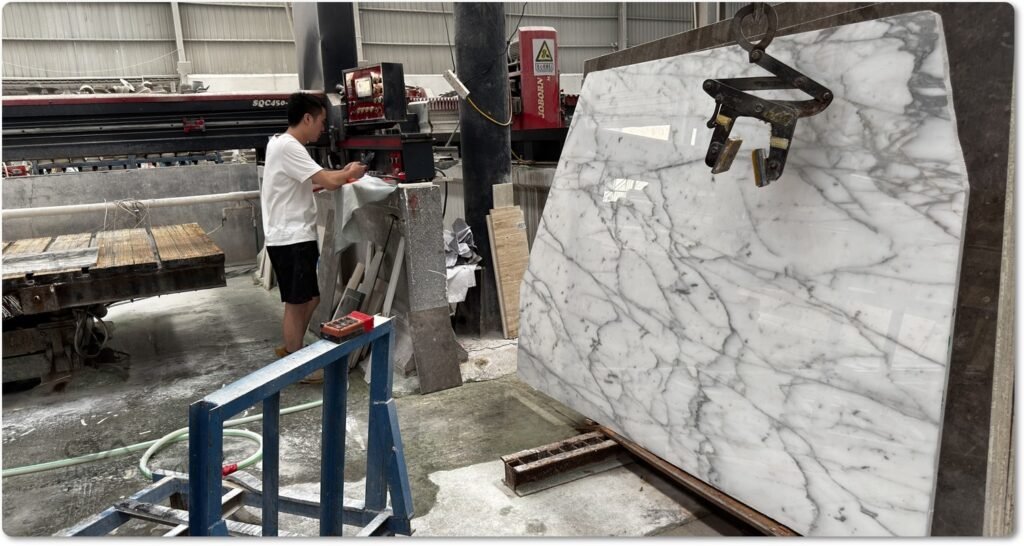
Stage 1: Raw Material Inspection
Before processing, incoming blocks or material lots should be inspected for:
Correct material identification.
Background color and tonal range.
Vein distribution.
Natural fissures and cracks.
Open defects.
Resin repairs or reinforcement.
Material integrity.
Compatibility with the approved reference.
Actual material photographs should be retained for buyer review.
Stage 2: In-Process Quality Inspection
During production, inspection should cover:
Tile dimensions.
Thickness calibration.
Length and width consistency.
Squareness.
Edge quality.
Surface finish.
Visible cracks and chips.
Polishing consistency.
Matching against the approved material reference.
For customized orders, production should also follow the agreed drawings, samples, and processing instructions.
Stage 3: Finished Product Inspection
Before packing, finished marble tiles should be checked against the approved specification.
The inspection should consider:
Actual color and pattern range.
Surface defects.
Edge damage.
Dimensional tolerances.
Thickness.
Finish consistency.
Sorting and classification.
Quantity reconciliation.
The inspection criteria and sampling plan should be agreed before production so that supplier and buyer share the same acceptance requirements.
Stage 4: Export Packaging Inspection
Packaging is a critical part of international natural stone supply.
EDG Stone’s export-oriented packaging inspection should verify:
Protective separators between tiles.
Appropriate surface protection.
Corner and edge protection.
Wooden crate condition.
Internal support and reinforcement.
Secure strapping.
Moisture and handling protection appropriate to the shipment.
Crate identification and product labels.
Quantity and packing-list consistency.
Container loading photographs.
For bulk marble tile shipments, clear crate identification and loading documentation can significantly improve shipment traceability.
8.4 Actual Material Images and Production Evidence
For buyers comparing marble tiles by color, a useful supplier presentation should contain more than polished showroom photographs.
EDG Stone’s product database should ideally display:
Actual natural stone block or slab photographs.
Finished marble tile photographs.
Surface finish close-ups.
Available size and thickness options.
Actual batch photographs before shipment.
Production and quality inspection photographs.
Export packing and container loading records.
An important distinction: A catalogue image represents a material’s general appearance. A batch photograph represents a specific production selection. For bulk procurement, the second is essential.
9. Practical RFQ Template: Marble Tiles by Color
International importers and wholesalers can use the following RFQ format when contacting a marble tile manufacturer or factory.
Marble Tiles Procurement Request
| RFQ Field | Required Information |
|---|---|
| Buyer / Company | Company name and contact details |
| Material Color | White / Black / Green / Grey / Beige / Brown / Blue |
| Commercial Stone Name | Carrara / Calacatta / Nero Marquina / Crema Marfil / Other |
| Geological Identification | Marble / Serpentine / Quartzite / Other, where applicable |
| Product Type | Natural marble modular tiles |
| Dimensions | Length × Width |
| Thickness | Required nominal thickness |
| Surface Finish | Polished / Honed / Brushed / Tumbled / Other |
| Edge Processing | Standard / Bevelled / Custom |
| Quantity | Square meters or pieces |
| Color Selection | Approved reference sample and acceptable variation |
| Application | Floor / Wall / Bathroom / Commercial Project |
| Quality Requirements | Applicable standards and project inspection criteria |
| Packaging | Export wooden crates |
| Trade Terms | EXW / FOB / CIF |
| Destination | Country and port |
| Required Delivery | Target delivery schedule |
| Documentation | Technical data, inspection records, packing list |
Recommended RFQ Message
Subject: RFQ – Natural Marble Tiles by Color

Dear EDG Stone Team,

We are interested in sourcing natural marble tiles for our
distribution / wholesale / construction project.

Please provide your available selections and quotation
based on the following requirements:

1. Preferred color:
2. Marble variety:
3. Required dimensions:
4. Thickness:
5. Surface finish:
6. Estimated quantity:
7. Intended application:
8. Required quality standards:
9. Destination country and port:
10. Preferred trade term: EXW / FOB / CIF
11. Target delivery schedule:

Please provide:

- Actual material and batch photographs.
- Available marble color collections.
- Technical specifications, where available.
- Sample availability.
- Production and quality inspection information.
- Export packaging details.
- Quotation and estimated lead time.

We look forward to reviewing your materials and quotation.

Best regards,
[Company Name]
This structure helps suppliers provide more accurate quotations and reduces unnecessary clarification during procurement.
10. Frequently Asked Questions About Marble Tiles by Color
FAQ 1: What are the most popular colors of marble tiles?
The main commercial color families include white, black, green, grey, beige, brown, and selected blue natural stones.
White, beige, and grey are common choices for broad interior applications, while black, green, brown, and blue varieties are often selected for decorative contrast and distinctive architectural designs.
The most appropriate choice depends on the project style, material availability, performance requirements, and regional preferences.
FAQ 2: What is the best white marble for floor tiles?
Carrara, Calacatta, and Statuario are widely recognized white marble selections.
Carrara offers a relatively restrained grey-veined appearance, Calacatta provides more expressive veining, and Statuario is frequently selected for premium decorative applications.
For flooring, buyers should compare abrasion resistance, absorption, finish, traffic conditions, and maintenance requirements rather than choosing exclusively by appearance.
FAQ 3: Are black marble tiles suitable for bathrooms?
Yes. Black marble tiles can be used for bathroom walls and appropriately specified floors.
However, buyers should evaluate surface finish, slip resistance, water exposure, cleaning requirements, and natural variation.
Honed or textured finishes may be worth considering for wet walking surfaces.
FAQ 4: Are green marble tiles real marble?
Some commercially named green marble varieties are true marble, while others are serpentine-rich natural stones or other geological materials.
The term green marble is widely used commercially, but the actual mineral composition and geological identity should be confirmed before technical specification.
FAQ 5: How do I ensure marble tiles have consistent colors in a bulk order?
Approve actual production material before manufacturing, define acceptable natural color variation, reserve sufficient material from compatible lots, and inspect finished tiles before packaging.
For larger installations, retain batch records and spare tiles from the original shipment.
A small showroom sample alone cannot guarantee that a future bulk shipment will have an identical appearance.
References and Technical Sources
The following standards, regulations, and industry resources provide a technical foundation for professional marble tile selection and procurement.
ASTM International – ASTM C503/C503M-23: Standard Specification for Marble Dimension Stone.
https://store.astm.org/c0503_c0503m-23.htmlASTM International – ASTM C97/C97M-26: Standard Test Methods for Absorption and Bulk Specific Gravity of Dimension Stone.
https://store.astm.org/c0097_c0097m-26.htmlASTM International – ASTM C1528/C1528M-26: Standard Guide for Selection of Dimension Stone.
https://store.astm.org/c1528_c1528m-26.htmlASTM International – ASTM C880/C880M-25: Standard Test Method for Flexural Strength of Dimension Stone.
https://store.astm.org/c0880_c0880m-25.htmlASTM International – ASTM C241/C241M-21: Standard Test Method for Abrasion Resistance of Stone Subjected to Foot Traffic.
https://store.astm.org/c0241_c0241m-21.htmlASTM International – ASTM C1242-26: Standard Guide for Selection, Design, and Installation of Dimension Stone Attachment Systems.
https://store.astm.org/c1242-26.htmlASTM International – ASTM C1526: Standard Specification for Serpentine Dimension Stone.
ASTM Committee C18 Standards: https://www.astm.org/membership-participation/technical-committees/committee-c18/subcommittee-c18/jurisdiction-c1803European Committee for Standardization – EN 12057:2015: Natural Stone Products – Modular Tiles – Requirements.
European Committee for Standardization – EN 12058:2015: Natural Stone Products – Slabs for Floors and Stairs – Requirements.
European Union – Regulation (EU) 2024/3110: Revised Construction Products Regulation.
https://eur-lex.europa.eu/eli/reg/2024/3110/oj/engEuropean Commission – Construction Products Regulation Overview and Implementation.
https://single-market-economy.ec.europa.eu/sectors/construction/construction-products-regulation-cpr/cpr-overview_enOSHA – 29 CFR 1910.1053: Respirable Crystalline Silica – General Industry.
https://www.osha.gov/laws-regs/regulations/standardnumber/1910/1910.1053OSHA – 29 CFR 1926.1153: Respirable Crystalline Silica – Construction.
https://www.osha.gov/laws-regs/regulations/standardnumber/1926/1926.1153OSHA – Worker Exposure to Silica during Countertop Manufacturing, Finishing, and Installation.
https://www.osha.gov/sites/default/files/publications/OSHA3768.pdfHouzz – What’s New in Tile for 2026: Design directions presented at The International Surfaces Event.
https://www.houzz.com/magazine/whats-new-in-tile-for-2026-stsetivw-vs~184464887
Standards and regulations should always be checked against the latest applicable edition, jurisdiction, product category, and project specification before use.
11. EDG Stone CTA: Explore Natural Marble Tiles by Color
Discover Natural Marble Tile Collections from EDG Stone
Finding the right marble tile involves more than selecting a color. It requires reliable material sourcing, suitable fabrication, consistent production quality, and dependable international delivery.
EDG Stone is a professional Chinese natural stone manufacturer and exporter supplying marble and other natural stone products for international buyers and commercial projects.
Our marble tile sourcing and product selection approach focuses on seven major color families:
White Marble: Carrara, Calacatta, Statuario, and other white marble selections.
Black Marble: Nero Marquina and selected black natural stones.
Green Marble: Verde Alpi, Verde Guatemala and other green natural stone varieties.
Grey Marble: Armani Grey and selected silver-grey materials.
Beige Marble: Crema Marfil, Botticino and other cream-tone selections.
Brown Marble: Emperador Dark, Emperador Light and earth-tone collections.
Blue Natural Stone: Selected blue and blue-grey decorative materials.
Our Supply and Processing Capabilities
EDG Stone supports professional buyers with:
Natural marble material sourcing.
Marble tile cutting and processing.
Custom sizes and thicknesses.
Polished, honed, and other selected finishes.
Project-based material selection.
Raw material inspection.
In-process production inspection.
Finished product quality inspection.
Export wooden crate packaging.
Container loading and shipment preparation.
Request Marble Tile Samples and Wholesale Quotations
Whether you are an importer, distributor, stone wholesaler, flooring contractor, designer, or commercial project buyer, EDG Stone can assist with material selection and customized procurement requirements.
To receive a more accurate quotation, provide your preferred marble color, material name, dimensions, thickness, finish, quantity, and destination port.
Contact EDG Stone to explore natural marble tile collections, review actual material photographs, request samples, and discuss your next bulk procurement project.
EDG Stone – Natural Stone Products, Custom Fabrication & International Supply.
Marble Tile Color Selection: Materials, Applications and Professional Procurement Insights
Natural marble tiles are architectural materials defined by their geological composition, natural color, mineral structure, veining, surface finish, and processing characteristics. White, black, green, grey, beige, brown, and blue-toned collections provide different visual opportunities for residential, hospitality, and commercial construction projects. A professional marble tile selection process must connect visual appearance with material identification, technical suitability, batch availability, and manufacturing quality.
What Makes Marble Tiles Different from Other Natural Stone Tiles?
Marble is generally a calcite- or dolomite-rich metamorphic rock. Its natural appearance develops through geological processes that influence mineral distribution, background color, veins, and texture. Commercially named green and blue stones may belong to different geological categories, making accurate material identification important for professional procurement.
Why Does Marble Tile Color Matter in Architectural Design?
Color determines how natural stone interacts with lighting, furniture, cabinetry, metal finishes,s and surrounding materials. White and beige marble can create visual continuity, black marble introduces contrast, green and blue natural stones create decorative focal points, while grey and brown collections support contemporary and earth-inspired interiors.
How Should Buyers Compare Different Marble Tile Collections?
Buyers should compare actual material photographs, geological identity, color variation, physical properties, dimensional tolerances, surface finishes, and intended applications. Production-batch approval and material reservation are particularly important for wholesale orders and projects requiring large quantities of visually coordinated tiles.
Which Marble Tile Colors Are Suitable for Different Projects?
White and beige marble collections are frequently specified for residential interiors, bathrooms,s and hospitality spaces. Black and green materials are effective for decorative surfaces and feature areas. Grey and brown tiles offer versatile solutions for contemporary and traditional architectural environments. Rare blue natural stones are generally more specialized and are often selected for accent surfaces and luxury decoration.
What Should Be Considered Before Placing a Bulk Marble Tile Order?
Commercial procurement should include an approved physical sample, clearly defined color variation, material and batch identification, agreed dimensions, thickness, finish, inspection criteria, packaging requirements, ts and delivery terms. Applicable ASTM or European technical requirements should be confirmed according to the material and destination market.
How Does a Professional Marble Tile Manufacturer Reduce Procurement Risk?
A reliable manufacturer integrates raw material inspection, production process inspection, finished-product inspection,n and export packaging verification. Actual batch photographs, dimensional checks, quality documentation, crate identification and container loading records help buyers maintain better control over product consistency and international shipment traceability.
What Is the Direction of the Natural Marble Tile Market?
Design coverage in 2026 highlights continued interest in warm neutrals, creamy whites, natural earth tones, green accents,e nts and distinctive material textures. For manufacturers, wholesalers and distributors, the opportunity is to develop balanced color collections supported by dependable sourcing, transparent material information and project-specific processing.
EDG Stone: From Natural Material Selection to International Supply
EDG Stone connects natural marble sourcing, color-based material selection, custom tile processing, quality inspection,ction and export packaging. By evaluating actual stone characteristics rather than relying only on commercial color names, international buyers can make better-informed decisions and develop more reliable marble tile collections for wholesale distribution and architectural projects.
The most effective marble tile procurement decision is the one that balances appearance, technical suitability, batch consistency, processing quality, and total delivered cost.