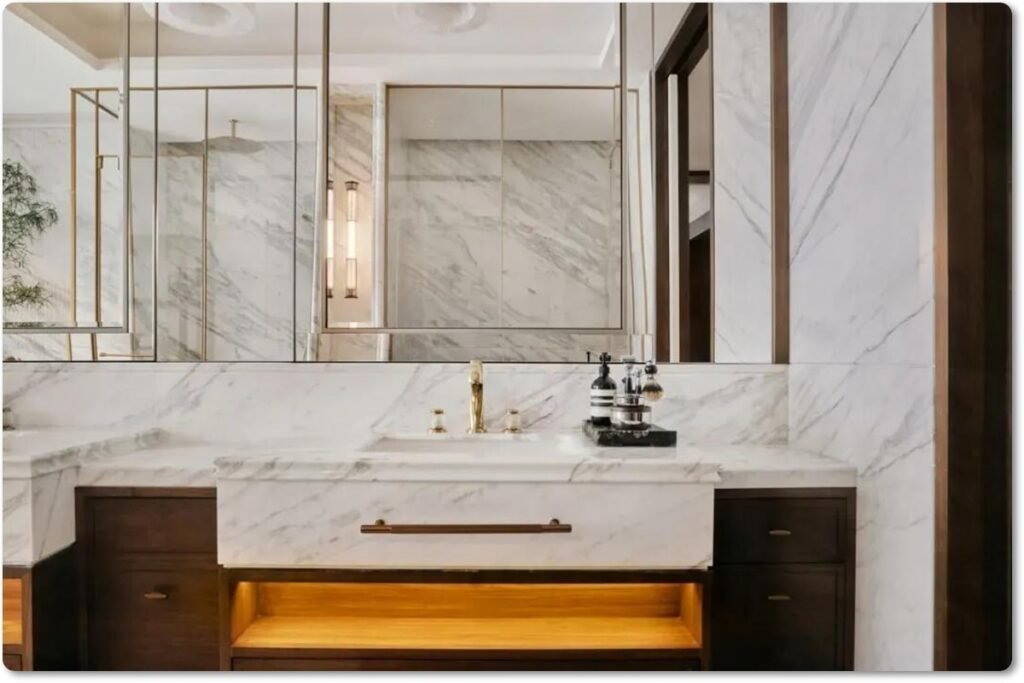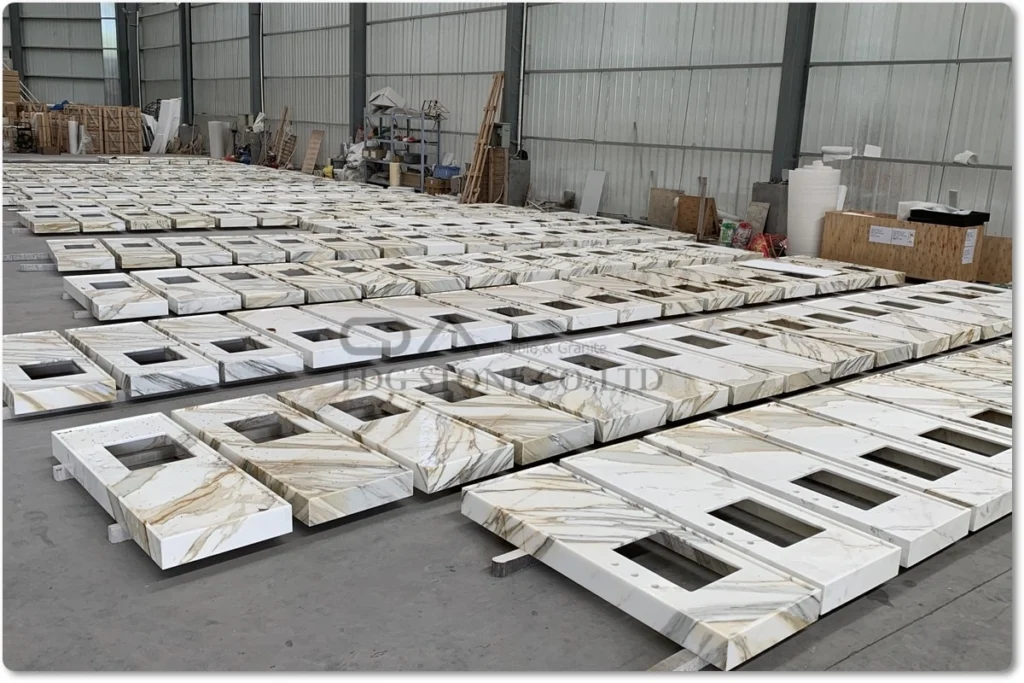
Content Category: Marble Tiles / Kitchen & Interior Applications / Stone Procurement Guide
Target Audience: Kitchen Cabinet Manufacturers, Kitchen Renovation Contractors, Interior Designers, Stone Importers, Marble Wholesalers, Distributors, Hospitality Procurement Managers, and Commercial Interior Contractors.
Executive Summary: Choosing Marble Tiles for Kitchen Walls and Decorative Applications
Marble tiles are widely used in kitchen backsplashes, wall cladding, decorative panels, feature walls, mosaic installations, and selected flooring applications. Their natural veining, mineral patterns,s and distinctive color variations allow designers to create surfaces that cannot be perfectly replicated by manufactured materials.
However, selecting marble tiles for kitchens requires more than choosing an attractive color. Buyers must evaluate mineral composition, surface finish, water absorption, dimensional consistency, installation conditions, chemical exposure, maintenance requirements, ts and the compatibility of the stone with the intended application.
Quick Summary:
Marble tiles for kitchen walls are particularly suitable for backsplashes, decorative wall panels, feature walls,lls and low-impact interior applications. Natural marble offers authentic mineral patterns and design flexibility, while marble-look porcelain tiles generally provide better resistance to household acids, staining,ning and intensive cleaning. For kitchen flooring, abrasion resistance, slip performance, thickness, finish,inish and maintenance requirements must be assessed. Professional procurement should include material approval, technical specifications, batch consistency, fabrication inspection,ection and export packaging verification.
Key Procurement Conclusions:
Natural marble is an excellent decorative material for kitchen backsplashes and feature walls when properly selected and maintained.
Polished marble creates a luxurious appearance but can show etching and surface wear.
Honed and textured finishes offer different visual and functional characteristics.
Marble mosaics and waterjet patterns allow manufacturers to produce customized designs, bormedallionssllions and feature installations.
Marble is sensitive to acidic substances, particularly calcite-rich varieties.
Marble-look porcelain is a practical alternative where chemical resistance and lower maintenance are priorities.
Kitchen projects should specify material properties, dimensions, tolerances, finish, installation materials, and acceptance criteria before production.
For kitchen cabinet manufacturers, contractors, and wholesale distributors, the most effective sourcing strategy is to evaluate marble tiles as part of a complete kitchen surface package rather than as an isolated decorative product.
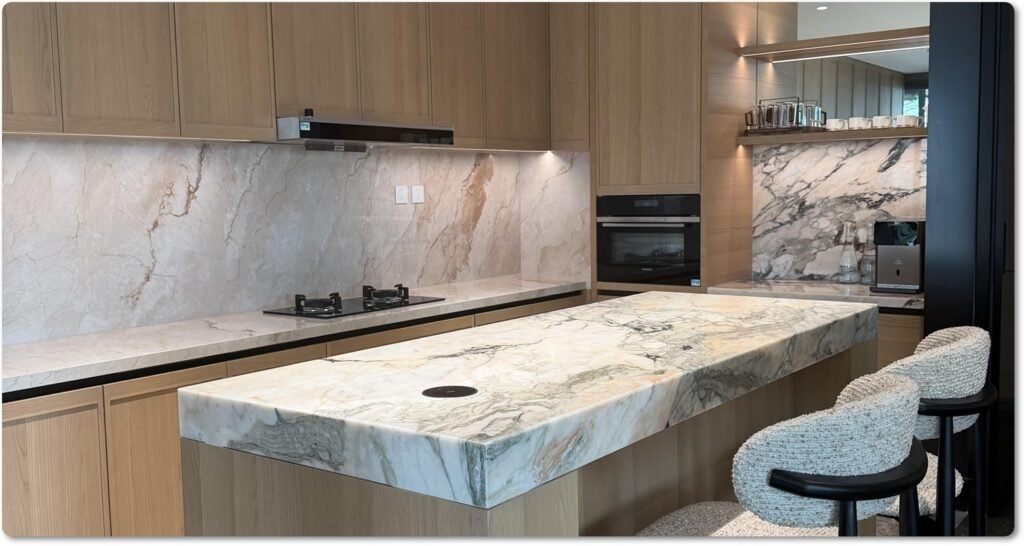
1. Scope and Definitions: Understanding Marble Tiles for Kitchen Walls
1.1 What Are Marble Tiles?
Marble tiles are dimension-stone products manufactured by cutting natural marble blocks or slabs into smaller units with specified dimensions, thicknesses, and surface finishes.
Commercial marble tile products may include:
Standard rectangular and square marble tiles
Large-format marble wall tiles
Marble backsplash tiles
Marble mosaic tiles
Marble border and decorative strips
Marble waterjet medallions
Marble feature wall panels
Bookmatched marble wall installations
Custom-cut marble decorative components
Natural marble is a metamorphic rock composed primarily of recrystallized carbonate minerals, commonly calcite or dolomite.
The geological composition influences color, veining, hardness, absorption, acid sensitivity, and fabrication behavior.
Consequently, two marble varieties with similar appearances may have significantly different physical properties.
1.2 Marble Tiles vs. Marble-Look Tiles
The term marble tiles is sometimes used loosely in the flooring and interior design markets.
However, buyers should distinguish between genuine natural marble and manufactured marble-look products.
| Product | Material Composition | Main Characteristics |
|---|---|---|
| Natural marble tiles | Natural carbonate stone | Authentic mineral patterns and natural variation |
| Marble-look porcelain tiles | Fired ceramic material | Printed or digitally reproduced marble appearance |
| Marble-look ceramic tiles | Ceramic body with decorative surface | Manufactured decorative alternative |
| Engineered marble | Natural stone particles and binders | Factory-controlled composition and appearance |
These products are not interchangeable from a technical or commercial perspective.
Specifications, installation systems, cleaning instructions,s and performance claims should identify the actual material.
1.3 Typical Kitchen Applications
Marble tiles can be incorporated into several areas of a kitchen:
Backsplashes behind sinks and preparation counters.
Decorative walls behind kitchen islands.
Full-height kitchen feature walls.
Range hood surrounds and decorative cooking-area walls.
Mosaic panels and geometric patterns.
Kitchen flooring.
Breakfast areas and adjoining dining spaces.
Decorative transitions between countertops and cabinetry.
The suitability of each application depends on the stone, installation system, maintenance expectations, ns and exposure conditions.
2. Technical Evaluation: Marble Tiles for Kitchen Walls and Backsplashes
2.1 Why Marble Is Popular for Kitchen Backsplashes
Marble backsplashes create a visual connection between kitchen countertops, cabinetry, try and wall surfaces.
Unlike repetitive manufactured patterns, natural marble provides variations in veining, mineral distribution,tion and background color.
Popular design directions include:
White marble with grey veining.
Calacatta-style marble with dramatic patterns.
Carrara marble with softer grey movement.
Black marble with contrasting white veins.
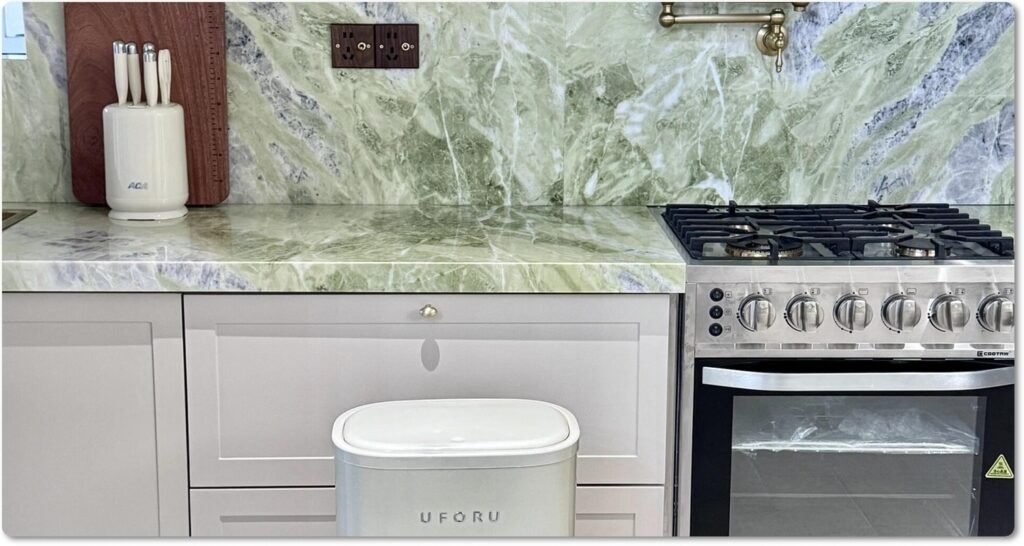
Green marble for statement kitchen interiors.
Beige and cream marble for warm contemporary kitchens.
Bookmatched marble panels for premium residential projects.
The backsplash is particularly suitable for natural marble because it generally experiences less direct mechanical abrasion than flooring.
However, backsplash surfaces near sinks, cooking equipment,pment and food preparation areas may encounter water, oils, detergents, acidic liquids,iquids and heat.
Material selection must reflect these conditions.
2.2 Common Marble Backsplash Layouts
Subway Pattern
Rectangular marble tiles are installed in a staggered brick pattern.
This layout works particularly well with white and grey marble in transitional and contemporary kitchens.
Stacked Pattern
Tiles are aligned vertically or horizontally to create a clean geometric appearance.
It is frequently used in minimalist kitchens and modern cabinet designs.
Herringbone Pattern
Rectangular tiles are arranged at alternating angles.
The pattern creates visual movement without requiring a large decorative centerpiece.
Large-Format Marble Panels
Large marble tiles reduce the number of grout joints and allow natural veining to become a major design feature.
They require careful substrate preparation, handling,andling and installation planning.
Bookmatched Marble Walls
Two or more slabs are selected and positioned so that their veins create mirrored or continuous patterns.
Bookmatching is particularly effective behind kitchen islands, integrated dining areas and premium feature walls.
2.3 Choosing Marble Surface Finishes
Different finishes change both the visual appearance and maintenance characteristics of marble.
| Finish | Appearance | Typical Application | Considerations |
|---|---|---|---|
| Polished | Reflective, glossy | Backsplashes, feature walls | Shows fingerprints and etching more visibly |
| Honed | Smooth, matte | Kitchen walls, flooring | Etching may be less visually obvious but remains possible |
| Brushed | Soft, textured | Decorative wall surfaces | Texture can retain dirt |
| Leathered | Subtle tactile texture | Selected decorative applications | Requires finish-specific cleaning |
| Sandblasted | Rougher, matte | Selected textured surfaces | Needs project-specific evaluation |
| Antique | Aged appearance | Traditional and decorative interiors | Surface profile and maintenance require approval |
A polished finish does not make marble chemically resistant.
Likewise, a honed finish does not eliminate the possibility of acid etching.
The correct finish should be selected according to appearance, cleaning conditions, installation location, and expected use.
2.4 Marble Tile Dimensions and Thickness
Commonly requested marble tile formats include:
12 x 12 inches
12 x 24 inches
18 x 18 inches
24 x 24 inches
24 x 48 inches
300 x 600 mm
600 x 600 mm
600 x 1200 mm
Custom dimensions
These are commercial examples rather than universal standard sizes.
Thickness may vary according to the product, stone characteristics, fabrication processes,s and installation requirements.
Commonly specified thicknesses include 10 mm, 12 mm, 15 mm, 18 mm and 20 mm.
For custom marble tiles, buyers should specify:
Nominal dimensions.
Actual finished dimensions.
Thickness and tolerance.
Edge profile.
Surface finish.
Calibration requirements.
Corner and edge protection.
Permitted natural variation.
Large-format marble tiles require particular attention to flatness, substrate preparation, handling, and installation support.
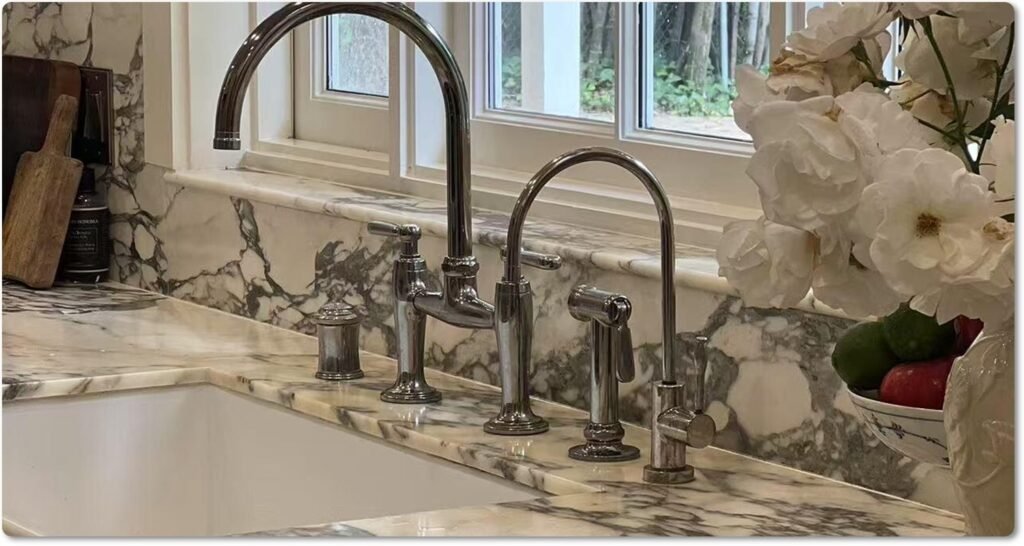
3. Marble Kitchen Flooring: Technical and Performance Considerations
Natural marble flooring can create visual continuity between kitchen walls, countertops, and adjoining living spaces.
However, kitchen floors experience more demanding conditions than decorative wall installations.
3.1 Abrasion and Foot Traffic
Kitchen flooring is exposed to:
Repeated pedestrian traffic.
Dust and abrasive particles.
Furniture movement.
Dropped kitchen utensils.
Cleaning equipment.
Occasional food and liquid spills.
Marble varieties differ in mineral composition and abrasion resistance.
For commercial and residential flooring projects, buyers should request relevant test information rather than assuming that all marble performs identically.
ASTM C241/C241M provides a test method for evaluating the abrasion resistance of stone subjected to foot traffic.
ASTM C97/C97M addresses water absorption and bulk specific gravity of dimension stone.
These tests provide useful technical information, but the results must be interpreted in relation to the actual application.
3.2 Slip Resistance
Polished marble flooring may become slippery when wet.
This is especially relevant in kitchens, restaurants, hotel food preparation areas and other environments where spills occur.
Buyers should specify the required slip-performance evaluation method and acceptance criteria for the project.
The surface finish alone should not be treated as proof of compliance with a particular slip-resistance requirement.
For public or commercial projects, confirm applicable local building regulations and flooring specifications before ordering.
3.3 Is Marble Suitable for High-Traffic Commercial Kitchens?
Natural marble may be appropriate for selected commercial interior flooring and decorative areas.
However, intensive food preparation environments can involve aggressive cleaning chemicals, grease, repeated moisture exposure, and demanding sanitation procedures.
In these conditions, other materials may be more practical.
For example:
Porcelain tile for high-cleaning-frequency areas.
Quarry tile or other specified commercial flooring systems.
Approved non-slip flooring for wet work areas.
Natural marble for customer-facing decorative areas.
A practical design strategy is to use marble where its aesthetic value is strongest while specifying more chemically and mechanically resistant materials for demanding operational zones.
4. Natural Marble vs. Marble-Look Tiles: Which Is Better for Kitchens?
Choosing between natural marble and marble-look porcelain is one of the most important decisions in kitchen surface procurement.
Neither material is universally superior.
The correct selection depends on design objectives, performance requirements, budget, maintenance expectations, and project positioning.
4.1 Natural Marble: Advantages and Limitations
Advantages
Authentic geological patterns.
Natural variation between individual tiles.
Premium architectural appearance.
Compatibility with natural marble countertops and other stone products.
Potential for custom fabrication and decorative detailing.
Availability in numerous colors and geological varieties.
Limitations
Sensitivity to acidic substances.
Possible staining depending on porosity and exposure.
Variation in color and veining.
Need for appropriate installation and maintenance.
Possible additional fabrication and selection costs.
Surface damage cannot always be prevented by sealing.
Natural marble is especially suitable for projects where authentic stone character is an important design requirement.
4.2 Marble-Look Porcelain: Advantages and Limitations
Marble-look porcelain tiles reproduce marble-inspired patterns using digital decoration and ceramic manufacturing technology.
Their main advantages may include:
Generally lower water absorption.
Better resistance to many household acids than calcite-rich marble.
Consistent manufactured patterns.
Availability in large-format dimensions.
Lower routine sealing requirements in many product systems.
However, porcelain does not reproduce every characteristic of natural marble.
Printed patterns may repeat, and the material lacks the geological depth and individual mineral variation of genuine stone.
4.3 Comparison Table
| Evaluation Factor | Natural Marble | Marble-Look Porcelain |
|---|---|---|
| Material origin | Natural stone | Manufactured ceramic |
| Pattern | Natural mineral variation | Printed or digitally reproduced |
| Acid sensitivity | Generally high for calcitic marble | Generally lower |
| Water absorption | Varies by stone | Typically very low |
| Sealing | May be recommended | Usually not required for the tile body |
| Repair | Specialized stone restoration | Replacement or ceramic repair |
| Pattern consistency | Naturally variable | More controlled |
| Custom waterjet fabrication | Suitable | Depends on product and processing |
| Luxury natural-stone positioning | Strong | Design imitation |
| Maintenance | Stone-specific | Product-specific |
4.4 Procurement Recommendation
For premium residential kitchens, hospitality interiors and custom-designed feature walls, natural marble offers an authentic material identity.
For commercial kitchens requiring frequent aggressive cleaning, predictable surface performance and reduced maintenance, marble-look porcelain may be the more appropriate specification.
A mixed-material approach is also effective:
Natural marble backsplash.
Porcelain flooring.
Natural marble island feature wall.
Engineered or other specified countertop material.
This approach balances appearance and operational requirements.

5. Heat, Acid and Stain Resistance: What Kitchen Buyers Must Know
Kitchen environments expose natural marble to several potential sources of surface damage.
Understanding these risks is essential before specifying marble tiles for kitchen walls and backsplashes.
5.1 Acid Resistance
Many marble varieties contain calcite, which reacts with acids.
Common household substances that can damage calcite-rich marble include:
Lemon juice.
Vinegar.
Wine.
Tomato-based sauces.
Citrus cleaning products.
Acidic descaling agents.
Acid exposure can cause etching.
Etching is a chemical alteration of the stone surface rather than simply a removable stain.
It may appear as dull spots, changes in gloss, or surface texture.
The Natural Stone Institute recommends avoiding acidic cleaning products on acid-sensitive natural stone and using neutral cleaners designed for stone surfaces.
5.2 Stain Resistance
Marble may absorb liquids depending on its mineral structure, porosity, surface treatment,t and exposure conditions.
Common kitchen staining agents include:
Cooking oils.
Coffee.
Tea.
Wine.
Food coloring.
Grease.
Sauces.
An appropriate impregnating sealer may reduce the rate of liquid penetration in suitable marble varieties.
However, sealers do not make marble completely stain-proof or acid-proof.
The effectiveness of a sealer depends on the stone, product chemistry, application method, od and maintenance.
5.3 Heat Resistance
Natural marble is a stone material and can tolerate many ordinary indoor temperature conditions.
Nevertheless, sudden temperature changes, direct high-temperature exposure, thermal shock, ock and contact with hot cookware may create risks depending on the stone and installation assembly.
For kitchen backsplashes near cooktops:
Follow the appliance manufacturer’s clearance requirements.
Confirm the suitability of the complete wall assembly.
Use appropriate installation materials.
Avoid assuming that every marble variety has identical thermal behavior.
Consult the appliance and installation specifications.
Marble should not automatically be treated as a substitute for a tested fire-rated or heat-protection assembly.
5.4 Maintenance Recommendations
For routine cleaning:
Use a neutral-pH stone cleaner or a suitable mild detergent.
Avoid vinegar, lemon-based cleaners, and acidic descalers.
Remove spills promptly.
Use soft cleaning cloths.
Rinse cleaning residues where appropriate.
Follow the sealer manufacturer’s maintenance instructions.
Test cleaning products in an inconspicuous area before widespread use.
A maintenance plan should be provided to homeowners, hotel operators, and commercial facility managers.
6. Marble Mosaic Tiles and Waterjet Patterns: Custom Decorative Applications
Marble mosaic tiles allow designers to create more complex decorative surfaces than standard rectangular tiles.
They are particularly suitable for kitchen backsplashes, borders, feature panels, decorative niches,s and coordinated interior stone packages.
6.1 Common Marble Mosaic Types
Basketweave Mosaic
Small rectangular marble pieces create an interwoven visual pattern.
Herringbone Mosaic
Rectangular pieces are arranged in alternating directions to create a dynamic surface.
Hexagon Mosaic
Hexagonal marble pieces provide a geometric appearance suitable for contemporary and traditional interiors.
Penny Round Mosaic
Small circular pieces create a softer decorative texture.
Chevron Mosaic
Angled pieces form repeated V-shaped patterns.
Mixed-Stone Mosaic
Different marble colors and varieties are combined to create contrasting designs.
6.2 Waterjet Marble Mosaic Fabrication
Waterjet cutting uses a high-pressure water stream, often combined with abrasive material, to cut stone into complex shapes.
This technology enables manufacturers to produce:
Geometric marble mosaics.
Floral patterns.
Circular medallions.
Marble borders.
Decorative inlays.
Custom logos and motifs.
Multi-color stone compositions.
Intricate floor and wall designs.
Compared with simple straight cutting, waterjet fabrication offers greater flexibility for complex shapes and detailed patterns.
However, the final result depends on material quality, cutting parameters, component dimensions, assembly accuracy,cy and installation planning.
6.3 Important Quality Factors for Waterjet Products
Buyers should evaluate:
Cutting accuracy.
Pattern alignment.
Component size consistency.
Edge quality.
Joint spacing.
Color coordination.
Mesh backing compatibility, where applicable.
Panel dimensions.
Assembly stability.
Installation drawings.
For complicated designs, approve a full-size sample or representative production panel before mass production.
6.4 Custom Marble Medallions
Marble medallions can become focal points in luxury kitchens, hotel interiors, and large residential spaces.
A design may combine several marble colors to create:
Circular geometric patterns.
Compass-inspired designs.
Floral arrangements.
Traditional ornamental motifs.
Contemporary abstract patterns.
EDG Stone can be positioned as a custom stone fabrication source for waterjet medallions, mosaic panels, and decorative stone components.
For each project, buyers should submit CAD drawings, dimensions, material selections, and installation requirements.
7. Feature Walls and Decorative Marble Panels
Marble feature walls are increasingly used to connect kitchen spaces with dining areas, living rooms, and open-plan interiors.
They provide a visual focal point while allowing natural stone to become part of the overall architectural design.
7.1 Full-Height Marble Kitchen Walls
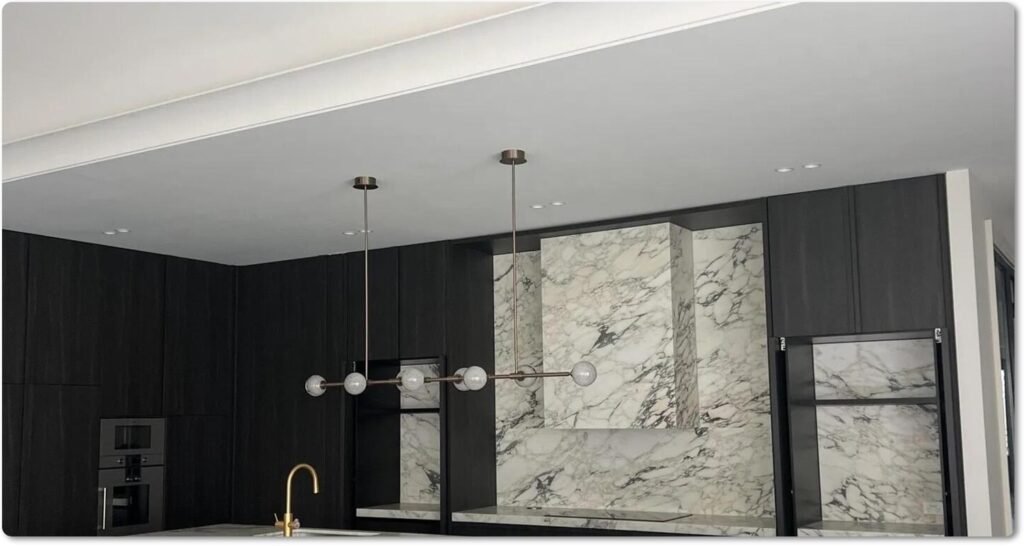
Full-height marble walls can extend from the countertop to the ceiling.
Potential applications include:
Kitchen island backgrounds.
Range hood feature walls.
Dining-area walls.
Open-plan kitchen transitions.
Decorative walls behind integrated shelving.
Large-format marble surfaces can reduce visible grout lines and emphasize natural veining.
7.2 Bookmatched Marble Panels
Bookmatching involves arranging adjacent marble pieces so that their natural patterns create a mirrored composition.
It is especially effective with strongly veined marble.
The process requires careful block or slab selection.
Buyers should confirm:
Matching material origin and production batch.
Vein direction.
Pattern continuity.
Panel sequence.
Finished dimensions.
Surface finish.
Installation orientation.
Digital layout drawings and photographs of the selected slabs should be approved before fabrication.
7.3 Decorative Stone and Mixed-Material Applications
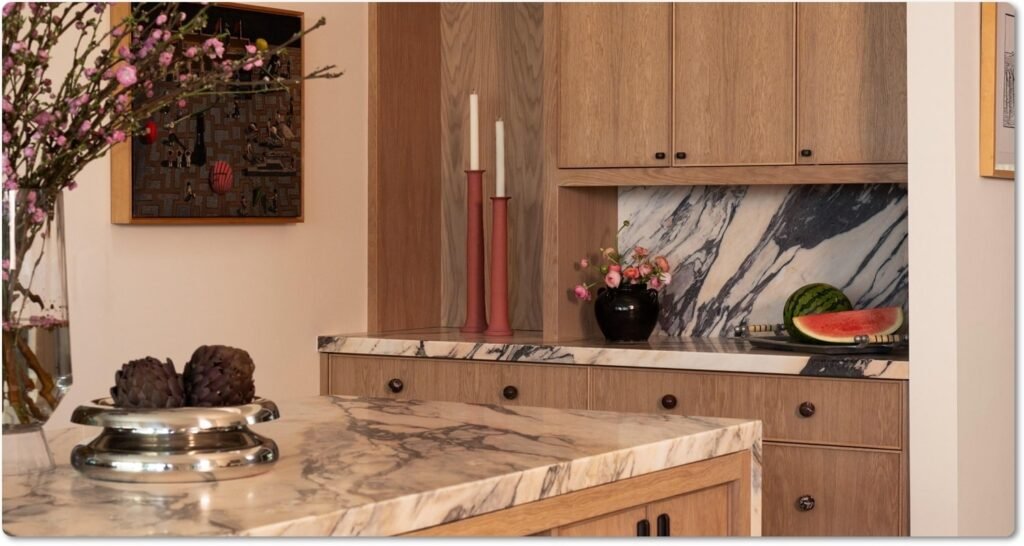
Marble walls can also be combined with:
Metal trims.
Wood cabinetry.
Glass shelving.
Stainless steel kitchen equipment.
Porcelain surfaces.
Engineered stone countertops.
The objective is to coordinate the color, texture,e and visual weight of each material.
For wholesale distributors and kitchen cabinet manufacturers, offering coordinated wall tiles, mosaics, decorative borders, rs and countertop materials can create additional value beyond selling individual tiles.
8. Matching Marble Tiles with Kitchen Countertops
One of the most important design considerations is the relationship between backsplash materials and countertop surfaces.
A coordinated kitchen package should consider color, veining, finish, thickness, ess and overall visual balance.
8.1 Matching the Same Marble Variety
Using the same marble variety for countertops and backsplashes creates a consistent appearance.
However, natural stone is not a manufactured product with perfectly identical patterns.
Even within the same quarry or block, individual pieces may differ.
Buyers should not assume that two products with the same commercial name will have identical color and veining.
For larger projects, material selection should be coordinated before fabrication.
8.2 Contrasting Marble Combinations
Designers may combine:
White marble countertops with dark marble backsplashes.
Grey marble countertops with white wall tiles.
Beige marble countertops with green marble accents.
Dramatic veined countertops with restrained mosaic patterns.
Plain countertops with decorative waterjet panels.
The selection should consider the overall kitchen color scheme and lighting conditions.
8.3 Coordinated Procurement for Cabinet Manufacturers
Kitchen cabinet manufacturers and wholesale distributors can benefit from sourcing a coordinated stone package.
A complete package may include:
| Product | Application |
|---|---|
| Marble countertops | Kitchen work surfaces |
| Marble backsplash tiles | Wall protection and decoration |
| Marble wall panels | Feature surfaces |
| Marble mosaics | Decorative details |
| Marble thresholds | Transitions |
| Marble shelves | Decorative and functional elements |
| Custom stone components | Project-specific requirements |
This strategy helps reduce design inconsistencies and simplifies supplier coordination.
9. Commercial Kitchen Design Limitations
Natural marble is not automatically suitable for every commercial kitchen application.
Restaurant kitchens, hotel food preparatifacilitiesi li, and institutional foodservice environments have more demanding sanitation and maintenance requirements than ordinary residential kitchens.
9.1 Decorative Zones vs. Food Preparation Zones
A useful distinction is between decorative surfaces and operational surfaces.
Decorative Zones
Examples:
Restaurant reception walls.
Hotel breakfast-area feature walls.
Dining-room decorative panels.
Customer-facing kitchen walls.
Decorative backsplashes outside intensive preparation zones.
Natural marble may be appropriate when cleaning and maintenance procedures are compatible with the material.
Operational Zones
Examples:
Commercial food preparation counters.
Heavy-duty wash areas.
Intensive food handling surfaces.
Areas exposed to aggressive cleaning chemicals.
These locations require materials and assemblies selected for their specific hygiene, cleanability, durability, ility and regulatory requirements.
9.2 Food Equipment Standards
NSF/ANSI 51-2025 addresses minimum public-health and sanitation requirements for materials used in commercial food equipment and its components.
However, this standard should not be interpreted as a blanket certification for every marble tile, wall, panel,l or building finish.
Project teams should distinguish between:
Food equipment materials.
Food-contact surfaces.
Building finishes.
Wall and floor coverings.
Decorative stone installations.
The applicable requirements depend on the actual function of the surface and the local regulatory framework.
9.3 Worker Safety During Stone Fabrication
Stone fabrication involves occupational safety considerations.
Cutting, grinding, grinding, grinding, and polishing stone can generate airborne particulate matter.
OSHA’s respirable crystalline silica standards, including 29 CFR 1910.1053 for general industry and 29 CFR 1926.1153 for construction, establish exposure-control requirements for covered workplaces.
Although marble generally contains less crystalline silica than many quartz-rich stones, fabrication operations still require appropriate risk assessment and controls.
Manufacturers should implement suitable engineering controls, wet processing where appropriate, dust collection, housekeeping procedures, worker training, and applicable protective measures.
Responsible fabrication is part of professional stone manufacturing.
10. Custom Marble Tile Fabrication: From Raw Blocks to Finished Products
Custom marble tile manufacturing requires coordinated control of raw materials, cutting, surface finishing, dimensional accuracy, and final inspection.
For kitchen cabinet companies, designers,s and wholesale buyers, a reliable manufacturer should be able to work from drawings and project specifications rather than relying exclusively on standard catalog products.
10.1 Raw Material Selection
The manufacturing process begins with marble block or slab selection.
Important considerations include:
Geological variety.
Color consistency.
Natural veining.
Visible cracks and fissures.
Mineral distribution.
Existing repairs.
Surface defects.
Available block dimensions.
Expected cutting yield.
Material selection should reflect the approved sample and the visual requirements of the final project.
10.2 Cutting and Calibration
Selected marble blocks or slabs are processed into tiles or custom components.
Operations may include:
Block or slab cutting.
Gang sawing or bridge-saw processing.
Tile cutting.
Thickness calibration.
Edge trimming.
Surface grinding.
Polishing or honing.
Custom profiling.
Waterjet cutting.
Final cleaning.
The process depends on the product type and required specifications.
10.3 Custom Edge Processing
Kitchen and decorative marble products may require:
Straight edges.
Beveled edges.
Bullnose profiles.
Chamfered edges.
Custom decorative profiles.
Mitered components.
Edge details should be clearly defined in the approved technical drawing.
10.4 EDG Stone Quality Control Procedures
For international B2B projects, quality control should cover the entire production chain rather than only the final product.
EDG Stone’s procurement and manufacturing quality-control framework can be presented in four stages:
Stage 1: Raw Material Inspection
The inspection focuses on:
Marble variety and material identification.
Color and vein characteristics.
Visible cracks and natural defects.
Material condition.
Sample-to-production consistency.
Suitability for the intended application.
Stage 2: In-Process Inspection
During production, inspection can include:
Cutting dimensions.
Thickness.
Edge processing.
Surface finishing.
Waterjet pattern accuracy.
Panel alignment.
Fabrication quality.
Stage 3: Finished Product Inspection
Before shipment, finished marble tiles and decorative products should be checked against the approved specifications.
Inspection items may include:
Length and width.
Thickness tolerance.
Flatness and squareness.
Surface finish.
Color and pattern consistency.
Edge condition.
Visible cracks and chips.
Quantity.
Product identification.
Acceptance criteria should be agreed upon before production.
Stage 4: Export Packaging Inspection
Packaging is particularly important for natural stone products because marble tiles can be damaged during handling, loading, and international transportation.
Export packaging checks should include:
Protective separation between stone pieces.
Appropriate cartons, crates or wooden packaging.
Moisture protection where required.
Corner and edge protection.
Secure palletization or crating.
Container loading arrangements.
Product labels and identification.
Packing list verification.
Photographic loading records.
For international shipments, packaging should be selected according to product dimensions, thickness, weight, transportation method,d and destination requirements.
11. Procurement Checklist: How to Buy Marble Tiles for Kitchen Projects
Professional buyers should establish a clear technical and commercial specification before placing an order.
The following checklist can be used by importers, kitchen cabinet manufacturers, contractors, rs and distributors.
11.1 Material Selection
Confirm natural marble or marble-look porcelain.
Specify the commercial marble name.
Request photographs of actual available material.
Approve a physical sample.
Confirm acceptable natural variation.
Specify the required color range and veining characteristics.
11.2 Technical Specifications
Product dimensions.
Thickness.
Dimensional tolerances.
Surface finish.
Edge processing.
Water absorption requirements where relevant.
Relevant mechanical properties for flooring applications.
Slip-performance requirements where applicable.
Installation method.
Intended interior or wet-area application.
11.3 Design and Fabrication
Provide CAD drawings.
Specify tile layout.
Confirm pattern direction.
Define grout joint dimensions.
Confirm mosaic assembly requirements.
Approve waterjet patterns.
Confirm panel numbering and installation sequence.
Approve pre-production samples.
11.4 Commercial and Logistics Requirements
Order quantity.
Packaging specification.
Shipping destination.
Incoterms.
Required delivery schedule.
Inspection arrangements.
Replacement and damage-claim procedures.
Spare material allowance.
Documentation requirements.
A written procurement specification reduces misunderstandings between the buyer, manufacturer, fabricator, and installer.
12. Cost and Risk Factors: What Determines Marble Tile Prices?
The price of marble tiles is influenced by more than the square-meter price of the raw material.
For importers and wholesale distributors, the complete landed cost should be evaluated.
12.1 Main Cost Components
| Cost Factor | Influence on Pricing |
|---|---|
| Marble variety | Quarry availability, rarity, and market demand |
| Material selection | Color consistency and vein selection |
| Tile dimensions | Cutting yield and processing requirements |
| Thickness | Material consumption and handling |
| Surface finish | Grinding, polishing or texturing |
| Edge processing | Additional machining operations |
| Waterjet fabrication | Cutting complexity and assembly labor |
| Mosaic assembly | Component count and backing requirements |
| Inspection | Sampling and quality-control requirements |
| Packaging | Crates, protective materials and loading |
| Transportation | Freight, insurance and destination charges |
12.2 Natural Stone Yield
Natural marble is a geological material.
Cracks, veins, color variation and block geometry influence usable production yield.
A project requiring highly consistent patterns may need additional material selection and more restrictive production controls.
Bookmatched panels and custom waterjet mosaics may require additional material planning.
12.3 Common Procurement Risks
Color Mismatch
A small sample may not represent the full production batch.
Solution: approve production photographs and establish an acceptable natural-variation range.
Dimensional Inconsistency
Poor calibration may create installation difficulties.
Solution: specify actual dimensions and tolerance requirements.
Surface Damage
Inadequate handling and packaging may cause chips, scratches, and breakage.
Solution: establish packaging requirements and conduct pre-shipment inspections.
Incorrect Material Specification
Commercial stone names may be used inconsistently.
Solution: confirm the material identity through samples, photographs, and relevant technical information.
Installation Failure
Unsuitable adhesives, substrates,s or installation methods can compromise the finished project.
Solution: coordinate the manufacturer, installer, er and project designer before production.
13. Supplier Evaluation: Choosing a Marble Tiles Manufacturer and Factory
A professional marble tiles manufacturer should demonstrate the ability to control material selection, fabrication, quality inspection, and export logistics.
For international buyers, evaluating a supplier only by the quoted price is insufficient.
13.1 Factory and Manufacturing Capabilities
Ask whether the supplier can provide:
Natural marble sourcing.
Block and slab selection.
Standard marble tile production.
Large-format marble wall tiles.
Custom cutting.
Thickness calibration.
Polished and honed finishes.
Edge processing.
Mosaic fabrication.
CNC machining.
Waterjet cutting.
Decorative panels.
Export packaging.
13.2 Quality Documentation
Request the following where applicable:
Material specifications.
Technical data sheets.
Relevant laboratory test reports.
Approved material samples.
Production inspection records.
Dimensional inspection records.
Final inspection photographs.
Packing photographs.
Commercial invoice and packing list.
Origin and shipping documentation as required.
13.3 Why Factory-Direct Sourcing Matters
Working directly with a manufacturer may improve communication about material selection, production specifications, customization, and inspection.
For wholesalers and distributors, a manufacturer with flexible fabrication capabilities can support more than one product category.
Instead of purchasing only standard marble tiles, buyers may source coordinated products such as:
Marble wall tiles.
Marble backsplash tiles.
Marble mosaic sheets.
Waterjet medallions.
Marble borders.
Custom wall panels.
Kitchen countertops.
Vanity tops.
Cut-to-size stone products.
EDG Stone is positioned as a Chinese natural stone manufacturer and exporter serving international B2B customers with natural stone products and custom fabrication solutions.
14. Regulations, Standards and Industry Direction for 2026
International marble tile procurement should consider material standards, installation standards, occupational safety,afety and destination-market requirements.
No single standard automatically certifies a marble tile as suitable for every kitchen application.
14.1 ASTM Standards for Natural Stone
Relevant references include:
ASTM C503/C503M-23
Standard Specification for Marble Dimension Stone.
This standard addresses material characteristics, physical requirements, and sampling for marble dimension stone.
ASTM C97/C97M
Standard Test Methods for Absorption and Bulk Specific Gravity of Dimension Stone.
Relevant when evaluating absorption characteristics and density.
ASTM C241/C241M-21
Standard Test Method for Abrasion Resistance of Stone Subjected to Foot Traffic.
Relevant when comparing stone varieties for flooring applications.
ASTM C1721-22
Standard Guide for Petrographic Examination of Dimension Stone.
Petrographic examination can help characterize mineral composition and geological features.
The applicable edition should be verified when writing a project specification or requesting laboratory testing.
14.2 ANSI and TCNA Installation Standards
Tile installation should be specified with reference to applicable industry standards and the project conditions.
Relevant references include:
ANSI A108.01-2026: General Requirements for Structures, Substrates and Preparation of Tile.
ANSI A108.5-2023: Setting of Ceramic Tile with Cement Mortar.
ANSI A118.1-2023: Dry-Set Cement Mortar.
ANSI A118.4-2023: Modified Dry-Set Cement Mortar.
ANSI A118.3-2021, reaffirmed 2025: Chemical-Resistant Epoxy Tile-Setting and Grouting Materials.
Important distinction: certain ANSI installation provisions specifically address ceramic tile. They should not automatically be applied to natural marble without confirming compatibility with the stone and the relevant installation method.
The 2026 TCNA Handbook for Ceramic, Glass and Stone Tile Installation is an important current reference for professional tile installation planning.
14.3 Commercial Foodservice Requirements
NSF/ANSI 51-2025 covers materials used in commercial food equipment.
It is relevant when specifying materials for covered food-equipment components, but does not automatically establish the compliance of all architectural marble wall and floor finishes.
Project teams should confirm the actual applicable foodservice, sanitation,itation and building requirements.
14.4 Occupational Silica Safety
Stone fabrication and installation activities must consider respirable crystalline silica exposure.
In the United States, relevant OSHA regulations include:
29 CFR 1910.1053 for general industry.
29 CFR 1926.1153 for construction.
The standards address exposure assessment, engineering controls, housekeeping, respiratory protection, training, and written exposure-control plans where applicable.
14.5 European Construction Products Regulation
Regulation (EU) 2024/3110 entered into force on January 7, 2025, with its main application beginning on January 8, 2026, subject to transitional provisions and product-specific harmonised technical specifications.
The revised framework strengthens the integration of product information, environmental performance and digital information requirements.
For marble tile exporters serving European buyers, the practical approach is to:
Identify the applicable product category.
Check the relevant harmonised technical specifications.
Confirm whether a Declaration of Performance and Conformity is required.
Review applicable environmental and product-information obligations.
Confirm documentation requirements with the importer.
Not every natural stone product is automatically subject to the same documentation pathway. Applicability must be determined for the specific product and market.
14.6 Industry Direction: 2026 and Beyond
Several procurement and design directions are important:
Material Traceability
Buyers increasingly benefit from clear identification of stone varieties, production batches, and inspection records.
Custom Fabrication
Waterjet mosaics, decorative wall panels and coordinated kitchen packages allow manufacturers to provide more project-specific products.
Digital Design Coordination
CAD drawings, digital slab photographs and panel numbering can reduce layout and installation errors.
Material Transparency
Clear technical documentation and accurate product descriptions are increasingly important in international procurement.
Responsible Manufacturing
Dust management, workplace safety, material utilization, and packaging efficiency are relevant considerations for professional stone manufacturers.
15. Practical RFQ Template: Marble Tiles for Kitchen and Wall Projects
The following template can be copied and sent to marble tile manufacturers, factories, wholesalers, and exporters.
Marble Tiles RFQ – Kitchen Walls, Backsplashes and Decorative Applications
A. Buyer Information
Company Name:
Contact Person:
Country:
Email:
Website:
B. Project Information
Project Name:
Project Location:
Project Type: Residential / Hotel / Restaurant / Commercial / Other
Application: Kitchen Backsplash / Wall Tiles / Feature Wall / Flooring / Mosaic / Decorative Panel
Estimated Quantity:
Required Delivery Date:
C. Material Requirements
Material: Natural Marble / Marble-Look Porcelain / Other
Marble Variety:
Color:
Preferred Veining:
Material Origin (if specified):
Sample Required: Yes / No
Reference Images Attached: Yes / No
D. Product Specifications
Tile Size:
Thickness:
Surface Finish:
Edge Profile:
Dimensional Tolerance:
Custom Cutting Required: Yes / No
Waterjet Fabrication Required: Yes / No
Mosaic Pattern:
CAD Drawing Available: Yes / No
E. Quality Requirements
Approved Sample:
Color Variation Criteria:
Surface Defect Criteria:
Dimensional Inspection:
Test Reports Required:
Pre-Shipment Inspection:
Packaging Requirements:
F. Commercial Requirements
Quantity:
Unit:
Target Price:
Incoterms: EXW / FOB / CIF / Other
Destination Port:
Packaging:
Payment Terms:
Estimated Production Lead Time:
G. Supplier Response
Please provide:
Available marble varieties.
Actual material photographs.
Technical specifications.
Product quotation.
Fabrication capabilities.
Sample arrangements.
Quality-control procedures.
Export packaging details.
Estimated production schedule.
Relevant certificates and test reports, where applicable.
A detailed RFQ allows buyers to compare suppliers on material, fabrication, quality, and logistics rather than price alone.
16. Frequently Asked Questions: Marble Tiles for Kitchens and Walls
1. Are marble tiles good for kitchen backsplashes?
Yes. Natural marble is suitable for many residential kitchen backsplashes and decorative wall applications. However, marble is sensitive to acids and may stain depending on its properties and exposure. Proper sealing where appropriate, prompt spill removal,l and neutral cleaning products are recommended.
2. Are marble tiles suitable for kitchen walls behind a stove?
They can be used in suitable installations, but the complete assembly must meet the appliance manufacturer’s clearance and installation requirements. Heat exposure, thermal movement, adhesives, es and the actual cooking equipment should be evaluated before installation.
3. What is the best marble for kitchen backsplash tiles?
There is no universally best marble. Carrara, Calacatta-style, white, grey, beige, black, ack and green marble varieties are popular design choices. The correct selection depends on color preference, veining, material properties, budget,dget and maintenance expectations.
4. Are marble mosaic tiles suitable for kitchen backsplashes?
Yes. Marble mosaic tiles are suitable for many decorative backsplash applications. Buyers should evaluate the quality of the individual pieces, joint spacing, mesh backing, installation materials, rials and maintenance requirements.
5. Are marble tiles better than marble-look porcelain tiles?
Natural marble offers authentic geological patterns and a premium natural-stone appearance. Marble-look porcelain generally offers better resistance to household acids and lower maintenance requirements. The best option depends on the intended application and project priorities.
6. Do marble backsplash tiles need sealing?
Some marble varieties benefit from an appropriate impregnating sealer. The decision depends on the stone’s porosity, intended use, exposure, and the sealer manufacturer’s recommendations. Sealing does not make marble acid-proof or completely stain-proof.
7. Can marble tiles be customized for kitchen wall designs?
Yes. Professional stone factories can manufacture custom sizes, thicknesses, edge profiles, mosaic patterns, decorative borders, and waterjet-cut components. CAD drawings and approved samples are recommended for customized projects.
8. What thickness is recommended for marble wall tiles?
There is no single thickness suitable for every project. Common commercial options include 10 mm, 12 mm, 15 m,m and 18 mm, subject to the stone, dimensions, substrate, installation system, and handling requirements. The final thickness should be approved by the project designer and installer.
9. Can marble tiles be used for commercial kitchen walls?
They may be suitable for selected decorative walls and customer-facing interior areas. However, intensive food preparation and cleaning zones require materials selected for their hygiene, cleanability, chemical resistance,e and applicable regulatory requirements.
10. How do I choose a reliable marble tiles manufacturer or wholesale supplier?
Evaluate material sourcing, actual product photographs, fabrication capabilities, dimensional control, inspection procedures, technical documentation, packaging quality, ty and export experience. Request samples and a written specification before placing a bulk order.
17. Semantic Insight: How to Specify, Design and Procure Marble Tiles for Modern Kitchens
What Makes Natural Marble Different from Marble-Look Tiles?
Natural marble is a geological material with mineral structures, natural veins, and variations formed through geological processes. Marble-look porcelain is a manufactured ceramic product designed to reproduce some of these visual characteristics.
This difference influences appearance, fabrication, maintenance,e and procurement.
The choice should be determined by the project’s material objectives rather than appearance alone.
Why Are Marble Backsplashes Popular in Premium Kitchen Design?
A backsplash is one of the most visible surfaces in a kitchen.
It connects the countertop, cabinetry, wall, ll and lighting design.
Natural marble introduces mineral variation and visual depth that can complement both traditional and contemporary interiors.
Full-height marble backsplashes and bookmatched wall panels can create a continuous architectural surface, while small-format mosaics offer a more detailed decorative language.
How Should Buyers Evaluate Marble Tile Quality?
Quality should be evaluated through a combination of material characteristics, manufacturing accuracy,acy and application suitability.
A reliable evaluation process includes:
Confirming the stone variety.
Reviewing actual material photographs.
Approving representative samples.
Checking dimensions and thickness.
Evaluating surface finish.
Reviewing relevant physical test information.
Inspecting fabrication details.
Confirming packaging specifications.
A visually attractive sample is not sufficient evidence of production consistency.
Which Applications Are Best for Natural Marble?
Natural marble is particularly valuable for:
Kitchen backsplashes.
Decorative wall cladding.
Feature walls.
Marble mosaics.
Waterjet medallions.
Decorative borders.
Coordinated kitchen interior packages.
For demanding operational surfaces, alternative materials may offer more practical performance.
What Should Importers and Wholesale Distributors Consider?
Importers should evaluate the complete commercial supply chain.
This includes material availability, production capacity, sample approval, batch consistency, fabrication yield, inspection, packaging, and transportation.
Wholesale distributors should also consider the potential to develop coordinated product collections rather than relying on a limited range of standard tile sizes.
How Is Custom Marble Fabrication Changing Kitchen Design?
Modern fabrication technologies enable natural marble to be manufactured into more than standard tiles.
CNC machining, precision cutting,g and waterjet processing allow manufacturers to produce decorative patterns, custom mosaics, borders, panels, ls and integrated stone components.
This creates opportunities for kitchen cabinet brands, interior designers and stone distributors to develop differentiated products.
What Is the Future Direction of Marble Tile Procurement?
The direction of professional stone procurement is moving toward better product identification, clearer technical specifications, documented quality inspection, digital design coordination, and more customized manufacturing.
Buyers are increasingly evaluating suppliers based on the ability to deliver a complete and traceable product package.
For a professional marble tiles manufacturer, product quality is not limited to the appearance of the finished stone. It includes material selection, manufacturing accuracy, installation compatibility, inspection,n and safe international transportation.
18. EDG Stone: Natural Marble Tiles, Kitchen Wall Cladding and Custom Stone Fabrication
EDG Stone is a Chinese natural stone manufacturer and exporter specializing in marble, granite, quartzite, engineered stone, and customized stone products.
For kitchen cabinet manufacturers, contractors, designers, importers,s and wholesale distributors, EDG Stone provides a range of stone sourcing and fabrication solutions.
Marble Products and Applications
EDG Stone’s product and fabrication categories include:
Natural marble tiles.
Marble wall tiles.
Marble backsplash products.
Marble mosaics.
Waterjet marble medallions.
Custom marble decorative panels.
Marble wall cladding.
Kitchen countertops.
Cut-to-size stone products.
Custom stone fabrication.
Manufacturing and Quality Control
EDG Stone’s quality-control approach covers four important stages:
Raw material inspection.
In-process manufacturing inspection.
Finished product inspection.
Export packaging and loading inspection.
This process helps establish a clearer quality-control framework for international stone procurement.
Custom Fabrication Capabilities
Project-specific fabrication may include:
CNC processing.
Waterjet cutting.
Custom dimensions.
Edge profiling.
Mosaic assembly.
Decorative patterns.
Stone wall panels.
Custom-cut kitchen components.
Buyers can provide drawings, reference photographs, dimensions, material preferences, es and project quantities for evaluation.
Who Can Work with EDG Stone?
EDG Stone welcomes inquiries from:
Kitchen cabinet manufacturers.
Kitchen renovation contractors.
Interior designers.
Marble and stone importers.
Wholesale distributors.
Stone fabricators.
Hotel and hospitality procurement teams.
Residential and commercial project developers.
Whether you require standard marble tiles, custom backsplash panels, waterjet mosaics, or coordinated kitchen stone products, the procurement process can begin with your material selection and project specifications.
Request a Marble Tiles Quotation
To receive a project-specific quotation, prepare the following information:
Preferred marble variety.
Tile dimensions and thickness.
Surface finish.
Required quantity.
Application area.
Reference photographs or CAD drawings.
Shipping destination.
Target delivery schedule.
Contact EDG Stone to discuss marble tiles, marble wall cladding, kitchen backsplash products, decorative mosaics,s and custom stone fabrication.
Website: https://www.edgstone.com/
Explore EDG Stone’s stone products and manufacturing capabilities, and submit your project requirements for a customized quotation.
References and Technical Resources
The following publications and regulatory resources provide a technical foundation for the material selection, installation, maintenance,ce and procurement recommendations in this guide.
ASTM International. ASTM C503/C503M-23, Standard Specification for Marble Dimension Stone. https://www.astm.org/c0503_c0503m-23.html
ASTM International. ASTM C97/C97M, Standard Test Methods for Absorption and Bulk Specific Gravity of Dimension Stone. https://www.astm.org/
ASTM International. ASTM C241/C241M-21, Standard Test Method for Abrasion Resistance of Stone Subjected to Foot Traffic. https://www.astm.org/
ASTM International. ASTM C1721-22, Standard Guide for Petrographic Examination of Dimension Stone. https://www.astm.org/
Natural Stone Institute. ASTM Standards Relevant to Natural Stone. https://www.naturalstoneinstitute.org/designprofessionals/astm/
Natural Stone Institute. Care and Cleaning of Natural Stone. https://www.naturalstoneinstitute.org/consumers/care/
Tile Council of North America. ANSI Standards and Installation Specifications. https://tcnatile.com/resource-center/ansi-standards/
NSF International. NSF/ANSI 51-2025, Food Equipment Materials. https://www.nsf.org/nsf-standards/standards-portfolio/food-equipment-standards
U.S. Occupational Safety and Health Administration. 29 CFR 1910.1053 and 29 CFR 1926.1153, Respirable Crystalline Silica Standards. https://www.osha.gov/silica-crystalline
European Union. Regulation (EU) 2024/3110 on Harmonised Rules for the Marketing of Construction Products. https://eur-lex.europa.eu/eli/reg/2024/3110/oj
Technical Note: Standards and regulatory requirements may be revised. Buyers, manufacturers, designers, installers, and contractors should verify the latest applicable editions, product-category requirements, local building codes, and installation specifications before finalizing a project.