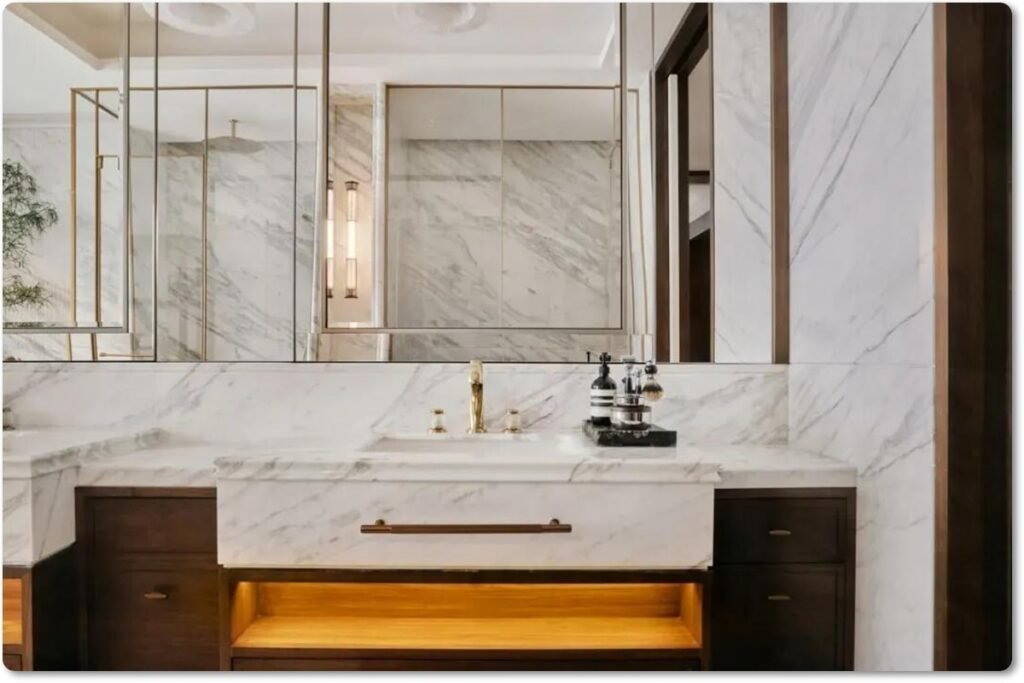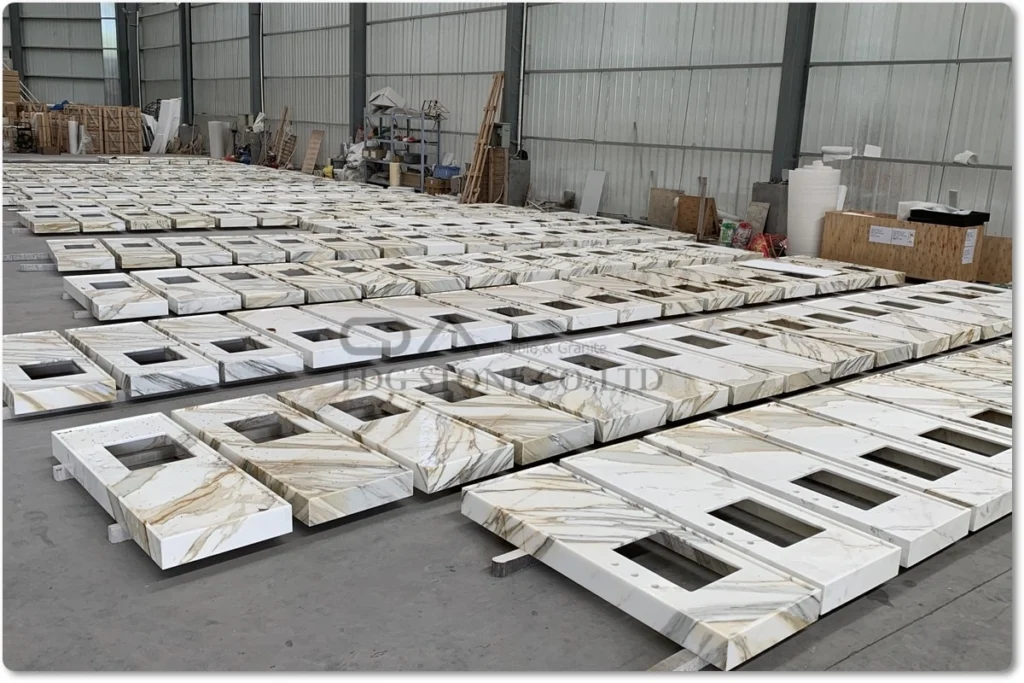
1. Executive Summary: What Are the Marble Tile Trends for 2026?
Quick Summary:
The defining marble tile design directions for 2026 include warm beige and cream palettes, nature-inspired green marble, large-format surfaces, expressive natural veining, bookmatched stone layouts, tactile finishes, and understated luxury. These directions reflect a broader preference for authentic materials, organic visual movement, and sophisticated interiors. Coverings 2026 also highlights tactile surfaces, jade-inspired colors, organic minimalism, artistic expression, and advanced surface technologies across the wider tile industry. However, ceramic and porcelain innovations should not automatically be interpreted as natural marble characteristics. For architects, developers and importers, successful marble specification requires evaluating material suitability, finish performance, dimensional consistency, fabrication quality and maintenance requirements alongside visual appeal.
The 2026 tile design market is increasingly focused on materials that create atmosphere rather than simply decorate a surface. Architects and interior designers are exploring natural textures, warmer colors, expressive patterns, and carefully coordinated materials to create interiors that feel more personal and enduring.
Natural marble remains an important material in this direction because every slab contains geological characteristics that cannot be reproduced identically. Mineral composition, veining, crystallization, color variation, and surface finishing contribute to the individuality of each marble collection.
The 2026 Coverings trends announcement provides a useful reference for understanding the wider tile market. Its ten identified directions include Articulated Accents, Brutalist Sanctuary, Gilded Age, Haptic Experience, Jade Terrain, Micro-Illusions, Organic Minimalism, Surface Technologies, Tailored Craft, and Tile as Art.
These are industry-wide tile design trends, not ten independently verified natural marble trends. Nevertheless, several offer valuable inspiration for natural stone applications, particularly organic colors, tactile surfaces, artistic layouts, and material authenticity.
For commercial buyers, the opportunity is to translate these design directions into practical specifications.
A beautiful marble tile collection must also meet requirements for thickness, dimensional tolerance, absorption, mechanical performance, finish consistency, installation conditions, and maintenance.
EDG Stone approaches this process through natural stone selection, factory fabrication, quality inspections, and export packaging, helping international buyers source marble tiles and customized stone products for residential and commercial projects.
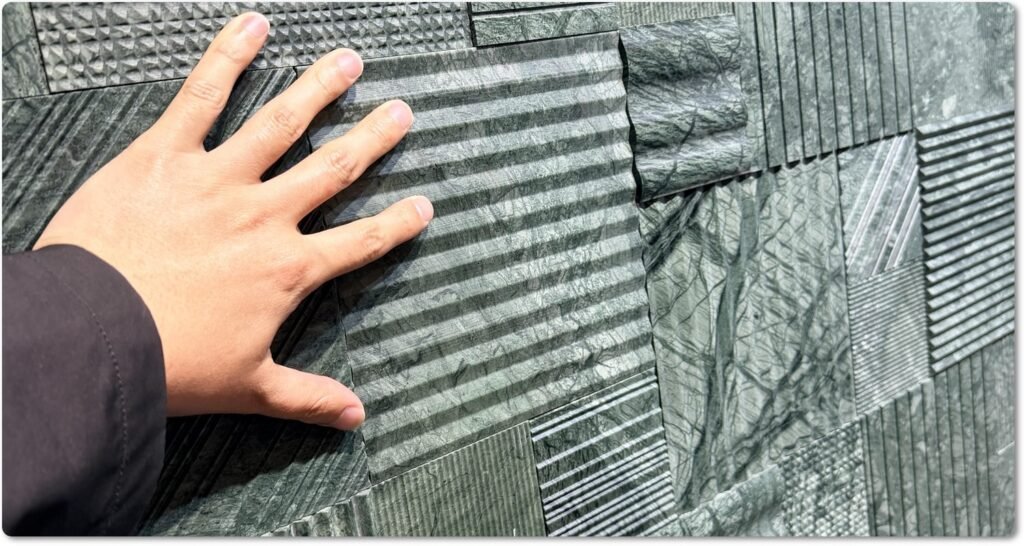
2. Scope and Definitions: Understanding Marble Tile Trends in 2026
2.1 What Are Natural Marble Tiles?
Natural marble tiles are dimensioned stone products manufactured from quarried marble blocks or slabs.
Geologically, marble is a metamorphic rock composed predominantly of recrystallized carbonate minerals, commonly calcite or dolomite. Its appearance depends on the original rock, geological processes, mineral impurities, and metamorphic conditions.
Natural marble tiles are typically manufactured through several stages:
Quarrying and block selection.
Block cutting or slab production.
Slab inspection and material grading.
Tile cutting to specified dimensions.
Surface finishing.
Edge processing and calibration where required.
Quality inspection.
Protective packaging and shipment.
Unlike digitally printed ceramic tiles, natural marble lacks a standardized printed pattern. Its veins, mineral concentrations, and color transitions are geological features.
2.2 Natural Marble vs. Ceramic and Porcelain Tiles
An important distinction in 2026 design research is the difference between natural stone trends and manufactured tile innovations.
| Category | Natural Marble Tiles | Ceramic / Porcelain Tiles |
|---|---|---|
| Raw material | Natural quarried stone | Processed ceramic materials |
| Appearance | Geological veining and mineral variation | Printed, glazed or engineered patterns |
| Color consistency | Naturally variable | Generally more controlled |
| Surface technology | Polishing, honing, brushing, leathering and other stone processes | Glazing, digital printing, embossing and advanced surface technologies |
| Maintenance | Depends on stone composition, finish and application | Depends on product type and technical specification |
| Customization | Cutting, sizing, edging, waterjet and stone fabrication | Factory-controlled formats and surface designs |
| Main attraction | Authentic geological character | Design consistency and manufactured performance |
This distinction matters when interpreting the 2026 tile trends.
For example, Coverings’ Haptic Experience and Surface Technologies trends emphasize advanced ceramic manufacturing, dimensional glazing,g and technologically enhanced surfaces.
Natural marble can participate in the broader tactile design direction through honed, brushed, leathered, or other mechanically finished surfaces. However, these are different manufacturing processes.
Likewise, digitally printed jade-effect porcelain is not the same material as natural green marble.
2.3 What Does 2026 Marble Tile Design Mean for Buyers?
For buyers, marble tiles 2026 should be understood as a combination of:
Color and material selection.
Surface finish and tactile experience.
Tile dimensions and layout.
Natural pattern variation.
Fabrication and installation requirements.
Long-term maintenance.
Project-specific procurement specifications.
The most effective design decisions balance visual character with measurable material performance.
3. Technical Evaluation: The Main Marble Tile Design Directions for 2026
3.1 Warm Beige, Cream and Earth-Tone Marble
Warm neutral colors remain an important design direction for sophisticated residential and hospitality interiors.
Rather than relying exclusively on cool white and grey surfaces, designers can introduce warmer natural materials to create more inviting spaces.
Popular color directions include:
Beige marble.
Cream marble.
Ivory marble.
Light brown marble.
Golden beige marble.
Travertine-inspired natural stone.
Warm grey and taupe marble.
Examples of relevant natural stone selections include Crema Marfil, Botticino, Travertine, Light Emperador, and other beige-toned marble varieties.
Why Are Warm Marble Colors Important?
Warm-colored marble coordinates effectively with:
Natural oak and walnut furniture.
Bronze and brushed brass hardware.
Warm white cabinetry.
Textured wall finishes.
Neutral upholstery.
Natural linen and other organic materials.
For luxury bathrooms, beige marble floor tiles can create a calm visual foundation. In hotel lobbies, larger beige marble panels can establish an understated and welcoming atmosphere.
For residential developers, consistent color selection across flooring, bathrooms,s and common areas can help create a coordinated interior specification.
Procurement Considerations
Natural beige marble may contain variations in background tone, veins, mineral deposits, ts and localized color concentrations.
Buyers should request:
Current slab photographs.
Representative tile samples.
Approved color-range references.
Surface finish samples.
Production batch identification.
A small sample is useful for evaluating color and finish, but it cannot represent the complete natural variation of a production batch.
3.2 Green Marble and Nature-Inspired Interiors
Green is one of the most recognizable nature-inspired color directions in the 2026 tile trend conversation.
Coverings identified Jade Terrain as a major tile trend, emphasizing green tones ranging from soft pastel shades to turquoise, mossy,ssy and deeper earthy greens.
This trend is particularly relevant to natural marble design because green marble offers genuine mineral variation and geological depth.
Popular natural green marble selections include:
Verde Guatemala.
Verde Alpi.
Rainforest Green.
Ming Green.
Tinos Green.
Other regionally sourced green marble varieties.
How to Use Green Marble in Interior Design
Green marble bathroom walls
Green marble can create a distinctive feature wall behind a bathtub or vanity. Pairing it with cream-colored flooring and warm metallic fixtures can balance the overall composition.
Green marble kitchen islands
A green marble island can become the main visual element in a neutral kitchen. Designers should evaluate the particular stone’s absorption, chemical sensitivity, and suitability for food-preparation environments.
Green marble hotel interiors
Hospitality projects can use green marble for reception counters, decorative wall panels, elevator surrounds and selected feature floors.
Green marble furniture and decorative products
Smaller stone components can be used for tabletops, side table consoles,s and decorative architectural elements.
Important Material Distinction
Not all green stones marketed commercially as marble have the same mineral composition or physical properties.
Some green decorative stones may be serpentine-rich or contain other minerals. Therefore, buyers should request the correct geological material description and relevant technical information instead of relying exclusively on commercial color names.
3.3 Large-Format Marble Tiles and Visual Continuity
Large-format surfaces remain an important architectural design strategy because they reduce visual interruptions and allow natural patterns to become more prominent.
Large marble tiles are particularly suitable for:
Luxury residential flooring.
Hotel corridors and lobbies.
Large bathrooms.
Feature walls.
Commercial reception areas.
High-end retail interiors.
A larger tile can reveal more of the natural marble pattern and create a stronger relationship between individual pieces.
Large-Format Marble vs. Conventional Tile Sizes
There is no single universal definition of large-format natural marble tiles.
Commonly specified formats may include:
| Nominal Size | Typical Design Application |
|---|---|
| 300 × 600 mm | Bathrooms and wall applications |
| 600 × 600 mm | Residential flooring |
| 600 × 1200 mm | Contemporary floors and walls |
| 800 × 800 mm | Large residential interiors |
| 900 × 1800 mm | Large architectural surfaces |
| Custom dimensions | Hospitality and commercial projects |
These are illustrative procurement formats, not mandatory international standard sizes or universal stock availability.
Actual dimensions should be confirmed with the manufacturer.
Why Do Designers Prefer Large Marble Tiles?
Large-format marble surfaces can:
Reduce the number of visible grout joints.
Create stronger visual continuity.
Highlight long mineral veins.
Support minimalist architectural concepts.
Produce a more expansive visual effect.
However, larger dimensions also increase handling and installation complexity.
The substrate must be appropriately prepared, and installers must consider tile thickness, flatness, dimensional tolerances, handling equipment, setting materials, and movement joints.
For large-format stone, the project specification should identify the actual finished dimensions, thickness, edge conditions, and installation method.
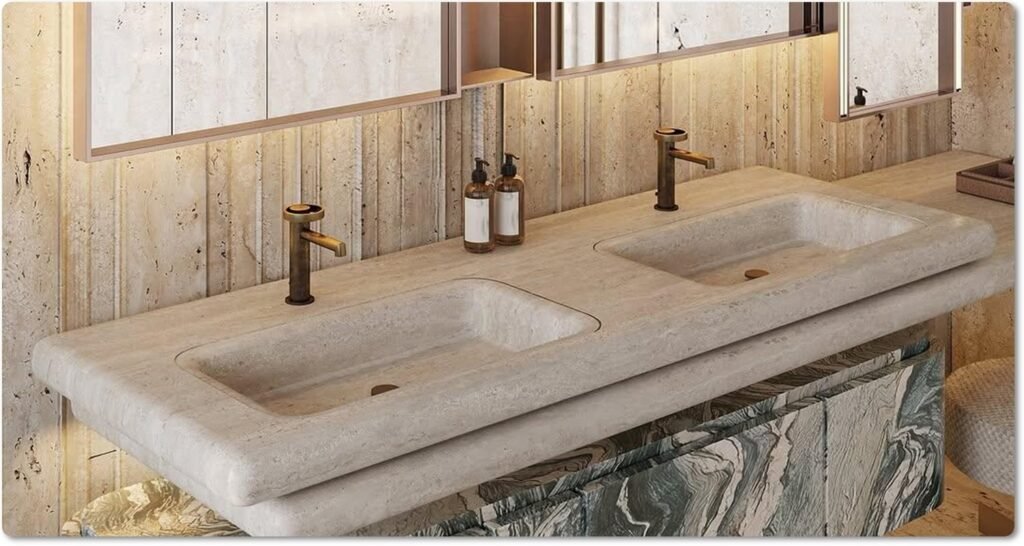
3.4 Textured and Tactile Stone Finishes
Surface texture is an important component of 2026 tile design.
The coverings’ Haptic Experience trend highlights surfaces that engage with touch as well as sight. This concept can be translated into natural stone through different mechanical finishing techniques.
Natural marble offers several surface finishing possibilities.
Polished Marble
Appearance: Reflective and smooth.
Polished marble enhances color depth and often makes natural veins more visually pronounced.
Applications:
Hotel reception areas.
Luxury residential floors.
Decorative walls.
Vanity surrounds.
Formal interior spaces.
Considerations:
Polished surfaces can show scratches and etching. Their suitability for wet floors depends on the actual stone, finish, installation, and tested slip performance.
Honed Marble
Appearance: Smooth, matte or low-sheen.
Honed marble is a popular option for understated contemporary interiors.
Applications:
Bathrooms.
Kitchen wall surfaces.
Residential floors.
Minimalist interiors.
Commercial feature walls.
Honing reduces reflectivity but does not automatically make marble stain-proof or slip-resistant.
Brushed Marble
Appearance: Subtly textured and natural.
Brushed finishes create a softer tactile character and can emphasize the geological surface.
Applications:
Feature flooring.
Transitional interiors.
Decorative walls.
Selected hospitality environments.
Leathered Marble
Appearance: Textured with a soft, low-reflective appearance.
Leathered finishes are commonly used where designers want a more tactile stone appearance.
They can be particularly effective for selected countertop and decorative applications, depending on the stone’s physical characteristics.
Tumbled Marble
Appearance: Softened edges and an aged character.
Tumbled marble can create a traditional or timeworn aesthetic.
Applications:
Mediterranean-style interiors.
Rustic residential spaces.
Decorative flooring.
Mosaic installations.
How Should Buyers Select Marble Finishes?
The correct finish depends on:
The intended application.
Exposure to water and contaminants.
Cleaning requirements.
Expected traffic.
Lighting conditions.
Slip-resistance requirements.
Maintenance expectations.
A finish should always be evaluated on the actual stone, not just on a photograph.
3.5 Marble Veining, Bookmatched Designs and Natural Patterns
Natural marble is valued for its geological individuality.
In 2026, marble tile design can benefit from more deliberate pattern coordination rather than treating every tile as an isolated piece.
Common design approaches include:
Linear veining
Tiles are arranged to create a directional visual flow.
Cloud-like patterns
Soft mineral transitions create a calmer and more organic atmosphere.
Dramatic veining
Strong veins become architectural features, particularly on large walls and feature floors.
Bookmatched marble
Two adjacent stone slabs are selected and arranged as mirror images to create a symmetrical composition.
Continuous vein matching
Multiple pieces are arranged to create visual continuity across a larger surface.
Bookmatched Marble vs. Bookmatched Marble Tiles
Bookmatching is generally easier to plan with larger slabs or panels because the complete vein pattern is visible.
When manufacturing smaller marble tiles, maintaining a continuous bookmatched pattern requires careful block selection, cutting sequence documentation, and piece identification.
Buyers should provide:
Approved slab photographs.
Required installation sequence.
Matching direction.
Numbering requirements.
Joint dimensions.
Panel or tile layout drawings.
EDG Stone can evaluate custom cutting and fabrication requirements based on the approved material and project drawings.
3.6 Minimalist and Luxury Marble Interiors
The relationship between minimalism and luxury is changing.
Rather than relying on excessive decoration, contemporary interiors increasingly use carefully selected materials, natural textures,s and controlled color combinations.
This approach can be described as organic minimalism.
White Marble
White marble remains a versatile choice for bright, sophisticated interiors.
Examples include:
Carrara White.
Calacatta.
Statuario.
Volakas.
Thassos White.
Arabescato.
Different white marble varieties offer different levels of veining, background colour, and visual contrast.
Grey Marble
Grey marble can create a contemporary atmosphere when paired with timber, metal and warm lighting.
Black Marble
Black marble is often selected for dramatic feature walls, luxury bathrooms, reception counters and contrasting floor patterns.
Beige and Cream Marble
These materials provide warmth and work particularly well in residential projects, hotel rooms and spa environments.
Design Principle: Use Natural Marble as the Main Material, Not Just Decoration
A coordinated interior might combine:
Large-format beige marble flooring.
Cream marble bathroom walls.
A contrasting green marble vanity feature.
Brushed metal hardware.
Natural wood furniture.
This approach allows different stone varieties to complement each other without making the interior visually overwhelming.
3.7 Marble Tiles vs. Marble Effect Tiles
Marble-look porcelain and natural marble are both useful materials, but they serve different project requirements.
| Evaluation | Natural Marble Tiles | Marble-Effect Porcelain |
|---|---|---|
| Material identity | Genuine natural stone | Manufactured ceramic material |
| Veining | Natural mineral formation | Digitally designed or printed |
| Pattern repetition | Naturally variable | Depends on available design faces |
| Thickness | Depends on stone fabrication | Depends on porcelain product |
| Surface options | Polished, honed, brushed, honed, and others | Glazed, matte, textured, and others |
| Maintenance | Requires stone-specific care | Generally easier to maintain, depending on specification |
| Repairs | Stone-specific repair methods | Replacement or specialized repair |
| Design appeal | Geological authenticity | Controlled visual consistency |
When Should Designers Choose Natural Marble?
Choose natural marble when:
Authentic geological patterns are essential.
Each surface should have an individual character.
The project requires genuine stone material.
Natural mineral depth is a major design feature.
The client values natural stone as a premium material.
When Should Designers Choose Porcelain?
Porcelain may be preferable when:
Repeated visual patterns are required.
Lower routine maintenance is a priority.
Specific technical performance requirements are difficult to meet with the selected natural stone.
Large production quantities require controlled visual consistency.
Neither material is universally superior. The correct decision depends on the design concept, project performance requirements, and lifecycle considerations.
3.8 Residential and Hospitality Design Applications
Luxury Residential Projects
Natural marble tiles are suitable for carefully specified applications such as:
Living room floors.
Bathroom walls and floors.
Entrance halls.
Staircases.
Feature walls.
Fireplace surrounds.
Decorative furniture.
For kitchen flooring and countertops, designers should consider staining, etching, wear, and maintenance.
Hotels and Hospitality Projects
Hotel projects frequently require material consistency, documented inspection,n and reliable supply coordination.
Potential applications include:
Hotel lobby floors.
Guest bathroom walls.
Reception counters.
Spa interiors.
Elevator surrounds.
Decorative wall panels.
Restaurant feature walls.
Multifamily and Residential Developments
For developers and contractors, procurement considerations often include:
Repeated dimensions.
Consistent thickness.
Batch management.
Installation productivity.
Replacement stock.
Packaging and delivery coordination.
Natural marble should be selected according to the actual intended use, maintenance plan, and project budget.
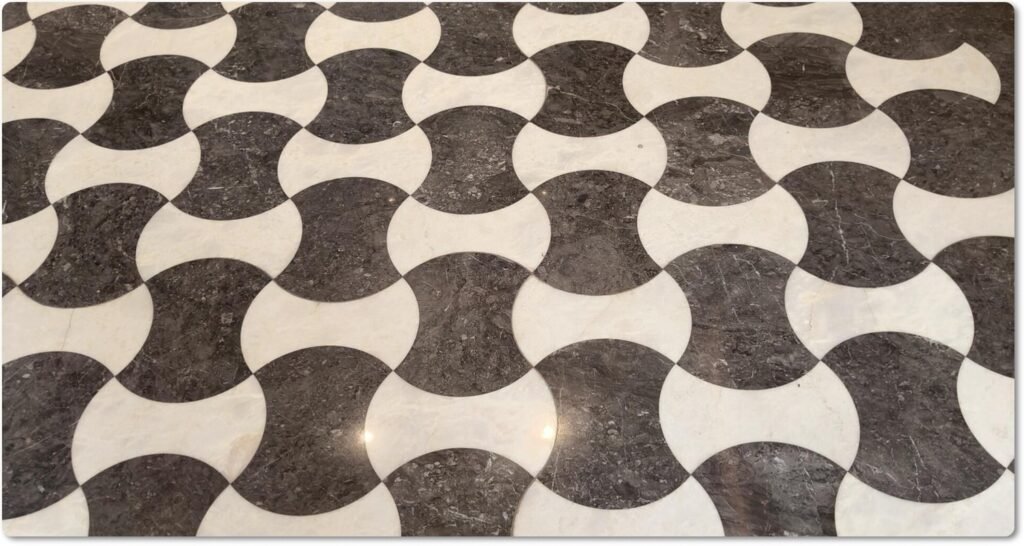
4. Procurement Checklist: How to Source Marble Tiles for 2026 Projects
Design intent must be translated into an executable purchasing specification.
The following checklist can help architects, importers, distributors, and contractors evaluate marble tile suppliers.
4.1 Material Selection
Confirm:
Commercial stone name.
Geological material description where available.
Quarry or source information.
Color range.
Veining characteristics.
Natural variation acceptance.
Approved reference samples.
Do not assume that two suppliers using the same commercial stone name are offering identical material.
4.2 Dimensional and Manufacturing Specifications
Confirm:
Nominal tile size.
Actual finished dimensions.
Thickness.
Thickness tolerance.
Length and width tolerance.
Squareness.
Flatness.
Edge finish.
Surface finish.
Corner condition.
For calibrated marble tiles, request measurable inspection records.
4.3 Physical Properties and Technical Documentation
Depending on the material and application, request relevant test information.
| Property | Relevant Evaluation |
|---|---|
| Water absorption | ASTM C97/C97M |
| Bulk specific gravity | ASTM C97/C97M |
| Compressive strength | ASTM C170/C170M |
| Modulus of rupture | ASTM C99/C99M |
| Flexural strength | ASTM C880/C880M |
| Marble material specification | ASTM C503/C503M, where applicable |
Important: ASTM C503/C503M is a specification for marble dimension stone in exterior applications. Its scope should not be misrepresented as a universal product certification for every interior marble tile.
The applicable testing and acceptance criteria must be established for the actual stone, thickness, application,n and jurisdiction.
4.4 Surface Finish Approval
Request samples of the actual proposed finish.
Evaluate:
Color appearance.
Reflectivity.
Surface texture.
Visible repair locations.
Edge quality.
Cleaning behavior.
Suitability for the installation environment.
For wet areas, request project-appropriate slip-performance information rather than assuming a honed or textured finish is automatically safe.
4.5 Production and Packaging
Before approving a wholesale or bulk order, verify:
Production capacity.
Cutting and finishing equipment.
Inspection procedures.
Batch identification.
Packing specifications.
Pallet or crate construction.
Container loading method.
Export documentation.
Replacement and damage-claim procedures.
5. Cost and Risk Factors: What Affects Marble Tile Prices?
The price of marble tiles depends on more than the stone’s commercial name.
Several factors influence the final purchase price.
5.1 Material Cost
Material cost depends on:
Stone rarity.
Quarry availability.
Block dimensions.
Color consistency.
Veining characteristics.
Material grade.
Quarry and transportation costs.
Rare colors or highly selected patterns may require additional material selection and yield allowances.
5.2 Tile Size and Thickness
Larger tiles may require larger raw blocks, specialized handling, ng and additional fabrication controls.
Thickness also influences material consumption, weight, transportation and installation requirements.
5.3 Surface Finishing
Polished, honed, brushed, leathered and tumbled finishes may involve different processing stages and production requirements.
Custom finishing should be priced against an approved physical sample.
5.4 Cutting Yield and Natural Variation
Natural marble is not a perfectly uniform manufactured material.
Veining, fissures, mineral concentrations,ons and block geometry can influence usable yield.
A project requiring strict visual matching may need additional material selection and reservation.
5.5 Packaging and International Transportation
For international wholesale buyers, the landed cost may include:
Factory price.
Export packing.
Inland transportation.
Port charges.
Ocean freight.
Cargo insurance.
Customs clearance.
Import duties and taxes.
Local transportation.
Breakage and replacement allowances.
Buyers should compare quotations using clearly defined Incoterms and shipment responsibilities.
5.6 Main Procurement Risks
| Risk | Potential Consequence | Preventive Action |
|---|---|---|
| Color mismatch | Visual inconsistency | Approve production batch |
| Dimensional variation | Installation difficulty | Inspect finished dimensions |
| Insufficient thickness | Structural or handling concerns | Specify and measure thickness |
| Poor surface finishing | Uneven appearance | Approve finish sample |
| Inadequate packaging | Transportation damage | Confirm export packing method |
| Incorrect material description | Specification mismatch | Request material identification |
| Unclear acceptance criteria | Disputes | Agree on inspection standards |
6. Supplier Evaluation: How to Choose a Marble Tiles Manufacturer or Factory
Choosing a marble tiles manufacturer requires more than comparing catalog photographs and prices.
For importers, distributors, contractors, and project procurement teams, supplier evaluation should include material sourcing, processing capability, quality management,ement and international shipping experience.
6.1 Raw Material Inspection
A reliable marble tiles factory should be able to explain how incoming blocks or slabs are evaluated.
The inspection process should consider:
Material identity.
Background color.
Vein distribution.
Natural fissures.
Visible cracks.
Mineral concentrations.
Resin treatment or repairs, where applicable.
Suitability for the intended application.
Natural characteristics must be distinguished from manufacturing defects.
Buyers should agree in advance on acceptable natural variations and unacceptable defects.
6.2 Processing Inspection
During manufacturing, inspection should cover:
Cutting dimensions.
Thickness consistency.
Edge processing.
Surface finishing.
Calibration.
Corner integrity.
Repair quality.
Batch identification.
For large projects, first-article approval is useful before full-scale production.
6.3 Finished Product Inspection
Finished marble tiles should be inspected against the approved order specification.
The inspection may include:
Visual appearance.
Dimensions.
Thickness.
Surface finish.
Edge quality.
Color variation.
Quantity.
Identification and labeling.
Inspection frequency and sampling plans should be agreed upon before production.
6.4 Export Packaging Inspection
Packaging is a critical part of natural stone export quality.
A supplier should be able to demonstrate how finished tiles are protected against:
Edge impact.
Surface abrasion.
Moisture exposure.
Movement during transportation.
Improper stacking.
Loading and unloading damage.
Export packaging should be suitable for the actual product dimensions, weight, and transportation conditions.
6.5 Why Consider EDG Stone?
EDG Stone is a Chinese natural stone manufacturer and exporter specializing in marble, granite, quartzite, engineered stone, and customized stone fabrication.
Its product and processing capabilities support international buyers sourcing natural stone materials for residential, hospitality,pitality and commercial applications.
EDG’s manufacturing quality-control approach covers four important stages:
Stage 1: Raw Material Inspection
Incoming stone materials are evaluated for color, pattern, visible defects, and suitability for the intended product.
Stage 2: Processing Inspection
Manufacturing checks focus on cutting, dimensions, thickness, edge treatment,t and surface finishing.
Stage 3: Finished Product Inspection
Completed products are checked against approved specifications, including appearance, dimensions, finish, and quantity.
Stage 4: Pre-Export Packaging Inspection
Packaging, product protection, labeling, and loading arrangements are reviewed before shipment.
For buyers, this process helps establish a traceable quality-control framework from material selection to export preparation.
EDG Stone also supports customized stone processing, including cut-to-size production, CNC processing, waterjet fabrication, edgefinishingn,g and project-specific stone components.
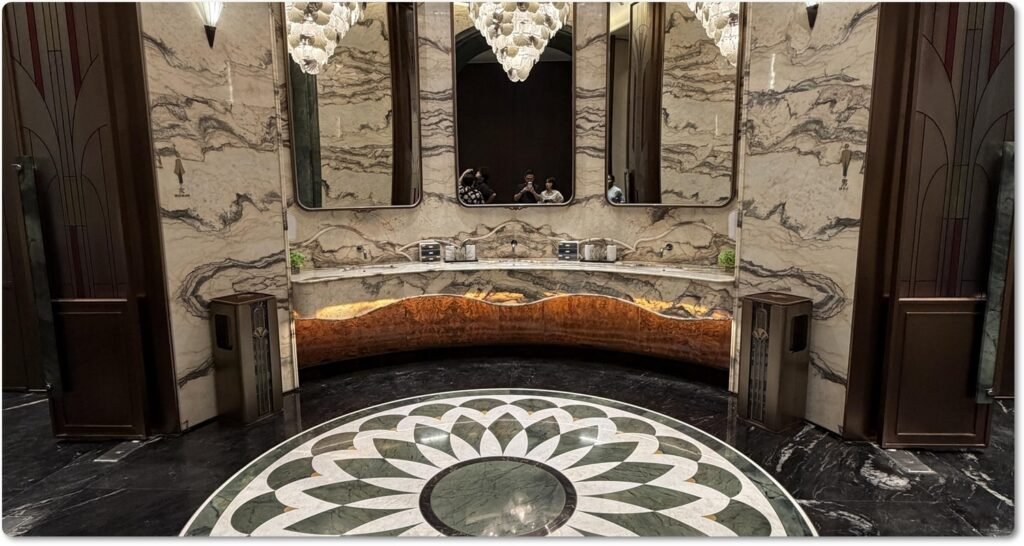
7. Practical RFQ Template: Marble Tiles Manufacturer and Wholesale Inquiry
Importers, distributors, architects, and contractors can use the following template when requesting quotations from a marble tiles manufacturer or wholesale supplier.
7.1 Marble Tile RFQ Information
| RFQ Field | Information Required |
|---|---|
| Project name | Project or development name |
| Buyer type | Importer / Distributor / Contractor / Designer / Developer |
| Material | Marble commercial name and preferred origin |
| Color | White / Beige / Green / Grey / Black / Other |
| Tile size | Required length × width |
| Thickness | Required thickness in mm |
| Surface finish | Polished / Honed / Brushed / Leathered / Tumbled |
| Edge | Straight / Beveled / Custom |
| Quantity | Square meters or pieces |
| Natural variation | Approved color and pattern range |
| Application | Floor / Wall / Bathroom / Hospitality / Other |
| Sample requirement | Physical sample or sample board |
| Drawings | CAD / PDF / Installation layout |
| Inspection | Factory inspection / Third-party inspection |
| Packing | Crates / Pallets / Project-specific packing |
| Destination | Port, city and country |
| Trade term | EXW / FOB / CIF / Other agreed Incoterm |
| Delivery schedule | Required shipment date |
| Documentation | Test reports / Commercial documents / Other |
7.2 Suggested Supplier Questions
Before placing an order, buyers should ask:
Can you provide actual slab or production photographs?
Can the factory manufacture the required dimensions and thickness?
What dimensional tolerances can be guaranteed?
How are natural color variations controlled?
Can the supplier provide material test reports?
Can the factory provide pre-shipment inspection photographs?
What packaging method is used for export?
What is the production lead time after sample and drawing approval?
What is the procedure for reporting transportation damage?
Can the supplier support repeat orders using the approved material reference?
7.3 Production Approval Recommendation
For substantial wholesale and commercial orders, establish three approval stages:
Sample approval: Confirm material, color range, and finish.
First-article approval: Verify the initial production against the drawings and specifications.
Pre-shipment approval: Confirm finished product quality, quantity,y and packaging.
This process reduces misunderstandings between the designer, buyer, manufacturer, er and installation contractor.
8. Frequently Asked Questions: 2026 Marble Tile Trends
Q1. What are the biggest marble tile trends for 2026?
The major natural marble design directions for 2026 include warm beige and cream tones, green marble, large-format surfaces, expressive natural veining, bookmatched layouts, textured finishes,hes and understated luxury.
These directions are consistent with the wider tile industry’s interest in natural inspiration, tactile design, and organic minimalism.
Q2. Are green marble tiles trending in 2026?
Green is a prominent color direction in the 2026 tile industry, highlighted by Coverings under its Jade Terrain trend.
Natural green marble varieties such as Verde Guatemala, Verde, Alpi, and Rainforest Green can translate this color direction into authentic stone interiors.
Q3. Are large-format marble tiles better than small tiles?
Large-format marble tiles can reduce grout lines and create stronger visual continuity, making them suitable for contemporary residential and hospitality interiors.
However, they require careful handling, substrate preparation,n and installation planning. Small-format marble tiles remain valuable for mosaics, decorative patterns, bathrooms, and detailed architectural applications.
The best size depends on the design, material, installation conditions,ons and project budget.
Q4. What is the best marble tile finish for modern interiors?
Honed and brushed finishes are useful for contemporary interiors that emphasize natural textures and understated luxury.
Polished marble is suitable when designers want stronger reflectivity and more pronounced visual depth.
The correct choice depends on the application, cleaning requirements, lighting, and slip-performance specifications.
Q5. Where can I buy wholesale marble tiles directly from a manufacturer or factory?
Importers, wholesalers, distributors and contractors can purchase marble tiles directly from qualified stone manufacturers and exporters.
When evaluating a marble tile factory, buyers should compare material sourcing, production capabilities, dimensional tolerances, inspection procedures, export packaging, and technical documentation.
EDG Stone provides natural stone products and customized fabrication for international B2B buyers. Buyers can submit their material preferences, tile dimensions, finish requirements, quantities,s and destination for a project quotation.
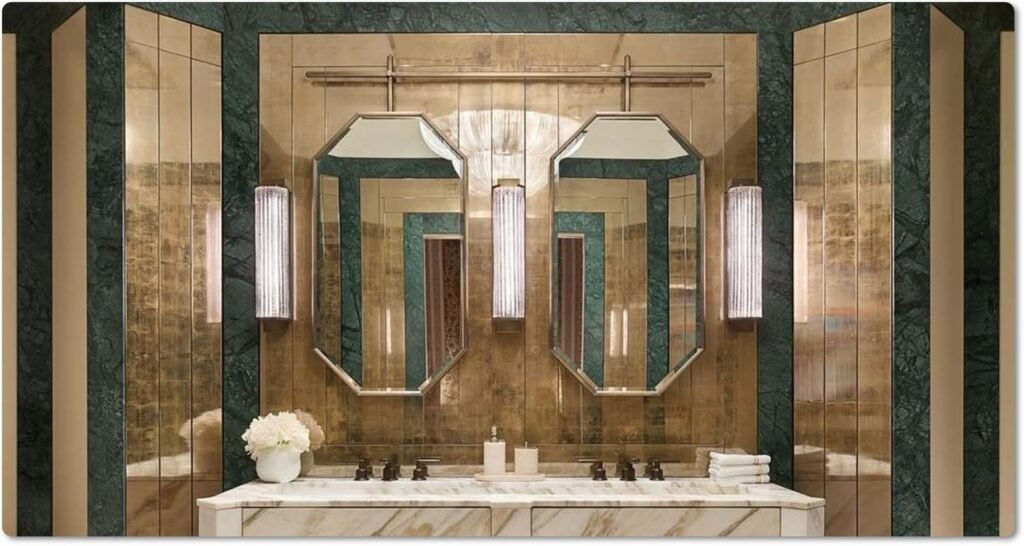
9. References: Industry Trends, Technical Standards and Regulatory Sources
The following references provide a foundation for the design, technical, and procurement discussions in this article.
9.1 Industry Trends and Design Research
1. Coverings 2026 – Official Top 10 Tile Trends Announcement
Published February 18, 2026.
Official industry announcement covering the ten 2026 tile trends, including Jade Terrain, Haptic Experience, Organic Minimalism,m and Surface Technologies.
2. Coverings – Celebrate National Tile Day with the Top 10 Tile Trends of 2026
Official trend explanations and design context.
https://www.coverings.com/blog/celebrate-national-tile-day-with-the-top-10-tile-trends-of-2026/
3. Interior Design – Top Tile Trends Spotted at Coverings 2026
Published April 10, 2026.
Industry reporting on green tones, dimensional surfaces, organic minimalism, sm and emerging tile design directions.
https://interiordesign.net/designwire/top-tile-trends-spotted-at-coverings-2026/
9.2 Natural Stone Technical Standards
4. ASTM C503/C503M-23
Standard Specification for Marble Dimension Stone.
Relevant to evaluating marble dimension stone within the scope of the specification.
5. ASTM C97/C97M
Standard Test Methods for Absorption and Bulk Specific Gravity of Dimension Stone.
6. ASTM C170/C170M
Standard Test Method for Compressive Strength of Dimension Stone.
7. ASTM C99/C99M
Standard Test Method for Modulus of Rupture of Dimension Stone.
8. ASTM C880/C880M
Standard Test Method for Flexural Strength of Dimension Stone.
Natural Stone Institute – ASTM International Standards:
https://www.naturalstoneinstitute.org/stoneprofessionals/astm/
ASTM standards should be checked against their current editions and the applicable material and project requirements before being incorporated into a purchase contract.
9.3 Regulatory and Environmental Context
9. Regulation (EU) 2024/3110 – Construction Products Regulation
The revised EU Construction Products Regulation entered into force in January 2025, with its principal application date beginning January 8, 2026.
The regulation establishes a revised framework for construction product information, harmonized technical requirements, and environmental performance information. Specific obligations depend on product categories, applicable harmonized technical specifications, and implementation provisions.
Official European Commission overview:
10. Regulation (EU) 2024/3110 – EUR-Lex
Official legal text:
https://eur-lex.europa.eu/eli/reg/2024/3110/oj/eng
Buyers should confirm which regulatory and documentation requirements apply to the specific product and destination market. A trend article or commercial product description does not replace a declaration of performance, applicable conformity documentation, or technical assessment where legally required.
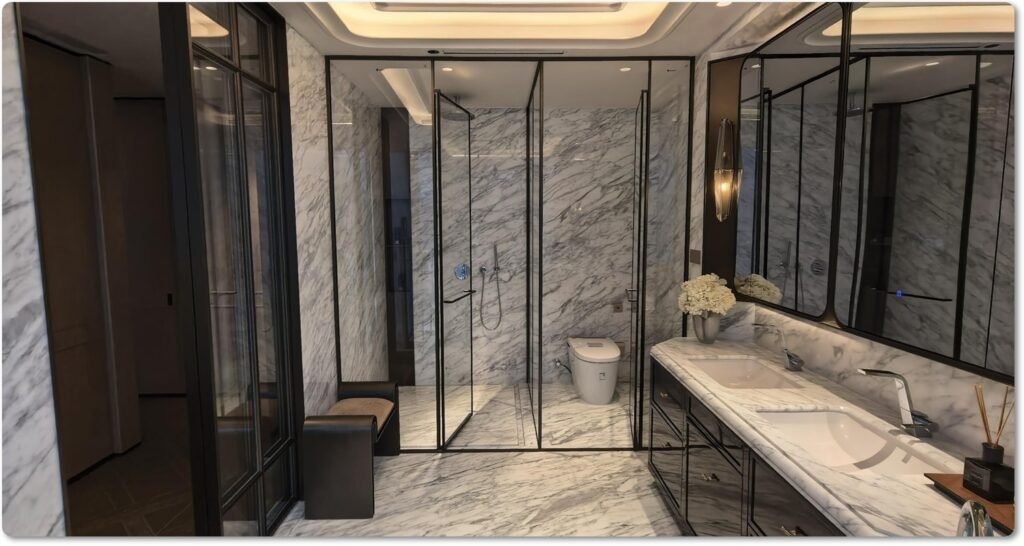
10. EDG Stone CTA: Discover Natural Marble Tiles and Custom Stone Manufacturing
Find the Right Marble Tile Collection for Your 2026 Project
The most successful marble tile projects combine distinctive natural materials with reliable manufacturing, accurate fabrication and carefully planned installation.
Whether you are an importer building a wholesale marble tile collection, an architect specifying natural stone for a luxury residence, or a contractor sourcing materials for a hospitality development, the selection of a qualified marble manufacturer is an important part of the procurement process.
EDG Stone supplies natural stone products and supports customized fabrication for international B2B customers.
Our product and fabrication capabilities include:
Natural marble tiles and slabs.
White, beige, green, grey and black marble collections.
Polished, honed, brushed and other customized finishes.
Cut-to-size marble products.
CNC and waterjet fabrication.
Custom stone panels and decorative components.
Project-based production and export packaging.
Request a Marble Tile Factory Quotation
To help EDG evaluate your requirements, please provide:
Preferred marble color or material.
Tile dimensions and thickness.
Surface finish.
Estimated order quantity.
Project application.
Drawings or reference photographs.
Destination country and delivery port.
EDG can review the material and processing requirements and discuss suitable production options.
Explore EDG Stone’s natural stone collections and custom fabrication services.
Contact EDG Stone for a Factory-Direct Marble Tile Quote.
2026 Marble Tile Design: Materials, Trends and Procurement Insights
What Is Defining Marble Tile Design in 2026?
Marble tile design in 2026 is characterized by a stronger emphasis on natural colors, geological patterns, tactile surfaces, and architectural continuity. Warm beige marble, cream marble, green marble, large-format tiles and bookmatched stone layouts offer designers opportunities to create distinctive residential and hospitality interiors. These natural stone directions complement broader tile industry trends identified by Coverings 2026, particularly Jade Terrain, Organic Minimalism and Haptic Experience.
Why Is Natural Marble Important in Contemporary Architecture?
Natural marble provides geological variation, mineral depth and individual patterns that cannot be reproduced identically through industrial printing. Its architectural value comes from the combination of material authenticity, visual character, and customizable fabrication. Designers can coordinate marble colors, finishes, dimensions,s and vein directions to create integrated architectural surfaces.
How Can Designers Apply 2026 Marble Tile Trends?
Warm beige and cream marble can establish welcoming residential interiors. Green marble can create distinctive bathroom walls, vanity features and hotel reception areas. Large-format marble tiles can reduce visual interruptions across floors and walls. Honed, brushed, ed and leathered finishes introduce tactile qualities, while polished marble emphasizes natural color and veining. Bookmatched layouts can transform selected stone surfaces into architectural focal points.
Which Is Better: Natural Marble or Marble-Look Porcelain?
Natural marble is suitable for projects prioritizing authentic geological patterns, natural material variation, ion and premium stone character. Marble-look porcelain is suitable when controlled pattern repetition, specific manufactured performance, ance and comparatively simple routine maintenance are priorities. Selection should consider the intended application, technical specifications, maintenance requirements, and project budget.
What Should Buyers Consider When Choosing a Marble Tiles Factory?
Professional marble tile procurement requires evaluation of raw material quality, color consistency, dimensions, thickness, surface finishing, fabrication capabilities, inspection procedures, and export packaging. Importers, wholesalers,
distributors, architects and contractors should request representative samples, technical documentation, production photographs and clearly defined acceptance criteria before approving bulk orders.
EDG Stone: Natural Marble Tiles Manufacturer and Export Supplier
EDG Stone is a Chinese natural stone manufacturer and exporter providing marble, granite, quartzite and customized stone fabrication for international projects. Its quality-control approach includes raw material inspection, processing inspection, finished product inspection, and pre-export packaging inspection. International buyers can request customized marble tile sizes, colors, finishes,s and project-specific fabrication based on approved samples and technical drawings.
2026 Design Direction and Long-Term Material Value
The strongest marble tile design strategy for 2026 is not simply following a color or surface trend. It is selecting an appropriate natural material, coordinating its geological characteristics with the architectural concept, specifying the correct finish, and ensuring that manufacturing and installation requirements are properly controlled. This combination creates interiors that remain visually distinctive and functionally appropriate beyond a single design season.