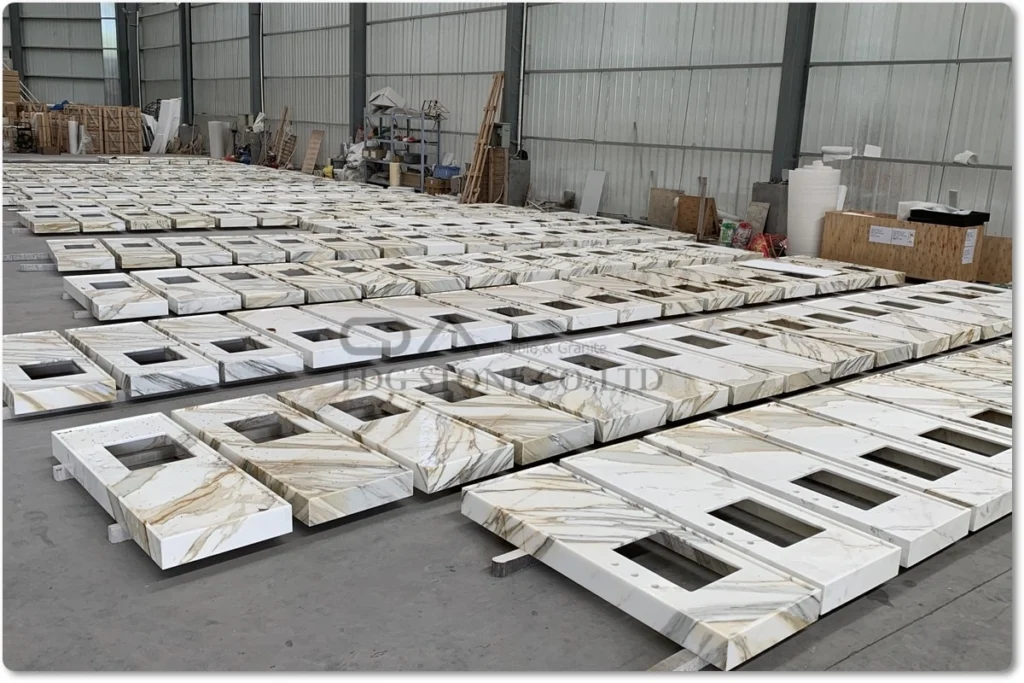
Executive Summary: Understanding Marble Tile Quality Before Procurement
Marble is a natural geological material. Unlike ceramic tiles and homogeneous engineered surfaces, natural marble contains variations in mineral composition, crystal structure, veining, color distribution, and geological discontinuities.
These characteristics make marble visually distinctive but also introduce challenges in quality control, manufacturing consistency, and long-term performance.
For international buyers, purchasing marble floor tiles based only on photographs, sample appearance,e or nominal dimensions is insufficient. A professional procurement process must evaluate both the intrinsic characteristics of the stone and the manufacturing quality of the finished product.
This guide explains how to assess marble tiles through recognized ASTM standards, practical factory inspection procedures, dimensional verification, surface defect classification,n and batch acceptance systems.
It also explains how professional marble tile manufacturers and exporters, including EDG Stone Factory, can establish quality control procedures covering raw material selection, cutting, finishing, calibration, final inspection, a nd export packaging.
The objective is straightforward: help buyers establish measurable acceptance criteria before production rather than discover quality problems after containers arrive.

1. Scope and Definitions: What Constitutes Marble Tile Quality?
1.1 Natural Marble Tiles vs. Other Stone and Tile Products
Natural marble tiles are dimensioned products manufactured from geological marble blocks or slabs through sawing, cutting, calibration, surface finishing, and edge processing.
Commercial marble products may include:
Calcite marble tiles.
Dolomitic marble tiles.
White, beige, gray and black marble tiles.
Green, red and other colored marble varieties.
Polished marble finish tiles.
Honed marble floor tiles.
Brushed and tumbled marble tiles.
Large-format marble tiles.
Mosaic marble tiles and decorative stone pieces.
It is important to distinguish natural marble from engineered marble, agglomerated stone, porcelain marble-look tiles,s and artificial stone products.
Their composition, manufacturing methods, test requirements, ts and performance characteristics are different.
ASTM C503/C503M-23, Standard Specification for Marble Dimension Stone, covers marble used for general building and structural purposes. Its scope expressly includes marble that is sawed, cut, split, or otherwise shaped into blocks, slabs,s or tiles.
This makes it an important reference for natural marble tile procurement.
1.2 Relevant ASTM Standards for Marble Tile Inspection
The following standards form a useful technical framework for professional buyers.
| Standard | Technical purpose | Procurement application |
|---|---|---|
| ASTM C503/C503M-23 | Marble dimension stone specification | Material selection and physical requirements |
| ASTM C97/C97M | Water absorption and bulk specific gravity | Porosity and density evaluation |
| ASTM C99/C99M-25 | Modulus of rupture | Flexural failure resistance |
| ASTM C170/C170M | Compressive strength | Resistance to compressive loading |
| ASTM C880/C880M | Flexural strength | Resistance to bending |
| ASTM C1353/C1353M | Abrasion resistance under foot traffic | Surface wear evaluation |
| ASTM C241/C241M | Abrasion resistance | Alternative abrasion testing reference |
| ASTM C1721 | Petrographic examination | Mineral composition and geological characteristics |
Important version control note: ASTM editions are revised periodically. Buyers should confirm the latest active edition and the contractual edition applicable to their project when issuing an RFQ. The ASTM C97/C97M series, for example, has a 2026 edition. A contract referencing an earlier edition should not be silently changed during testing.
ASTM test methods describe how properties are measured. They do not automatically establish one universal acceptance limit for every marble variety, thickness, tile format, or installation environment.
Buyers should specify the required limits, test conditions, sampling frequency,y and acceptance procedures in their purchase specifications.
2. Technical Evaluation: Mineral Composition and Physical Properties
2.1 Marble Mineral Composition and Natural Variations
Natural marble is primarily composed of recrystallized carbonate minerals, especially calcite and dolomite.
Calcitic marble is predominantly composed of calcium carbonate, while dolomitic marble contains a greater proportion of calcium magnesium carbonate.
The distinction matters because mineral composition can influence:
Hardness and scratch behavior.
Acid sensitivity.
Water absorption.
Density.
Polishing response.
Flexural and compressive performance.
Suitability for different applications.
However, mineral composition alone cannot determine the complete engineering performance of a marble tile.
Crystal size, grain boundaries, mineral impurities, veins, microcracks, and geological discontinuities also influence the behavior of the stone.
Natural Variation Is Not Automatically a Defect
Marble may exhibit:
Color bands.
Mineral veins.
Cloud-like patterns.
Crystalline inclusions.
Fossil traces.
Natural tonal variation.
Localized mineral concentrations.
These features are part of the geological identity of the material.
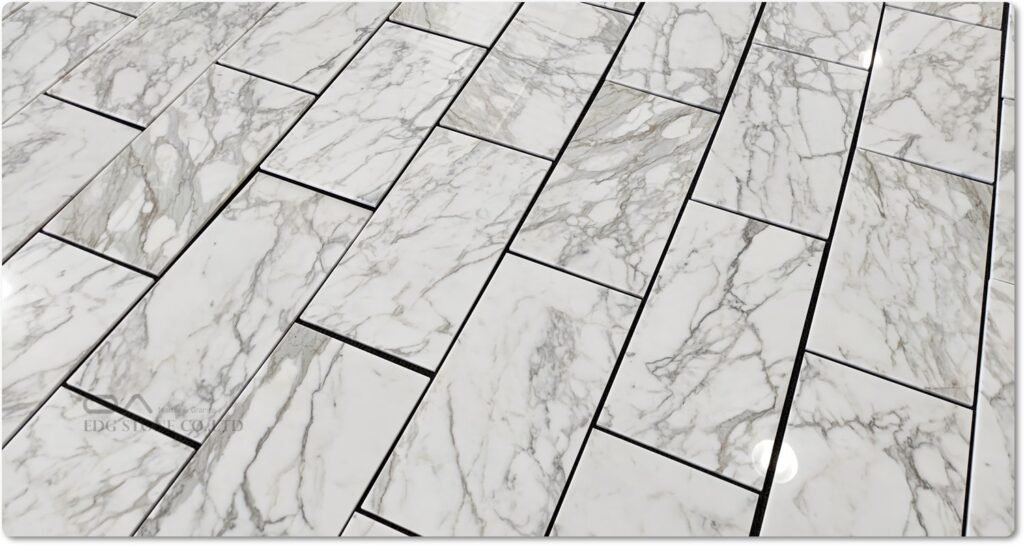
A white marble tile with gray veining, for example, should not automatically be classified as defective because the pattern differs from another tile.
Instead, buyers should distinguish between acceptable geological variation and structural defects.
A useful classification is:
| Feature | Typical interpretation | Inspection approach |
|---|---|---|
| Natural veining | Geological characteristic | Compare with approved sample |
| Color variation | Natural material variation | Establish acceptable range |
| Mineral inclusions | Depends on type and location | Assess appearance and soundness |
| Open fissures | Potential structural concern | Examine continuity and depth |
| Resin-filled veins | Processed natural stone | Declare and agree acceptance |
| Loose particles | Potential material defect | Check surface integrity |
Petrographic Examination
For high-value projects or unfamiliar marble varieties, petrographic examination can help identify mineral composition, grain structure, alteration, weathering,g and discontinuities.
ASTM C1721 guides petrographic examination of dimension stone.
For buyers sourcing marble from a new quarry, this examination can be especially useful when visual similarity between different commercial materials makes identification difficult.
2.2 Water Absorption and Bulk Specific Gravity
Water absorption is one of the most important properties to consider when purchasing marble tiles.
It indicates how much water a stone specimen absorbs under specified laboratory conditions.
Bulk specific gravity provides information about the relationship between the stone’s mass and its bulk volume.
The two measurements help buyers understand differences in stone density and pore structure.
Why Water Absorption Matters?
Higher water absorption may increase the likelihood of:
Moisture penetration.
Water staining.
Mineral discoloration.
Efflorescence associated with moisture and soluble salts.
Freeze-thaw deterioration in exposed environments.
Changes in appearance caused by moisture migration.
These risks depend on the stone’s mineralogy, pore structure, installation materials, drainage,ge and environmental conditions.
A low absorption result does not guarantee that a marble tile is stain-proof or suitable for every outdoor environment.
ASTM C97/C97M Testing
ASTM C97/C97M specifies test methods for determining absorption and bulk specific gravity of dimension stone, excluding slate.
A professional testing program should record:
Sample identification and quarry or production batch.
Specimen dimensions and preparation.
Dry mass.
Saturation procedure.
Saturated mass.
Calculated absorption.
Bulk specific gravity.
Test date and laboratory identification.
Water absorption by weight is generally expressed as:
Water Absorption (%) = [(Saturated Mass – Dry Mass) / Dry Mass] × 100
The test result should be interpreted against the relevant marble specification, approved material benchmark, ar,k and intended application.
Do not impose an arbitrary universal absorption limit on all marble products.
Different geological varieties have different physical characteristics.
Procurement Recommendation
For marble tiles intended for bathrooms, commercial flooring, hotel lobbies, lobbies, or exterior applications, request absorption test results for the actual material or a demonstrably representative quarry lot.
Also assess the compatibility of the proposed adhesive, grout, sealer, and substrate.
2.3 Compressive Strength and Flexural Strength
Strength testing is essential when evaluating marble for flooring, architectural applications, and products exposed to mechanical loading.
Two important properties are compressive strength and flexural strength.
Compressive Strength
Compressive strength measures the ability of a stone specimen to withstand compressive loading before failure.
ASTM C170/C170M provides the test method for determining the compressive strength of dimension stone.
The result is commonly expressed in MPa.
For marble tile procurement, compressive strength provides useful information about the material’s resistance to crushing under compression.
However, it should not be interpreted as the maximum allowable load of an installed floor.
Actual floor performance also depends on:
Tile thickness.
Tile dimensions.
Substrate stiffness.
Bedding coverage.
Installation workmanship.
Concentrated loads.
Existing cracks or unsupported areas.
A marble tile installed over an uneven or inadequately supported substrate may fracture even when the stone has relatively high laboratory compressive strength.
Modulus of Rupture
ASTM C99/C99M covers the determination of the modulus of rupture of dimension stone.
Modulus of rupture is an indicator of the stone’s resistance to failure under a specified bending test arrangement.
It is particularly relevant when evaluating marble tiles that may experience bending stresses during handling, transportation, or installation.
Flexural Strength
ASTM C880/C880M provides a separate test method for flexural strength of dimension stone.
Although C99 and C880 both involve bending-related performance, they are different test methods and should not be treated as interchangeable.
The test configuration, specimen preparation, and loading conditions matter.
A professional laboratory report should identify the exact standard used rather than simply state that the marble passed a strength test.
Practical Application
For large-format marble floor tiles, thin marble panels, stairs, and other applications where bending or handling stress is relevant, buyers should pay particular attention to flexural test results.
For structural applications, consult the project engineer and applicable stone design guidance rather than relying solely on tile-level test results.
2.4 Abrasion Resistance and Surface Durability
Marble floor tiles experience wear through pedestrian traffic, footwear, dust, sand, and cleaning operations.
Abrasion resistance is therefore an important consideration when selecting marble for commercial floors, hotel corridors, shopping environments, and public spaces.
Relevant testing references include:
ASTM C1353/C1353M: abrasion resistance of dimension stone subjected to foot traffic using a rotary platform abrader.
ASTM C241/C241M: abrasion resistance of stone subjected to foot traffic.
These methods evaluate abrasion performance under specified laboratory conditions.
They should not be confused with scratch resistance, impact resistance,e or slip resistance.
What Influences Marble Floor Wear?
Surface durability is affected by:
Mineral hardness and crystal structure.
Surface finish.
Pedestrian traffic intensity.
Sand and abrasive particles.
Cleaning chemicals.
Maintenance frequency.
Surface protection and sealing.
Installation and environmental conditions.
A highly polished marble floor may gradually lose its gloss in high-traffic locations.
A honed finish may make certain wear patterns less visually obvious, but it does not make the stone immune to abrasion.
Choosing the Right Marble Finish
| Application | Possible finish | Main consideration |
|---|---|---|
| Luxury hotel lobby | Polished | Appearance and maintenance |
| Residential living room | Polished or honed | Design and lifestyle |
| Commercial corridor | Honed or suitable textured finish | Traffic and maintenance |
| Bathroom floor | Textured or properly specified honed finish | Slip-risk assessment |
| Exterior paving | Suitable textured finish | Weather and surface safety |
The correct selection should be based on the actual environment rather than appearance alone.
2.5 Thickness, Length, Width and Squareness
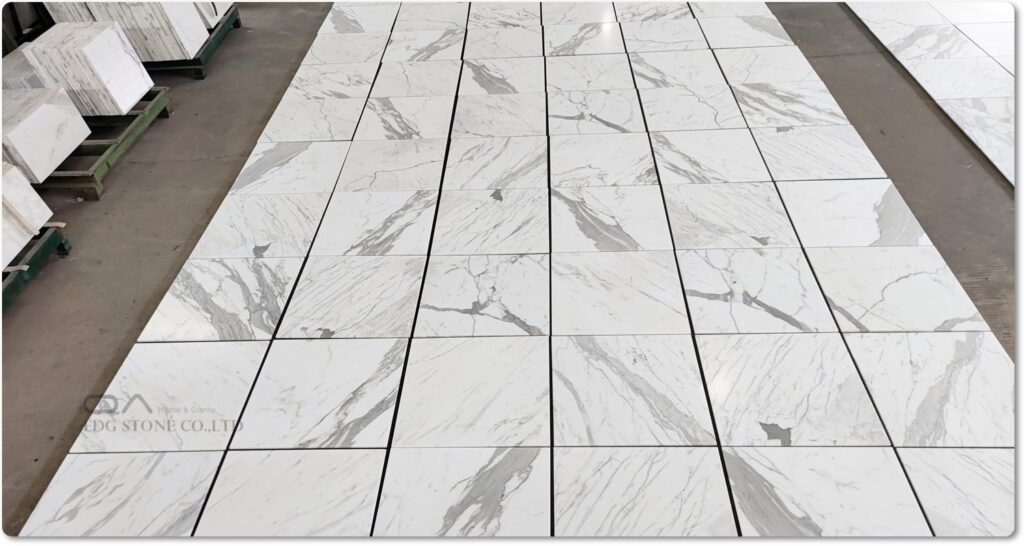
Dimensional accuracy is one of the most important practical inspection areas for marble tiles.
Even when the raw stone has excellent physical properties, inaccurate cutting and calibration can cause installation problems.
Commonly requested marble tile standard size formats include:
12 × 12 inches.
12 × 24 inches.
18 × 18 inches.
24 × 24 inches.
24 × 48 inches.
300 × 300 mm.
300 × 600 mm.
400 × 400 mm.
600 × 600 mm.
600 × 1200 mm.
These are common commercial formats, not universal ASTM-mandated sizes.
Actual dimensions must be confirmed in the purchase order.
Five Dimensional Inspection Items
1. Length and Width
Measure each tile using calibrated measuring instruments.
Record actual dimensions and compare them with the contractual nominal size and permitted tolerances.
2. Thickness
Measure at multiple locations rather than relying on a single reading.
Thickness variation can influence adhesive consumption, lippage, and installation alignment.
3. Squareness
Check whether adjacent edges form a right angle.
Out-of-square tiles may create inconsistent joints and alignment problems.
4. Edge Straightness
Inspect the edges for bowing, chipping, and irregular cutting.
5. Flatness
Check for warping, uneven surfaces,s and local irregularities using an agreed inspection method.
For large-format tiles, flatness and thickness consistency become particularly important.
Establishing a Dimensional Tolerance
A buyer should not simply write “standard size” in an RFQ.
Instead, specify:
Nominal length.
Nominal width.
Nominal thickness.
Minimum and maximum dimensions.
Permitted thickness variation.
Squareness tolerance.
Edge condition.
Measurement method.
Sampling frequency.
For example, a project may specify 600 × 600 × 20 mm marble tiles with a contractual length and width tolerance of ±1.0 mm and a thickness tolerance of ±1.0 mm.
These figures are an illustrative purchasing specification, not an ASTM universal requirement. They must be checked against manufacturing feasibility, tile size, finish, installation system, and project requirements.
2.6 Surface Defects: Cracks, Fissures, Pits and Repairs
Visual inspection must distinguish natural geological characteristics from manufacturing defects.
The most common inspection concerns include:
Cracks
Cracks are fractures that may compromise structural integrity.
Inspect whether they are:
Through-body cracks.
Edge cracks.
Hairline surface cracks.
Cracks associated with veins.
Cracks introduced during cutting or transportation.
Through-body cracks and unstable fractures should normally be treated as critical defects unless specifically engineered and approved.
Fissures
Fissures are natural separations or discontinuities within the stone.
Some natural fissures are stable and part of the stone’s geological structure.
Others may open during cutting, polishing, transportation,n or installation.
A fissure should be assessed according to:
Width.
Depth.
Length.
Location.
Stability.
Repair condition.
Intended application.
Pits and Voids
Small pits may be natural characteristics of some marble varieties.
They may also be caused by mineral loss, processing damage,ge or surface deterioration.
The acceptance criteria should address:
Maximum permitted pit size.
Maximum permitted number.
Location and concentration.
Filling requirements.
Surface smoothness.
Resin Repairs and Filled Areas
Some marble products undergo resin treatment to stabilize natural fissures, fill pits, or improve surface appearance.
Resin treatment is not automatically evidence of poor quality.
However, it should be disclosed and evaluated.
Buyers should specify whether resin-treated marble is acceptable, whether repairs must be color-matched, and whether the treatment must be suitable for the intended application.
A useful inspection principle is:
Natural variation is evaluated aesthetically; structural discontinuities are evaluated mechanically; repairs are evaluated for stability, appearance, ance and disclosure.
2.7 Polished, Honed, Brushed and Tumbled Marble Finishes
Surface finishing changes both the appearance and practical behavior of marble tiles.
Polished Marble Finish Tiles
Polishing creates a smooth, reflective surface.
Advantages include:
Strong visual depth.
Enhanced color contrast.
High-end decorative appearance.
Easy removal of some surface contaminants when properly maintained.
Potential limitations include visible scratching, etching, and gloss reduction.
Honed Marble
Honed marble has a smooth but generally non-reflective surface.
It is frequently selected for residential flooring, commercial interiors, and contemporary architectural designs.
Honed marble is not automatically slip-resistant. Actual slip performance depends on stone, surface texture, contaminants, water conditions, and maintenance.
Brushed Marble
Brushing creates a textured surface by mechanically treating the stone.
This finish can emphasize natural veining and produce a more tactile appearance.
Inspect the consistency of texture and ensure that the brushing process does not leave excessive roughness or loose particles.
Tumbled Marble
Tumbled marble has softened edges and a deliberately aged appearance.
It is commonly used for mosaics, decorative wall finishes,s and traditional architectural projects.
Inspection should focus on consistent edge treatment, surface integrity, and the agreed degree of natural variation.
Finish Inspection Criteria
For each finish, buyers should specify:
Gloss or reflectance expectations where relevant.
Texture consistency.
Surface flatness.
Edge treatment.
Visible scratch limits.
Repair visibility.
Color consistency.
Cleaning and maintenance requirements.
For flooring, also specify the appropriate slip-resistance assessment required by the destination market and project designer.
Aesthetic finish and slip performance are separate acceptance criteria.
3. Factory Quality Control and Pre-Shipment Inspection
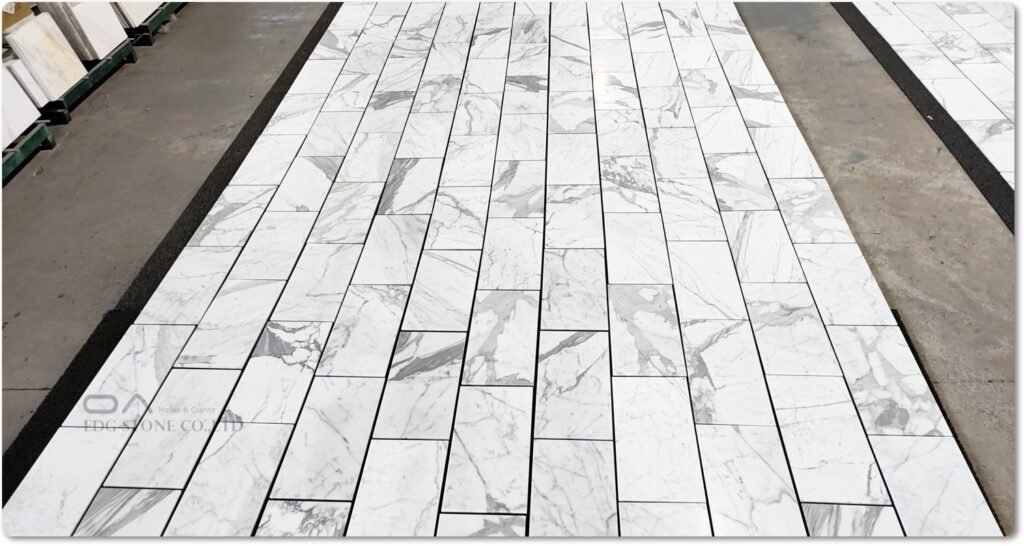
Professional marble tile manufacturers should implement quality control at multiple stages.
A final visual inspection alone cannot reliably identify all production problems.
3.1 Raw Material Inspection
Before cutting, the factory should inspect the incoming marble blocks or slabs.
Key checks include:
Material identification.
Quarry or supplier traceability.
Color and vein characteristics.
Geological discontinuities.
Visible cracks and open seams.
Existing repairs.
Block or slab condition.
Suitability for the required tile thickness and format.
For large orders, the buyer should approve the raw material selection before mass production.
This is particularly important for marble with distinctive veining or significant natural color variation.
3.2 Processing Inspection
During manufacturing, inspection should cover:
Cutting: Verify cutting dimensions, cutting direction, and material yield.
Calibration: Check thickness consistency.
Edge processing: Inspect edge straightness, chips,s and dimensional accuracy.
Surface treatment: Confirm the specified polished, honed, brushed, ed, or tumbled finish.
Repair and filling: Check resin filling, color matching, and repair stability.
Sorting: Separate tiles according to color, vein pattern, finish, and quality classification.
3.3 Finished Product Inspection
Finished marble tiles should undergo systematic inspection before packing.
The inspection should include:
Quantity verification.
Length and width measurement.
Thickness measurement.
Squareness and edge inspection.
Flatness assessment.
Surface finish evaluation.
Crack and fissure examination.
Repair inspection.
Color and vein comparison.
Batch identification and carton labeling.
3.4 Export Packaging Inspection
Packaging is a critical part of international marble tile quality management.
Even correctly manufactured marble tiles can arrive damaged if packaging, palletization,n or container loading is inadequate.
EDG Stone Factory treats packaging and transportation as an essential part of product quality control.
Export inspection should verify:
Protective separation between individual tiles.
Appropriate foam paper or other cushioning.
Strong cartons or suitable protective crates.
Pallet strength and stability.
Moisture protection where appropriate.
Correct carton labeling.
Packing list consistency.
Safe stacking and load distribution.
Container cleanliness and dry condition.
Proper cargo securing.
For large-format marble tiles, appropriate vertical or horizontal support arrangements should be selected according to product geometry, packaging design,ign and transportation conditions.
The packaging system should be validated for the expected international shipping route.
4. Sample Approval and Batch Consistency
4.1 Why Sample Approval Matters
Natural marble cannot be expected to exhibit the same visual uniformity as a manufactured homogeneous product.
A single small sample may not adequately represent a large quarry lot or production batch.
For this reason, buyers should establish a sample approval system before bulk manufacturing.
A recommended approval process includes:
Stage 1: Material Sample
Approve the marble variety, base color, characteristic veining,ning and natural variation range.
Stage 2: Finish Sample
Approve the polished, honed, br,ushed or other specified surface treatment.
Stage 3: Production Sample
Approve finished tiles manufactured using the intended production process.
Stage 4: Batch Reference
Retain signed or otherwise documented reference samples and photographs for comparison with bulk production.
4.2 Batch Consistency Inspection
For large wholesale and project orders, evaluate consistency across multiple cartons and production dates.
Compare:
Base color.
Vein characteristics.
Thickness.
Dimensions.
Surface finish.
Resin repairs.
Edge quality.
Packaging and labeling.
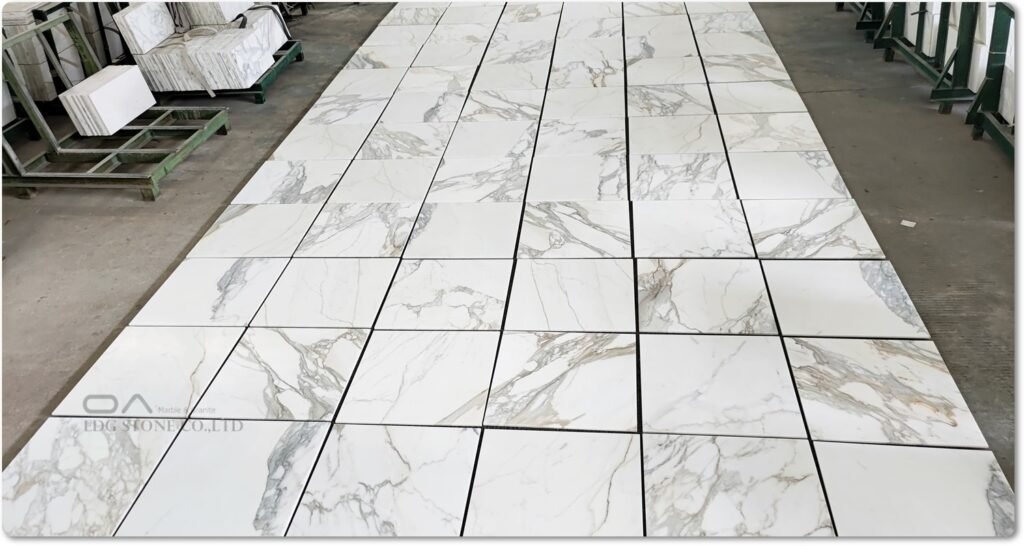
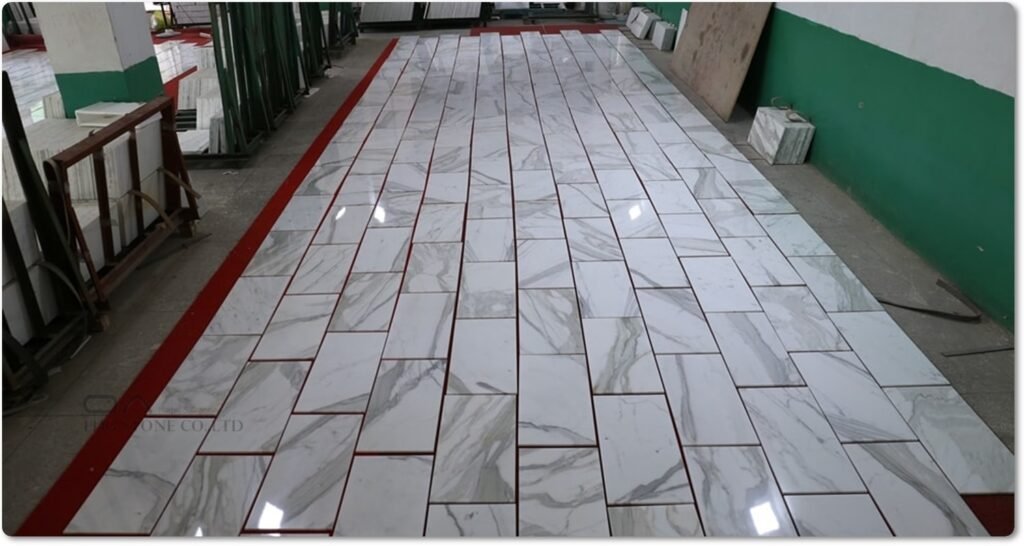
For highly veined marble, buyers may also request dry-lay photographs or digitally arranged tile sequences before shipment.
This is particularly useful for luxury hotels, residential developments and large-format flooring installations.
4.3 Establishing an Acceptance and Rejection System
A practical inspection system can classify defects into three categories.
| Classification | Examples | Recommended treatment |
|---|---|---|
| Critical | Through-body cracks, dangerous instability, incorrect material | Reject or quarantine |
| Major | Significant dimensional deviation, unacceptable finish, serious edge damage | Reject, rework or obtain written concession |
| Minor | Small agreed natural variation, limited cosmetic imperfections | Accept within agreed limits |
The buyer and supplier should define these classifications before production.
Natural color variation should not automatically be classified as a major defect when the approved specification allows it.
Likewise, a defect that is acceptable for decorative wall cladding may be unacceptable for a heavily trafficked floor.
5. Procurement Checklist: A Practical Marble Tile Inspection System
Professional buyers can use the following checklist when evaluating a marble tile manufacturer, factory, or wholesale supplier.
5.1 Before Placing an Order
Confirm the natural marble variety and material identity.
Obtain quarry or material origin information where available.
Define the tile dimensions and thickness.
Specify the surface finish.
Request relevant physical property reports.
Review water absorption and bulk specific gravity.
Review compressive and flexural test results where required.
Confirm the intended flooring or wall application.
Define acceptable natural color variation.
Approve repair and resin treatment requirements.
Confirm the reference sample.
Agree on dimensional tolerances.
Establish inspection and sampling procedures.
5.2 During Production
Check raw material consistency.
Monitor cutting dimensions.
Verify thickness calibration.
Inspect surface finishing.
Review edge processing.
Record repairs and filling.
Conduct batch sorting.
Compare production tiles with approved samples.
5.3 Before Shipment
Verify ordered quantity.
Inspect representative cartons.
Measure tile dimensions and thickness.
Check squareness and flatness.
Inspect cracks, fissures, and pits.
Verify surface finish.
Confirm color and vein consistency.
Review repair quality.
Check labels and carton identification.
Verify export packaging.
Photograph the inspection and loading process.
Confirm packing list and shipping documents.
5.4 Sampling and Inspection Frequency
Sampling should reflect order size, risk, product variation,n and contractual requirements.
For example, buyers may agree to inspect:
Every production batch for identification and basic process records.
Multiple cartons selected randomly for dimensional inspection.
Representative tiles from different pallets for visual evaluation.
Laboratory specimens from representative production material for physical testing.
A statistically based sampling plan can use ISO 2859-1 where appropriate, but the buyer must define the inspection characteristics, lot size, inspection level, el and acceptance quality limit.
AQL is not a universal quality grade and does not replace specific engineering acceptance requirements.
6. Cost and Risk Factors: What Determines Marble Tile Quality and Price?
Marble tile pricing is influenced by much more than the cost of the raw stone.
6.1 Raw Material Cost
The price of natural marble depends on:
Quarry characteristics.
Block availability.
Geological soundness.
Color and vein selection.
Material rarity.
Block size.
Quarry recovery rate.
Premium marble with distinctive veining may require additional sorting and produce lower usable yield.
6.2 Manufacturing Cost
Processing costs may include:
Block cutting.
Slab production.
Tile cutting.
Thickness calibration.
Surface polishing.
Honing or brushing.
Edge processing.
Resin treatment.
Quality inspection.
Sorting and packing.
Large-format marble tiles may require more careful handling, specialized cutting equipment, and stronger packaging.
6.3 Quality Control Cost
Professional testing and inspection create additional costs,s but help reduce downstream risks.
Relevant costs may include:
Laboratory testing.
Third-party inspection.
Production monitoring.
Sample approval.
Additional sorting.
Packaging upgrades.
Replacement and rework allowances.
6.4 International Logistics and Damage Risk
For wholesale and bulk orders, buyers should consider:
Carton and crate design.
Palletization.
Container loading.
Inland transportation.
Ocean freight.
Cargo insurance.
Import duties and taxes.
Destination handling.
Unloading and warehousing.
A low factory price does not necessarily represent the lowest landed cost.
The buyer should compare the complete procurement and logistics structure.
6.5 Application-Related Risk
The cheapest marble is not necessarily the most economical choice for every project.
For example:
A high-traffic commercial floor requires appropriate wear performance and maintenance planning.
A bathroom floor requires careful water management and slip-risk evaluation.
An exterior installation requires assessment of weather exposure drainagea, drainage, and freeze-thaw conditions where applicable.
Large-format tiles require attention to substrate preparation and installation support.
Selecting a marble variety that is unsuitable for its intended environment may create higher lifecycle costs.
7. Supplier Evaluation: How to Choose a Professional Marble Tiles Manufacturer and Factory?
A professional supplier should be able to demonstrate more than attractive product photographs and competitive quotations.
Buyers should assess the supplier’s technical capability, production control, documentation, and export experience.
7.1 Material Knowledge
Can the supplier explain:
Whether the material is calcitic or dolomitic marble?
What natural variations are expected?
Whether the stone contains visible fissures?
Whether resin treatment is required?
Which applications are appropriate?
7.2 Manufacturing Capability
Can the factory provide:
Block and slab cutting?
Custom marble tile dimensions?
Thickness calibration?
Polished and honed finishes?
Brushed and tumbled finishes?
Large-format tile production?
Mosaic and cut-to-size fabrication?
Batch sorting?
7.3 Quality Documentation
A reliable marble tiles manufacturer should be prepared to provide relevant evidence, including:
Product specifications.
Material identification.
Physical test reports.
Approved sample records.
Dimensional inspection records.
Production photographs.
Final inspection reports.
Packing photographs.
Packing lists and shipment documentation.
Not every product requires every laboratory test. Testing should be selected according to the project specifications and the risk associated with the material and application.
7.4 Why Factory-Level Quality Control Matters
Purchasing directly from a marble tiles factory can improve communication between the buyer and production team.
This is especially relevant for:
Custom dimensions.
Large wholesale orders.
Hotel and residential projects.
Private-label supply.
Long-term distributor programs.
Multiple-container procurement.
However, factory-direct purchasing does not automatically guarantee quality.
The buyer still needs approved samples, measurable specifications, traceable inspection records,s and contractual acceptance criteria.
7.5 EDG Stone Factory: Material Selection, Manufacturing and Export Quality Control
EDG Stone is a Chinese natural stone manufacturer and exporter with experience in international stone supply.
For marble tiles and other natural stone products, EDG’s quality management approach focuses on four connected stages.
1. Raw Material Inspection
The process begins with evaluating raw marble materials for visual characteristics, natural veins, geological discontinuities, material suitability, ty and consistency with the buyer’s approved selection.
2. Processing Quality Inspection
During manufacturing, attention is given to cutting accuracy, thickness calibration, surface finishing, edge treatment, filling, and product sorting.
3. Finished Product Inspection
Before packing, finished products are checked against agreed specifications, including dimensions, thickness, surface appearance, edge condition, natural variation,tion and order quantity.
4. Export Packaging and Transportation Inspection
EDG emphasizes protective packaging, carton and crate condition, palletization, container loading,ading and cargo protection to help reduce the risk of damage during international transportation.
For importers, wholesalers, contractors, and project procurement teams, the objective is to establish clear quality expectations from the raw material stage through final shipment.
EDG can discuss standard marble tiles, custom dimensions, different surface finishes,s and project-based stone fabrication according to drawings, material requirements, ts and order specifications.
8. Practical RFQ Template: Marble Tiles Quality and Inspection Requirements
The following template can be copied into an inquiry or purchase specification.
8.1 Marble Tile RFQ Information
| RFQ Field | Information to Provide |
|---|---|
| Material name | Marble variety and commercial name |
| Material origin | Quarry or country of origin, if specified |
| Product type | Marble floor tiles/wall tiles/mosaics |
| Nominal dimensions | Length × width |
| Thickness | Required thickness in mm |
| Surface finish | Polished / honed/brushed/tumbled |
| Edge treatment | Saw-cut / bevelled/other |
| Quantity | Pieces, square meters or cartons |
| Application | Residential / hotel / commercial/exterior |
| Destination | Country, port or delivery address |
| Packaging | Cartons / wooden crates/pallets |
| Incoterms | EXW / FOB / CIF / other agreed rule |
| Required documents | Test reports/inspection reports/packing list |
8.2 Quality Acceptance Specification
| Inspection item | Required specification |
|---|---|
| Material identity | Match approved marble variety |
| Color variation | Within approved reference range |
| Veining | Natural variation as agreed |
| Length and width | Contractual dimensions and tolerances |
| Thickness | Contractual thickness and tolerance |
| Squareness | Defined project tolerance |
| Flatness | Agreed measurement method and tolerance |
| Surface finish | Match approved finish sample |
| Cracks | No unacceptable structural cracks |
| Fissures | Declare and evaluate according to approved criteria |
| Pits and voids | Within agreed limits |
| Resin repairs | Disclosed and approved |
| Quantity | Match purchase order |
| Packaging | Suitable for international transportation |
8.3 Laboratory Test Requirements
For projects requiring technical documentation, buyers may request:
| Property | Reference standard |
|---|---|
| Water absorption | ASTM C97/C97M |
| Bulk specific gravity | ASTM C97/C97M |
| Compressive strength | ASTM C170/C170M |
| Modulus of rupture | ASTM C99/C99M |
| Flexural strength | ASTM C880/C880M |
| Abrasion resistance | ASTM C1353/C1353M or C241/C241M |
| Petrographic examination | ASTM C1721 |
The contract should identify the required test method, applicable edition, laboratory qualifications, specimen preparation, reporting units, and acceptance criteria.
8.4 Suggested Pre-Shipment Inspection Report
A final inspection report should include:
Purchase order number.
Supplier and manufacturer information.
Material identification.
Production batch number.
Inspection date.
Sampling method.
Number of cartons inspected.
Number of tiles inspected.
Dimensional measurement results.
Thickness measurement results.
Surface defect records.
Finish and color evaluation.
Quantity verification.
Packaging inspection.
Photographic evidence.
Accepted, rejected or conditionally accepted status.
Both buyer and supplier should agree on the inspection procedure before production begins.
9. Frequently Asked Questions: Marble Tiles Quality Standards
Q1. What are the most important quality standards for natural marble tiles?
ASTM C503/C503M is an important material specification for marble dimension stone. ASTM C97/C97M covers water absorption and bulk specific gravity, ASTM C99/C99M covers modulus of rupture, ASTM C170/C170M covers compressive strength, and ASTM C880/C880M covers flexural strength. The applicable standards depend on the project and the required performance characteristics.
Q2. How do you test the quality of marble floor tiles?
A professional inspection combines laboratory testing and physical product inspection. Buyers should evaluate water absorption, density, strength, and abrasion resistance where relevant, together with dimensions, thickness, squareness, surface finish, cracks, fissures, repairs, and batch consistency.
Q3. What is the standard size of marble tiles?
There is no single universal standard size for all marble tiles. Common formats include 300 × 300 mm, 300 × 600 mm, 600 × 600 mm and 600 × 1200 mm. Buyers should confirm the actual dimensions, thickness, and tolerances in the purchase order.
Q4. What is the difference between polished and honed marble finish tiles?
Polished marble has a reflective surface created through polishing, while honed marble has a smooth, generally matte or low-sheen appearance. Both finishes have different aesthetic and maintenance characteristics. Neither should automatically be assumed to provide adequate slip resistance in wet environments.
Q5. How can buyers ensure consistent quality in bulk marble tile orders?
Buyers should approve representative material and finish samples, establish dimensional tolerances, define acceptable natural variation, inspect production batches, request relevant laboratory reports, and conduct pre-shipment inspections. For highly veined marble, dry-lay photographs and batch sorting are also useful.
10. References: ASTM Standards and Natural Stone Technical Resources
The following sources provide technical references for marble selection, testing and quality control.
ASTM International — ASTM C503/C503M-23, Standard Specification for Marble Dimension Stone. Material characteristics, physical requirements and sampling for marble dimension stone.
ASTM International — ASTM C97/C97M-26, Standard Test Methods for Absorption and Bulk Specific Gravity of Dimension Stone. Water absorption and bulk specific gravity testing.
ASTM International — ASTM C99/C99M-25, Standard Test Method for Modulus of Rupture of Dimension Stone. Bending-related failure evaluation.
ASTM International — ASTM C170/C170M-24a, Standard Test Method for Compressive Strength of Dimension Stone. Compressive strength determination.
ASTM International — ASTM C880/C880M-25, Standard Test Method for Flexural Strength of Dimension Stone. Flexural strength evaluation.
ASTM International — ASTM C1353/C1353M-20e1, Standard Test Method for Abrasion Resistance of Dimension Stone Subjected to Foot Traffic Using a Rotary Platform Abraser. Abrasion evaluation for pedestrian-use applications.
ASTM International — ASTM C241/C241M-21, Standard Test Method for Abrasion Resistance of Stone Subjected to Foot Traffic. Alternative abrasion testing reference.
ASTM International — ASTM C1721-22, Standard Guide for Petrographic Examination of Dimension Stone. Petrographic examination and geological characterization.
Natural Stone Institute — ASTM International Standards. Industry reference listing relevant ASTM dimension stone testing and technical standards.
Natural Stone Institute — Dimension Stone Design Manual and technical resources. Professional guidance on stone selection, design, fabrication, installation and maintenance.
ISO 2859-1 — Sampling Procedures for Inspection by Attributes. Statistical sampling framework for inspection by attributes, where contractually applicable.
Standards note: Always verify the active edition, official scope and applicable project requirements directly with ASTM International, the Natural Stone Institute or the relevant standards organization. This article provides procurement guidance and is not a substitute for the full standards, engineering calculations or project-specific specifications.
11. EDG Stone CTA: Source Marble Tiles from a Professional Manufacturer and Exporter
Choosing the right marble tiles manufacturer involves more than selecting an attractive stone color.
For international importers, wholesalers, distributors and project procurement teams, the real priorities include consistent raw materials, accurate cutting, controlled surface finishing, reliable dimensional tolerances, transparent quality inspection and safe international packaging.
EDG Stone provides natural stone products and customized fabrication solutions for international markets.
Our product and manufacturing capabilities include:
Natural marble tiles and slabs.
Marble floor tiles and wall tiles.
Polished, honed, brushed and other customized finishes.
Custom marble tile dimensions.
Marble mosaics and cut-to-size products.
Project-based stone fabrication.
Export packaging and container loading coordination.
Whether you are sourcing marble tiles for wholesale distribution, a hotel development, a residential project or a commercial flooring installation, EDG can discuss material selection, production specifications, sample approval and export requirements.
Ready to source marble tiles directly from a Chinese manufacturer and exporter?
Send EDG your preferred marble variety, dimensions, thickness, finish, estimated quantity and destination.
Our team can review your requirements and discuss a suitable material and manufacturing solution.
EDG Stone — Natural Stone Manufacturer & Exporter
Website: https://www.edgstone.com/
Request a Marble Tiles Quotation | Submit Your Project Specifications | Explore Custom Stone Fabrication
Semantic Closure: Marble Tile Quality, Procurement Decisions and Industry Insights
How Should Buyers Evaluate Marble Tile Quality?
Marble tile quality should be understood as the combined result of geological characteristics, physical performance, manufacturing accuracy, and installation suitability.
A marble tile with attractive veining may still be unsuitable for a high-traffic floor if its physical characteristics and finish are inappropriate. Similarly, a tile with excellent laboratory strength may fail during installation if its thickness is inconsistent or the substrate is poorly prepared.
The most reliable procurement approach combines material testing, dimensional inspection, visual acceptance, and application-specific engineering requirements.
Why Are ASTM Standards Important for Marble Tile Manufacturers?
ASTM standards create a common technical language between marble manufacturers, international buyers, laboratories, architects, and contractors.
C503/C503M establishes a specification framework for marble dimension stone, while C97/C97M, C99/C99M, C170/C170M and C880/C880M address specific physical properties.
Their value lies in standardized test procedures and comparable technical evidence. They do not replace contractual product dimensions, appearance requirements, or installation specifications.
What Should Buyers Prioritize When Purchasing Marble Floor Tiles?
For residential flooring, visual appearance, maintenance, and dimensional consistency may be primary concerns.
For commercial flooring, buyers should pay additional attention to abrasion resistance, traffic intensity, cleaning practices, and long-term surface maintenance.
For wet environments, surface finish alone is insufficient. A project-specific slip-resistance assessment and suitable installation design are necessary.
For exterior flooring, weather exposure, water management, frost conditions, and stone durability must also be considered.
Which Quality Control Options Should a Marble Tiles Factory Provide?
A professional marble tiles factory should offer a traceable quality control process covering four major stages:
Raw material inspection and material identification.
Manufacturing inspection during cutting, calibration, and finishing.
Final product inspection for dimensions, thickness, surface condition, and quantity.
Pre-shipment inspection covering packaging, palletization, and container loading.
These stages connect material quality with actual delivery quality.
What Is the Most Reliable Way to Control Quality in Wholesale Marble Tile Orders?
The strongest approach is to establish a documented acceptance system before mass production.
Buyers should approve the material, finish, and reference samples; define measurable dimensional tolerances; establish natural variation limits; request appropriate laboratory reports; and agree on sampling and defect classification.
For large orders, batch traceability and photographic inspection records provide additional evidence.
Industry Insight: The Direction of Marble Tile Procurement in 2026
International marble procurement is increasingly dependent on documented specifications, material traceability, consistent production batches, and transparent supplier communication.
Three developments are particularly important.
First, performance-based procurement is becoming more valuable. Buyers increasingly need to evaluate stone properties against actual applications rather than relying exclusively on color, appearance, or supplier descriptions.
Second, documented quality assurance is becoming a commercial advantage. Physical test reports, approved samples, batch inspection records and pre-shipment photographs help reduce information gaps between manufacturers and international buyers.
Third, manufacturing flexibility is important for project procurement. Custom dimensions, large-format marble tiles, specialized finishes, and coordinated production batches allow suppliers to support a wider range of architectural and commercial requirements.
For EDG Stone and other professional marble manufacturers, the opportunity is to connect material expertise, controlled fabrication, and international export quality management into one procurement process.
Final Procurement Principle: The best marble tile is not simply the most beautiful stone or the one with the highest laboratory strength. It is the material whose geological characteristics, physical properties, manufacturing tolerances, surface finish, and quality documentation are appropriate for its intended application and contractual requirements.