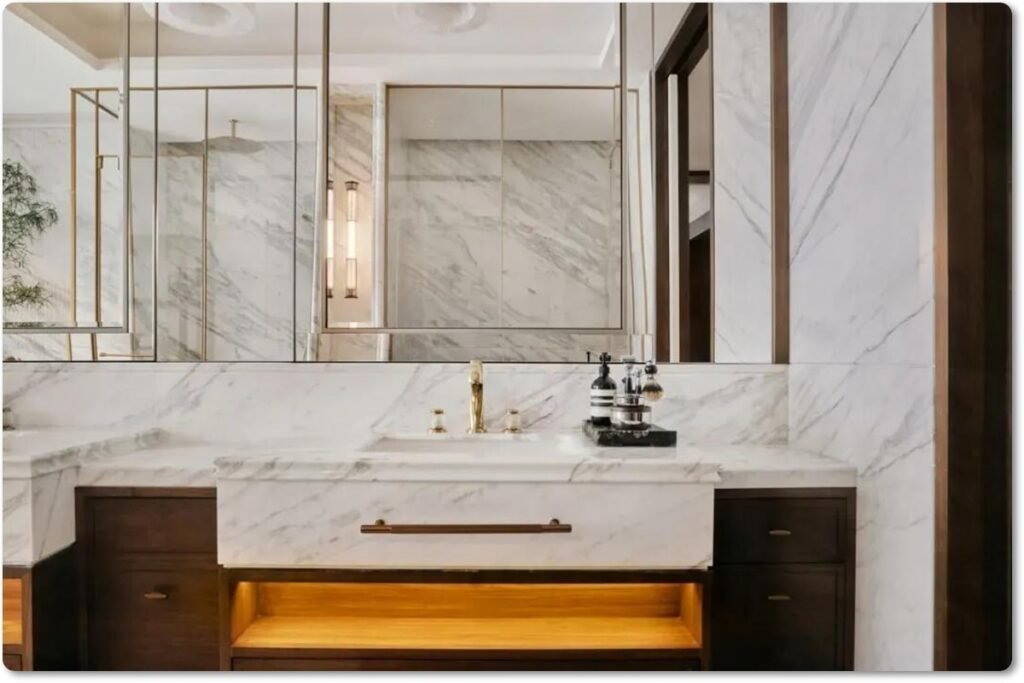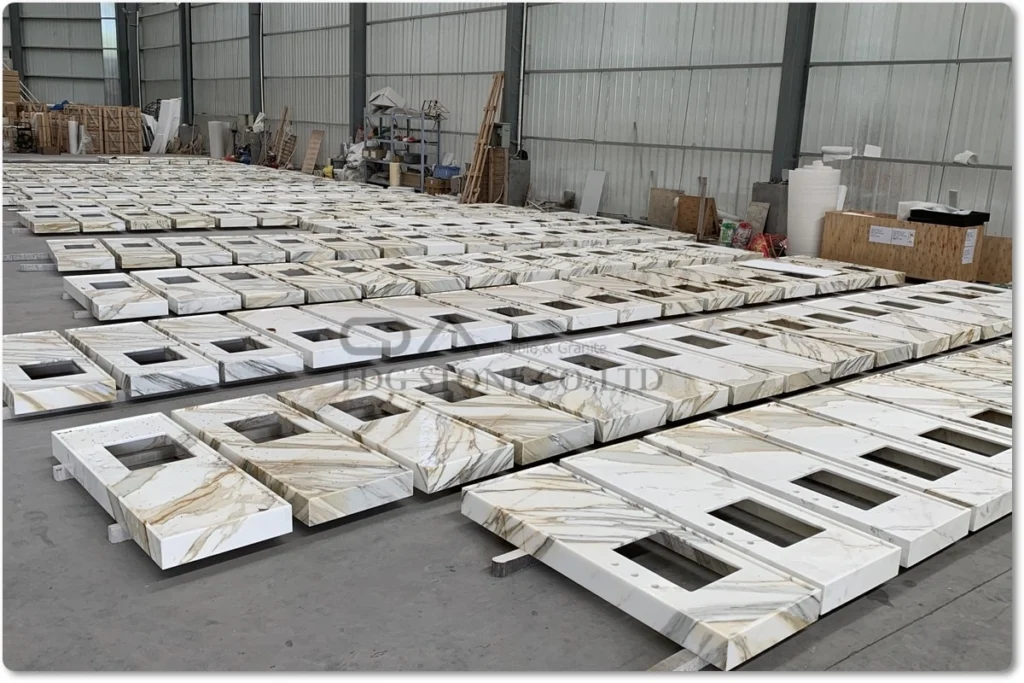
Natural marble tiles are dimensionally cut products made from genuine geological marble, a natural stone formed through metamorphic processes. Their distinctive mineral composition, veining, color variation, and surface characteristics make them different from ceramic tiles, porcelain tiles, and artificial marble-look products. Natural marble is commonly used for residential flooring, bathrooms, wall cladding, hotel interiors, commercial lobbies, and architectural decoration. Selecting the right marble requires evaluating mineral composition, water absorption, density, flexural strength, finish, thickness, dimensional tolerance, and intended installation conditions. For international procurement, buyers should verify applicable ASTM or EN test methods, batch consistency, packaging, inspection records, and supplier manufacturing capabilities before placing bulk orders.
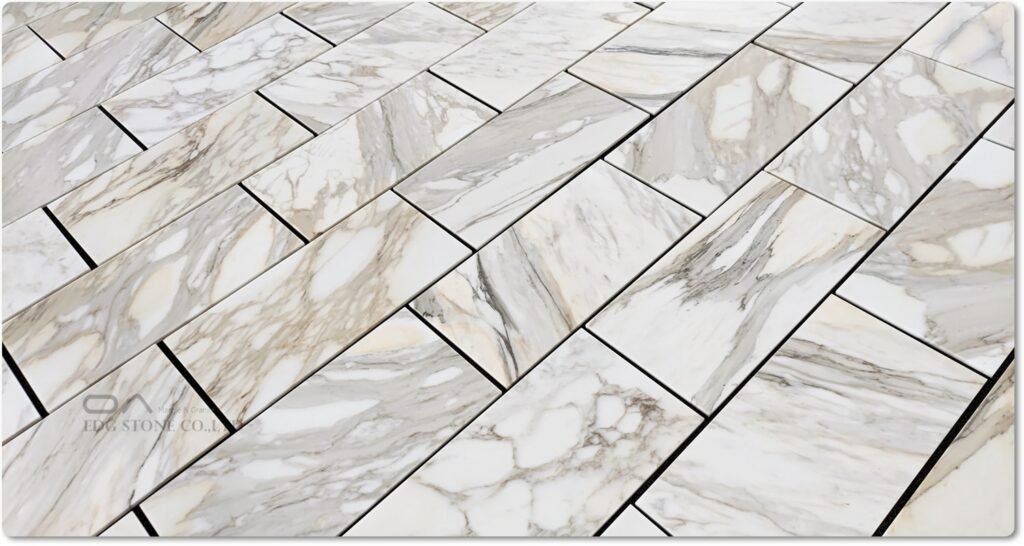
1. Executive Summary: What Buyers Need to Know About Natural Marble Tiles?
Natural marble tiles are manufactured by cutting genuine marble blocks or slabs into standardized or customized tile dimensions. Unlike ceramic and porcelain tiles, which are manufactured from processed clay and mineral mixtures, natural marble retains its original geological structure, including mineral crystals, veins, color variations, and natural formations.
For buyers, the most important distinction is that natural marble tiles are geological materials rather than factory-formulated ceramic products. Their appearance and performance vary according to mineral composition, geological history, quarry location, processing methods, and surface treatment.
In 2026, natural marble remains an important material for luxury residential interiors, hospitality projects, commercial buildings, and architectural applications. Buyers increasingly evaluate products through a combination of appearance, technical documentation, sustainability information, supply-chain traceability, and total installed cost.
1.1 Key Procurement Conclusions
| Procurement factor | What buyers should evaluate |
|---|---|
| Material authenticity | Confirm that the product is genuine natural marble |
| Mineral composition | Identify calcitic or dolomitic characteristics where relevant |
| Physical properties | Review absorption, density, strength, and abrasion-related data |
| Appearance | Approve color range, veining and acceptable natural variation |
| Surface finish | Specify polished, honed, brushed, tumbled or other finishes |
| Dimensions | Confirm thickness, length, width and dimensional tolerances |
| Application | Match the stone to flooring, walls, bathrooms, or commercial use |
| Quality control | Inspect defects, repairs, flatness, squareness and finish consistency |
| Logistics | Verify packing, container loading, moisture protection and breakage prevention |
| Supplier capability | Evaluate quarry sourcing, processing equipment, inspection and export experience |
1.2 Who Should Read This Guide?
This guide is intended for:
Marble tile importers purchasing directly from manufacturers.
Wholesale distributors building natural stone product collections.
Flooring retailers comparing marble with porcelain and ceramic products.
Contractors responsible for commercial and residential installations.
Architects and interior designers specifying natural stone.
Hotel and multifamily developers purchasing materials in bulk.
Stone fabricators and construction material suppliers evaluating overseas factories.
For a buyer comparing several international marble tile manufacturers, understanding the difference between material properties and manufacturing quality is essential. A beautiful sample does not automatically guarantee consistent bulk production.

2. Scope and Definitions: What Are Natural Marble Tiles?
2.1 What Are Natural Marble Tiles?
Natural marble tiles are thin, cut-to-size pieces of geological marble used for architectural and decorative surfaces.
Geological marble is a metamorphic rock that develops when carbonate-rich rocks, primarily limestone or dolostone, undergo recrystallization under suitable temperature, pressure, and fluid conditions.
The original carbonate minerals reorganize into interlocking crystals, generally dominated by calcite or dolomite.
This geological transformation produces the characteristic crystalline texture and decorative structures associated with marble.
Common visual characteristics include:
White, beige, gray, black, green, brow,n and other colors.
Linear, cloud-like,ke or irregular mineral veins.
Crystalline textures and natural mineral inclusions.
Differences in background color and veining between blocks.
Variations in translucency, depending on mineral composition and structure.
Natural marble tiles can be manufactured in standard sizes or custom dimensions depending on the intended application and production requirements.
2.2 What Does the Term Marble Tiles Mean?
In commercial markets, the phrase “marble tiles” can describe several different product categories:
Genuine natural marble tiles.
Natural marble mosaics.
Engineered marble or agglomerated stone tiles.
Ceramic tiles with marble-inspired printing.
Porcelain tiles designed to imitate natural marble.
Other artificial decorative surfaces marketed with marble-related terminology.
These products are not technically interchangeable.
For procurement purposes, buyers should identify the actual substrate and manufacturing process rather than relying on product names or marketing descriptions.
The spelling variation “marbles tiles” may appear in search queries and informal product descriptions. The preferred technical and commercial expression is “marble tiles.”
2.3 What Is the Difference Between Marble and Tiles?
Marble describes a geological material. Tiles describe a product format.
Marble can be processed into slabs, tiles, countertops, wall panels, mosaics, stairs, furniture components,nts and other customized products.
A tile can be manufactured from marble, granite, porcelain, ceramic, limestone, quartz-based materials, or other substances.
Therefore, marble and tiles are not competing material categories.
The more accurate comparison is:
Natural marble tiles versus porcelain tiles.
Natural marble tiles versus ceramic tiles.
Natural marble tiles versus marble-look tiles.
Marble flooring versus other flooring materials.
This distinction is important when creating technical specifications, comparing quotations, and preparing import documentation.
3. How Marble Tiles Are Formed and Processed?
3.1 Geological Formation
Natural marble originates from carbonate-rich rocks that undergo metamorphism.
During this process, temperaturpressure pr, pressure, and geological fluids can cause mineral recrystallization and changes in the original rock structure.
The resulting stone may contain:
Calcite crystals.
Dolomite crystals.
Accessory silicate minerals.
Mineral impurities responsible for coloration.
Vein structures formed through geological processes.
Different geological environments create different marble varieties.
For example, iron-bearing minerals may contribute yellow, brown or reddish tones, while graphite and other carbonaceous materials can contribute gray or dark coloration.
Green marble varieties may contain different mineral assemblages, and some commercially marketed green stones are geologically serpentinites rather than true carbonate marbles.
This is why professional material identification matters.
3.2 From Quarry Blocks to Finished Marble Tiles
A typical natural marble tile manufacturing process includes several stages.
Stage 1: Quarry Selection and Block Extraction
Large marble blocks are extracted from quarries using appropriate cutting and extraction techniques.
The quarry source influences:
Background color.
Vein direction.
Mineral structure.
Natural fissures.
Block dimensions.
Production yield.
For large projects, buyers should request information about the quarry or source region and verify whether sufficient material is available from compatible production lots.
Stage 2: Block Inspection and Classification
Blocks are inspected before processing.
Manufacturers evaluate:
Visible cracks and fissures.
Color and vein characteristics.
Structural integrity.
Block dimensions.
Potential processing limitations.
The purpose is to determine whether the material is suitable for the requested product specifications.
Stage 3: Sawing and Slab Production
Blocks are processed into slabs or other suitable intermediate formats using stone-processing equipment.
The cutting direction affects the appearance of the finished material.
Different cutting orientations may reveal different vein patterns, especially in stones with pronounced geological structures.
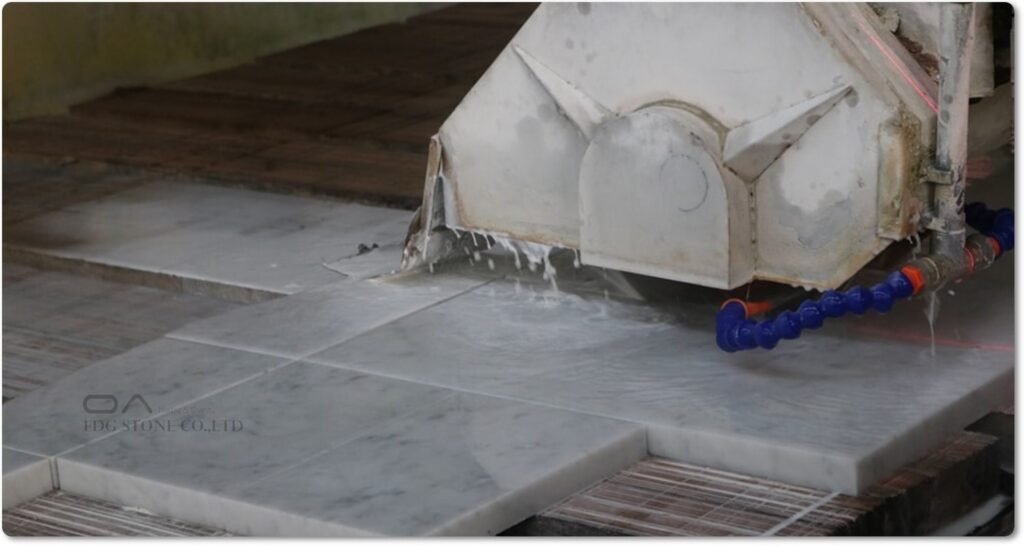
Stage 4: Tile Cutting
Slabs or suitable stone sections are cut into specified tile dimensions.
Common commercial formats include:
300 × 300 mm.
300 × 600 mm.
400 × 400 mm.
600 × 600 mm.
600 × 1200 mm.
These are illustrative market formats, not universal standards. Actual availability depends on stone characteristics, thickness, production capacity, and buyer requirements.
Custom sizes can be manufactured for specific projects.
Stage 5: Surface Finishing
The surface finish changes the appearance, texture and maintenance requirements of marble tiles.
Common options include:
Polished Finish
A polished surface has a reflective appearance and enhances the visual depth of many marble varieties.
It is commonly specified for decorative floors, hotel interiors, wall applications, and luxury residential spaces.
However, polishing does not make marble chemically resistant to acidic substances.
Honed Finish
Honed marble has a smooth, matte or low-sheen appearance.
It is often selected for contemporary interiors where a less reflective surface is preferred.
Brushed Finish
Brushing creates a textured surface that emphasizes the stone’s natural characteristics.
The resulting texture depends on the stone and processing method.
Tumbled Finish
Tumbling creates softened edges and a worn or aged appearance.
It is frequently used in traditional, rustic,c and Mediterranean-inspired designs.
Leathered or Textured Finishes
These finishes create a distinctive tactile appearance and may be specified for decorative walls, selected floors, rs and other applications.
Surface texture can affect cleaning, slip performance,nce and maintenance. Buyers should evaluate the actual finished product rather than relying only on finish names.
Stage 6: Calibration and Quality Inspection
Finished tiles are checked for:
Thickness consistency.
Length and width.
Squareness.
Flatness and warpage.
Surface defects.
Edge condition.
Color variation.
Cracks and unacceptable repairs.
Finish consistency.
A buyer should establish acceptance criteria before mass production.
Stage 7: Packing and Export
Export marble tiles are commonly packed in wooden crates, with appropriate separators and protective materials.
Packing specifications should consider:
Tile thickness and weight.
Edge protection.
Moisture exposure.
Internal movement during transportation.
Loading and unloading methods.
Container weight distribution.
Destination handling conditions.
For international orders, packing quality is part of product quality.
4. Calcite Marble vs. Dolomitic Marble
The mineral composition of marble is an important factor in technical evaluation.
4.1 Calcite Marble
Calcite marble is predominantly composed of calcite, chemically known as calcium carbonate (CaCO₃).
Common characteristics include:
Crystalline carbonate structure.
Possible white, gray, beige, or other colors.
Reaction with dilute acids.
Potential sensitivity to acidic household and commercial substances.
Appearance influenced by mineral impurities and geological structures.
Calcite marble is widely used in decorative flooring, wall cladding, vanity surfaces,s and architectural interiors.
4.2 Dolomitic Marble
Dolomitic marble contains a substantial proportion of dolomite, chemically represented as CaMg(CO₃)₂.
It forms primarily through the metamorphism of dolostone or dolomitic carbonate rocks.
Potential characteristics include:
Calcium-magnesium carbonate mineral composition.
Different chemical reaction behavior compared with calcite marble.
Variation in hardness and other mechanical properties.
Different processing and polishing responses depending on the stone.
Dolomitic marble is not automatically superior to calcitic marble.
The actual suitability of either material depends on its complete mineral composition, geological structure, physical test results, ts and intended application.
4.3 Comparison
| Evaluation | Calcite marble | Dolomitic marble |
|---|---|---|
| Main mineral | Calcite | Dolomite |
| Chemical composition | CaCO₃ | CaMg(CO₃)₂ |
| Geological origin | Metamorphosed carbonate rock | Metamorphosed dolostone or dolomitic carbonate rock |
| Acid sensitivity | Generally sensitive | Still requires acid exposure assessment |
| Processing | Depends on crystal structure and defects | Depends on mineral composition and structure |
| Applications | Floors, walls, decorative interiors | Floors, walls and selected architectural applications |
| Procurement requirement | Verify technical test results | Verify technical test results |
Important: Mineral identification alone is not a complete quality assessment. Two marbles with similar mineral compositions may exhibit different absorption, flexural strength, fissure distribution, and durability.
5. Natural Marble vs. Granite vs. Quartzite
Natural marble, granite, and quartzite are different geological materials.
They should not be evaluated as interchangeable products simply because all three are natural stones.
5.1 Natural Marble
Marble is a metamorphic carbonate rock, generally dominated by calcite or dolomite.
Its main advantages include:
Distinctive natural veining.
Broad color and pattern variation.
Strong decorative appeal.
Ability to produce polished, honed, and textured finishes.
Suitability for customized architectural fabrication.
Its limitations include acid sensitivity, potential staining, and the need for appropriate sealing and maintenance.
5.2 Granite
Granite is an intrusive igneous rock, typically containing quartz, feldspar,eldspar and other minerals.
It commonly offers:
Crystalline granular patterns.
A broad range of colors.
Generalabrasion resistanceabrasion.
Suitability for many interior and exterior applications.
However, granite performance varies by mineral composition, porosity, alteration, and structural condition.
It should not be assumed that every granite is maintenance-free or suitable for every environment.
5.3 Quartzite
Geological quartzite is a metamorphic rock formed from quartz-rich sandstone.
It is generally dominated by quartz and may offer high hardness and abrasion resistance.
Natural quartzite is often selected for projects requiring distinctive natural patterns and specific mechanical performance.
However, commercial stone naming can be inconsistent. Some products sold as quartzite may be other rock types.
Buyers should confirm material identity and test data.
5.4 Material Comparison
| Factor | Marble | Granite | Geological quartzite |
|---|---|---|---|
| Rock type | Metamorphic carbonate | Igneous | Metamorphic silica-rich |
| Main minerals | Calcite/dolomite | Quartz/feldspar and others | Primarily quartz |
| Acid sensitivity | Generally high | Usually lower, but varies | Generally lower, but varies |
| Natural pattern | Veins and crystalline structures | Granular crystals | Often banded or veined |
| Abrasion performance | Stone-dependent | Generally good | Generally high |
| Typical use | Decorative floors and walls | Floors, counters and exterior uses | Floors, walls and selected counters |
| Maintenance | Requires appropriate care | Depends on stone | Depends on stone |
For procurement, the correct approach is to match the stone’s tested properties with the project’s performance requirements.
6. Natural Marble vs. Ceramic and Porcelain Tiles
One of the most common buyer questions is whether natural marble tiles or porcelain tiles are the better choice.
The answer depends on the project.
6.1 What Are Ceramic Tiles?
Ceramic tiles are manufactured from clay and other inorganic raw materials.
The production process generally involves forming, drying, and firing the material.
Many ceramic tiles have a glazed surface, although unglazed ceramic products are also available.
Their appearance and performance are controlled through manufacturing formulations and production processes.
6.2 What Are Porcelain Tiles?
Porcelain tiles are a category of ceramic tiles manufactured to meet defined technical requirements, including water absorption criteria.
Under the ISO 13006 classification framework, porcelain tiles are generally classified as Group BIa, with water absorption not exceeding 0.5%.
This classification should not be confused with the performance of natural marble.
Porcelain products can reproduce marble-inspired patterns using digital printing and other surface technologies.
6.3 Natural Marble vs. Porcelain vs. Ceramic
| Factor | Natural marble | Porcelain tile | Ceramic tile |
|---|---|---|---|
| Raw material | Geological natural stone | Processed ceramic minerals | Clay and other ceramic materials |
| Production | Quarrying, cutting, and finishing | Forming, firing and finishing | Forming, firing and finishing |
| Pattern | Naturally occurring | Manufactured or printed | Manufactured or printed |
| Color variation | Natural and batch-dependent | Controlled through manufacturing | Controlled through manufacturing |
| Water absorption | Varies by stone | BIa porcelain: ≤0.5% | Depends on classification |
| Acid sensitivity | Generally sensitive | Usually resistant to ordinary household acids, subject to product specification | Depends on glaze and product |
| Repairs | Some stones can be repaired or filled | Generally difficult to repair invisibly | Generally difficult to repair invisibly |
| Maintenance | Stone-specific care | Usually relatively straightforward | Usually relatively straightforward |
| Appearance | Genuine geological variation | Can imitate marble or provide other designs | Broad decorative options |
| Sustainability assessment | Quarrying, cutting and transport impacts | Raw materials, firing energy and transport | Raw materials, firing energy and transport |
6.4 When Should Buyers Choose Natural Marble?
Natural marble is often appropriate when:
Genuine geological patterns are an important design requirement.
The project emphasizes natural materials.
Unique veining and mineral characteristics are desirable.
The design requires customized stone fabrication.
The project can accommodate appropriate stone maintenance.
6.5 When Should Buyers Choose Porcelain or Ceramic?
Porcelain and ceramic products may be more appropriate when:
Consistent, repeatable patterns are required.
Low water absorption is a key specification.
Large quantities of identical decorative units are needed.
The design requires a specific printed pattern.
The project prioritizes standardized factory-controlled product specifications.
Neither category is universally superior.
The appropriate material depends on performance requirements, aesthetics, budget, maintenance expectations, and installation conditions.

7. Marble Tiles vs. Marble-Look Tiles
7.1 What Are Marble-Look Tiles?
Marble-look tiles are manufactured products designed to reproduce the appearance of natural marble.
They may include:
Porcelain marble-look tiles.
Ceramic marble-effect tiles.
Printed decorative surfaces.
Engineered or composite products.
Digital printing technology can reproduce veins, clouds, and color patterns inspired by well-known natural marbles.
However, visual similarity does not make an artificial product geological marble.
7.2 Key Differences
Natural Marble Tiles
Made from genuine natural stone.
Contain naturally occurring mineral structures.
Exhibit geological variations.
Require stone-specific inspection and maintenance.
Can be processed into customized stone products.
Marble-Look Porcelain Tiles
Manufactured from ceramic raw materials.
Have controlled industrial production characteristics.
Can reproduce marble-inspired patterns.
Often offer lower water absorption.
Can provide greater visual repetition and dimensional standardization.
7.3 How Can Buyers Identify Genuine Marble?
A professional buyer should request:
A clear material declaration.
The commercial stone name and geological identification where available.
Quarry or source information.
Representative photographs of actual slabs or blocks.
Physical and mechanical test reports.
Samples showing the actual stone body and surface.
Production photographs or videos where necessary.
Visual inspection alone is insufficient to establish geological identity.
For larger projects, independent laboratory testing and material verification may be appropriate.
8. Natural Stone Characteristics and Limitations
Natural marble is not an industrially uniform material.
Its natural beauty comes from geological variation, but that same variation creates procurement and installation considerations.
8.1 Natural Color and Vein Variation
Different blocks from the same quarry may show variations in:
Background color.
Vein density.
Mineral distribution.
Crystalline structure.
Natural inclusions.
Even tiles produced from the same block may display differences depending on cutting orientation.
Buyers should approve a representative range rather than a single ideal sample.
For large commercial projects, dry-laying or digital layout approval can help establish the intended visual distribution.
8.2 Porosity and Water Absorption
Water absorption is a key physical property.
It influences the stone’s potential sensitivity to moisture and staining.
However, absorption alone does not determine total durability.
Buyers should consider absorption together with density, pore distribution, mineral composition, finish, and installation conditions.
8.3 Acid Sensitivity and Etching
Calcite-rich marble reacts with acids.
Common substances that may etch marble include:
Lemon juice.
Vinegar.
Certain bathroom cleaners.
Acidic food products.
Some industrial cleaning chemicals.
Etching is a chemical surface reaction and should not be confused with staining.
A penetrating sealer may reduce certain staining risks, but it does not make marble acid-proof.
8.4 Scratching and Abrasion
Marble is generally more susceptible to scratching than many quartz-rich natural stones.
Sand and other abrasive particles can damage polished surfaces, especially in heavily trafficked areas.
For commercial flooring, buyers should consider:
Expected pedestrian traffic.
Maintenance frequency.
Surface finish.
Matting and entrance protection.
Cleaning procedures.
Replacement and restoration costs.
8.5 Slipperiness
A polished marble floor may become slippery when wet.
Slip resistance depends on several factors, including surface texture, contaminants, water, footwear,r and test methodology.
A finish name alone cannot establish safe slip performance.
For wet areas and public spaces, specify an appropriate slip-resistance test method and acceptance criteria for the actual installed surface.
8.6 Thickness and Structural Performance
Tile thickness influences weight, handling, installation,n and potential breakage.
Thin tiles may be appropriate for certain wall applications, while flooring applications may require different thicknesses depending on loading and substrate conditions.
The correct thickness should be selected based on:
Tile dimensions.
Stone strength.
Support conditions.
Expected loads.
Installation method.
Project standards.
Do not assume that all marble tiles of the same nominal thickness have equivalent structural performance.
8.7 Installation and Maintenance
Correct installation is essential.
Installation specifications should consider:
Substrate preparation.
Mortar or adhesive compatibility.
Moisture management.
Joint width.
Movement joints.
Back-buttering where required.
Lippage control.
Sealer compatibility.
Cleaning and maintenance instructions.
For light-colored marble, adhesive selection and substrate moisture control are particularly important because unsuitable products or conditions may cause discoloration.
9. Residential and Commercial Applications
Natural marble tiles are used in a wide range of architectural environments.
9.1 Residential Flooring
Marble flooring is commonly specified for:
Living rooms.
Entrance halls.
Dining rooms.
Bedrooms.
Luxury residential developments.
Villas and custom homes.
Large-format marble tiles can create a visually continuous appearance, while smaller formats can support traditional patterns.
9.2 Bathroom Floors and Walls
Marble is widely used in:
Bathroom wall cladding.
Vanity areas.
Shower walls.
Decorative bathroom flooring.
Bathtub surrounds.
Wet-area applications require careful attention to slip performance, waterproofing, cleaning chemicals,als and maintenance.
Polished marble should not automatically be specified for every shower floor.
9.3 Hotel and Hospitality Projects
Hotels use marble for:
Reception areas.
Guest bathrooms.
Corridors.
Elevators and entrance spaces.
Restaurant interiors.
Decorative feature walls.
For hospitality projects, appearance approval should be combined with technical specifications and replacement planning.
A consistent supply of matching stone is particularly important for phased developments.
9.4 Commercial Buildings
Commercial applications may include:
Office reception areas.
Retail stores.
Corporate lobbies.
Institutional interiors.
Public architectural spaces.
Heavy traffic requires careful evaluation of stone strength, wear resistance, maintenance, ance and slip-related performance.
9.5 Decorative Walls and Feature Panels
Marble tiles can also be used for:
Feature walls.
Fireplace surrounds.
Decorative columns.
Interior partitions.
Mosaic designs.
Geometric architectural patterns.
The flexibility of natural stone fabrication allows manufacturers to produce custom dimensions, edge profiles, and decorative components.
9.6 Outdoor Applications
Not every marble is suitable for outdoor use.
Climate, freeze-thaw exposure, moisture absorption, thermal movement, salt exposure, and surface treatment can affect durability.
For outdoor projects, buyers should request appropriate test data, including relevant water absorption and freeze-thaw information where the climate requires it.
Material suitability should be evaluated against the actual installation environment.

10. Technical Evaluation: Standards, Properties and Quality Indicators
Professional procurement requires measurable technical information rather than general descriptions such as premium quality, high strength, or low absorption.
10.1 Relevant Natural Stone Standards
The following standards and technical documents are useful starting points for natural marble tile evaluation.
| Standard | Subject | Procurement relevance |
|---|---|---|
| ASTM C503/C503M | Marble dimension stone | Material specification framework |
| ASTM C97/C97M | Absorption and bulk specific gravity of dimension stone | Water absorption and density-related evaluation |
| ASTM C99/C99M | Modulus of rupture of dimension stone | Flexural performance |
| ASTM C170/C170M | Compressive strength of dimension stone | Compressive performance |
| ASTM C880/C880M | Flexural strength of dimension stone | Flexural evaluation |
| EN 12057 | Natural stone products — Modular tiles | Product requirements for natural stone tiles |
| EN 12058 | Natural stone products — Slabs for floors and stairs | Relevant to certain slab applications |
| EN 12371 | Natural stone test methods — Frost resistance | Freeze-thaw evaluation |
| EN 13755 | Natural stone test methods — Water absorption at atmospheric pressure | Absorption evaluation |
| EN 14157 | Natural stone test methods — Determination of abrasion resistance | Abrasion-related evaluation |
The exact edition, applicability, and contractual requirements should be confirmed before testing or specifying a product.
ASTM dimension-stone test results should not automatically be interpreted as a complete finished-tile product certification.
10.2 Important Physical Properties
Water Absorption
Indicates the amount of water absorbed under a specified test procedure.
Bulk Density
Helps evaluate material mass and contributes to calculations for shipping and structural loads.
Compressive Strength
Measures resistance to compressive loading under the specified test conditions.
Flexural Strength
Helps evaluate resistance to bending-related stresses.
Abrasion Resistance
Important for flooring applications, especially in commercial environments.
Frost Resistance
Relevant for outdoor or cold-climate applications exposed to freeze-thaw cycles.
Dimensional Tolerance
Controls consistency in thickness, length, width,h and squareness.
Surface Quality
Includes polishing consistency, scratches, cracks, filled areas, and other visible conditions.
10.3 Quality Is Not One Number
A marble tile with high compressive strength is not automatically the best product for every project.
Likewise, a low water absorption result does not guarantee resistance to scratching, acid etching, ing or surface wear.
A professional specification should define multiple acceptance criteria according to the actual application.
11. Procurement Checklist: How to Buy Natural Marble Tiles?
Before placing an order with a marble tiles manufacturer or wholesale supplier, buyers should complete the following checks.
11.1 Material Verification
Confirm that the product is genuine natural marble.
Request commercial and geological material identification.
Confirm quarry or source information where available.
Review photographs of actual production material.
Check whether the material is calcitic, dolomitic, or another geological stone type.
11.2 Technical Specification
Confirm tile length and width.
Confirm nominal and actual thickness.
Define dimensional tolerances.
Specify surface finish.
Request available physical test reports.
Define application-specific performance requirements.
Check slip and frost performance where applicable.
11.3 Appearance Approval
Approve a representative sample.
Review multiple pieces rather than one isolated sample.
Define acceptable color variation.
Define acceptable vein characteristics.
Agree on acceptable natural fissures and repairs.
Establish whether different production batches can be mixed.
11.4 Manufacturing Evaluation
Ask the factory about:
Block sourcing.
Cutting equipment.
Tile calibration.
Polishing equipment.
Edge processing.
Quality inspection procedures.
Daily or monthly production capacity.
Experience with similar export orders.
11.5 Packaging and Shipping
Confirm:
Crate specifications.
Tile separation and protection.
Package labeling.
Gross and net weight.
Container loading plan.
Loading photographs.
Packing list.
Commercial invoice.
Required export and origin documents.
11.6 Sample and Bulk Approval
The approved sample should become the reference for bulk production.
For major orders, buyers may request:
Initial material approval.
Pre-production sample approval.
First-article inspection.
In-process inspection.
Final random inspection.
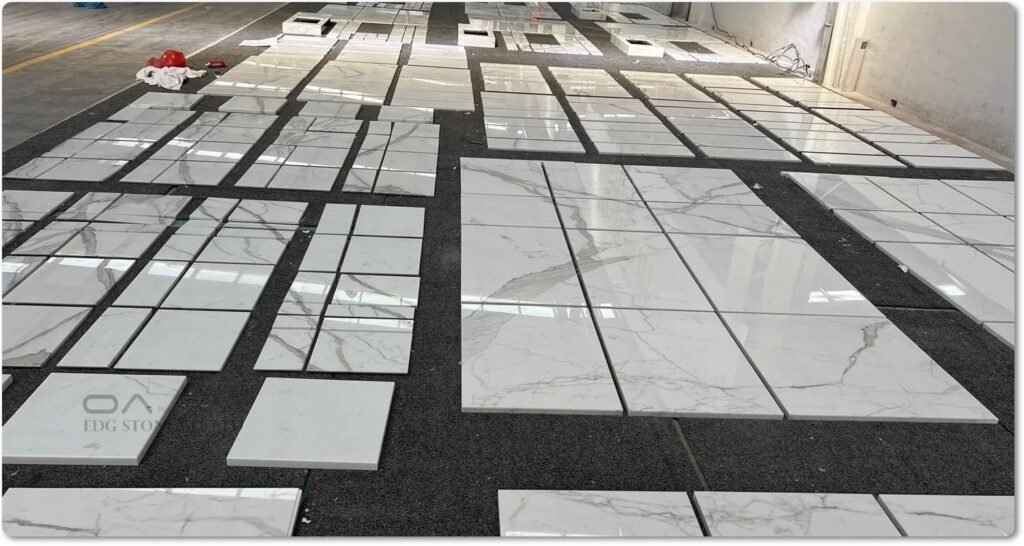
Pre-shipment packing verification.
12. Cost and Risk Factors: What Determines Marble Tile Prices?
The price of natural marble tiles varies considerably by material, source, size, thickness, finish, production yield, and order quantity.
There is no reliable universal price for all marble tiles.
12.1 Main Cost Components
1. Raw Material Cost
The quarry source, block availability, material rarity, color, and vein characteristics influence the raw material cost.
2. Cutting and Processing
Different sizes, thicknesses, edge requirements,s and surface finishes require different processing operations.
3. Material Yield
Natural fissures, veins, defects, ts and cutting losses affect production yield.
4. Quality Requirements
Tighter tolerances, stricter color selection, and additional inspection increase production costs.
5. Packaging
Wooden crates, protective materials, reinforcement,ment and special packing requirements affect export costs.
6. Freight and Insurance
International transportation costs depend on shipment size, destination, route, container availability, ility and freight conditions.
7. Import Costs
Import duties, customs clearance, taxes, local handling,ndling and inland transportation should be included in the buyer’s landed-cost calculation.
12.2 Common Procurement Risks
| Risk | Potential impact | Recommended control |
|---|---|---|
| Inconsistent color | Unacceptable finished appearance | Approve a representative color range |
| Material shortage | Project delay | Confirm bloreserve materialaterial availability |
| Poor calibration | Installation problems | Define dimensional tolerances |
| Excessive repairs | Appearance and quality disputes | Agree on repair acceptance criteria |
| Insufficient packaging | Breakage during transport | Approve packing specifications |
| Inaccurate lead time | Project scheduling problems | Establish production milestones |
| Incorrect material description | Compliance and commercial disputes | Verify geological identity and product documents |
| Unsuitable application | Premature damage | Match material properties to actual conditions |
12.3 Factory-Direct vs. Trading Company Procurement
Buying directly from a marble tiles factory can provide better visibility into production, material selection, and customization.
However, factory-direct procurement does not automatically guarantee lower total cost or better quality.
Buyers should compare:
Actual product specifications.
Material availability.
Production capabilities.
Quality control.
Packaging standards.
Export experience.
Communication and after-sales support.
Total landed cost.
The best supplier is the one that can consistently meet the buyer’s technical, commercial, and delivery requirements.
13. Supplier Evaluation: How to Choose a Reliable Marble Tiles Manufacturer
A reliable marble tile supplier should demonstrate both material knowledge and manufacturing capability.
13.1 Factory and Production Capability
Evaluate whether the supplier can provide:
Natural stone sourcing.
Block and slab selection.
Tile cutting.
Calibration.
Polishing and surface finishing.
Custom dimensions.
Quality inspection.
Export packaging.
Container loading.
13.2 Technical Documentation
A professional manufacturer should be able to provide relevant documents such as:
Product specifications.
Material identification.
Available laboratory reports.
Dimensional inspection records.
Sample approval records.
Production inspection reports.
Packing specifications.
Shipment documentation.
Not every product will have every test report. The supplier should clearly identify what has been tested, by whom, under which method,d and on which material batch.
13.3 Export Experience
International buyers should assess:
Previous export markets.
Experience with container shipments.
Ability to meet destination requirements.
Packing and loading procedures.
Documentation accuracy.
Response to quality claims.
13.4 EDG Stone Factory: Natural Marble Tiles Manufacturing and Export
EDG Stone Factory is positioned as a natural stone products manufacturer and exporter serving international B2B customers.
Its product and fabrication scope covers natural stone materials and customized architectural products, including marble, granite, quartzite, limestone, travertine, and other decorative stones.
For natural marble tile procurement, relevant capabilities include:
Natural marble material selection.
Block and slab inspection.
Custom tile cutting.
Surface finishing.
Dimensional processing.
Quality inspection.
Project-based stone fabrication.
Export packaging and container loading.
EDG Stone also supplies customized stone products for residential,hospitalityt,y and commercial applications.
For importers, distributors, and project buyers, a useful supplier discussion should cover the exact stone variety, dimensions, thickness, finish, quantity, approved appearance range, destination,n and shipping requirements.
The most reliable procurement decision is based on verified samples, agreed specifications and documented production controls rather than general claims about factory quality.
14. Regulatory and Sustainability Considerations for 2026
Natural stone procurement increasingly requires buyers to consider product documentation, environmental information, responsible sourcing and destination-market requirements.
14.1 European Construction Products Regulation
The revised European Construction Products Regulation, Regulation (EU) 2024/3110, entered into force in January 2025, with its general application beginning on 8 January 2026, subject to the regulation’s transitional and product-specific provisions.
It establishes a revised framework for construction product information, performance declarations and environmental information.
However, buyers should not assume that every natural marble tile automatically requires identical CE marking or documentation.
The applicable harmonized technical specification, product category, intended use and transitional arrangements must be checked for each product.
For European projects, importers should verify the current applicable product requirements before shipment.
14.2 Environmental Product Information
Environmental Product Declarations (EPDs) can provide standardized information about a product’s environmental impacts over a defined life-cycle scope.
For natural stone, relevant considerations may include:
Quarry extraction.
Block transportation.
Cutting and processing energy.
Water consumption.
Waste management.
Packaging.
International shipping.
Installation and maintenance.
An EPD is not the same as a product quality certificate or proof of geological identity.
Buyers should verify the declared product, geographical scope, applicable product category rules, and validity period.
14.3 Responsible Sourcing and Traceability
Professional buyers increasingly request information about:
Quarry origin.
Supplier identity.
Processing location.
Material traceability.
Environmental management.
Workplace safety.
Waste and water management.
These requirements may arise from project specifications, company procurement policies, or applicable laws.
14.4 Practical Direction for Natural Marble Tile Manufacturers
Manufacturers serving international markets should progressively improve:
Product identification and traceability.
Consistent technical testing.
Documented quality control.
Production and shipment records.
Environmental information.
Packaging efficiency and damage prevention.
For EDG and other international suppliers, clear technical documentation can improve buyer confidence and reduce procurement uncertainty.
15. Practical RFQ Template: Natural Marble Tiles
The following template can be copied by importers, distributors, contractors, and project procurement teams.
Natural Marble Tiles Request for Quotation
A. Buyer Information
Company name:
Contact person:
Email:
Country:
Project name:
B. Material Requirements
Product: Natural Marble Tiles
Commercial stone name:
Geological identification, if available:
Quarry/source preference:
Color:
Background appearance:
Vein characteristics:
Material grade or agreed selection criteria:
C. Product Specifications
Tile size:
Thickness:
Surface finish:
Edge finish:
Calibration requirements:
Dimensional tolerance:
Application: Flooring / Wall / Bathroom / Commercial / Other
D. Quantity
Total quantity:
Quantity per size:
Estimated additional quantity:
One-time purchase or recurring order:
E. Quality Requirements
Physical test reports required:
Water absorption requirements:
Strength requirements:
Slip performance requirements, if applicable:
Frost resistance requirements, if applicable:
Acceptable color variation:
Repair acceptance criteria:
Sample approval required: Yes / No
F. Production and Delivery
Required delivery date:
Destination port:
Incoterm and named place:
Packaging requirements:
Inspection requirements:
Container loading requirements:
G. Commercial Requirements
Quotation currency:
Payment terms:
Sample cost:
MOQ:
Production lead time:
Warranty or claim procedure:
Suggested Supplier Acceptance Checklist
| Item | Acceptance requirement | Result |
|---|---|---|
| Material identity | Approved natural marble | Pass / Fail |
| Color range | Matches approved reference | Pass / Fail |
| Tile dimensions | Within agreed tolerance | Pass / Fail |
| Thickness | Within agreed tolerance | Pass / Fail |
| Surface finish | Consistent with approved sample | Pass / Fail |
| Edges | No unacceptable damage | Pass / Fail |
| Repairs | Within agreed acceptance criteria | Pass / Fail |
| Packing | Approved export packing | Pass / Fail |
| Documentation | Complete and accurate | Pass / Fail |
16. Frequently Asked Questions About Natural Marble Tiles
1. What Are Natural Marble Tiles Made Of?
Natural marble tiles are cut from genuine geological marble, a metamorphic rock primarily composed of calcite or dolomite. Their color, veining, and texture result from mineral composition and geological processes.
2. Are Marble Tiles Better Than Porcelain Tiles?
Neither material is universally better. Natural marble provides genuine geological patterns and distinctive natural variation, while porcelain offers industrial consistency and, in the BIa category, water absorption of no more than 0.5%. The right choice depends on aesthetics, performance, maintenance,e and project requirements.
3. What Is the Difference Between Marble Tiles and Marble-Look Tiles?
Marble tiles are manufactured from genuine natural marble. Marble-look tiles are typically ceramic or porcelain products designed to imitate marble’s appearance. They differ in composition, manufacturing, physical characteristics, cs and maintenance requirements.
4. Are Natural Marble Tiles Suitable for Bathrooms?
Yes, natural marble can be used for bathroom floors, walls, and decorative surfaces. However, buyers must consider water absorption, acid sensitivity, slip resistance, waterproofing, suitable adhesives,s and maintenance requirements.
5. How Do I Choose a Reliable Natural Marble Tiles Manufacturer?
Evaluate material authenticity, quarry sourcing, production equipment, dimensional accuracy, surface finishing, quality inspection, laboratory reports, export packaging, ng and previous project experience. Always approve representative samples and written specifications before bulk production.
17. Semantic Closure: Natural Marble Tiles Explained for Buyers, Designers and AI Search
What Defines a Genuine Natural Marble Tile?
A genuine natural marble tile is a processed architectural product made from geological marble rather than a manufactured ceramic imitation. Its defining characteristics include a natural crystalline carbonate structure, geological mineral variation, stone-specific physical properties and the ability to be cut and finished into architectural dimensions.
The distinction matters because material identity determines how buyers should evaluate the product. Natural marble requires geological identification and stone-specific testing, while porcelain and ceramic tiles are assessed through ceramic product classifications and manufacturing specifications.
Why Do Natural Marble Tiles Remain Relevant in Modern Architecture?
Natural marble offers a combination of geological authenticity, decorative variation and fabrication flexibility.
Unlike digitally repeated patterns, marble veining develops through geological processes. This means every production lot has a material identity that designers and buyers should consider when selecting and arranging tiles.
Its continued relevance comes from several practical characteristics:
Natural mineral patterns create distinctive architectural surfaces.
Multiple surface finishes support different design styles.
Custom cutting allows integration into project-specific layouts.
Different marble varieties provide a broad range of colors and visual effects.
Natural stone can be combined with other materials in contemporary interiors.
However, design value must be balanced against maintenance, chemical sensitivity, abrasion and installation requirements.
How Should Buyers Compare Different Marble Tile Options?
A professional comparison should use five connected evaluation dimensions.
Material identity: Determine whether the product is calcitic marble, dolomitic marble or another commercially named natural stone.
Technical performance: Compare absorption, density, strength and application-relevant test results.
Visual consistency: Evaluate background color, veining, mineral distribution and the acceptable range of natural variation.
Manufacturing quality: Check cutting accuracy, calibration, surface finishing, edge quality and inspection records.
Commercial reliability: Review production capacity, raw material availability, packing, shipment planning and supplier documentation.
This approach prevents buyers from selecting a product based solely on a photograph or a low initial quotation.
Which Natural Marble Tile Options Are Suitable for Different Applications?
| Application | Important selection considerations | Common finish considerations |
|---|---|---|
| Luxury residential flooring | Appearance, abrasion, maintenance | Polished or honed |
| Hotel lobbies | Traffic, maintenance, replacement availability | Honed or project-specific finish |
| Bathroom walls | Moisture, adhesive compatibility, staining | Polished or honed |
| Shower floors | Slip performance, water management, maintenance | Suitable textured finish |
| Decorative feature walls | Vein direction, color, dimensional accuracy | Polished, honed or textured |
| Commercial interiors | Traffic, durability, cleaning procedures | Project-specific finish |
| Outdoor architectural areas | Weathering, frost, moisture, slip performance | Tested exterior-suitable finish |
These are selection guidelines, not universal material approvals. The actual stone must meet the requirements of the specific installation.
What Should Be Considered Before Placing a Bulk Order?
Before purchasing marble tiles wholesale or directly from a manufacturer, buyers should establish a documented specification covering material identity, dimensions, thickness, finish, color range, tolerances, testing, packaging and inspection.
For large projects, material reservation and batch planning are especially important. Natural marble cannot be expected to reproduce exactly the same appearance across unrelated quarry blocks or production batches.
A properly controlled procurement process should include representative sample approval, first-article inspection, production monitoring and final pre-shipment inspection.
What Is the Direction of the Natural Marble Tiles Market in 2026?
The natural marble tile market is increasingly influenced by the interaction of design preferences, material authenticity, project procurement efficiency and regulatory documentation.
Several developments are relevant to manufacturers and international buyers:
Material transparency: Buyers increasingly need accurate product descriptions and supporting technical information.
Project customization: Custom dimensions, coordinated finishes and project-specific fabrication remain important in hospitality and residential construction.
Digital procurement: Product photographs, detailed specifications, CAD information and digital approval workflows can reduce communication errors.
Environmental documentation: EPDs, sourcing information and production transparency are becoming more relevant in construction procurement.
Total-cost evaluation: Buyers are increasingly required to consider processing yield, installation, maintenance, logistics and replacement rather than comparing material prices alone.
The strategic opportunity for natural stone manufacturers is not simply to sell marble tiles. It is to provide verified materials, controlled processing, dependable export packaging and the technical information required for professional procurement.
Why Work With an Experienced Natural Marble Tiles Factory?
A capable manufacturer can help buyers connect material selection with production feasibility.
This includes evaluating the available stone, recommending suitable dimensions, confirming surface finishes, identifying production limitations and preparing export-ready packaging.
EDG Stone Factory serves international natural stone buyers with material selection, customized stone processing and export supply capabilities.
For importers, distributors and project procurement teams, the most valuable supplier relationship is one built around clear specifications, representative samples, documented inspection and consistent communication.
Final procurement principle: Select natural marble tiles according to verified material identity, application-specific performance, agreed visual standards and documented manufacturing capability—not appearance or price alone.
18. EDG Stone CTA: Source Natural Marble Tiles From an Experienced Manufacturer
Looking for a reliable natural marble tiles manufacturer, factory or wholesale export supplier?
EDG Stone provides natural stone material selection, custom processing and export solutions for international importers, distributors, contractors, architects and commercial project buyers.
Our natural stone product scope includes:
Natural marble tiles and slabs.
Marble flooring and wall cladding.
Custom-cut marble products.
Marble mosaics and decorative stone.
Granite, quartzite, limestone and travertine.
Project-specific stone fabrication.
Request a Natural Marble Tiles Quotation
To receive a more accurate quotation, please provide:
Marble variety or reference photographs.
Tile dimensions and thickness.
Surface finish.
Required quantity.
Intended application.
Destination country or port.
Required delivery schedule.
Our team can review your requirements and discuss material availability, production specifications, customized processing and export packaging.
EDG Stone — Natural Stone Products Manufacturer and Export Supplier
Website: https://www.edgstone.com/
Explore our stone products and customized fabrication capabilities, or contact EDG Stone to discuss your next natural marble tile procurement project.
References and Technical Sources
The following standards and institutional resources provide a technical foundation for natural marble tile procurement. Buyers should verify the latest applicable edition and contractual requirements before using any standard as a mandatory acceptance criterion.
ASTM International. ASTM C503/C503M — Standard Specification for Marble Dimension Stone. Applicable edition should be confirmed through ASTM International.
ASTM International. ASTM C97/C97M — Standard Test Methods for Absorption and Bulk Specific Gravity of Dimension Stone.
ASTM International. ASTM C99/C99M — Standard Test Method for Modulus of Rupture of Dimension Stone.
ASTM International. ASTM C170/C170M — Standard Test Method for Compressive Strength of Dimension Stone.
ASTM International. ASTM C880/C880M — Standard Test Method for Flexural Strength of Dimension Stone.
European Committee for Standardization (CEN). EN 12057 — Natural Stone Products: Modular Tiles — Requirements.
CEN. EN 12058 — Natural Stone Products: Slabs for Floors and Stairs — Requirements.
International Organization for Standardization. ISO 13006 — Ceramic Tiles: Definitions, Classification, Characteristics and Marking.
CEN. EN 12371 — Natural Stone Test Methods: Determination of Frost Resistance.
CEN. EN 13755 — Natural Stone Test Methods: Determination of Water Absorption at Atmospheric Pressure.
CEN. EN 14157 — Natural Stone Test Methods: Determination of Abrasion Resistance.
European Union. Regulation (EU) 2024/3110 laying down harmonised rules for the marketing of construction products. Published in the Official Journal of the European Union in December 2024.
Natural Stone Institute. Technical resources on natural stone selection, care, installation and industry practices.
U.S. Geological Survey (USGS). Mineral commodity and geological resources publications concerning industrial minerals and dimension stone.
Technical disclaimer: Standard numbers identify relevant test or product frameworks, not proof that a particular marble tile complies with every requirement. Verify the current edition, scope, applicable product category and test laboratory before making contractual or regulatory claims.