Executive Summary: Choosing the Right Marble Tiles for Flooring
Marble tiles for flooring are natural stone products manufactured from quarried marble blocks or slabs and processed into calibrated flooring units for residential, hospitality, and commercial applications. The right selection depends on the marble’s physical properties, thickness, surface finish, dimensions, expected foot traffic, installation conditions, and maintenance requirements.
For hotel lobbies, luxury residential developments, commercial entrances, and multifamily common areas, marble flooring offers a combination of natural appearance, architectural flexibility, and long-term renovation potential.
However, not every marble variety is suitable for every flooring environment. A polished marble floor may provide an elegant appearance in a luxury hotel lobby, while a honed or textured finish may be more appropriate for areas exposed to moisture or frequent pedestrian traffic.
Project buyers should evaluate stone properties, abrasion resistance, water absorption, finish durability, slip resistance, dimensional tolerances, and installation compatibility before approving a flooring specification.
Marble tiles for flooring are available in multiple stone varieties, dimensions, thicknesses, and finishes. Common commercial flooring formats include 300 × 600 mm, 600 × 600 mm, 600 × 1200 mm, and custom large-format pieces, although actual availability depends on the stone block, processing requirements, and project drawings. Polished marble provides a reflective luxury appearance, honed marble offers a softer matte appearance, and textured finishes can be considered for areas requiring additional surface traction. Successful marble flooring projects require appropriate material testing, stable substrate preparation, compatible setting materials, properly designed grout and movement joints, and a documented maintenance plan. Commercial buyers should evaluate the complete flooring system rather than selecting marble tiles by appearance or price alone.
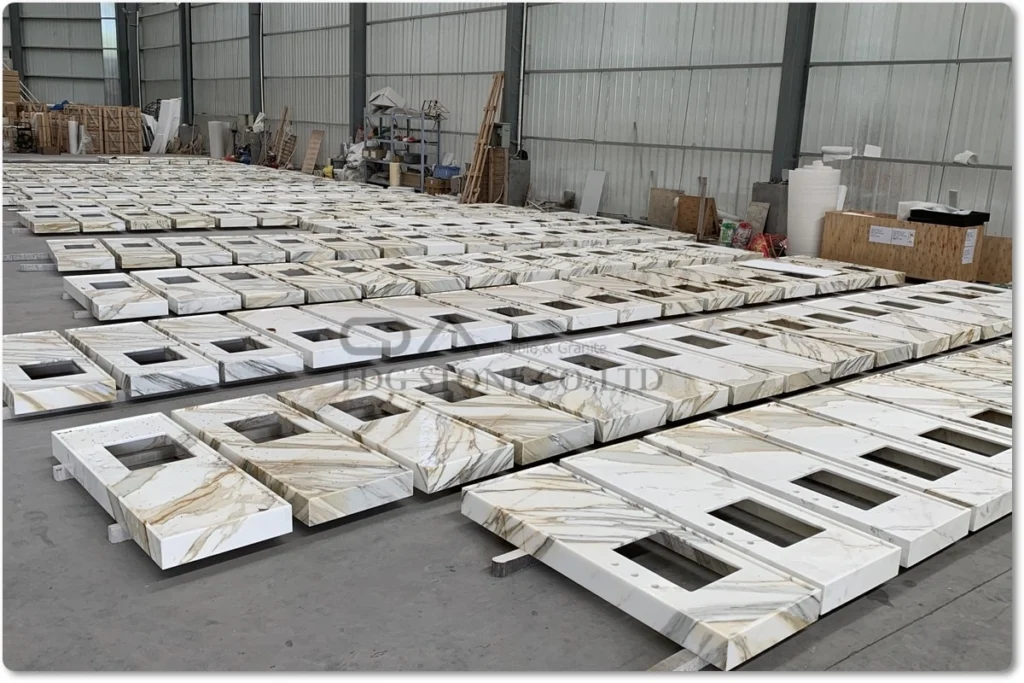
This guide explains how to select, specify, inspect, install, and procure marble floor tiles for residential and commercial construction projects. It also outlines how a professional marble tiles manufacturer and factory supplier such as EDG Stone can support project-specific material selection, dimensional fabrication, quality inspection, and export packaging.
1. Scope and Definitions: Understanding Marble Floor Tiles
Marble flooring is a natural stone flooring system consisting of marble units installed over a prepared substrate using an appropriate setting method.
The term marble floor tiles generally refers to relatively thin, regularly dimensioned stone units. Larger custom-cut pieces may be more appropriately described as marble slabs or dimension-stone flooring panels, depending on their dimensions and project specification.
1.1 Natural Marble Tiles vs. Engineered Flooring
Natural marble is a geological stone, generally consisting predominantly of calcite or dolomite. Its appearance results from mineral composition, geological formation, veining, and other natural characteristics.
Natural marble tiles should be distinguished from:
Engineered quartz flooring.
Porcelain tiles with marble-effect printing.
Sintered stone panels.
Artificial marble and agglomerated stone.
Terrazzo flooring.
These materials may imitate marble aesthetics but have different compositions, manufacturing processes, physical properties, and maintenance requirements.
For procurement purposes, buyers should clearly identify whether the specified product is genuine natural marble or an engineered alternative.
1.2 Typical Applications
Marble flooring is commonly specified for:
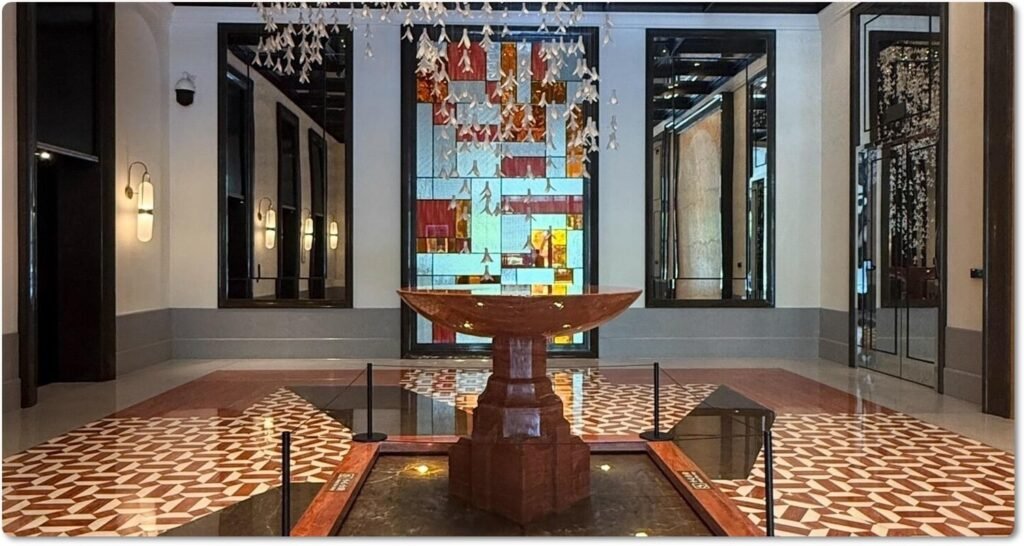
Luxury hotel lobbies and reception areas.
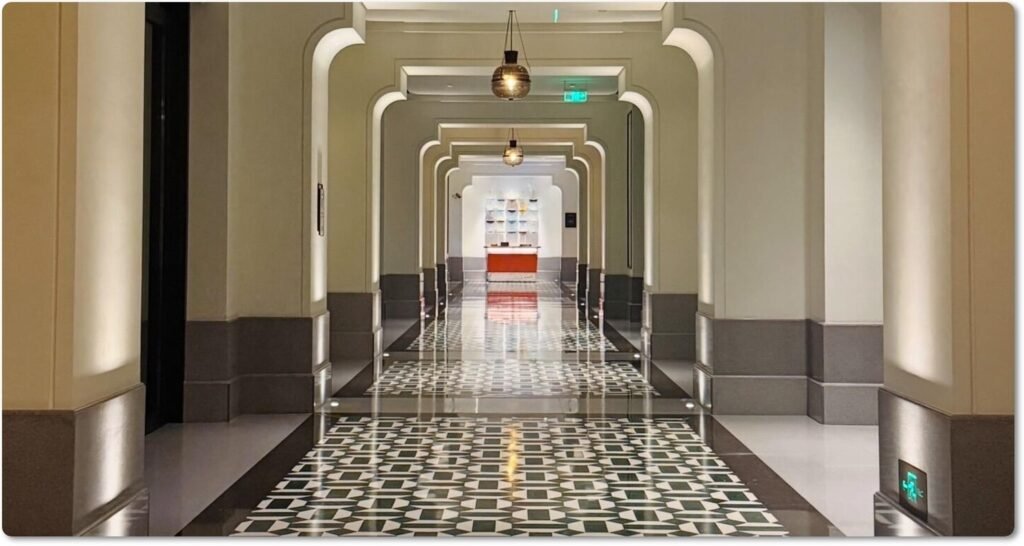
Hotel corridors and selected guestroom interiors.
Residential entrance halls.
Apartment building common areas.
Shopping centers and retail interiors.
Corporate offices and reception spaces.
Luxury villas and private residences.
Staircases, landings, and decorative floor installations.
Each application requires a different balance between appearance, abrasion resistance, maintenance, and slip resistance.
1.3 Important Technical Standards
ASTM C503/C503M-23, Standard Specification for Marble Dimension Stone, covers marble material characteristics, physical requirements, and sampling. Its scope includes marble processed into blocks, slabs, or tiles.
Relevant properties include water absorption, density, compressive strength, modulus of rupture, abrasion resistance, and flexural strength.
Other useful references include:
ASTM C97/C97M: Absorption and bulk specific gravity of dimension stone.
ASTM C99: Modulus of rupture of dimension stone.
ASTM C170/C170M: Compressive strength of dimension stone.
ASTM C241/C241M and ASTM C1353: Abrasion resistance evaluation.
ANSI A326.3: Dynamic coefficient of friction testing for hard-surface flooring.
ANSI A108: Installation-related requirements.
TCNA Handbook: Ceramic, glass, and stone tile installation details.
The project specification should identify the applicable edition and the required acceptance criteria rather than simply stating that a product complies with an unspecified standard.
2. Technical Evaluation: Best Marble Types for Flooring
Selecting the best marble for flooring requires evaluating both appearance and performance.
Different marble varieties have different mineral compositions, geological structures, abrasion characteristics, and resistance to environmental exposure.
2.1 White Marble Flooring
White marble is widely used in luxury residential and hospitality interiors.
Popular options include:
Carrara White Marble.
Calacatta White Marble.
Statuario Marble.
Volakas White Marble.
Thassos White Marble.
Arabescato Marble.
China White Marble varieties.
White marble flooring creates a bright, spacious visual effect and can complement contemporary, classical, and minimalist architectural styles.
However, white marble may require careful selection and maintenance because some varieties are relatively susceptible to staining, etching, or visible wear.
For large commercial projects, buyers should request actual batch photographs and approved reference samples rather than relying exclusively on representative catalog images.
2.2 Beige and Cream Marble Flooring
Beige marble provides a warm, neutral appearance suitable for:
Hotel lobbies.
Residential corridors.
Luxury apartment entrances.
Commercial reception areas.
Large residential living spaces.
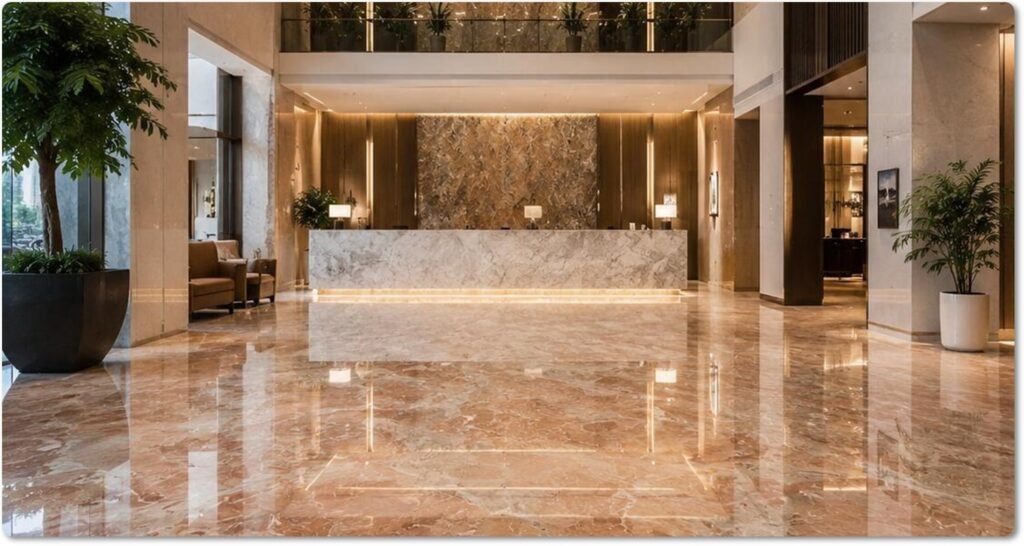
Beige marble varieties can help create visually continuous flooring across large interior spaces.
A consistent color range is particularly important for projects requiring hundreds or thousands of square meters.
2.3 Grey Marble Flooring
Grey marble is frequently selected for contemporary commercial architecture.
Its neutral appearance works with:
Metal architectural details.
Glass partitions.
Dark wood finishes.
Minimalist furniture.
Modern lighting systems.
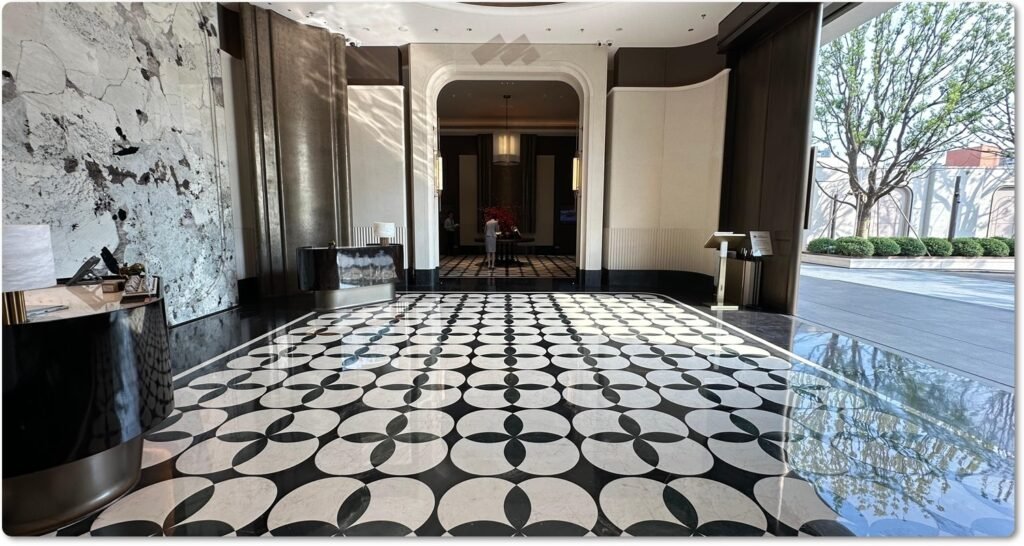
Grey marble can also be used in alternating patterns with white or black marble to create geometric flooring designs.
2.4 Black Marble Flooring
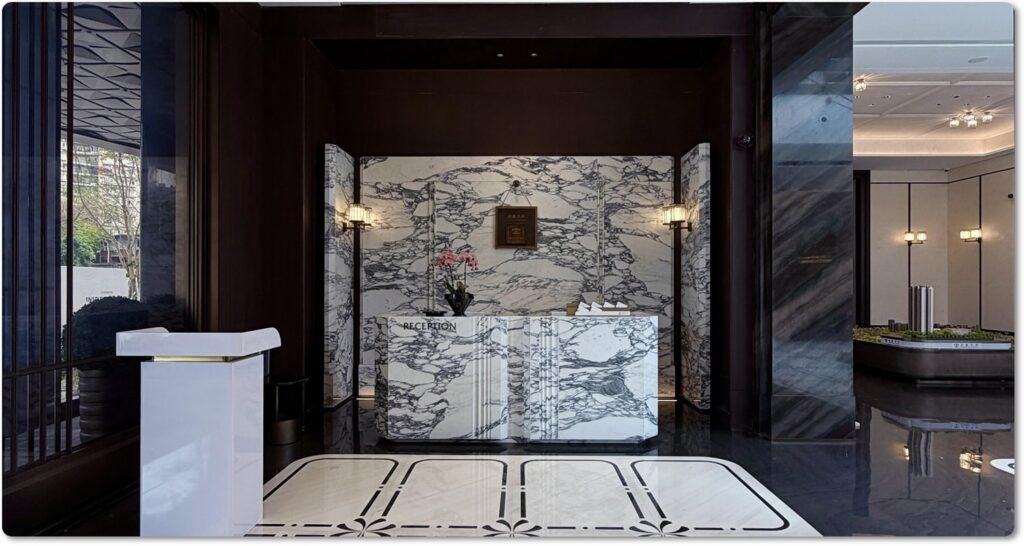
Black marble creates a dramatic architectural appearance and is frequently used for feature floors, reception areas, borders, and decorative inlays.
Potential selections include Nero Marquina and other black marble varieties.
Buyers should evaluate vein distribution, natural fissures, resin treatments, color consistency, and surface finish.
2.5 Green and Other Decorative Marble
Green marble can be used in luxury hotels, boutique retail interiors, private residences, and decorative flooring compositions.
Brown, red, blue, and multicolored marble varieties are also suitable for selected architectural applications.
The most important consideration is not simply the color but whether the material’s physical properties and finish are appropriate for the intended traffic and environmental conditions.
2.6 How to Evaluate Marble for High-Traffic Floors?
For hotels and commercial buildings, request the following information:
| Evaluation Item | Procurement Purpose |
|---|---|
| Water absorption | Understand moisture susceptibility |
| Bulk density | Evaluate material characteristics |
| Compressive strength | Assess resistance to compressive loading |
| Flexural strength | Evaluate bending-related performance |
| Abrasion resistance | Assess surface wear potential |
| Surface finish | Determine appearance and maintenance requirements |
| Dimensional tolerance | Control installation quality |
| Soundness and defects | Evaluate cracks, open seams, and structural weaknesses |
| Slip-resistance test | Assess suitability for the intended walking environment |
ASTM C503/C503M-23 provides a useful material specification framework, but individual project requirements and the actual test results remain essential.
3. Marble Floor Tile Sizes and Thickness
Tile dimensions influence architectural appearance, installation productivity, grout-joint layout, material utilization, and overall project cost.
There is no single universal standard size for all natural marble floor tiles. Available dimensions depend on the quarry block, slab dimensions, cutting technology, stone characteristics, and project requirements.
3.1 Common Marble Floor Tile Sizes
The following dimensions are commonly used commercial and residential product formats.
| Marble Tile Size | Typical Application |
|---|---|
| 300 × 300 mm | Small rooms and decorative layouts |
| 300 × 600 mm | Residential and commercial interiors |
| 400 × 400 mm | Traditional flooring layouts |
| 600 × 600 mm | Hotel rooms and commercial floors |
| 600 × 1200 mm | Contemporary large-format interiors |
| 800 × 800 mm | Large residential and commercial spaces |
| 900 × 900 mm | Custom commercial flooring |
| 1200 × 1200 mm | Selected large-format architectural projects |
These are indicative formats, not mandatory standard dimensions. Project-specific availability must be confirmed with the manufacturer.
3.2 Large Marble Tiles for Modern Flooring
Large marble tiles are increasingly specified in contemporary architectural projects because they can reduce the visual frequency of grout joints.
Common benefits include:
A more continuous stone appearance.
Fewer grout lines across large areas.
Greater visual emphasis on natural veining.
Opportunities for bookmatched or directional patterns.
A more expansive appearance in large rooms.
However, large-format marble flooring also introduces additional technical considerations.
The substrate must provide appropriate flatness and support. Tile thickness, dimensional stability, handling methods, adhesive compatibility, and installation tolerances must be evaluated together.
A large marble tile should not be approved solely because it looks attractive in a sample display.
3.3 Marble Floor Tile Thickness
Commonly specified thickness ranges include:
| Thickness | Potential Application |
|---|---|
| 10 mm | Selected interior flooring applications |
| 12 mm | Residential and light commercial interiors |
| 15 mm | Custom interior flooring |
| 18 mm | Selected commercial applications |
| 20 mm | Heavy-duty or project-specific flooring assemblies |
These are indicative manufacturing options rather than universal load-bearing ratings.
The required thickness depends on stone characteristics, tile dimensions, substrate support, installation method, anticipated loads, and project engineering requirements.
For example, a 600 × 600 mm marble tile and a 1200 × 1200 mm marble panel should not automatically be specified at the same thickness without technical review.
3.4 Dimensional Tolerances and Calibration
Commercial buyers should establish acceptable tolerances for:
Length and width.
Thickness.
Squareness.
Flatness.
Edge quality.
Surface finish.
Color and veining variation.
Calibrated marble tiles can help improve installation consistency.
For large-format marble flooring, dimensional variation can create lippage, irregular grout joints, and alignment problems.
A professional marble tiles factory should confirm its achievable tolerances before mass production.
4. Polished vs. Honed vs. Brushed Marble Finishes
Surface finish affects the appearance, tactile characteristics, maintenance, and potential slip performance of marble flooring.
4.1 Polished Marble Tiles
Polished marble has a smooth, glossy surface created through progressive grinding and polishing.
Advantages:
Reflects light effectively.
Highlights natural mineral patterns.
Creates a luxury architectural appearance.
Provides a smooth, refined surface.
Applications:
Luxury hotel lobbies.
Formal reception areas.
Residential living rooms.
Decorative interior flooring.
Selected low-moisture commercial environments.
Limitations:
Water and contaminants can reduce available traction.
Scratches and etching may become visually apparent.
Gloss can diminish under abrasive pedestrian traffic.
Regular maintenance may be necessary.
Polished marble should not be assumed suitable for wet floors simply because it is widely used in luxury interiors.
4.2 Honed Marble Tiles
Honed marble has a matte or satin appearance without the strong reflective gloss of polished stone.
Advantages:
Softer architectural appearance.
Less obvious reflections and glare.
Can make minor surface wear less visually prominent.
Often suitable for contemporary residential and commercial interiors.
Applications:
Apartment common areas.
Hotel corridors.
Residential kitchens.
Selected commercial entrances.
Contemporary interior flooring.
Honed marble is not automatically slip-proof. Its actual performance depends on the stone, finish quality, contaminants, cleaning products, and surface texture.
4.3 Brushed Marble Tiles
Brushed marble is processed using abrasive brushes to create a textured surface.
Advantages:
More tactile surface character.
Natural-looking appearance.
Suitable for selected rustic and contemporary designs.
Potentially improved traction compared with highly polished surfaces.
Applications may include selected hotel entrances, residential transitional spaces, and decorative commercial floors.
4.4 Tumbled and Other Textured Finishes
Tumbled marble has softened edges and an aged appearance.
Other available treatments may include sandblasted, leathered, or specially textured surfaces.
Each finish should be evaluated using actual production samples.
| Finish | Appearance | Key Consideration |
|---|---|---|
| Polished | Glossy and reflective | Etching, wear, and wet traction |
| Honed | Matte and smooth | Maintenance and actual slip performance |
| Brushed | Textured | Cleaning and surface consistency |
| Tumbled | Aged and irregular | Grout and dirt accumulation |
| Sandblasted | Matte and textured | Surface wear and cleaning |
For commercial flooring, approve a physical sample of the finish.
5. Slip Resistance and Wet-Area Considerations
Slip resistance is one of the most important considerations when selecting marble tiles for commercial flooring.
A marble floor may be exposed to water, cleaning agents, food residues, dust, oils, or other contaminants.
The same marble can perform differently under dry, wet, and contaminated conditions.
5.1 Understanding DCOF
ANSI A326.3 provides a standardized test method for measuring the dynamic coefficient of friction (DCOF) of hard-surface flooring materials.
The commonly referenced value of 0.42 is associated with certain interior flooring use classifications. It should not be interpreted as a universal guarantee of safety for every marble floor or every operating condition.
The current standard distinguishes product-use categories including:
Interior Dry (ID).
Interior Wet (IW).
Interior Wet Plus (IW+).
Exterior Wet (EW).
Oils and Greases (O/G).
Some categories require manufacturer-declared classifications rather than relying on a single numerical threshold.
Specifiers should also consider footwear, expected contaminants, cleaning procedures, pedestrian traffic, drainage, and the intended use of the floor.
5.2 Marble Flooring in Wet Areas
Potential wet-area applications include:
Hotel bathroom floors.
Residential bathrooms.
Spa changing areas.
Public restroom entrances.
Poolside circulation areas.
Commercial kitchen-adjacent spaces.
Not every marble is appropriate for these locations.
A polished marble surface may be unsuitable where frequent water exposure creates a foreseeable slip hazard.
Honed or textured finishes may be considered, but actual product testing and project-specific assessment are still necessary.
5.3 ADA and Accessibility Considerations
The 2010 ADA Standards for Accessible Design require floor and ground surfaces on applicable accessible routes to be stable, firm, and slip-resistant.
Importantly, the ADA does not prescribe one universal numerical coefficient-of-friction threshold for every flooring material.
Therefore, buyers should not rely on a marketing statement such as non-slip marble.
Instead, request documented test results and confirm that the specified material is appropriate for the applicable building regulations and actual operating environment.
6. Subfloor Preparation and Marble Tile Installation
Even high-quality marble tiles can fail if the underlying floor assembly is poorly designed or installed.
Subfloor preparation is one of the most important stages in marble flooring construction.
6.1 Substrate Inspection
Before installation, contractors should inspect:
Concrete or mortar-bed condition.
Surface flatness.
Structural movement.
Cracks and existing control joints.
Moisture conditions.
Surface contamination.
Compatibility with the specified setting materials.
The substrate must provide adequate support and comply with the installation system requirements.
6.2 Moisture and Crack Evaluation
Moisture-related problems can affect setting materials, stone appearance, and long-term performance.
Certain marble varieties may also be sensitive to moisture migration or installation-related discoloration.
Where moisture or cracking is a concern, the contractor should evaluate the substrate and specify an appropriate membrane or installation system.
Crack-isolation membranes do not eliminate the need to respect structural and movement joints.
6.3 Mortar and Adhesive Selection
The setting material must be compatible with both the marble and the substrate.
Selection should consider:
Stone color and translucency.
Moisture sensitivity.
Tile dimensions.
Substrate type.
Installation environment.
Manufacturer’s technical recommendations.
White mortar is commonly considered for light-colored or translucent marble to reduce the risk of visible discoloration from the setting bed.
For certain moisture-sensitive stones, specialized setting materials may be necessary.
6.4 Large-Format Marble Installation
Large marble tiles require particular attention to:
Substrate flatness.
Mortar coverage.
Back-buttering where specified.
Tile handling and lifting.
Alignment.
Lippage control.
Movement accommodation.
Contractors should follow the applicable installation standards and mortar manufacturer’s instructions.
A project mock-up is strongly recommended for large-format marble flooring, particularly in prominent hotel and commercial spaces.
6.5 Installation Standards
Relevant references include ANSI A108 installation requirements and the Tile Council of North America Handbook.
For natural stone applications, the Natural Stone Institute’s Dimension Stone Design Manual provides additional guidance on natural stone design, construction, installation, and maintenance.
The 2024 edition includes updated guidance for horizontal and vertical natural stone installations.
7. Grout Joints and Movement Joints
Grout joints and movement joints serve different purposes and should not be treated as interchangeable.
7.1 Grout Joint Width
Grout joint width depends on:
Tile dimensions.
Dimensional variation.
Edge finishing.
Installation method.
Design requirements.
Applicable installation standards.
Rectified or precisely calibrated marble tiles may permit narrower joints, subject to the approved installation specification.
However, eliminating grout joints is generally not recommended.
Grout helps accommodate dimensional variation and contributes to the finished flooring assembly.
7.2 Grout Color Selection
Common grout choices include:
White grout for light marble.
Beige grout for cream marble.
Grey grout for contemporary grey stone.
Dark grout for selected decorative patterns.
Before installation, test grout against the actual marble because pigments and installation residues may affect the finished appearance.
Some marble surfaces are sensitive to staining from unsuitable grout or cleaning products.
7.3 Movement and Expansion Joints
Movement joints accommodate changes caused by thermal expansion, contraction, moisture variation, and substrate movement.
TCNA Detail EJ171 guides movement joints in tile installations.
Movement joints should be considered at:
Perimeters.
Changes in plane.
Structural joints.
Existing control joints.
Large uninterrupted floor areas.
Areas exposed to direct sunlight or significant moisture variation.
The exact locations and spacing must be determined by the project design and applicable installation guidance.
Grout or mortar should never obstruct a movement joint intended to remain functional.
8. Large-Format Flooring and Marble Tiles Design
Large-format marble flooring can create a more continuous architectural appearance and provide greater opportunities for coordinated patterns.
The final design should consider stone characteristics, available slab dimensions, production yield, installation sequence, and visual continuity.
8.1 Straight-Lay Marble Flooring
Straight-lay installation aligns tiles along regular horizontal and vertical grid lines.
Advantages:
Simple layout planning.
Predictable cutting requirements.
Efficient installation.
Suitable for many commercial spaces.
This layout is commonly used in hotel corridors, apartment common areas, and commercial reception areas.
8.2 Diagonal Marble Flooring
Diagonal layouts position tiles at an angle to the primary room boundaries.
They can create visual movement and make certain spaces appear wider.
However, diagonal layouts generally increase cutting requirements and material wastage.
8.3 Versailles and Modular Patterns
Versailles patterns use different tile dimensions to create a coordinated repeating composition.
They are suitable for selected luxury residences, hotel interiors, and traditional architectural designs.
The manufacturer should prepare a layout drawing and cutting schedule before production.
8.4 Bookmatched Marble Flooring
Bookmatching involves placing complementary stone pieces in mirrored orientations to create symmetrical vein patterns.
It is particularly suitable for:
Hotel feature entrances.
Luxury reception areas.
Decorative floor medallions.
Premium residential interiors.
Bookmatching requires careful slab selection, sequence identification, and production coordination.
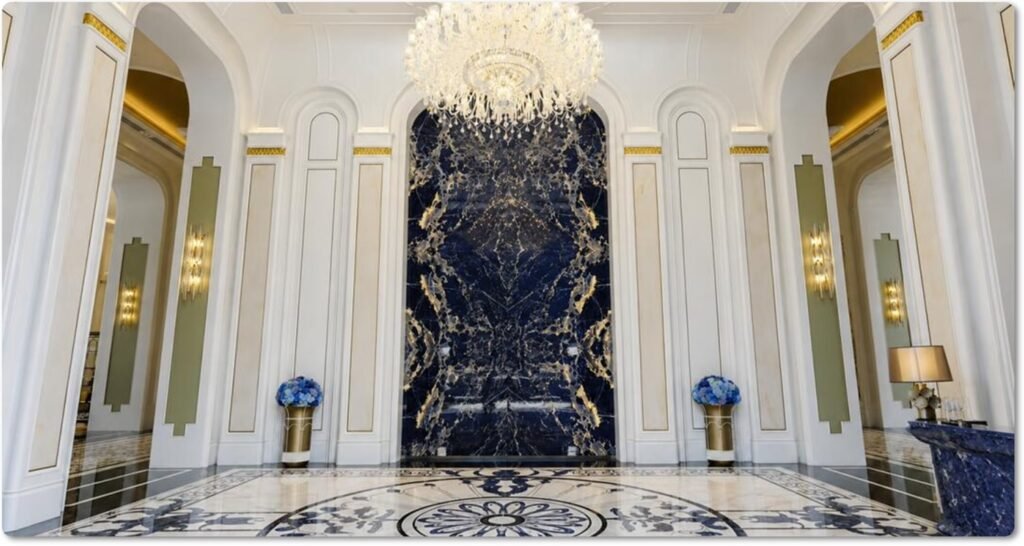
8.5 Custom Marble Floor Medallions and Waterjet Patterns
Waterjet cutting allows marble to be fabricated into complex decorative patterns.
Possible applications include:
Hotel entrance medallions.
Geometric borders.
Circular floor designs.
Floral motifs.
Brand-inspired decorative elements.
Contrasting marble inlays.
For complex flooring projects, EDG Stone can support custom marble processing based on approved CAD drawings, dimensions, and material selections.
9. Maintenance, Sealing and Lifecycle Considerations
Marble flooring is a natural material and requires an appropriate maintenance program.
Its long-term appearance depends on stone characteristics, finish, pedestrian traffic, contaminants, installation quality, and cleaning practices.
9.1 Marble Floor Sealing
Many marble floors benefit from an appropriate penetrating impregnating sealer.
However, sealing does not make marble completely waterproof, stain-proof, or acid-resistant.
The appropriate product should be selected according to the stone, finish, application, and sealer manufacturer’s instructions.
Before full application, perform a compatibility test on an approved sample area.
9.2 Daily and Periodic Cleaning
Recommended general practices include:
Remove loose dust and abrasive particles regularly.
Use a clean microfiber mop or suitable floor-cleaning equipment.
Select a pH-neutral cleaner formulated for natural stone.
Avoid acidic cleaning products.
Clean spills promptly.
Use entrance mats to reduce abrasive dirt.
Inspect high-traffic areas regularly.
Acidic substances such as vinegar, lemon juice, and certain bathroom cleaners can etch calcite-based marble.
9.3 Polishing and Restoration
Over time, polished marble may develop scratches, dull areas, and localized etching.
Professional restoration may include:
Diamond honing.
Surface grinding.
Re-polishing.
Localized stain treatment.
Crack and chip repair.
Reapplication of suitable protective treatments.
One advantage of genuine natural marble is that certain surface defects and wear patterns can be professionally restored rather than requiring immediate replacement.
9.4 Lifecycle Cost
The total cost of marble flooring should include more than the initial material purchase.
A realistic project budget should consider:
Material procurement.
Cutting and calibration.
Surface finishing.
Packaging and transportation.
Import duties and handling.
Installation labor.
Adhesives and grout.
Sealing and protection.
Cleaning and maintenance.
Periodic restoration.
Replacement and repair allowances.
A lower initial marble tile price does not necessarily produce the lowest lifecycle cost.
10. Commercial Project Procurement Checklist
Hotel developers, contractors, and importers should establish a documented procurement process before placing a bulk order.
10.1 Material Selection
Confirm:
Marble variety and origin, where documented.
Approved color range.
Veining characteristics.
Natural variation acceptance.
Physical property test results.
Abrasion resistance.
Water absorption.
Intended application.
10.2 Product Specifications
Confirm:
Tile length and width.
Thickness.
Dimensional tolerances.
Surface finish.
Edge processing.
Grout joint requirements.
Packaging configuration.
Required quantities.
10.3 Sample Approval
Request:
Representative material samples.
Finished surface samples.
Actual production photographs.
Batch identification.
Mock-up approval where required.
For large commercial projects, a signed sample approval should establish the acceptable visual range.
10.4 Production and Quality Control
A professional marble tiles manufacturer should provide an inspection process covering:
Raw Material Inspection
Material identity.
Visible cracks and open seams.
Natural color variation.
Block or slab selection.
Suitability for the intended product.
In-Process Inspection
Cutting dimensions.
Thickness calibration.
Edge quality.
Surface finishing.
Dimensional consistency.
Finished Product Inspection
Length and width.
Thickness.
Squareness.
Surface defects.
Finish consistency.
Color and pattern variation.
Quantity verification.
Pre-Shipment Inspection
Packaging integrity.
Protective separation.
Crate condition.
Product identification.
Loading arrangements.
Shipping documentation.
10.5 Commercial Documentation
For international marble flooring procurement, request:
Commercial invoice.
Packing list.
Product specification sheet.
Inspection report.
Material photographs.
Test reports where required.
Certificate of origin where applicable.
Shipping and customs documentation.
Documentation requirements depend on the importing country and contract.
11. Cost and Risk Factors in Marble Flooring Procurement
The price of marble floor tiles varies according to material selection, production complexity, dimensions, thickness, surface finish, quality requirements, and order volume.
11.1 Material Cost
Different marble varieties have different quarry availability, block sizes, color consistency, and production yields.
Rare colors and highly selective veining can increase material costs.
11.2 Processing Cost
Additional processing may include:
Large-format cutting.
Thickness calibration.
Precision edge finishing.
Special surface treatments.
Waterjet cutting.
Bookmatching.
Custom dimensional fabrication.
11.3 Shipping and Packaging Cost
Natural stone is heavy and requires suitable export packaging.
Packaging design should consider:
Product dimensions.
Total shipment weight.
Container loading.
Internal protection.
Moisture exposure.
Handling conditions.
Destination transport arrangements.
Poor packaging can create breakage, edge damage, and financial losses even when the stone was manufactured correctly.
11.4 Common Procurement Risks
| Risk | Potential Consequence | Recommended Control |
|---|---|---|
| Inconsistent stone batches | Visual differences | Approve batch samples |
| Incorrect thickness | Installation difficulties | Inspect production samples |
| Poor calibration | Uneven joints and lippage | Establish dimensional tolerances |
| Inappropriate finish | Slip and maintenance problems | Approve finished samples and testing |
| Inadequate substrate | Cracking or debonding | Conduct site assessment |
| Incorrect adhesive | Discoloration or installation failure | Verify material compatibility |
| Missing movement joints | Cracking or tenting | Follow project movement-joint design |
| Poor export packing | Transit damage | Conduct pre-shipment inspection |
12. Supplier Evaluation: Choosing a Professional Marble Tiles Manufacturer and Factory
Selecting a reliable marble tiles manufacturer is essential for large residential and commercial projects.
An experienced factory supplier should demonstrate more than the ability to provide attractive stone samples.
12.1 Manufacturing Capability
Evaluate whether the supplier can provide:
Natural marble block and slab selection.
Tile cutting and calibration.
Large-format marble processing.
Polished and honed finishes.
Brushed and textured finishes.
Custom dimensions.
Edge processing.
Waterjet fabrication.
Decorative patterns.
Project-based bulk production.
12.2 Quality Management
Ask the supplier to explain its inspection process.
A professional marble tiles factory should be able to document:
Raw material inspection.
Production process inspection.
Finished product inspection.
Pre-shipment packaging inspection.
Request photographs, inspection records, dimensional measurements, and approved samples where applicable.
12.3 Export and Project Experience
International buyers should evaluate:
Export packaging capabilities.
Container loading arrangements.
Production lead-time planning.
Bulk-order coordination.
Communication and documentation.
Ability to work from architectural drawings.
Experience with project-specific requirements.
12.4 EDG Stone: Marble Flooring Products and Custom Fabrication
EDG Stone is a Chinese natural stone manufacturer and exporter specializing in marble, granite, quartzite, quartz, stone countertops, slabs, and custom stone fabrication.
For marble flooring projects, EDG Stone can support product sourcing, material selection, dimensional cutting, surface finishing, custom fabrication, and export preparation.
Potential project applications include:
Luxury hotel lobby flooring.
Hotel reception and entrance areas.
Residential apartment common areas.
Multifamily development flooring.
Luxury villa interiors.
Commercial reception spaces.
Custom marble floor patterns and medallions.
EDG’s project-oriented quality inspection framework includes:
1. Raw Material Inspection
Reviewing material identity, visible defects, natural variation, and suitability before processing.
2. Processing Inspection
Checking cutting dimensions, thickness calibration, edge quality, surface finishing, and production consistency.
3. Finished Product Inspection
Verifying finished dimensions, appearance, surface condition, and compliance with approved specifications.
4. Pre-Export Packaging Inspection
Checking protective materials, crate condition, product identification, packing configuration, and container-loading preparation.
For buyers managing hotel, multifamily, and commercial flooring projects, the ability to coordinate material selection, custom dimensions, production inspection, and export packaging can help simplify international procurement.
13. Practical RFQ Template for Marble Flooring Projects
A complete request for quotation (RFQ) helps manufacturers evaluate project requirements accurately and prepare comparable commercial offers.
Buyers can copy the following template.
Marble Flooring RFQ Information
| RFQ Field | Information Required |
|---|---|
| Project Name | Hotel, apartment, commercial building, etc. |
| Destination | Country, city, and delivery port |
| Marble Type | Carrara, Calacatta, Beige, Grey, etc. |
| Product | Natural marble floor tiles |
| Tile Size | Length × width |
| Thickness | Required thickness in mm |
| Surface Finish | Polished, honed, brushed, etc. |
| Edge Type | Standard, bevelled, custom |
| Total Quantity | Square meters |
| Approved Sample | Reference sample or photographs |
| Drawings | CAD or PDF drawings |
| Packaging | Export crates or project-specific packing |
| Delivery Terms | EXW, FOB, CIF, or other agreed Incoterm |
| Required Delivery | Target shipment date |
| Inspection | Buyer inspection or third-party inspection |
| Documents | Test reports, packing list, invoice, etc. |
Recommended Supplier Confirmation
Before confirming the purchase order, request written confirmation of:
Material availability.
Approved sample reference.
Production dimensions and tolerances.
Surface finish.
Quantity and allowable production variation.
Packaging specifications.
Production schedule.
Inspection arrangements.
Shipping terms.
Claim and replacement procedures.
For large projects, divide procurement into sample approval, first-article approval, mass production, final inspection, and shipment release.
14. Frequently Asked Questions About Marble Tiles for Flooring
Q1. What are the best marble tiles for flooring?
The best marble tiles depend on the intended application, pedestrian traffic, maintenance expectations, and design requirements. Carrara, Calacatta, beige marble, grey marble, and selected black marble varieties are frequently considered for interior flooring. For commercial projects, evaluate abrasion resistance, finish durability, water absorption, and slip performance before selecting a material.
Q2. Are polished marble tiles suitable for commercial floors?
Polished marble can be suitable for selected commercial interiors, including hotel lobbies and reception areas. However, polished surfaces may become slippery when wet and can show scratches or etching under heavy use. Specify the finish according to traffic, moisture exposure, cleaning practices, and applicable safety requirements.
Q3. What is the best size for marble floor tiles?
Common formats include 300 × 600 mm, 600 × 600 mm, and 600 × 1200 mm. Large-format options such as 800 × 800 mm and 1200 × 1200 mm may also be manufactured for suitable projects. The ideal size depends on room dimensions, substrate flatness, installation capability, and the desired visual layout.
Q4. Are large marble tiles better than small marble tiles?
Large marble tiles create fewer visible grout joints and can provide a more continuous architectural appearance. However, they require more precise substrate preparation, handling, dimensional control, and installation. Smaller tiles may be easier to accommodate around complex layouts and certain drainage conditions.
Q5. How do you maintain marble floor tiles?
Use a pH-neutral natural stone cleaner, remove abrasive dirt regularly, and clean spills promptly. Avoid acidic cleaners because calcite-based marble can be etched by acids. Select an appropriate penetrating sealer where recommended, and arrange professional honing or polishing when the floor develops significant wear.
15. Semantic Content Block: Marble Flooring Selection, Performance and Procurement Insights
What Makes Marble Flooring Suitable for Hotels and Commercial Buildings?
Marble flooring is suitable for selected commercial buildings because it combines natural stone aesthetics, architectural flexibility, custom fabrication possibilities, and the ability to undergo professional restoration.
Its suitability is not determined by appearance alone. The stone’s physical properties, abrasion resistance, finish, installation system, pedestrian traffic, and maintenance requirements must be evaluated together.
For a luxury hotel lobby, polished marble may be selected to create a reflective and prestigious entrance. For apartment corridors or areas exposed to moisture, a different marble variety and finish may be more appropriate.
The correct specification is therefore application-dependent rather than based on a single universally superior marble.
Why Are Large-Format Marble Tiles Increasingly Important in Contemporary Architecture?
Large-format marble tiles support architectural designs that emphasize visual continuity and natural stone patterns.
Larger units can reduce the number of visible grout joints, provide greater opportunities for vein alignment, and create coordinated flooring compositions across spacious interiors.
However, larger dimensions increase the importance of production accuracy, substrate flatness, material handling, and installation control.
For commercial procurement, the decision should balance architectural appearance against manufacturing yield, shipping requirements, and installation costs.
How Should Buyers Compare Marble Flooring Manufacturers?
Buyers should compare manufacturers using a combination of technical, manufacturing, and commercial evidence.
Important evaluation areas include material selection, production equipment, dimensional calibration, surface finishing, inspection procedures, packaging capability, and experience with custom project orders.
A supplier that can provide documented inspection at raw material, production, finished-product, and pre-shipment stages offers buyers a more transparent procurement process.
What Is the Difference Between a Marble Tiles Supplier, Manufacturer and Wholesaler?
A marble tiles manufacturer processes stone into finished products and controls or coordinates the production process.
A marble tiles supplier may source products from different factories, quarries, or manufacturers and provide procurement services.
A marble tiles wholesaler typically focuses on bulk purchasing and distribution to retailers, fabricators, contractors, and project buyers.
An international project buyer should determine whether the quoted supplier owns the production facility, manages manufacturing directly, or operates through a sourcing network. The distinction affects production control, communication, lead-time management, and quality accountability.
Which Factors Have the Greatest Influence on Marble Flooring Lifecycle Performance?
The most important factors are the physical characteristics of the stone, abrasion exposure, finish selection, installation workmanship, moisture conditions, cleaning methods, and maintenance frequency.
A marble variety with attractive veining may not be appropriate for every high-traffic environment. Similarly, a durable stone can still experience premature failure if installed over an unsuitable substrate or cleaned using aggressive chemicals.
A complete flooring specification should therefore cover material selection, installation, surface protection, and maintenance from the beginning of the project.
What Should Be Included in a Commercial Marble Flooring Specification?
A complete specification should identify the stone variety, approved sample range, dimensions, thickness, tolerances, surface finish, edge treatment, physical test requirements, slip-resistance assessment, installation system, grout requirements, movement joints, cleaning procedures, and acceptance criteria.
For large orders, it should also establish inspection stages, packaging standards, production tolerances, batch identification, and shipment documentation.
Market Direction: What Is Shaping the Future of Marble Flooring?
Commercial marble flooring is increasingly influenced by several connected design and procurement considerations:
Larger architectural surfaces and more continuous visual compositions.
Greater interest in honed and textured natural stone finishes.
Custom waterjet patterns and decorative inlays.
More detailed quality documentation and material traceability.
Greater attention to lifecycle maintenance and restoration.
More coordinated procurement between architects, contractors, fabricators, and manufacturers.
These directions do not mean that polished marble or traditional tile formats are disappearing. Rather, buyers are increasingly matching stone selection and processing methods to the specific performance and design requirements of each project.
Procurement Insight: Why Factory-Direct Coordination Matters
For hotel developments, multifamily residential projects, and commercial buildings, marble flooring procurement involves more than selecting a color and negotiating a unit price.
The buyer must coordinate material approval, dimensional specifications, production capacity, quality inspection, export packing, shipping schedules, and installation requirements.
Working directly with an experienced marble tiles manufacturer or factory can provide a more coordinated approach to custom dimensions, bulk production, and project-specific quality control.
EDG Stone supports international stone buyers through natural stone selection, marble processing, custom fabrication, quality inspection, and export preparation.
16. Conclusion: Selecting the Right Marble Tiles for Flooring
Marble tiles for flooring offer extensive architectural possibilities for hotels, luxury residences, commercial buildings, and multifamily developments.
However, successful marble flooring projects depend on matching the stone’s physical characteristics, dimensions, thickness, finish, and installation system to the intended environment.
For commercial buyers, the most important decisions should be made before mass production begins:
Select a marble variety appropriate for the application.
Confirm dimensions, thickness, and production tolerances.
Evaluate surface finish and slip-resistance requirements.
Prepare the substrate and installation specification.
Approve actual production samples and visual variation.
Establish documented quality inspections.
Confirm export packaging and shipment arrangements.
Whether the project requires standard marble floor tiles, large-format marble flooring, custom decorative patterns, or hotel-grade natural stone products, working with a capable manufacturer is an important part of achieving consistent project results.
EDG Stone provides natural marble products, custom stone fabrication, project-oriented quality inspection, and international export support for commercial and residential stone procurement.
Contact EDG Stone to discuss your marble flooring specifications, project drawings, sample requirements, and bulk-order quotation.
References and Technical Resources
The following standards and industry publications provide a technical basis for marble flooring selection, installation, and procurement. Always verify the current edition and the requirements applicable to the project jurisdiction.
ASTM International. ASTM C503/C503M-23 – Standard Specification for Marble Dimension Stone. Approved December 15, 2023; published January 2024. https://www.astm.org/c0503_c0503m-23.html
ASTM International. ASTM C97/C97M – Standard Test Methods for Absorption and Bulk Specific Gravity of Dimension Stone. Consult the current edition.
ASTM International. ASTM C99 – Standard Test Method for Modulus of Rupture of Dimension Stone. Consult the current edition.
ASTM International. ASTM C170/C170M – Standard Test Method for Compressive Strength of Dimension Stone. Consult the current edition.
ASTM International. ASTM C241/C241M – Standard Test Method for Abrasion Resistance of Stone Subjected to Foot Traffic. Consult the current edition.
ASTM International. ASTM C1353 – Standard Test Method Using the Taber Abraser for Abrasion Resistance of Dimension Stone. Consult the current edition.
Tile Council of North America. ANSI A326.3 – Test Method for Measuring Dynamic Coefficient of Friction of Hard Surface Flooring Materials. Consult the current edition and applicable product-use classification.
Tile Council of North America. ANSI A108/A118/A136.1 – American National Standard Specifications for the Installation of Ceramic Tile and Related Installation Materials. Refer to the applicable current installation provisions.
Tile Council of North America. TCNA Handbook for Ceramic, Glass, and Stone Tile Installation. Refer to applicable installation details, including EJ171 for movement joints.
Natural Stone Institute. Dimension Stone Design Manual, Version 2024. Technical reference covering natural stone design, construction, horizontal installations, vertical installations, and maintenance.
U.S. Department of Justice. 2010 ADA Standards for Accessible Design, Section 302 – Floor or Ground Surfaces. https://www.ada.gov/law-and-regs/design-standards/2010-stds/
U.S. Access Board. Guide to the ADA Accessibility Standards – Chapter 3: Floor and Ground Surfaces. https://www.access-board.gov/ada/guides/chapter-3-floor-and-ground-surfaces/
EDG Stone – Marble Tiles Manufacturer and Factory Supplier
Looking for a professional marble tiles manufacturer for your next flooring project?
EDG Stone supplies natural marble products and supports custom stone fabrication for international importers, wholesalers, contractors, architects, hotel developers, and residential construction projects.
Our product and fabrication capabilities include:
Natural marble tiles and slabs.
Custom-size marble flooring.
Polished, honed, and textured finishes.
Large-format marble processing.
Waterjet cutting and decorative patterns.
Custom marble medallions.
Project-based stone fabrication.
Quality inspection and export packaging.
Send EDG Stone your project drawings, marble selection, required dimensions, estimated quantities, and destination.
Request a factory-direct quotation and discuss your marble flooring procurement requirements with our team.
Website: https://www.edgstone.com/