Quick Summary:
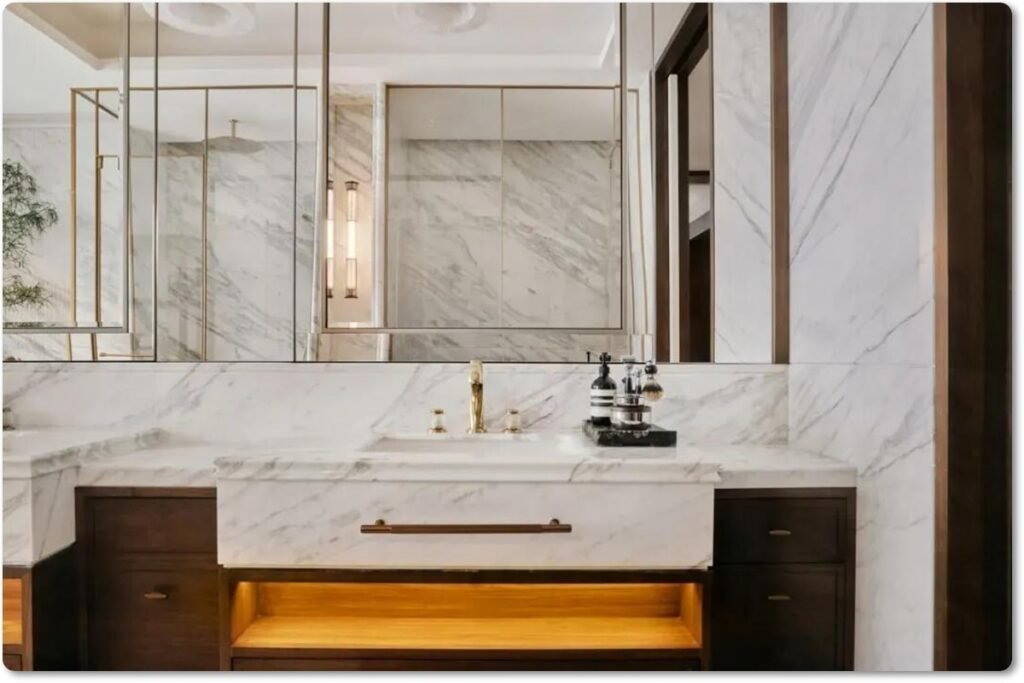
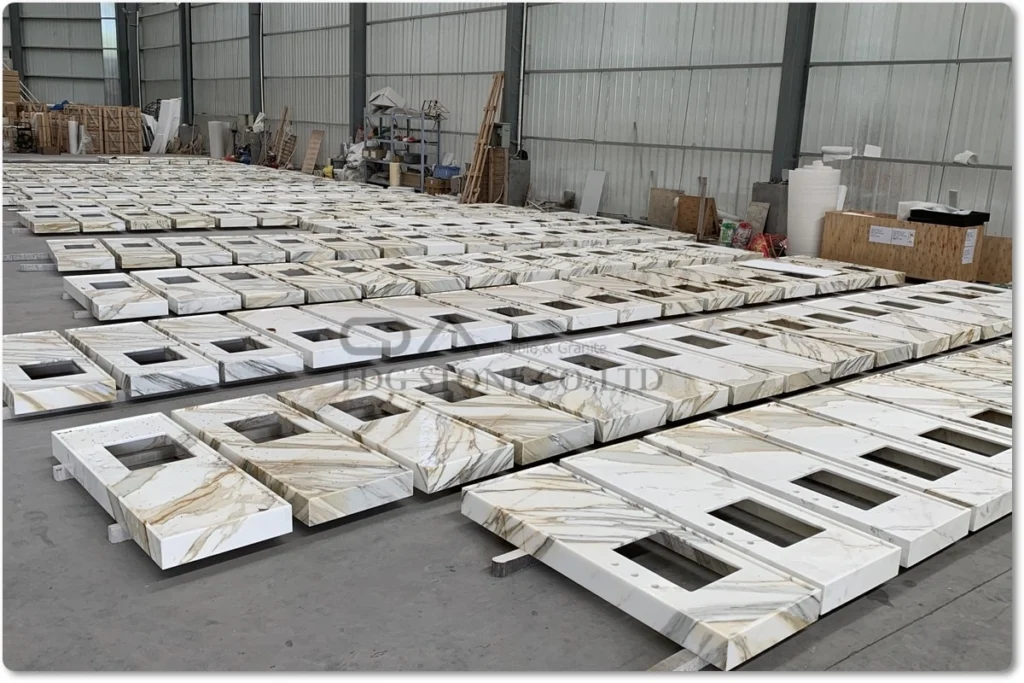
Italian marble tiles are premium natural stone products valued for their geological characteristics, distinctive veining, color variations, and suitability for luxury residential, hospitality, and commercial interiors. Carrara, Calacatta, and Statuario are among the best-known white Italian marble varieties, but they differ in appearance, geological characteristics, availability, and market positioning. Successful procurement requires more than selecting a marble name: buyers should verify quarry origin, block and slab consistency, tile dimensions, thickness, finish, physical properties, processing quality, and batch traceability. For international projects, buyers should compare genuine Italian marble with other natural marble sources based on documented origin, technical performance, design requirements, and landed cost. EDG Stone provides natural marble sourcing, custom tile fabrication, quality inspections, and export services according to individual project specifications, with material origins accurately identified.
1. Executive Summary: Understanding Italian Marble Tiles for Premium Projects
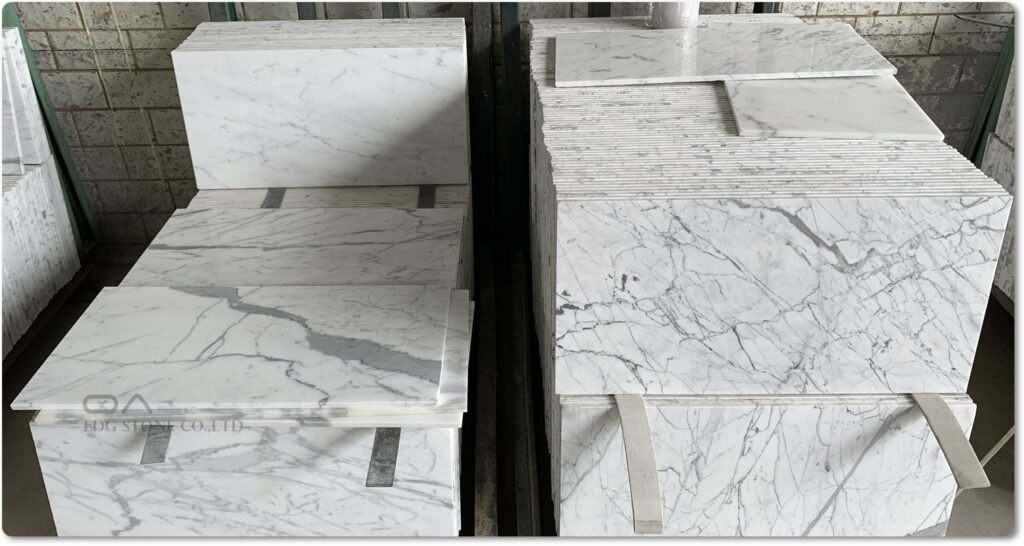
Italian marble tiles have maintained a strong position in the international natural stone market because of their distinctive appearance, historical association with architectural craftsmanship, and extensive use in luxury interiors.
Among the most recognized varieties are:
Carrara Marble: Generally characterized by a white to light-grey background with relatively soft grey veining.
Calacatta Marble: Known for a predominantly white background and often more pronounced, contrasting veins, sometimes featuring gold, beige, or warm-grey tones.
Statuario Marble: A premium white marble traditionally associated with a bright background and distinctive grey veining.
These names represent different commercial and geological material identities rather than standardized quality grades. Natural variation exists within every variety, and two slabs carrying the same trade name may have substantially different visual characteristics.
For architects, importers, contractors, and hotel developers, selecting Italian marble tiles involves five major decisions:
Confirming the actual quarry or geological origin.
Establishing an acceptable range of color and veining variation.
Specifying tile dimensions, thickness, finish, and dimensional tolerances.
Evaluating physical properties and suitability for the intended application.
Controlling procurement, production, packaging, and installation risks.
A premium marble tile specification should therefore identify both the commercial material name and its measurable acceptance criteria.
The procurement principle: Buy the documented stone, not merely the attractive name.
EDG Stone supports international buyers requiring natural marble from different documented origins, custom tile fabrication, project-specific inspection, and export packaging. Where a project specifies genuine Italian Carrara, Calacatta, or Statuario, the material must be sourced and documented as Italian origin. Other marble varieties offered through EDG must be identified by their actual country and geological source.
2. Scope and Definitions: What Are Italian Marble Tiles?
2.1 What Is Italian Marble?
Italian marble refers to natural marble quarried in Italy. The term is associated with several historic marble-producing regions, particularly Tuscany and the Apuan Alps.
The Carrara marble district in Tuscany is internationally recognized for its extensive marble resources and long-established stone industry.
Italian marble is not one uniform material. Its appearance and technical properties vary according to:
Geological formation.
Mineral composition.
Quarry location.
Individual quarry bench.
Block characteristics.
Natural fractures and discontinuities.
Processing and finishing methods.
Marble is a metamorphic rock primarily composed of recrystallized carbonate minerals, commonly calcite or dolomite.
Commercial white marble frequently contains predominantly calcite, although mineral impurities and geological structures contribute to differences in color, veining, and texture.
2.2 What Is the Difference Between Italian Marble Slabs and Italian Marble Tiles?
Italian marble slabs and Italian marble tiles are different finished product formats.
| Product | Description | Typical applications |
|---|---|---|
| Marble blocks | Extracted natural stone blocks | Slab and tile manufacturing |
| Marble slabs | Large rectangular processed stone sheets | Countertops, wall panels, flooring |
| Marble tiles | Cut-to-size individual units | Floors, walls, bathrooms |
| Marble mosaics | Small marble pieces assembled into patterns | Decorative walls, showers, feature floors |
| Marble cut-to-size | Customized dimensions based on drawings | Hotels, villas, commercial projects |
| Marble bookmatched panels | Sequentially selected and arranged stone pieces | Feature walls, reception areas |
Marble tiles are manufactured by cutting selected blocks or slabs into smaller pieces, followed by calibration, surface finishing, edge processing, inspection, and packaging.
Unlike ceramic or porcelain tiles, natural marble tiles retain the geological characteristics of the original stone.
2.3 Italian Marble Origin Versus Italian-Style Marble
This distinction is particularly important in international purchasing.
The following terms do not mean the same thing:
Italian marble: Marble genuinely quarried in Italy.
Italian-origin marble tiles: Finished marble tiles made from documented Italian-origin stone.
Italian-style marble: Marble from another country with an appearance similar to Italian varieties.
Italian marble design: A design description rather than proof of geographical origin.
Italian marble finish: A surface treatment description, not a quarry-origin statement.
A white marble tile produced in China, Turkey, Greece, Brazil, or another country does not become Italian marble simply because it resembles Carrara or Calacatta.
Importers should request quarry-origin documentation, supplier declarations, commercial invoices, and traceability information appropriate to the transaction.
3. Technical Evaluation: Carrara vs. Calacatta vs. Statuario
3.1 Carrara Marble Tiles
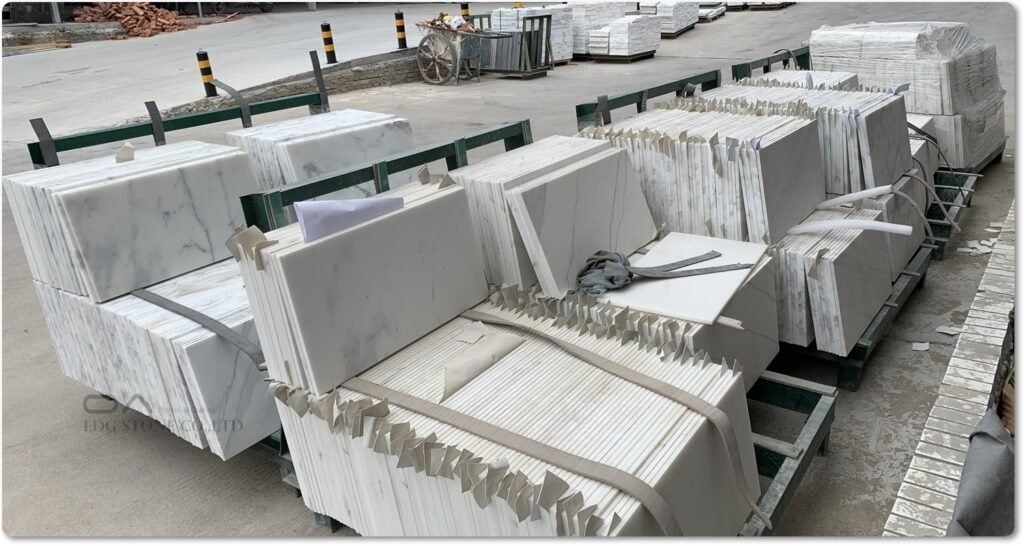
Carrara marble is among the most recognizable Italian white marble varieties.
It is associated with the Carrara area of Tuscany, where marble extraction has a long industrial and architectural history.
Appearance and Characteristics
Typical Carrara marble features include:
White, off-white, or light-grey backgrounds.
Fine to medium grey veining.
Cloud-like mineral patterns.
Relatively subtle visual contrast in many commercial selections.
Natural variations between blocks and quarry selections.
Not every Carrara selection has the same background color or vein density.
Some varieties display a cleaner white appearance, while others have more pronounced grey movement or darker mineral markings.
Applications of Carrara Marble Tiles
Carrara marble tiles are frequently considered for:
Luxury residential flooring.
Bathroom wall cladding.
Shower surrounds.
Kitchen backsplashes.
Hotel guest bathrooms.
Reception areas.
Interior staircases.
Decorative wall panels.
Carrara can work particularly well in projects seeking a restrained, classic, or contemporary aesthetic.
Carrara Marble Tile Selection
Buyers should evaluate:
Background whiteness.
Vein density and direction.
Grey mineral distribution.
Surface consistency.
Resin or mesh backing, if applicable.
Tile thickness and calibration.
Finish consistency across production batches.
For large projects, a sample board containing multiple tiles from the proposed production batch is more useful than a single isolated sample.
3.2 Calacatta Marble Tiles
Calacatta is one of the most commercially recognized premium Italian marble categories.
It is often selected for high-end interiors where a stronger natural stone pattern is required.
Appearance and Characteristics
Typical Calacatta selections may feature:
A white or creamy-white background.
Bold grey veining.
Warm gold or beige mineral tones in certain varieties.
Large flowing vein structures.
High visual contrast.
However, Calacatta is not a single uniform appearance category.
Different commercial varieties can have significantly different patterns and color combinations.
Popular Calacatta Selection Categories
| Commercial variety | General appearance | Design positioning |
|---|---|---|
| Calacatta Oro | White with grey and golden tones | Warm luxury interiors |
| Calacatta Gold | White background with gold and grey veining | Premium residential and hospitality |
| Calacatta Borghini | White background with prominent vein movement | Feature walls and luxury interiors |
| Calacatta Extra | Generally selected for a cleaner white appearance | High-end decorative applications |
| Calacatta Viola | White background with distinctive purple-red veining | Statement interiors |
These are commercial trade names. The exact appearance and origin must be confirmed for each offered lot.
Where Are Calacatta Marble Tiles Used?
Calacatta marble tiles are frequently specified for:
Luxury hotel lobbies.
Premium bathroom interiors.
High-end residential flooring.
Decorative feature walls.
Luxury retail environments.
Reception counters.
Statement fireplaces.
Selected custom furniture applications.
Calacatta is particularly suitable when the natural stone itself is intended to become a major design feature.
Procurement Considerations
Calacatta marble can involve greater material-selection complexity because buyers may require specific vein movement, background whiteness, or golden coloration.
A supplier should not rely solely on the trade name when preparing a commercial quotation.
The RFQ should include:
Reference photographs.
Required background color.
Acceptable vein characteristics.
Preferred block or slab selection.
Finished tile dimensions.
Surface finish.
Required quantity.
Acceptable natural variation.
3.3 Statuario Marble Tiles
Statuario is another well-known Italian white marble category, traditionally associated with premium architectural and sculptural applications.
It is frequently selected for projects that require a bright white background combined with distinctive grey veining.
Appearance and Characteristics
Typical Statuario selections may display:
A bright white background.
Distinctive grey veins.
Stronger contrast than many conventional Carrara selections.
Large and sometimes dramatic natural patterns.
Variation between individual blocks and quarry selections.
The visual boundary between premium commercial varieties is not always perfectly consistent.
For this reason, Statuario should be evaluated through actual slab photographs and physical samples rather than relying exclusively on its trade classification.
Applications
Statuario marble tiles are considered for:
Premium hotel interiors.
Luxury residential bathrooms.
Large-format wall cladding.
High-end flooring.
Feature walls.
Decorative staircases.
Premium retail and commercial spaces.
Statuario Selection Risks
The primary challenge is not simply finding a material carrying the Statuario name.
It is securing a sufficiently consistent quantity that meets the approved design reference.
For projects requiring hundreds or thousands of square meters, procurement teams should evaluate the complete available production lot before confirming the purchase.
3.4 Carrara vs. Calacatta vs. Statuario: Comparison Table
| Evaluation factor | Carrara | Calacatta | Statuario |
|---|---|---|---|
| General background | White to light grey | White to creamy white | Typically bright white |
| Veining | Often fine or moderate grey | Frequently bold and dramatic | Distinctive grey |
| Visual contrast | Low to moderate in many selections | Moderate to high | Moderate to high |
| Color variations | Grey and white | Grey, gold, beige and white | White and grey |
| Design character | Classic and understated | Dramatic and luxurious | Bright and architectural |
| Typical positioning | Premium | Premium to high luxury | Premium to high luxury |
| Major selection concern | Background and vein consistency | Vein movement and color | White background and pattern |
| Suitability | Residential and hospitality | Luxury residential and hospitality | Luxury residential and commercial |
Important: This table describes common commercial appearance characteristics, not guaranteed physical properties or universal market grades.
A particular Carrara block may be more visually desirable than a particular Calacatta block. Procurement decisions should be based on the actual stone rather than a simple ranking of trade names.
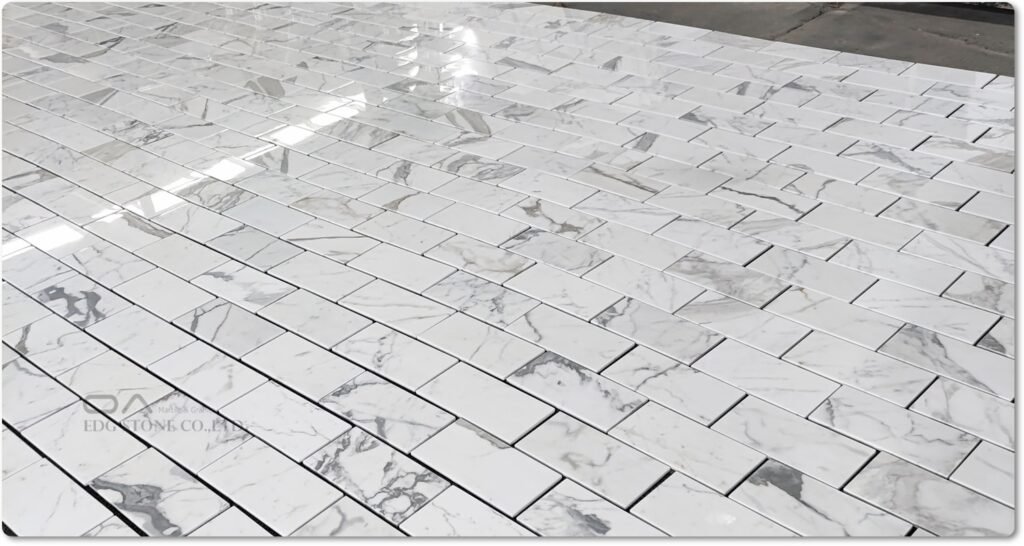
4. Italian Marble Grades and Natural Variations
4.1 Are Italian Marble Grades Standardized?
There is no single universally applicable grading system that classifies every Italian marble variety into identical international grades.
Terms such as:
First Choice.
Extra.
Premium.
Standard.
Commercial Grade.
A Grade.
B Grade.
may be used by individual quarries, processors, exporters, or distributors.
These descriptions should not be assumed to have identical meanings between suppliers.
A buyer should obtain the supplier’s written grading criteria and understand the specific visual and technical differences between offered selections.
4.2 Natural Marble Variation Is Not Automatically a Defect
Natural marble is a geological material.
Its visual characteristics can include:
Vein changes.
Mineral concentrations.
Fossil traces.
Clouding.
Color bands.
Natural fissures.
Crystalline structures.
Localized tonal differences.
Some characteristics are acceptable within the agreed material selection, while others may affect structural integrity or finished appearance.
The distinction between natural variation and unacceptable defects must be established before production.
4.3 Resin Repairs, Fissures, and Surface Treatments
Some marble blocks contain natural fissures or discontinuities.
Depending on the material and intended application, processors may use:
Resin filling.
Mesh reinforcement.
Surface reinforcement.
Localized repairs.
Polishing compounds.
Protective treatments.
These processes are not automatically evidence of poor-quality material.
However, buyers should be informed about significant repairs and reinforcement where they affect appearance, structural suitability, or installation requirements.
For high-value commercial projects, repair acceptance criteria should be included in the purchase specification.
4.4 Physical Properties That Require Evaluation
Natural marble tiles should be evaluated according to their intended application.
Important characteristics include:
| Property | Why it matters | Suggested evaluation |
|---|---|---|
| Water absorption | Potential moisture sensitivity | ASTM C97/C97M |
| Density | Material consistency and mass | ASTM C97/C97M |
| Compressive strength | Resistance under compressive loads | ASTM C170/C170M |
| Flexural strength | Performance under bending stress | ASTM C880/C880M |
| Abrasion resistance | Relevant to floor applications | ASTM C1353/C1353M, where applicable |
| Slip resistance | Important for pedestrian surfaces | Project-specified applicable test |
| Dimensional tolerance | Installation and joint consistency | Applicable product standard and purchase specification |
| Surface finish | Visual quality and maintenance | Approved physical sample |
Test results should identify the tested material, test method, laboratory, date, and specimen condition.
A test performed on a different marble variety should not automatically be used to certify the proposed production lot.
5. Slab Selection and Italian Marble Tile Production
5.1 Why Slab Selection Matters
Marble tile production begins with selecting suitable raw material.
For premium Italian marble tiles, block and slab selection directly affect:
Finished color consistency.
Vein direction.
Pattern continuity.
Usable material yield.
Tile appearance.
Production losses.
Final project cost.
Two blocks from the same quarry may have different geological characteristics.
Consequently, large-volume buyers should request current photographs or videos of the actual material available for their order.
5.2 From Marble Blocks to Finished Tiles
A typical natural marble tile manufacturing process includes the following stages:
Stage 1: Block Selection
The processor evaluates block dimensions, color, vein patterns, natural discontinuities, and expected production yield.
Stage 2: Block Cutting
Blocks are cut into slabs or other intermediate formats using suitable stone-processing equipment.
Stage 3: Slab Inspection
The slabs are checked for cracks, fissures, color variation, resin repairs, and surface characteristics.
Stage 4: Tile Cutting
Slabs are cut into the specified tile dimensions.
Stage 5: Calibration
The thickness of individual tiles is controlled to achieve the required dimensional consistency.
Stage 6: Surface Finishing
Common finishes include:
Polished.
Honed.
Brushed.
Leathered.
Antique.
Sandblasted.
Tumbled.
Not every finish is suitable for every marble variety or application.
Stage 7: Edge Processing
Edges may be square-cut, beveled, chamfered, or otherwise processed according to the order specification.
Stage 8: Final Inspection
Finished products are checked for dimensions, thickness, surface quality, color consistency, and order conformity.
Stage 9: Export Packaging
Tiles are protected, packed, labeled, and prepared for international transportation.
5.3 Standard Italian Marble Tile Sizes
Italian marble tiles are available in multiple dimensions.
Commonly requested commercial formats include:
| Nominal size | Approximate metric equivalent |
|---|---|
| 12 x 12 inches | 305 x 305 mm |
| 12 x 24 inches | 305 x 610 mm |
| 18 x 18 inches | 457 x 457 mm |
| 24 x 24 inches | 610 x 610 mm |
| 24 x 48 inches | 610 x 1,220 mm |
| 300 x 600 mm | 300 x 600 mm |
| 400 x 400 mm | 400 x 400 mm |
| 600 x 600 mm | 600 x 600 mm |
| 600 x 1,200 mm | 600 x 1,200 mm |
These are illustrative commercial formats, not a claim that all sizes are universally standardized or available from every quarry.
Large-format marble tiles may require additional attention to thickness, flatness, handling, transportation, and installation.
5.4 Thickness Selection
Typical natural marble tile thicknesses include:
10 mm.
12 mm.
15 mm.
18 mm.
20 mm.
30 mm.
The appropriate thickness depends on tile dimensions, stone characteristics, substrate conditions, installation method, expected loads, and project requirements.
Thin marble tiles can reduce transportation weight but may require additional engineering and handling precautions.
For commercial flooring, buyers should not specify thickness based only on a general market convention.
The finished assembly must be suitable for the actual loading and installation conditions.
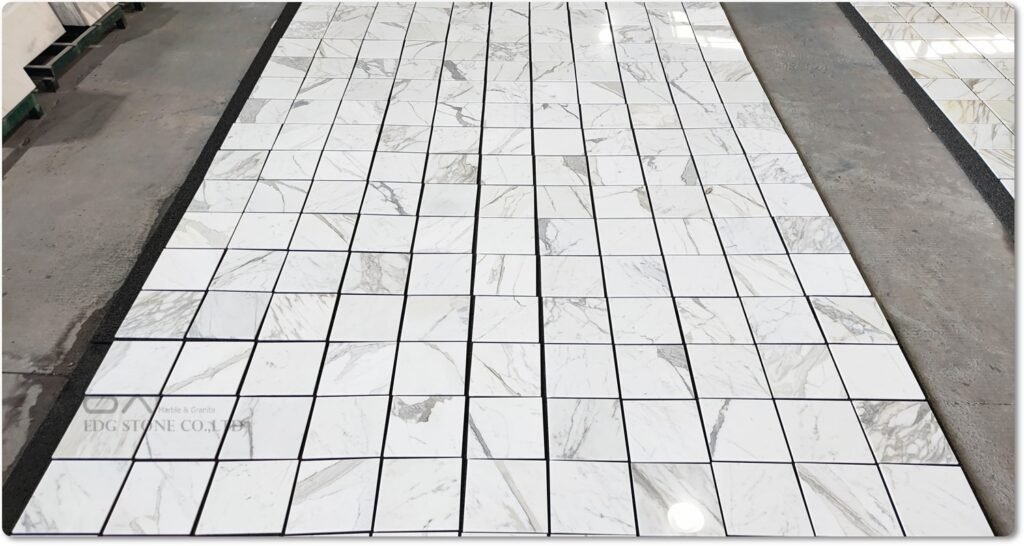
6. Bookmatched Patterns and Vein Matching
6.1 What Is Bookmatched Italian Marble?
Bookmatching is a natural stone selection and arrangement technique in which adjacent slabs or panels are positioned to create mirrored or symmetrical vein patterns.
It is particularly popular with Calacatta and Statuario selections that contain visually prominent veins.
<insert visual reference: bookmatched Calacatta marble feature wall>
Common applications include:
Hotel reception walls.
Luxury residential feature walls.
Fireplace surrounds.
Large bathroom walls.
Lobby installations.
Decorative architectural panels.
6.2 How Bookmatching Works
A typical bookmatching process involves:
Selecting slabs from the same block or a closely coordinated production sequence.
Identifying vein direction and pattern movement.
Arranging adjacent slabs in the intended sequence.
Photographing or digitally arranging the proposed layout.
Confirming the pattern with the architect or buyer.
Cutting and labeling the panels according to the approved layout.
Bookmatching is not guaranteed simply because two slabs carry the same commercial stone name.
The actual slabs must be inspected and arranged before final approval.
6.3 Vein Matching for Marble Tiles
For smaller marble tiles, vein matching can be managed through:
Sequential slab cutting.
Tile numbering.
Batch identification.
Layout planning.
Directional installation.
Sample-board approval.
For premium hotel and villa projects, buyers should consider purchasing tiles from coordinated production lots rather than combining unrelated batches.
6.4 Bookmatched Marble Procurement Checklist
Before approving a bookmatched order, confirm:
Actual slab photographs.
Number of required panels.
Panel dimensions.
Vein direction.
Matching sequence.
Acceptable color variation.
Thickness.
Surface finish.
Backing or reinforcement.
Packaging and panel identification.
A signed layout drawing and approved slab photographs should be treated as important production documents.
7. Italian Marble vs. Other Global Marble Sources
7.1 Why Buyers Compare Different Marble Origins
Italian marble is not the only source of premium natural marble.
International buyers frequently compare marble from Italy, Greece, Turkey, China, Brazil, India, and other producing regions.
The purpose is not necessarily to replace Italian marble with another origin.
It is to identify the material that best satisfies the project’s appearance, technical requirements, supply quantity, and commercial budget.
7.2 Global Marble Source Comparison
| Origin | Recognized commercial materials | General market characteristics |
|---|---|---|
| Italy | Carrara, Calacatta, Statuario | Established premium white marble selections |
| Greece | Volakas, Thassos, selected white marbles | White marble and decorative architectural materials |
| Turkey | Afyon White, Mugla White, other regional marbles | Diverse white, beige, and colored marble resources |
| China | Various domestic white, grey, green, and decorative marbles | Broad processing and fabrication capabilities |
| Brazil | Selected natural marble and other dimension stones | Distinctive decorative natural stone selections |
| India | Makrana and other regional marble varieties | Traditional marble resources and varied commercial selections |
This table is a general sourcing overview, not a complete inventory of each country’s marble production.
Individual quarry characteristics, availability, technical properties, and commercial trade names must be independently verified.
7.3 Can Non-Italian Marble Replace Italian Marble?
Sometimes, but not in every project.
An alternative marble may be suitable when the project prioritizes:
Similar background color.
Comparable vein movement.
Similar finish.
Required physical performance.
Availability in the necessary quantity.
Acceptable commercial cost.
However, a visually similar stone does not become geological or commercial Italian-origin marble.
Where the architect or owner specifies Italian origin, a substitution should only proceed after written approval.
7.4 EDG Stone: Multi-Origin Natural Marble Sourcing and Fabrication
EDG Stone serves international buyers seeking natural stone products and customized manufacturing services.
Rather than presenting every white marble as Italian material, EDG can assist buyers in evaluating different natural marble sources according to their actual procurement requirements.
Potential sourcing and fabrication requirements include:
White marble tiles.
Black marble tiles.
Green marble tiles.
Grey marble tiles.
Beige marble tiles.
Brown marble tiles.
Decorative marble selections.
Custom marble flooring.
Marble wall panels.
Marble mosaics.
Cut-to-size marble products.
Hotel and residential stone packages.
For genuine Italian-origin marble, the country and quarry origin should be verified through the relevant supply-chain documentation.
For marble sourced from other countries, the actual origin should be clearly stated.
This approach enables buyers to compare genuine origin-specific products with alternative natural stone selections without creating misleading country-of-origin claims.
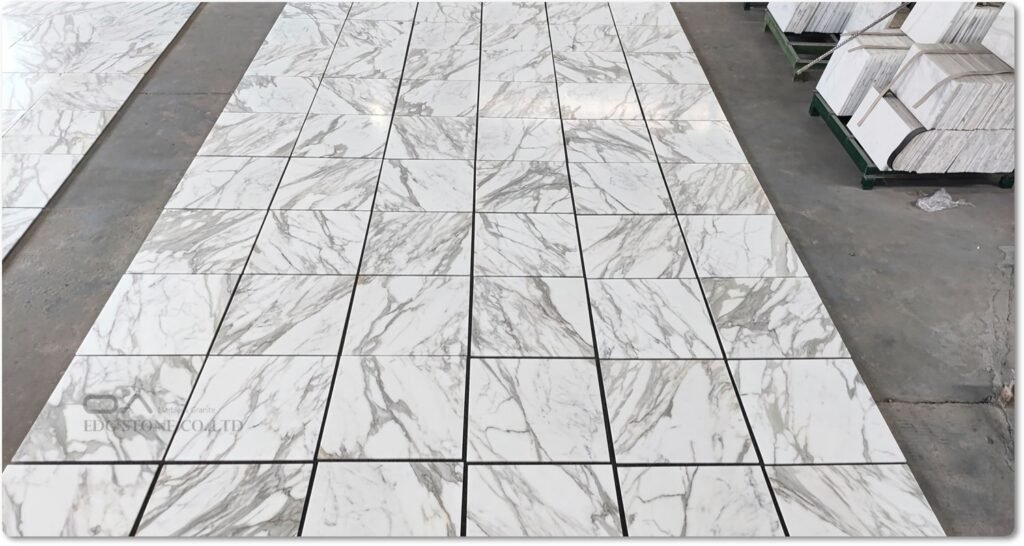
8. Cost and Risk Factors: Italian Marble Tiles Price and Import Considerations
8.1 What Determines Italian Marble Tiles Price?
Italian marble tiles price is influenced by several factors.
There is no single reliable international price applicable to all Carrara, Calacatta, or Statuario tiles.
The final quotation depends on the material selection, processing requirements, order quantity, and delivery conditions.
Major Pricing Factors
1. Marble Variety
Different commercial varieties have different availability, visual characteristics, and market positioning.
2. Block and Slab Selection
A particularly desirable background color or vein pattern may increase the cost of material selection and reduce usable yield.
3. Tile Dimensions
Large-format tiles may require different cutting strategies, handling procedures, and production controls.
4. Thickness
Thicker tiles consume more raw material and generally increase product weight and transportation costs.
5. Surface Finish
Polished, honed, brushed, and other finishes require different processing operations.
6. Quality Selection
Higher visual consistency requirements can reduce the number of acceptable finished tiles from a given production batch.
7. Custom Fabrication
Special sizes, edge profiles, cutouts, mosaics, and coordinated patterns can increase processing costs.
8. Order Quantity
Large orders may improve production efficiency, but they may also require more extensive material reservation and quality coordination.
9. Packaging
Export packaging requirements depend on tile size, thickness, fragility, destination, and transportation method.
10. Shipping and Import Costs
Freight, insurance, customs duties, brokerage, port charges, local transportation, and applicable taxes all influence the final landed cost.
8.2 How to Calculate the Landed Cost of Italian Marble Tiles
Buyers should compare suppliers using a consistent cost model.
A simplified calculation is:
Landed Cost = Product Cost + Export Packaging + Inland Transportation + International Freight + Insurance + Import Duties + Customs Clearance + Destination Charges + Local Delivery
The applicable Incoterm determines which costs and responsibilities are included in the quoted price.
Common quotation terms include:
EXW: Ex Works.
FOB: Free on Board.
CFR: Cost and Freight.
CIF: Cost, Insurance and Freight.
DAP: Delivered at Place.
DDP: Delivered Duty Paid.
The appropriate term depends on the shipping arrangement, destination, customs responsibilities, and contractual agreement.
For CIF transactions, insurance coverage and named destination port should be explicitly confirmed.
8.3 Import Documentation and Country-of-Origin Verification
For international marble procurement, buyers should establish the actual country of origin and confirm the documentation required by the importing jurisdiction.
Potential documents include:
Commercial invoice.
Packing list.
Bill of lading.
Certificate of origin, where required or requested.
Product specification.
Material identification records.
Relevant laboratory test reports.
Insurance documentation.
Customs classification information.
Natural marble products are commonly classified under heading 6802 of the Harmonized System, but the precise subheading depends on the product’s processing, form, and applicable national tariff schedule.
Buyers should confirm classification with a qualified customs broker or the relevant customs authority.
8.4 European Regulatory Considerations
For marble tiles intended for construction applications in European markets, importers and suppliers should review the applicable Construction Products Regulation framework.
Regulation (EU) 2024/3110 establishes a revised European framework for construction products. It entered into force in January 2025, with its general application beginning on 8 January 2026, subject to transitional provisions and the applicability of product-specific technical specifications.
The practical compliance route depends on the product, its intended use, applicable harmonised technical specifications, and the transition arrangements.
Relevant European natural stone product standards include:
EN 12057 – Natural stone products: Modular tiles.
EN 12058 – Natural stone products: Slabs for floors and stairs.
EN 1469 – Natural stone products: Slabs for cladding.
EN 1341 – Slabs of natural stone for external paving.
EN 1342 – Setts of natural stone for external paving.
EN 1343 – Kerbs of natural stone for external paving.
These standards address different product formats and applications. They should not be treated as interchangeable.
A buyer should establish which standard and conformity requirements apply to the actual product and intended market.
8.5 Environmental and Sustainability Considerations
The international natural stone industry is increasingly expected to provide more transparent information about material sourcing and environmental performance.
Relevant considerations include:
Quarry management.
Water consumption.
Processing waste.
Energy consumption.
Transport emissions.
Packaging materials.
Product durability.
Repair and replacement requirements.
Responsible extraction practices.
For European projects, buyers may also need to consider project-level environmental requirements, green building certification criteria, and relevant construction procurement policies.
Environmental product declarations may be useful when available and prepared according to applicable product category rules and recognized standards.
However, buyers should not assume that every marble tile automatically has an Environmental Product Declaration or qualifies for a specific green building credit.
9. Procurement Checklist: How to Buy Italian Marble Tiles
A structured purchasing process reduces the risk of receiving inconsistent material or products that do not match the approved design.
9.1 Step 1: Confirm the Material Identity
Ask the supplier:
Is the material genuine Italian-origin marble?
What is the quarry or production area?
What is the commercial variety?
Is the material supplied from a single quarry lot?
Can the supplier provide traceability documents?
Do not accept a trade name as sufficient proof of geographical origin.
9.2 Step 2: Review Actual Material Photographs
Request:
Current slab photographs.
Full slab videos.
Close-up photographs.
Photographs under neutral lighting.
Images of the actual production batch.
Sequential photographs for bookmatching projects.
Where possible, request images with slab identification numbers.
9.3 Step 3: Approve a Physical Sample
A sample should represent the intended:
Material selection.
Thickness.
Finish.
Edge treatment.
Surface appearance.
Repair acceptance criteria.
For natural stone, a small sample cannot represent every characteristic of a full production batch.
Therefore, sample approval should be combined with batch-level visual approval.
9.4 Step 4: Confirm Technical Specifications
The purchase specification should include:
Marble variety.
Country of origin.
Quarry or lot identification, where available.
Tile length and width.
Nominal thickness.
Dimensional tolerances.
Surface finish.
Edge processing.
Quantity.
Packaging requirements.
Intended application.
9.5 Step 5: Confirm Quality Inspection Procedures
A reliable supplier should have documented inspection procedures covering:
Raw Material Inspection
Material identity.
Visual consistency.
Natural fractures.
Surface defects.
Block and slab suitability.
In-Process Inspection
Cutting accuracy.
Thickness control.
Surface finishing.
Edge quality.
Repair and reinforcement acceptance.
Finished Product Inspection
Length and width.
Thickness.
Surface quality.
Color and pattern consistency.
Quantity.
Order conformity.
Pre-Shipment Inspection
Carton or crate condition.
Product identification.
Packing list accuracy.
Moisture protection where appropriate.
Container loading.
Export packaging security.
EDG Stone follows a project-oriented inspection approach involving raw material checks, processing-stage inspections, finished product inspection, and export packaging checks according to the agreed order specifications.
The inspection scope and acceptance criteria should be confirmed in writing before production.
9.6 Step 6: Approve Packaging and Transportation
Natural marble is heavy and can be damaged by impact, vibration, and improper handling.
Packaging requirements should consider:
Tile dimensions.
Tile thickness.
Surface finish.
Quantity per package.
Wooden crate design.
Internal cushioning.
Moisture protection.
Forklift handling.
Container loading.
Destination transportation conditions.
Wood packaging used in international trade should comply with applicable importing-country requirements, including ISPM 15 where applicable.
9.7 Step 7: Confirm the Commercial Agreement
Before placing the order, confirm:
Total quantity.
Unit price.
Currency.
Incoterm and named place.
Production lead time.
Payment terms.
Inspection and acceptance procedure.
Shipping schedule.
Documentation requirements.
Claims procedure.
Replacement or compensation arrangements.
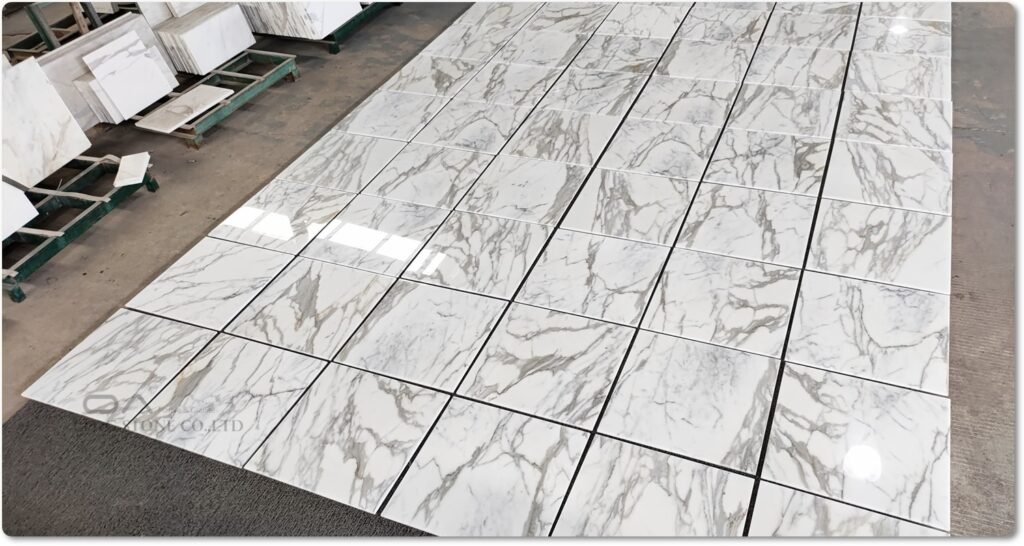
10. Supplier Evaluation: How to Choose an Italian Marble Tiles Manufacturer or Factory
10.1 Italian Quarry Versus Marble Processing Factory
Buyers should distinguish between different supplier roles.
| Supplier type | Main function |
|---|---|
| Quarry operator | Extracts marble blocks |
| Block trader | Purchases and distributes blocks |
| Slab manufacturer | Processes blocks into slabs |
| Tile factory | Cuts and finishes marble tiles |
| Stone fabricator | Produces customized stone products |
| Exporter | Coordinates international sales and shipping |
| Distributor | Supplies materials to regional customers |
One company may perform multiple functions, but buyers should establish which operations are actually carried out in-house and which are subcontracted.
10.2 What Should a Professional Marble Tile Supplier Provide?
A qualified supplier should be able to provide evidence of:
Material sourcing and identification.
Current inventory or confirmed material availability.
Technical product specifications.
Actual slab or batch photographs.
Manufacturing capabilities.
Dimensional inspection procedures.
Finished product inspection.
Export packaging capabilities.
Shipping and documentation experience.
Commercial references or relevant project records, where available.
10.3 Why Factory Capability Matters
For B2B buyers, a factory’s value is not limited to the price per square meter.
Production coordination can influence:
Material yield.
Dimensional consistency.
Batch uniformity.
Production scheduling.
Packaging reliability.
Project delivery.
Claims and replacement costs.
A capable manufacturing partner should be able to explain how each of these factors is controlled.
10.4 EDG Stone: Natural Marble Tiles Manufacturer and Export Partner
EDG Stone is a Chinese natural stone products manufacturer and exporter serving international buyers with natural stone sourcing, processing, customized fabrication, and export coordination.
Its product and fabrication capabilities cover natural stone and selected engineered stone products, including marble, granite, quartzite, and other decorative materials.
For buyers developing marble tile collections or sourcing materials for residential, hotel, and commercial projects, EDG can assist with:
Natural marble sourcing from different origins.
White marble tile selection.
Custom marble tile dimensions.
Marble wall and floor applications.
Cut-to-size marble manufacturing.
CNC and waterjet processing.
Edge finishing.
Marble mosaics.
Decorative stone panels.
Coordinated project stone packages.
Export packaging and container loading.
EDG’s role is to match the actual material origin, technical specifications, and manufacturing process with the buyer’s requirements.
If a project calls for Italian Carrara, Calacatta, or Statuario, the material must be verified as Italian origin. If the buyer accepts alternatives from other countries, those alternatives should be quoted and identified separately.
This distinction is essential for transparent international procurement.
11. Practical RFQ Template: Italian Marble Tiles Wholesale and Bulk Orders
The following template can be used by importers, wholesalers, contractors, architects, and hotel procurement departments.
11.1 Marble Tiles RFQ Information
| RFQ field | Information required |
|---|---|
| Project name | Project or purchasing program |
| Destination | Country, city, and delivery port |
| Material | Carrara / Calacatta / Statuario / Other |
| Required origin | Italy or an approved alternative origin |
| Product format | Floor tiles / Wall tiles / Cut-to-size |
| Tile dimensions | Length x width |
| Thickness | 10 / 12 / 15 / 18 / 20 / 30 mm or custom |
| Surface finish | Polished / Honed / Brushed / Other |
| Edge processing | Square / Beveled / Custom |
| Quantity | Square meters and/or pieces |
| Pattern requirement | Random / Directional / Bookmatched |
| Color selection | White / Grey / Gold / Other |
| Quality selection | Defined visual acceptance criteria |
| Technical standards | Applicable EN / ASTM requirements |
| Sample requirement | Physical sample or sample board |
| Inspection | Raw material / In-process / Final / Third-party |
| Packaging | Carton / Wooden crate / Project-specific |
| Trade term | EXW / FOB / CIF / DAP / Other |
| Required delivery | Target shipping date |
| Documentation | Origin and test documentation as applicable |
11.2 Sample RFQ Message
Subject: RFQ – Italian Marble Tiles for Luxury Residential / Hotel Project
Dear Sales Team,
We are sourcing premium natural marble tiles for an upcoming project and would like to receive your quotation.
Please provide your available selections and pricing based on the following requirements:
Material: Carrara / Calacatta / Statuario or approved alternatives.
Required origin: Italy, with origin identification.
Dimensions: [Insert dimensions].
Thickness: [Insert thickness].
Surface finish: [Polished / Honed].
Quantity: [Insert square meters].
Application: [Flooring / Wall Cladding / Bathroom].
Destination: [Insert destination].
Trade term: [FOB / CIF / DAP].
Required delivery schedule: [Insert date].
Please include:
Actual material and slab photographs.
Country and quarry origin information.
Available technical specifications.
Unit price and total quotation.
Production lead time.
Sample availability.
Inspection procedures.
Export packaging details.
Applicable shipping and documentation information.
Please identify genuine Italian-origin material separately from alternative marble sources.
We look forward to receiving your proposal.
Best regards,
[Buyer Name]
[Company Name]
[Contact Information]
12. Frequently Asked Questions: Italian Marble Tiles
1. What is the difference between Carrara, Calacatta, and Statuario marble?
Carrara typically features a white to light-grey background with relatively subtle grey veining. Calacatta is often associated with a brighter white background and stronger grey or gold vein patterns. Statuario generally features a bright white background and distinctive grey veining. Actual appearance varies between blocks and selections.
2. Are Italian marble tiles expensive?
Italian marble tile prices depend on the variety, material selection, slab yield, dimensions, thickness, finish, order quantity, and transportation. Premium Calacatta and Statuario selections can command higher prices than many conventional Carrara selections, but actual quotations depend on the specific material lot.
3. What are the best Italian marble tiles for luxury bathrooms?
Carrara, Calacatta, and Statuario are all potential options. The best selection depends on the desired appearance, water exposure, finish, slip resistance, maintenance requirements, and installation system. Honed surfaces may be considered where a less reflective appearance is preferred, but the complete flooring assembly must still meet applicable slip-safety requirements.
4. Are Italian marble tiles suitable for commercial flooring?
Yes, selected marble tiles can be used in commercial interiors when their technical properties, thickness, finish, installation system, and maintenance requirements are appropriate for the expected pedestrian traffic. A project-specific technical evaluation is recommended.
5. Can I buy Italian marble tiles wholesale directly from a factory?
Yes. Buyers can source through Italian quarries, processors, exporters, and authorized distributors. When purchasing through an international stone manufacturer or export partner, confirm the actual country of origin, supply-chain documentation, material availability, and whether the product is processed in-house or through another supplier.
13. References and Technical Resources
The following standards and institutional resources provide useful technical and regulatory foundations for Italian marble tile procurement.
EN 12057 – Natural Stone Products: Modular Tiles. European product standard for modular natural stone tiles. Buyers should verify the applicable edition and harmonised status for their intended market.
EN 12058 – Natural Stone Products: Slabs for Floors and Stairs. Relevant to natural stone slabs used in floor and stair applications.
EN 1469 – Natural Stone Products: Slabs for Cladding. Relevant to natural stone cladding products.
EN 1341 – Slabs of Natural Stone for External Paving. Relevant to natural stone paving slabs.
ASTM C97/C97M – Standard Test Methods for Absorption and Bulk Specific Gravity of Dimension Stone. Used to evaluate water absorption and bulk specific gravity.
ASTM C170/C170M – Standard Test Method for Compressive Strength of Dimension Stone.
ASTM C880/C880M – Standard Test Method for Flexural Strength of Dimension Stone.
ASTM C1353/C1353M – Standard Test Method for Abrasion Resistance of Dimension Stone Subjected to Foot Traffic Using a Rotary Platform Abraser.
Regulation (EU) 2024/3110 – Construction Products Regulation. Revised European framework governing construction products, including applicable transitional arrangements.
Regulation (EU) 305/2011 – Previous Construction Products Regulation. Relevant to understanding the transition from the former framework.
ISO 14025 – Environmental Labels and Declarations: Type III Environmental Declarations. Relevant to the preparation of environmental product declarations.
ISO 14040 and ISO 14044 – Life Cycle Assessment. International standards providing principles and requirements for life-cycle assessment.
FAO/UNECE International Standards for Natural Stone. Institutional resources relevant to natural stone market transparency and trade terminology.
Carrara Marble District and Relevant Italian Quarry Documentation. Primary quarry and producer records should be used to verify individual material origin and commercial identity.
Standards are subject to revision. Buyers should obtain the current edition and verify applicability, national adoption, harmonisation status, and project-specific contractual requirements before relying on a standard for conformity assessment.
14. EDG Stone CTA: Source and Customize Premium Natural Marble Tiles
Find the Right Natural Marble for Your Next Project
Selecting premium marble tiles requires more than choosing a recognizable Italian marble name.
Material origin, actual slab appearance, dimensional accuracy, surface finish, processing quality, packaging, and international delivery all contribute to the success of a stone project.
EDG Stone works with international importers, wholesalers, distributors, contractors, architects, designers, and hospitality procurement teams seeking natural stone products and customized fabrication services.
Whether your project requires Italian-origin Carrara, Calacatta, or Statuario, or alternative natural marble selections from other countries, EDG can assist with material evaluation, customized dimensions, fabrication coordination, quality inspection, and export packaging according to the agreed requirements.
Explore EDG Stone Capabilities
Natural Marble Tiles: Explore different colors, patterns, and natural stone selections.
Stone Countertops and Slabs: Discover natural stone materials for residential and commercial projects.
Custom Stone Fabrication: CNC, waterjet, cut-to-size, edge processing, and project fabrication.
Stone Project Solutions: Coordinate customized natural stone products for hotels, villas, multifamily developments, and commercial interiors.
Request a Marble Tiles Quotation
Send EDG your reference photographs, required material origin, dimensions, thickness, finish, estimated quantity, and destination.
Our team can evaluate the project requirements and provide a sourcing and fabrication proposal based on the available materials and agreed specifications.
EDG Stone – Natural Stone Products, Custom Fabrication and International Export.
Explore Natural Marble Collections
Contact EDG Stone for a Custom Marble Tiles RFQ
Semantic Closure: Italian Marble Tiles – Material Intelligence, Design Selection and Global Procurement Insights
What Defines the Value of Italian Marble Tiles?
The value of Italian marble tiles comes from the combination of geological origin, natural appearance, material selection, processing quality, and architectural application. Carrara, Calacatta, and Statuario are not interchangeable product labels. Each represents a distinct commercial selection with different visual characteristics and supply considerations. The strongest procurement decisions combine documented origin with physical samples, actual slab photography, technical testing, and clearly defined acceptance criteria.
Why Do Architects and Developers Select Carrara, Calacatta and Statuario?
Architects frequently consider Carrara for understated white and grey interiors, Calacatta for more dramatic natural patterns, and Statuario for bright white backgrounds with distinctive grey veining. These are design tendencies rather than fixed rules. The final choice should be determined by the actual material lot, lighting conditions, room dimensions, installation layout, maintenance expectations, and the architectural concept.
How Should Buyers Evaluate Italian Marble Tiles Before Purchasing?
Professional buyers should follow a traceable selection process: verify origin, inspect available slabs, approve representative samples, define dimensions and finishes, confirm technical requirements, establish visual acceptance criteria, and document the inspection and packaging process. For large-volume orders, batch consistency and material reservation are especially important because replacement material may have different natural patterns.
What Are the Options for Buyers Who Need Premium White Marble but Have Different Budgets?
Buyers can evaluate several sourcing options:
Option 1 – Genuine Italian Marble: Specify Carrara, Calacatta, or Statuario with appropriate origin documentation. This is the correct route when the project requires Italian-origin material.
Option 2 – Alternative European Marble: Evaluate selected Greek or other European white marble varieties where their actual appearance and technical characteristics meet the project requirements.
Option 3 – Marble from Other Global Sources: Compare suitable white marble from Turkey, China, and other producing countries. These materials must be identified by their actual origin and should not be marketed as Italian marble.
Option 4 – Mixed Material Procurement: Use different marble varieties in different project areas, provided the architect and owner approve the proposed material schedule.
Option 5 – Customized Fabrication: Optimize tile dimensions, slab yield, cutting layouts, and production sequencing to reduce avoidable waste without compromising the approved appearance.
What Should Buyers Consider When Comparing Italian Marble Tile Prices?
A low unit price does not necessarily indicate a lower total project cost. Buyers should calculate material yield, rejected tiles, cutting waste, processing charges, packaging, international freight, customs costs, installation requirements, and long-term maintenance. A supplier offering clear documentation, controlled production, and reliable export packaging may reduce total procurement risk even when its initial quotation is not the lowest.
How Is the Natural Stone Industry Moving Toward More Transparent Procurement?
The international stone supply chain is increasingly influenced by material traceability, technical documentation, environmental information, and more explicit product conformity requirements. European construction-product regulations and established EN standards reinforce the importance of identifying product categories and their applicable requirements. For buyers, this means that supplier evaluation should increasingly focus on verifiable evidence rather than unsupported claims about origin, grade, sustainability, or performance.
Why Is EDG Stone Relevant to International Marble Tile Buyers?
EDG Stone provides a manufacturing and export channel for buyers who need natural marble sourcing, customized stone processing, and coordinated international supply. Its multi-origin sourcing approach enables buyers to evaluate genuine Italian-origin material alongside clearly identified alternatives from other countries. Raw material inspection, processing-stage quality control, finished-product inspection, and export packaging checks can be incorporated into project-specific procurement procedures.
Final Procurement Insight
The most reliable way to purchase premium marble tiles is to connect four elements: verified material origin, approved visual selection, measurable technical specifications, and documented manufacturing quality control.
For genuine Italian marble, verify the Italian source. For alternative natural marble, evaluate its actual geological origin and technical performance. For every commercial project, make the approved sample, production lot, inspection criteria, and delivery requirements part of the purchasing agreement.
This approach creates a more transparent and repeatable procurement process for luxury residences, hotels, commercial developments, importers, wholesalers, and natural stone distributors.