Carrara Marble vs Calacatta Marble: The Short Answer
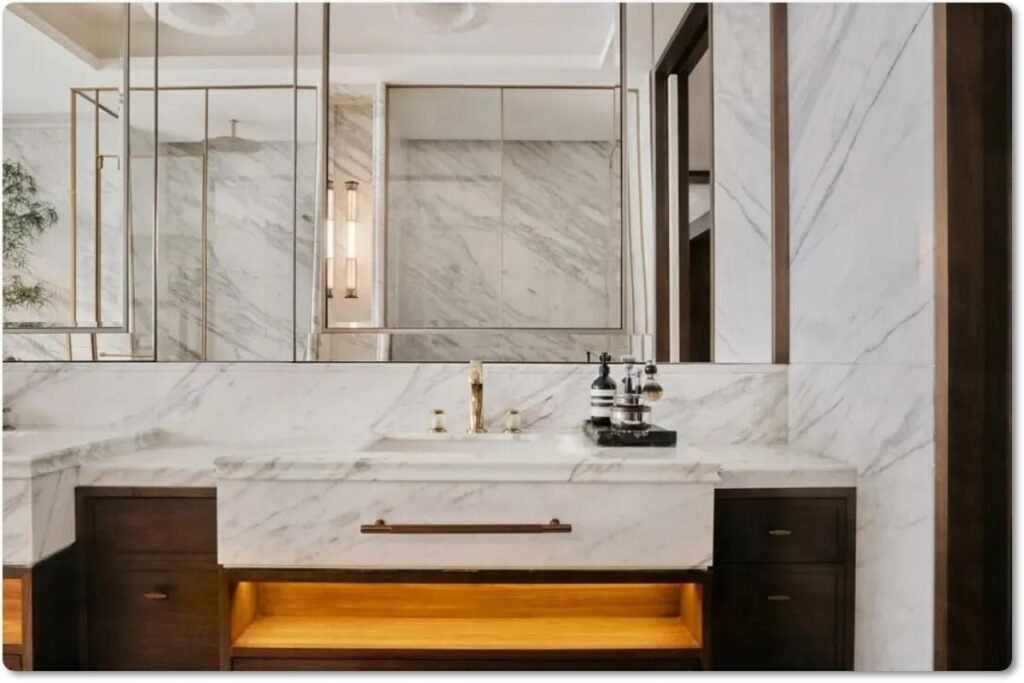
Carrara marble and Calacatta marble are among the world’s best-known white natural stones. Both are associated with Italy’s Tuscany region and are widely specified for Carrara marble countertops, bathroom vanity tops, wall applications, flooring, fireplaces, tables, hospitality interiors, and luxury residential projects.
The most important difference is visual and commercial rather than simply geological.
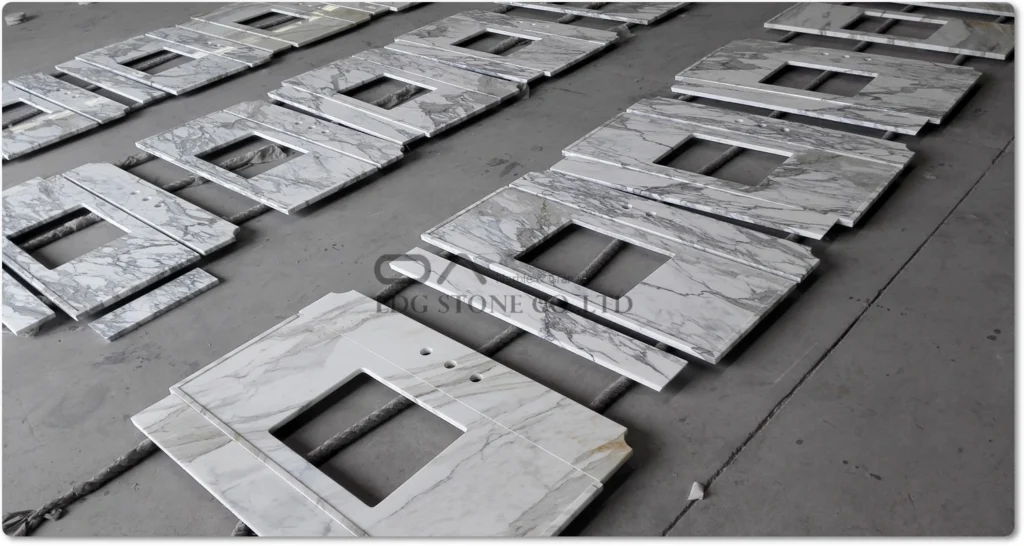
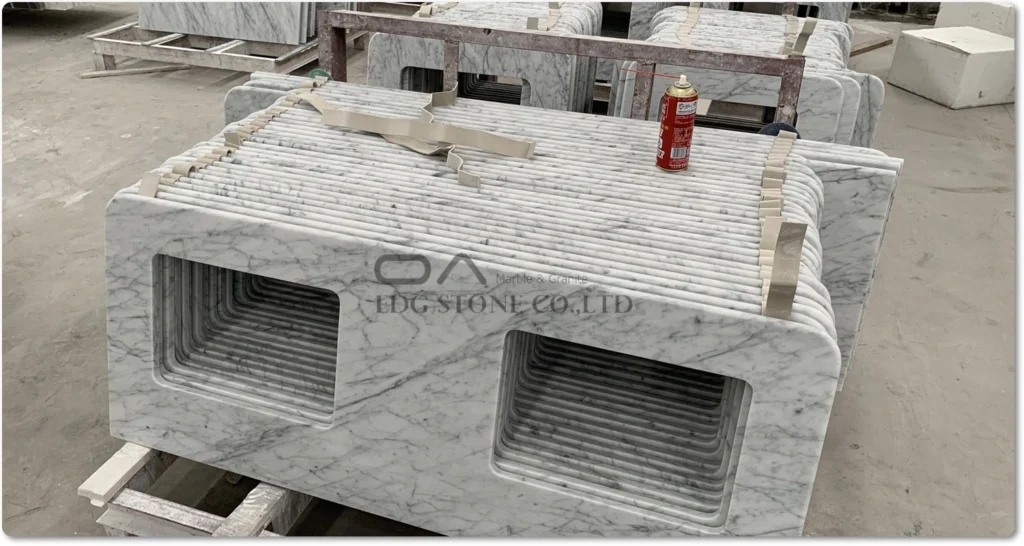
Carrara marble generally presents a softer white, blue-gray, or light-gray background with relatively fine and delicate gray veining. It is widely available and is often selected when designers want an elegant, timeless surface without overwhelming the surrounding architecture.
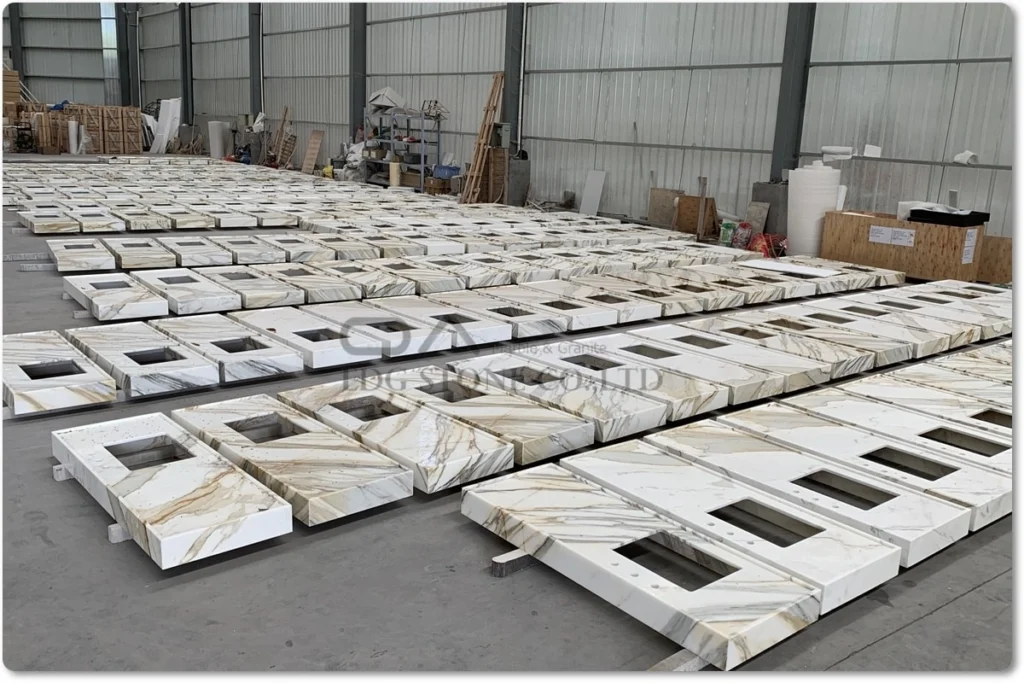
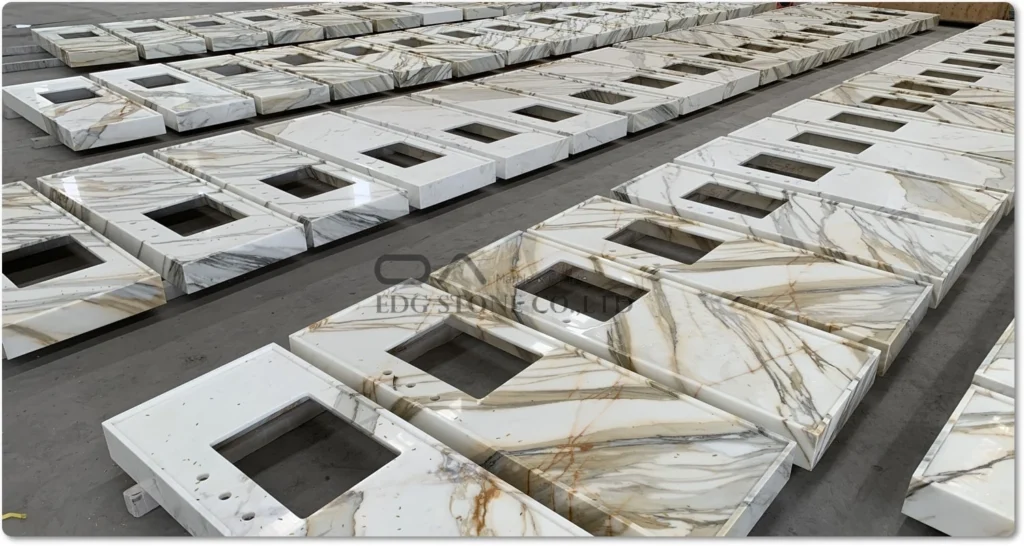
Calacatta marble generally has a brighter white background and stronger, more expressive veining. Depending on the variety, veins can be gray, charcoal, beige, brown, or gold. This dramatic appearance makes Calacatta particularly attractive for statement islands, luxury bathrooms, feature walls, fireplaces, and bookmatched slabs.
Current U.S. market guides illustrate the price difference. One 2026 pricing guide places Carrara at approximately $40–$75 per square foot for material and $75–$120 installed, while Calacatta is approximately $100–$180 for material and $150–$250 installed. Other market sources show substantially wider ranges depending on grade, origin, fabrication, thickness, region, and rarity. Therefore, these figures should be treated as budgeting references rather than fixed global prices.
For B2B buyers, the most useful conclusion is simple:
Carrara is usually the better choice for cost-controlled elegance; Calacatta is usually the better choice when dramatic veining, premium positioning, and visual impact are the priority.
What Is Carrara Marble?
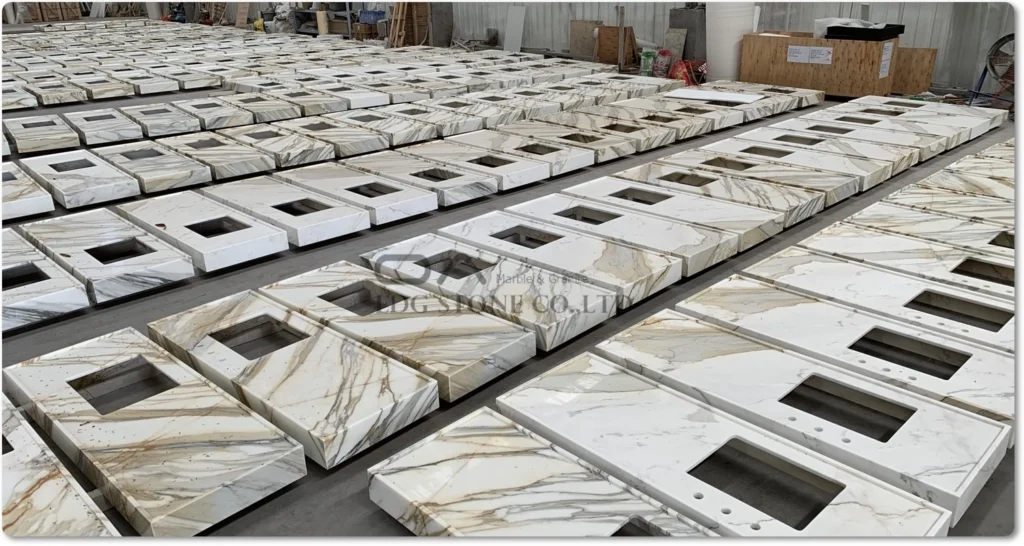
Carrara marble is a natural calcitic marble traditionally associated with the Carrara area of Tuscany, Italy. It has been used for architecture, sculpture, interiors, countertops, furniture, and decorative applications for centuries.
Carrara Marble Appearance
Typical Carrara marble features:
- White to blue-gray background
- Fine gray veining
- Soft, feather-like movement
- Moderate visual variation
- Occasional darker gray veins
- Some varieties with subtle warmer mineral characteristics
The exact appearance varies significantly from quarry block to quarry block and from slab to slab.
This is important for procurement: “Carrara” should not be treated as one standardized visual product.
A commercial buyer should request:
- Actual slab photographs
- Block or lot information
- Thickness
- Finish
- Surface treatment
- Slab dimensions
- Vein direction
- Available quantity
- Quality grade
- Inspection/QC documentation
Carrara Marble Countertops
Carrara marble countertops remain popular because they provide a classic European appearance without the visual intensity of some premium Calacatta selections.
Carrara works particularly well for:
- Traditional kitchens
- Transitional kitchens
- Modern farmhouse interiors
- Bathroom vanity tops
- Hotel bathrooms
- Apartment developments
- Café and restaurant interiors
- Fireplace surrounds
- Marble tables
For large-volume projects, Carrara can also offer a procurement advantage because commercially acceptable material is generally easier to source than highly selective Calacatta.
What Is Calacatta Marble?
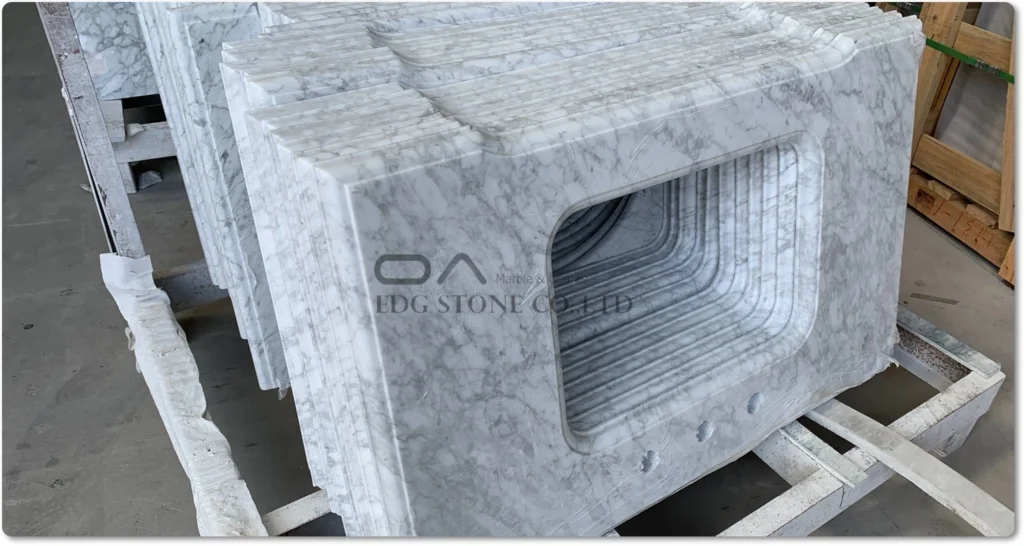
Calacatta marble is another premium Italian marble family associated with the Carrara/Tuscany area, but it is visually distinct from standard Carrara marble.
Calacatta is generally recognized for a bright white background combined with stronger, wider, and more dramatic veining.
Depending on the specific variety, the veining may be:
- Gray
- Dark gray
- Gold
- Beige
- Brown
- Warm gray
- Mixed gray and gold
Calacatta Marble Gold
Calacatta Gold is especially popular in luxury interior design because its warm gold or beige veining works well with:
- Brass hardware
- Gold lighting
- Warm oak
- Walnut
- Cream cabinetry
- Champagne finishes
- Luxury hospitality interiors
However, buyers should avoid assuming that every stone marketed as “Calacatta Gold” has the same geological origin or visual quality.
The commercial marble market contains many names that describe visual families, quarry selections, or trade classifications. Therefore, the exact quarry, block, slab photographs, and technical documentation matter more than the marketing name alone.
Carrara vs Calacatta Marble: Key Differences
| Feature | Carrara Marble | Calacatta Marble |
|---|---|---|
| Typical background | White/gray | Brighter white |
| Veining | Fine, soft, gray | Bold, wide, dramatic |
| Gold veining | Less typical | Common in selected varieties |
| Visual intensity | Moderate | High |
| Availability | Generally higher | Generally lower for premium grades |
| Typical price | Lower | Higher |
| Luxury positioning | Premium | Luxury/premium |
| Best use | Whole-project surfaces | Statement surfaces |
| Maintenance | Requires marble care | Requires marble care |
| Slab selection | Important | Extremely important |
| Bookmatching | Attractive | Often spectacular |
| Procurement risk | Relatively moderate | Higher for rare/select grades |
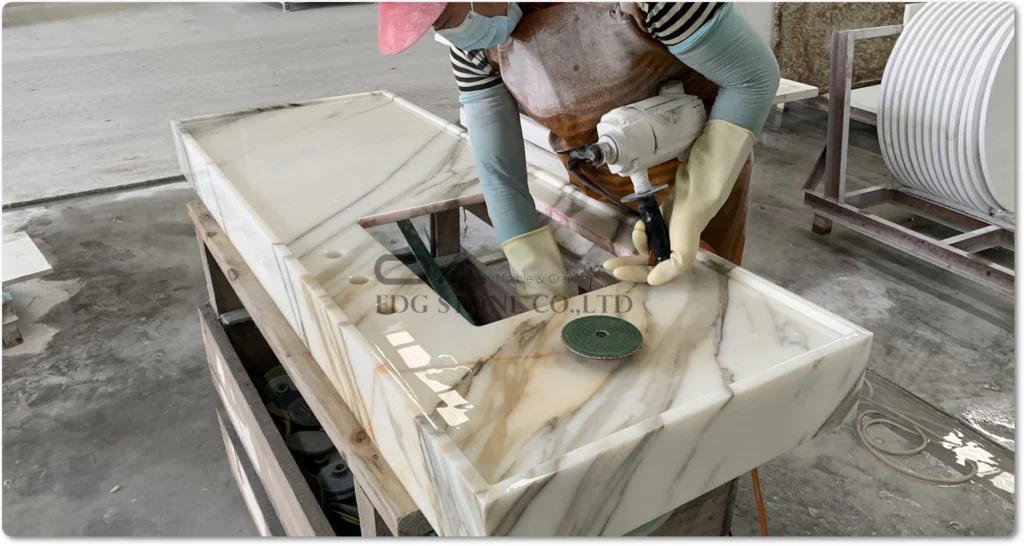
Why Is Calacatta More Expensive Than Carrara?
The question “Calacatta vs Carrara marble price” is one of the most commercially important comparisons for buyers.
The price difference is not caused by one factor alone.
1. Quarry Availability
Carrara material is generally available in larger commercial volumes. Premium Calacatta selections are more limited, especially slabs with:
- Very white backgrounds
- Strong continuous veins
- Attractive gold movement
- Low visual defects
- Large slab dimensions
- Bookmatch-compatible patterns
Limited availability can increase the price.
2. Visual Selection
A quarry may produce a large quantity of stone, but only a portion may meet the visual criteria required for a premium Calacatta project.
This creates a selection premium.
3. Slab Size
Large-format slabs are more expensive because:
- Suitable blocks are harder to obtain
- Transport is more demanding
- Cutting losses can increase
- Cracking risk increases
- Handling requires specialized equipment
4. Bookmatching
Calacatta is particularly popular for bookmatched walls and kitchen islands.
A bookmatched project requires careful block selection and slab sequencing. The value is therefore not simply the price of individual square feet.
It is the value of the complete visual composition.
5. Fabrication
Complex Calacatta projects may require:
- Vein matching
- Waterjet cutting
- CNC processing
- Large-radius edges
- Reinforced cutouts
- Mitered edges
- Bookmatch installation
- Careful seam positioning
These services can substantially increase total project cost.
Carrara vs Calacatta vs Statuario
The comparison becomes more useful when Statuario is included.
Carrara
Carrara is generally the most understated of the three.
Typical visual profile:
White-gray background + fine gray veins.
Calacatta
Calacatta generally has stronger movement.
Typical visual profile:
Bright white background + dramatic gray/gold veins.
Statuario
Statuario is commonly positioned as a high-end white marble with a bright background and pronounced veining. In many commercial markets, premium Statuario can command prices comparable to or above Calacatta depending on grade and origin.
A practical hierarchy for design selection is:
Carrara → subtle elegance
Calacatta → dramatic luxury
Statuario → high-contrast premium elegance
But this is a market positioning framework, not an absolute geological classification. Individual slabs can overlap considerably.
White Carrara Marble vs Calacatta Marble
For buyers specifically searching for white Carrara marble vs Calacatta marble, the most important visual difference is the balance between background and veining.
White Carrara
White Carrara usually provides:
- Softer contrast
- More consistent visual rhythm
- Fine gray movement
- Less dramatic focal impact
- Better suitability for larger continuous surfaces
Calacatta
Calacatta generally provides:
- Stronger contrast
- Larger veins
- More dramatic visual movement
- Greater focal impact
- Stronger luxury-market positioning
For a 1,000-unit apartment project, Carrara may be easier to standardize.
For a luxury hotel lobby, penthouse kitchen, or flagship retail interior, premium Calacatta may create more design value.
Carrara Marble vs White Marble: Are They the Same?
No.
“White marble” is a broad descriptive category, while Carrara is a specific commercial marble family.
White marble can include materials from:
- Italy
- Greece
- Turkey
- Spain
- India
- China
- Brazil
- Other producing regions
Therefore:
Carrara marble is a type of white marble, but not all white marble is Carrara marble.
This distinction is important when purchasing because price, mineral composition, veining, water absorption, durability, and processing characteristics can vary significantly between different white marbles.
Carrara Marble vs Calacatta Quartz
This is one of the most important modern purchasing comparisons.
Natural Carrara and Calacatta marble are geological materials.
Carrara quartz and Calacatta quartz are engineered surfaces designed to reproduce the visual language of natural marble.
Natural Marble
Advantages:
- Authentic natural stone
- Unique slab pattern
- High-end architectural character
- Can be honed or polished
- Strong heritage and design value
- Excellent for luxury projects
Limitations:
- Can etch from acids
- Can scratch
- Requires appropriate sealing/maintenance
- Slab variation is unavoidable
- Fabrication requires experienced professionals
Calacatta Quartz
Advantages:
- Consistent production
- Non-porous surface
- Generally lower routine maintenance
- Consistent color
- Predictable repeatability
- Easier specification for standardized developments
A current U.S. cost guide places installed Carrara-look quartz around $50–$60/sq. ft., and Calacatta-look quartz around $60–$100/sq. ft., although actual quotations vary substantially by brand, thickness, region, fabrication, and installation.
Therefore, the real question is not simply:
“Which is better?”
It is:
“Does the project value natural variation or manufacturing consistency more?”
Calacatta Marble vs Quartz: Which Is Better?
There is no universal winner.
Choose Calacatta Marble When:
- Natural stone authenticity is important
- The project is luxury-oriented
- Each slab can be individually selected
- Dramatic veining is part of the design
- Bookmatching is desired
- Natural material variation is acceptable
Choose Calacatta Quartz When:
- Low routine maintenance is important
- Standardization is required
- The buyer needs repeatable patterns
- Large development projects require consistent supply
- The project has strict cleaning requirements
However, quartz should not be treated as completely maintenance-free or suitable for every application. Product-specific technical data, heat limitations, UV exposure, warranty conditions, and fabrication instructions must be checked.
Carrara vs Calacatta Porcelain Tile
Porcelain has become another major alternative to natural marble.
Carrara porcelain tile typically imitates softer gray-veined Carrara marble.
Calacatta porcelain tile typically imitates stronger white backgrounds with bold gray or gold veining.
Porcelain can be attractive for:
- Large wall surfaces
- Commercial bathrooms
- High-traffic areas
- Exterior applications where the selected product is rated appropriately
- Projects requiring dimensional consistency
But porcelain and marble should not be considered interchangeable products.
They differ in:
- Material composition
- Manufacturing process
- Surface characteristics
- Edge treatment
- Repairability
- Slab/tile fabrication
- Visual authenticity
- Installation methods
For high-end interiors, a hybrid specification can be effective: natural Calacatta for the hero island or feature wall, with porcelain or engineered surfaces for secondary areas.
Carrara Marble vs Carrara Quartz
The word “Carrara” can create confusion.
Carrara marble refers to natural marble.
Carrara quartz generally means engineered quartz designed with a Carrara-inspired appearance.
The two can look similar in photographs but behave differently.
For a buyer, the product description should clearly state:
- Natural marble or engineered stone
- Country of origin
- Manufacturer
- Slab dimensions
- Thickness
- Finish
- Water absorption
- Technical properties
- Intended application
Never purchase solely based on the color name.
Carrara Marble vs Calcutta: Are They Different?
“Calcutta” is frequently used as a spelling variation or commercial term for Calacatta.
However, buyers should not assume that “Calcutta,” “Calacatta,” and “Calacatta Gold” automatically identify the same material.
The safest procurement method is to ask for the supplier’s:
- Exact commercial name
- Quarry/source
- Country of origin
- Actual slab images
- Technical data
- Available inventory
- Grade
- Block/slab identification
This prevents a common B2B problem: purchasing a material based on a familiar marketing name but receiving a substantially different visual product.
Arabescato Marble vs Calacatta
Arabescato marble is another useful comparison.
Arabescato generally has stronger, more complex, or curving veining than standard Carrara. Depending on the variety, its patterns can be highly expressive.
Arabescato
Best when the designer wants:
- Movement
- Complex veining
- Decorative character
- Strong natural variation
Calacatta
Best when the designer wants:
- Bright white background
- Bold architectural veins
- Gray/gold luxury appearance
- Bookmatching potential
For commercial procurement, actual slab selection remains more important than the label alone.
Marble Maintenance: Carrara vs Calacatta
Carrara and Calacatta are both natural marble, so their basic maintenance principles are similar.
Acid Sensitivity
Marble is primarily calcium-carbonate-based. Acidic substances can react with the surface and create etching.
Common risks include:
- Lemon juice
- Vinegar
- Certain cleaning chemicals
- Wine
- Acidic food
- Some bathroom products
A sealer can help reduce staining risk, but sealing does not make marble acid-proof.
Scratching
Marble is relatively soft compared with many engineered or harder stone surfaces.
Therefore:
- Use cutting boards
- Avoid abrasive cleaners
- Do not drag heavy objects across polished surfaces
- Follow supplier maintenance instructions
Honed vs Polished
A polished finish emphasizes:
- White background
- Vein contrast
- Reflectivity
- Luxury appearance
A honed finish produces:
- Lower reflectivity
- Softer visual character
- More contemporary appearance
- Different visibility of etching
For busy hospitality environments, finish selection should be considered alongside cleaning and maintenance expectations.
2026 Regulatory and Industry Trends Buyers Should Know
The marble-versus-quartz decision is increasingly influenced by factors beyond appearance.
Silica Safety Is Now a Procurement Issue
In July 2026, OSHA specifically highlighted silica exposure risks in the manufacturing, finishing, and installation of both natural and engineered stone countertops. OSHA recommends controls including wet methods, local exhaust ventilation, and process enclosure.
Importantly, OSHA’s 2026 hazard alert explains that calcium-carbonate-based natural stones such as marble generally contain little or no crystalline silica compared with many engineered stones and quartz-rich materials, although the exact composition varies by stone.
This does not mean natural marble fabrication is risk-free. Cutting, grinding, and polishing stone still require proper occupational safety controls.
For B2B buyers, the trend is clear:
Stone procurement is increasingly connected to fabrication safety, worker protection, process documentation and responsible manufacturing.
EU Construction Product Compliance Is Evolving
The EU’s new Construction Products Regulation, Regulation (EU) 2024/3110, entered into force in January 2025, with most provisions applying from January 8, 2026. The regulation establishes harmonized rules for marketing construction products and a common technical language for assessing product performance.
Whether a specific marble slab, countertop component, or finished stone product falls under particular CPR/CE requirements depends on the product, intended use, and applicable harmonized standards or technical assessment route.
Therefore, European buyers should request compliance documentation based on the actual intended application, rather than simply asking whether “marble is CE certified.”
How to Choose Carrara or Calacatta for a B2B Project?
Choose Carrara When the Priority Is Scale
Carrara is often appropriate when:
- The project requires many square meters
- Budget control is important
- A softer visual is preferred
- Repeat procurement is expected
- The design is classic rather than dramatic
Choose Calacatta When the Priority Is Visual Impact
Calacatta is often appropriate when:
- The project is luxury residential
- A statement kitchen island is required
- Bookmatching is important
- The project is hospitality-focused
- The stone itself is part of the design identity
Use a Hybrid Strategy
A highly effective 2026 strategy is to combine materials.
For example:
Kitchen island: Premium Calacatta marble
Perimeter countertops: Carrara marble or engineered surface
Bathroom vanity: Carrara
Feature wall: Bookmatched Calacatta
High-traffic secondary walls: Marble-look porcelain
This can control cost while preserving a premium visual experience.
How to Buy Carrara or Calacatta Marble From a Manufacturer or Factory?
For wholesale buyers, developers, contractors, and stone distributors, purchasing directly from a marble manufacturer, factory, or wholesale stone supplier can provide better control over material selection and fabrication.
A professional RFQ should include:
Product Information
- Marble name
- Quarry/source
- Country of origin
- Slab thickness
- Slab dimensions
- Finish
- Grade
- Quantity
- Application
Quality Documentation
Request:
- Technical data sheet
- Water absorption
- Density
- Flexural strength where applicable
- Compressive strength where applicable
- Test standards
- Inspection report
- Batch/slab identification
Visual Confirmation
For premium Calacatta, ask for:
- Full slab photographs
- High-resolution detail photographs
- Dry/wet images where relevant
- Slab sequence
- Bookmatch layout
- Vein direction
- Actual inventory confirmation
Export and Packaging
For international B2B purchasing, also confirm:
- Wooden crate specifications
- Reinforcement
- Container loading plan
- Moisture protection
- Edge protection
- Slab labeling
- Quantity per container
- Shipping terms
- Insurance
- Destination-port documentation
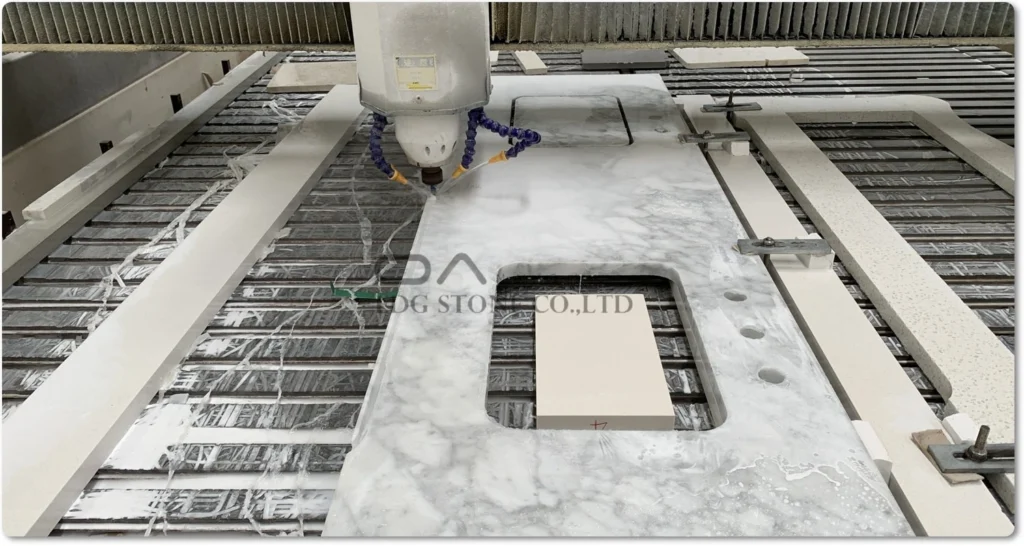
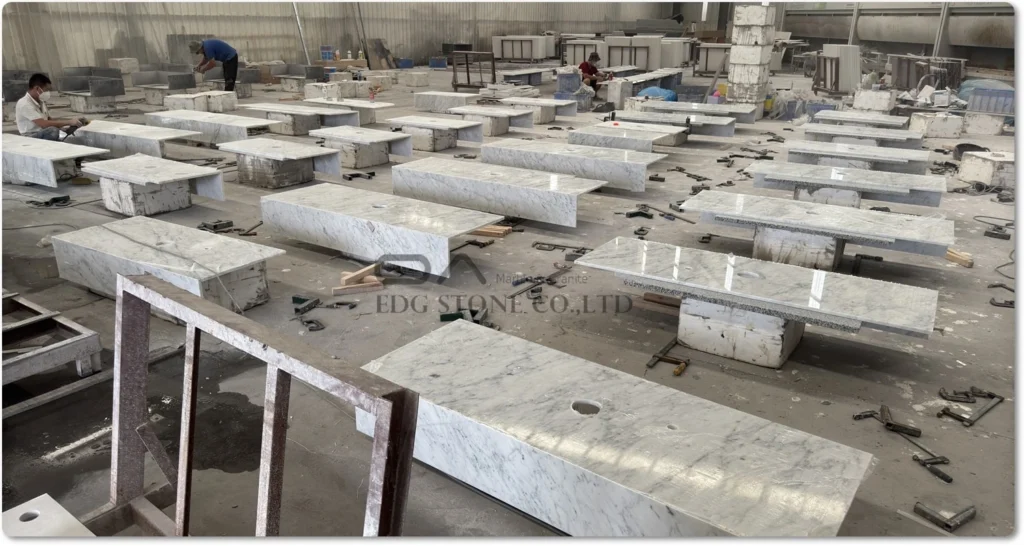
For large projects, a factory that can combine material sourcing + slab processing + CNC + waterjet + packaging + export logistics can reduce coordination risk.
Carrara vs Calacatta Marble: 2026 Price Guide
There is no single global Calacatta Marble price or Carrara price.
Prices vary according to:
- Quarry
- Block quality
- Slab grade
- Thickness
- Dimensions
- Finish
- Veining
- Color
- Availability
- Country
- Freight
- Fabrication
- Project quantity
- Incoterms
For general U.S. budgeting, current market references show Carrara material prices commonly around the lower end of premium marble, while Calacatta can move substantially higher. One 2026 guide lists approximately $40–$75/sq. ft. for Carrara material and $100–$180/sq. ft. for Calacatta, while installed ranges are approximately $75–$120 and $150–$250 respectively. Other sources report wider ranges, confirming that marble pricing is highly grade- and market-dependent.
For an exporter or wholesale buyer, factory pricing should therefore be evaluated on an FOB/CIF/DDP or other clearly defined basis, not compared directly with a U.S. retail installed price.
What Makes a Good Marble Manufacturer in 2026?
The modern marble manufacturer is no longer simply a company that cuts slabs.
A competitive supplier should demonstrate capabilities in:
- Quarry/material sourcing
- Block selection
- Slab production
- Quality control
- Digital slab inventory
- CNC fabrication
- Waterjet cutting
- Bookmatching
- Custom edges
- Vanity-top fabrication
- Countertop fabrication
- Protective packaging
- Container loading
- International logistics
- Technical documentation
For international B2B buyers, traceability + quality consistency + fabrication capability + communication speed can be as important as the stone name.
EDG Stone is positioned as a China-based natural stone supplier and manufacturer serving wholesale and project buyers, with capabilities covering marble slabs, countertops, vanity tops, custom fabrication, and stone applications.
Why EDG Stone Is a Practical Partner for Carrara and Calacatta Projects
For B2B buyers, the objective should not simply be to find the lowest price.
The objective is to obtain the right material at the right grade, with predictable processing and reliable delivery.
A professional supplier should help buyers evaluate:
Stone → Grade → Slab → Fabrication → Packaging → Logistics → Installation requirements
This is particularly important for Calacatta because the visual value often depends on selecting the right slabs rather than simply purchasing a specified “Calacatta” material.
For Carrara, the key advantage is often scalability and consistency.
For Calacatta, the key advantage is visual differentiation.
For both, professional slab selection and quality control are critical.
The Future of Carrara and Calacatta Marble in 2026 and Beyond
The white-marble market is moving toward three major directions.
1. Premium Natural Stone Will Remain Design-Led
Digital alternatives can reproduce the appearance of marble, but natural stone continues to provide geological variation that cannot be perfectly standardized.
This is especially valuable in:
- Luxury residential
- Hospitality
- High-end retail
- Custom furniture
- Feature walls
- Bespoke interiors
2. Engineered Alternatives Will Continue Growing
Quartz and porcelain will remain important because they provide consistency, manufacturing scalability, and predictable specifications.
The market is therefore unlikely to become simply “marble versus quartz.”
Instead, designers will increasingly specify:
Natural marble + engineered quartz + porcelain + quartzite
within the same project.
3. Responsible Fabrication Will Become More Important
The 2026 OSHA guidance demonstrates that fabrication safety is increasingly relevant to the countertop supply chain.
For international suppliers, responsible manufacturing should therefore include:
- Wet cutting
- Dust extraction
- Worker PPE
- Safe machinery
- Proper housekeeping
- Training
- Technical documentation
- Traceable production
This creates a stronger B2B value proposition than simply competing on price.
Final Verdict: Carrara or Calacatta?
If the project requires timeless elegance, softer veining, and stronger cost control, Carrara is usually the better choice.
If the project requires dramatic white backgrounds, bold veins, gold movement, and premium visual positioning, Calacatta is usually the stronger choice.
If the project requires maximum consistency and lower routine maintenance, compare both natural marbles with Calacatta-look quartz or porcelain.
If the project requires authentic natural stone and bookmatched architectural impact, premium Calacatta deserves serious consideration.
The most important rule is:
Do not select Carrara or Calacatta solely from a product name. Select the actual slab, grade, source, technical characteristics and fabrication plan.
For B2B buyers, this approach produces a much more reliable purchasing decision than comparing headline prices alone.
Google Search FAQ: Carrara Marble vs Calacatta Marble
1. Is Carrara marble cheaper than Calacatta marble?
Yes, Carrara is generally less expensive than premium Calacatta because Carrara is more widely available, while high-quality Calacatta selections can be scarcer and require more selective quarrying. Current U.S. market references show a substantial price gap, although actual prices vary by grade, source, thickness, fabrication, and location.
2. What is the main difference between Carrara and Calacatta marble?
Carrara typically has a softer white-to-gray background with finer gray veining. Calacatta generally has a brighter white background and bolder, more dramatic gray, gold, or warm-colored veining. Both are natural marble and require appropriate care.
3. Is Calacatta better than Carrara?
Neither is universally better. Carrara is often better for cost-conscious projects and large areas, while Calacatta is often better for luxury interiors where dramatic veining and visual impact are priorities.
4. Is Calacatta marble better than quartz?
It depends on the project. Calacatta marble offers authentic natural variation and premium architectural character, while Calacatta quartz generally offers greater consistency and lower routine maintenance. Buyers should compare heat, UV, maintenance, fabrication, and warranty requirements for the specific product.
5. What is the best marble for a luxury kitchen countertop?
Premium Calacatta, Statuario, Carrara, and other high-quality white marbles can all work well. For a dramatic luxury island, Calacatta is particularly popular because of its bold veining. The best choice depends on the actual slab, kitchen usage, maintenance expectations, and project budget.
Semantic Insight: How Should Buyers Think About Carrara vs Calacatta in 2026?
What Is the Core Difference?
Carrara and Calacatta are not simply two shades of white marble. They represent different combinations of geology, quarry availability, visual character, commercial positioning, and project value. Carrara generally emphasizes subtle gray movement and scalable elegance, while Calacatta generally emphasizes dramatic veining and luxury impact.
Why Does the Difference Matter?
The difference matters because the stone selected influences more than appearance. It affects slab cost, material availability, waste, fabrication strategy, bookmatching requirements, maintenance expectations, and the overall positioning of the finished project.
How Should a Buyer Compare Them?
A professional comparison should move from name → actual slab → grade → technical data → quantity → fabrication → logistics → installed project cost. Comparing only “Carrara price” with “Calacatta price” can produce a misleading conclusion because two slabs carrying the same commercial name may have very different grades and visual qualities.
Which Option Fits Which Project?
Carrara is particularly suitable for large-scale residential developments, bathrooms, classic kitchens, hospitality projects, and applications where subtle elegance and procurement efficiency are important. Calacatta is particularly suitable for luxury kitchens, statement islands, feature walls, fireplaces, high-end hotels,s and bookmatched architectural applications where the stone is intended to become a focal point.
What About Quartz and Porcelain Alternatives?
Calacatta-look quartz and porcelain provide alternative ways to achieve the visual language of white marble. They can be valuable where consistency, standardized production, maintenance requirements, ts or large-volume procurement are more important than natural geological variation. Natural marble remains differentiated by its authentic slab-to-slab character.
What Is Changing in the Market?
The 2026 stone industry is moving toward a broader definition of product value. Buyers increasingly evaluate not only color and price but also supplier traceability, fabrication safety, technical documentation, regulatory requirements, packaging, logistics, and production consistency. OSHA’s 2026 guidance specifically reinforces the importance of controlling respirable silica exposure during countertop manufacturing, finishing, and installation.
What Should a B2B Buyer Ask a Manufacturer?
The most useful questions are: Where was the stone quarried? What is the exact grade? Can the supplier provide actual slab photographs? How consistent is the available block? What are the slab dimensions and thickness? Can the factory perform CNC, waterjet, and bookmatching? What technical documentation is available? How is the stone packed for export? What quality-control process is used before shipment?
What Is the Strategic Buying Conclusion?
The strongest procurement strategy is not to ask whether Carrara or Calacatta is universally better. Instead, define the project’s required appearance, performance, budget, quantity, maintenance level, and delivery risk, then select the stone and supplier that best satisfy those conditions. For luxury projects, premium Calacatta can create exceptional visual value. For larger projects requiring controlled cost and softer aesthetics, Carrara can be more commercially efficient. For standardized or maintenance-focused applications, quartz or porcelain may provide a better solution.
What Should Designers and Procurement Teams Remember?
Carrara is generally about understated elegance; Calacatta is generally about dramatic luxury. The final decision should be based on the actual slab rather than the product name, and on total project value rather than material price alone.