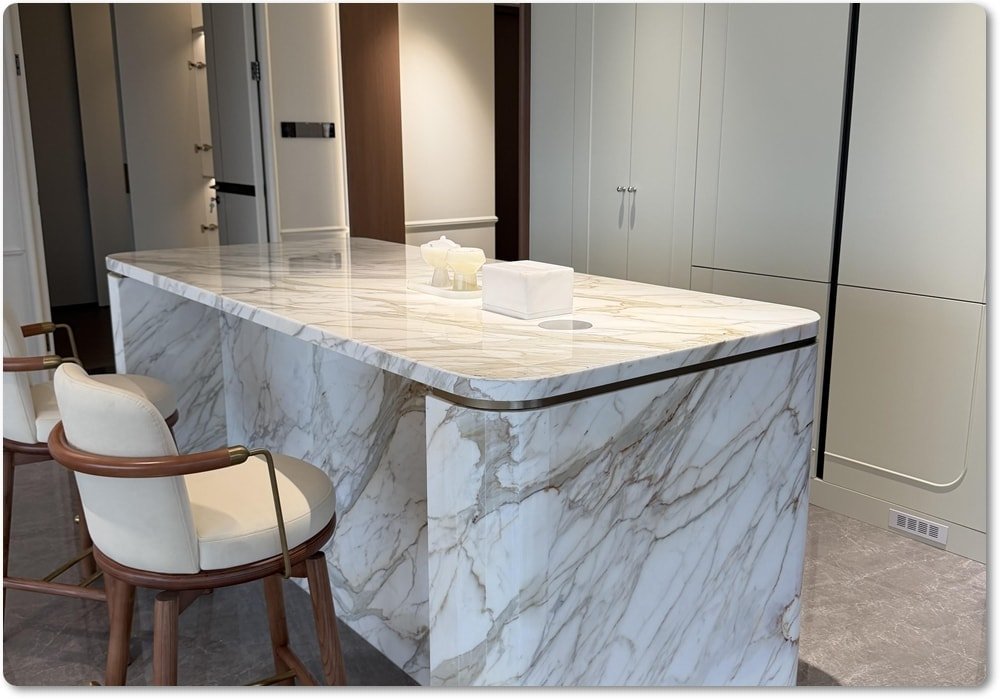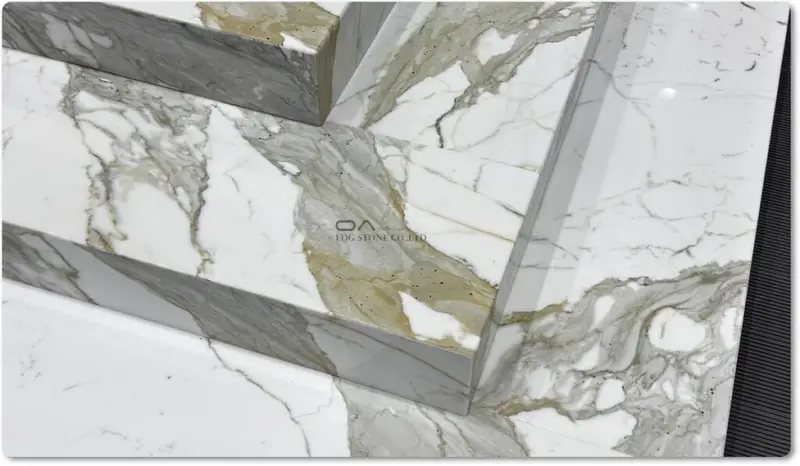
Quick Summary: Statuario Marble Essentials
Key Takeaways:
- Definition: Statuario (Statuary) is the most precious variety of Italian Carrara marble, known for its high-purity, translucent white background, and bold grey/gold veining.
- Rarity & Cost: Due to limited quarry availability in the Apuan Alps and stricter environmental regulations, Statuary marble cost is significantly higher than standard Carrara or Calacatta.
- Best Use: Ideal for statement islands, feature walls, and low-traffic luxury flooring.
- Sourcing: Working with a specialized Statuary marble factory direct supplier like EDG Stone ensures authenticity and access to premium “First Choice” slabs.
Introduction
In the realm of natural stone, few materials command the reverence and desire accorded to Statuary marble. Often referred to as the “White Gold” of Italy, this stone has transcended its geological origins to become a symbol of absolute luxury and artistic perfection. From the chisels of Michelangelo to the grand foyers of modern penthouses, Statuary stone represents the pinnacle of aesthetic purity.
However, as demand for this finite resource grows, understanding the nuances of Statuary marble purity, its pricing dynamics, and the complexities of the supply chain becomes crucial for architects, designers, and homeowners. This comprehensive guide delves into the definition of Statuario marble, why its pure white base is so coveted, and how industry leaders like EDG Stone are navigating the future of this legendary material.
What is Statuary (Statuario) Marble? Defining the Legend
To truly appreciate the value of this stone, one must first answer: What is Statuary marble?
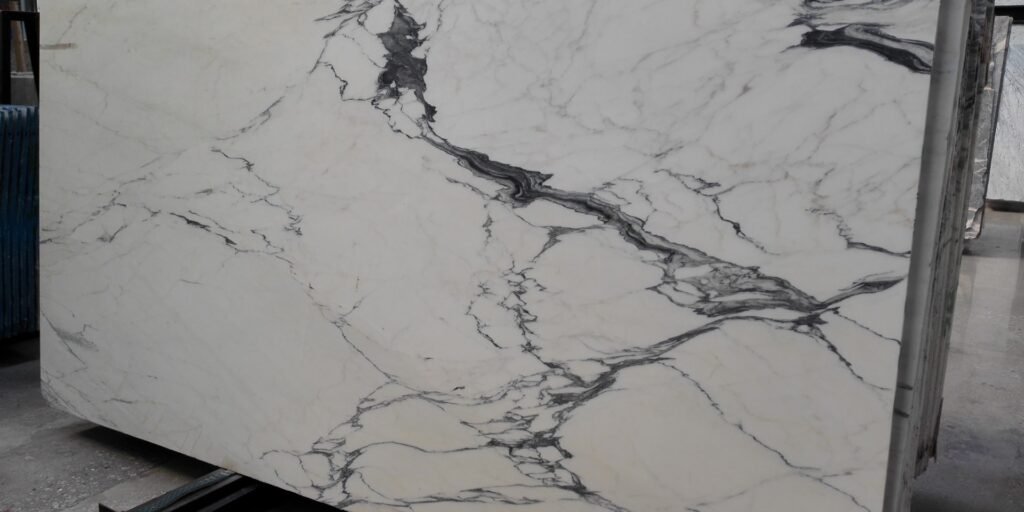
Statuario marble (the Italian name for Statuary) is a high-grade metamorphic rock derived from limestone. It is exclusively quarried in the Carrara region of Italy, specifically in the mountains above the city of Carrara. Unlike the more common Carrara marble, which often has a greyish or muddy background, Statuary is defined by its bright, semi-translucent white field.
How to Pronounce Statuario Marble & Origins?
For those navigating the international stone market, knowing how to pronounce Statuario marble is a small but significant detail. It is pronounced “Stat-too-AH-rio”. The name derives from its historical primary use: the creation of statues. Because the grain of the stone is so fine and the white background so pure, Renaissance sculptors found it the perfect medium to mimic the softness of human skin.
The Geological Miracle: Why is it so White?
The whiteness of Statuary white marble slabs is not a happy accident; it is a geological anomaly. The stone is composed almost entirely of Calcium Carbonate ($CaCO_3$). During the metamorphic process, extreme heat and pressure destroyed any impurities (like clay or silt) that typically cause darker coloration in limestone.
The result is a crystalline structure that allows light to penetrate slightly before being reflected—a phenomenon known as “sub-surface scattering.” This gives Statuary stone a wax-like, glowing appearance that artificial materials fail to replicate perfectly.
The Aesthetics of Purity: Visual Characteristics of Statuary Stone
When browsing Statuary marble slabs, the trained eye looks for specific traits that determine quality and price.
The Signature Pure White Base
The “purity” in the title of this article refers to the background color. The most prized Statuary marble features a background that is “ice white” or “milky white.” This stark whiteness provides a high-contrast canvas for the veining. In lower grades, the background may bleed into the veins, creating a “smoky” look, which significantly lowers the value.
Veining Patterns: The Art of Nature
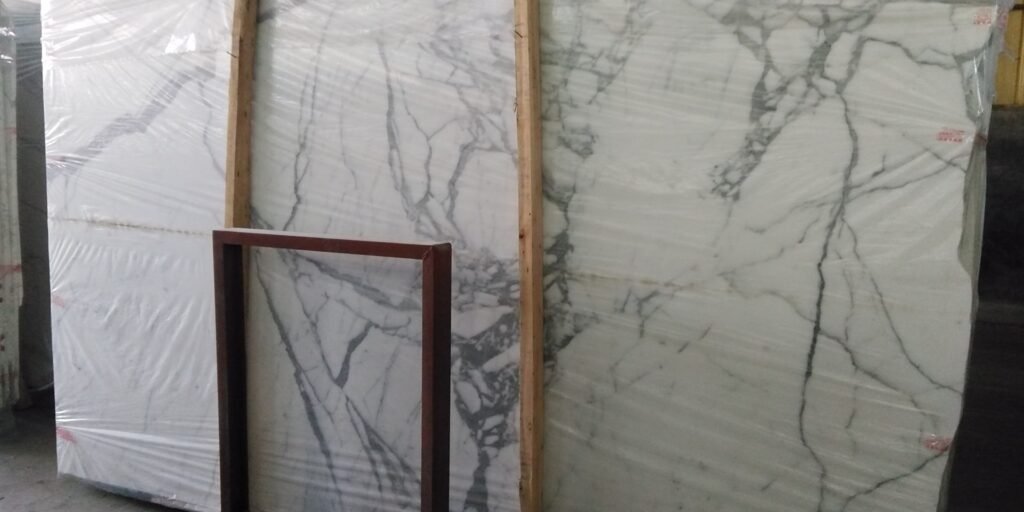
Unlike the busy, intricate web-like patterns of standard Carrara, Statuary/Statuario marble is characterized by:
Boldness: The veins are often thick, dramatic, and widely spaced.
Color: Predominantly distinct grey, ranging from light silver to dark charcoal. Occasionally, premium blocks will feature thin traces of gold, linking it visually to the Calacatta family.
Movement: The veins often run diagonally across the slab, making Statuary marble slabs excellent candidates for book-matching (mirroring two slabs to create a butterfly effect).
Statuario vs. Calacatta vs. Carrara
To clarify the confusion often seen in the market, here is a breakdown of the three Italian giants:
| Feature | Statuario (Statuary) | Calacatta | Carrara |
| Base Color | Bright, Ice White | Warm White / Creamy | Greyish / Blue-White |
| Veining | Bold, Dark Grey, Sparse | Thick, Dramatic, Gold/Grey | Fine, Feathery, Linear |
| Rarity | Extremely Rare (5% of quarry output) | Rare | Common |
| Cost | $$$$$ | $$$$-$$$$$ | $$ |
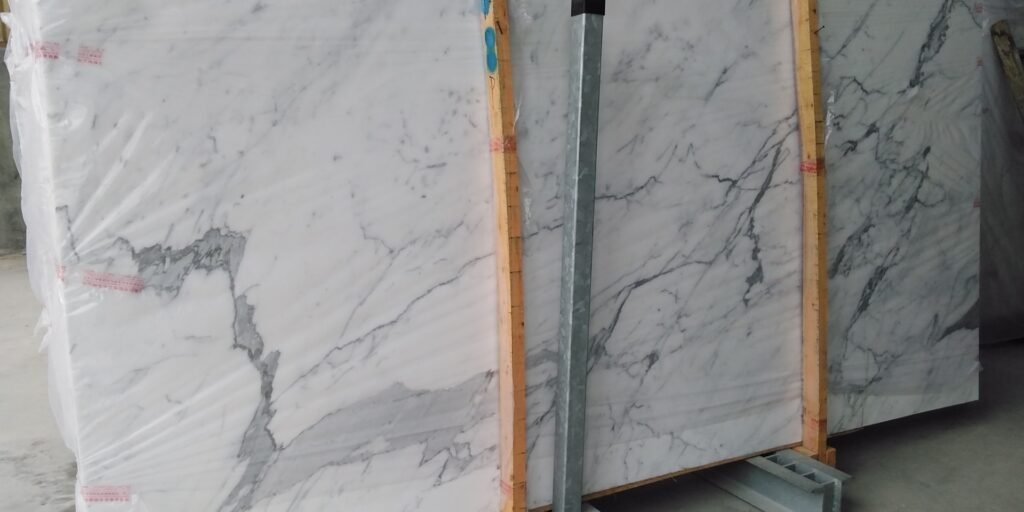
Market Dynamics: Statuary Marble Cost and Valuation 2024-2025
The Statuary marble cost is a frequent point of discussion. Why does one slab cost $150 per square foot while another costs $400+?
Understanding the Price Tags
The pricing of Statuary marble slabs is not arbitrary; it is graded based on aesthetic perfection.
Whiteness: The whiter the background, the higher the price.
Vein Definition: Crisp, sharp veins are preferred over blurry ones.
Slab Size: Larger, defect-free slabs are exponentially more expensive because Statuario blocks tend to be fractured.
Rarity and Quarry Limitations
Statuario constitutes a very small percentage of the total extraction in the Apuan Alps. As mining moves deeper into the mountain, the availability of “First Choice” (Extra Quality) Statuario is dwindling. This scarcity is the primary driver of its high valuation. A Statuario marble factory direct supplier often has to secure blocks months in advance to guarantee supply for high-end projects.
Sourcing Strategies: Finding the Best Statuary White Marble Slabs
For architects, developers, and wholesalers, sourcing authentic Statuary requires navigating a complex supply chain.
Factory Direct vs. Wholesale: Purchasing Insights
Searching for a Statuary marble slab wholesale price can be misleading. Many online prices reflect lower-grade material. To secure premium stone, purchasing from a reputable manufacturer or direct importer is essential.
Verify the Block: Ask to see photos of the specific block or bundle.
Check for Treatment: Ensure the stone hasn’t been heavily resin-treated to hide structural cracks, which can yellow over time.
The Role of EDG Stone in the Global Supply Chain
In a market flooded with “commercial grade” stone, EDG Stone distinguishes itself by maintaining direct relationships with Italian quarries. As the best Statuary white marble manufacturer and processor, EDG Stone curates blocks that emphasize the “pure white” criteria. By filtering out muddy backgrounds at the source, EDG Stone ensures that every slab exported meets the high standards required for luxury hotels and bespoke residences.
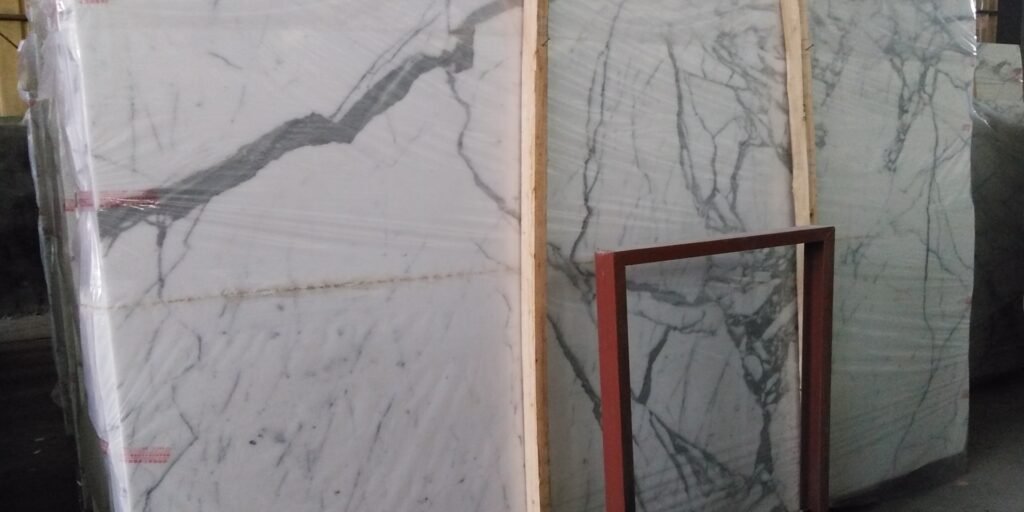
Industry Trends & Regulations: The Future of Italian Marble
The landscape of natural stone is shifting, influenced by environmental policy and changing design trends.
Sustainability in Quarrying (EU Regulations)
Recent EU regulations regarding the Carrara region are tightening. Permits for quarrying are becoming stricter to protect the landscape and local ecosystems. This means the volume of Statuary stone extracted annually is capped.
Impact: This regulatory pressure is expected to drive the Statuary marble cost higher over the next 3-5 years.
Strategy: Forward-thinking buyers are locking in stock now or working with suppliers like EDG Stone, who have secured long-term allocations.
Data Analysis: The Investment Value of Natural Stone
According to recent real estate data, luxury properties featuring authentic natural stone (specifically Italian white marble) retain higher resale values compared to those using engineered quartz. Statuario is no longer just a building material; it is an asset class. The “purity” of the stone is directly correlated to the property’s perceived value.
Installation, Care, and Maintenance
Owning Statuary white marble slabs is a commitment to care. Because the stone is calcium-based, it is acid-sensitive.
Sealing: It is non-negotiable. High-quality penetrating sealers must be applied upon installation and re-applied annually.
Etching vs. Staining: Owners must understand the difference. Sealing prevents stains (absorption) but not etching (chemical dulling from acids like lemon juice).
Honing: Many designers now prefer a honed (matte) finish for Statuary marble. This finish hides etch marks better than a high-polish finish, making it more practical for kitchens.
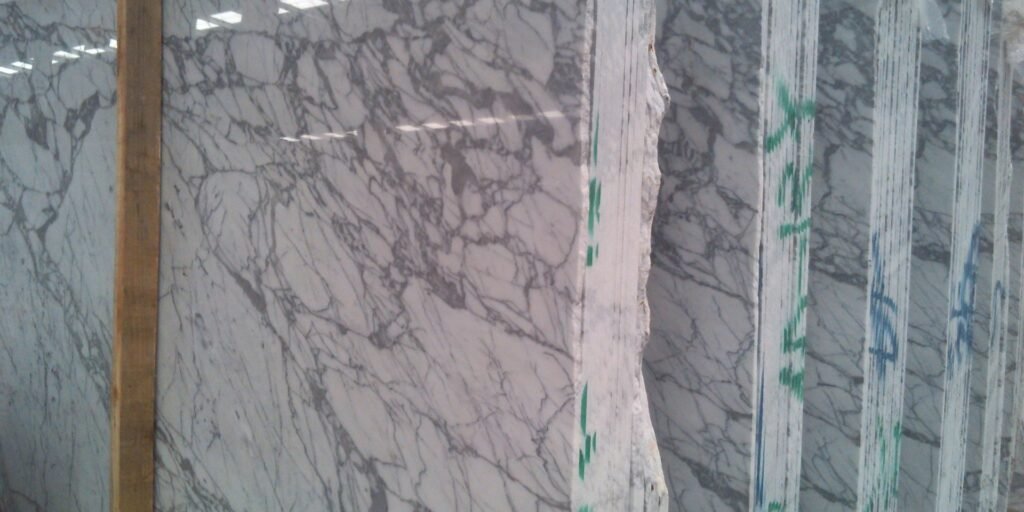
Frequently Asked Questions (Google Hot Search)
Q1: Is Statuary marble more expensive than Calacatta marble?
Generally, they are comparable in price, occupying the top tier of the market. However, premium “Extra” grade Statuario with a perfectly pure white background is often rarer than Calacatta and can command a higher price point due to its scarcity.
Q2: Can Statuary marble be used for kitchen countertops?
Yes, it is frequently used for high-end kitchen islands. However, it requires diligence. Homeowners must use cutting boards, wipe up spills immediately, and accept that the stone will develop a “patina” of use over time, which many consider part of its natural beauty.
Q3: Where does the best Statuary marble come from?
True Statuary marble comes exclusively from the Carrara region in Tuscany, Italy. While other countries produce white marbles, they cannot legally or geologically be classified as “Statuario.”
Q4: How do I identify real Statuario marble?
Look for the background color and vein structure. Real Statuario has a bright, translucent white background (not grey) and distinctive, bold grey veining. If the background looks muddy or the veins are very thin and web-like everywhere, it is likely standard Carrara.
Q5: What is the lead time for Statuary marble slabs from factories?
Lead times vary based on stock availability. For standard bundles, it might be 2-4 weeks. However, for custom cut-to-size projects or specific block matching from a Statuario marble factory direct supplier, lead times can range from 8 to 12 weeks to allow for quarrying, processing, and shipping.
Deep Dive: Statuario Marble Selection & Market Outlook
Why Choose Statuary Marble? (The “Why”)
Choosing Statuario is a decision to invest in art. Its primary value proposition lies in its high-fidelity white base, which reflects light differently than any other stone. It is chosen not for durability, but for prestige, rarity, and the visual expansion of space.
Buying Guide & Manufacturer Insight (The “Option”)
When selecting slabs, prioritize the “face” of the stone.
- Grade A (Extra): Pure white, sharp contrast. Highest cost.
- Grade B (Commercial): Slight grey undertone, blurry veins. Lower cost.
Brands like EDG Stone specialize in bridging the gap between the quarry and the project, filtering for Grade A material to ensure the investment holds value.
Future Trend Alert (The “Consideration”)
Sustainability & Scarcity: With EU quarrying limits tightening in 2024-2025, the supply of large-format Statuario slabs is shrinking. The market is shifting towards “Smart Luxury”—using Statuario for focal points (vertical cladding, islands) while using complementary stones for high-wear areas. This maximizes visual impact while managing budget and resource scarcity.