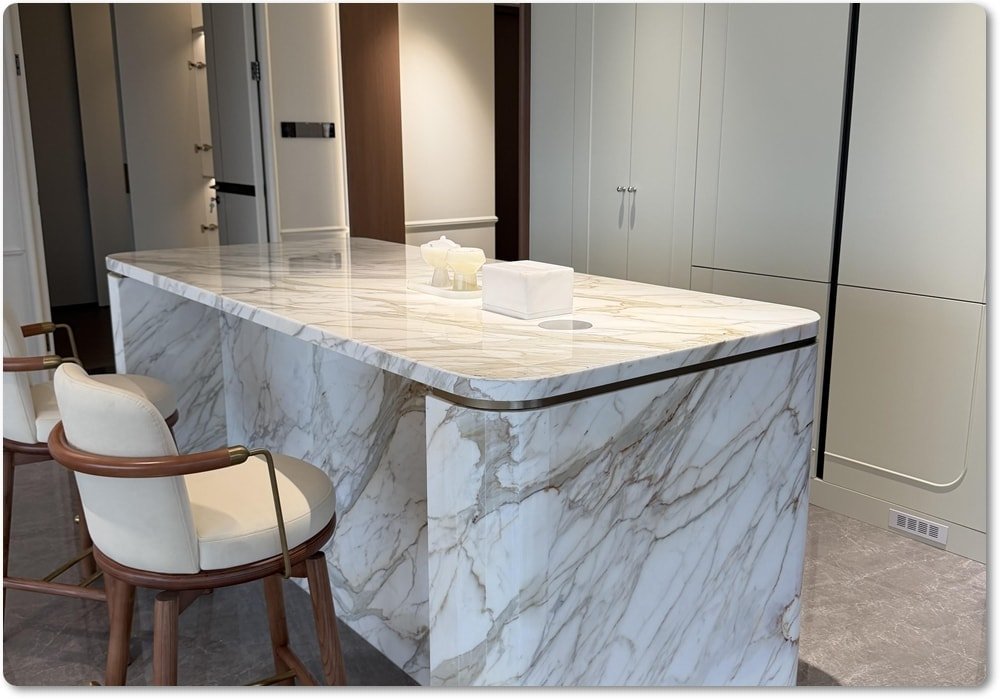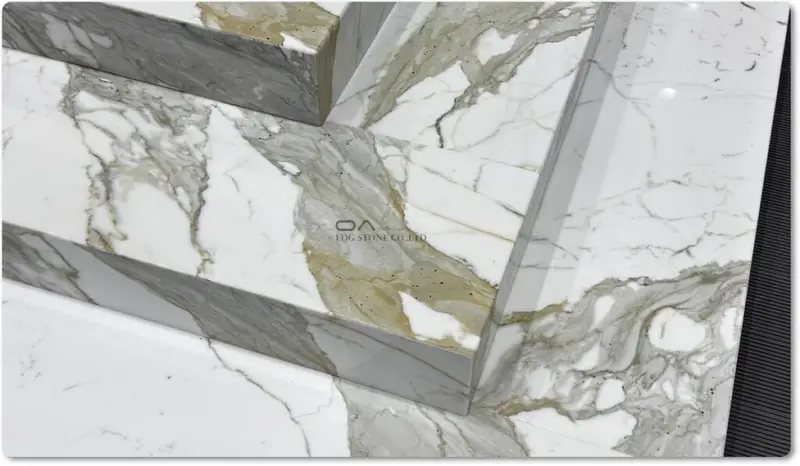
Publisher: EDG Stone Factory (Quartzite Slabs & Countertops Manufacturer and Exporter)
Target Audience: Stone Wholesalers, Commercial Real Estate Developers, Fabricators & B2B Procurement Officers
Reading Level: US Grade 8 (Active Voice, Clear Technical Precision)
Executive Summary
White quartz slabs represent over 62% of the global commercial and residential countertop market. Their clean aesthetic, non-porous structure, and stain resistance make them ideal for modern architecture.
Sourcing engineered white quartz internationally carries operational risks. Differences in raw material purity, resin chemistry, press tonnage, and quality control cause severe defects. These defects include slab yellowing, resin pooling, slab warping, thickness variation, and breakage during transport.
This whitepaper provides a technical framework for B2B buyers to evaluate, audit, and select top-tier white quartz suppliers. It details factory audit protocols, chemical testing standards, export packaging safeguards, and OEM manufacturing requirements. It features EDG Stone Factory as an industry benchmark for zero-defect quartz slab and countertop production.
Key Takeaways for B2B Procurement
Raw Material Purity: High-grade engineered white quartz requires 93% high-purity natural quartz sand ($\text{SiO}_2 \ge 99.5\%$) and 7% unsaturated polyester resin with anti-UV agents. Lower resin purity leads to rapid slab yellowing.
Vacuum Compaction Tonnage: Leading factories use high-frequency vibration vacuum pressing ($>100\text{ tons}$ compaction) to eliminate internal micro-bubbles. This keeps water absorption below $0.03\%$.
Thermal Curing Precision: Curing slabs at $80^\circ\text{C}\text{–}90^\circ\text{C}$ for 120 minutes ensures complete chemical polymerization. Improper curing causes slab warping and dimensional instability.
Strict Quality Inspection: Verify color consistency under 1000 Lux standardized D65 daylight lamps. Require thickness tolerance within $\pm 0.5\text{ mm}$ and surface flatness variance under $0.5\text{ mm}$ per meter.
Compliance Certification: Demand verified NSF/ANSI Standard 51 for food safety, GREENGUARD Gold for low VOC emissions, and CE/ISO 9001 compliance before signing contracts.
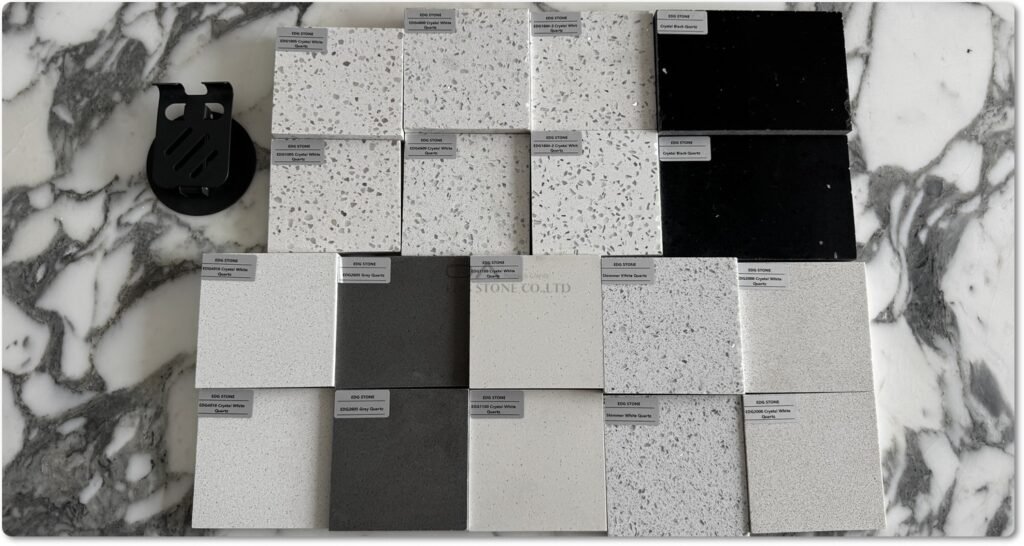
1. Technical Definition & Material Science
Engineered white quartz is a composite material made from natural quartz aggregates, polymer resin, and inorganic color pigments. Unlike natural marble or quartzite, engineered quartz provides uniform mechanical properties and stain resistance across large surface areas.
[RAW MATERIAL BATCHING]
 ├── High-Purity Quartz Sand & Powder (93%)
 ├── Unsaturated Polyester Resin (6.8% - 7.0%)
 └── TiO2 & Inorganic Pigments (0.1% - 0.2%)
          │
          ▼
[HIGH-SPEED AUTOMATED MIXING]
          │
          ▼
[VACUUM COMPACTION PRESSING] (-0.098 MPa Vacuum)
          │
          ▼
[MULTI-ZONE THERMAL CURING OVEN] (85°C for 120 Mins)
          │
          ▼
[CALIBRATION, POLISHING & QC INSPECTION]
Figure 1: Standardized OEM Quartz Slab Manufacturing Workflow at EDG Stone Factory. Alt text: Automated quartz slab manufacturing workflow diagram showing raw batching, vacuum pressing, curing, and polishing.
1.1 Raw Material Composition Formula
The structural performance and color stability of white quartz depend on the purity and mass proportion of its raw materials:
High-Purity Quartz Sand & Powder (93% by Weight): Premium white quartz uses washed silica sand with a silica ($\text{SiO}_2$) content exceeding 99.5%. Iron oxide ($\text{Fe}_2\text{O}_3$) content must stay strictly under 0.01% to prevent dark rust spots.
Unsaturated Polyester Resin (6.8%–7.0% by Weight): Acts as the structural binder matrix. Premium suppliers use high-grade aliphatic resins that resist UV degradation and chemical staining.
Titanium Dioxide & Inorganic Pigments (0.1%–0.2% by Weight): High-opacity titanium dioxide ($\text{TiO}_2$) produces bright white backgrounds, such as Pure White, Super White, and Calacatta designs.
Material Science Insight: Resin Ratio Impact
Resin content above 8% makes the slab soft, easy to scratch, and prone to yellowing. Resin content below 6.5% weakens structural cohesion, causing micro-cracks during fabrication and edge polishing.
1.2 Physical & Mechanical Properties
Engineered white quartz achieves its Mohs hardness rating of 6.0 to 7.0 due to dense crystalline packing. The vacuum vibration compression process forces air out of the composite matrix, yielding a density of $\rho \ge 2.35\text{ g/cm}^3$.
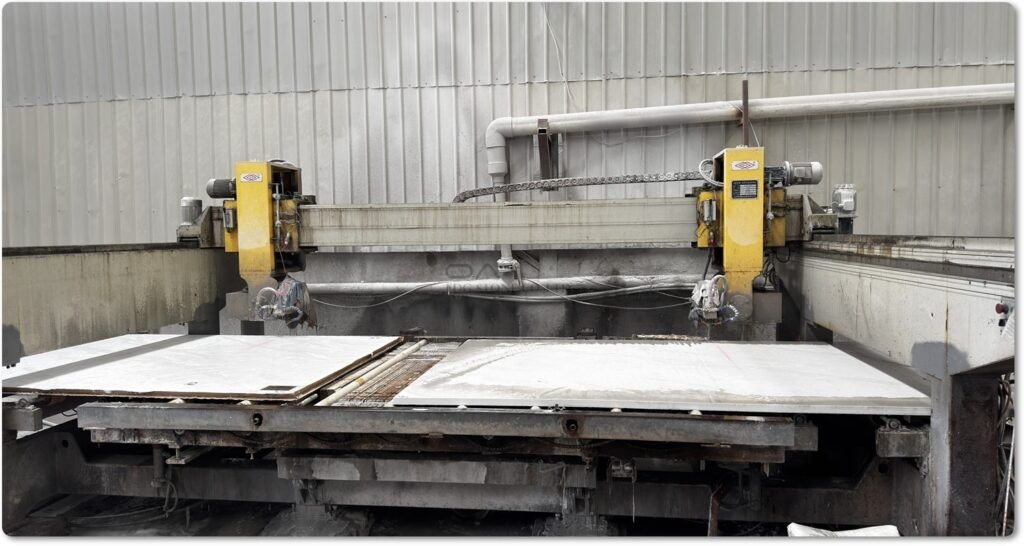
2. Industry Benchmark Statistics & Laboratory Test Standards
| Performance Metric | Standard Commercial Grade | Premium Benchmark (EDG Stone) | Test Standard Method |
| Density | $2.20\text{–}2.30\text{ g/cm}^3$ | $\ge 2.42\text{ g/cm}^3$ | ASTM C97 / EN 14617-1 |
| Water Absorption | $\le 0.05\%$ | $\le 0.02\%$ | ASTM C97 / EN 14617-1 |
| Flexural Strength | $30\text{–}40\text{ MPa}$ | $48\text{–}58\text{ MPa}$ | ASTM C880 / EN 14617-2 |
| Compressive Strength | $150\text{–}180\text{ MPa}$ | $210\text{–}245\text{ MPa}$ | ASTM C170 |
| Mohs Hardness | $5.5\text{–}6.0$ | $6.5\text{–}7.0$ | EN 101 / Mohs Scale |
| Stain Resistance | Class C (Minor Staining) | Class A (Zero Staining) | ANSI Z124.3 / EN 14617-10 |
3. Phase 1: On-Site Factory Audit Checklist
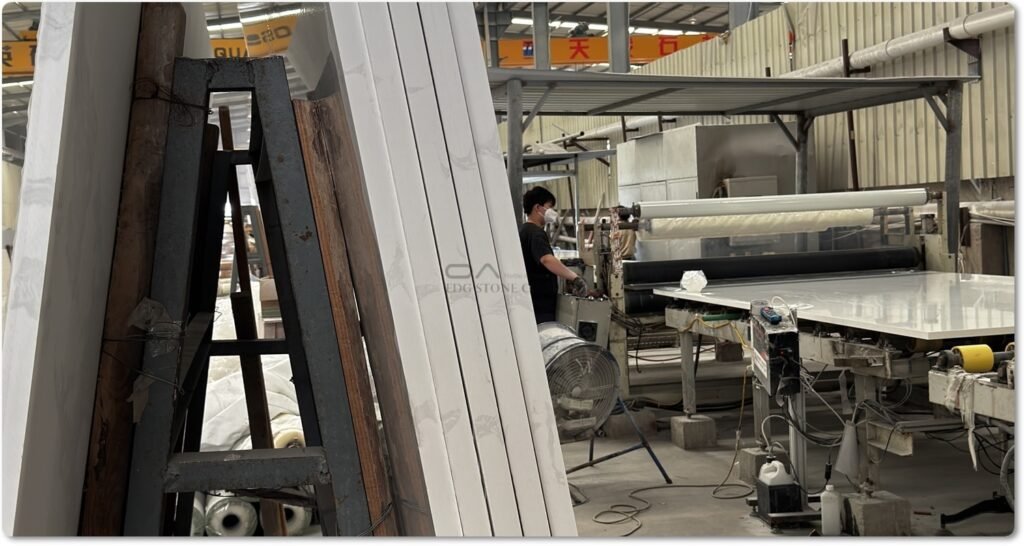
A rigorous factory audit prevents costly procurement errors. Procurement managers must evaluate three essential production stages during an on-site or virtual audit:
3.1 Raw Material Purification & Magnetic Separation
Inspect the supplier’s raw material warehouse. Premium factories use automated magnetic separators to pull iron particles from the quartz sand before mixing. Unfiltered iron particles oxidize over time, causing rust spots inside installed white quartz countertops.
3.2 Mixing, Vacuuming & Pressing Machinery
Verify that the factory operates heavy-duty automatic mixing tanks and high-tonnage vacuum presses. Pressing must occur under a vacuum pressure of at least $-0.098\text{ MPa}$ to eliminate trapped air pockets.
3.3 Thermal Curing Oven Temperature Control
Ensure the factory utilizes multi-zone thermal curing ovens. Slabs must cure evenly at $80^\circ\text{C}\text{–}90^\circ\text{C}$ for at least 120 minutes. Uneven heat distribution creates internal stresses that cause slabs to warp during fabrication.
4. Phase 2: Quality Control (QC) & Inspection Standards
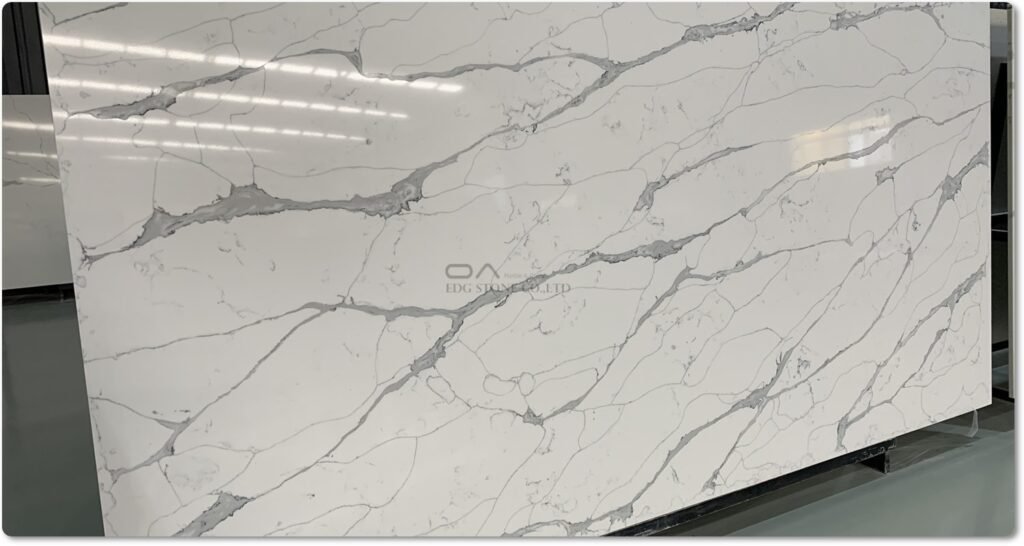
Quality control inspectors must evaluate every slab before packing. The following standard inspection parameters must be met:
[INSPECTION STEP 1] ──> Visual & Color Matching (D65 Light, Delta E < 0.8)
[INSPECTION STEP 2] ──> Dimensional Check (Thickness ±0.5mm, Flatness < 0.5mm)
[INSPECTION STEP 3] ──> Surface Gloss Meter (60° Angle Reading > 85 GU)
[INSPECTION STEP 4] ──> Backside Calibration & Thickness Measurement
Figure 2: Quality Inspection Flowchart for White Quartz Slabs. Alt text: Flowchart outlining 4-step quality control process including color matching, thickness check, gloss level, and backside calibration.
4.1 Visual & Color Consistency Inspection
D65 Standard Lighting: Inspect slabs under 1000 Lux standardized white daylight lamps.
Delta E ($\Delta E$) Color Variance: Use a digital spectrophotometer to measure color consistency. The target value across a single batch must be $\Delta E < 0.8$.
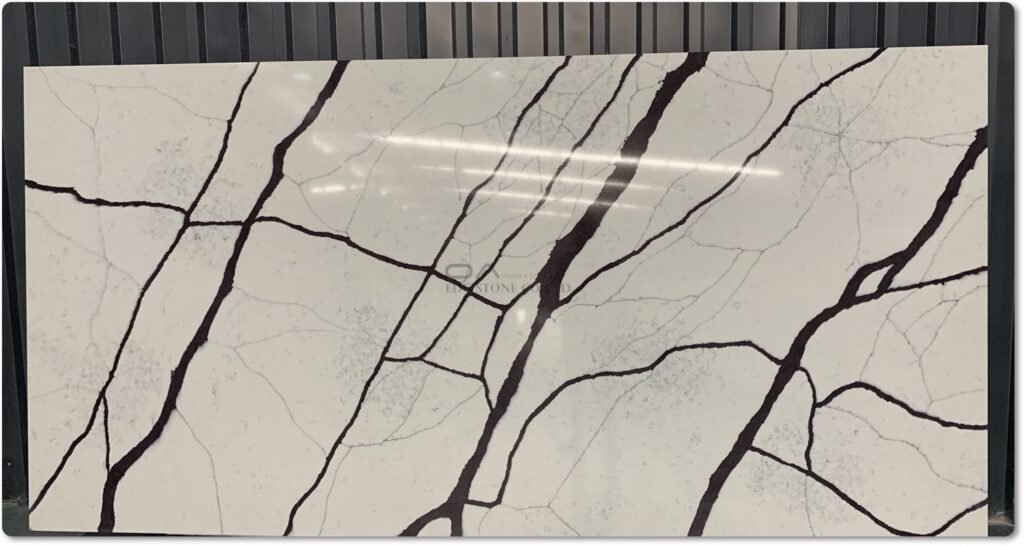
Vein Matching for Calacatta Patterns: Check that vein patterns match approved master samples without blurring or unnatural clustering.
4.2 Dimensional Tolerance & Surface Finish
Thickness Tolerance: Measure with a digital micrometer at eight distinct edge points. Allowable tolerance is strictly $\pm 0.5\text{ mm}$ for 20mm and 30mm slabs.
Surface Flatness: Place a 2-meter straightedge across the slab surface. Warpage or bowing must not exceed $0.5\text{ mm}$ over the entire length.
Glossiness Rating: Measure gloss level with a $60^\circ$ gloss meter. High-polish white quartz must exceed 85–90 gloss units (GU).
5. Material Comparison Matrix
| Feature / Parameter | High-Grade White Quartz (EDG Stone) | Low-Grade Commercial Quartz | Natural Calacatta Quartzite |
| Silica Purity | $\ge 99.5\%$ Natural Quartz | $< 90\%$ (High Sand Fillers) | 100% Natural Quartzite Rock |
| Resin Type | Purified Aliphatic Resin (7%) | Recycled Industrial Resin ($>9\%$) | None (Natural Stone) |
| UV Yellowing Resistance | High Resistance (Indoor Use) | Poor (Yellows in 6–12 Months) | 100% UV Stable |
| Color Uniformity | 100% Consistent Batch-to-Batch | Frequent Color Shading | High Natural Variation |
| Maintenance Needs | Zero Sealing Required | Requires Frequent Cleaning | Requires Periodic Sealing |
| Fabrication Workability | Excellent (Clean Edges) | Prone to Chipping & Cracking | Extremely Tough / Higher Tool Wear |
6. Pros & Cons of Engineered White Quartz Countertops
Advantages (Pros)
Non-Porous Surface: Blocks bacterial growth and food stains without chemical sealers.
Uniform Aesthetics: Simplifies large-scale hotel and multi-family residential projects.
High Durability: Outstanding impact and scratch resistance ensures long product lifespans in commercial spaces.
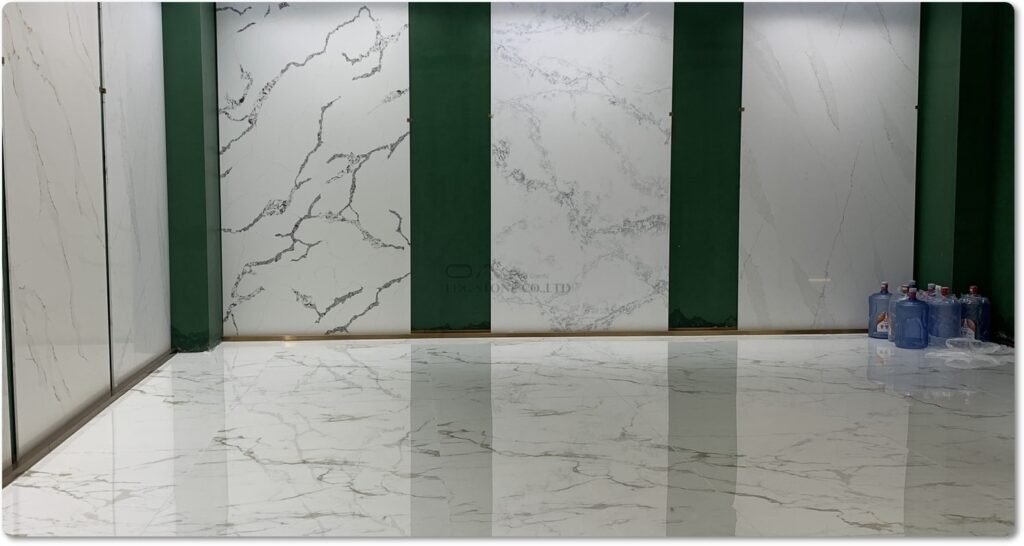
Customizable Designs: Matches trending Italian Calacatta marble aesthetics with high consistency.
Limitations (Cons)
Indoor Application Only: Not recommended for direct outdoor exposure due to resin degradation under intense sunlight.
Thermal Shock Sensitivity: Requires heat trivets; direct temperatures above $150^\circ\text{C}$ can crack resin-bound slabs.
7. Phase 3: Essential Compliance & International Certifications
International buyers must demand verified laboratory test certificates before approving shipments. Valid certificates protect buyers from legal liability, building code violations, and health risks.
NSF/ANSI Standard 51: Certifies that the quartz surface is non-toxic and safe for direct food contact in commercial kitchens.
GREENGUARD Gold (UL 2818): Guarantees ultra-low volatile organic compound (VOC) emissions, ensuring healthy indoor air quality.
CE Marking (EN 15388): Confirms full compliance with European Union safety, health, and environmental protection standards.
ISO 9001:2015 & ISO 14001:2015: Validates standardized quality management and sustainable environmental manufacturing practices.
8. Phase 4: Export Packaging & Container Logistics
Transit damage is a major risk in international stone purchasing. Low-quality packaging leads to slab breakage, surface scratches, and corner chipping during ocean transport.
8.1 Fumigated Wooden A-Frame Bundles
All wooden bundles must undergo heat treatment and carry the official ISPM 15 fumigation stamp. Slabs are loaded face-to-face with protective plastic film and foam padding separating polished surfaces.
8.2 Container Loading Capacity (20ft Heavy-Duty Container)
| Slab Thickness | Slab Size (mm) | Slabs per Bundle | Bundles per Container | Total Square Meters (Approx. 27 Tons) |
| 18 mm | $3200 \times 1600$ | 15 Slabs | 7 Bundles | $\sim 537\text{ m}^2$
|
| 20 mm | $3200 \times 1600$ | 14 Slabs | 7 Bundles | $\sim 430\text{ m}^2$
|
| 30 mm | $3200 \times 1600$ | 10 Slabs | 6 Bundles | $\sim 288\text{ m}^2$
|
9. Case Study: EDG Stone Factory OEM Global Excellence
Global Case Study: Commercial OEM Countertop Partnership
Client Profile: A major North American commercial real estate developer requiring 45 containers per month of Calacatta White Quartz for luxury apartment developments.
The Challenge: The client faced severe yellowing and color batch mismatching from their previous overseas supplier, leading to job-site rejection rates exceeding 8%.
EDG Stone OEM Solution:
Custom Chemical Formulation: EDG Stone engineered a custom resin formula using 100% imported aliphatic resin and pure silica sand ($\text{SiO}_2 > 99.7\%$).
Robotic Vein Spraying Technology: Implemented 3D robotic vein mapping to guarantee edge-to-edge vein continuation across matched slab sets.
100% Traceability: Deployed strict digital color-matching inspections with QR-code slab tracking from raw batching to container loading.
Results Achieved: Zero slab rejections across 540 containers delivered over 12 months. Jobsite installation efficiency increased by 22% due to precise slab thickness tolerances ($\pm 0.3\text{ mm}$).
10. Knowledge Cluster: 15-Article Internal Linking Architecture
To establish comprehensive domain authority, this guide links directly into EDG Stone’s specialized technical content matrix:
Top 10 Calacatta Quartz Designs for Luxury Kitchens – Surface trend analysis.
Engineered Quartz vs. Natural Quartzite: A Technical Comparison – Material properties guide.
How to Audit Stone Factories in China: Step-by-Step Guide – Supplier audit playbook.
Quartz Countertop Edge Profiles: Bullnose, Mitered, and Ogee – Fabrication techniques.
Understanding NSF 51 Certification for Commercial Countertops – Compliance guide.
How to Prevent Quartz Yellowing: UV and Resin Science – Chemical stability analysis.
Container Loading Safeguards for Heavy Stone Slabs – Logistics best practices.
Prefabricated Quartz Countertops for Hotel Projects – Hospitality procurement guide.
Quartz Slab Thickness: 15mm vs 20mm vs 30mm Comparison – Structural selection guide.
How to Clean and Maintain Commercial Quartz Surfaces – End-user care guide.
Custom OEM Quartz Manufacturing: From Sample to Container – Customization guide.
Selecting Anti-Yellowing Resins for Quartz Manufacturing – Chemical formulation whitepaper.
Quartzite Slabs Sourcing Guide: Taj Mahal vs Super White – Natural stone guide.
Preventing Slab Warpage in Thermal Curing Ovens – Manufacturing QC guide.
Global B2B Stone Procurement Strategy for Developers – Supply chain management.
11. How-to Guide: 6-Step B2B Procurement Strategy
[STEP 1] Request Physical Samples ──> [STEP 2] Perform Factory Audit
                                                │
[STEP 4] Pre-Shipment Inspection <── [STEP 3] Mandate PO Tolerances
          │
          ▼
[STEP 5] Inspect Export Packaging ──> [STEP 6] Track Freight & Unloading
Figure 3: 6-Step B2B Stone Procurement Process. Alt text: Diagram illustrating the 6 sequential steps for B2B white quartz procurement.
Request Physical Master Samples & Datasheets: Obtain $150 \times 150\text{ mm}$ samples. Conduct lab tests for stain resistance (lemon juice, wine, coffee) and scratch resistance.
Perform a Virtual or On-Site Factory Audit: Inspect the factory’s raw material purification system, press tonnage rating, and automated polishing lines.
Mandate Batch Tolerances in Purchase Orders: Include strict legal clauses specifying $\Delta E < 0.8$ color tolerance, $\pm 0.5\text{ mm}$ thickness tolerance, and zero-defect requirements.
Conduct Pre-Shipment Inspection (PSI): Inspect full slab bundles under D65 lighting before container loading. Measure surface gloss, flatness, and back-side polishing.
Inspect Export Packaging & Rigging: Verify ISPM 15 fumigation stamps on wooden crates. Ensure container tie-down steel cables and wooden bracing meet maritime standards.
Track Freight & On-Site Unloading: Use padded spreader bars and overhead cranes during container unloading to prevent slab flexing and corner damage.
12. Expert Opinion
Chief Quality Engineer, EDG Stone Factory:
“The most common mistake B2B buyers make is evaluating white quartz solely based on square-meter pricing. Low-cost slabs almost always sacrifice resin quality and vacuum compaction pressure. Within 12 months of installation, these slabs exhibit surface dulling, yellowing, and micro-cracking around sink cutouts. True value lies in raw material purity, high-density pressing, and rigorous thermal curing.”
13. Frequently Asked Questions (B2B FAQ)
Q1: How do I verify if a white quartz supplier uses genuine high-purity quartz sand?
Answer: Request an X-ray fluorescence (XRF) elemental analysis report. High-grade quartz slabs must show an $\text{SiO}_2$ content $\ge 99.5\%$ and iron oxide ($\text{Fe}_2\text{O}_3$) content $< 0.01\%$. You can also inspect raw sand stockpiles during a factory audit to verify optical clarity and washing standards.
Evidence: Chemical testing standards per ASTM C568 and EN 14617 laboratory test protocols.
Summary: XRF testing guarantees raw silica purity and prevents iron-spot contamination.
Q2: What causes white quartz slabs to turn yellow over time, and how can it be prevented?
Answer: Yellowing occurs when low-quality resins degrade under UV light or high temperatures. Premium manufacturers like EDG Stone blend UV-stabilized aliphatic polyester resins and UV-absorber additives into the batch to prevent chemical discoloration.
Evidence: Accelerated weathering test data using QUV solar radiation chambers under ASTM G154 standards.
Summary: Purified aliphatic resin with UV stabilizers prevents resin oxidation and yellowing.
Q3: How many 20mm white quartz slabs can fit into a 20-foot container?
Answer: A standard 20ft container (27-ton weight limit) holds approximately 98 to 105 jumbo slabs ($3200 \times 1600 \times 20\text{ mm}$), divided across 7 wooden A-frame bundles (14–15 slabs per bundle), totaling roughly 430–450 square meters.
Evidence: Standard international shipping payload guidelines for heavy stone products.
Summary: Optimum loading efficiency yields $\sim 430\text{ m}^2$ of 20mm quartz slab per 20ft container.
Q4: What certifications are mandatory for importing commercial white quartz into the USA and Europe?
Answer: The United States requires NSF/ANSI 51 for food safety and GREENGUARD Gold for indoor air emissions. Europe mandates CE marking complying with EN 15388, along with ISO 9001 quality management standards.
Evidence: U.S. commercial building codes and EU Construction Products Regulation (CPR).
Summary: NSF 51, GREENGUARD Gold, and CE certification are mandatory compliance prerequisites.
14. References & Standards
ASTM C97 / C97M: Standard Test Methods for Absorption and Bulk Specific Gravity of Dimension Stone.
ASTM C880 / C880M: Standard Test Method for Flexural Strength of Dimension Stone.
NSF/ANSI Standard 51: Food Equipment Materials – Synthetic Surfaces for Commercial Food Handling.
UL 2818: GREENGUARD Certification Program for Chemical Emissions for Building Materials, Finishes and Furnishings.
EN 14617 (1-15): Agglomerated Stone – Test Methods for Physical and Mechanical Properties.
Natural Stone Institute (NSI): Dimension Stone Design Manual, Version 2024.
ISPM 15 Standard: Regulation of Wood Packaging Material in International Trade (FAO).
ISO 9001:2015: Quality Management Systems – Requirements.