1. Introduction & Material Fundamentals
Engineered white quartz represents one of the most durable surface solutions for high-traffic architectural spaces. Unlike natural stone, manufactured quartz combines raw quartz crystals with specialized polymer resins and pigments. This engineering process creates a non-porous material that resists stains, scratches, and chemical degradation.
+-----------------------------------------------------------------------+
|                      Raw Quartz Crystal (90-93%)                      |
|                  Recycled Silica & Crushed Granite                    |
+-----------------------------------------------------------------------+
                                   |
                                   v
+-----------------------------------------------------------------------+
|                 Polymer Resin Matrix & Pigments (7-10%)                |
|                    Polyester/Acrylic & Titanium Dioxide               |
+-----------------------------------------------------------------------+
                                   |
                                   v
+-----------------------------------------------------------------------+
|                  Compaction via Vibro-Compression                    |
|                        Under Vacuum (100 Tons)                        |
+-----------------------------------------------------------------------+
                                   |
                                   v
+-----------------------------------------------------------------------+
|                      Curing Kiln Treatment                            |
|                       (100°C - 110°C / 1 Hour)                        |
+-----------------------------------------------------------------------+
                                   |
                                   v
+-----------------------------------------------------------------------+
|               Calibration, Polishing, & Quality Control               |
+-----------------------------------------------------------------------+
Raw Material Composition
High-grade white quartz slabs consist of specific, calibrated ingredient ratios:
Natural Quartz Aggregate (90–93%): Sourced from high-purity silica deposits. Quartz crystals provide a Mohs hardness rating of 7.
Polymer Resin Binder (7–10%): Unsaturated polyester resin or acrylic resin bonds the quartz particulates together.
Pigments & Additives (1%): Titanium dioxide ($TiO_2$) provides the bright white base color, while glass chips, mirror flakes, or inorganic oxides create specific visual patterns.
| Property | Engineered Quartz | Natural Marble (Carrara) | Natural Granite |
| Mohs Hardness | 6.5 – 7.0 | 3.0 – 4.0 | 6.0 – 7.0 |
| Water Absorption | $< 0.05\%$ | $0.15\% – 0.20\%$ | $0.10\% – 0.40\%$ |
| Flexural Strength | $40 – 55 \text{ MPa}$ | $7 – 12 \text{ MPa}$ | $10 – 20 \text{ MPa}$ |
| Stain Resistance | High (Non-porous) | Low (Porous) | Moderate (Porous) |
| Chemical Resistance | Acid Resistant | Acid Sensitive | Acid Resistant |
Source: American Society for Testing and Materials (ASTM) C97, C170, and C880 Physical Testing Standards for Stone Materials.
2. White Quartz Aesthetics and Vein Design Categorization
White quartz slabs fall into three main visual categories: Carrara-style, Calacatta-style, and Sparkle/Mirror-infused designs.
                    White Quartz Visual Categories
                                  |
     +----------------------------+----------------------------+
     |                            |                            |
     v                            v                            v
+------------------+    +------------------+    +--------------------+
|  Carrara Series  |    | Calacatta Series |    |   Sparkle Series   |
| Subtle Feathering|    | Bold Linear Veins|    | Reflective Glass   |
+------------------+    +------------------+    +--------------------+
A. Carrara White Quartz Series
Carrara White Quartz (also written as Carrera White Quartz or White Carrara Quartz) mimics classic Italian Carrara marble.
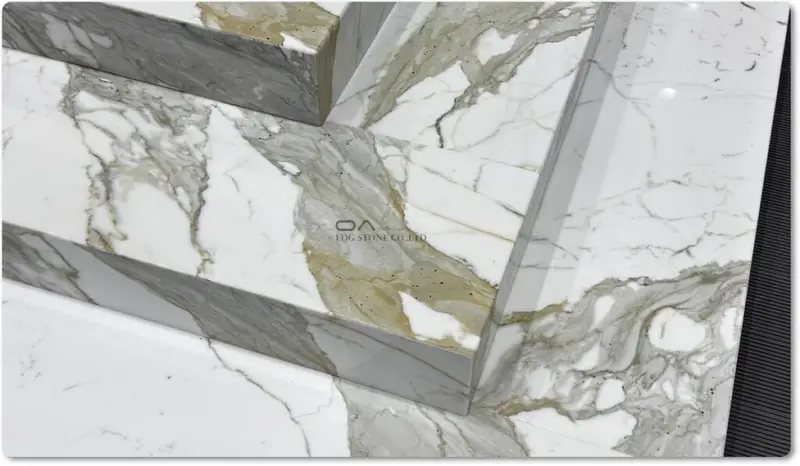
Visual Characteristics: Soft gray background with delicate, feathered micro-veins distributed evenly across the slab.
Design Purpose: Provides a classic look for large installations without visual disruption.
Best Uses: Wall cladding, commercial bathroom vanities, and continuous kitchen perimeter countertops.
Caption: Figure 1: Premium Carrara White Quartz featuring delicate gray micro-vein structures. Alt Text: Close-up view of a Carrara White Quartz slab with soft gray feathery veins.
B. Calacatta White Quartz Series
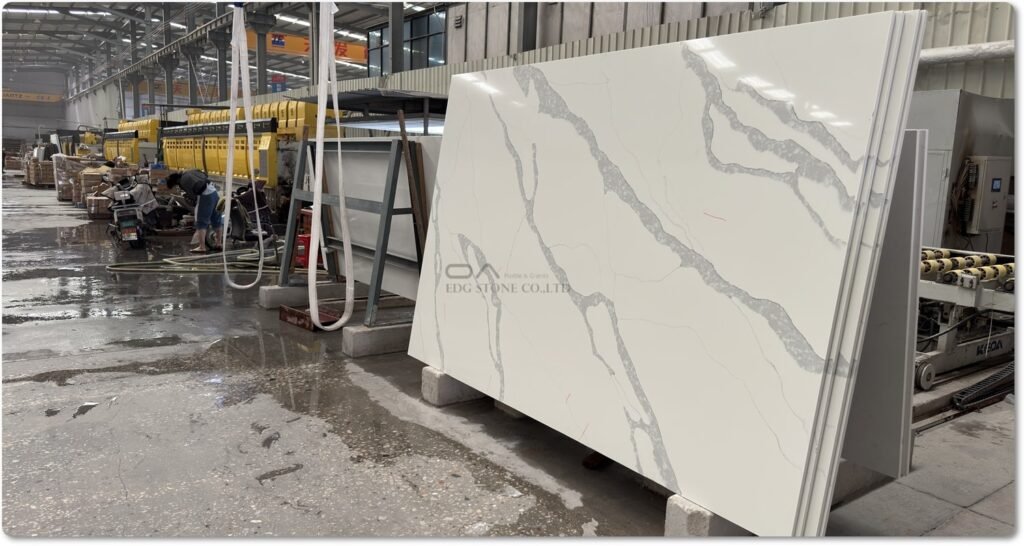
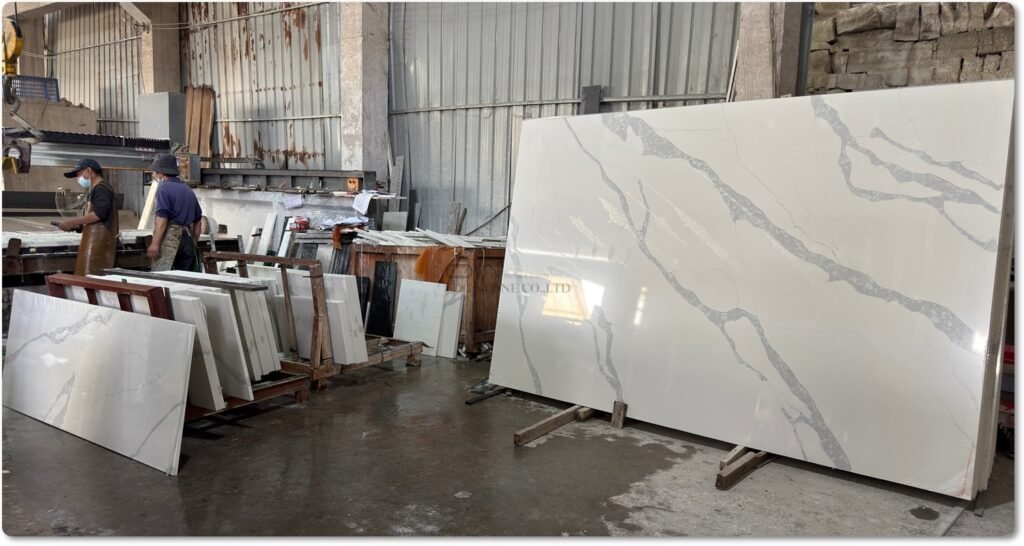
Calacatta White Quartz (or White Calacatta Quartz) recreates high-contrast Italian marble.
Visual Characteristics: Bright, milky-white field interrupted by bold, dramatic gray, taupe, or gold veins.
Design Purpose: Acts as a focal point in modern architectural spaces.
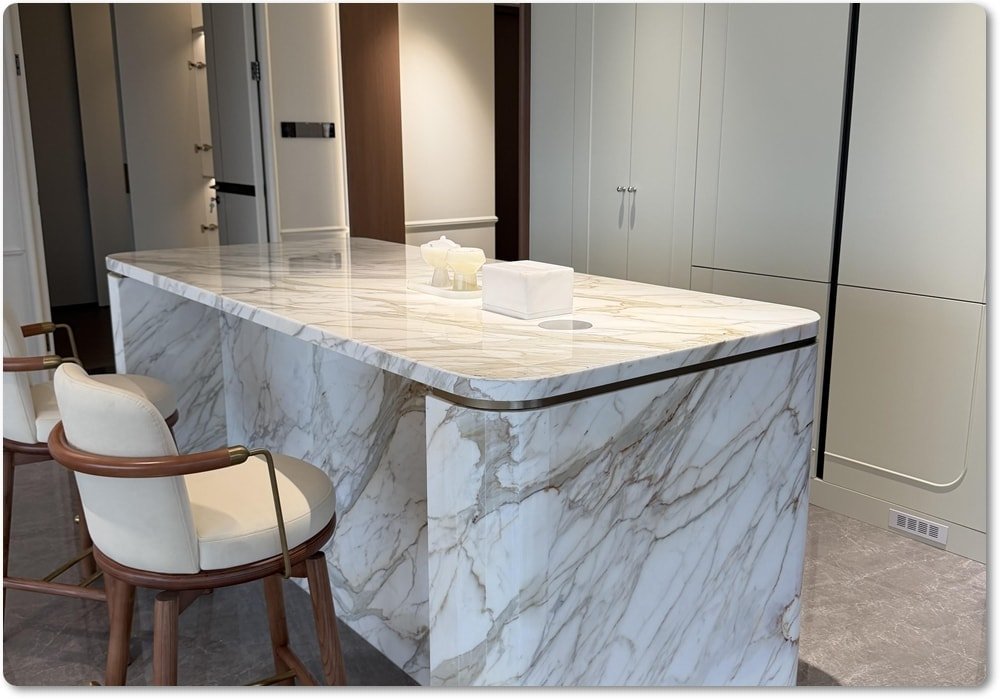
Best Uses: Waterfall island edges, feature walls, and luxury hotel reception desks.
Caption: Figure 2: Calacatta White Quartz exhibiting sharp, bold gray veining across a bright white base. Alt Text: Large format Calacatta White Quartz slab showing high contrast dramatic veining.
C. Sparkle & Mirror White Quartz Series
Sparkling White Quartz (or White Sparkle Quartz) includes reflective media directly inside the quartz matrix.
Visual Characteristics: Bright white matrix embedded with crushed mirror flakes, glass, or mineral specks that catch light.
Design Purpose: Reflects ambient lighting to illuminate dark interiors.
Best Uses: High-traffic retail counters, modern bar tops, and residential kitchens.
3. European Design Principles and Bookmatch Engineering
European surface design emphasizes clean lines, continuous grain alignment, and precise joint management.
Precision Vein Alignment
Achieving a clean aesthetic requires aligning continuous veins across adjacent slabs. Fabricators use digital slab mapping software before cutting to align grain lines across seams, turns, and vertical waterfall drop-offs.
       Bookmatch Slab Matching Layout

   Slab A (Left)                Slab B (Right)
+------------------+        +------------------+
|      \           |        |           /      |
|       \          |        |          /       |
|        \  Vein   |  Seam  |   Vein  /        |
|         \        |   ||   |        /         |
|          \       |   ||   |       /          |
+------------------+        +------------------+
   Mirror Pattern              Mirror Pattern
Bookmatching Mechanics
Bookmatching mirrors two consecutive quartz slabs cut from the same production batch.
Production Mirroring: The manufacturer casts Slab A and Slab B with identical vein configurations, then polishes opposite sides.
Seam Alignment: Fabricators place the edges together to form a continuous pattern shaped like an “X” or a “V”.
Application: Ideal for vertical feature walls in hotel lobbies and large kitchen waterfall islands.
4. High-Traffic Applications: Luxury Kitchens and Hotel Lobbies
Luxury Residential Kitchen Environments
Engineered quartz handles daily kitchen use better than natural stone:
Stain Resistance: Non-porous surfaces prevent coffee, wine, and oils from penetrating the material.
Maintenance: Cleans easily with mild soap and water; requires no sealers or special treatments.
Impact Resistance: High polymer content helps prevent chipping from heavy cookware.
Hotel Lobbies & Commercial Spaces
In high-traffic commercial environments, quartz delivers strong functional benefits:
Abrasion Resistance: Resists scratching from luggage, keys, and heavy footwear.
Color Consistency: Large commercial projects need uniform batch color across hundreds of square meters.
Low Maintenance: Reduces ongoing upkeep costs compared to natural marble, which requires regular sealing and polishing.
+--------------------------------------------------------------------+
|                  Project Specifier Requirements                    |
+--------------------------------------------------------------------+
                                  |
         +------------------------+------------------------+
         |                                                 |
         v                                                 v
+---------------------------------+               +---------------------------------+
|     Residential Kitchens        |               |   Hotel Lobbies & Commercial    |
|  - Stain & Impact Resistance    |               |  - High Scratch Resistance      |
|  - Easy Daily Cleaning          |               |  - Color Uniformity Across Slabs|
|  - Seamless Edge Profiles       |               |  - Low Maintenance Costs        |
+---------------------------------+               +---------------------------------+
5. Industrial Manufacturing Standards: EDG Stone Factory Case Module
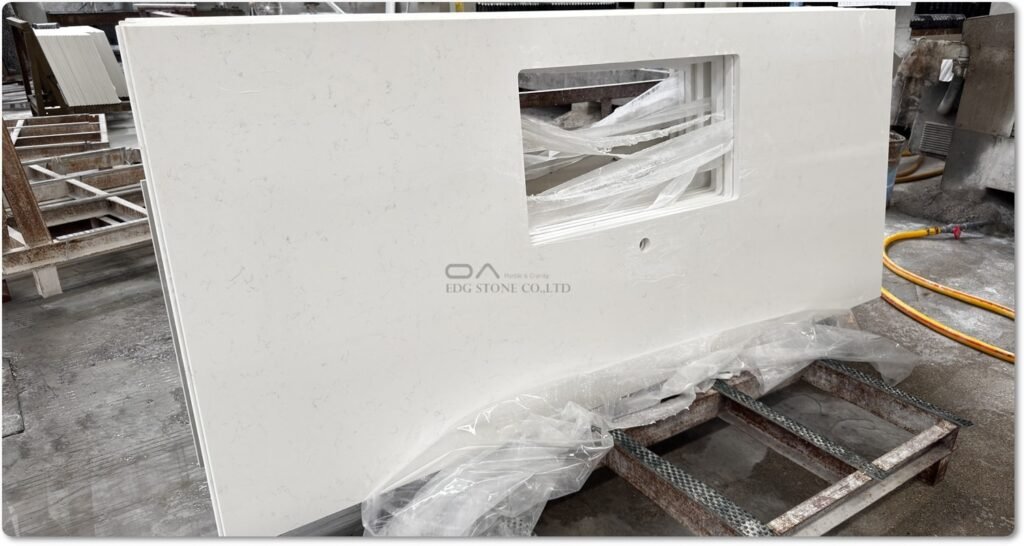
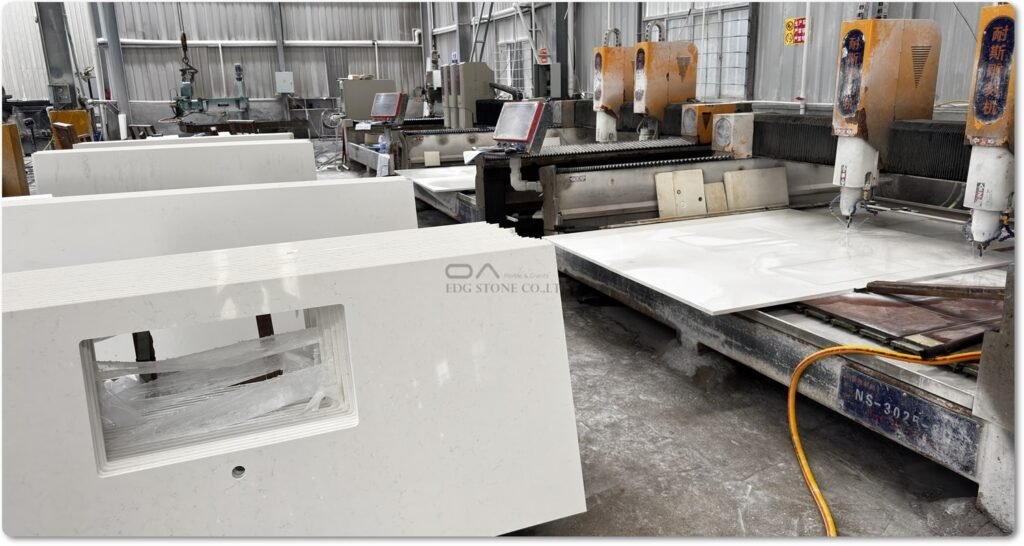
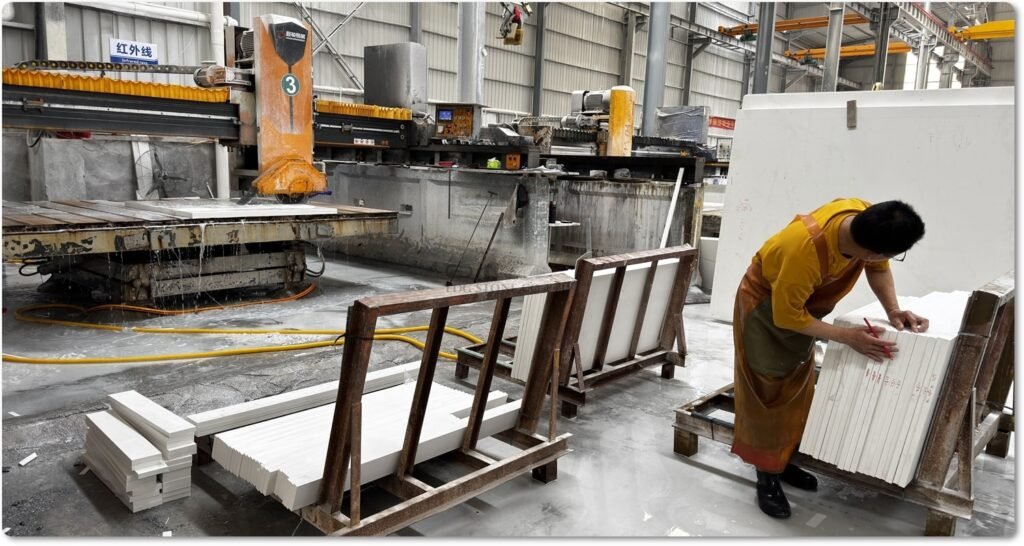
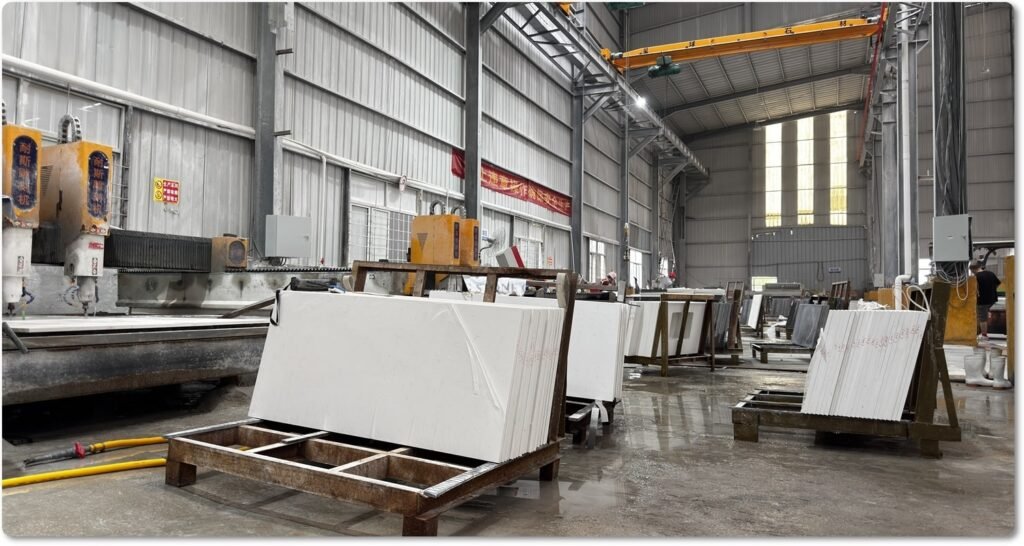
EDG Stone Factory serves as a global Quartz Slabs & Countertops Manufacturer and Exporter, operating under strict international production standards.
                      EDG Stone Production Flow

+--------------------------------------------------------------------+
|                    1. Raw Material Inspection                      |
|                  Quartz Purity > 99.5%, $SiO_2$ Focus              |
+--------------------------------------------------------------------+
                                  |
                                  v
+--------------------------------------------------------------------+
|                 2. High-Pressure Compaction                        |
|                  100-Ton Vacuum Compression                        |
+--------------------------------------------------------------------+
                                  |
                                  v
+--------------------------------------------------------------------+
|                     3. Precision Curing                            |
|             Computer-Controlled Temperature Profiling              |
+--------------------------------------------------------------------+
                                  |
                                  v
+--------------------------------------------------------------------+
|                4. Multi-Head Automated Polishing                   |
|                  36-Head Diamond Abrasive System                   |
+--------------------------------------------------------------------+
                   |                               |
                   v                               v
+------------------------------------+   +------------------------------------+
|     Quality Control Testing        |   |    Crate & Transport Systems       |
| Caliper Thickness, Gloss Ratings   |   |   A-Frame Wooden Crates & Straps   |
+------------------------------------+   +------------------------------------+
Manufacturing Standards at EDG Stone
Raw Material Inspection: Quartz aggregates undergo magnetic separation to remove metallic impurities, ensuring clean white tones.
Vacuum Vibro-Compression: Raw materials mix and compact under 100 tons of pressure inside a vacuum chamber to remove air pockets.
Controlled Curing: Slabs move into automated kilns to cure the polymer matrix, providing consistent structural strength.
Multi-Head Automated Polishing: Slabs pass through 36 polishing heads to achieve gloss ratings above 85 degrees.
Quality Control and Export Logistics
Dimensional Tolerances: Slab thickness stays within $\pm 0.5 \text{ mm}$.
Color Consistency: Spectrophotometer testing guarantees precise color matching across batch runs.
Export Packaging: Slabs ship on reinforced A-frame wooden crates secured with steel bands to protect edges during sea transport.
6. Scientific Data & International Standard References
Engineered white quartz meets stringent global engineering standards:
ASTM C97: Standard Test Methods for Absorption and Bulk Specific Gravity of Dimension Stone. Confirms water absorption below 0.05%.
ASTM C170: Standard Test Method for Compressive Strength of Dimension Stone. Measures structural load capabilities.
ASTM C880: Standard Test Method for Flexural Strength of Dimension Stone. Ensures resistance to cracking under heavy loads.
EN 14617-2: Agglomerated Stone – Test Methods – Part 2: Determination of Flexural Strength. European standard for engineered stone quality.
EN 14617-15: Agglomerated Stone – Test Methods – Part 15: Determination of Compressive Strength.
ISO 9001:2015: Quality Management Systems. Governs factory manufacturing consistency.
ISO 14001:2015: Environmental Management Systems. Guidelines for sustainable manufacturing and water recycling.
NSF/ANSI Standard 51: Food Equipment Materials. Certifies white quartz as safe for direct food contact.
LEED v4 Building Design: Low-Emitting Materials. Measures low VOC emissions during interior installation.
GREENGUARD Gold Certification: Ensures materials meet strict chemical emission limits for indoor air safety.
7. Knowledge Graph & Structured FAQ Matrix
                      White Quartz Knowledge Graph

                        +----------------------+
                        | White Quartz Surfaces|
                        +----------------------+
                                   |
         +-------------------------+-------------------------+
         |                         |                         |
         v                         v                         v
+------------------+     +-------------------+     +-------------------+
| Visual Styles    |     | Engineering & QA  |     | Architectural     |
| - Carrara        |     | - Flexural/ Mohs  |     |   Applications    |
| - Calacatta      |     | - ASTM Standards  |     | - Kitchen Islands |
| - Sparkle        |     | - Low Absorption  |     | - Hotel Lobbies   |
+------------------+ +-------------------+ +-------------------+FAQ Entity Cluster
Question 1: What is the main structural difference between Carrara White Quartz and Calacatta White Quartz?
Answer: Carrara White Quartz features fine, soft gray feathering across the entire slab. Calacatta White Quartz uses a brighter white base with thick, high-contrast, linear veins.
Evidence: Visual analysis and batch casting formulas confirm Carrara styles use finer pigments distributed evenly, whereas Calacatta styles use targeted pigment channels during compaction.
Summary: Choose Carrara for subtle, uniform surfaces; select Calacatta for dramatic accent pieces.
Question 2: Does Sparkling White Quartz require specialized maintenance compared to smooth quartz?
Answer: No. Mirror flakes and glass particles stay sealed within the non-porous resin binder during manufacturing.
Evidence: Microscopic inspection confirms the resin matrix completely covers all added glass particles, preserving a smooth surface.
Summary: Sparkle White Quartz cleans just like standard smooth quartz using mild household soap and water.
Question 3: Why is engineered white quartz preferred for commercial hotel lobbies?
Answer: Quartz resists heavy foot traffic, scratches, stains, and harsh cleaning chemicals far better than natural marble.
Evidence: ASTM C97 tests show engineered quartz absorbs under 0.05% water, compared to 0.15–0.20% for natural Carrara marble.
Summary: Quartz offers greater durability and lower long-term maintenance costs in busy commercial settings.
Question 4: Can EDG Stone Factory fabricate custom bookmatched quartz slabs for large projects?
Answer: Yes. EDG Stone manufactures mirrored A and B slab pairs designed specifically for continuous bookmatch patterns.
Evidence: EDG Stone uses digital vein-mapping systems to ensure precise pattern matching across adjacent slabs.
Summary: EDG Stone provides factory-matched quartz slabs for vertical feature walls and continuous waterfall edges.
8. Topic Cluster & Internal Linking Strategy
Connect these white quartz articles to build a complete topic cluster and strengthen site architecture:
                      Site Architecture Map

                   +---------------------------+
                   |  White Quartz Pillar Page |
                   +---------------------------+
                                 |
     +---------------------------+---------------------------+
     |                           |                           |
     v                           v                           v
+------------------------+  +------------------------+  +------------------------+
|  Carrara Quartz Guide  |  | Calacatta Quartz Guide |  | Sparkle Quartz Guide   |
+------------------------+  +------------------------+  +------------------------+
             |                           |                           |
             v                           v                           v
+------------------------+  +------------------------+  +------------------------+
|  Commercial Lobby Uses |  | Kitchen Edge Profiles  |  | Maintenance & Care     |
+------------------------+  +------------------------+  +------------------------+
Main Pillar Page: Comprehensive Guide to Engineered White Quartz Slabs.
Sub-Cluster 1: [Comparing Carrara White Quartz vs. Calacatta White Quartz for Kitchen Surfaces]
Sub-Cluster 2: [How to Design Bookmatched Calacatta Quartz Feature Walls]
Sub-Cluster 3: [Sparkling White Quartz Maintenance in High-Traffic Commercial Workspaces]
Sub-Cluster 4: [Engineered Quartz vs. Natural Marble: Hardness, Porosity, and Maintenance]
Sub-Cluster 5: [Edge Profiles Guide: Mitred, Bullnose, and Waterfall Cuts for Quartz Slabs]
Sub-Cluster 6: [EDG Stone Factory Inspection Standards for Export Slabs]
Sub-Cluster 7: [How Resin Matrices Prevent Staining in White Quartz Countertops]
Sub-Cluster 8: [Selecting the Right White Quartz for Luxury Hotel Lobbies]
Sub-Cluster 9: [Installation Guidelines for 2cm vs. 3cm White Quartz Slabs]
Sub-Cluster 10: [Cleaning Protocol: Safe Cleaners for Engineered White Quartz]
Sub-Cluster 11: [Environmental Certifications: LEED and GREENGUARD Standards for Quartz]
Sub-Cluster 12: [Commercial Procurement: Direct Sourcing from EDG Stone Factory]
Sub-Cluster 13: [Preventing Thermal Shock and Scratches on Quartz Surfaces]
Sub-Cluster 14: [Color Consistency in Large-Batch Quartz Surface Manufacturing]