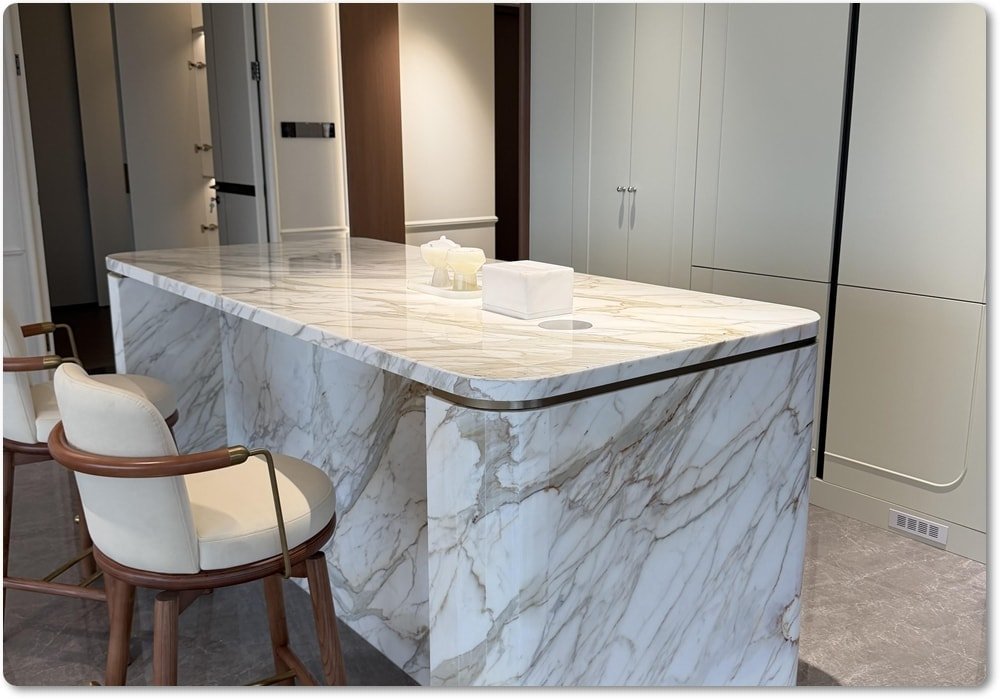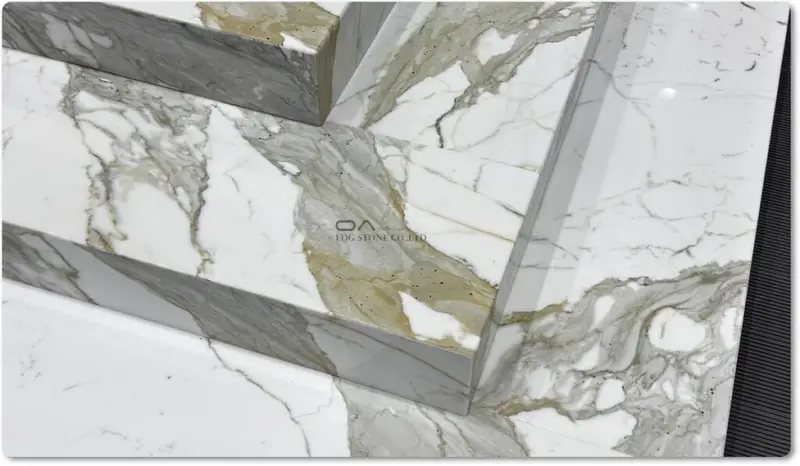
White quartz is the most sought-after surface material in modern architecture, residential design, and high-tech industrial manufacturing. Its popularity stems from its high mechanical strength, chemical inertness, and clean visual appeal.
This whitepaper provides a technical procurement guide for B2B buyers, architects, project contractors, and stone distributors. It breaks down mineral geology, engineering formulations, industrial applications, global trade dynamics, and factory fabrication standards.
What is White Quartz?
White quartz is a crystalline mineral composed of silicon dioxide ($SiO_2$). It is the second most abundant mineral in Earth’s continental crust. It forms in igneous, metamorphic, and sedimentary rocks under varying temperatures and pressures.
                                  +------------------------------------+
                                  |    Silicon Dioxide (SiO2) Matrix   |
                                  +------------------------------------+
                                                    |
                       +----------------------------+----------------------------+
                       |                                                         |
        +------------------------------+                          +------------------------------+
        |   Natural Crystalline Forms  |                          |  Engineered Composite Slabs  |
        +------------------------------+                          +------------------------------+
                       |                                                         |
        +--------------+--------------+                           +--------------+--------------+
        |                             |                           |                             |
 +--------------+              +--------------+            +--------------+              +--------------+
 | Clear Quartz |              | Milky Quartz |            | Resin-Bound  |              | Low-Silica   |
 |   Crystal    |              | (Fluid-Incl.)|            | Slabs (90%+) |              | Bio-Slabs    |
 +--------------+              +--------------+            +--------------+              +--------------+
Chemical Structure and Crystallography
White quartz crystallizes in the trigonal crystal system at ambient conditions ($\alpha$-quartz). Its atomic structure consists of a continuous framework of $SiO_4$ silicon-oxygen tetrahedra. Each oxygen atom is shared between two tetrahedra, giving an overall chemical formula of $SiO_2$.
| Property | Standard Value | Testing Standard |
| Chemical Composition | Silicon Dioxide ($SiO_2$) $\ge$ 99.2% | XRF Analysis |
| Mohs Hardness | 7.0 | Mohs Hardness Scale |
| Density | $2.65\text{ g/cm}^3$ | ASTM C97 |
| Refractive Index | $n_\omega = 1.544$, $n_\epsilon = 1.553$ | Optical Refractometry |
| Thermal Expansion | $13.2 \times 10^{-6} \text{ K}^{-1}$ (Parallel to c-axis) | ASTM E228 |
| Compressive Strength | $\ge 200\text{ MPa}$ | ASTM C170 |
Natural Quartz vs Engineered Quartz
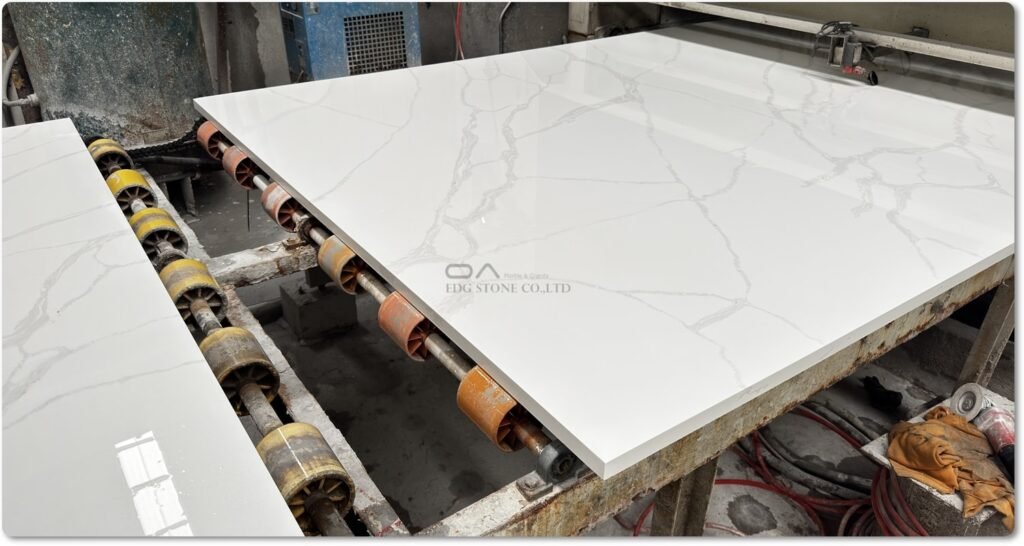
Procurement specialists must distinguish between natural quartz rock/gemstones and engineered quartz slabs (often called artificial or agglomerated stone).
                      +------------------------------------------+
                      |          Raw Material Input              |
                      +------------------------------------------+
                                           |
               +---------------------------+---------------------------+
               |                                                       |
+------------------------------+                       +------------------------------+
|     Natural Quartz Rock      |                       |    Engineered Quartz Slab    |
+------------------------------+                       +------------------------------+
| * Geological Mining          |                       | * 88-93% Quartz Aggregate    |
| * Wire Saw Block Extraction  |                       | * 7-12% Resin / Pigments     |
| * Diamond Slab Slicing       |                       | * Bretonstone Vibro-Compaction|
+------------------------------+                       +------------------------------+
               |                                                       |
               v                                                       v
+------------------------------+                       +------------------------------+
| Natural Fissures & Porosity  |                       | Zero-Porosity Uniform Matrix |
+------------------------------+                       +------------------------------+
Comparative Analysis
Natural Quartzite & Quartz Rock: Pure natural rock formed through metamorphism of sandstone under extreme heat and pressure. It is mined directly as blocks and sawn into slabs. It features natural veins, non-uniform porosity, and minor fissures.
Engineered Quartz: A composite material consisting of 88–93% crushed natural quartz aggregate bound together by 7–12% unsaturated polyester or polymer resin, pigments, and performance additives. It is compacted under intense vacuum pressure to eliminate porosity.
+---------------------------------------------------------------------------------------+
| COMPOSITIONAL MATRIX COMPARISON                                                       |
+---------------------------------------------------------------------------------------+
| NATURAL QUARTZITE                                                                     |
| [ SiO2 Crystal Structure 98%+ ] --------------------> [ Natural Porosity / Micro-cracks]|
+---------------------------------------------------------------------------------------+
| ENGINEERED WHITE QUARTZ                                                               |
| [ Crushed Quartz Aggregate 90% ] + [ Polymer Resin 8% ] + [ TiO2 Pigment & Additives 2%]|
+---------------------------------------------------------------------------------------+
White Quartz Crystal Formation
Natural white quartz crystals grow through hydrothermal processes inside Earth’s crust. Silica-saturated water solutions penetrate fractures and cavities within rock formations.
       GEOLOGICAL PROCESS OF WHITE QUARTZ CRYSTALLIZATION

Stage 1: Hydrothermal Fluid Injection
+-------------------------------------------------------------------+
| Silica-rich fluids (SiO2 in H2O) under high pressure (>100 MPa)   |
| penetrate tectonic faults at temperatures between 250°C - 500°C.  |
+-------------------------------------------------------------------+
                                  |
                                  v
Stage 2: Nucleation and Crystal Growth
+-------------------------------------------------------------------+
| As fluids cool, silica drops out of solution and nucleates on     |
| rock faces, forming hexagonal prismatic quartz structures.       |
+-------------------------------------------------------------------+
                                  |
                                  v
Stage 3: Fluid Inclusion Trapping (White / Milky Phase)
+-------------------------------------------------------------------+
| Rapid cooling traps sub-micron droplets of water, CO2, and gas.   |
| These microscopic bubbles scatter light, creating white opacity.  |
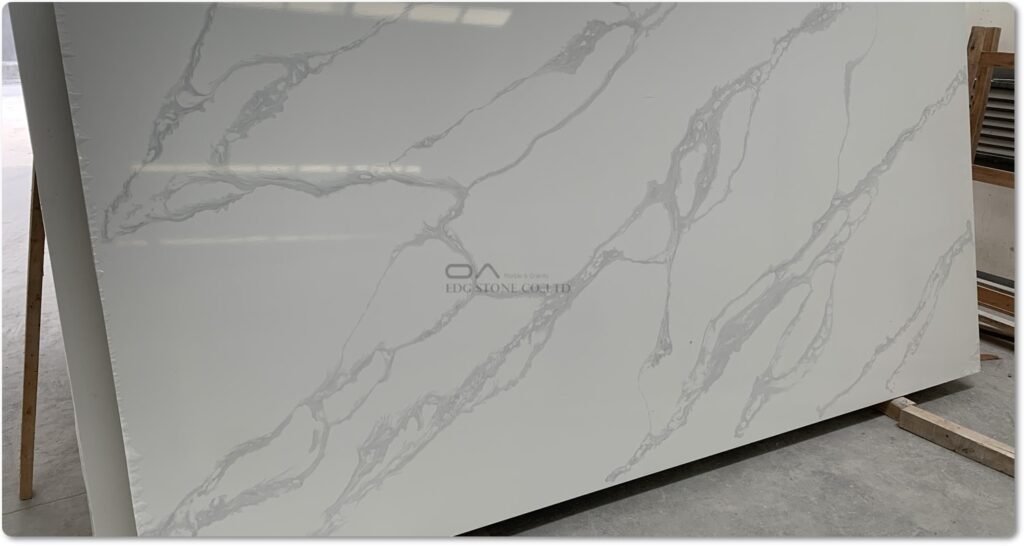
+-------------------------------------------------------------------+
Milky Quartz Explained
Milky quartz is the most common variety of crystalline quartz. While pure single-crystal quartz is optically clear, milky quartz appears white, opaque, or translucent.
The Physics of Opacity
Milky quartz is white because of microscopic fluid inclusions trapped during crystal growth. These inclusions consist of tiny bubbles containing water, carbon dioxide, or volatile organic compounds ranging from 0.1 to 10 micrometers in size.
When light enters the quartz, it strikes thousands of these micro-interfaces per millimeter. The difference in refractive index between the liquid/gas inclusions ($n \approx 1.33$) and the quartz matrix ($n \approx 1.54$) causes intense internal light scattering (Rayleigh and Mie scattering). This turns the crystal white rather than transparent.
       LIGHT SCATTERING IN MILKY QUARTZ

    Incoming Light Ray
    ===================>  [ Solid Quartz Matrix: n = 1.54 ]
                                 |
                                 v  (Hits Fluid Inclusion: n = 1.33)
                             \   |   /
                              \  |  /  Mie Scattering
                               \ v /   (All visible light frequencies)
                            <--- * --->
                               / ^ \
                              /  |  \
                             /   |   \
                                 v
                     Scattered Light = Opaque White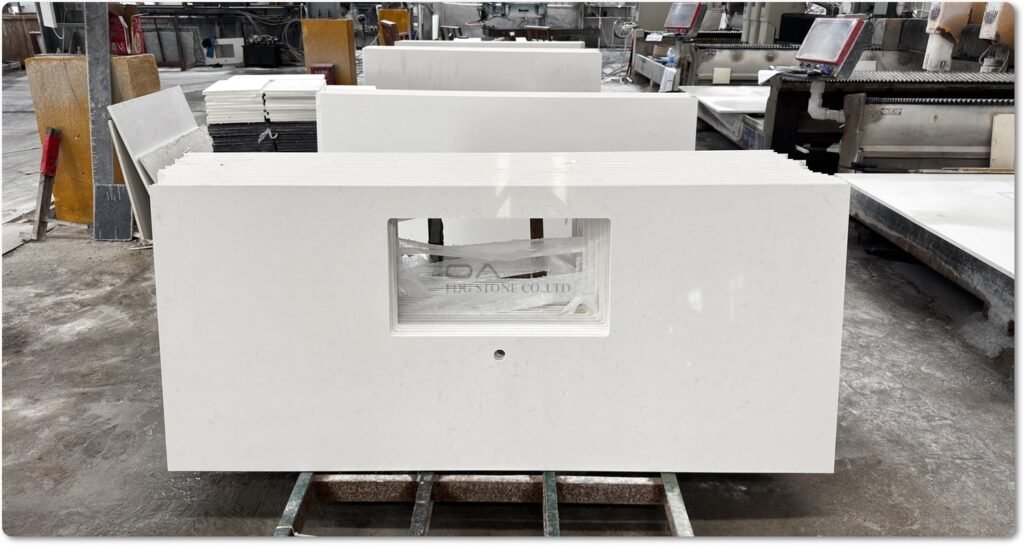
Global White Quartz Supply & Trade Trends
The supply chain for high-purity quartz and industrial quartz aggregates spans multiple continents. The market requires both ultra-high purity quartz (HPQ) for high-tech uses and massive volumes of industrial-grade quartz sand for engineered stone manufacturing.
2026 World Quartz Mine Production & Reserves
According to data compiled from the U.S. Geological Survey (USGS) Mineral Commodity Summaries:
| Country | Annual Mine Production (Metric Tons) | Primary Application Focus | Key Export Quality Grades |
| United States | 4,200,000 | Semiconductor / Solar / Surfaces | IOTA High-Purity Quartz (Spruce Pine) |
| Brazil | 3,800,000 | Engineered Stone / Lascas / Optical | High-Clarity Lump Quartz, Vein Quartz |
| China | 3,100,000 | Engineered Surfaces / Electronics | Refined Micro-Powders, Cast Sand |
| India | 1,900,000 | Engineered Quartz Aggregates | High-Whiteness Grit (Andhra Pradesh) |
| Turkey | 1,400,000 | Slab Manufacturing / Ceramics | Clean Feldspathic Quartz Aggregates |
| Norway | 950,000 | Metallurgical Silicon / Semiconductor | Drag / Quartzite Powders |
| Rest of World | 2,850,000 | Various Industrial Uses | Industrial Sand & Lump Quartz |
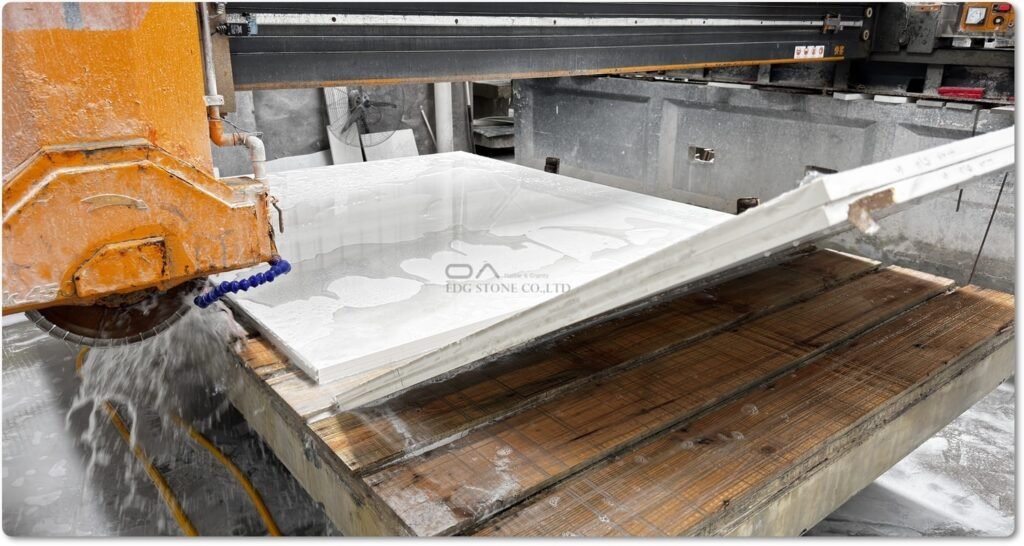
Major Quartz Producing Countries
                  GLOBAL QUARTZ SUPPLY CHAIN FLOW

   RAW MINING REGIONS                       PROCESSING HUBS
+-----------------------+               +-----------------------+
|  Spruce Pine, USA     |-------------->| Ultra-High Purity HPQ |
| (Semiconductor Grade) |               | (Solar / Microchips)  |
+-----------------------+               +-----------------------+
                                                    |
+-----------------------+               +-----------------------+
| Andhra Pradesh, India |-------------->| High-Whiteness Grits  |
| (High-Whiteness Grit) |               | (Surfaces / Slabs)    |
+-----------------------+               +-----------------------+
                                                    |
+-----------------------+               +-----------------------+
| Minas Gerais, Brazil  |-------------->| Industrial Aggregates |
| (Clear & Vein Quartz) |               | (Engineered Stone)    |
+-----------------------+               +-----------------------+
                                                    |
                                                    v
                                        +-----------------------+
                                        | Global Slab & Chip    |
                                        | Manufacturing Centers |
                                        +-----------------------+
1. United States (Spruce Pine District, North Carolina)
The Spruce Pine pegmatite district produces the world’s highest-purity natural quartz. This quartz contains extremely low concentrations of structural aluminum, titanium, and iron (less than 20 ppm total impurities). It is the raw material used to manufacture fused-quartz crucibles for growing silicon crystals for semiconductors.
2. India (Andhra Pradesh & Rajasthan)
India is a leading exporter of raw quartz grains and fines used in engineered stone slab manufacturing. Indian quartz features high Whiteness Index values ($WI > 88$), low iron oxide content ($Fe_2O_3 < 0.02\%$), and exceptional hardness.
3. Brazil (Minas Gerais)
Brazil holds vast reserves of high-clarity quartz crystals and vein quartz. Brazilian raw material is heavily used for engineered stone aggregates, optical applications, and synthetic quartz growth seed crystals.
Industrial Applications
White quartz is essential across several heavy and high-tech industries.
                       WHITE QUARTZ INDUSTRIAL USES
                                     |
    +-----------------+--------------+--------------+-----------------+
    |                 |                             |                 |
    v                 v                             v                 v
+------------+  +--------------+              +-----------+     +------------+
| Structural |  | Construction |              | Electronics|     | High-Tech  |
| Architectural | Surfaces     |              | & Optics  |     | Processing |
+------------+  +--------------+              +-----------+     +------------+
| * Slabs    |  | * Sinks      |              | * Solar   |     | * Chemical |
| * Cladding |  | * Tile Beds  |              | * Chips   |     | * Glass    |
+------------+  +--------------+              +-----------+     +------------+
Architectural Slabs & Countertops
Commercial real estate and residential developers use white quartz slabs because they resist stains, scratching, and water absorption better than natural marble.
Electronics and Photovoltaics
High-purity white quartz ($SiO_2 > 99.99\%$) is melted down to produce fused silica glass. This glass is used for semiconductor wafers, optical fiber preforms, and photovoltaic solar cell crucibles.
Chemical and Glass Processing
Finely ground white quartz powder serves as a filler in ceramics, paints, precision casting moulds, and specialized low-iron flat glass production.
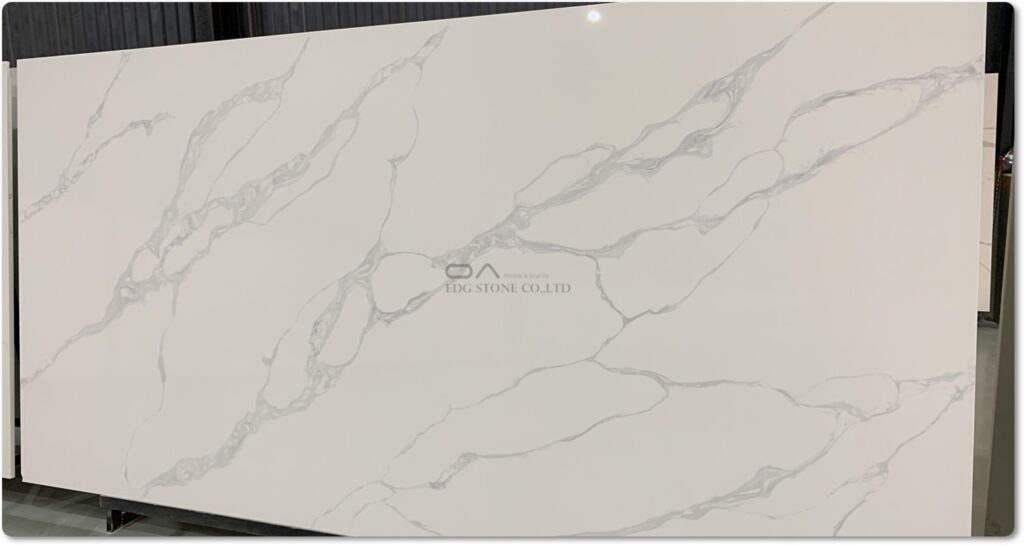
Future Market Outlook (2026–2032)
Four structural trends shape the global white quartz industry:
                  2026-2032 MARKET DRIVERS FOR WHITE QUARTZ

 1. Low-Silica Transition         2. Crystalline Silica Safety
 +------------------------------+ +------------------------------+
 | Crystalline silica regulations| | Transition toward bio-resins |
 | push slabs to <30% silica    | | and recycled glass/amorphous |
 | content using recycled glass. | | mineral filler matrixes.     |
 +------------------------------+ +------------------------------+
                |                                |
                v                                v
 3. High-Purity Solar Demand      4. Automated Large Slabs
 +------------------------------+ +------------------------------+
 | PV solar expansion drives    | | Demand shifts to jumbo       |
 | double-digit growth for HPQ  | | 3300x1600mm slabs for       |
 | raw quartz inputs globally.  | | seamless architectural designs|
 +------------------------------+ +------------------------------+
Crystalline Silica Regulations: Occupational safety standards (like Australia’s strict bans and OSHA’s reduced Permissible Exposure Limits) are shifting demand toward low-silica quartz surfaces. Manufacturers are reducing free crystalline silica from 90% down to under 30% by substituting amorphous glass, recycled crushed glass, and bio-feldspars.
Resin Evolution & Bio-Binders: Manufacturers are replacing petroleum-derived unsaturated polyester resins with plant-based bio-resins. This lowers VOC emissions and improves UV resistance for semi-outdoor applications.
High-Purity Quartz (HPQ) Supply Tightness: Rapid expansion in the solar PV and semiconductor industries has increased competition for ultra-pure white vein quartz deposits, driving up prices for premium raw materials.
Jumbo & Super-Jumbo Slab Formats: Commercial projects increasingly require seamless installations. This has made jumbo ($3200 \times 1600\text{ mm}$) and super-jumbo ($3300 \times 1900\text{ mm}$) white quartz slabs the standard export sizes.
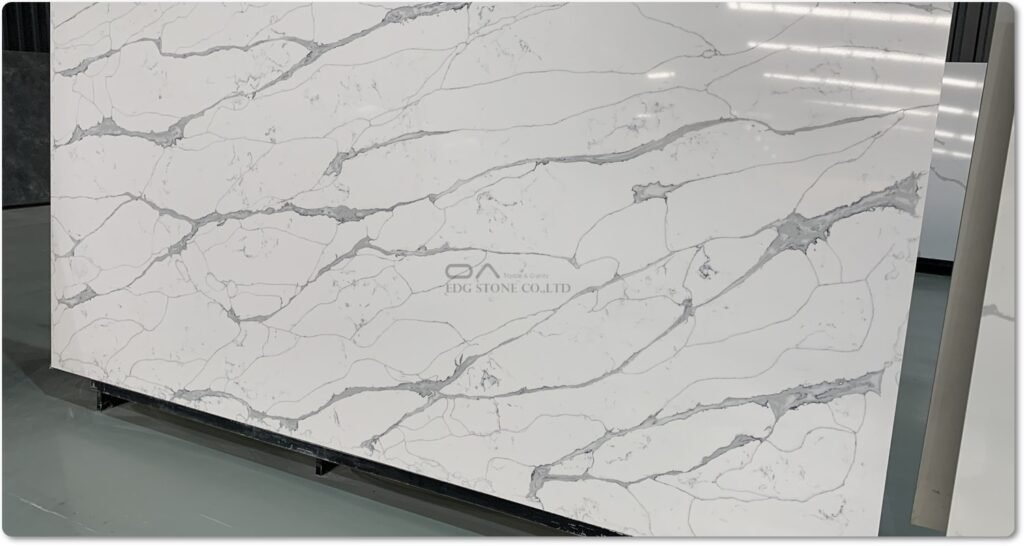
Case Study: How EDG Stone Factory Manufactures White Quartz Slabs?
As a global manufacturer and exporter of quartz slabs and prefabricated tops, EDG Stone Factory operates modern production lines configured for high whiteness consistency, structural density, and low resin-shadowing.
          EDG STONE FACTORY PRODUCTION PIPELINE

[ Step 1: Raw Material Sorting & XRF Testing ]
                      |
                      v
[ Step 2: Dosing & Precision Batch Mixing ]
                      |
                      v
[ Step 3: High-Vacuum Vibro-Compaction Pressing ]
                      |
                      v
[ Step 4: Controlled Thermal Curing Kiln (100°C) ]
                      |
                      v
[ Step 5: Thickness Calibration & Multi-Head Polishing ]
                      |
                      v
[ Step 6: Automated Optical Quality Inspection ]
Step 1: Raw Material Inspection & Grain Sorting
EDG Stone sources pure white quartz aggregates with an iron oxide content below 0.015%. Raw grains are sorted into specific particle sizes:
Coarse Aggregates: 2.5 mm – 4.0 mm (for structural strength)
Medium Aggregates: 0.6 mm – 1.2 mm (for color density)
Fine Micro-Powders: $325\text{ mesh}$ silica flour (for void filling)
Step 2: High-Precision Batch Mixing
Raw aggregates (91%), liquid unsaturated polyester resin (8%), TiO2 white pigments (0.8%), and silane coupling agents (0.2%) are mixed under vacuum. The silane coupling agent creates a chemical bond between the inorganic quartz grains and the organic resin matrix.
Step 3: Vacuum Vibro-Compaction Pressing
The mixed mass is distributed into a slab mold and transferred into a heavy-duty hydraulic press.
Vacuum Pressure: Under $-0.098\text{ MPa}$ (removes trapped air pockets)
Vibration Frequency: 3,000–4,500 Hz
Compaction Force: 100 tons
This process eliminates internal voids, bringing total water absorption down to under 0.03%.
Step 4: Thermal Curing
The compacted slab enters a multi-zone curing tunnel heated to 85°C – 105°C for 60 minutes. This cures and cross-links the polymer resins, hardening the loose aggregate into a solid stone slab.
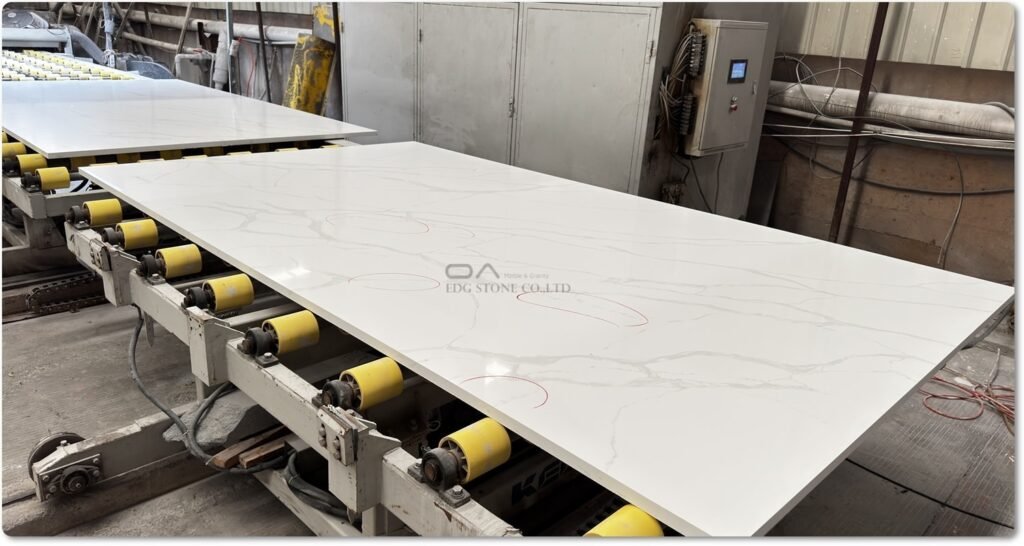
Step 5: Calibration, Gauging & Polishing
Once cooled, slabs pass through a multi-head diamond calibration machine:
Diamond Drum Calibration: Sets precise slab thickness (e.g., $20\text{ mm} \pm 0.5\text{ mm}$ or $30\text{ mm} \pm 0.5\text{ mm}$).
Sequential Polishing: Slabs move through 36 sequential diamond abrasive polishing heads, graduating from 50 grit up to 3,000 grit to achieve a gloss rating over 85 GU (Gloss Units).
Step 6: Automated QC and Color Matching
Every finished white quartz slab undergoes strict quality control checks:
Spectrophotometric Color Matching: Ensures total color consistency across batch lots ($\Delta E < 0.5$).
LED Defect Mapping: Detects micro-cracks, resin spots, or foreign particle contamination.
+---------------------------------------------------------------------------------------+
| EDG STONE FACTORY TECHNICAL SPECIFICATION SHEET SHEET (WHITE QUARTZ)                 |
+---------------------------------------------------------------------------------------+
| Parameter                   | EDG Factory Standard       | Testing Standard           |
+-----------------------------+----------------------------+----------------------------+
| Quartz Content              | 90% - 93% Purified Mineral | XRF Analysis               |
| Water Absorption            | < 0.02%                    | ASTM C373                  |
| Flexural Strength           | 45 - 55 MPa                | ASTM C880                  |
| Impact Resistance           | > 5.2 Joules               | EN 14617-9                 |
| Stain Resistance            | Class 5 (Maximum Rating)   | ANSI Z124.3                |
| Slip Resistance (Polished)  | DCOF > 0.42                | ANSI A137.1                |
| Chemical Resistance         | Resistant to Acids/Alkalis | ASTM C650                  |
+---------------------------------------------------------------------------------------+Technical Knowledge Verification (Q&A)
Q1: Why do some commercial white quartz surfaces develop yellowing over time?
Answer: Yellowing is caused by photo-degradation of lower-grade unsaturated polyester resins when exposed to ultraviolet (UV) radiation, or by resin over-heating during fabrication.
Evidence: Standard orthophthalic resins break down under UV light ($300\text{–}400\text{ nm}$ wavelengths), causing the polymer chain to cleave and turn yellow.
Summary: Premium factories prevent yellowing by using UV-stabilized resins mixed with Neopentyl Glycol (NPG) and hindered amine light stabilizers (HALS).
Q2: How does pure white quartz differ from white marble in stain resistance?
Answer: White quartz has zero open pores and does not react with acids, whereas white marble ($CaCO_3$) is porous and etches upon contact with acidic substances like lemon juice or vinegar.
Evidence: Engineered white quartz records water absorption under $0.03\%$ (ASTM C373), while natural Carrara marble ranges between $0.15\%$ and $0.30\%$. Marble dissolves when exposed to $pH < 7$ liquids due to calcium carbonate decomposition.
Summary: White quartz provides superior stain and acid resistance, making it better suited for high-use commercial and residential surfaces.
Q3: What is the purpose of adding Silane Coupling Agents during quartz slab manufacturing?
Answer: Silane coupling agents act as a molecular bridge connecting inorganic quartz grains to the organic resin binder.
Evidence: Without silane, the interface between $SiO_2$ and polymer resin is purely mechanical, lowering flexural strength by up to $40\%$. Organofunctional silanes form covalent bonds ($Si-O-Si$) across the interface.
Summary: Silane coupling agents increase flexural strength, impact resistance, and long-term moisture resistance in quartz slabs.
Technical Content Network & Internal Links
To build a comprehensive topic cluster, this whitepaper links directly to 15 specialized technical guides across our knowledge base:
                                     2026 WHITE QUARTZ GUIDE
                                        (Core Pillar Page)
                                                |
    +-------------------------------------------+-------------------------------------------+
    |                                           |                                           |
    v                                           v                                           v
[ GEOLOGY & MATERIALS ]                     [ FABRICATION & TESTING ]                    [ COMMERCIAL PROCUREMENT ]
1. High-Purity Silica Refining              6. ASTM C373 Water Absorption Testing        11. B2B Wholesale Pricing Models
2. Calacatta Quartz Vein Matching           7. Low-Silica Bio-Resin Innovations          12. Private Label OEM Slab Programs
3. Natural Quartzite Slicing Guide          8. Diamond Calibration Head Maintenance      13. Commercial Project Specifying
4. Quartzite vs Engineered Quartz           9. Anti-Yellowing Resin Formulations         14. Container Loading & Slab Crating
5. Quartz Crystal Hydrothermal Growth       10. Edge Profiling for Heavy Traffic         15. Maintenance Guide for Quartz
High-Purity Silica Refining: Process workflows for producing 99.9% $SiO_2$ quartz sand.
Calacatta Quartz Vein Matching: Robotic vein-printing methods for engineered slabs.
Natural Quartzite Slicing Guide: Wire saw operation standards for hard quartz blocks.
Quartzite vs Engineered Quartz: Detailed mechanical property comparisons.
Quartz Crystal Hydrothermal Growth: Synthetic quartz production for optical uses.
ASTM C373 Water Absorption Testing: Laboratory testing procedures for non-porous surfaces.
Low-Silica Bio-Resin Innovations: Sustainable slab alternatives containing under 30% crystalline silica.
Diamond Calibration Head Maintenance: Polishing equipment management in slab factories.
Anti-Yellowing Resin Formulations: NPG and HALS chemistry for UV resistance.
Edge Profiling for Heavy Traffic: Mitred, bullnose, and eased edge engineering.
B2B Wholesale Pricing Models: Bulk slab purchasing strategies for stone distributors.
Private Label OEM Slab Programs: Custom branding strategies for regional stone brands.
Commercial Project Specifying: Writing architect specifications for hotel and residential projects.
Container Loading & Slab Crating: A-frame steel rack packaging for ocean transit.
Maintenance Guide for Quartz: Cleaning protocols for commercial quartz installations.