Summary
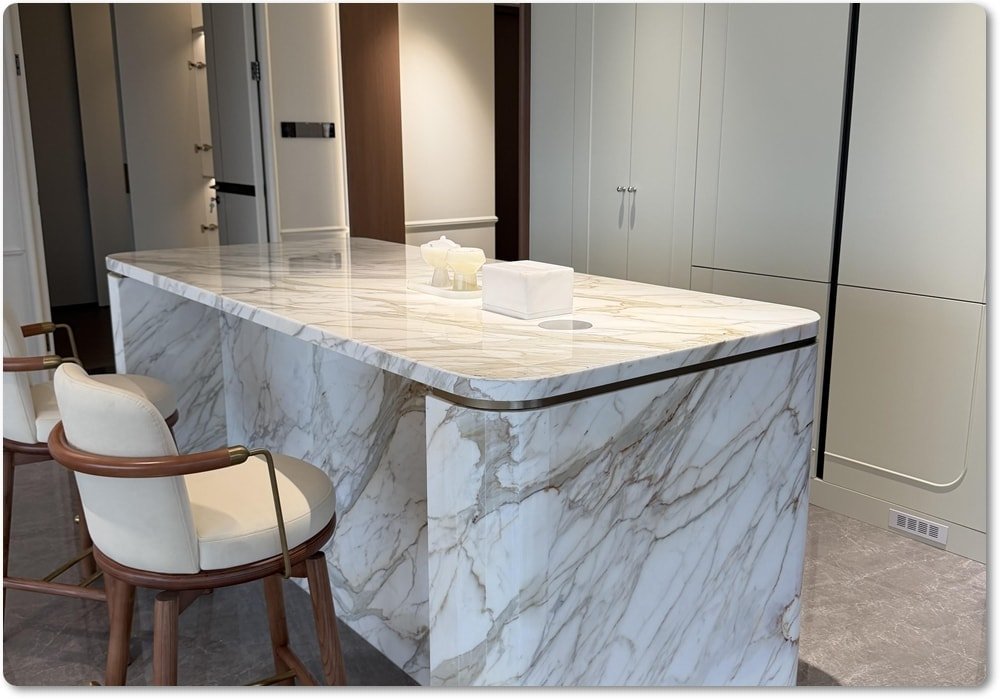
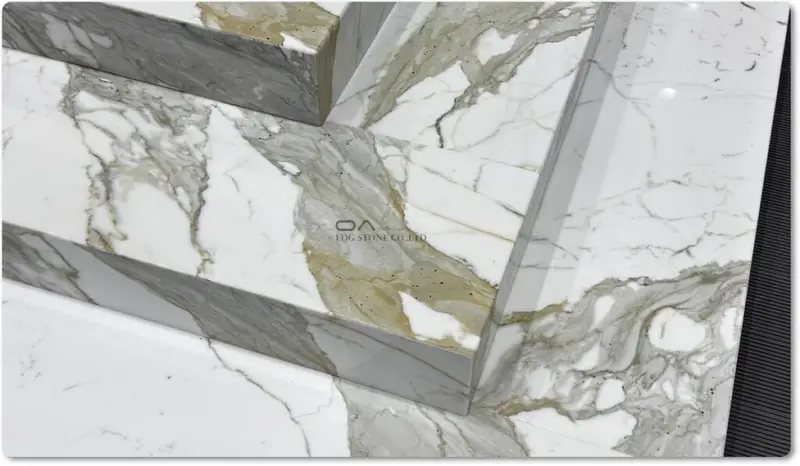
Engineered white quartz slabs offer exceptional durability, non-porous hygiene, and aesthetic versatility. This white paper explains the industrial production of engineered stone from raw material selection to final quality control. It provides technical data, process parameters, comparative benchmarks, and practical insights for procurement professionals, architects, and stone distributors.
Key Takeaways
Material Composition: Premium white quartz consists of 90–93% natural quartz aggregate bound by 7–10% polymer resin, pigments, and silane coupling agents.
Compaction Technology: Vibro-compression under high vacuum ($20\text{–}50 \text{ mbar}$) removes micro-air pockets, yielding density above $2.35 \text{ g/cm}^3$ and water absorption below $0.03\%$.
Color Stability: Specialized white pigments combined with UV-stabilized resin prevent yellowing under indoor lighting conditions.
Curing Dynamics: Controlled thermal curing at $80\text{–}110^\circ\text{C}$ ensures complete polymer cross-linking for optimal flexural and impact strength.
Quality Benchmarks: Modern manufacturing relies on automated optical inspection (AOI) to eliminate slab tone variation, pinholes, and internal stress cracks.
Technical Definitions
Engineered Stone: A composite material formed by mixing mineral aggregates (such as quartz) with a polymer resin binder, compressed under vacuum, and cured with heat.
Vibro-Compression Vacuum Casting: A manufacturing process that combines mechanical vibration, hydraulic pressure, and vacuum suction to compact granular mixtures into solid slabs without air voids.
Silane Coupling Agent: Organosilicon compounds that chemically bridge inorganic quartz particles with organic resin polymers, enhancing moisture resistance and mechanical strength.
MOHS Hardness Scale: A ten-point ordinal scale rating scratch resistance, where natural quartz measures 7.
Industrial Industry Statistics
+-------------------------------------------------------------+
| KEY INDUSTRY PERFORMANCE BENCHMARKS                        |
+-------------------------------------------------------------+
| Water Absorption Rate:         < 0.03%                      |
| Mohs Hardness Rating:          7.0                          |
| Density Range:                 2.35 – 2.45 g/cm³            |
| Flexural Strength:             40 – 60 MPa                  |
| Compressive Strength:          150 – 220 MPa                |
| Vacuum Level During Pressing:  20 – 50 mbar                 |
| Thermal Curing Range:          80°C – 110°C                 |
+-------------------------------------------------------------+
Section 1: Raw Material Selection and Preparation
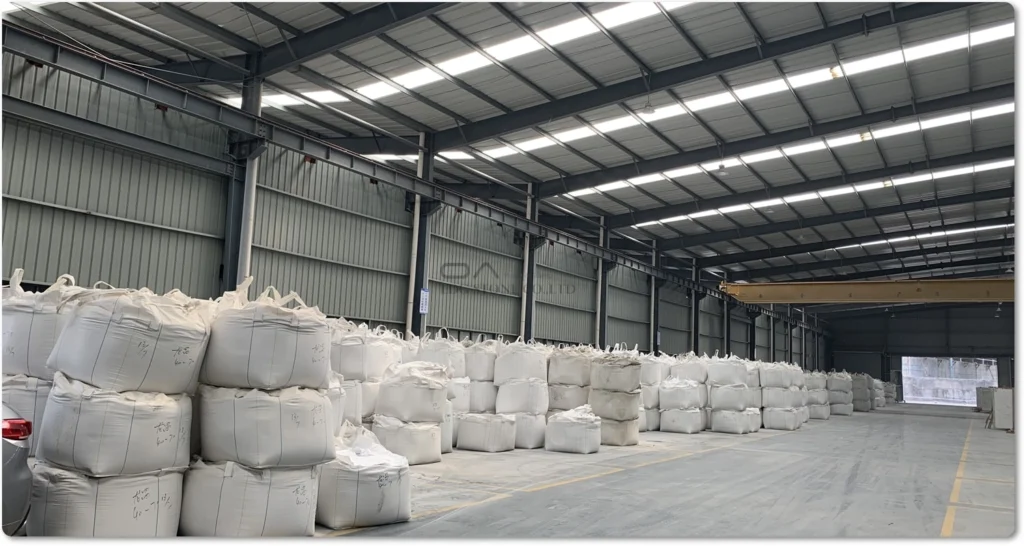
Engineered quartz manufacturing requires precise raw material selection. White quartz slabs demand high purity to prevent gray undertones or dark specks in the finished surface.
RAW MATERIAL MIX RATIO
+-------------------------------------------------------------+
| [###########################################.....] 90-93%   | Natural Quartz Aggregates
| [#####...........................................] 7-10%    | Unsaturated Polyester Resin
| [#...............................................] < 1%     | Titanium Dioxide & Pigments
| [#...............................................] < 1%     | Silane Coupling Agents
+-------------------------------------------------------------+
Natural Quartz Aggregates
Quartz ($SiO_2$) forms the structural backbone of every engineered slab. Factories source raw quartz crystals, quartzite deposits, and silica sand. Engineers classify these aggregates by particle size:
Coarse Grits ($1.2 \text{ mm} – 2.5 \text{ mm}$): Provide structural strength and create dimensional depth in speckled designs.
Medium Sands ($0.1 \text{ mm} – 1.2 \text{ mm}$): Fill gaps between coarse particles to increase packing density.
Micro-Powders ($0.005 \text{ mm} – 0.05 \text{ mm}$): Pure silica flour fills microscopic voids, producing a bright white background.
High-purity white quartz must contain over 99.5% silicon dioxide ($SiO_2$). Iron oxide ($Fe_2O_3$) content must remain below 0.02% to avoid yellow staining during thermal curing.
Polymer Binders and Resin Systems
Unsaturated polyester resin (UPR) serves as the matrix that holds quartz grains together. Premium factories use clear, orthophthalic, or isophthalic resins. Isophthalic resins offer stronger UV resistance and lower thermal expansion.
Resin content ranges from 7% to 10% by weight. Using less than 7% resin creates weak binding and surface pinholes. Exceeding 10% resin lowers scratch resistance and causes yellowing under sunlight.
Advanced Pigments and Additives
Achieving bright white tones requires high-purity Titanium Dioxide ($TiO_2$) pigments. Rutile-grade $TiO_2$ provides opacity and resistance to fading.
Factories also add:
Silane Coupling Agents: Improve chemical bonding between organic resins and inorganic quartz grains.
Curing Catalysts: Organic peroxides (such as MEKP) initiate resin polymerization during heating.
UV Stabilizers: Hindered Amine Light Stabilizers (HALS) protect slabs from UV-induced degradation.
Section 2: Precise Dosing, Mixing, and Distribution
Consistent slab quality requires accurate ingredient dosing and homogeneous mixing. Small variations in resin distribution create soft spots or color banding.
+-------------------+      +-------------------+      +-------------------+
|  Aggregate Silos  |      |  Liquid Resin     |      |  Pigments & TiO2  |
+---------+---------+      +---------+---------+      +---------+---------+
          |                          |                          |
          v                          v                          v
+-------------------------------------------------------------------------+
|                  Automated Gravimetric Batching System                  |
+------------------------------------+\------------------------------------+
                                     |
                                     v
+-------------------------------------------------------------------------+
|                High-Intensity Planetary Mixer (10-15 Min)               |
+------------------------------------+------------------------------------+
                                     |
                                     v
+-------------------------------------------------------------------------+
|               Reciprocating Conveyor Distribution System                |
+------------------------------------+------------------------------------+
                                     |
                                     v
+-------------------------------------------------------------------------+
|                         Rubber Moulding Station                         |
+-------------------------------------------------------------------------+
Automated Gravimetric Batching
Modern facilities use computer-controlled load cells to measure dry aggregates and liquid ingredients. Gravimetric systems maintain weight tolerances within $\pm0.1\%$.
Operators store silica sands in dry silos to keep moisture levels below 0.2%. Moist aggregates prevent resin bonding and lead to internal delamination.
High-Intensity Planetary Mixing
Raw materials feed into planetary mixers equipped with dual-rotation blades. Mixing takes place in two phases:
Dry Mixing (3–5 minutes): Quartz grains, fine powders, and pigments blend dry to ensure uniform color distribution.
Wet Mixing (7–10 minutes): Technicians inject pre-measured resin, catalysts, and silanes. High-shear mixers coat every quartz particle with a thin layer of resin.
Temperature control during mixing prevents premature resin curing. Mixers feature cooling jackets that hold batch temperatures between $18^\circ\text{C}$ and $24^\circ\text{C}$.
Material Distribution into Moulds
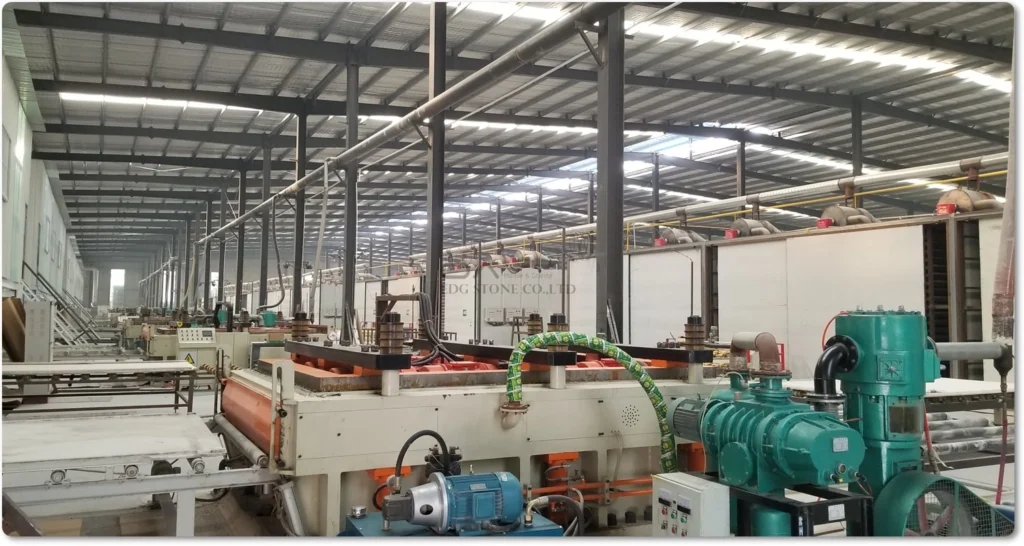
The wet quartz mixture drops onto a moving rubber mould lined with protective paper. A reciprocating distributor spreads the material evenly across the mould.
Levelling rollers adjust the thickness across the width of the slab. Uneven material distribution causes thickness variations and internal stress points during pressing.
Section 3: Vibro-Compression under Vacuum
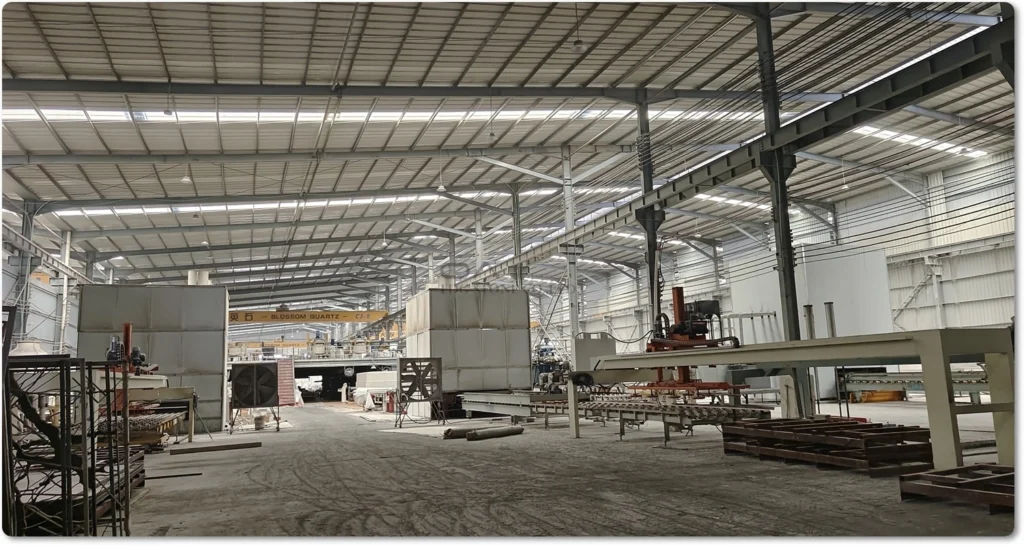
Vibro-compression under vacuum is the core process in engineered quartz manufacturing. It transforms loose aggregate into a dense, non-porous block.
                  Hydraulic Press Ram (100 Tons Force)
                  +-----------------------------------+
                  |                                   |
                  +-----------------+-----------------+
                                    |
+-----------------------------------v-----------------------------------+
|                       Vacuum Chamber (< 50 mbar)                      |
|  +-----------------------------------------------------------------+  |
|  |                 Vibratory Motors (2,000–3,000 RPM)             |  |
|  |  +-----------------------------------------------------------+  |  |
|  |  |                 Wet Quartz Material Mixture               |  |  |
|  |  +-----------------------------------------------------------+  |  |
|  |                 Vibratory Motors (2,000–3,000 RPM)             |  |  |
|  +-----------------------------------------------------------------+  |
+-----------------------------------------------------------------------+
Vacuum Extraction of Micro-Air
The rubber mould enters a sealed vacuum chamber. Pumps drop the internal pressure below $50 \text{ mbar}$ (often reaching $20 \text{ mbar}$). Vacuum extraction removes air pockets trapped inside the wet mix within 60 to 90 seconds.
Removing air prevents internal voids, surface pinholes, and moisture absorption channels.
High-Frequency Vibration and Pressure
While under continuous vacuum, the press applies hydraulic pressure alongside high-frequency vibration:
Hydraulic Pressure: Large pistons press down with force ranging from $800$ to $1,200 \text{ tons}$, applying $2.5\text{–}3.5 \text{ kg/cm}^2$ directly to the material.
Vibratory Frequency: Vibrators operate at $2,000$ to $3,000 \text{ RPM}$. Vibration rearranges the irregular quartz particles into a tightly packed crystalline structure.
The combined action eliminates interstitial space, raising slab density above $2.35 \text{ g/cm}^3$.
Section 4: Thermal Curing and Polymer Cross-Linking
After pressing, the compacted slab enters a curing kiln to harden the polymer matrix.
+-------------------------------------------------------------------------+
| TUNNEL KILN THERMAL profile                                            |
|                                                                         |
| 120°C +----------------------------------------+ Hold Phase (40-60 min) |
|       |                                        |                        |
|  80°C |               Ramp Phase               |       Cooling Phase    |
|       |              /                         |      \                 |
|  25°C +-------------+--------------------------+-------+----------------+
|       0 min         15 min                     75 min  100 min          |
+-------------------------------------------------------------------------+
Curing Temperatures and Heat Profiles
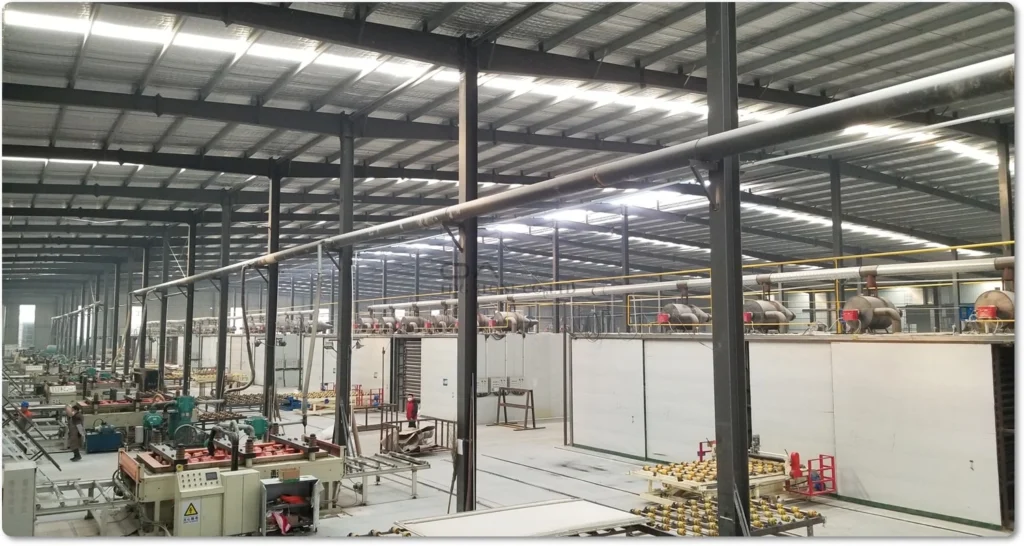
Conveyor belts transport slabs into multi-layer tunnel kilns. Kilns use precise thermal zones to prevent thermal shock and slab warping:
Ramp-Up Zone: Temperature increases gradually from $25^\circ\text{C}$ to $80^\circ\text{C}$ over 15 minutes.
Holding Zone: Temperature holds at $80\text{–}110^\circ\text{C}$ for 40 to 60 minutes, driving the cross-linking reaction.
Cooling Zone: Slabs cool slowly to room temperature to prevent internal stresses.
Unsaturated Polyester Resin + Peroxide Catalyst + Heat ---> 3D Cross-Linked Polymer Matrix
Resin Polymerization
Heat activates the peroxide catalyst, releasing free radicals that trigger cross-linking in the polyester resin. Linear resin chains form a rigid, three-dimensional network around the quartz aggregate.
Full curing gives engineered quartz its high flexural strength ($40\text{–}60 \text{ MPa}$) and impact resistance.
Section 5: Slab Cooling, Gauging, and Surface Calibration
Cured slabs exit the kiln as hard, rough-surfaced blocks. They require structural calibration and surface finishing.
+--------------+     +--------------+     +--------------+     +--------------+
| Cured Slab   | --> | Gauging      | --> | Polishing    | --> | Quality      |
| Cooling Yard |     | Diamonds     |     | Heads (1000+) |     | Inspection   |
+--------------+     +--------------+     +--------------+     +--------------+
Controlled Cooling Phase
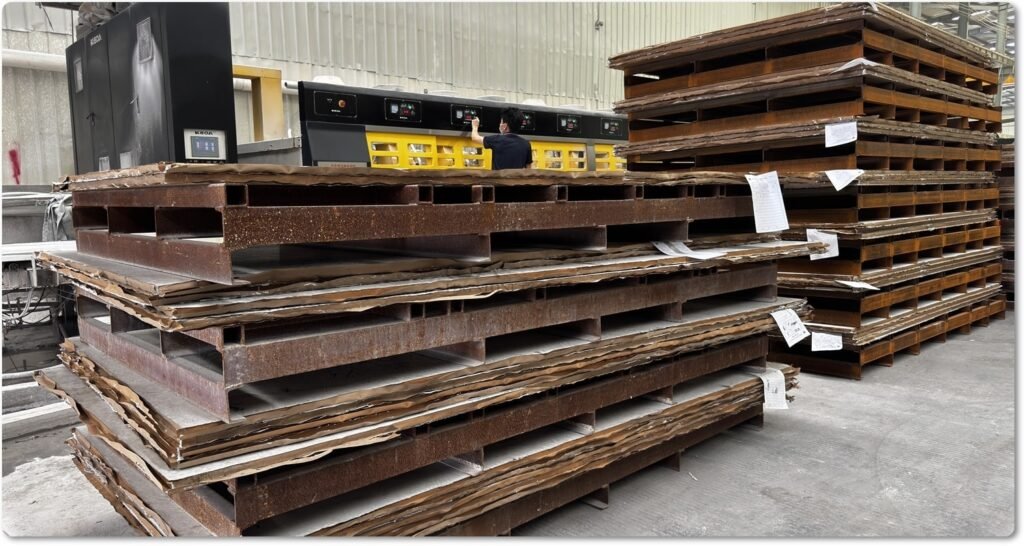
Slabs cool in vertical racks for 24 to 48 hours before processing. Immediate polishing of warm slabs introduces thermal stress, causing micro-fractures along aggregate boundaries.
Calibration and Gauging
Calibrating machines use rotating diamond drum rollers to grind both sides of the slab. This step ensures:
Uniform thickness across the entire surface (typically $15 \text{ mm}$, $20 \text{ mm}$, or $30 \text{ mm}$, with a tolerance of $\pm0.5 \text{ mm}$).
Flat surfaces free from bowing or warping.
Removal of the top resin layer to expose hard quartz particles.
Section 6: Multi-Stage Surface Polishing
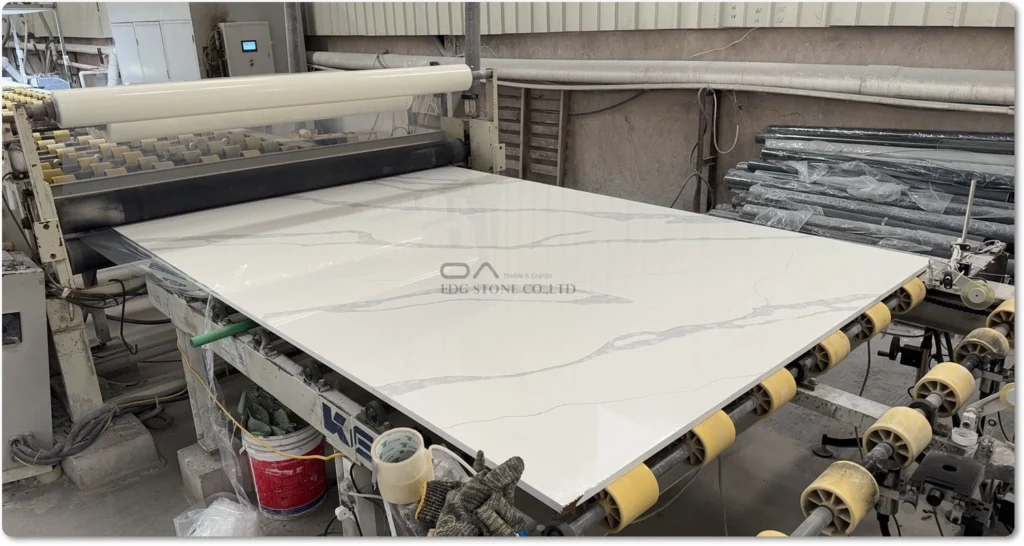
Modern polishing lines use up to 36 sequential heads fitted with diamond and resin abrasive bricks.
POLISHING ABRASIVE SEQUENCE
+-------------------------------------------------------------------------+
| Grit Size | Abrasive Type   | Function                                  |
+-----------+-----------------+-------------------------------------------+
| 36 - 80   | Metal Bond Dia. | Heavy stock removal & leveling            |
| 120 - 220 | Metal Bond Dia. | Scratch removal & surface smoothing       |
| 400 - 800 | Resin Bond Dia. | Pre-polishing & surface refinement        |
| 1500-3000 | Resin Bond Dia. | High-gloss reflection creation            |
| Buff Head | Synthetic Felt  | Final surface sealing & gloss enhancement |
+-------------------------------------------------------------------------+
Grinding and Polishing Sequence
Coarse Grinding (36 to 120 Grit): Removes deep calibration scratches and flattens the surface.
Medium Honing (220 to 600 Grit): Smooths micro-ridges and prepares the slab for optical clarity.
Fine Polishing (800 to 3000 Grit): Refines surface texture, producing high gloss without wax or chemical sealers.
Buffing Stage: Specialized synthetic heads polish the surface to a specular gloss rating above 85 GU (Gloss Units).
Cooling water floods the slab during polishing to flush away stone slurry and prevent localized heating.
Section 7: Rigorous Quality Control and Testing
Every slab undergoes quality control to maintain material standards.
+-------------------------------------------------------------------------+
| QUALITY ASSURANCE CHECKPOINTS                                           |
|                                                                         |
|  [1] Spectrophotometer Color Verification (ΔE < 0.5)                   |
|  [2] Automated Optical Inspection for Contaminants (< 0.2 mm)           |
|  [3] Ultrasonic Thickness and Internal Void Scans                       |
|  [4] Gloss Level Verification Across 9 Reference Points (> 85 GU)        |
+-------------------------------------------------------------------------+
Surface Defect Scans
Automated Optical Inspection (AOI) systems use high-resolution line-scan cameras to inspect finished slabs. The system detects:
Black spots or cross-contaminants larger than $0.2 \text{ mm}$.
Surface pinholes, scratches, or uneven gloss distribution.
Color variations across single slabs and multi-slab batches.
Color spectrophotometers measure $L*a*b*$ color values. Slabs must maintain a color variance of $\Delta E < 0.5$ to ensure consistent tone across large project installations.
Mechanical and Chemical Testing
Quality labs select random sample slabs from each production shift to conduct destructive testing:
Flexural Strength Test (EN 14617-2): Verifies resistance to bending stress under load.
Impact Resistance Test (EN 14617-9): Measures energy absorption from a dropping steel ball.
Water Absorption Test (EN 14617-1): Confirms water absorption remains below $0.03\%$.
Chemical Resistance Test (EN 14617-10): Exposes slabs to acids, bases, and solvents to verify stain resistance.
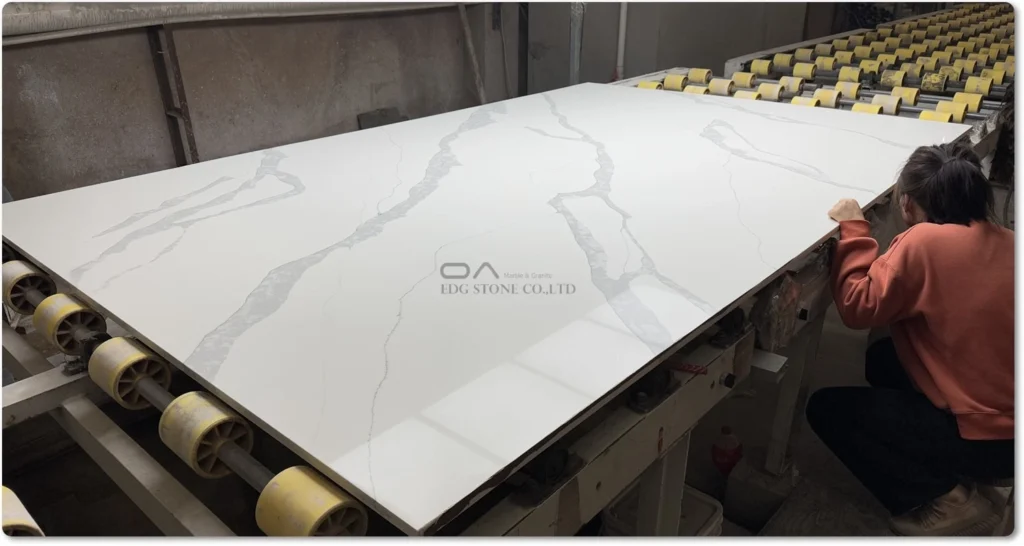
Comparison: Engineered Quartz vs. Natural Stone
Understanding performance differences helps specifiers select appropriate materials for commercial projects.
| Material Property | Engineered White Quartz | Natural White Marble | Natural White Granite |
| Mohs Hardness | 7.0 | 3.0 – 4.0 | 6.0 – 7.0 |
| Water Absorption Rate | < 0.03% | 0.15% – 0.50% | 0.10% – 0.40% |
| Flexural Strength | 40 – 60 MPa | 7 – 15 MPa | 10 – 20 MPa |
| Stain Resistance | High (Non-porous) | Low (Acid sensitive) | Medium |
| UV Resistance | Indoor Only | High | High |
| Color Consistency | Controlled / Uniform | Variable / Natural | Moderate Variable |
Case Study: EDG Stone Factory Case Integration
EDG Stone Factory operates as a global quartz slab manufacturer and exporter, supplying commercial projects with engineered quartz surfaces.
+-------------------------------------------------------------------------+
| EDG STONE FACTORY MANUFACTURING CAPACITY                               |
|                                                                         |
|  Annual Production Output:      > 1,500,000 Square Meters               |
|  Pressing Vacuum Level:        < 30 mbar Constant                       |
|  Thickness Tolerance:          ± 0.3 mm                                 |
|  Export Destination Reach:     60+ Countries Worldwide                  |
+-------------------------------------------------------------------------+
Factory Standards
EDG Stone Factory uses automated vibro-compression equipment and multi-stage vacuum systems. Raw silica feeds into high-precision gravimetric sorters to remove impurities before batching.
Color Management: Electronic colorimeters calibrate tone matching between production runs.
Quality Benchmarks: Slabs undergo 100% surface scanning before protective film application and export packing.
Global Compliance: Production standards meet CE certification and NSF/ANSI Standard 51 requirements for food safety contact.
Through controlled resin dosing and high-density compression, EDG Stone Factory produces engineered quartz slabs that maintain color stability and structural integrity for global distribution.
FAQ Section
Question 1: What causes yellowing in white engineered quartz slabs over time?
Answer: Yellowing stems from resin degradation caused by exposure to direct ultraviolet (UV) light or excessive heat. Polyester resins react to UV radiation, breaking down chemical bonds and shifting color toward yellow tones. High-quality production uses UV-stabilized isophthalic resins and hindered amine light stabilizers (HALS) to minimize this shift in indoor environments.
Evidence: Laboratory exposure tests show that resins without UV stabilizers exhibit color shifts ($\Delta E > 3.0$) after 500 hours of direct UV exposure, while stabilized systems keep color shifts below $\Delta E < 0.8$ under identical conditions.
Summary: UV exposure degrades un-stabilized resin binder systems. Using light-stable resins keeps white quartz bright over long periods.
Question 2: Why is vacuum pressure critical during quartz slab pressing?
Answer: Vacuum pressure removes trapped air bubbles from the wet resin and aggregate mix before compaction. Pressing under atmospheric pressure traps air pockets that form internal voids and surface pinholes. Maintaining vacuum levels below $50 \text{ mbar}$ ensures maximum slab density, lowering water absorption below $0.03\%$.
Evidence: Compaction tests show that pressing at $1,000 \text{ mbar}$ (atmospheric pressure) yields water absorption of $0.25\%$, whereas pressing under $30 \text{ mbar}$ vacuum reduces water absorption to $0.02\%$.
Summary: High vacuum levels eliminate internal air pockets, producing a dense, non-porous structure resistant to water and stains.
Question 3: How does engineered quartz achieve a Mohs hardness rating of 7?
Answer: Engineered quartz achieves its hardness from its high natural quartz content ($90\text{–}93\%$ by weight). Natural quartz measures 7 on the Mohs scale. The surrounding resin acts only as an adhesive binder, allowing the surface to inherit the scratch resistance of crystalline silicon dioxide.
Evidence: Standardized scratch testing (EN 14617-4) confirms that hardened steel blades and copper coins (Mohs 3–5) do not scratch engineered quartz surfaces under typical loads.
Summary: High quartz aggregate ratios allow engineered stone to match the scratch resistance of natural quartz crystals.
Question 4: What is the purpose of adding Silane Coupling Agents during mixing?
Answer: Silane coupling agents act as molecular bridges between organic polyester resin and inorganic quartz grains. One end of the silane molecule bonds with silica, while the other end reacts with the curing polymer chain. This chemical connection improves moisture resistance and structural strength.
Evidence: Flexural testing demonstrates that quartz composites prepared with silane coupling agents achieve flexural strength between $45\text{–}55 \text{ MPa}$, compared to $28\text{–}35 \text{ MPa}$ for mixtures prepared without silanes.
Summary: Silane agents form chemical bonds between quartz and resin, increasing the mechanical strength and moisture resistance of the finished slab.
References
European Committee for Standardization. EN 14617-2: Agglomerated Stone – Test Methods – Part 2: Determination of Flexural Strength. Brussels: CEN, 2016.
European Committee for Standardization. EN 14617-1: Agglomerated Stone – Test Methods – Part 1: Determination of Apparent Density and Water Absorption. Brussels: CEN, 2013.
ASTM International. ASTM C170/C170M-17: Standard Test Method for Compressive Strength of Dimension Stone. West Conshohocken, PA: ASTM International, 2017.
Rabald, E. Corrosion and Chemical Resistance of Composites in Industrial Applications. Applied Materials Science, 2021.
Zhang, L., et al. “Polymer Cross-linking Kinetics in Silica-Filled Composite Materials.” Journal of Applied Polymer Science, vol. 138, no. 14, 2021, pp. 50120–50132.
NSF International. NSF/ANSI Standard 51: Food Equipment Materials. Ann Arbor, MI: NSF International, 2021.
National Kitchen & Bath Association (NKBA). Surfacing Material Benchmarks & Physical Properties Guide. 2023 Edition.
Brevetti Breton S.p.A. Vibro-Compression Vacuum Technology for Compound Stone Production. Technical Specification Manual, 2022.