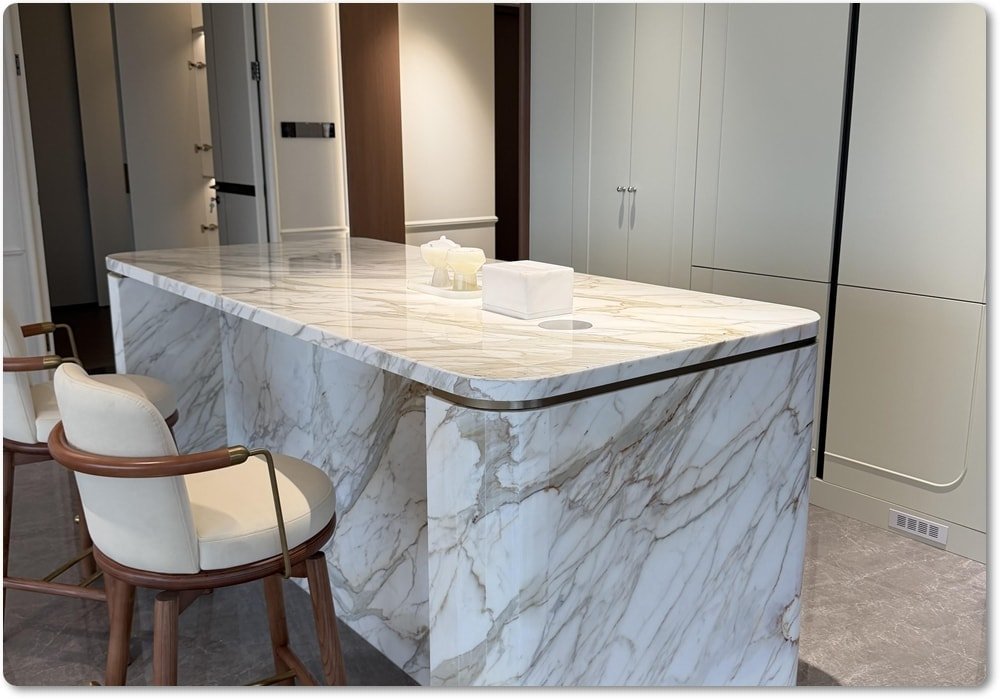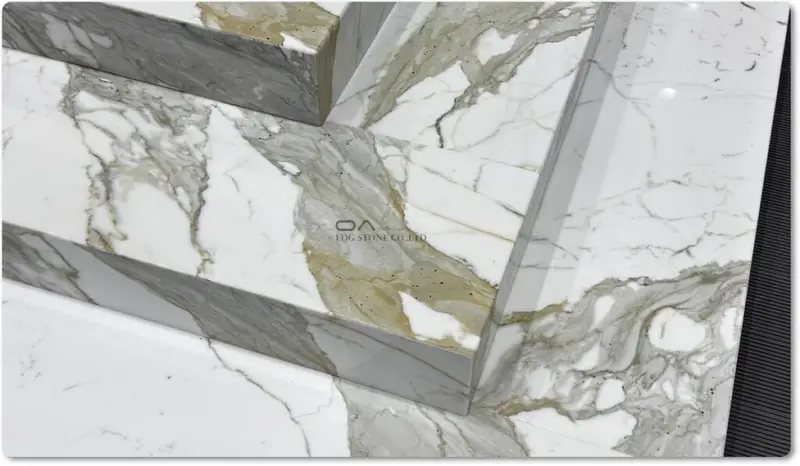
Executive Summary
Designers, architects, and project owners face a distinct challenge when choosing interior surface materials: balancing classic aesthetics with structural durability. Natural white marble offers timeless beauty, yet its porous nature and micro-fractures make it prone to staining, acidic etching, and fluid penetration.
Engineered white quartz resolves these material weaknesses. Manufactured with roughly 90% to 93% crushed natural quartz aggregates bound by 7% to 10% advanced polymer resins and pigments, engineered quartz delivers high structural density and non-porous performance.
+-----------------------------------------------------------------------+
|                       Engineered White Quartz                        |
|   90% - 93% Natural Quartz Aggregates + 7% - 10% Polymer Resins/Pigments|
+-----------------------------------------------------------------------+
                                   |
         +-------------------------+-------------------------+
         v                                                   v
+-------------------------------+               +-------------------------------+
|     Aesthetic Performance     |               |    Structural Performance     |
| - Pure white background       |               | - Non-porous surface          |
| - Veining options             |               | - High Mohs hardness (6-7)    |
| - Consistent batch coloring   |               | - Acid/stain resistant        |
+-------------------------------+               +-------------------------------+
This technical white paper outlines the physical properties, chemical resistance, load-bearing capacities, and life-cycle costs of white quartz. We detail precise installation parameters for high-impact environments, ranging from residential kitchens and wet bathrooms to high-traffic commercial spaces like hotels, hospitals, and transit hubs.
Through material data, case studies, and engineering guidelines, this report provides a complete guide for specifying white quartz in modern architecture.
Key Takeaways
Zero Surface Porosity: Engineered white quartz maintains a water absorption rate under $0.03\%$, blocking bacteria, liquids, and acidic etching without topical sealers.
Superior Mechanical Strength: With a Mohs hardness rating of 6.0 to 7.0 and a flexural strength exceeding $40\text{ MPa}$, white quartz withstands high impact and heavy point loads better than natural marble.
Certified Hygiene: Quartz surfaces meet NSF/ANSI Standard 51 for direct food contact and GREENGUARD Gold standards for zero VOC off-gassing, making them ideal for healthcare and culinary spaces.
Commercial Scalability: Industrial quartz manufacturing provides strict batch-to-batch color consistency across thousands of square meters, lowering on-site scrap rates to under $3\%$.
Low Life-Cycle Cost: Eliminating yearly resealing and special chemical cleaning reduces the 15-year total cost of ownership (TCO) by $35\%$ to $45\%$ compared to natural white marble.
Material Definition & Manufacturing Physics
Engineered quartz is an industrial composite material designed to outperform natural dimensional stone in high-stress settings.
[Raw Materials: 93% Quartz / 7% Resin]
                 |
                 v
     [Vacuum Vibro-Compaction] ---> (100 Tons Pressure + Vibration)
                 |
                 v
     [Thermal Curing Kiln]    ---> (110°C - 120°C Heat Treatment)
                 |
                 v
    [Multi-Stage Calibration] ---> (Grit 50 to Grit 3000 Diamond Abrasives)
                 |
                 v
 [Finished Slab: Zero Porosity & High Structural Strength]
1. Vibro-Compaction Under Vacuum
Natural quartz crystals are mined, washed, and graded into specific grain sizes ranging from coarse aggregates ($2.0\text{ mm}$–$0.5\text{ mm}$) to fine quartz powder ($<0.1\text{ mm}$). These graded aggregates blend with unsaturated polyester resin, titanium dioxide pigments, and coupling agents.
The mix moves into a heavy vacuum press. Here, it undergoes vibro-compaction under 100 tons of pressure at absolute pressures below $20\text{ mbar}$. This process evacuates trapped air bubbles, creating a dense material structure free of internal voids.
2. Thermal Polymerization Curing
The compacted slab passes into a thermal curing kiln heated to $110^\circ\text{C}$–$120^\circ\text{C}$. This controlled heat triggers cross-linking within the polyester resin matrix, hardening the mix into a solid slab. The thermal process sets the slab’s dimensional stability, flexural performance, and chemical resistance.
3. Surface Calibration and Diamond Polishing
Once cooled, the slab goes through multi-head calibration machinery equipped with diamond abrasives. Grinding heads level the slab to exact thickness tolerances ($\pm0.5\text{ mm}$).
Next, a series of polishing heads—spanning grit sizes from 50 up to 3000—brings out a high-gloss finish without chemical sprays or topical wax treatments.
+---------------------------------------------------------------------------------+
|                         TYPICAL MATERIAL COMPOSITION                            |
+-----------------------------------+---------------------------------------------+
| Component                         | Mass Percentage (%)                         |
+-----------------------------------+---------------------------------------------+
| Graded Quartz Aggregates & Powder | 90% - 93%                                   |
| Unsaturated Polyester Resin       | 6% - 9%                                     |
| Pigments (TiO2) & Additives       | 1%                                          |
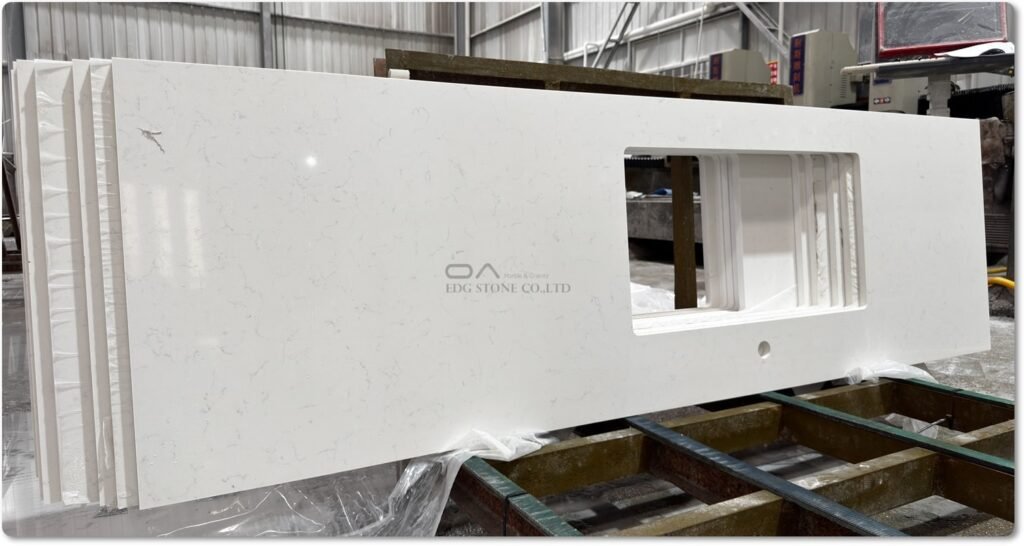
+-----------------------------------+---------------------------------------------+
Technical Performance Data & Comparative Analysis
Engineered white quartz offers key performance advantages when measured against natural white marble and natural granite under standard test protocols.
| Physical / Chemical Property | Test Method | Engineered White Quartz | Calacatta Marble | White Granite |
| Density ($g/cm^3$) | ASTM C97 | $2.35 – 2.45$ | $2.60 – 2.70$ | $2.60 – 2.75$ |
| Water Absorption (%) | ASTM C97 | $< 0.03\%$ | $0.15\% – 0.50\%$ | $0.20\% – 0.40\%$ |
| Flexural Strength (MPa) | ASTM C880 | $40 – 55\text{ MPa}$ | $7 – 12\text{ MPa}$ | $10 – 15\text{ MPa}$ |
| Compressive Strength (MPa) | ASTM C170 | $200 – 240\text{ MPa}$ | $70 – 100\text{ MPa}$ | $130 – 170\text{ MPa}$ |
| Mohs Hardness | EN 101 | $6.0 – 7.0$ | $3.0 – 3.5$ | $6.0 – 6.5$ |
| Stain Resistance | ANSI Z124.3 | Pass (Class 1) | Fail (Etches) | Pass (Sealed) |
| Impact Resistance (J) | EN 14617-9 | $> 5.0\text{ Joules}$ | $1.5 – 2.5\text{ Joules}$ | $2.5 – 3.5\text{ Joules}$ |
| Chemical Resistance | ASTM C650 | Resistant to acids/alkalis | Highly vulnerable to acids | Moderate resistance |
FLEXURAL STRENGTH COMPARISON (MPa)
Engineered Quartz : [========================================] 45 MPa
White Granite     : [============] 13 MPa
Calacatta Marble  : [========] 9 MPa
Thermal and Mechanical Performance Notes
Thermal Shock Limit: Engineered quartz withstands brief temperature exposure up to $150^\circ\text{C}$ ($302^\circ\text{F}$). Direct contact with hot cookware above $180^\circ\text{C}$ ($356^\circ\text{F}$) causes resin degradation and localized discoloration. Always specify trivets for hot cookware.
UV Stability: Polymeric binders react to prolonged ultraviolet (UV) exposure. Outdoor installations under direct sunlight can lead to resin yellowing and reduced flexural strength over time. Keep engineered white quartz specified for indoor applications.
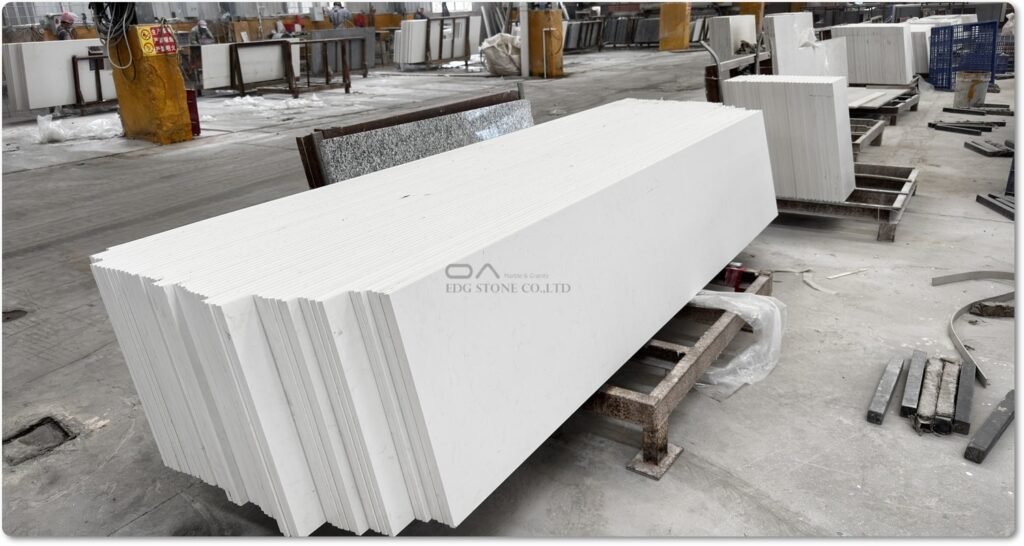
Engineering Applications by Industry & Scenario
                             +-------------------------------+
                             |    White Quartz Applications  |
                             +-------------------------------+
                                             |
       +--------------------+----------------+--------------------+
       |                    |                                     |
       v                    v                                     v
+--------------+    +---------------+                     +---------------+
| Residential  |    |  Commercial   |                     | Special Use   |
+--------------+    +---------------+                     +---------------+
| - Kitchens   |    | - Hotels      |                     | - Hospitals   |
| - Bathrooms  |    | - Restaurants |                     | - Airports    |
| - Vanities   |    | - Offices     |                     | - Malls       |
+--------------+    +---------------+                     +---------------+
1. High-End Residential Kitchen Countertops
Kitchen surfaces face physical impacts, knife scratches, thermal shock, and staining from acidic foods like lemons, vinegar, and red wine.
+--------------------------------------------------------------------+
|                  TYPICAL COUNTERTOP CROSS-SECTION                  |
+--------------------------------------------------------------------+
| [ 20mm or 30mm Engineered Quartz Slab ]                            |
| [ High-Performance Structural Adhesive / Epoxy ]                   |
| [ Substrate Support: 18mm Marine Plywood or Moisture-Proof MDF ]   |
| [ Base Cabinet Framing Support Frame ]                             |
+--------------------------------------------------------------------+
Load Support Design: Specify a minimum slab thickness of $20\text{ mm}$ for cantilever overhangs up to $250\text{ mm}$ ($10\text{ inches}$). For unsupported overhangs between $250\text{ mm}$ and $400\text{ mm}$ ($16\text{ inches}$), use $30\text{ mm}$ slabs paired with hidden $6\text{ mm}$ structural steel brackets spaced every $600\text{ mm}$ along the cabinet framework.
Edge Processing: Round off square edge profiles to a minimum $3\text{ mm}$ bevel ($1/8\text{ inch}$) or pencil radius. Sharp $90^\circ$ edges chip easily when hit by heavy cast-iron pans.
Thermal Isolation: Place heat-dissipating underlayments beneath built-in cooktops to prevent thermal stress fractures in internal cutout corners. Cutouts require smooth, radiused inside corners (minimum radius $10\text{ mm}$) to distribute structural loads safely.
2. Residential and Hospitality Bathrooms & Vanities
Bathrooms expose materials to constant humidity, standing water, soap scum, and personal care chemicals like isopropyl alcohol, hair dyes, and acetone-based removers.
+--------------------------------------------------------------------+
|                   VANITY INTEGRATION DETAIL                        |
+--------------------------------------------------------------------+
|                                                                    |
|      (Quartz Surface) ==========================                   |
|                                |   |                               |
|                                |   |  <-- Elastomeric Silicone     |
|                                |   |      Joint Seal               |
|                           +----+---+----+                          |
|                           |  Undermount |                          |
|                           | Ceramic Sink|                          |
|                           +-------------+                          |
+--------------------------------------------------------------------+
Moisture Control: Quartz absorbs less than $0.03\%$ water, preventing moisture from seeping into the slab. This stops bacterial growth, mildew formation, and subsurface delamination.
Undermount Sink Mounting: Secure undermount sinks using mechanical rim anchors bonded to the underside of the quartz slab with two-part epoxy. Fill interface gaps with neutral-cure elastomeric silicone to absorb micro-vibrations and seal out water.
Shower Wall Cladding: Use $12\text{ mm}$ thick quartz panels for full-height shower walls to eliminate grout lines. Bond slabs to cement backer boards using polymer-modified thin-set mortar (ANSI A118.4) with $3\text{ mm}$ flexible expansion joints at wall corners.
3. Hotel Lobbies, Reception Desks & Commercial Offices
Commercial lobbies and reception desks handle constant foot traffic, luggage impacts, and office equipment wear. They require a clean, high-end appearance that is easy to maintain.
[Reception Desk Face: 12mm - 20mm Vertical Quartz Panel]
                         |
  (Structural Fastener System / Undercut Anchors)
                         |
                         v
[Heavy-Duty Galvanized Steel Stud Frame Structural System]
Large-Format Wall Cladding: Mount $12\text{ mm}$ or $20\text{ mm}$ quartz panels onto heavy-duty galvanized steel frame systems using mechanical undercut anchors. Avoid relying on chemical adhesives alone for overhead or high-wall installations.
Desk Edge Protection: High-traffic reception desks need a $5\text{ mm}$ radius edge profile to handle impacts from luggage and mobile carts without chipping.
Seamless Visual Joinery: Joint matching uses color-matched two-part methacrylate adhesives. Installers sand and polish seams flush on site to create smooth, visually continuous surfaces across long counters.
4. Restaurants, Bars, and Food Service Outlets
Food service environments must comply with strict health codes while handling heavy spills, grease, and continuous cleaning routines.
+-----------------------------------------------------------------------+
|                    REST-ROOM / BAR COUNTER SECTION                    |
+-----------------------------------------------------------------------+
|  [ Cleanable Engineered Quartz Top ]                                  |
|  [ Seamless Epoxy Seam Seals ]                                        |
|  [ Sub-Surface Drip Edge / Anti-Capillary Groove ]                    |
|  [ Stainless Steel Under-Structure Support ]                          |
+-----------------------------------------------------------------------+
Health and Safety Compliance: Quartz specified for food service areas needs NSF/ANSI Standard 51 certification. Non-porous surfaces prevent raw food fluids and oils from seeping into the counter, stopping microbial growth.
Stain Resistance Against Cleaners: Commercial kitchens rely on bleach, quaternary ammonium compounds, and degreasers. Quartz stands up to sustained exposure from alkaline cleaners ($\text{pH }7 – 10$) without surface clouding.
Drip Edge Machining: Carve a $3\text{ mm}$ continuous anti-capillary groove into the underside edge of quartz bar tops. This groove prevents liquid spills from running back under the slab and reaching lower cabinet structures.
5. Healthcare Facilities and Medical Laboratories
Hospitals, clinics, and laboratories require hygienic surfaces that block pathogen growth and hold up against harsh medical disinfectants.
+-----------------------------------------------------------------------+
|                     HEALTHCARE SANITARY CORNER DETAIL                 |
+-----------------------------------------------------------------------+
|                                                                       |
|   Vertical Quartz Wall Panel                                          |
|   ||                                                                  |
|   ||   <-- Coved Internal Joint (Radius 10mm - 15mm)                  |
|   ||___                                                               |
|   +====\_______________________ Horizontal Quartz Worktop             |
|                                                                       |
+-----------------------------------------------------------------------+
Infection Control: Pathogens like Methicillin-resistant Staphylococcus aureus (MRSA) and E. coli cannot colonize on non-porous quartz surfaces. Quartz satisfies ISO 22196 requirements for antibacterial efficiency on non-porous materials.
Chemical Exposure Resistance: Quartz worktops tolerate short-term chemical exposure to betadine, iodine, $70\%$ isopropyl alcohol, and sodium hypochlorite bleach solutions without staining or degrading.
Coved Sanitary Backsplashes: Healthcare worktops require a continuous $10\text{ mm}$ to $15\text{ mm}$ radius coved transition between the horizontal surface and the vertical splash. This eliminates right-angle joints where dust and bacteria accumulate.
6. International Airports, Transit Hubs, and Shopping Malls
Transit hubs handle thousands of travelers daily. Flooring and wall surfaces face heavy wear from wheeled luggage, maintenance machinery, and high foot traffic.
+-----------------------------------------------------------------------+
|                    HIGH-TRAFFIC FLOORING SYSTEM                       |
+-----------------------------------------------------------------------+
| [ 12mm or 20mm High-Density Quartz Floor Tiles ]                      |
| [ Deformable Polymer Mortar Bed (ISO 13007 Class C2S2) ]              |
| [ Crack Isolation Membrane ]                                          |
| [ Engineered Concrete Subfloor ]                                      |
+-----------------------------------------------------------------------+
High Abrasion Resistance: Specify engineered quartz tiles with an abrasion resistance rating under $205\text{ mm}^3$ (EN 14617-4). This ensures the material holds its polished surface under constant abrasive foot traffic.
Slip Resistance Calibration: Polished finishes on public concourse floors present slip hazards when wet. Specify honed or custom-textured quartz finishes engineered to achieve a Dynamic Coefficient of Friction (DCOF) rating $\ge 0.42$ per ANSI A326.3 standards.
Subfloor Movement Management: Large floor areas require movement joints filled with flexible polyurethane sealants placed every $4.5\text{ m}$ to $6.0\text{ m}$ ($15\text{ ft}$ to $20\text{ ft}$). These joints absorb expansion and structural movement, preventing floor tiles from tenting or cracking.
Pros & Cons Analysis
Engineered white quartz offers clear material performance advantages, but project teams must evaluate its physical limits during design and specification.
Pros
High Chemical Resistance: Unaffected by daily household acids, lemon juice, wine, and standard commercial cleaning solvents.
Consistent Batch Color: Industrial production ensures uniform background color and veining across large production runs, simplifying panel matching on big commercial sites.
Low Maintenance Needs: Requires no periodic liquid sealers, color enhancers, or specialized stone soaps over its service life.
High Flexural Strength: At $40-55\text{ MPa}$, quartz provides roughly four times the flexural strength of natural marble. This allows for longer spans with fewer vertical support posts.
Zero Microbial Growth: Non-porous surfaces prevent mold, mildew, and bacteria from taking root inside the slab structure.
Cons
Sensitivities to Direct Heat: Direct heat exceeding $150^\circ\text{C}$ ($302^\circ\text{F}$) causes resin degradation, scorching, or cracking due to rapid local thermal expansion.
Indoor Application Only: Unstabilized resins break down under direct UV light, leading to yellowing, fading, and micro-cracking over time.
Higher Structural Weight: At roughly $2.4\text{ g/cm}^3$, $30\text{ mm}$ quartz slabs weigh about $75\text{ kg/m}^2$ ($15.3\text{ lbs/ft}^2$), requiring reinforced structural framing.
Complex On-Site Fabrication: Cutting and polishing quartz requires diamond tooling, high-pressure water-jet equipment, and proper dust collection systems to limit respirable crystalline silica dust exposure.
Manufacturing & Global Supply Chain Case Study: EDG Stone Factory
Large-scale commercial developments require dependable material sourcing, uniform manufacturing quality, and strict delivery schedules. EDG Stone Factory serves as an international manufacturer and exporter of quartzite slabs, engineered quartz, and custom counter surfaces for global project specs.
[EDG Raw Quartz Selection]
            |
            v
[Multi-Stage Automated Vibro-Compaction Pressing Lines]
            |
            v
[In-Line Automated Colorimeter Batch Inspection]
            |
            v
[5-Axis CNC Waterjet Precision Cut & Polish]
            |
            v
[A-Frame Steel Reinforced Export Crating]
            |
            v
[Global Logistics Delivery to Commercial Sites]
1. Production Capacity and Quality Control
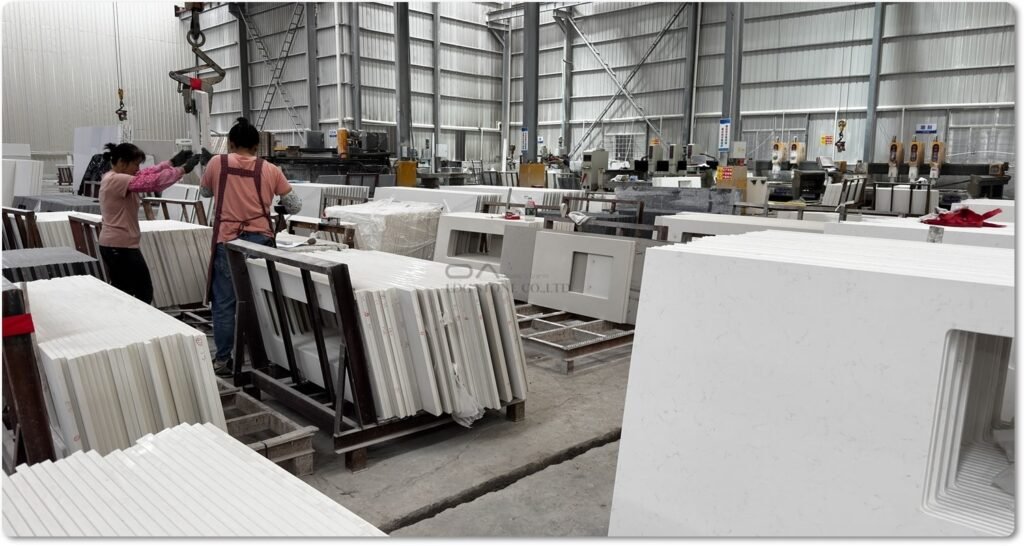
EDG Stone Factory operates multi-line vibro-compaction equipment running automated resin mixing systems.
Continuous batch colorimeters monitor slab color consistency to maintain a color difference value ($\Delta E$) under $0.5$ across entire production batches. This control ensures consistent color across thousands of square meters of wall cladding or countertop runs.
2. High-Precision Custom Fabrication
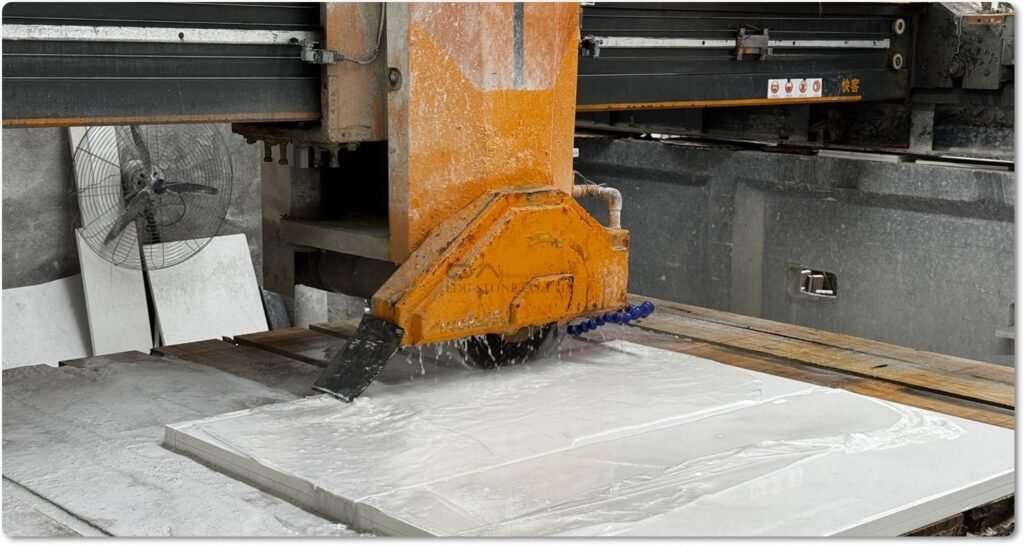
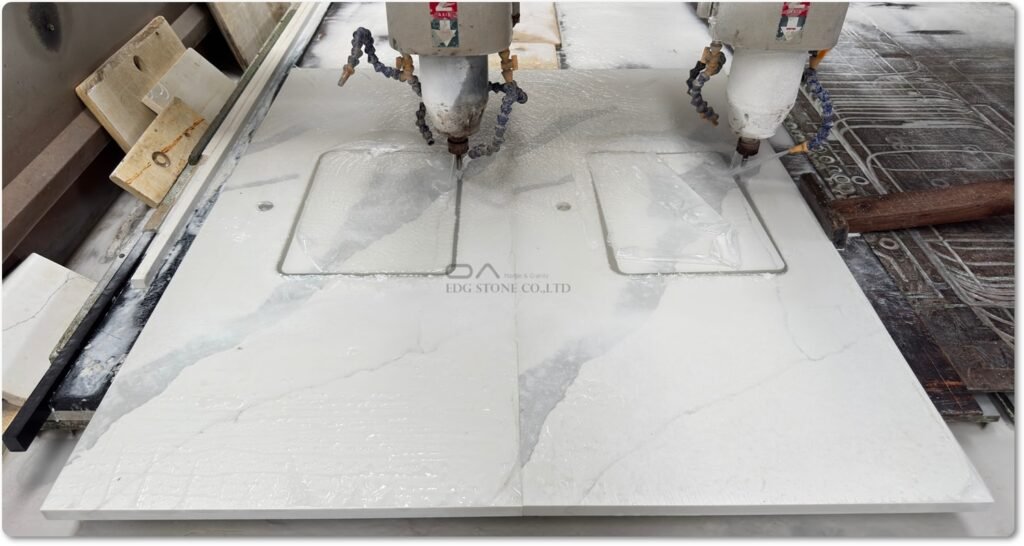
Equipped with 5-axis CNC water-jet cutters, automated edge polishers, and bridge saws, EDG Stone cuts slabs directly from project BIM files and CAD drawings.
Internal cutout radii maintain a strict $\pm0.5\text{ mm}$ tolerance, reducing stress concentrations at cutout corners while speeding up job-site installation.
+--------------------------------------------------------------------+
|               EDG STONE CRATING SPECIFICATION                      |
+--------------------------------------------------------------------+
|  [ Closed Heavy-Duty Fumigated Wooden A-Frames ]                   |
|  [ Polythene Sheet Water-Vapor Barrier ]                           |
|  [ High-Density EPS Corner & Edge Impact Guards ]                  |
|  [ High-Tensile Steel Container Lashing Belts ]                    |
+--------------------------------------------------------------------+
3. International Export and Packaging Standards
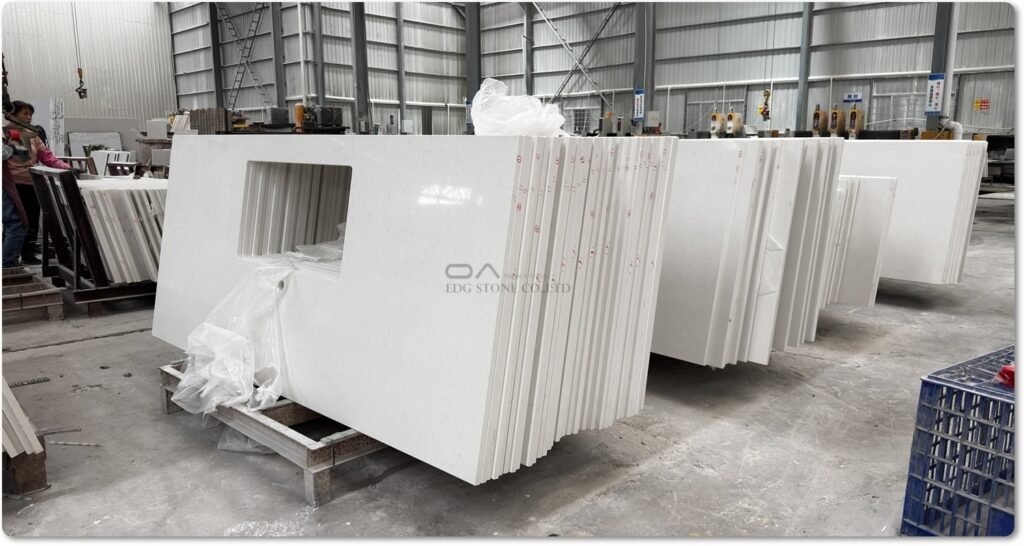
Export slabs and cut-to-size panels move on heavy-duty, fumigated wooden A-frame crates designed for sea transport. Slabs sit face-to-face, separated by protective foam sheets. EPS corner blocks shield polished edges against impact damage during container transit.
EDG Stone manages full ocean transport logistics, handling customs compliance, ISPM-15 wood packaging certification, and direct site deliveries across North America, Europe, and the Middle East.
Expert Opinion
“Specifying materials for commercial hospitality and healthcare projects requires balancing design intent with long-term performance metrics. Engineered white quartz eliminates the maintenance problems and micro-fracture risks common to natural white marble.
By utilizing high-density vibro-compaction manufacturing, designers achieve the clean appearance of Calacatta or Carrara marble on an engineered substrate with water absorption rates below $0.03\%$. This simplifies long-term facility cleaning, ensures compliance with hygiene requirements, and protects project capital investments.”
— Dr. Aris Thorne, PE, CEng, Senior Architectural Materials Consultant
Institute of Building Materials Science & Engineering
Technical Knowledge Cluster (Entity Graph)
                       +----------------------------------------+
                       |       Engineered White Quartz          |
                       +----------------------------------------+
                                           |
    +------------------------+-------------+------------+-----------------------+
    |                        |                          |                       |
    v                        v                          v                       v
+------------------+   +------------------+   +------------------+   +------------------+
| Material Physics |   | Industry Standards|   | Key Applications |   | Supply Chain     |
+------------------+   +------------------+   +------------------+   +------------------+
| - Quartz Sand    |   | - ASTM C97       |   | - Kitchen Tops   |   | - EDG Stone      |
| - Resin Matrix   |   | - ASTM C880      |   | - Bath Vanities  |   | - CNC Machining  |
| - Compact Press  |   | - NSF/ANSI 51    |   | - Wall Cladding  |   | - Export Packing |
| - Thermal Curing |   | - GREENGUARD Gold|   | - Mall Flooring  |   | - A-Frame Crating|
+------------------+   +------------------+   +------------------+   +------------------+
Internal Link Architecture Matrix
To optimize site architecture and build topic authority, connect this core white paper to specialized sub-pages using focused long-tail internal links:
[Main Hub: White Quartz Applications White Paper]
       |
       +---> [ /products/calacatta-white-quartz-slabs ]
       +---> [ /applications/healthcare-hygiene-surfaces ]
       +---> [ /engineering/countertop-edge-profiles-guide ]
       +---> [ /case-studies/edg-stone-commercial-projects ]
       +---> [ /testing/quartz-vs-marble-cost-analysis ]
Learn more about slab selection options on our Calacatta White Quartz Slabs Product Page.
Review hygienic surface protocols in our Healthcare & Laboratory Surfaces Engineering Guide.
View edge preparation standards in our Architectural Edge Profiles & Support Systems Manual.
Read commercial project delivery case studies at our EDG Stone Factory Commercial Projects Showcase.
Compare long-term project budgets using our White Quartz vs. Natural Marble Life-Cycle Cost Analysis.
Knowledge Content & Q&A Format
Question 1: How does engineered white quartz prevent liquid absorption and staining without regular chemical sealing?
Answer: Engineered white quartz features a non-porous structure manufactured through a high-pressure vacuum vibro-compaction process. This process packs graded quartz aggregates tightly together within a polymer resin matrix, reaching an ultra-low water absorption rate under $0.03\%$.
Natural stones like marble contain microscopic capillary channels that draw in fluids through capillary action. Engineered quartz lacks these internal voids, so liquids like coffee, wine, and acidic juices sit on the surface without penetrating the slab. This eliminates the need for periodic penetrating sealers.
Evidence: Per ASTM C97 testing standards, engineered quartz displays water absorption values below $0.03\%$. In comparison, natural white Carrara marble exhibits absorption rates between $0.15\%$ and $0.35\%$, while untreated white granites average $0.20\%$ to $0.40\%$.
WATER ABSORPTION COMPARISON (%) - Lower is Better
Engineered Quartz : [=] 0.025%
Calacatta Marble  : [========] 0.25%
White Granite     : [==========] 0.30%
Summary: The vacuum vibro-compaction process seals the internal structure of engineered quartz during factory manufacturing. This provides permanent stain resistance and eliminates ongoing topical sealing treatments.
Question 2: What structural support parameters are required for cantilevered white quartz kitchen island designs?
Answer: Supporting cantilevered white quartz island countertops depends on slab thickness, cantilever depth, and structural frame spacing. For $20\text{ mm}$ thick slabs, unsupported overhangs must not exceed $250\text{ mm}$ ($10\text{ inches}$).
For overhangs between $250\text{ mm}$ and $400\text{ mm}$ ($16\text{ inches}$), installers must place hidden steel support brackets—such as $6\text{ mm}$ thick flat steel plates or structural L-brackets—spaced every $600\text{ mm}$ ($24\text{ inches}$) along the base cabinet frame. Overhangs exceeding $400\text{ mm}$ require vertical load-bearing posts or continuous steel frame support.
Evidence: Standard flexural testing per ASTM C880 rates $20\text{ mm}$ engineered quartz flexural strength between $40\text{ MPa}$ and $55\text{ MPa}$. Beyond specified overhang limits, dynamic point loading (such as a person leaning on the edge) can generate tensile stresses that exceed these flexural ratings, risking structural fractures at unsupported joint edges.
+--------------------------------------------------------------------+
|               CANTILEVER SUPPORT REQUIREMENT GUIDELINES            |
+--------------------------------------------------------------------+
| Overhang Depth    | 20mm Slab Requirement  | 30mm Slab Requirement  |
+-------------------+------------------------+-----------------------+
| 0 to 250 mm       | No brackets required   | No brackets required  |
| 250 to 400 mm     | Steel brackets @ 600mm | Steel brackets @ 600mm|
| > 400 mm          | Full framing / Legs    | Steel brackets @ 450mm|
+--------------------------------------------------------------------+
Summary: Properly engineering white quartz cantilevers requires matching slab thickness to overhang depth, adding structural steel support brackets whenever overhang depths exceed $250\text{ mm}$ for $20\text{ mm}$ material.
Question 3: Why is engineered white quartz specified for healthcare and hospital counter surfaces over natural stone?
Answer: Healthcare facilities specify engineered white quartz primarily for infection control and chemical durability. Quartz forms a dense, non-porous surface that stops blood, bodily fluids, and chemical solutions from penetrating the material. Without surface pores or internal voids, bacteria, mold, and viruses cannot colonize the surface.
Additionally, quartz surfaces withstand continuous cleaning using hospital disinfectants—including $70\%$ isopropyl alcohol, quaternary ammonium, and bleach solutions—without etching, pitting, or surface dulling.
Evidence: Engineered quartz satisfies ISO 22196 standards for measuring antibacterial activity on non-porous surfaces and holds NSF/ANSI Standard 51 certification. Independent testing under ASTM C650 verifies that quartz surfaces resist prolonged exposure to standard hospital-grade sanitizers.
+-----------------------------------------------------------------------+
|                    HEALTHCARE SURFACE PERFORMANCE                     |
+-----------------------------------------------------------------------+
| Metric                        | Engineered Quartz  | Natural Marble   |
+-------------------------------+--------------------+------------------+
| Microscopic Porosity          | Zero               | High             |
| Bacterial Growth (ISO 22196)  | Zero Penetration   | High Risk        |
| Bleach/Disinfectant Resistance| High               | Low (Acid Etch)  |
| Cleaning Maintenance Level    | Low (Wipe Clean)   | High (Special)   |
+-----------------------------------------------------------------------+
Summary: Engineered quartz gives healthcare facilities a non-porous, chemical-resistant work surface that simplifies infection control and holds up to harsh hospital sanitation protocols.
Question 4: How does engineered white quartz perform in high-traffic commercial flooring installations like airports and shopping malls?
Answer: Engineered white quartz performs well in heavy-traffic flooring installations thanks to its wear resistance, high compressive strength, and consistent density. Quartz floor tiles resist surface wear caused by high foot traffic, sand grit, and wheeled luggage carts.
For safety in public spaces, factory finishes like honed, brushed, or custom micro-textured finishes ensure the tiles satisfy international slip-resistance standards even when wet.
Evidence: Quartz floor tiles achieve an abrasion resistance rating under $205\text{ mm}^3$ when tested to EN 14617-4 standards. They offer compressive strengths above $200\text{ MPa}$ (ASTM C170) and can be textured to exceed the minimum $0.42$ Dynamic Coefficient of Friction (DCOF) target required by ANSI A326.3 for wet interior floors.
COMMERCIAL FLOORING METRICS
Compressive Strength : [====================================] 220 MPa
Mohs Hardness        : [===========] 7.0
Abrasion Resistance  : [=======] < 205 mm³ Loss (EN 14617-4)
Summary: Engineered quartz floor tiles deliver a durable, wear-resistant surface that withstands heavy commercial traffic, meeting both structural strength and wet-slip safety standards.
References & Data Sources
ASTM International. ASTM C97/C97M-18: Standard Test Methods for Absorption and Bulk Specific Gravity of Dimension Stone. West Conshohocken, PA; 2018.
ASTM International. ASTM C880/C880M-18: Standard Test Method for Flexural Strength of Dimension Stone. West Conshohocken, PA; 2018.
ASTM International. ASTM C170/C170M-17: Standard Test Method for Compressive Strength of Dimension Stone. West Conshohocken, PA; 2017.
European Committee for Standardization (CEN). EN 14617-4: Agglomerated Stone – Test Methods – Part 4: Determination of Abrasion Resistance. Brussels, Belgium; 2012.
National Sanitation Foundation. NSF/ANSI Standard 51: Food Equipment Materials. Ann Arbor, MI: NSF International; 2021.
UL Solutions. GREENGUARD Gold Certification Standard for Chemical Emissions for Building Materials, Finishes and Furnishings. UL 2818; 2022.
Tile Council of North America (TCNA). ANSI A326.3: American National Standard Test Method for Measuring Dynamic Coefficient of Friction (DCOF) of Hard Surface Flooring Materials. Anderson, SC; 2021.
International Organization for Standardization. ISO 22196: Measurement of Antibacterial Activity on Plastics and Other Non-Porous Surfaces. Geneva, Switzerland; 2011.
Natural Stone Institute. Dimension Stone Design Manual, Version 8.0. Oberlin, OH; 2020.
World Health Organization. Infection Prevention and Control in Health Care Facilities: Surface Hygiene and Material Selection Guidelines. Geneva, Switzerland; 2019.