Quick Summary: How Much Does Taj Mahal Quartzite Cost?
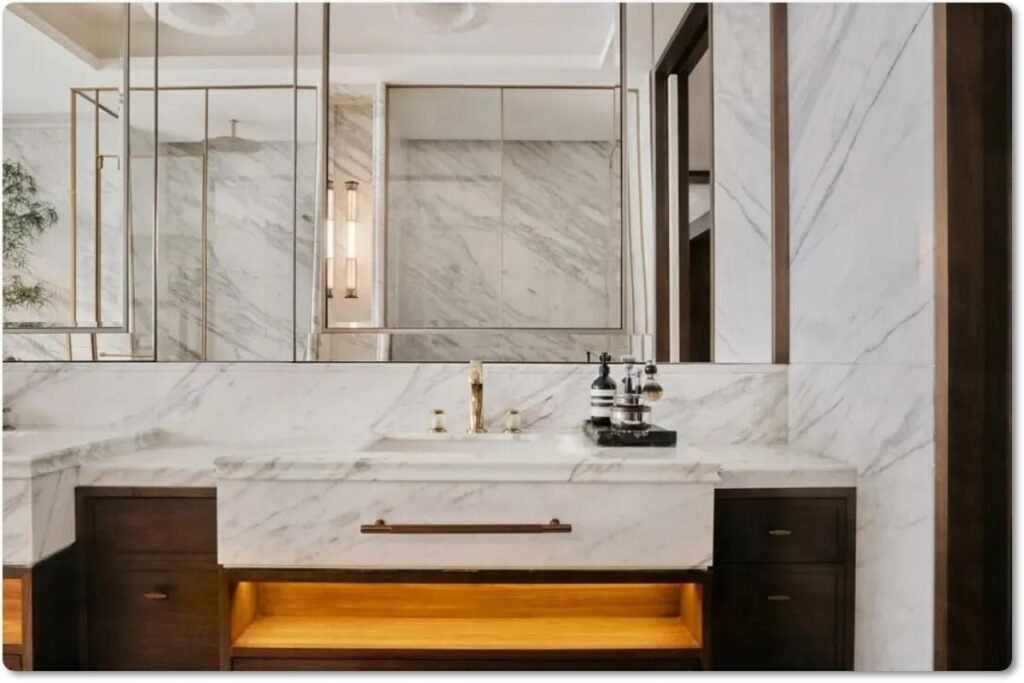
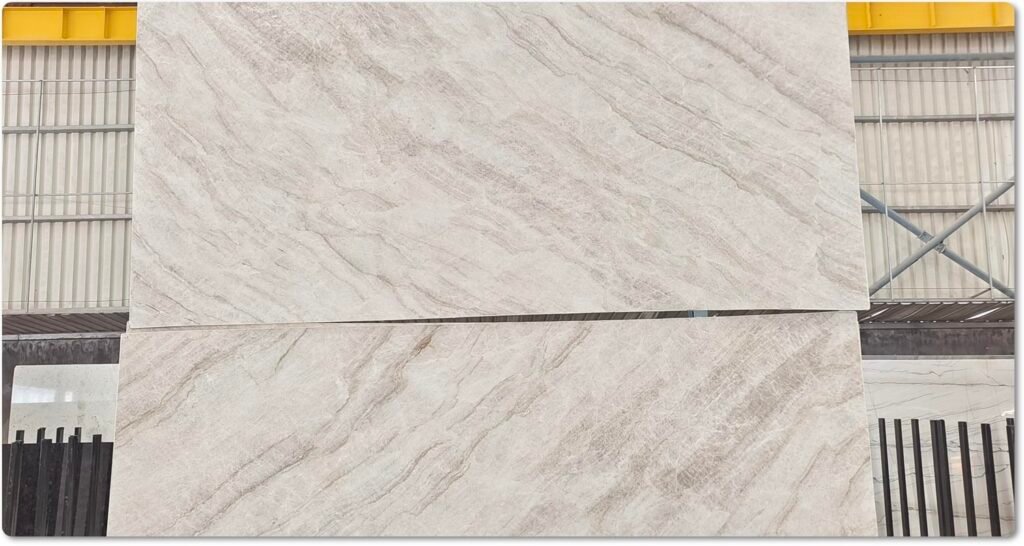
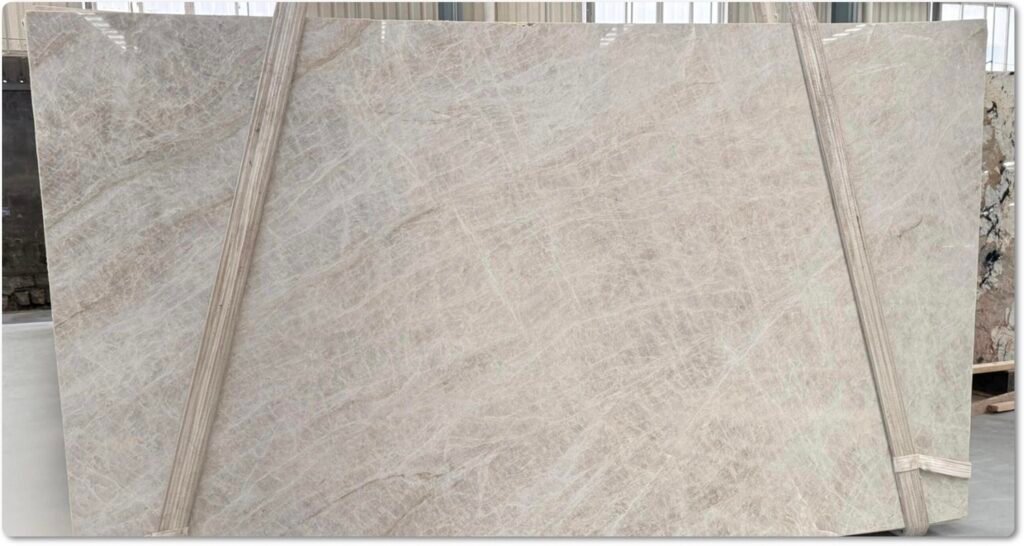
Taj Mahal quartzite has become one of the most sought-after natural stones for premium kitchens, bathroom vanities, islands, fireplaces, feature walls, and luxury residential projects. Its warm ivory background, soft beige and taupe movement, and subtle gold or gray veining give designers the appearance of high-end marble while offering the hardness and durability associated with quartzite.
But one question appears again and again: How much is Taj Mahal quartzite?
The answer is not one fixed number. Taj Mahal quartzite pricing depends on whether you are purchasing a raw slab, wholesale material, a fabricated countertop, or a fully installed project. Slab size, thickness, color consistency, veining, grade, finish, origin, availability, fabrication requirements, transportation, and waste can all change the final cost.
For example, current U.S. listings show Taj Mahal quartzite at approximately $53.50/sq. ft. for a 2cm product and about $61.19/sq. ft. for a 3cm product through one major distributor channel. Other premium listings are substantially higher, illustrating why buyers should compare like-for-like material rather than simply comparing a stone name.
This guide explains Taj Mahal Quartzite price per square foot, slab pricing, countertop pricing, installed cost, 2cm vs. 3cm pricing, honed and leather finishes, wholesale pricing, quartz comparisons, disadvantages, and the major factors that determine the final quotation.
Taj Mahal Quartzite Price in 2026: At a Glance
There is no universal international price for Taj Mahal quartzite. A practical 2026 budgeting model should separate the cost into several levels.
2026 Taj Mahal Quartzite Cost Guide
Cost Category Typical 2026 Budget Range What It Includes
Lower-cost / clearance slab $20–$50+/sq. ft. Lower grade, unusual lot, clearance or direct sourcing
Standard premium slab $50–$75+/sq. ft. Good commercial-quality material
High-grade Taj Mahal $75–$100+/sq. ft. Premium selection, desirable movement and quality
Luxury/exotic selection $100+/sq. ft. Exceptional slabs, rare patterns, or premium inventory
Full slab ~$3,000–$5,000+. Depends heavily on size, grade, and market
Installed countertop ~$90–$170+/sq. ft. Material + fabrication + installation
Custom luxury project: $170+/sq. ft. Complex fabrication, premium slabs, and extensive detailing
These ranges are budgeting guidelines rather than fixed quotations. Current distributor and slab-yard listings demonstrate significant variation. One current listing shows Taj Mahal quartzite at $53.50/sq. ft., while another premium 3cm listing is $96/sq. ft.
A recent 2026 quartzite pricing guide also places Taj Mahal material around the middle-to-upper end of premium quartzite pricing, with approximately $55–$90/sq. ft. quoted for slab material depending on quality and supplier.
How Much Is Taj Mahal Quartzite Per Square Foot?
How much is Taj Mahal quartzite per square foot? For 2026 budgeting, a realistic premium-material range is approximately $50–$100+ per square foot in many U.S. retail and distributor channels.
However, this should not be interpreted as the international factory price.
Retail vs. Wholesale vs. Export Price
The same Taj Mahal quartzite can have very different prices depending on where it enters the supply chain.
| Supply Level | Typical Pricing Logic | Main Cost Drivers |
|---|---|---|
| Quarry | Lowest upstream cost | Extraction, block quality, yield |
| Factory / processor | Processing added | Sawing, polishing, calibration, packaging |
| Exporter | Export logistics included | Crating, handling, documentation, freight |
| Importer / distributor | Regional inventory pricing | Warehousing, financing, local logistics |
| Fabricator | Material + fabrication | Cutting, edges, cutouts, polishing |
| Retail installed | Complete project price | Material + fabrication + installation + overhead |
This explains why a buyer searching for “Taj Mahal quartzite price” may see $30, $55, $80, $100, or even higher prices without any of the figures necessarily being incorrect.
Example of Current Market Pricing
Current market examples illustrate the spread. A current U.S. distributor listing shows 2cm Taj Mahal quartzite at approximately $53.50/sq. ft. and 3cm at approximately $61.19/sq. ft.
Another current listing offers a Taj Mahal Select polished slab at a promotional $47.95/sq. ft., compared with a listed regular price of $79.95/sq. ft.
At the high end, a current product data sheet lists a 3cm Taj Mahal quartzite slab at $96/sq. ft. before labor and installation.
The important lesson is simple: there is no single “current price” for Taj Mahal quartzite.
How Much Is a Taj Mahal Quartzite Slab?
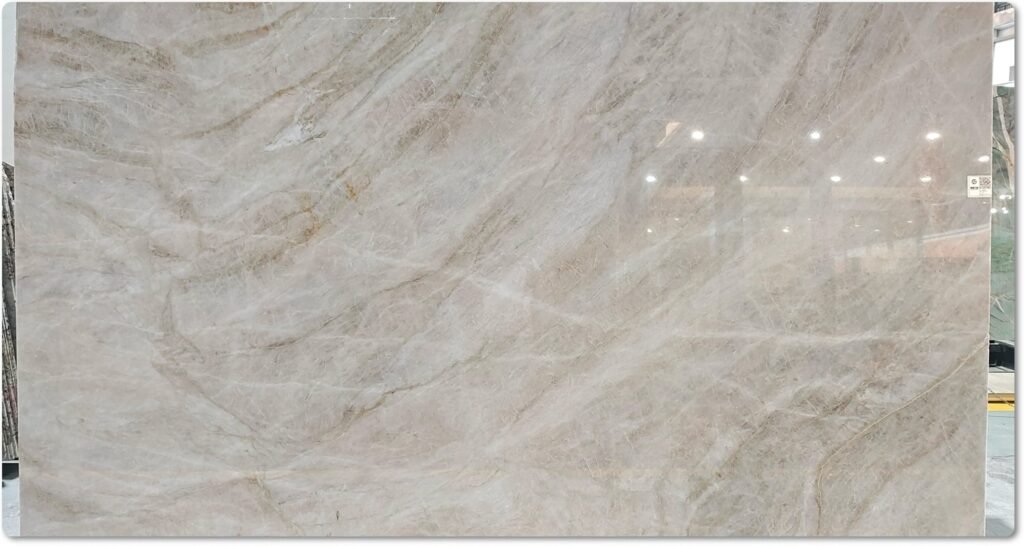
How much is Taj Mahal quartzite per slab? A typical premium slab can cost approximately $3,000–$5,000 or more at retail, although actual prices can fall below or exceed this range.
Current market information describes typical Taj Mahal slabs around approximately 3m × 2m, with some jumbo slabs reaching approximately 118–136 inches long and around 78 inches wide. One current slab-yard source reports roughly $3,000–$5,000 per slab for Taj Mahal quartzite material.
Why Slab Price Is Different From Square-Foot Price
Suppose a slab measures approximately 120 × 78 inches:
- 120 inches = 10 feet
- 78 inches = 6.5 feet
- Approximate slab area = 65 square feet
If the slab costs $4,000, the nominal material price is approximately:
$4,000 ÷ 65 sq. ft. = approximately $61.54/sq. ft.
But that does not mean a countertop will cost $61.54/sq. ft. The countertop may require seams, cutouts, edge fabrication, polishing, reinforcement, transportation, installation, and waste.
How Much Is Taj Mahal Quartzite Per Slab From a Factory or Wholesale Supplier?
Wholesale and export pricing can be significantly different from U.S. retail slab-yard pricing.
For example, current international marketplace listings for Taj Mahal quartzite from China show certain 2cm Brazil-origin slabs at approximately $150–$240 per square meter FOB, equivalent to roughly $14–$22 per square foot before international freight, duties, insurance, local handling, warehousing and fabrication.
Other listings show different FOB levels, including approximately $150–$188 per square meter for certain 2cm products.
Why Factory Prices Are Not Directly Comparable With Retail Prices
A factory quotation may be:
- FOB rather than delivered;
- based on a minimum order quantity;
- based on a specific grade;
- based on 2cm rather than 3cm;
- based on polished rather than honed or leathered;
- excluding inland transportation;
- excluding customs and import costs;
- excluding local warehouse handling;
- excluding fabrication.
Therefore, a professional buyer should compare landed cost, not simply the lowest FOB number.
2cm Taj Mahal Quartzite vs. 3cm Taj Mahal Quartzite: Price Comparison
Thickness is one of the most obvious variables affecting price.
2cm Taj Mahal Quartzite
2cm material is approximately 20mm thick. It is commonly used for countertops, vanities and wall applications when the fabrication system is designed appropriately.
Current U.S. distributor pricing provides an example of approximately $53.50/sq. ft. for a 2cm Taj Mahal product.
3cm Taj Mahal Quartzite
3cm material is approximately 30mm thick. It provides a thicker natural-stone profile and can simplify certain countertop edge treatments and structural applications.
A current distributor listing shows approximately $61.19/sq. ft. for a 3cm Taj Mahal quartzite product.
Which Is Better?
Neither thickness is universally better. The correct choice depends on:
- cabinet construction;
- countertop overhang;
- edge profile;
- support requirements;
- fabrication method;
- project design;
- shipping weight;
- local building and installation practices.
For large commercial or multifamily projects, 2cm may offer transportation and material-efficiency advantages. For premium residential islands and luxury applications, 3cm is frequently selected for its substantial appearance and fabrication flexibility.
Taj Mahal Quartzite Countertops: How Much Does the Complete Project Cost?
How much is Taj Mahal quartzite installed? The installed cost is much higher than the raw slab price.
A useful 2026 planning range is approximately $90–$170+ per square foot installed, with premium and highly customized projects potentially exceeding this range.
One current Taj Mahal quartzite reference places installed pricing around $90–$169/sq. ft., illustrating the substantial premium associated with fabrication and installation.
What Is Included in Installed Pricing?
A complete countertop quotation can include:
- Quartzite slab material
- Slab selection
- Digital templating
- CAD/CNC programming
- Cutting
- Sink cutouts
- Cooktop cutouts
- Edge profiling
- Polishing
- Seams
- Reinforcement
- Transportation
- Jobsite handling
- Installation
- Sealing
- Disposal and cleanup
Example: 60-Square-Foot Kitchen
Imagine a kitchen requiring 60 sq. ft. of finished Taj Mahal quartzite countertop.
| Component | Example Budget |
|---|---|
| Stone material | $3,600–$5,400 |
| Fabrication | $1,200–$2,500 |
| Installation | $1,000–$2,000 |
| Transportation/handling | $300–$800 |
| Estimated total | $6,100–$10,700+ |
This illustrates why the final installed price can be significantly higher than the stone’s advertised square-foot price.
What Determines the Price of Taj Mahal Quartzite?
1. Slab Grade
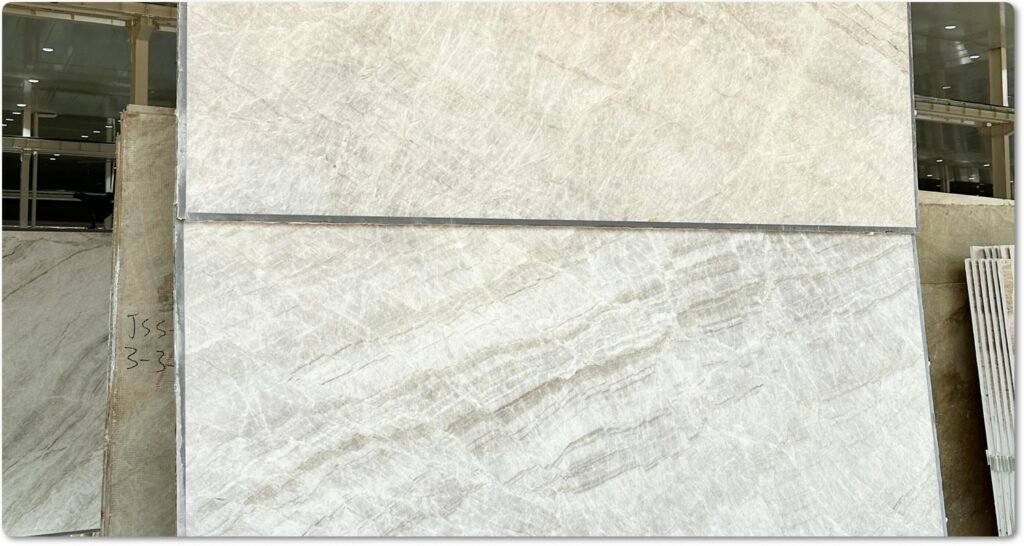
Not all Taj Mahal slabs have identical visual quality. Premium slabs with consistent creamy backgrounds, attractive movement, desirable veining, and fewer imperfections generally command higher prices.
2. Slab Size
Jumbo slabs can provide better yield for large kitchen islands, but they may also command a premium due to scarcity, extraction requirements,s and logistics.
3. Thickness
2cm and 3cm material should not automatically be treated as equivalent products. Thickness affects material consumption, weight, fabrication, and edge construction.
4. Finish
Polished is usually the most familiar finish, but Taj Mahal Leather Quartzite and honed finishes have become increasingly popular in contemporary interiors.
5. Veining and Bookmatching
Bookmatched slabs can require careful slab selection and additional material because the visual composition must be coordinated across multiple slabs.
6. Waste
A simple rectangular countertop may have relatively efficient material utilization. A kitchen with an oversized island, waterfall edges, curves, sink cutouts, and complex corners can require considerably more slab material.
7. Fabrication Complexity
CNC machining, waterjet cutting, radius corners, mitered edges, laminated edges, integrated sinks,s and special profiles all increase fabrication costs.
Taj Mahal Leather Quartzite vs. Polished vs. Honed
Finish affects both aesthetics and price.
Taj Mahal Polished Quartzite
Polished Taj Mahal has a reflective surface that emphasizes the stone’s warm background and veining. It remains the most recognizable finish for luxury kitchens.
3cm Taj Mahal Honed Quartzite
A 3cm Taj Mahal Honed Quartzite surface has a softer, more matte appearance. Honed finishes can create a sophisticated architectural look, especially in modern kitchens and hospitality environments.
2cm Taj Mahal Honed Quartzite
2cm Taj Mahal Honed Quartzite can be useful when weight, project specifications, or wall applications make a thinner slab appropriate.
Taj Mahal Leather Quartzite
Taj Mahal Leather Quartzite has a textured surface designed to emphasize the natural character of the stone while reducing the reflective quality of polished material.
The best finish is not necessarily the cheapest one. Buyers should compare finish pricing together with maintenance expectations, tactile characteristics, design requirements, and fabrication availability.
Taj Mahal Quartzite vs. Taj Mahal Quartz: Cost Comparison
This is one of the most important distinctions in the market.
| Feature | Taj Mahal Quartzite | Taj Mahal Quartz |
|---|---|---|
| Material | Natural stone | Engineered stone |
| Pattern | Naturally variable | Manufactured for consistency |
| Slab variation | High | Lower |
| Maintenance | May require sealing | Generally low maintenance |
| Heat behavior | High heat resistance | Resin-containing products require greater care |
| Repairability | Fabricator-dependent | Damage can be difficult to repair invisibly |
| Typical positioning | Premium natural stone | Premium engineered surface |
Is Taj Mahal Quartzite More Expensive Than Quartz?
Often, yes.
Premium Taj Mahal quartzite can cost more than standard engineered quartz, particularly when the project uses premium natural slabs, bookmatching, special finishes,s or complex fabrication.
However, comparing only material price can be misleading. Quartz may offer predictable color, lower routine maintenance,ce and standardized slab specifications, while Taj Mahal quartzite offers natural variation and a distinctive stone aesthetic that engineered products may attempt to reproduce.
What Are the Disadvantages of Taj Mahal Quartzite?
Taj Mahal quartzite is a premium material, but it is not maintenance-free.
1. Higher Purchase Price
Premium natural quartzite generally costs more than entry-level countertop materials.
2. Natural Variation
The exact appearance shown in an online photograph may not match the next slab. Buyers should approve actual slabs whenever possible.
3. Sealing Requirements
Natural stone may require periodic sealing depending on the stone’s absorption, finish, sealer, and application. Current slab-yard guidance commonly recommends sealing and periodic resealing.
4. Fabrication Requires Experienced Professionals
Quartzite is hard and can require specialized diamond tooling, CNC equipment,t and experienced fabricators.
5. Some “Taj Mahal” Material Can Behave Differently
Commercial stone names do not always communicate complete geological information. Some material marketed as Taj Mahal may contain significant carbonate minerals and can show acid sensitivity. Buyers should ask for technical information and test representative material rather than assuming every slab behaves identically.
Is Taj Mahal Quartzite Really Quartzite?
The commercial name Taj Mahal quartzite does not eliminate the need for technical verification.
Different suppliers may use geological terminology differently, and materials marketed under the same commercial name can vary by quarry, lot, and mineral composition. Some industry sources describe Taj Mahal as dolomitic or carbonate-bearing quartzite and note that certain slabs can show acid sensitivity.
For professional projects, the safest purchasing approach is to request:
- quarry origin;
- technical data;
- absorption data;
- thickness tolerance;
- finish information;
- available slab photographs;
- actual slab inspection;
- sample testing where appropriate.
This is particularly important for commercial projects where material consistency and maintenance expectations must be documented.
What Is the Most Expensive Quartzite?
There is no official global ranking of the “most expensive quartzite.” Prices depend on quarry scarcity, slab quality, color, pattern, size, availability, and market demand.
Highly exotic quartzites such as exceptional Cristallo, rare blue quartzites, premium Calacatta-style quartzites, and unusual Brazilian materials can exceed mainstream Taj Mahal pricing.
Taj Mahal is therefore better described as a premium and highly demanded quartzite rather than universally the most expensive quartzite.
For comparison, current market listings can place premium Taj Mahal around $60–$100/sq. ft., while certain exceptional quartzites can command significantly more.
What Is the Average Cost of Taj Mahal Quartzite?
For a practical 2026 budget, a buyer can use the following simplified model:
- Material only: approximately $50–$100+/sq. ft. for premium U.S. market material.
- Full slab: approximately $3,000–$5,000+ for many premium slabs.
- Installed countertop: approximately $90–$170+/sq. ft.
- Luxury custom work: potentially $170–$200+/sq. ft.
These numbers should be treated as budgeting benchmarks rather than a guaranteed quotation. Current listings demonstrate why the exact slab and supplier must be identified before making a purchasing decision.
How Much Is Taj Mahal Quartzite From a Manufacturer?
For B2B buyers, sourcing directly from a manufacturer or exporter can change the economics considerably.
Advantages of Direct Factory Purchasing
- Lower material markup
- Custom slab selection
- Project-based pricing
- Custom thickness and finish options
- Cut-to-size production
- Countertop fabrication
- Custom vanity production
- Container consolidation
- Export packaging
- Direct communication with production
For importers, distributors, contractors, and hospitality procurement teams, the more meaningful question is often not “What is Taj Mahal quartzite per square foot?” but:
“What is my landed cost per usable square foot after fabrication, packing, freight, duty, breakage and waste?”
How EDG Stone Can Help Reduce the Total Cost of Taj Mahal Quartzite
EDG Stone works with natural stone slabs and custom stone fabrication for international buyers. For B2B customers, the objective should not simply be to find the lowest slab price. The goal is to optimize the complete procurement chain.
Material Selection
EDG Stone can help buyers compare Taj Mahal selections based on background color, veining, thickness, finish, and intended application.
Custom Fabrication
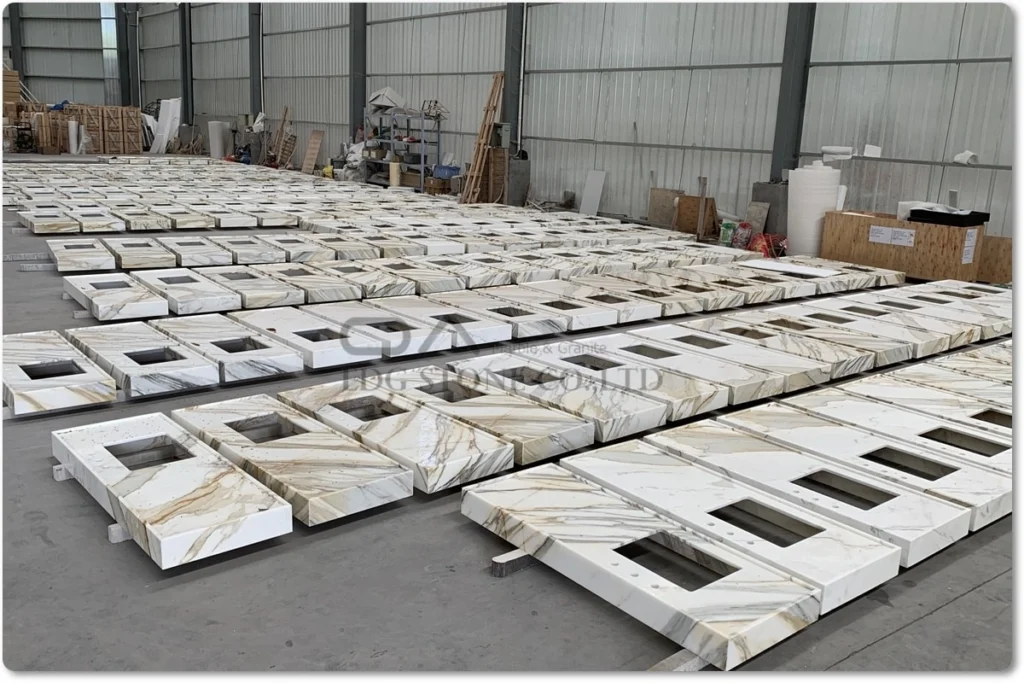
Instead of importing slabs and arranging all fabrication locally, buyers can evaluate a factory-fabricated solution for countertops, vanity tops, wall panels, and other custom components.
Container Planning
Efficient container loading can reduce the effective logistics cost per square foot, particularly for larger projects.
Export Packaging
Natural stone is heavy and fragile at the same time. Proper crates, A-frame support, moisture protection, labeling, and loading procedures are essential to reducing breakage risk.
Project Procurement
For hotels, apartments, multifamily developments, and large residential projects, purchasing finished stone components can reduce the number of separate suppliers involved in the project.
Regulations, Silica Safety and the Future of Stone Fabrication
Price is not the only factor changing the stone industry in 2026. Worker safety and responsible fabrication are increasingly important parts of professional procurement.
OSHA regulates occupational exposure to respirable crystalline silica. Under OSHA’s general-industry standard, the permissible exposure limit is 50 μg/m³ as an 8-hour time-weighted average, with an action level of 25 μg/m³. Construction work is covered under OSHA’s separate standard, 29 CFR 1926.1153.
OSHA identifies cutting, grinding, drilling, and other stone-processing operations as potential sources of respirable crystalline silica exposure. OSHA also notes that approximately 2.3 million U.S. workers are exposed to silica at work across affected industries.
Why This Matters for Taj Mahal Quartzite Buyers
Although natural stone can have different silica characteristics from engineered stone, fabrication still requires appropriate dust controls.
Professional fabrication facilities increasingly need to demonstrate appropriate use of:
- wet cutting;
- water-fed grinding;
- local exhaust ventilation;
- HEPA filtration;
- dust shrouds;
- proper housekeeping;
- worker protection procedures.
OSHA specifically recommends engineering and work-practice controls such as water suppression, local exhaust ventilation, and HEPA-filtered vacuuming for countertop fabrication and installation environments.
Industry direction: stone buyers increasingly need to evaluate not only stone price and appearance, but also supplier manufacturing controls, worker safety, traceability, packaging, documentation, and responsible fabrication practices.
How to Get the Best Taj Mahal Quartzite Price
1. Ask for the Exact Slab
Do not purchase solely from a generic stock photograph.
2. Compare the Same Thickness
Compare 2cm with 2cm and 3cm with 3cm.
3. Compare the Same Finish
Polished, honed, and leathered slabs should be compared separately.
4. Ask for FOB, CIF, or Delivered Pricing
For international sourcing, clarify the Incoterm. A $20/sq. ft. FOB quotation and a $35/sq. ft. delivered quotation may represent the same economic cost depending on logistics.
5. Calculate Yield
Do not divide the slab price by its total surface area without considering countertop layout and waste.
6. Request Fabrication Together With Slabs
For large projects, factory fabrication can sometimes improve material yield and reduce local labor requirements.
7. Consolidate Multiple Stone Products
A container containing countertops, vanity tops, slabs, and other stone components can potentially improve freight economics compared with multiple small shipments.
Buyer Checklist: What to Ask Before Buying Taj Mahal Quartzite
- What is the exact quarry origin?
- Is the stone natural Taj Mahal quartzite?
- What is the actual slab thickness?
- What is the slab size?
- What is the net usable area?
- What finish is offered?
- Is the slab polished, honed or leathered?
- What is the absorption rate?
- Has the slab been inspected?
- Does the price include fabrication?
- Does it include edge profiling?
- Does it include sink cutouts?
- Does it include delivery?
- What is the Incoterm?
- How is the material packed?
- What is the replacement policy for transit damage?
- Can the supplier provide actual slab photographs?
- Can the supplier provide samples?
FAQ: Taj Mahal Quartzite Price
1. How much is Taj Mahal quartzite per square foot?
In 2026, premium Taj Mahal quartzite commonly falls around $50–$100+ per square foot for slab material in U.S. retail and distributor channels. Actual pricing depends on grade, thickness, finish, slab size, availability, and supplier.
2. How much is Taj Mahal quartzite installed?
A reasonable 2026 budgeting range is approximately $90–$170+ per square foot installed. Complex projects involving premium slabs, bookmatching, waterfall edges, custom fabrication, and difficult installation can cost more.
3. How much is a Taj Mahal quartzite slab?
A premium full Taj Mahal quartzite slab can commonly cost around $3,000–$5,000 or more at retail. Current market listings demonstrate that actual prices can vary substantially depending on slab size and grade.
4. Is Taj Mahal quartzite more expensive than quartz?
Premium Taj Mahal quartzite is often more expensive than standard engineered quartz, particularly when the project uses high-grade natural slabs and complex fabrication. However, the difference depends on the quartz brand, quartzite grade, and local fabrication market.
5. What are the disadvantages of Taj Mahal quartzite?
The primary disadvantages are higher upfront cost, natural slab variation, potential need for periodic sealing, and the requirement for experienced fabrication. Some material sold under the Taj Mahal name can also show different acid-sensitivity characteristics, so buyers should evaluate the actual slab rather than relying solely on the commercial name.
Semantic Closed-Loop Insight: Is Taj Mahal Quartzite Worth the Price in 2026?
What Is the Core Value of Taj Mahal Quartzite?
Taj Mahal quartzite combines the visual character of warm-toned luxury marble with the physical characteristics expected from a premium natural stone. Its value is therefore not determined by price per square foot alone, but by appearance, durability, slab uniqueness, project positioning, and long-term design value.
Why Does Taj Mahal Quartzite Cost More Than Many Countertop Materials?
The premium comes from the combination of natural quarrying, block quality, slab yield, selection, transportation, processing, market demand and fabrication. Exceptional slabs with attractive movement and large dimensions can command significantly higher prices than commercial-grade material.
What Are the Main Purchasing Options?
Buyers can purchase raw slabs through a distributor, source slabs directly through an exporter, purchase fabricated components from a stone manufacturer, or buy a complete installed countertop package. For B2B projects, comparing the total landed and usable cost is generally more meaningful than comparing the advertised slab price.
What Should Buyers Consider Before Choosing Taj Mahal Quartzite?
Buyers should evaluate slab appearance, geological characteristics, thickness, finish, absorption, fabrication requirements, maintenance, transportation, installation, and supplier reliability. The actual slab should be inspected whenever the visual pattern is a major part of the design.
What Is the 2026 Market Direction?
The premium natural-stone market is moving toward greater specification transparency, better digital slab selection, factory fabrication, efficient international logistics, responsible manufacturing and stronger worker-safety controls. At the same time, buyers are increasingly comparing natural quartzite with engineered quartz and other large-format surfaces based on total lifecycle value rather than material price alone.
What Is the Best Way to Buy Taj Mahal Quartzite?
The best purchasing strategy depends on project scale. A homeowner may prioritize local inventory and installation support, while an importer, contractor, hotel developer or distributor may benefit from direct factory sourcing, container consolidation and custom fabrication. For larger projects, a professional supplier should provide a complete quotation covering material, fabrication, packaging, logistics and project specifications.
Final Takeaway: How Much Should You Budget for Taj Mahal Quartzite?
If you are planning a Taj Mahal quartzite project in 2026, a practical starting point is:
$50–$100+ per sq. ft. for premium slab material
and approximately:
$90–$170+ per sq. ft. for a complete installed countertop.
A full slab may cost approximately $3,000–$5,000+ depending on size, grade, and market.
For wholesale and international buyers, the price can be considerably lower at the source, but the correct comparison is the landed cost per usable square foot after packaging, freight, import expenses, fabrication, waste, and local handling.
For buyers working on residential developments, hotels, multifamily projects, luxury villas, or stone distribution programs, EDG Stone can provide a sourcing and fabrication approach covering Taj Mahal quartzite slabs, countertops, vanity tops, and custom stone components.
The most important question is therefore not simply “How much is Taj Mahal quartzite?” but “What specification and supply chain will deliver the best total value for my project?”
References & Data Sources
- OSHA — Respirable Crystalline Silica Standards and guidance.
- OSHA — Silica exposure information and countertop fabrication guidance.
- Current U.S. Taj Mahal quartzite distributor pricing examples.
- Current Taj Mahal quartzite slab pricing examples.
- Current 3cm Taj Mahal quartzite product pricing.
- Current international wholesale/export pricing examples.
Looking for Taj Mahal Quartzite countertops from a China manufacturer?
Explore Taj Mahal Quartzite Products →