1. Introduction — why impact resilience matters for a Taj Mahal kitchen?
Kitchens are active environments where material beauty must meet real-world resilience. Homeowners want the warm, veined look of Taj Mahal quartzite but also expect counters to survive dropped cookware, frequent use near sinks, and everyday hustle without expensive repairs. This article explains the stone’s intrinsic strengths and its vulnerability points, examines how fabrication and installation change outcomes, compares Taj Mahal quartzite to engineered quartz, and gives actionable, purchase-ready advice for designers, builders, and consumers.
2. What is Taj Mahal quartzite? — composition, hardness, porosity
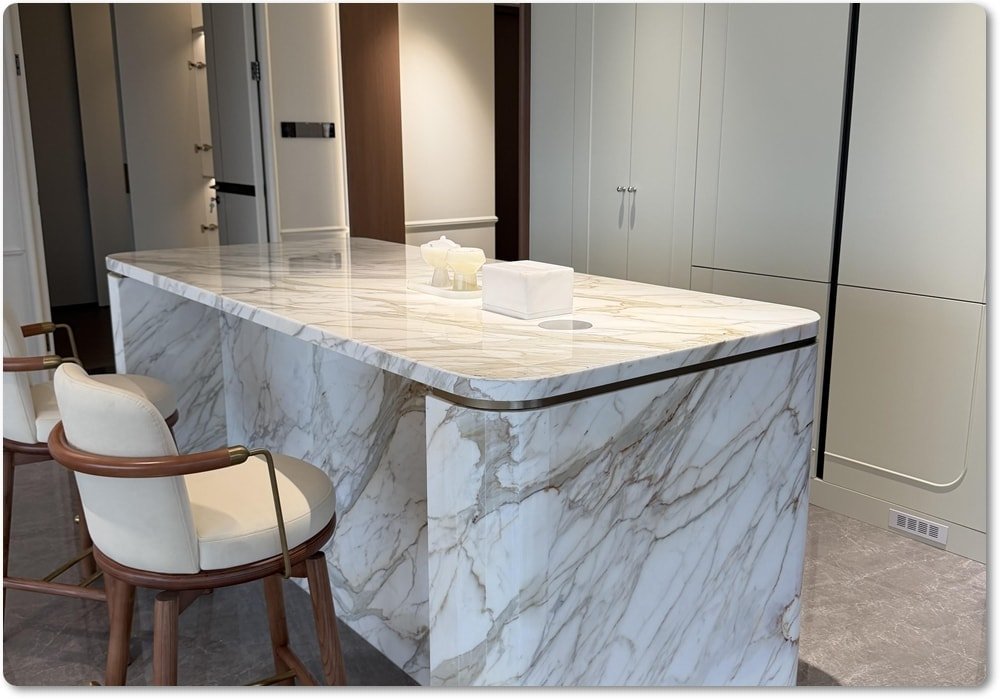
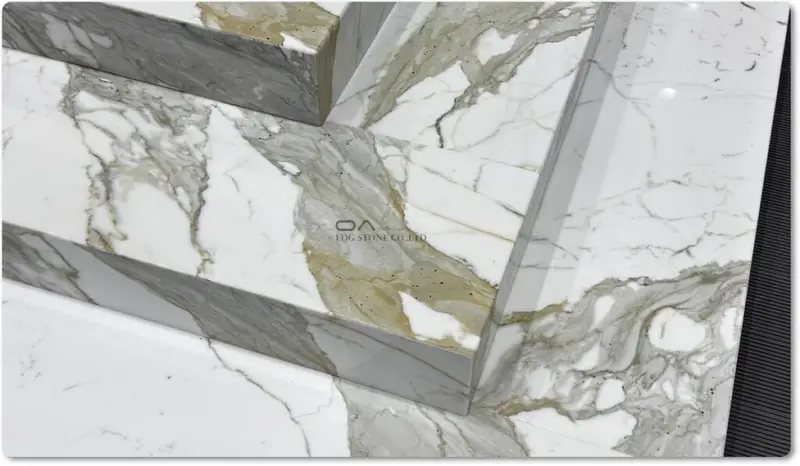
Taj Mahal quartzite is a naturally occurring metamorphic stone: originally sandstone transformed by heat and pressure into a dense, interlocked quartz-rich rock that often presents a creamy white ground with warm gold or rust veining. Its appearance is frequently chosen as a natural alternative to Calacatta-style marbles when buyers want a similar aesthetic but greater surface durability. Typical lab- and industry- reports place many quartzites around Mohs hardness ~7, which gives superior scratch resistance compared with softer marbles and many building materials.
Porosity varies with quarry and metamorphic history: some quartzites are tightly recrystallized and comparatively low-porosity, while others retain microscopic voids. Practically, Taj Mahal is denser than many marbles yet still benefits from periodic sealing because porosity and microscopic fissures can permit stains and liquid penetration if left unprotected.
3. Everyday impact threats in kitchens — what actually breaks stone?
Daily impact and failure modes are predictable once you know where stresses concentrate.
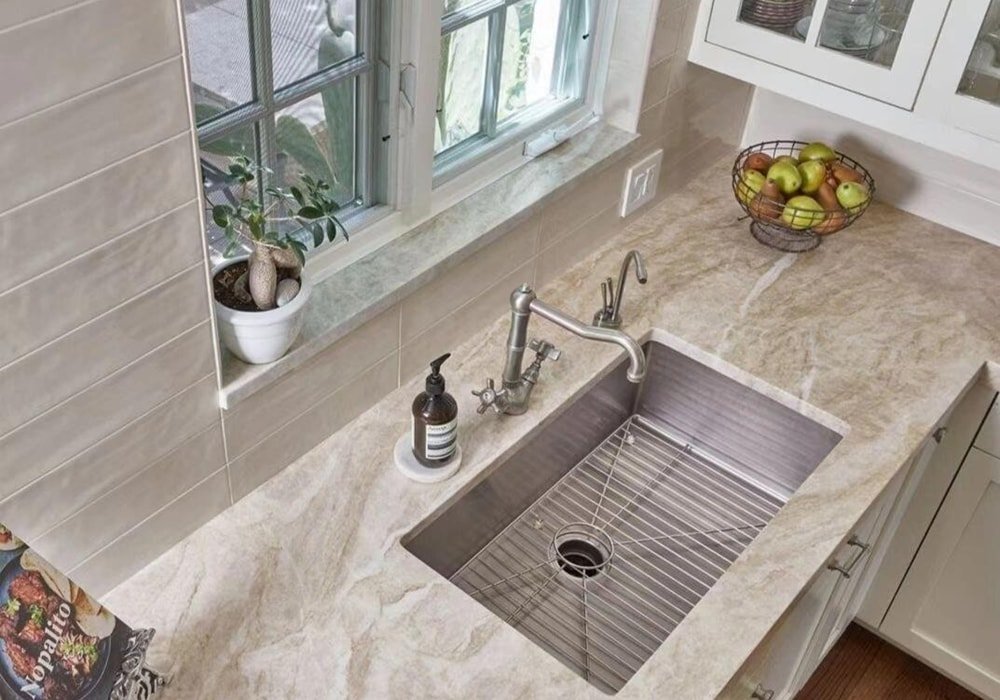
Dropped heavy cookware (cast-iron pans, kettles) applied to thin or unsupported spans near edges is a common cause of chips or cracks.
Point impacts at edges: thin knife-like edges, ogee profiles, and exposed seams concentrate stress and can spall or chip when hit.
Unsupported overhangs and island cantilevers that flex under load introduce bending stresses that can open micro-fractures, which can propagate into visible cracks.
Cutouts and undermount sink zones are stress concentrators—especially when tight inner corners or inadequate backing are used.
In short, where force is applied and how the slab is supported matter more than raw mineral hardness when it comes to breakage risk.
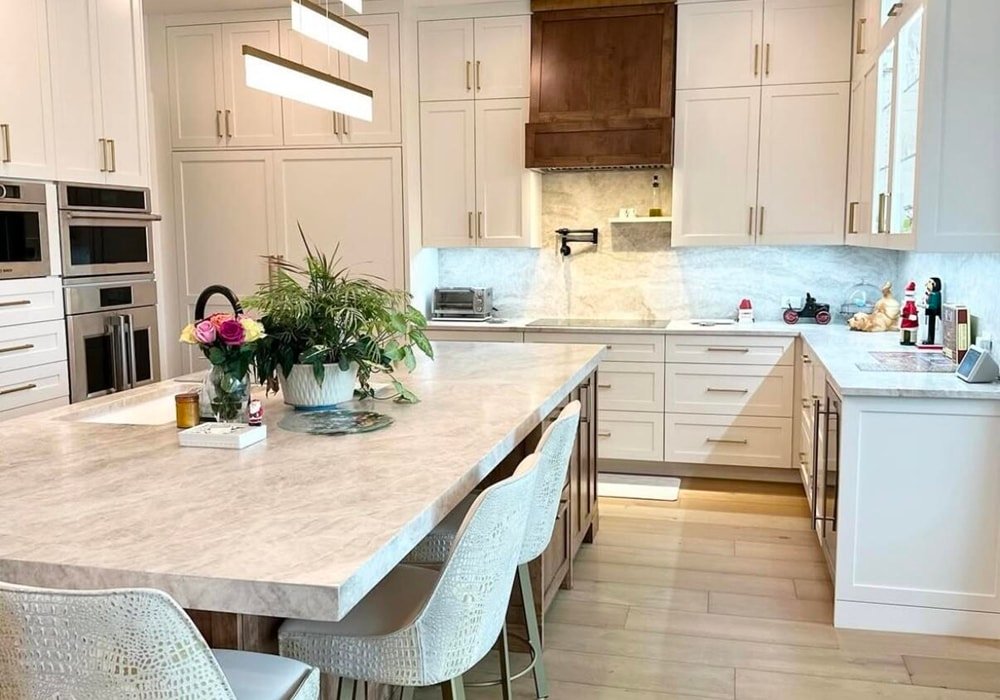
4. Material mechanics: hardness vs toughness — why quartzite behaves the way it does?
Two different material properties explain most countertop behavior: hardness and toughness.
Hardness refers to resistance to surface scratching and abrasion. Taj Mahal quartzite ranks high here, meaning it resists knife-scratches and abrasive wear.
Toughness refers to resistance to crack initiation and propagation. Natural stones, being crystalline and brittle, typically have lower toughness than ductile composites; they absorb less energy before fracturing. A very hard stone can still fracture under a sharp, localized impact because the material cannot plastically deform to spread the load.
Practical implication: Taj Mahal’s hardness gives exceptional scratch and heat performance, but localized blunt impacts—especially near thin features or cutouts—remain the principal vulnerability. Design choices that reduce stress concentration and increase backing/support make toughness limitations mostly irrelevant for everyday use.
5. Real-world performance: scratches, chipping, cracking, and heat events
Scratches
Taj Mahal quartzite excels at resisting visible scratches from knives and utensils—far better than many marbles and on par with or better than many granites. For most households, normal use will not leave obvious knife marks if proper cutting boards are used.
Chipping and spalling
Chips usually form at exposed edges and corners after a high-energy impact or repeated small knocks. Rounded (eased or half-bullnose) edges dramatically reduce chip frequency compared to thin, decorative knife or ogee edges. Thickening edges or using laminated edges for delicate profiles reduces damage risk.
Cracks and fractures
Large cracks more commonly arise from bending stresses (flex) or from pre-existing fissures in the slab that are stressed during transport, templating, or installation. Correct slab selection and expert fabrication greatly lower the probability of crack propagation.
Heat events
Quartzite tolerates hot pans far better than most engineered quartz products because it lacks the polymer/resin binders that can discolor or delaminate under extreme heat. Still, direct and repeated severe thermal shock at an unsupported seam or near adhesives can contribute to micro-fractures, so caution and trivets are still sensible.
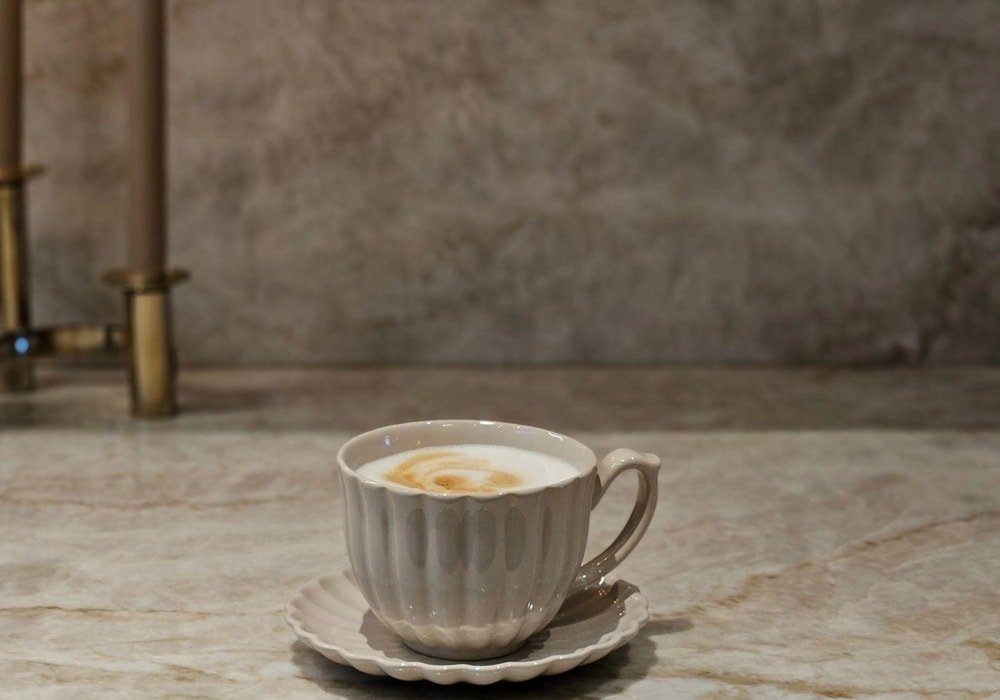
6. Installation, edge details, seams, and substrate — hidden risk factors
Installation quality is the single greatest non-material factor that determines long-term performance.
Support and substrate: Continuous, level support (proper plywood backing, mortar bed choices for heavy spans) prevents deflection that initiates cracks. For islands, steel brackets or thicker stone reduce bending.
Edge profile selection: Choose eased or rounded edges for active kitchens. Elaborate profiles add beauty but increase vulnerability unless extra thickness and reinforcement are used.
Seam placement and joining: Seams should be planned away from high-use zones and should be fully backed; adhesives and seam treatments must be applied correctly to avoid weakness under load.
Cutout detailing: Inner corners of sink cutouts should be radiused; fabricators often add relief notches or backing plates to reduce stress concentration.
Fabricator QC: A skilled fabricator inspects slabs for fissures, rejects questionable sections, and can recommend orientation to minimize stress along natural grain lines.
In short, professional templating, fabricating, and installation convert a vulnerable slab into a resilient surface.
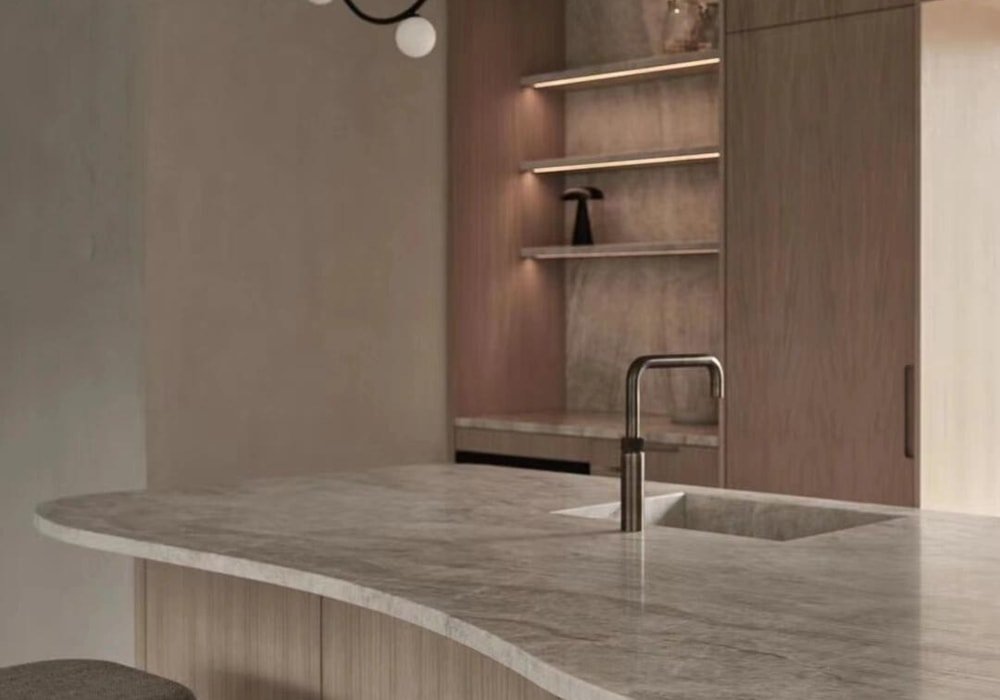
7. Maintenance, sealing, and repairability — how to reduce long-term risk?
Sealing and cleaning
Because quartzite can be porous, a high-quality penetrating sealer is recommended. Most trade guidance suggests sealing annually to every two years, depending on sealer performance and kitchen intensity; simple tests (water droplet beading) indicate when resealing is needed. Proper sealing reduces stain ingress into tiny fissures that might otherwise weaken the slab marginally over long years.
Routine inspection
Inspect seams, sink cutouts, and exposed edges annually. Early detection of micro-chips or hairline cracks allows conservative repair (resin injection, edge patching) before larger replacement is required.
Repair options
Minor chips: Professionally applied color-matched epoxy or resin fills are widely used and can be nearly invisible when matched correctly.
Cracks: Small cracks can sometimes be stabilized by resin infiltration; severe structural cracks usually require slab replacement or careful patching. Keep records of slab origin and lot numbers for warranty claims.
8. Taj Mahal quartzite vs engineered quartz — resilience tradeoffs
Comparing a natural quartzite slab with modern engineered quartz (manufactured composite surfaces) highlights tradeoffs:
Scratch resistance: Quartzite typically wins thanks to natural mineral hardness.
Heat tolerance: Quartzite performs better under high temperatures; engineered quartz can discolor or delaminate under direct extreme heat due to resin content.
Maintenance: Engineered quartz is non-porous and maintenance-free (no sealing); quartzite requires periodic sealing.
Impact/chipping behavior: Engineered quartz often includes a resin matrix that can absorb some blunt impact energy, making it less likely to fracture catastrophically under certain blunt-force events; natural quartzite can be more brittle in localized impacts but is generally more forgiving for high-heat usage.
Worker safety & regulation: Fabrication of engineered stone has been associated with severe silica dust illnesses among workers (silicosis), prompting regulatory scrutiny and even partial bans in some jurisdictions; this affects supply, cost, and manufacturer practices and may influence procurement choices for conscientious buyers.
These tradeoffs mean the best choice depends on project priorities: authenticity and heat resilience (quartzite) vs. low maintenance and uniformity (engineered quartz).
9. Cost, availability, and buying-intent long-tail keywords
Pricing snapshot
Market surveys and fabricator quotes put installed quartzite countertop prices commonly in a band of roughly $60–$150 per sq ft, variable by slab rarity, thickness, edge choices, fabrication complexity, and local labor. Premium slabs and complicated installs (waterfall edges, mitered seams) can push costs higher.
Long-tail transactional keywords (use in product schema, H2s, alt-text)
Taj Mahal quartzite wholesale slab manufacturer
Buy Taj Mahal quartzite factory direct price per slab
Taj Mahal quartzite countertops near me installation quote
Taj Mahal quartzite supplier bulk wholesale for builders
Calacatta quartzite vs Taj Mahal quartzite manufacturer comparison
Embedding these intent-rich phrases in product pages, FAQ, and schema helps capture both consumer and trade searchers.
10. Regulations, workplace safety, and market trends that influence material choice
Worker safety developments are shifting the industry. Several governments and regulators scrutinize or restrict engineered stone fabrication because of documented silicosis cases among workers exposed to respirable crystalline silica. Some jurisdictions have introduced stricter controls, mandatory wet-cutting, ventilation standards, or even temporary bans on engineered stone imports or on-site cutting without permits. These regulatory moves influence supply chains, fabrication costs, and the relative attractiveness of natural stone options to specifiers and institutional buyers. Designers and procurement teams should monitor local workplace-safety regulations and prefer fabricators who publish safety compliance practices.
Market trend surveys continue to show strong consumer demand for natural looks, with quartzite maintaining popularity among high-end kitchen projects alongside continued mainstream adoption of engineered quartz for its maintenance advantages. Sustainability, worker safety, and life-cycle cost considerations increasingly influence specification decisions.
11. Practical recommendations — checklists
For homeowners & designers (quick)
Choose eased or half-bullnose edges for busy kitchens.
Require professional templating and insist seams be located away from sinks and cooktops.
Specify minimum slab thickness for islands and heavy islands (3 cm standard; 2 cm only with proper laminating/backing).
Include a maintenance plan (sealing frequency, cleaning guidance) in handover documents.
For fabricators & installers (quick)
Inspect slabs for fissures and match seams across veins.
Provide full backing under cutouts and islands; use steel reinforcement for cantilevers.
Educate clients on sealing, trivet use, and edge vulnerability.
Maintain documented QC and worker-protection practices to comply with evolving silica regulations.
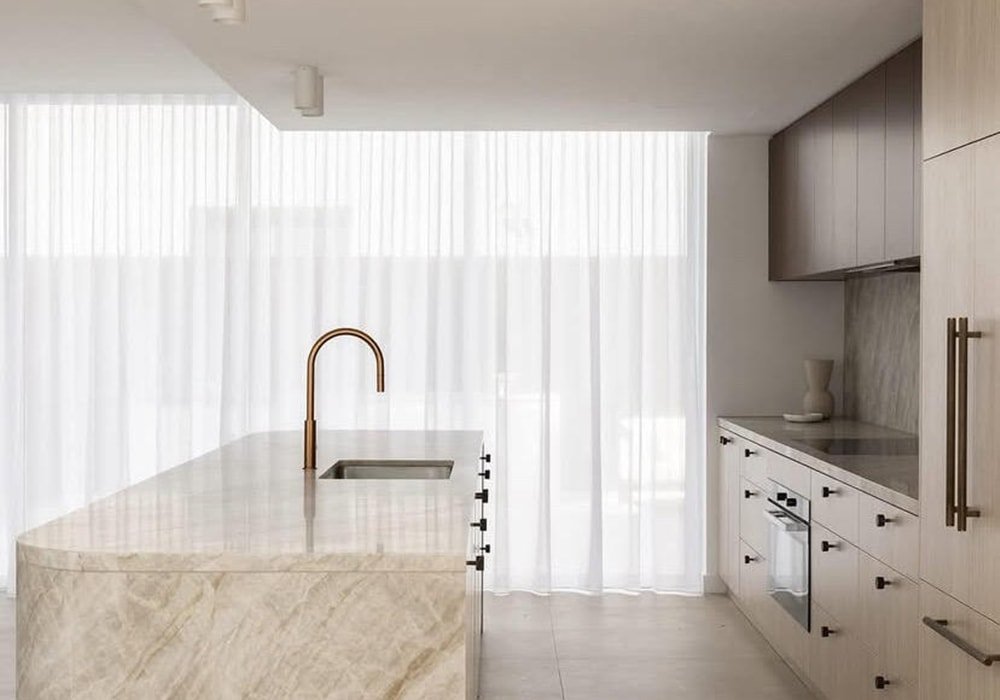
12. FAQ — Google-style hot questions (detailed answers)
Q1: Is Taj Mahal quartzite prone to cracking from dropped pans or heavy cookware?
A1: Generally, no — on full, well-supported surfaces, Taj Mahal quartzite resists everyday kitchen impacts well because of its density and high mineral hardness. However, cracking risk rises when heavy objects strike thin edges, unsupported overhangs, or seam areas. Reinforcing supports and choosing forgiving edge profiles reduce this risk significantly.
Q2: How often should I seal Taj Mahal quartzite, and does sealing affect impact resistance?
A2: Industry guidance commonly recommends sealing quartzite every 12–24 months, depending on sealer type and usage intensity; a simple water-drop test shows when resealing is needed. While sealing primarily reduces stain vulnerability and liquid ingress, it can also slow long-term weakening by preventing fluids from entering micro-fissures—indirectly supporting long-term impact resilience.
Q3: Is Taj Mahal quartzite more impact-resistant than engineered quartz?
A3: It depends. Taj Mahal’s higher mineral hardness gives better scratch and heat resistance, but natural quartzite can be more brittle under sharp, localized impacts. Engineered quartz’s resin matrix sometimes allows it to absorb blunt loads differently, reducing catastrophic fracture in specific scenarios. Ultimately, fabrication, edge design, and support are often the decisive factors.
Q4: Which edge profiles reduce the chance of chipping in an active kitchen?
A4: Simpler, rounded profiles—such as eased edges, bevels, or half-bullnose—are the most forgiving for everyday use. Thin, decorative knife-edges and elaborate ogee profiles look elegant but increase the likelihood of chipping unless fabricated with additional thickness and reinforcement. Choose robust edges for islands and high-traffic zones.
Q5: What should I ask my fabricator to ensure the long-term durability of Taj Mahal quartzite?
A5: Ask about slab inspection and rejection criteria, substrate and backing recommendations, seam placement strategy, edge thickness and profile choices, reinforcement for overhangs, and warranty/maintenance guidance. Also, confirm the fabricator’s silica-safety practices and whether they offer post-installation maintenance packages.
Semantic Closure: Taj Mahal Quartzite — How it performs, why it matters, what to specify, options, and key considerations
How: Taj Mahal quartzite performs through densely bonded quartz grains that give high surface hardness and excellent heat resistance. Its impact resilience is maximized when slabs are fully supported, edges are rounded, and seams and cutouts are engineered to reduce stress concentrations.
Why: For clients seeking the visual warmth of Calacatta-style stone with better everyday performance, Taj Mahal quartzite offers a compelling balance: marble-like aesthetics with stronger scratch and thermal characteristics. Designers choose it when the look matters alongside functional longevity.
What: Specify minimum edge thickness for islands, insist on reinforced overhangs for seating, request radiused sink cutouts, and include a documented maintenance plan. Demand fabrication QC reports and ask for a slab map showing any natural fissures and seam locations.
Options: If maintenance-free is the strictest requirement, engineered quartz remains attractive; if high-heat tolerance and authenticity are priorities, Taj Mahal quartzite is preferred. Hybrid approaches (quartz in prep zones, quartzite near cooktop/warm appliances, or vice versa) can optimize both performance and maintenance needs.
Considerations: Monitor local silica and fabrication regulations when selecting materials and fabricators—regulatory shifts can affect cost, lead times, and supplier options. Factor lifecycle costs (initial premium + sealing + potential repairs) into procurement decisions rather than only the upfront price.
14. References (author — article title — outlet) — no links
Weha USA — “Taj Mahal Quartzite Countertop Information” — Weha USA (industry product/fabrication guide).
KQED / investigative reporting — “As California Silicosis Cases Rise, Engineered Stone Industry Seeks Immunity in DC” — KQED News (worker safety/regulatory reporting).
The Guardian — “UK urged to consider ban on artificial stone worktops over silicosis risk” — The Guardian (industry health coverage).
News.com.au / Australian reporting — “Engineered stone import ban and enforcement” — Australian news reporting (regulatory action overview).