Quick Summary: Calacatta Marble Buying Guide
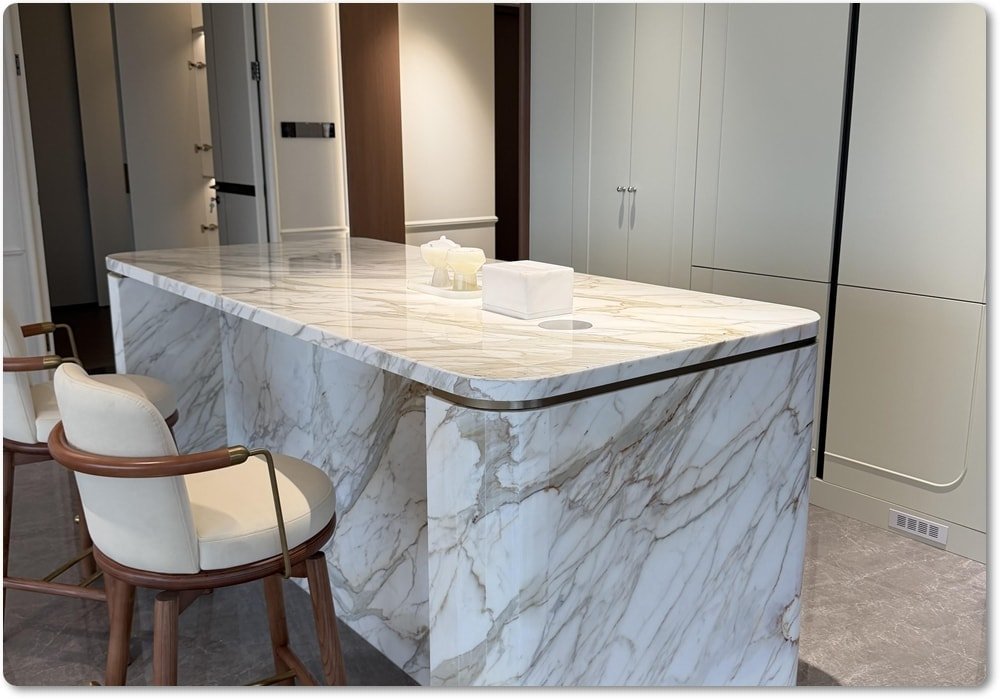
Calacatta marble has become one of the most recognizable luxury stones in residential, hospitality, and high-end commercial interiors. However, “Calacatta” is not simply one uniform marble product. It is better understood as a family of premium Apuan marbles whose appearance and commercial value can vary substantially from one quarry, block, and slab to another.
For architects, designers, contractors, importers, stone distributors,a nd homeowners, this distinction matters. Two slabs marketed as Calacatta can have very different backgrounds, vein structures, colors, grades, and prices.
This Calacatta Marble Buying Guide explains where Calacatta marble comes from, the major Calacatta marble types, Calacatta Gold and Borghini, Calacatta White and Green options, bookmatched marble, pricing factors, maintenance, purchasing considerations, and the regulatory direction affecting stone fabrication.
What Is Calacatta Marble?
Calacatta marble is a natural metamorphic stone associated with the Apuan Alps in Tuscany, Italy, particularly the marble-producing area surrounding Carrara.
Geologically, marble is formed when limestone undergoes metamorphism, resulting in recrystallized carbonate minerals. Calacatta is particularly valued for its combination of a light background and distinctive veining.
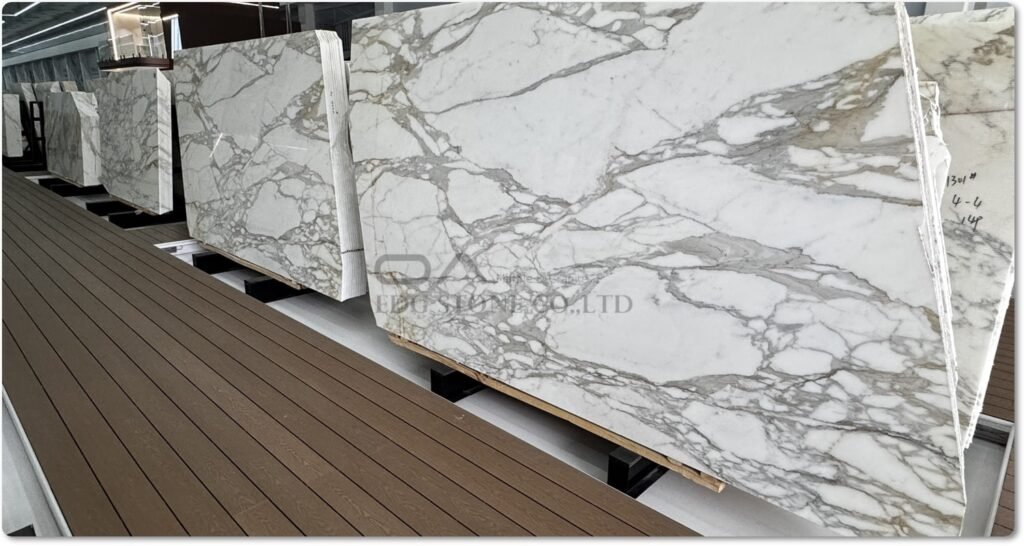
A typical premium Calacatta may feature:
- Bright white or warm-white background
- Gray veining
- Gold or yellow-gold accents
- Taupe or beige movement
- Dramatic linear or branching patterns
- Large-scale veining
- Strong visual contrast
- Potential for bookmatched designs
Industry references describe Calacatta as generally having a brighter background and more dramatic veining than typical Carrara marble.
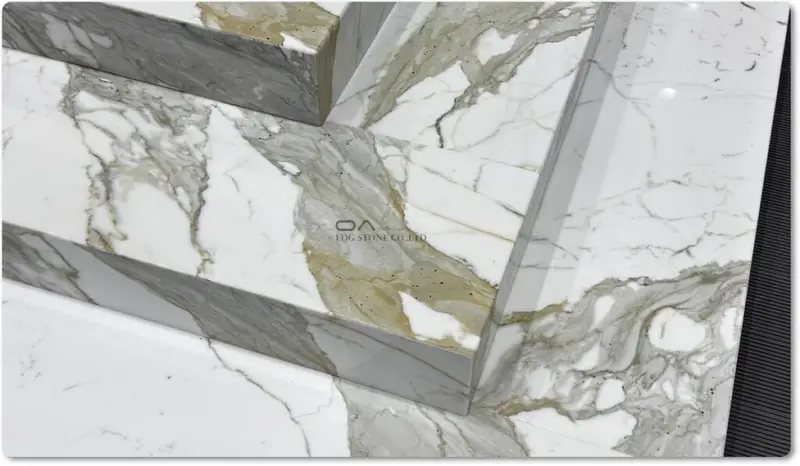
The key point for buyers is that Calacatta is a natural material, so every block and slab can be different. A photograph from a supplier should therefore never be treated as a guarantee of the exact vein pattern that will arrive.
Calacatta Marble: Where Is It From?
Calacatta Marble Origin
The traditional answer to “Calacatta marble where is it from?” is the Apuan Alps around Carrara, Tuscany, Italy.
The Carrara marble district contains numerous quarries and marble varieties. Calacatta and Carrara marble can therefore share a broad geographic region while remaining visually and commercially distinct materials.
Calacatta is generally associated with:
- Apuan Alps
- Carrara marble district
- Tuscany, Italy
- Specialized quarry zones
- Limited or selective extraction
The geological origin is important because the quarry and specific extraction zone can influence the stone’s background color, mineral composition, veining, and commercial classification.
Calacatta vs. Carrara
One of the most common buying mistakes is assuming that Calacatta and Carrara are interchangeable.
| Feature | Calacatta | Carrara |
|---|---|---|
| Typical background | Brighter white | White to gray-white |
| Veining | Bold, dramatic | Generally softer and finer |
| Gold veining | Common in some varieties | Less characteristic |
| Visual impact | High | More understated |
| Availability | More selective | Generally more abundant |
| Typical positioning | Premium/luxury | Broad residential/commercial |
Carrara marble is generally more abundant, while premium Calacatta selections can command higher prices because of rarity, appearance, and slab quality.
Calacatta Marble Types: What Options Should Buyers Consider?
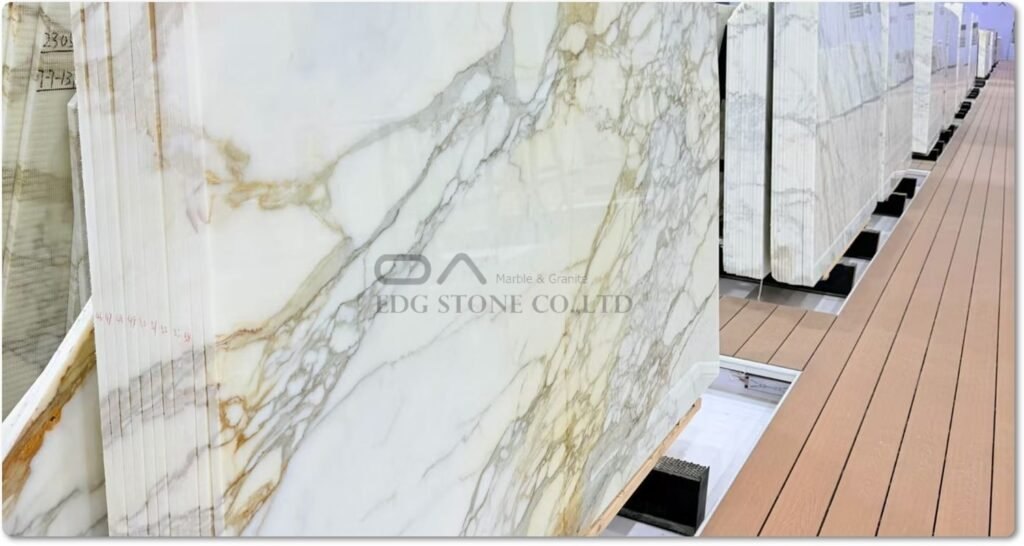
“Calacatta marble types” is one of the most important search and buying topics because the name covers a broad range of visual characteristics.
1. Calacatta Gold Marble
Calacatta Marble Gold, commonly called Calacatta Gold, is among the most commercially recognized options.
Its typical appearance combines:
- White background
- Gray veining
- Warm gold or honey-colored accents
- Strong movement
- Luxury appearance
The exact balance of gray and gold can vary significantly between slabs.
High-grade Calacatta Gold is especially popular for:
- Kitchen islands
- Bathroom vanities
- Feature walls
- Luxury hotel bathrooms
- Fireplace surrounds
- Reception counters
- High-end furniture
- Full-height wall applications
2. Calacatta Borghini
Calacatta Borghini is a highly sought-after Calacatta selection associated with the Borghini quarry area.
It is commonly characterized by a bright white field combined with strong gray and gray-gold veining. Some commercial descriptions emphasize its dramatic, open-book potential and suitability for luxury architectural applications.
Borghini should not automatically be treated as synonymous with every Calacatta Gold slab. Rather, Borghini is a specific and highly desirable selection within the broader Calacatta market.
3. Calacatta White Marble
Calacatta White Marble generally emphasizes the clean white background.
Buyers looking for Calacatta White should clarify whether they want:
- Pure white appearance
- White with gray veins
- White with subtle gold
- White with dramatic veins
- Minimal movement
- Strong bookmatch movement
A supplier should provide actual slab photographs rather than relying exclusively on catalog images.
4. Calacatta Marble Green
Calacatta Marble Green refers to Calacatta selections incorporating noticeable green or green-gray coloration.
Green Calacatta options can create a much more distinctive interior than conventional white-and-gold Calacatta.
They can be suitable for:
- Luxury bathrooms
- Statement walls
- Hotel lobbies
- Designer furniture
- Decorative panels
- Boutique hospitality interiors
Because green coloration can vary significantly, buyers should approve the actual block or slabs before production.
5. Other Calacatta Options
Depending on the quarry, distributor, and commercial naming system, buyers may encounter names such as:
- Calacatta Oro
- Calacatta Vagli
- Calacatta Viola
- Calacatta Monet
- Calacatta Green
- Calacatta Borghini
- Calacatta Gold
- Calacatta Extra
- Calacatta Select
Importantly, commercial names are not always standardized internationally. A buyer should evaluate the actual material specification instead of purchasing based only on the name.
Calacatta Borghini vs Calacatta Gold: What Is the Difference?
The question “Calacatta Borghini vs Calacatta Gold” is especially important for premium projects.
The terms can overlap in the marketplace because Borghini material can be marketed as a type or selection of Calacatta Gold. Some specialist stone suppliers describe Borghini as a named cut within the broader Calacatta Gold family.
Calacatta Gold
Usually emphasizes:
- White background
- Gold veins
- Gray-gold movement
- Warm luxury appearance
Calacatta Borghini
Often emphasizes:
- Very bright white background
- Stronger, more painterly veins
- Gray and gold combinations
- Dramatic movement
- High-end quarry-specific positioning
The most important buying rule is:
Do not purchase premium Calacatta solely by the commercial name. Purchase the block, slab selection, technical specification and visual pattern.
For an expensive hotel or luxury residential project, the actual slab is the product.
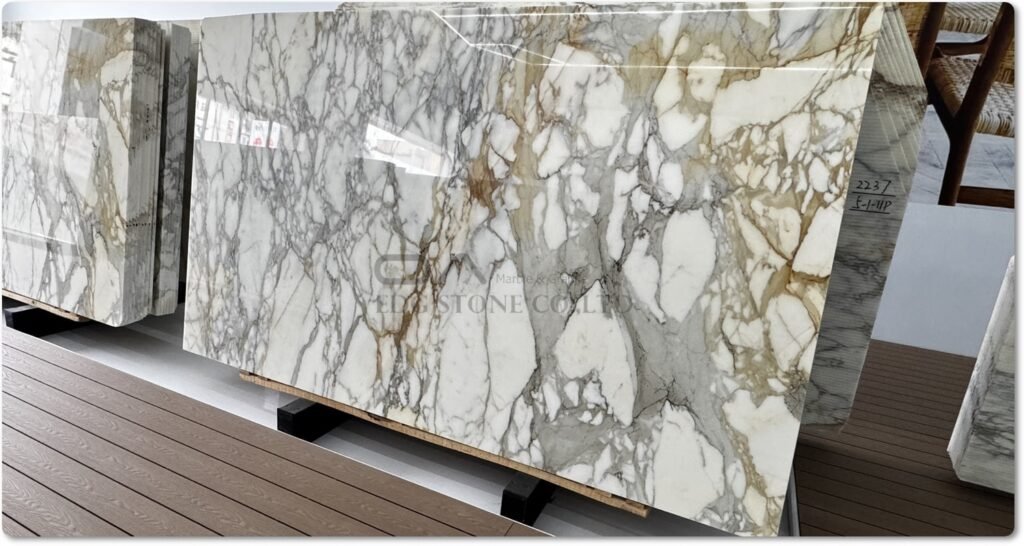
How Much Does Calacatta Marble Cost?
Calacatta Marble Price Factors
There is no single global Calacatta marble price.
A useful purchasing formula is:
Final project cost = material cost + processing + finishing + fabrication + packing + freight + insurance + installation + wastage
Material pricing can vary according to:
- Quarry
- Block quality
- Grade
- White background
- Vein density
- Gold coloration
- Vein continuity
- Slab dimensions
- Thickness
- Finish
- Bookmatching requirements
- Quantity
- Availability
- Fabrication complexity
- Country of delivery
For example, a specialist Carrara supplier currently lists a Calacatta Borghini Gold product from approximately €280/m², illustrating why actual supplier and grade information is essential when discussing price.
This should not be interpreted as a universal market price.
Why Premium Calacatta Costs More
A high-value slab may combine several scarce characteristics:
- Extremely white background
- Large, clean surface
- Attractive gold veining
- Strong vein continuity
- Low visual defects
- Large block yield
- Excellent bookmatch potential
The price premium is therefore often driven by selection quality, rather than simply by the fact that the material is called Calacatta.
How to Buy Calacatta Marble: A Professional Procurement Process
Step 1: Define the Application
First, determine whether the stone will be used for:
- Countertops
- Vanity tops
- Flooring
- Wall cladding
- Fireplace surrounds
- Furniture
- Hotel bathrooms
- Reception desks
- Staircases
Different applications may require different thicknesses, finishes, reinforcement, and fabrication methods.
Step 2: Define the Visual Target
Do not simply specify “Calacatta marble.”
Instead specify:
Bright white Calacatta + medium-to-heavy gray/gold veins + polished finish + large slab + bookmatch required.
This gives suppliers a much more useful purchasing specification.
Step 3: Request Actual Slab Photos
Ask for:
- Full slab photograph
- High-resolution detail photographs
- Slab dimensions
- Thickness
- Lot/block number
- Quarry information
- Finish
- Available quantity
For bookmatched projects, request photographs of all slabs together.
Step 4: Approve the Layout
For large projects, the buyer should approve a slab layout before fabrication.
This is particularly important for:
- Kitchen islands
- Full-height walls
- Shower walls
- Hotel vanity walls
- Reception desks
- Fireplace walls
Calacatta Bookmatched Marble: Why It Matters
Calacatta bookmatched marble is one of the most visually impressive ways to use dramatic-veined stone.
Bookmatching involves placing adjacent slabs so that their vein patterns create a mirrored or butterfly-like composition.
Why Calacatta Is Ideal for Bookmatching
Strong Calacatta veins can create:
- Symmetrical patterns
- Butterfly effects
- Large-scale visual movement
- Architectural focal points
- Luxury feature walls
The effect is especially powerful with Calacatta Gold and Calacatta Borghini.
Calacatta Gold Bookmatched Applications
Common applications include:
- Hotel feature walls
- Luxury bathroom walls
- Fireplace surrounds
- Kitchen islands
- Lobby walls
- Restaurant interiors
- Marble furniture
- Reception desks
Bookmatch Purchasing Checklist
Before purchasing, confirm:
- Same block or compatible blocks
- Vein continuity
- Slab sequence
- Slab dimensions
- Thickness
- Polishing consistency
- Resin treatment
- Mesh backing
- Fabrication direction
- Installation sequence
For premium projects, bookmatch planning should happen before cutting, not after fabrication.
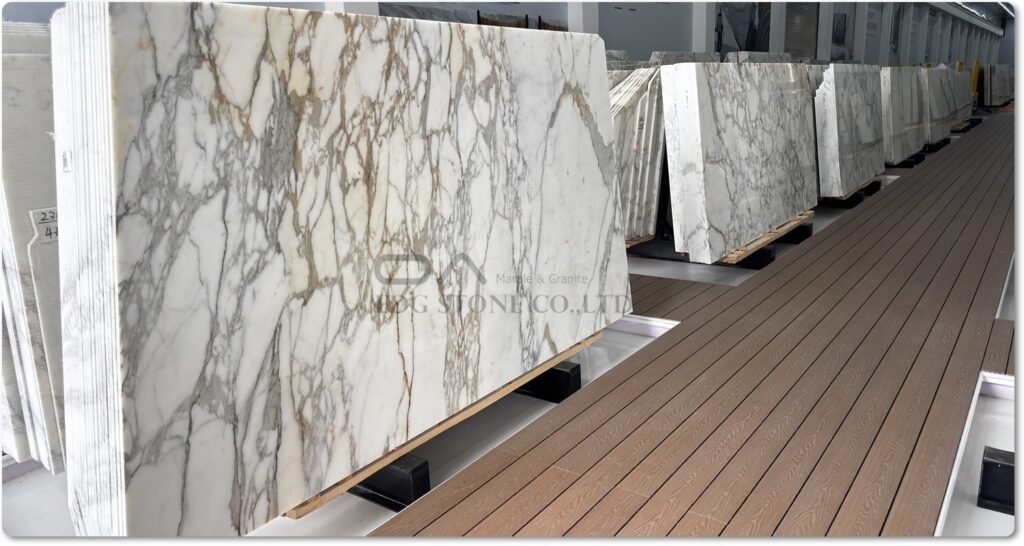
How to Evaluate Calacatta Marble Quality
Background Color
A cleaner and more consistent white background is often preferred for luxury applications.
However, “whiter” does not automatically mean “better.” The correct stone depends on the project’s design concept.
Vein Quality
Evaluate:
- Thickness
- Direction
- Color
- Continuity
- Contrast
- Distribution
- Natural character
Surface Defects
Check for:
- Cracks
- Open fissures
- Excessive resin filling
- Structural weaknesses
- Unwanted mineral concentrations
- Edge damage
- Inconsistent polishing
Slab Size
Large slabs can reduce joints and improve visual continuity, but larger dimensions also increase:
- Handling requirements
- Fabrication difficulty
- Packaging requirements
- Breakage risk
- Shipping complexity
Calacatta Marble Maintenance and Fabrication Considerations
Marble is a calcium-carbonate-based natural stone and should be treated differently from engineered quartz.
Calacatta marble can be susceptible to:
- Acid etching
- Scratching
- Staining
- Surface wear
- Improper chemical cleaning
For countertops and vanities, buyers should discuss sealing and maintenance requirements with the fabricator and stone supplier.
Fabrication
Fabricators should consider:
- Wet cutting
- Proper blade selection
- Edge support
- Slab handling
- CNC or waterjet requirements
- Seam placement
- Reinforcement where appropriate
- Polishing consistency
For a bookmatched wall, fabrication tolerances become especially important because even a small installation error can disrupt the visual symmetry.
2026 Regulatory Direction: Why Natural Marble and Engineered Stone Should Be Distinguished
The regulatory environment surrounding stone fabrication is changing rapidly, particularly in relation to respirable crystalline silica.
This is important for buyers because natural marble should not automatically be treated as equivalent to engineered quartz.
OSHA states that crystalline silica exposure can occur during cutting, grinding, drilling, and other stone-processing activities. Its guidance notes that calcium-based stones, including many marble varieties, contain little or no silica compared with engineered stone products that can contain very high silica concentrations.
The regulatory direction became especially significant in California in 2026. In May 2026, the California Occupational Safety and Health Standards Board voted to initiate a process concerning a proposed prohibition on fabrication and installation of artificial stone products containing more than 1% crystalline silica.
Cal/OSHA subsequently convened advisory proceedings in July 2026 concerning proposed emergency rules for engineered stone containing more than 1% crystalline silica.
The Natural Stone Institute has also emphasized that the current California regulatory discussion concerns engineered stone while noting continuing scientific and regulatory discussions around silica-containing natural stones.
What This Means for Calacatta Marble Buyers
The industry direction increasingly favors:
- Better material identification
- Transparent composition information
- Safer fabrication
- Wet processing
- Dust control
- Worker protection
- Technical documentation
- Responsible sourcing
- Traceable supply chains
For professional buyers, this means a good supplier should be able to distinguish natural marble, engineered quartz, quartzite, porcelain, and sintered stone clearly rather than treating all “stone” products as equivalent.
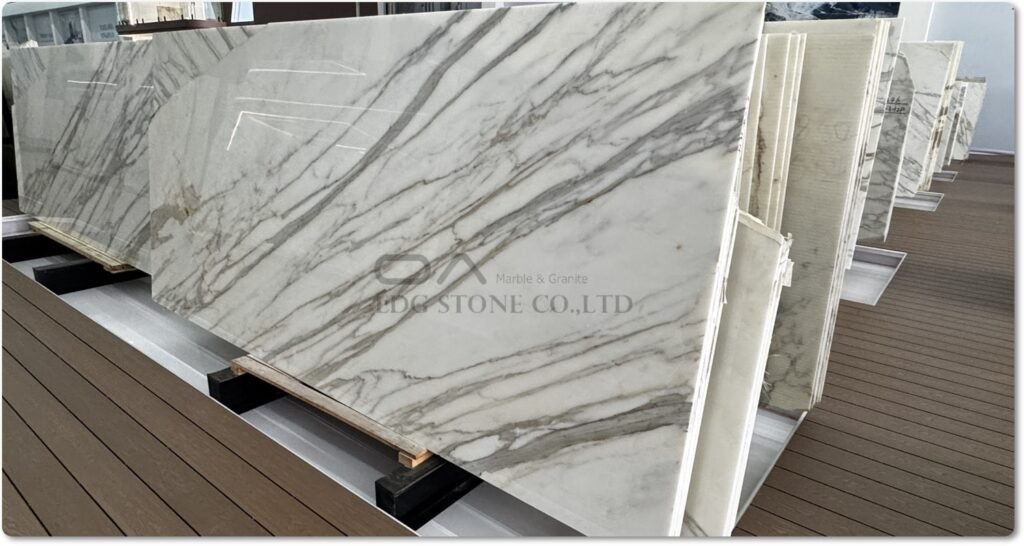
Why Buy Calacatta Marble From a Professional Manufacturer or Factory?
For large projects, purchasing directly from a professional stone manufacturer can provide advantages beyond material price.
A qualified supplier such as EDG Stone can support buyers with:
- Material sourcing
- Slab selection
- Custom fabrication
- Vanity tops
- Countertops
- CNC processing
- Waterjet cutting
- Bookmatching
- Technical drawings
- Quality inspection
- Export packaging
- Container loading
- Project coordination
Calacatta Marble Wholesale
For wholesale buyers, the purchasing strategy should focus on total landed project cost, rather than slab price alone.
A professional wholesale quotation should ideally identify:
- Material name
- Material origin
- Thickness
- Finish
- Dimensions
- Quantity
- Packaging
- Fabrication
- Inspection
- Shipping terms
- Lead time
- Replacement policy
For hospitality and multi-unit projects, consistency between batches is also critical.
Calacatta Marble Buying Guide: What Should You Ask the Supplier?
Before placing a purchase order, ask the supplier:
- Where exactly is this Calacatta marble quarried?
- Is the material natural marble?
- What is the quarry or block identification?
- What grade is being offered?
- What are the actual slab dimensions?
- What thickness is available?
- Is the slab polished, honed or otherwise finished?
- Are the slabs resin-treated?
- Is mesh reinforcement applied?
- Can you provide full-slab photographs?
- Can you provide matching bookmatched slabs?
- What is the available quantity from the same block?
- What are the acceptable natural variations?
- How is the stone packed for export?
- Can the factory provide fabrication drawings?
- What is the expected production lead time?
- What inspection process is used?
- Can the supplier provide technical documentation?
- What happens if slabs arrive damaged?
- Can the supplier provide project references?
These questions turn a generic marble quotation into a professional procurement process.
Calacatta Marble Options: How Should You Choose?
Choose Calacatta Gold If:
You want a warm, luxurious appearance with prominent gold and gray movement.
Choose Calacatta Borghini If:
You want premium white marble with dramatic, painterly gray-gold veining and strong architectural impact.
Choose Calacatta White If:
You want a cleaner white appearance and a more restrained luxury aesthetic.
Choose Calacatta Green If:
You want a distinctive statement material with green or green-gray movement.
Choose Bookmatched Calacatta If:
You want the marble itself to become the primary architectural feature.
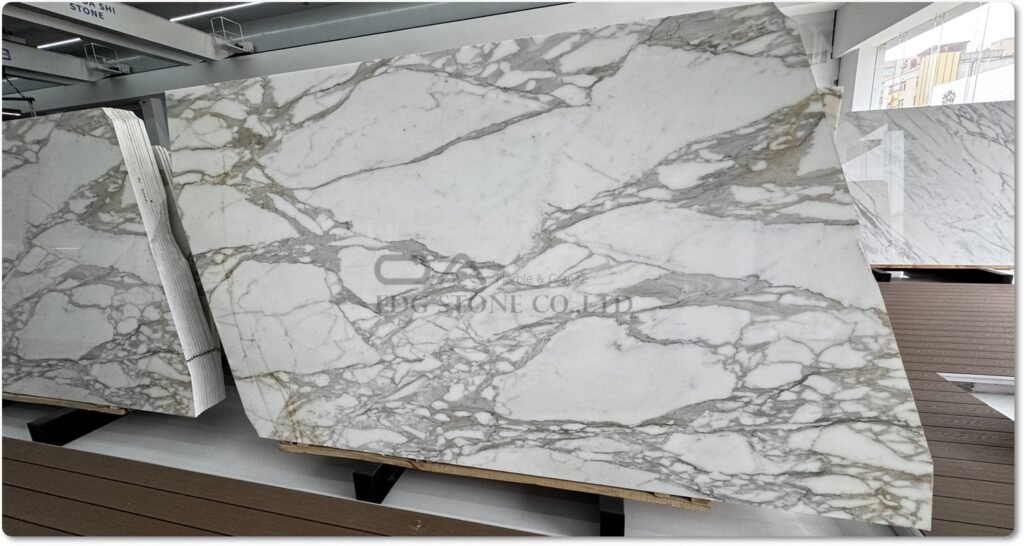
Final Buying Recommendation: What Makes a Good Calacatta Marble Purchase?
The best Calacatta marble purchase is not necessarily the cheapest slab or the most famous commercial name.
It is the material that provides the best combination of:
Origin + visual quality + slab consistency + technical suitability + fabrication quality + bookmatch potential + logistics + total project cost.
For homeowners, the priority may be appearance and maintenance.
For designers, it may be vein movement and bookmatching.
For contractors, fabrication consistency and installation requirements may be more important.
For wholesalers and importers, the critical factors are repeatability, price, packaging, quality control, production capacity, and delivery reliability.
For large hospitality projects, all of these factors matter simultaneously.
This is why buyers should evaluate Calacatta marble at the slab and project level, rather than relying only on a material name.
Frequently Asked Questions About Calacatta Marble
1. Where is Calacatta marble from?
Traditional Calacatta marble is quarried in the Apuan Alps around Carrara in Tuscany, Italy. Different quarry areas and selections can produce substantially different appearances.
2. How much does Calacatta marble cost?
Calacatta marble price varies significantly according to quarry, grade, slab quality, dimensions, thickness, vein pattern, finish, availability, and fabrication. Premium selections can cost substantially more than standard white marble.
3. What is the difference between Calacatta Gold and Calacatta Borghini?
Calacatta Gold generally describes a white marble with prominent gold and gray veining, while Calacatta Borghini is a more specific quarry-associated selection often characterized by strong gray-gold veining and a bright white background. The terms can overlap commercially.
4. Is Calacatta marble good for kitchen countertops?
Yes, Calacatta marble can be used for kitchen countertops, but buyers should understand that marble is more susceptible to etching and scratching than many engineered surfaces. Proper sealing, fabrication, and maintenance are important.
5. What is Calacatta bookmatched marble?
Calacatta bookmatched marble consists of sequential slabs arranged so that their natural vein patterns mirror each other, creating a symmetrical architectural effect. It is particularly effective for feature walls, islands, fireplaces, and luxury bathrooms.
Semantic Insight: How to Choose the Right Calacatta Marble for a Project
What Is the Core Value of Calacatta Marble?
Calacatta marble combines the natural variation of genuine marble with a highly recognizable white-and-veined luxury aesthetic. Its value is determined not simply by the word “Calacatta,” but by origin, quarry selection, background color, vein structure, slab size, quality, availability, and fabrication potential.
How Should Buyers Compare Calacatta Options?
Buyers should compare actual slabs rather than product names alone. Calacatta Gold may emphasize warm gold movement; Borghini may offer stronger gray-gold veining; Calacatta White may prioritize a cleaner background; and Calacatta Green may provide a more distinctive color statement. For large architectural applications, vein continuity and bookmatching potential can be as important as the basic stone classification.
Why Does Bookmatching Increase Design Value?
Bookmatching transforms naturally occurring vein patterns into a planned architectural composition. When two or more slabs are selected from compatible blocks and installed in sequence, the marble can create a mirrored visual field across an island, wall, fireplace, or reception desk. The result depends heavily on block selection and pre-fabrication layout planning.
What Should Buyers Consider Before Purchasing?
Consider five dimensions simultaneously: visual appearance, technical suitability, fabrication requirements, commercial supply reliability, and total landed cost. Buyers should verify origin, slab dimensions, thickness, finish, treatment, defects, quantity, packaging, and quality-control procedures before approving production.
What Is Changing in the Stone Industry?
The stone industry is moving toward greater material transparency, safer fabrication, better worker protection, more detailed technical documentation, and stronger supply-chain accountability. Regulatory attention to respirable crystalline silica is particularly important for engineered stone fabrication. Natural calcium-based marble has a materially different silica profile from high-silica engineered stone, but safe dust-control practices remain essential during cutting and fabrication.
What Is the Best Buying Strategy?
The most reliable strategy is to define the project’s visual target first, shortlist appropriate Calacatta types, inspect actual slabs, approve the slab layout, confirm technical specifications, establish acceptable natural variation, and then finalize fabrication and logistics. For wholesale and commercial projects, a manufacturer capable of sourcing, processing, quality control, and export packaging can simplify the entire procurement chain.
Conclusion
Calacatta marble remains one of the most desirable natural stones for luxury interiors because it combines a bright marble background with dramatic natural veining. However, successful procurement requires much more than searching for “Calacatta marble for sale.”
Buyers should understand the difference between Calacatta Gold, Calacatta Borghini, Calacatta White, Calacatta Green, and other Calacatta marble options, while recognizing that commercial naming conventions can vary.
For a premium project, the safest approach is to evaluate the actual slab, origin, grade, vein structure, bookmatch potential, technical suitability, fabrication capability, and total landed cost.
For wholesalers, developers, hospitality groups and international buyers, working with an experienced manufacturer such as EDG Stone can also provide a more integrated path from material sourcing and slab selection through fabrication, quality control, packaging and export.
Ultimately, the best Calacatta marble is the one that satisfies the project’s design objective, technical requirements, budget, and supply-chain expectations—not simply the one with the most famous name.