Quick Summary
— What color is Calacatta Verde? (Definition & visual range)
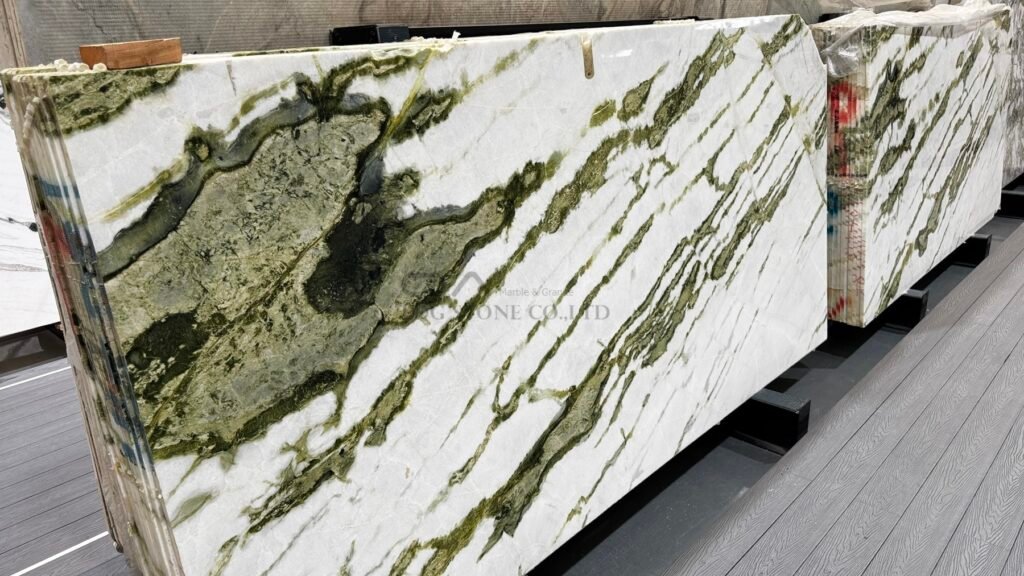
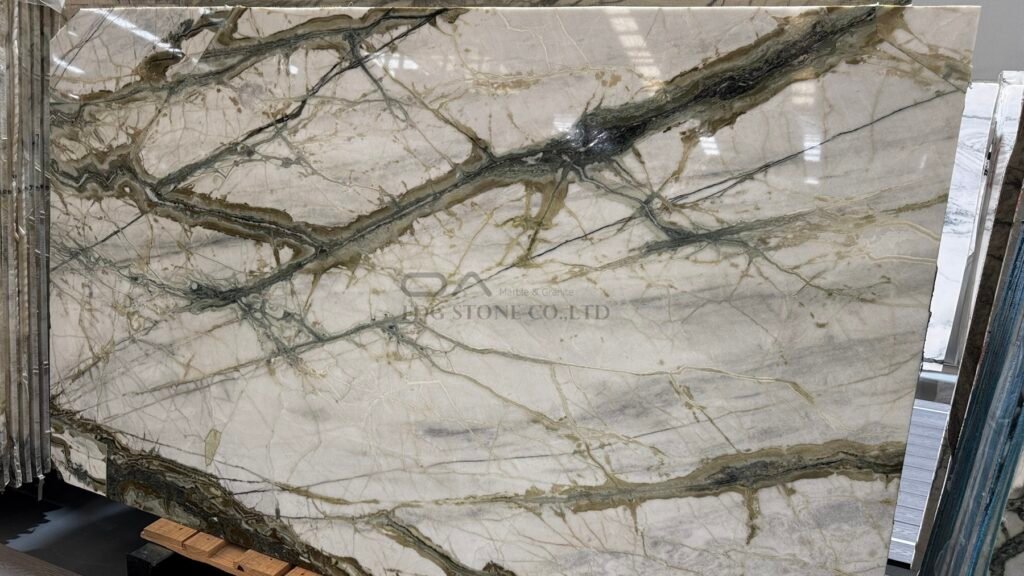
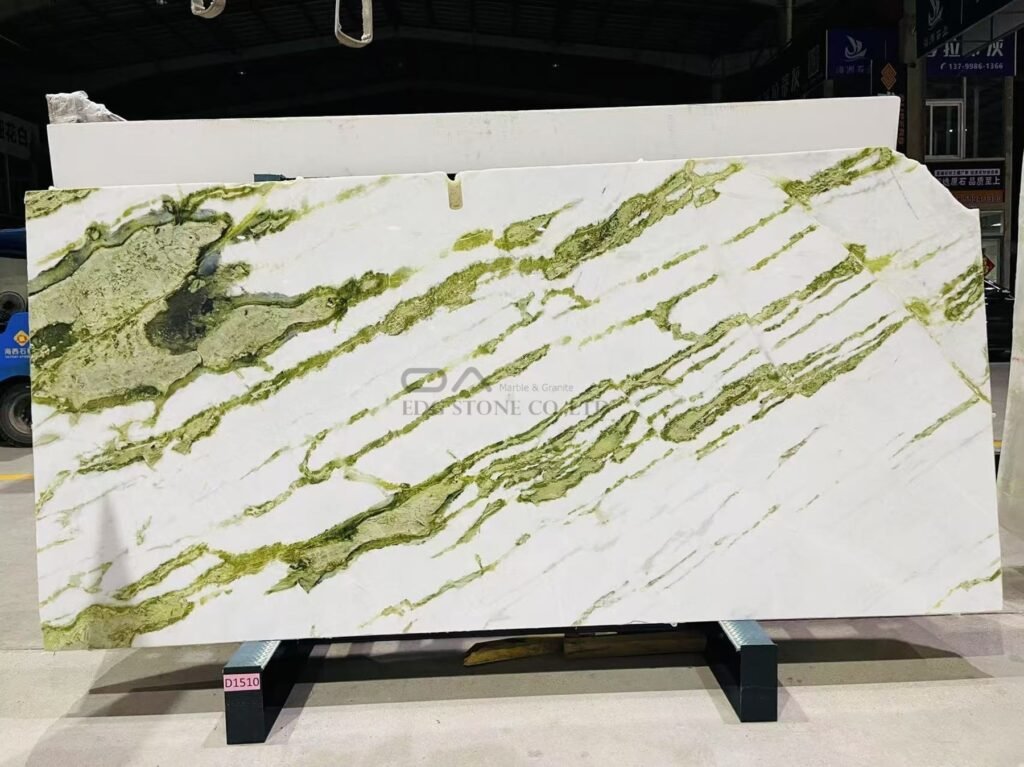
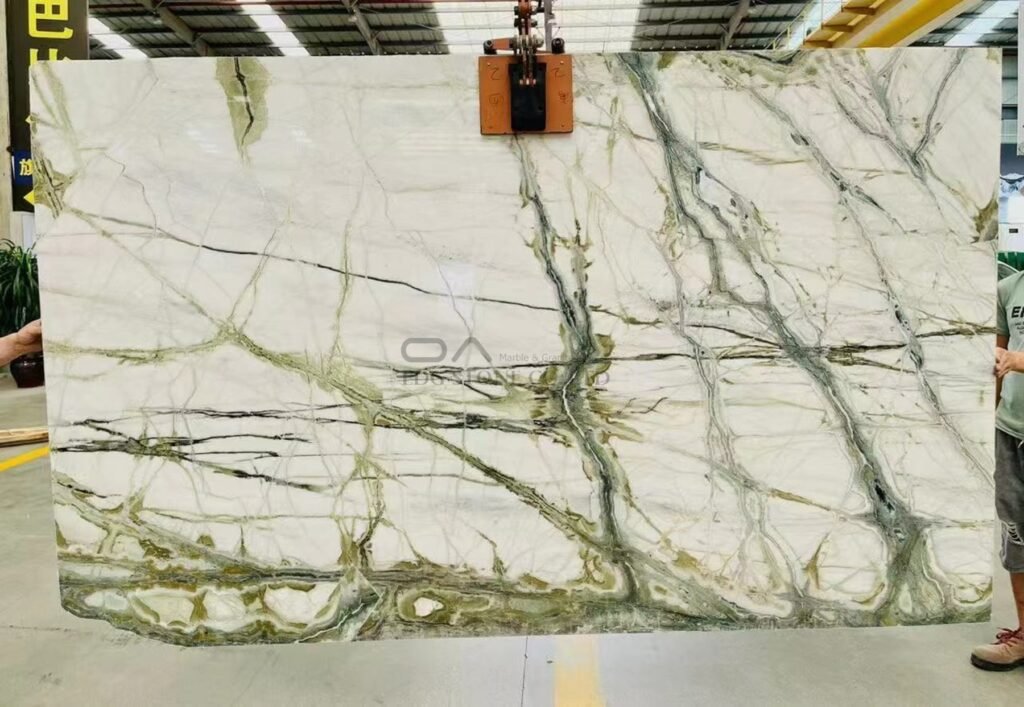
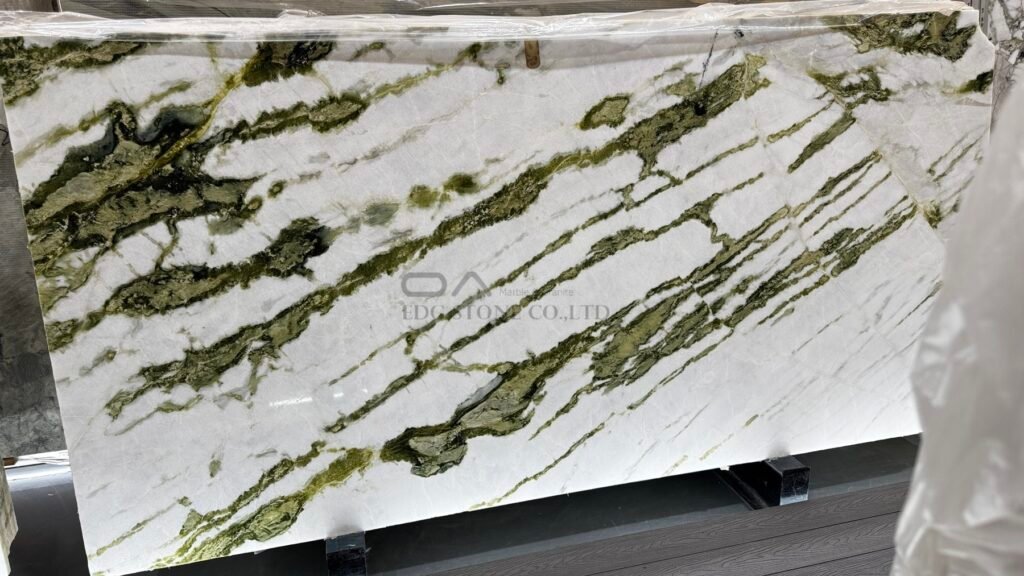
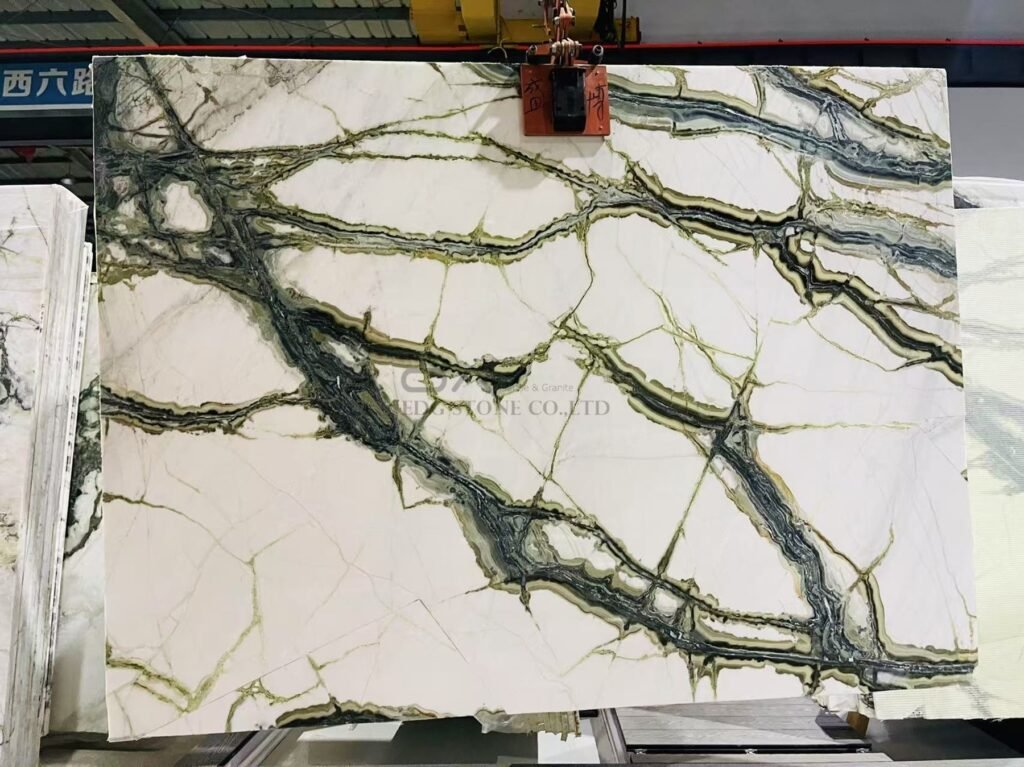
Calacatta Verde is best described as a marble family variant whose defining look is: a predominantly white to creamy-ivory background overlaid with green veining, swaths, or cloud-like patches. The green accents can vary across slabs from pale mint and celadon through moss and teal, and occasionally into deeper emerald tones. Some slabs show delicate, wispy veins; others display bold, flowing bands or large green fields framed by the white Calacatta ground.
Mineralogically, the green shades are generally produced by trace minerals and alteration products (for example, chlorite, serpentine, or other green silicate minerals) intermixed with the calcitic matrix of marble; the exact hue and intensity depend on local geochemistry and cutting orientation. For a detailed mineral-composition analysis and how particle size and mineral content affect stone color, see materials research on marble composition.
— Appearance, texture, and pattern notes
Base (ground) color: creamy white, warm ivory, or milky white—this is the hallmark that keeps a slab within the “Calacatta” visual family.
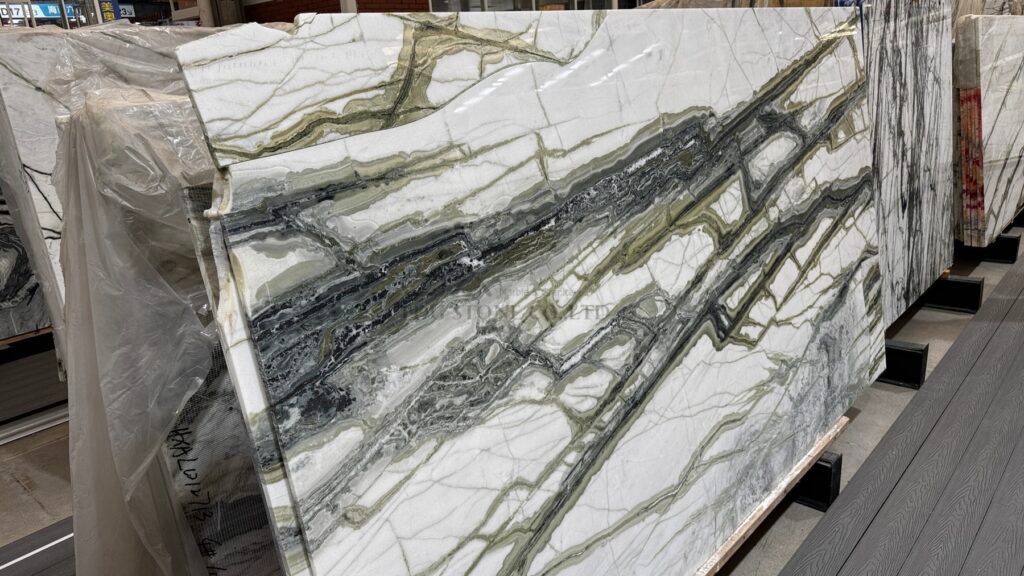
Green range: pale mint → celadon → moss → deep emerald; sometimes mixed with slate gray or near-black streaks for contrast.
Special inclusions: some slabs contain small metallic specks or golden flashes (pyrite/iron oxides) that catch light and add a luxurious sparkle.
Pattern types: fine hairline veins, broad flowing bands, clouded patches, and islanded green pockets—each slab is unique and should be chosen with the project’s pattern intent in mind.
Because of this variety, the same trade name (“Calacatta Verde”) can describe visually different slabs from different quarries or different cuts of the same block. Always verify and lock LOT numbers for large projects.
— How does Calacatta Verde differ from other “green” stones?
Green marble vs green granite
From a functional standpoint, marble (including Calacatta Verde) and granite differ substantially: marble is a metamorphosed limestone composed predominantly of calcite; granite is an igneous rock composed of quartz, feldspar, and mica. As a result, granite typically rates harder than marble on the Mohs scale and is more scratch- and heat-resistant; marble is softer and more susceptible to acid etching and staining. If hardness and low porosity are primary functional needs (heavy-use countertops, outdoor applications), granite is often preferable. For durability comparisons and hardness ranges, consult natural stone technical resources.
Calacatta Verde vs classic Calacatta (gray/gold veined)
Classic Calacatta marbles are prized for dramatic gray or gold veins on white grounds. Calacatta Verde swaps the neutral vein color for green, altering the marble’s emotional tone—from purely classic/neutral to botanical/nature-connected aesthetics. Designers often choose Calacatta Verde when they want a luxurious white canvas with a distinct green focal accent.
— Applications & design pairings
Where does it shine?
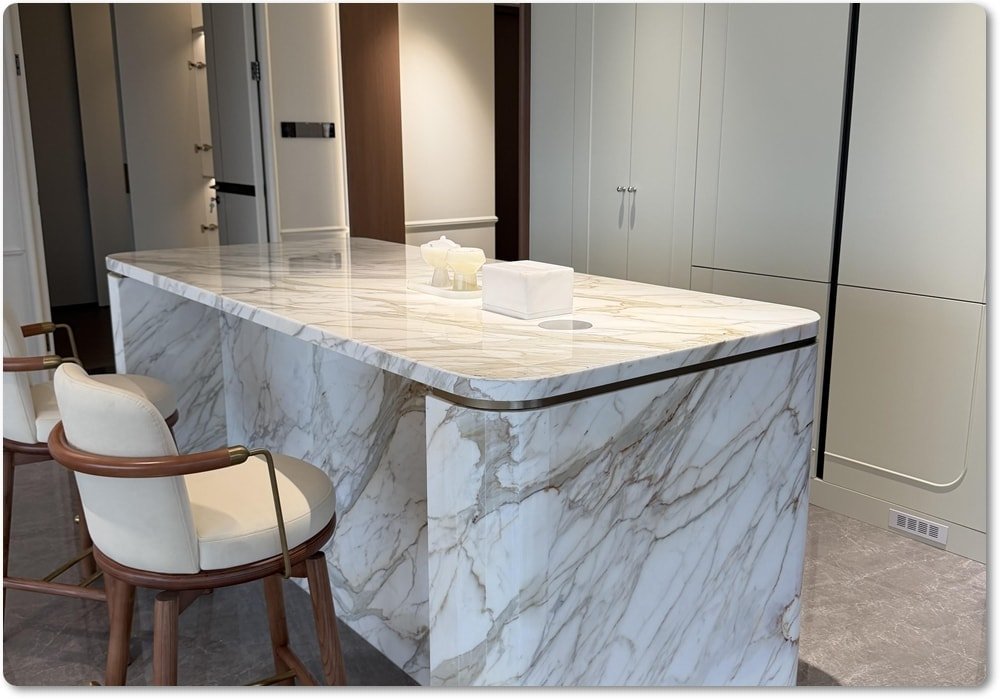
Kitchen countertops & islands (accent or full slab): Use where a dramatic, high-end focal point is desired. Consider zone protection (see maintenance section) as marble will etch with acids.
Backsplashes & feature walls: Green veins create depth and motion—ideal behind ranges or vanities.
Mosaics and trims (picket, rivet, and window mosaics): Small tile formats allow pattern control while reducing maintenance exposure and material waste.
Bathroom vanities and sinks: Offers a spa-like, verdant impression when paired with matte brass or satin nickel fittings.
Material finish choices
Polished: High gloss enhances the cream background and green contrasts—shows every mark quickly.
Honed / matte: Softer, less reflective look that hides scratches slightly better but still requires careful maintenance.
Leathered/textured: Adds tactile depth and can mask fingerprints and light wear; a good choice for islands that see hands-on use.
Design tip: pair Calacatta Verde with warm brass hardware and natural wood tones for an elegant, earthy palette; for a modern palette, combine it with charcoal cabinetry and matte black accents.
— Procurement, price drivers, and commercial keywords
What controls price?
Vein rarity and visual drama: Highly bookmatched, continuous veins or rare deep emerald pockets command premiums.
Thickness and finish: 2cm vs 3cm, and specialized finishes (leathered, hand-polished) affect cost.
Yield and waste during cutting: Irregular patterning demands more careful cutting and increases waste.
Logistics and LOT consistency: Quarries that can guarantee LOT continuity and supply are more valuable for large projects.
Commercial long-tail keywords to use (purchase intent)
Calacatta Verde marble slab manufacturer,
Calacatta Verde marble wholesale factory,
bulk Calacatta Verde marble slabs price,
Calacatta Verde marble tile supplier,
Calacatta Verde picket mosaic manufacturer.
These capture both search intent and B2B transactional queries for suppliers, factories, and wholesalers.
— Inspection & acceptance checklist (before install)
Request multiple sample pieces from the same LOT and inspect in natural daylight.
Confirm slab grade, thickness, and finish (2cm vs 3cm; polished/honed/leather).
Check for hairline fissures, voids, or excess pyrite/iron staining.
Request technical data: density, water absorption rate, and any lab tests required by your jurisdiction.
For bookmatched seams, confirm layout mockups and seam placement before cutting.
— Care & maintenance: how to clean Calacatta marble?
Daily care focuses on preventing etch and stain: keep the stone free of abrasive grit, wipe spills quickly (especially acidic substances), and use pH-neutral stone cleaners.
Practical regimen:
Wipe surfaces daily with a soft microfiber cloth and clean water or a manufacturer-recommended neutral stone cleaner.
For oily stains, use a poultice recommended for calcitic stones; for iron stains, contact a stone professional.
Reapply a high-quality penetrating sealer periodically (commonly every 6–12 months depending on use) to reduce liquid penetration.
Avoid acidic cleaners (vinegar, lemon), bleach, or strong alkaline cleaners that can chemically etch marble surfaces.
For industry-standard care recommendations and downloadable care brochures, consult trade associations and stone care resources.
— Regulatory, sustainability & export considerations
When supplying or importing natural stone, particularly into regulated markets, two areas deserve attention: chemical/compliance screening and sustainability/transparency.
Chemical & compliance screening
In the European Union, materials may need evaluation relative to chemical regulations that apply to articles placed on the market. Importers and suppliers should confirm whether any processing additives or surface treatments introduce regulated substances and maintain documentation for compliance. For guidance on REACH and articles guidance, consult the European Chemicals Agency’s publication.
Sustainability & life-cycle thinking
Stakeholders increasingly expect quarry traceability, environmental management, and reclamation plans. Life-cycle assessments and transparent supplier documentation (e.g., environmental data, worker safety records) are competitive advantages for premium stone suppliers. Studies and industry LCA reports outline the comparative footprints and encourage disclosure for high-end architectural projects.
— Technical performance: what to expect?
Hardness: Typical marble Mohs rating ≈ 3–4, making it softer than granite and engineered quartz; expect greater susceptibility to scratches and abrasions.
Porosity & absorption: Higher than many granites; sealing reduces liquid ingress but does not eliminate risk.
Thermal performance: Marble tolerates heat, but sudden thermal shock (hot pan to cool stone) is not recommended; use trivets.
Where project performance is critical (restaurant kitchens, high-traffic hospitality installations), consider mixing materials—use Calacatta Verde for visual zones and use tougher stones or engineered surfaces where mechanical abuse is expected.
— Installation & fabrication notes
Bookmatching is possible where two slabs are cut in sequence, producing mirror-image veins—this can be stunning for islands and full-height walls but requires careful seam planning.
Edge profiles: eased, ogee, bullnose, and mitered edges are common; mitered edges give a thicker look but require workshop precision.
Backup material for undermount sinks or heavy appliances is recommended to reduce stress concentrations.
— Design scenarios & case suggestions
Luxury kitchen island: Full slab bookmatched island top, polished finish, matte brass hardware, white oak base—Calacatta Verde becomes the room’s sculptural element.
Hotel lobby reception desk: Leathered finish, large format slab with dramatic green banding and integrated LED uplighting to accent veining.
Spa bathroom: Honed vanity tops and matching picket mosaics inside shower niches for a cohesive, natural palette.
— Conclusion: color, choice, and care
Calacatta Verde’s color range—white ground with green veins from mint to emerald—makes it an attention-grabbing choice for designers seeking a balance between classic Calacatta luminosity and verdant personality. Success with the material depends on diligent sampling and LOT control, honest communication with suppliers/manufacturers about finishes and testing, and a maintenance plan that protects the softer calcitic stone from etching and staining. For projects exported to regulated markets, secure compliance documentation early and ensure suppliers are transparent about quarry practices and material testing.
FAQ — Google hot-search style (visible answers)
What color is Calacatta Verde marble?
Calacatta Verde typically features a milky white or ivory background with green veins or green clouding that can range from pale mint to deep emerald. The exact green hue depends on the slab’s origin and the specific mineral content that produces the color.How does Calacatta Verde compare to green granite?
Green granite is usually harder, less porous, and more resistant to scratching and staining; Calacatta Verde (a marble) is softer and more vulnerable to acid etching and staining but offers more fluid, dramatic veining prized in luxury interiors.How to clean Calacatta marble?
Use a soft microfiber cloth and pH-neutral stone cleaner or plain water for daily care; wipe spills promptly and avoid acids (lemon, vinegar). Apply a penetrating sealer as recommended by the fabricator or stone professional, typically every 6–12 months, depending on use.Can I use Calacatta Verde for kitchen countertops?
Yes—many homeowners use it for countertops, but be prepared for higher maintenance: seal regularly, use trivets and cutting boards, and treat acidic spills quickly to avoid etching.What should I check before buying a Calacatta Verde slab?
Request multiple samples from the same LOT, inspect color and vein continuity under natural light, confirm thickness and finish, check for hairline fissures or excessive pyrite, and request technical data (absorption, density) and any regulatory or export documentation required for your market.
Semantic closed-loop content block (How / Why / What / Options / Consideration)
Why — It delivers classic Calacatta brightness with botanical green accents that function as a strong visual focal point in contemporary and traditional interiors.
What — Expect a white/ivory base and green veins ranging from pale to deep. Performance: softer than granite, needs sealing and careful maintenance.
Options — Use large slabs where continuous, mosaics/pickets for decorative bands, or mixed materials (engineered stone in prep zones) for pragmatic durability.
Consideration — For EU imports and certain projects, obtain product testing and documentation early; demand quarry traceability and environmental practice disclosures from your supplier.
References (author — title — source)
(Up to 10 authoritative references; no links included as requested.)
European Chemicals Agency — Guidance on requirements for substances in articles — ECHA guidance document.
H. Xu et al. — Effect of Mineral Composition and Particle Size on the Properties of Marble — Materials (MDPI), 2024.
P. Strzałkowski et al. — Guidelines for Natural Stone Products Concerning Critical Rock Properties — Materials (MDPI), 2023.
T. Adhikari — Life Cycle Assessment (LCA) of Natural Stone Countertops — Transparency / LCA report, 2022.
EcoProtec / Product SDS — Stone aftercare product safety data and REACH references — manufacturer SDS.